Basic PC shortcut keys:
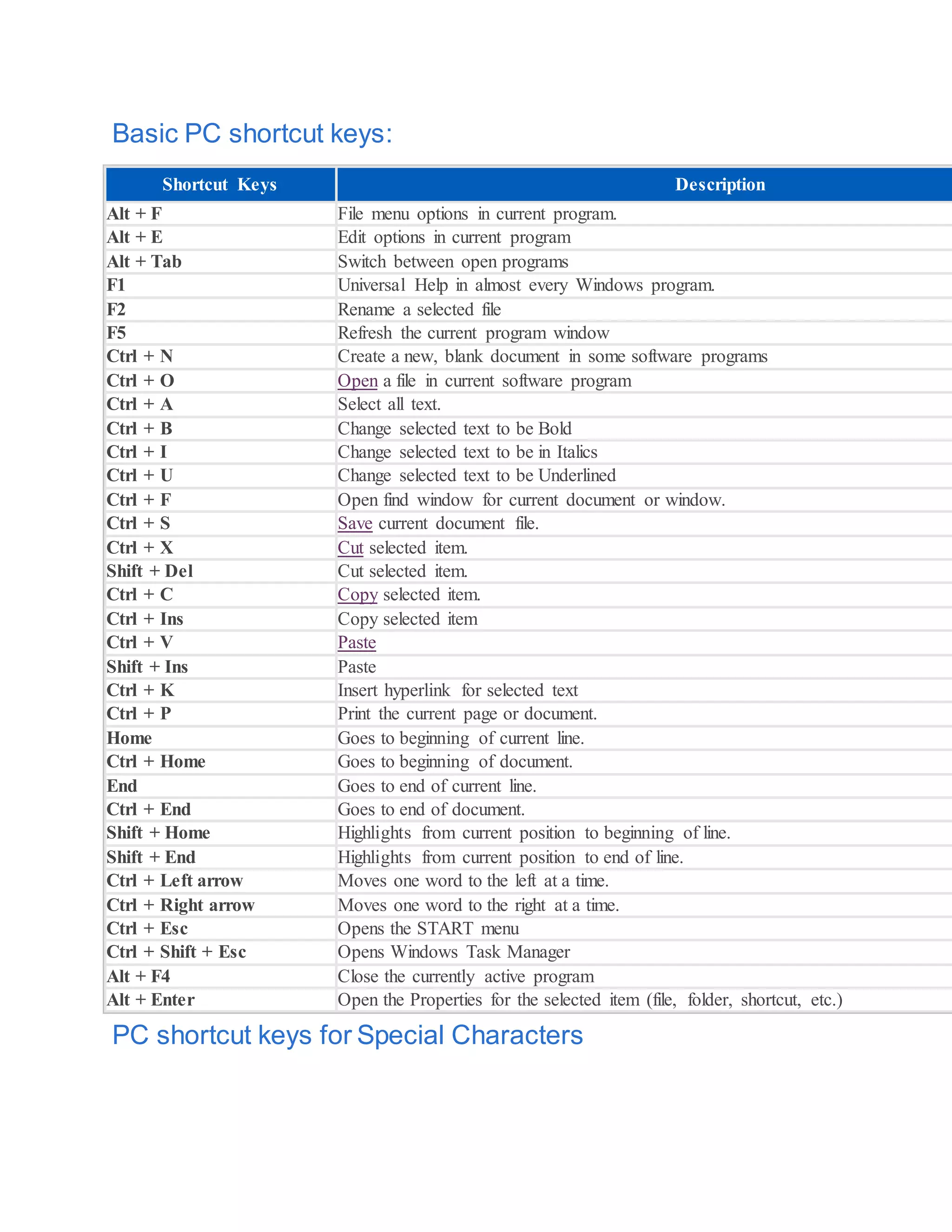
Shortcut Keys Description
Alt + F File menu options in current program.
Alt + E Edit options in current program
Alt + Tab Switch between open programs
F1 Universal Help in almost every Windows program.
F2 Rename a selected file
F5 Refresh the current program window
Ctrl + N Create a new, blank document in some software programs
Ctrl + O Open a file in current software program
Ctrl + A Select all text.
Ctrl + B Change selected text to be Bold
Ctrl + I Change selected text to be in Italics
Ctrl + U Change selected text to be Underlined
Ctrl + F Open find window for current document or window.
Ctrl + S Save current document file.
Ctrl + X Cut selected item.
Shift + Del Cut selected item.
Ctrl + C Copy selected item.
Ctrl + Ins Copy selected item
Ctrl + V Paste
Shift + Ins Paste
Ctrl + K Insert hyperlink for selected text
Ctrl + P Print the current page or document.
Home Goes to beginning of current line.
Ctrl + Home Goes to beginning of document.
End Goes to end of current line.
Ctrl + End Goes to end of document.
Shift + Home Highlights from current position to beginning of line.
Shift + End Highlights from current position to end of line.
Ctrl + Left arrow Moves one word to the left at a time.
Ctrl + Right arrow Moves one word to the right at a time.
Ctrl + Esc Opens the START menu
Ctrl + Shift + Esc Opens Windows Task Manager
Alt + F4 Close the currently active program
Alt + Enter Open the Properties for the selected item (file, folder, shortcut, etc.)
PC shortcut keys for Special Characters
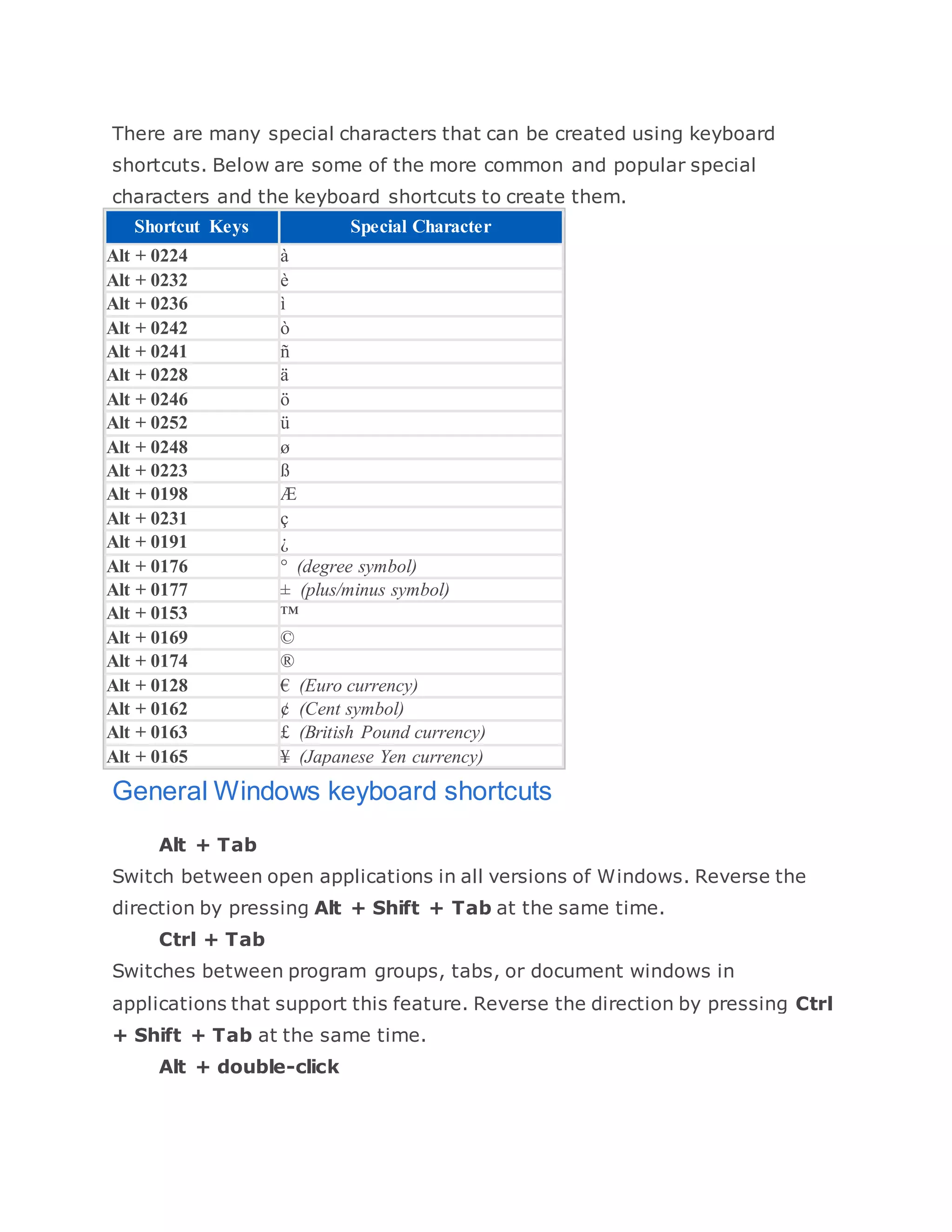
There are many special characters that can be created using keyboard
shortcuts. Below are some of the more common and popular special
characters and the keyboard shortcuts to create them.
Shortcut Keys Special Character
Alt + 0224 à
Alt + 0232 è
Alt + 0236 ì
Alt + 0242 ò
Alt + 0241 ñ
Alt + 0228 ä
Alt + 0246 ö
Alt + 0252 ü
Alt + 0248 ø
Alt + 0223 ß
Alt + 0198 Æ
Alt + 0231 ç
Alt + 0191 ¿
Alt + 0176 ° (degree symbol)
Alt + 0177 ± (plus/minus symbol)
Alt + 0153 ™
Alt + 0169 ©
Alt + 0174 ®
Alt + 0128 € (Euro currency)
Alt + 0162 ¢ (Cent symbol)
Alt + 0163 £ (British Pound currency)
Alt + 0165 ¥ (Japanese Yen currency)
General Windows keyboard shortcuts
Alt + Tab
Switch between open applications in all versions of Windows. Reverse the
direction by pressing Alt + Shift + Tab at the same time.
Ctrl + Tab
Switches between program groups, tabs, or document windows in
applications that support this feature. Reverse the direction by pressing Ctrl
+ Shift + Tab at the same time.
Alt + double-click
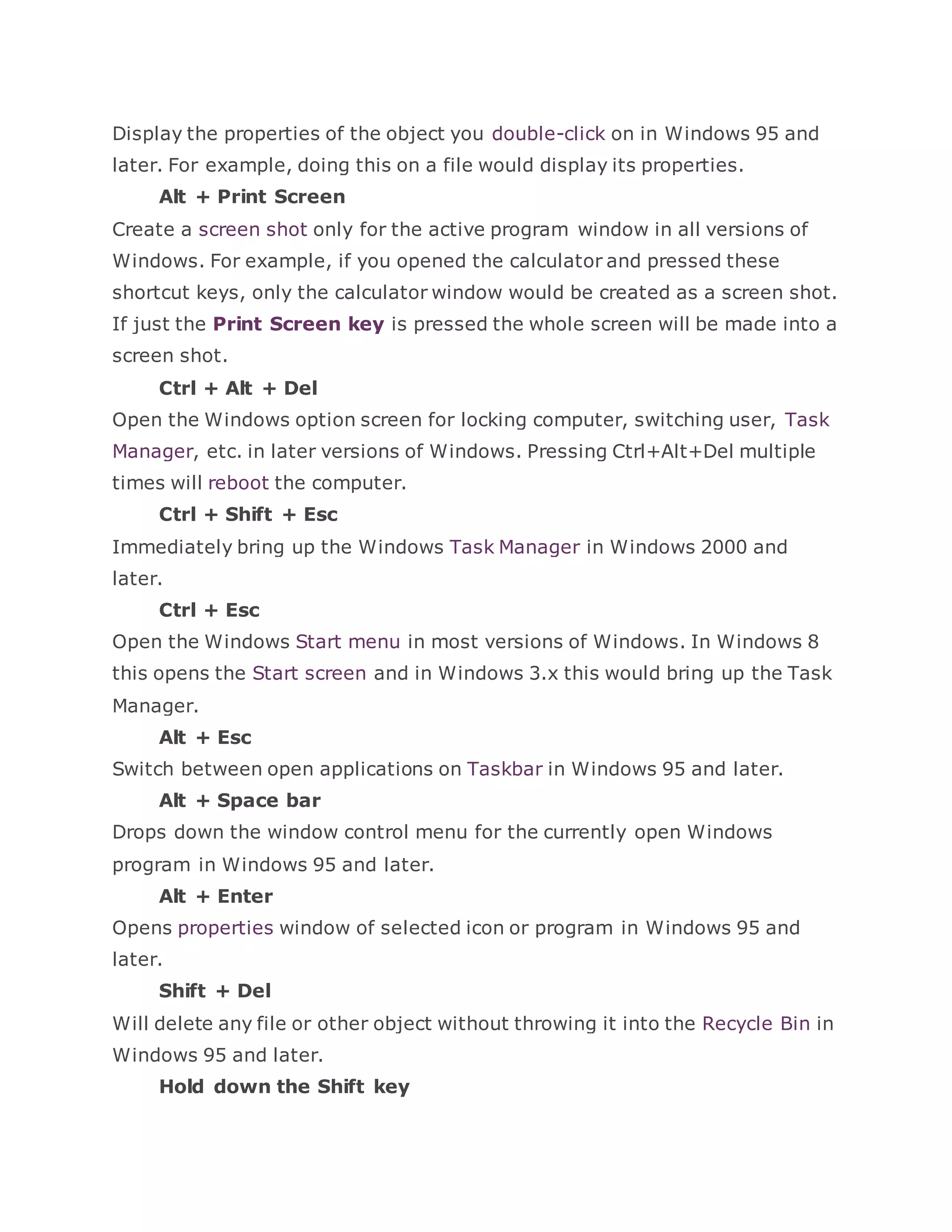
Display the properties of the object you double-click on in Windows 95 and
later. For example, doing this on a file would display its properties.
Alt + Print Screen
Create a screen shot only for the active program window in all versions of
Windows. For example, if you opened the calculator and pressed these
shortcut keys, only the calculator window would be created as a screen shot.
If just the Print Screen key is pressed the whole screen will be made into a
screen shot.
Ctrl + Alt + Del
Open the Windows option screen for locking computer, switching user, Task
Manager, etc. in later versions of Windows. Pressing Ctrl+Alt+Del multiple
times will reboot the computer.
Ctrl + Shift + Esc
Immediately bring up the Windows Task Manager in Windows 2000 and
later.
Ctrl + Esc
Open the Windows Start menu in most versions of Windows. In Windows 8
this opens the Start screen and in Windows 3.x this would bring up the Task
Manager.
Alt + Esc
Switch between open applications on Taskbar in Windows 95 and later.
Alt + Space bar
Drops down the window control menu for the currently open Windows
program in Windows 95 and later.
Alt + Enter
Opens properties window of selected icon or program in Windows 95 and
later.
Shift + Del
Will delete any file or other object without throwing it into the Recycle Bin in
Windows 95 and later.
Hold down the Shift key
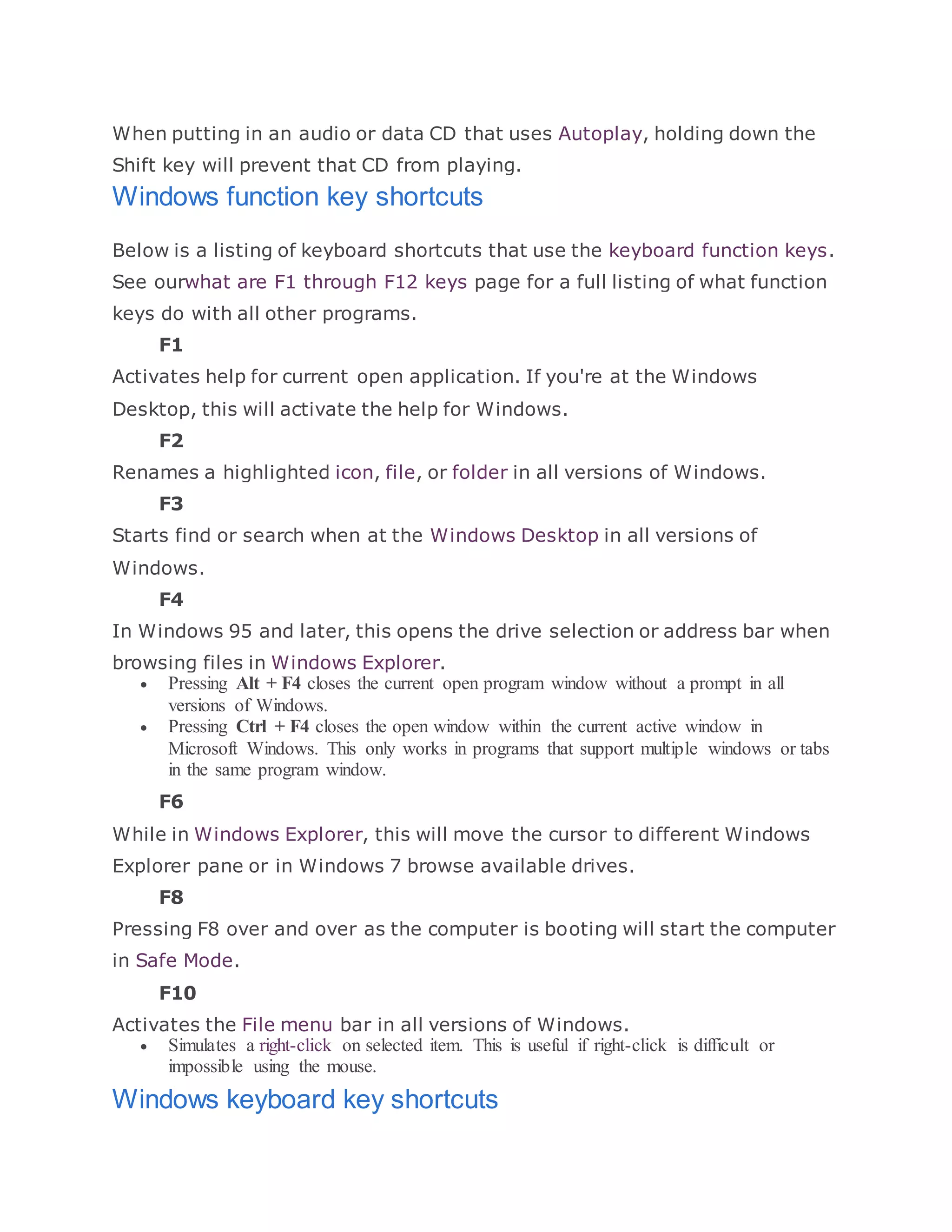
When putting in an audio or data CD that uses Autoplay, holding down the
Shift key will prevent that CD from playing.
Windows function key shortcuts
Below is a listing of keyboard shortcuts that use the keyboard function keys.
See ourwhat are F1 through F12 keys page for a full listing of what function
keys do with all other programs.
F1
Activates help for current open application. If you're at the Windows
Desktop, this will activate the help for Windows.
F2
Renames a highlighted icon, file, or folder in all versions of Windows.
F3
Starts find or search when at the Windows Desktop in all versions of
Windows.
F4
In Windows 95 and later, this opens the drive selection or address bar when
browsing files in Windows Explorer.
 Pressing Alt + F4 closes the current open program window without a prompt in all
versions of Windows.
 Pressing Ctrl + F4 closes the open window within the current active window in
Microsoft Windows. This only works in programs that support multiple windows or tabs
in the same program window.
F6
While in Windows Explorer, this will move the cursor to different Windows
Explorer pane or in Windows 7 browse available drives.
F8
Pressing F8 over and over as the computer is booting will start the computer
in Safe Mode.
F10
Activates the File menu bar in all versions of Windows.
 Simulates a right-click on selected item. This is useful if right-click is difficult or
impossible using the mouse.
Windows keyboard key shortcuts
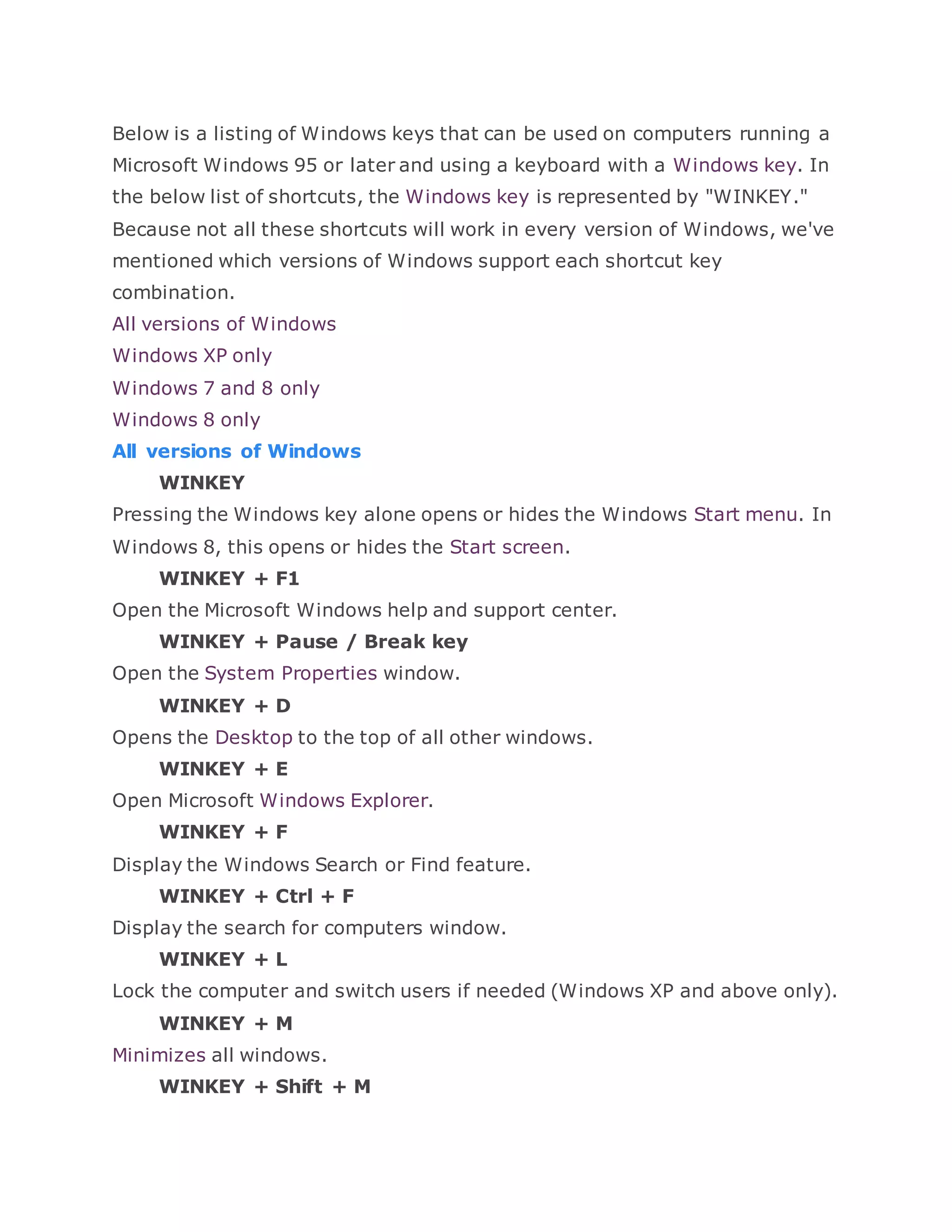
Below is a listing of Windows keys that can be used on computers running a
Microsoft Windows 95 or later and using a keyboard with a Windows key. In
the below list of shortcuts, the Windows key is represented by "WINKEY."
Because not all these shortcuts will work in every version of Windows, we've
mentioned which versions of Windows support each shortcut key
combination.
All versions of Windows
Windows XP only
Windows 7 and 8 only
Windows 8 only
All versions of Windows
WINKEY
Pressing the Windows key alone opens or hides the Windows Start menu. In
Windows 8, this opens or hides the Start screen.
WINKEY + F1
Open the Microsoft Windows help and support center.
WINKEY + Pause / Break key
Open the System Properties window.
WINKEY + D
Opens the Desktop to the top of all other windows.
WINKEY + E
Open Microsoft Windows Explorer.
WINKEY + F
Display the Windows Search or Find feature.
WINKEY + Ctrl + F
Display the search for computers window.
WINKEY + L
Lock the computer and switch users if needed (Windows XP and above only).
WINKEY + M
Minimizes all windows.
WINKEY + Shift + M
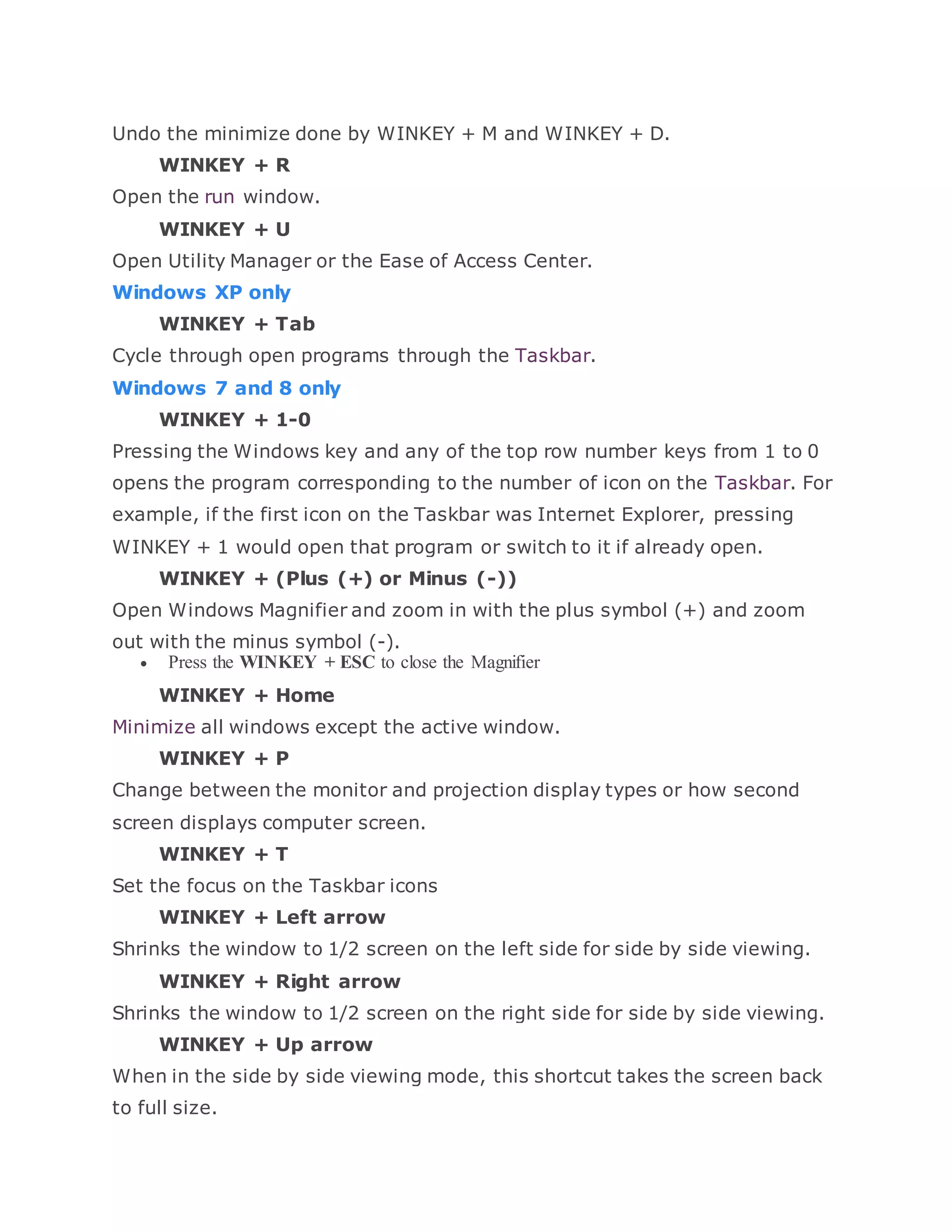
Undo the minimize done by WINKEY + M and WINKEY + D.
WINKEY + R
Open the run window.
WINKEY + U
Open Utility Manager or the Ease of Access Center.
Windows XP only
WINKEY + Tab
Cycle through open programs through the Taskbar.
Windows 7 and 8 only
WINKEY + 1-0
Pressing the Windows key and any of the top row number keys from 1 to 0
opens the program corresponding to the number of icon on the Taskbar. For
example, if the first icon on the Taskbar was Internet Explorer, pressing
WINKEY + 1 would open that program or switch to it if already open.
WINKEY + (Plus (+) or Minus (-))
Open Windows Magnifier and zoom in with the plus symbol (+) and zoom
out with the minus symbol (-).
 Press the WINKEY + ESC to close the Magnifier
WINKEY + Home
Minimize all windows except the active window.
WINKEY + P
Change between the monitor and projection display types or how second
screen displays computer screen.
WINKEY + T
Set the focus on the Taskbar icons
WINKEY + Left arrow
Shrinks the window to 1/2 screen on the left side for side by side viewing.
WINKEY + Right arrow
Shrinks the window to 1/2 screen on the right side for side by side viewing.
WINKEY + Up arrow
When in the side by side viewing mode, this shortcut takes the screen back
to full size.
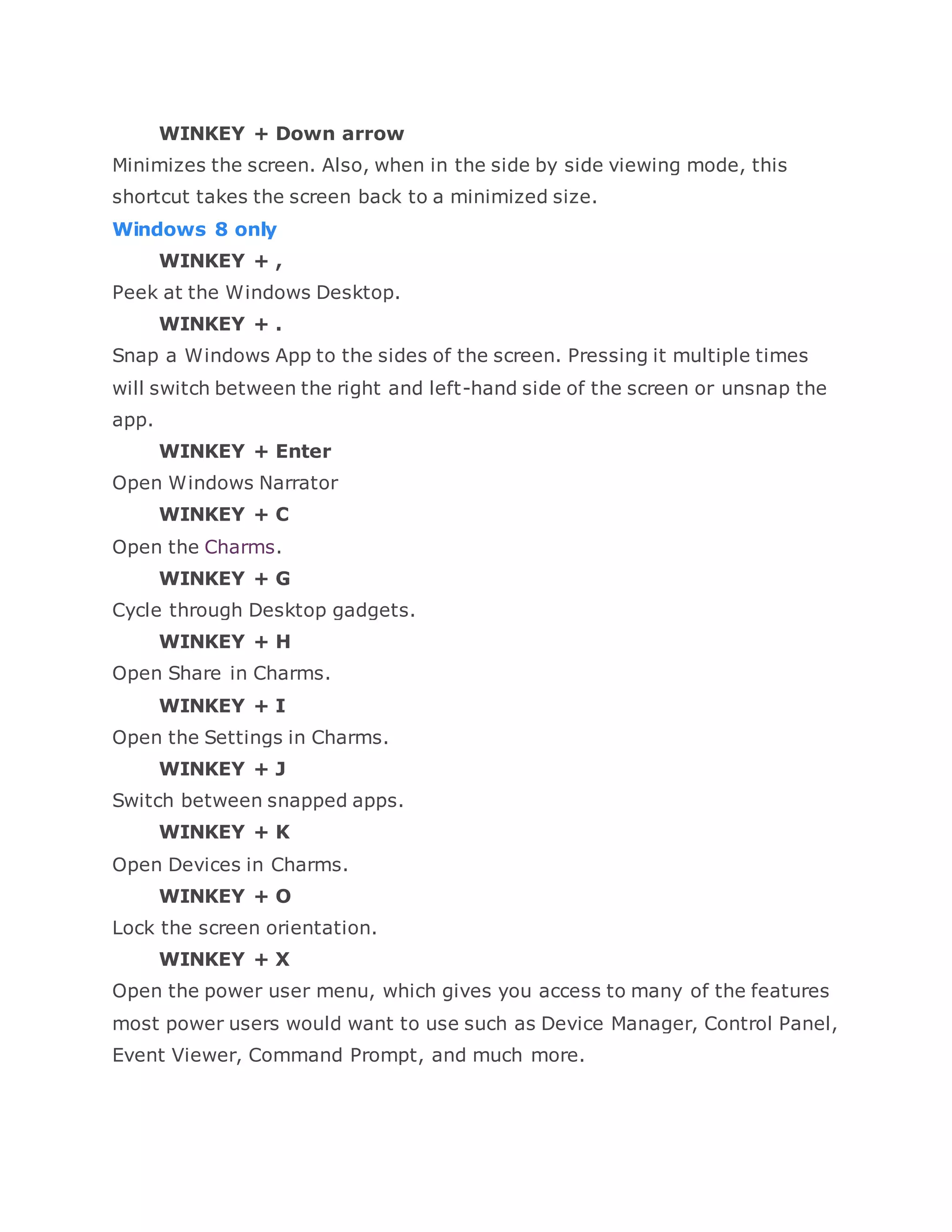
WINKEY + Down arrow
Minimizes the screen. Also, when in the side by side viewing mode, this
shortcut takes the screen back to a minimized size.
Windows 8 only
WINKEY + ,
Peek at the Windows Desktop.
WINKEY + .
Snap a Windows App to the sides of the screen. Pressing it multiple times
will switch between the right and left-hand side of the screen or unsnap the
app.
WINKEY + Enter
Open Windows Narrator
WINKEY + C
Open the Charms.
WINKEY + G
Cycle through Desktop gadgets.
WINKEY + H
Open Share in Charms.
WINKEY + I
Open the Settings in Charms.
WINKEY + J
Switch between snapped apps.
WINKEY + K
Open Devices in Charms.
WINKEY + O
Lock the screen orientation.
WINKEY + X
Open the power user menu, which gives you access to many of the features
most power users would want to use such as Device Manager, Control Panel,
Event Viewer, Command Prompt, and much more.
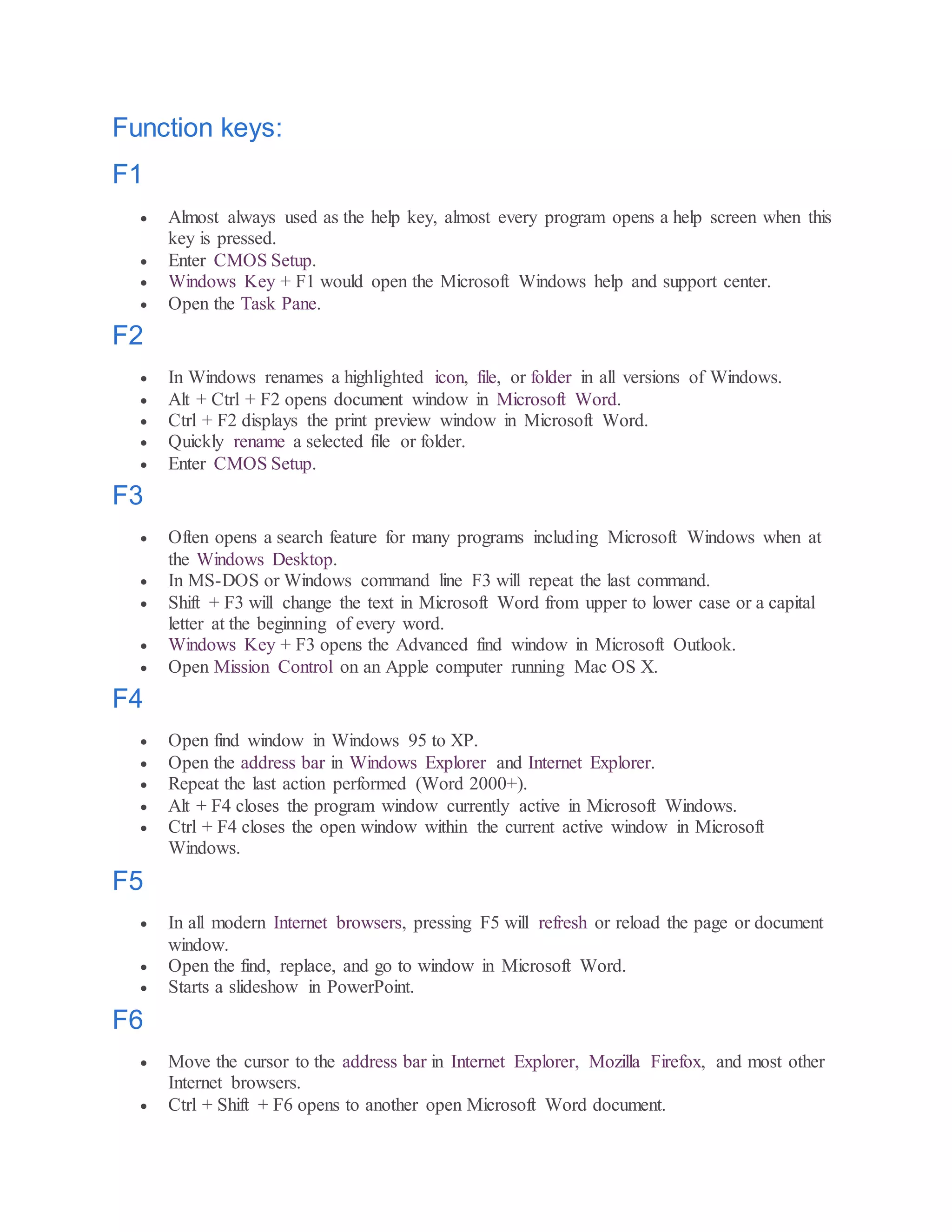
Function keys:
F1
 Almost always used as the help key, almost every program opens a help screen when this
key is pressed.
 Enter CMOS Setup.
 Windows Key + F1 would open the Microsoft Windows help and support center.
 Open the Task Pane.
F2
 In Windows renames a highlighted icon, file, or folder in all versions of Windows.
 Alt + Ctrl + F2 opens document window in Microsoft Word.
 Ctrl + F2 displays the print preview window in Microsoft Word.
 Quickly rename a selected file or folder.
 Enter CMOS Setup.
F3
 Often opens a search feature for many programs including Microsoft Windows when at
the Windows Desktop.
 In MS-DOS or Windows command line F3 will repeat the last command.
 Shift + F3 will change the text in Microsoft Word from upper to lower case or a capital
letter at the beginning of every word.
 Windows Key + F3 opens the Advanced find window in Microsoft Outlook.
 Open Mission Control on an Apple computer running Mac OS X.
F4
 Open find window in Windows 95 to XP.
 Open the address bar in Windows Explorer and Internet Explorer.
 Repeat the last action performed (Word 2000+).
 Alt + F4 closes the program window currently active in Microsoft Windows.
 Ctrl + F4 closes the open window within the current active window in Microsoft
Windows.
F5
 In all modern Internet browsers, pressing F5 will refresh or reload the page or document
window.
 Open the find, replace, and go to window in Microsoft Word.
 Starts a slideshow in PowerPoint.
F6
 Move the cursor to the address bar in Internet Explorer, Mozilla Firefox, and most other
Internet browsers.
 Ctrl + Shift + F6 opens to another open Microsoft Word document.
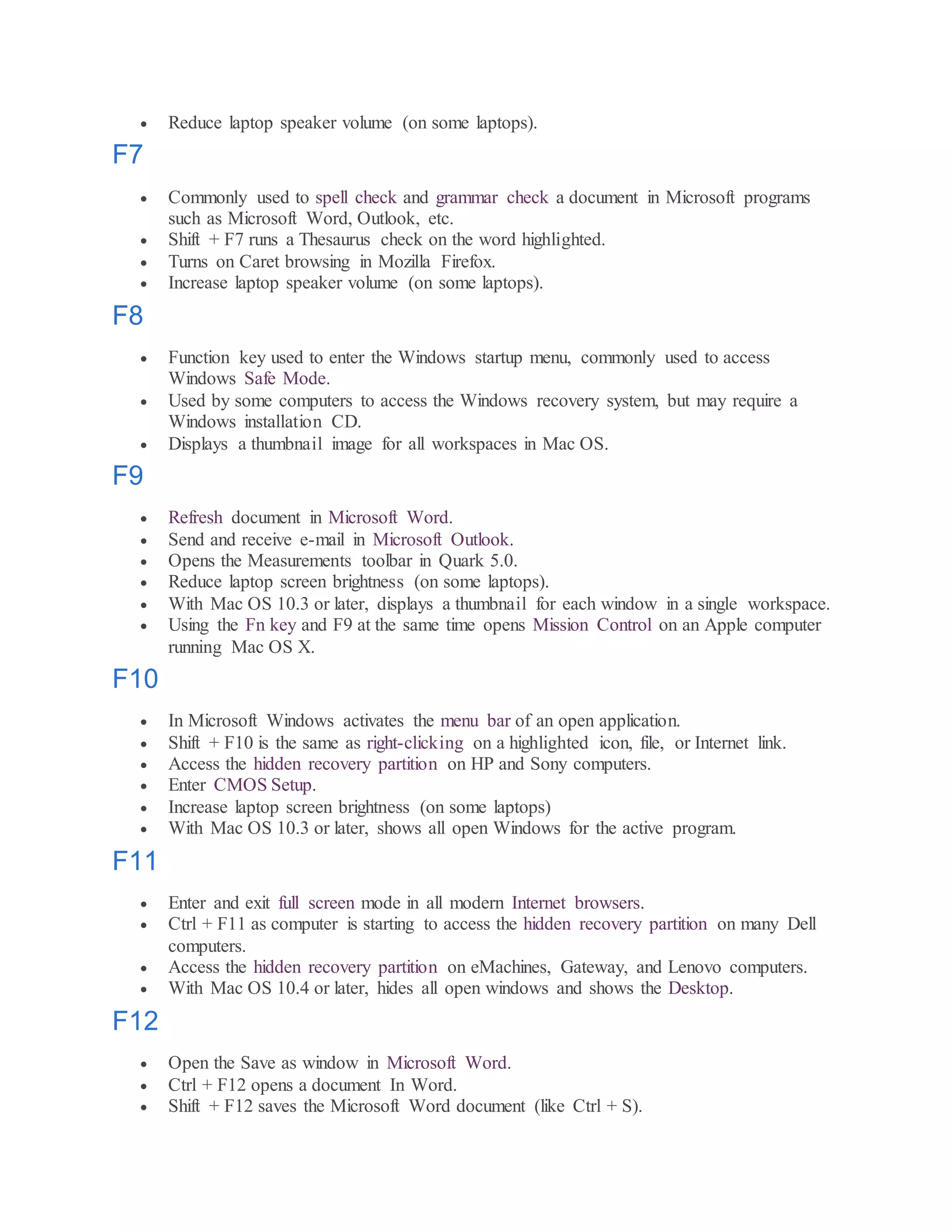
 Reduce laptop speaker volume (on some laptops).
F7
 Commonly used to spell check and grammar check a document in Microsoft programs
such as Microsoft Word, Outlook, etc.
 Shift + F7 runs a Thesaurus check on the word highlighted.
 Turns on Caret browsing in Mozilla Firefox.
 Increase laptop speaker volume (on some laptops).
F8
 Function key used to enter the Windows startup menu, commonly used to access
Windows Safe Mode.
 Used by some computers to access the Windows recovery system, but may require a
Windows installation CD.
 Displays a thumbnail image for all workspaces in Mac OS.
F9
 Refresh document in Microsoft Word.
 Send and receive e-mail in Microsoft Outlook.
 Opens the Measurements toolbar in Quark 5.0.
 Reduce laptop screen brightness (on some laptops).
 With Mac OS 10.3 or later, displays a thumbnail for each window in a single workspace.
 Using the Fn key and F9 at the same time opens Mission Control on an Apple computer
running Mac OS X.
F10
 In Microsoft Windows activates the menu bar of an open application.
 Shift + F10 is the same as right-clicking on a highlighted icon, file, or Internet link.
 Access the hidden recovery partition on HP and Sony computers.
 Enter CMOS Setup.
 Increase laptop screen brightness (on some laptops)
 With Mac OS 10.3 or later, shows all open Windows for the active program.
F11
 Enter and exit full screen mode in all modern Internet browsers.
 Ctrl + F11 as computer is starting to access the hidden recovery partition on many Dell
computers.
 Access the hidden recovery partition on eMachines, Gateway, and Lenovo computers.
 With Mac OS 10.4 or later, hides all open windows and shows the Desktop.
F12
 Open the Save as window in Microsoft Word.
 Ctrl + F12 opens a document In Word.
 Shift + F12 saves the Microsoft Word document (like Ctrl + S).
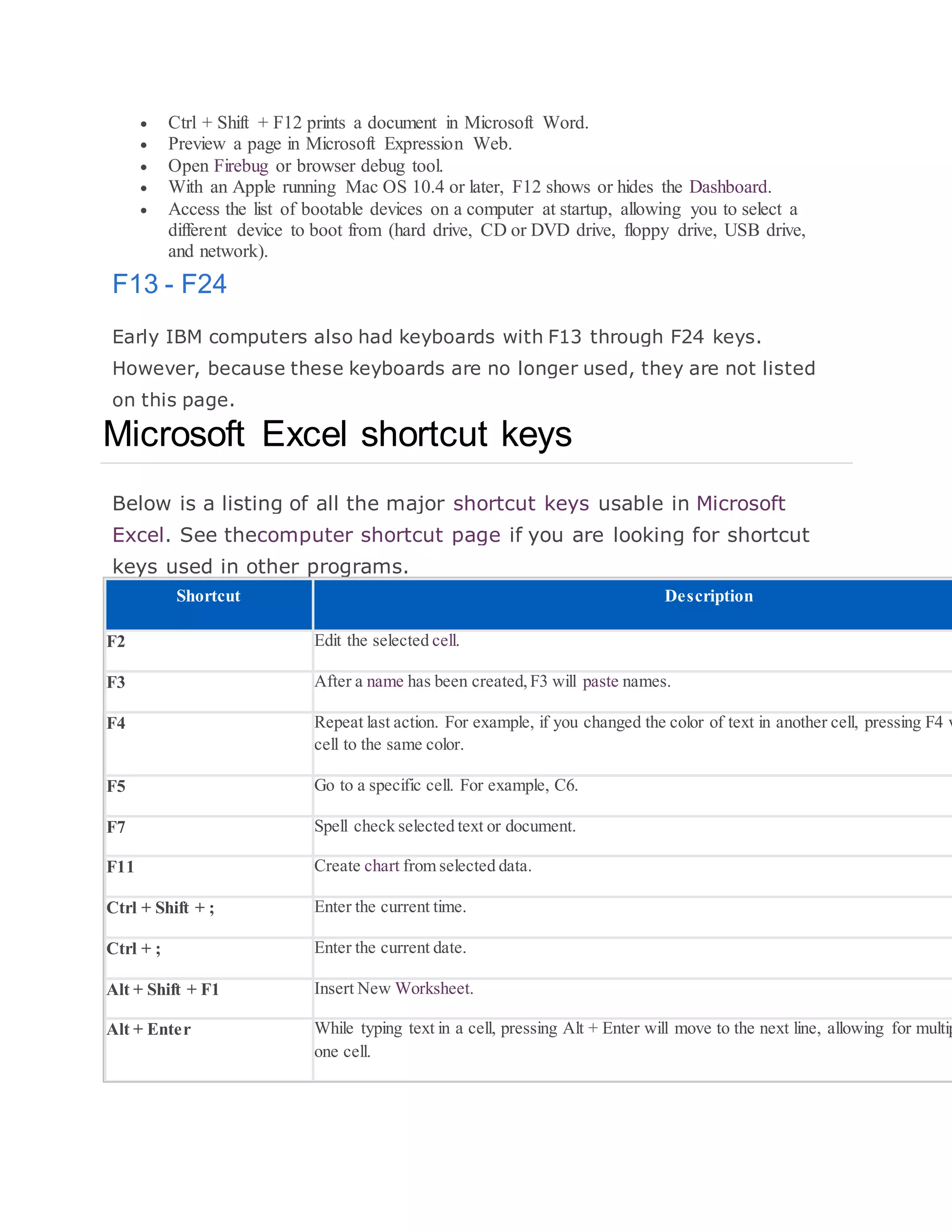
 Ctrl + Shift + F12 prints a document in Microsoft Word.
 Preview a page in Microsoft Expression Web.
 Open Firebug or browser debug tool.
 With an Apple running Mac OS 10.4 or later, F12 shows or hides the Dashboard.
 Access the list of bootable devices on a computer at startup, allowing you to select a
different device to boot from (hard drive, CD or DVD drive, floppy drive, USB drive,
and network).
F13 - F24
Early IBM computers also had keyboards with F13 through F24 keys.
However, because these keyboards are no longer used, they are not listed
on this page.
Microsoft Excel shortcut keys
Below is a listing of all the major shortcut keys usable in Microsoft
Excel. See thecomputer shortcut page if you are looking for shortcut
keys used in other programs.
Shortcut Description
F2 Edit the selected cell.
F3 After a name has been created,F3 will paste names.
F4 Repeat last action. For example, if you changed the color of text in another cell, pressing F4 w
cell to the same color.
F5 Go to a specific cell. For example, C6.
F7 Spell check selected text or document.
F11 Create chart from selected data.
Ctrl + Shift + ; Enter the current time.
Ctrl + ; Enter the current date.
Alt + Shift + F1 Insert New Worksheet.
Alt + Enter While typing text in a cell, pressing Alt + Enter will move to the next line, allowing for multip
one cell.
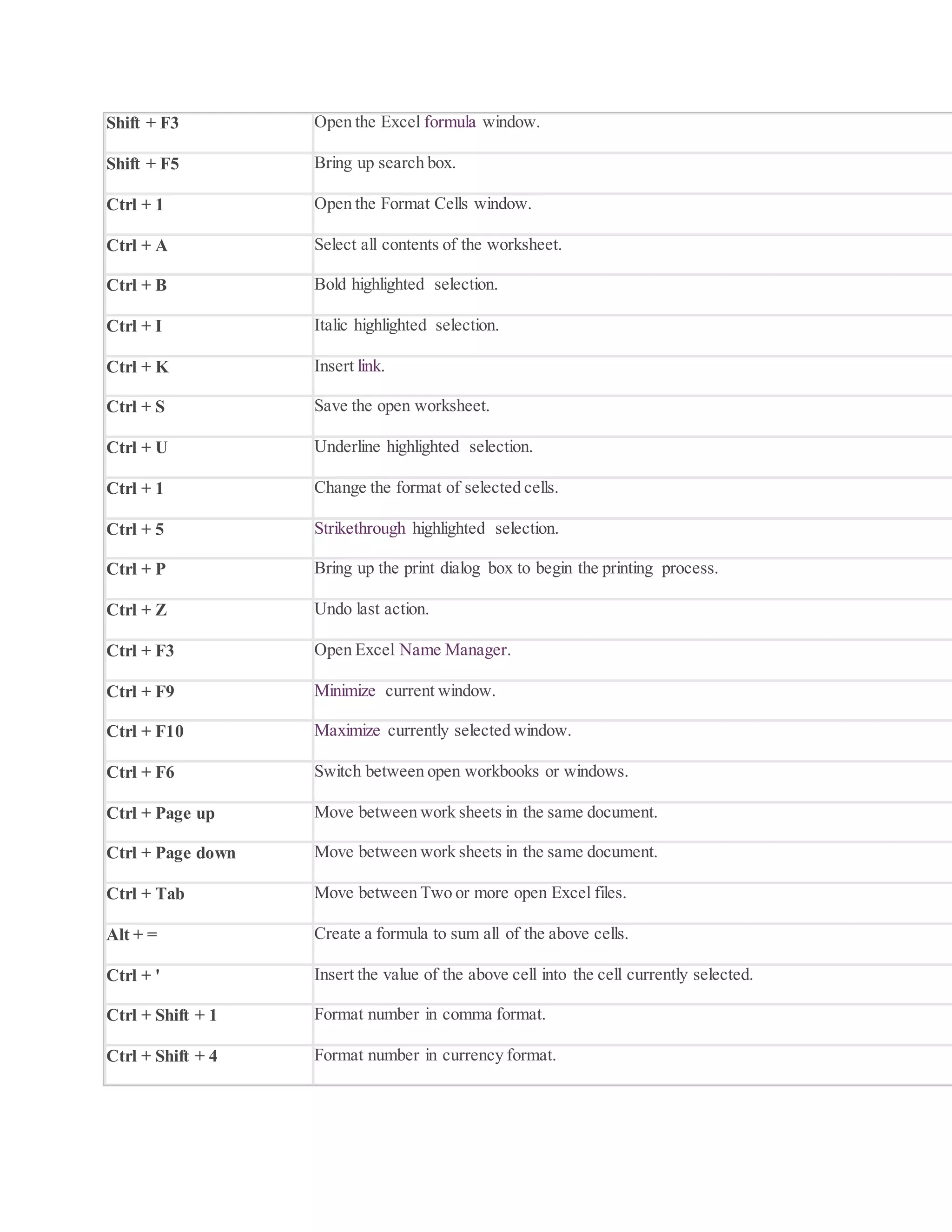
Shift + F3 Open the Excel formula window.
Shift + F5 Bring up search box.
Ctrl + 1 Open the Format Cells window.
Ctrl + A Select all contents of the worksheet.
Ctrl + B Bold highlighted selection.
Ctrl + I Italic highlighted selection.
Ctrl + K Insert link.
Ctrl + S Save the open worksheet.
Ctrl + U Underline highlighted selection.
Ctrl + 1 Change the format of selected cells.
Ctrl + 5 Strikethrough highlighted selection.
Ctrl + P Bring up the print dialog box to begin the printing process.
Ctrl + Z Undo last action.
Ctrl + F3 Open Excel Name Manager.
Ctrl + F9 Minimize current window.
Ctrl + F10 Maximize currently selected window.
Ctrl + F6 Switch between open workbooks or windows.
Ctrl + Page up Move between work sheets in the same document.
Ctrl + Page down Move between work sheets in the same document.
Ctrl + Tab Move between Two or more open Excel files.
Alt + = Create a formula to sum all of the above cells.
Ctrl + ' Insert the value of the above cell into the cell currently selected.
Ctrl + Shift + 1 Format number in comma format.
Ctrl + Shift + 4 Format number in currency format.
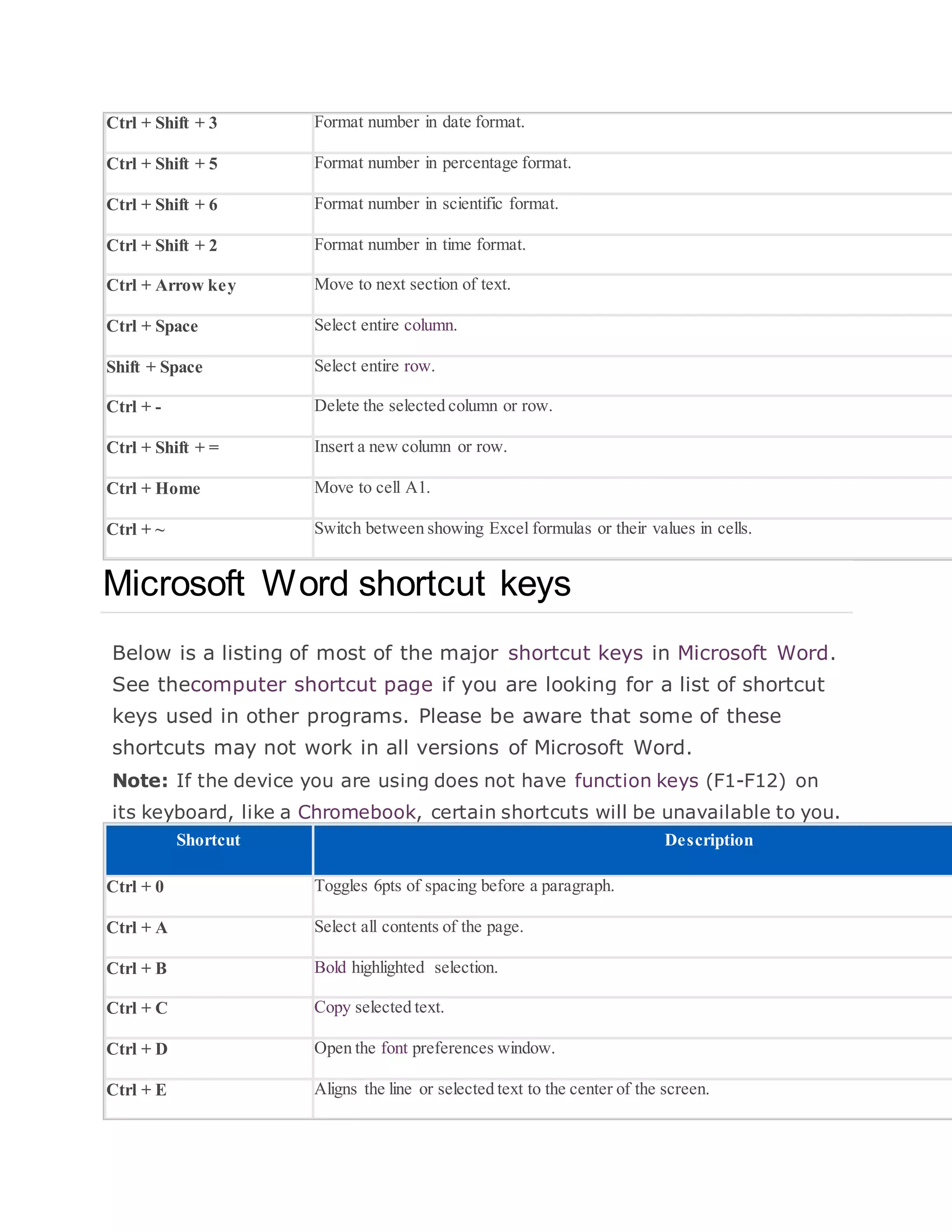
Ctrl + Shift + 3 Format number in date format.
Ctrl + Shift + 5 Format number in percentage format.
Ctrl + Shift + 6 Format number in scientific format.
Ctrl + Shift + 2 Format number in time format.
Ctrl + Arrow key Move to next section of text.
Ctrl + Space Select entire column.
Shift + Space Select entire row.
Ctrl + - Delete the selected column or row.
Ctrl + Shift + = Insert a new column or row.
Ctrl + Home Move to cell A1.
Ctrl + ~ Switch between showing Excel formulas or their values in cells.
Microsoft Word shortcut keys
Below is a listing of most of the major shortcut keys in Microsoft Word.
See thecomputer shortcut page if you are looking for a list of shortcut
keys used in other programs. Please be aware that some of these
shortcuts may not work in all versions of Microsoft Word.
Note: If the device you are using does not have function keys (F1-F12) on
its keyboard, like a Chromebook, certain shortcuts will be unavailable to you.
Shortcut Description
Ctrl + 0 Toggles 6pts of spacing before a paragraph.
Ctrl + A Select all contents of the page.
Ctrl + B Bold highlighted selection.
Ctrl + C Copy selected text.
Ctrl + D Open the font preferences window.
Ctrl + E Aligns the line or selected text to the center of the screen.
Ctrl + F Open find box.
Ctrl + I Italic highlighted selection.
Ctrl + J Aligns the selected text or line to justify the screen.
Ctrl + K Insert link.
Ctrl + L Aligns the line or selected text to the left of the screen.
Ctrl + M Indent the paragraph.
Ctrl + P Open the print window.
Ctrl + R Aligns the line or selected text to the right of the screen.
Ctrl + S Save the open document. Just like Shift + F12.
Ctrl + T Create a hanging indent.
Ctrl + U Underline the selected text.
Ctrl + V Paste.
Ctrl + X Cut selected text.
Ctrl + Y Redo the last action performed.
Ctrl + Z Undo last action.
Ctrl + Shift + L Quickly create a bullet point.
Ctrl + Shift + F Change the font.
Ctrl + Shift + > Increase selected font +1pts up to 12pt and then increase font +2pts.
Ctrl + ] Increase selected font +1pts.
Ctrl + Shift + < Decrease selected font -1pts if 12pt or lower; if above 12, decreases font by +2pt.
Ctrl + [ Decrease selected font -1pts.
Ctrl + / + c Insert a cent sign (¢).
Ctrl + ' + <char> Insert a character with an accent (grave) mark, where <char> is the character you want. For ex
wanted an accented è you would use Ctrl + ' + e as your shortcut key. To reverse the accent m
accent mark, often on the tilde key.
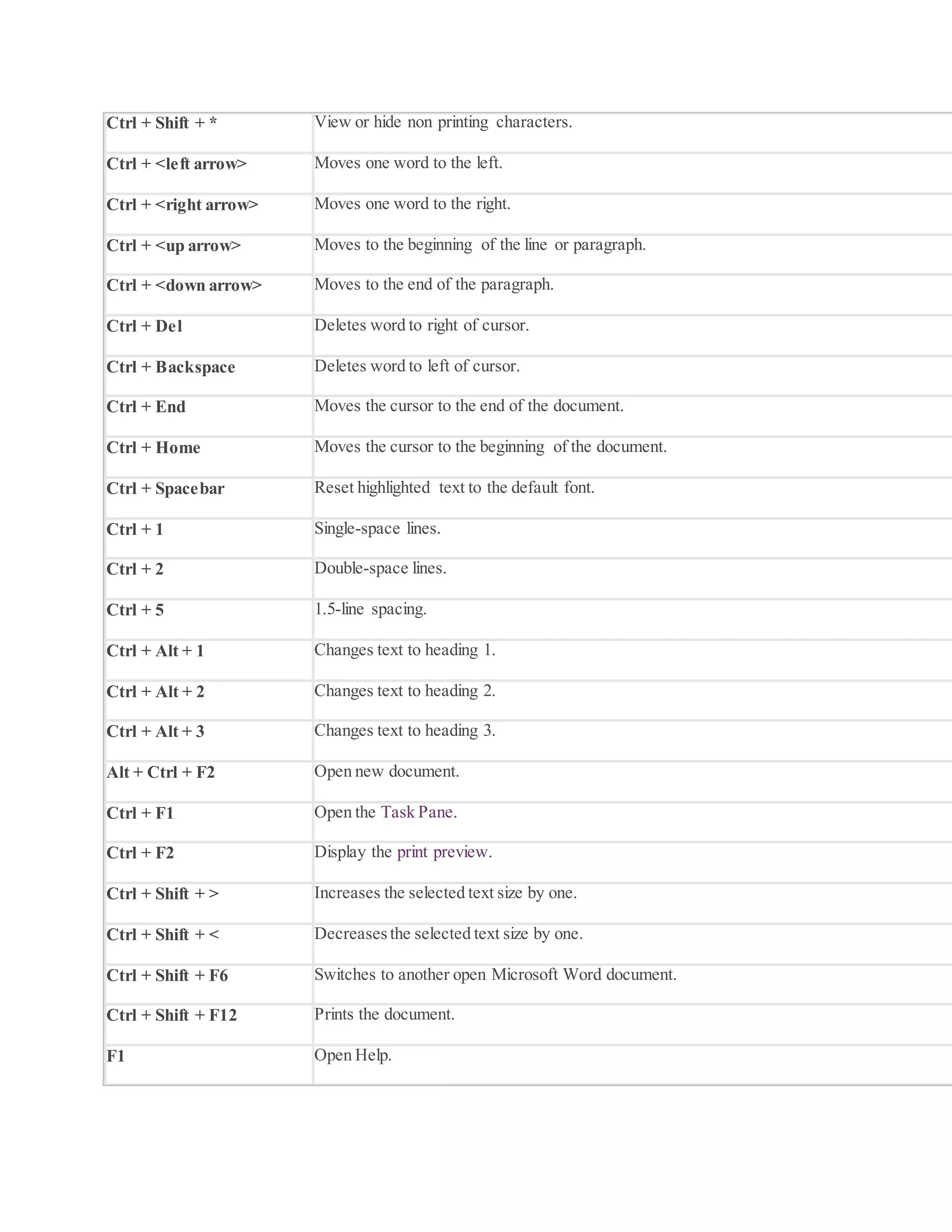
Ctrl + Shift + * View or hide non printing characters.
Ctrl + <left arrow> Moves one word to the left.
Ctrl + <right arrow> Moves one word to the right.
Ctrl + <up arrow> Moves to the beginning of the line or paragraph.
Ctrl + <down arrow> Moves to the end of the paragraph.
Ctrl + Del Deletes word to right of cursor.
Ctrl + Backspace Deletes word to left of cursor.
Ctrl + End Moves the cursor to the end of the document.
Ctrl + Home Moves the cursor to the beginning of the document.
Ctrl + Spacebar Reset highlighted text to the default font.
Ctrl + 1 Single-space lines.
Ctrl + 2 Double-space lines.
Ctrl + 5 1.5-line spacing.
Ctrl + Alt + 1 Changes text to heading 1.
Ctrl + Alt + 2 Changes text to heading 2.
Ctrl + Alt + 3 Changes text to heading 3.
Alt + Ctrl + F2 Open new document.
Ctrl + F1 Open the Task Pane.
Ctrl + F2 Display the print preview.
Ctrl + Shift + > Increases the selected text size by one.
Ctrl + Shift + < Decreasesthe selected text size by one.
Ctrl + Shift + F6 Switches to another open Microsoft Word document.
Ctrl + Shift + F12 Prints the document.
F1 Open Help.
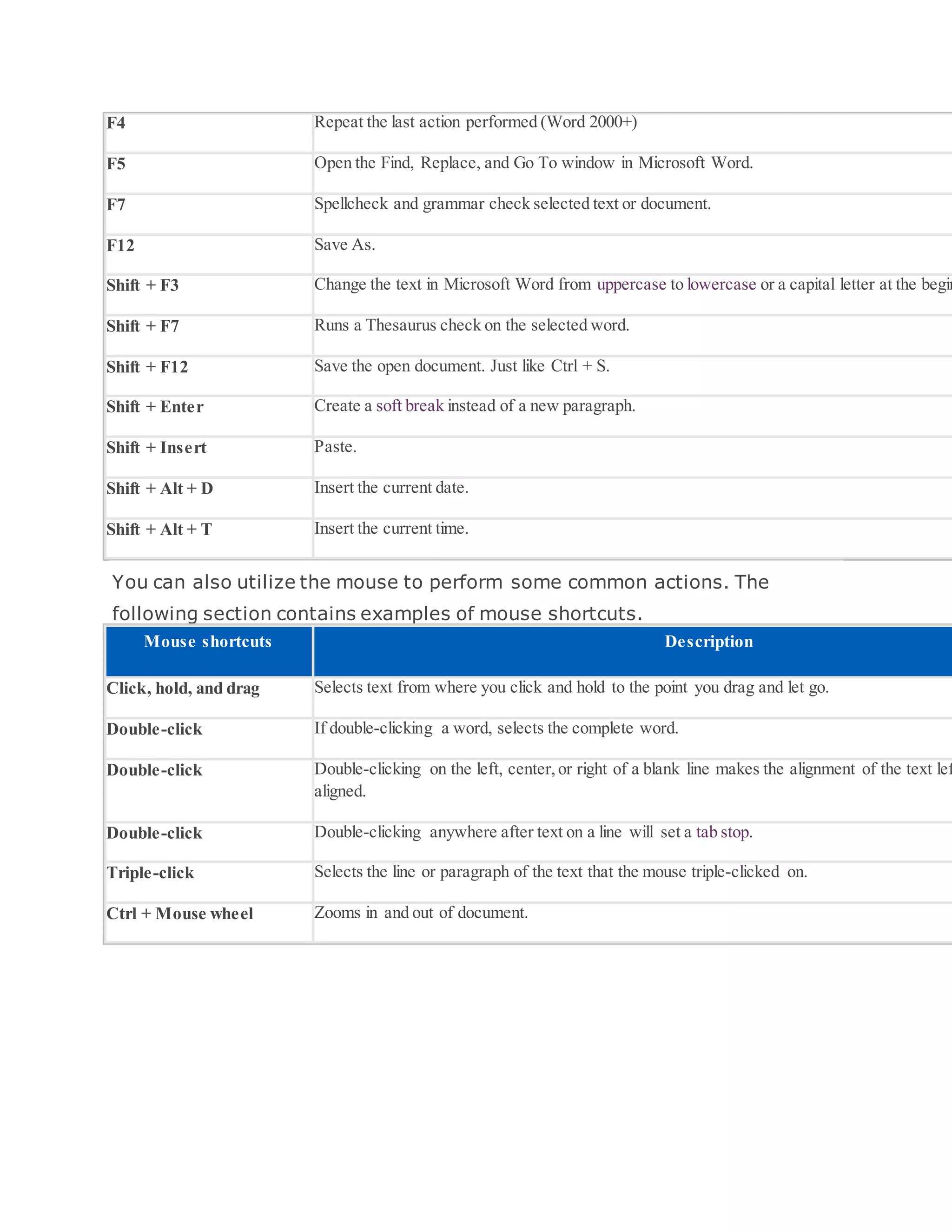
F4 Repeat the last action performed (Word 2000+)
F5 Open the Find, Replace, and Go To window in Microsoft Word.
F7 Spellcheck and grammar check selected text or document.
F12 Save As.
Shift + F3 Change the text in Microsoft Word from uppercase to lowercase or a capital letter at the begin
Shift + F7 Runs a Thesaurus check on the selected word.
Shift + F12 Save the open document. Just like Ctrl + S.
Shift + Enter Create a soft break instead of a new paragraph.
Shift + Insert Paste.
Shift + Alt + D Insert the current date.
Shift + Alt + T Insert the current time.
You can also utilize the mouse to perform some common actions. The
following section contains examples of mouse shortcuts.
Mouse shortcuts Description
Click, hold, and drag Selects text from where you click and hold to the point you drag and let go.
Double-click If double-clicking a word, selects the complete word.
Double-click Double-clicking on the left, center,or right of a blank line makes the alignment of the text lef
aligned.
Double-click Double-clicking anywhere after text on a line will set a tab stop.
Triple-click Selects the line or paragraph of the text that the mouse triple-clicked on.
Ctrl + Mouse wheel Zooms in and out of document.
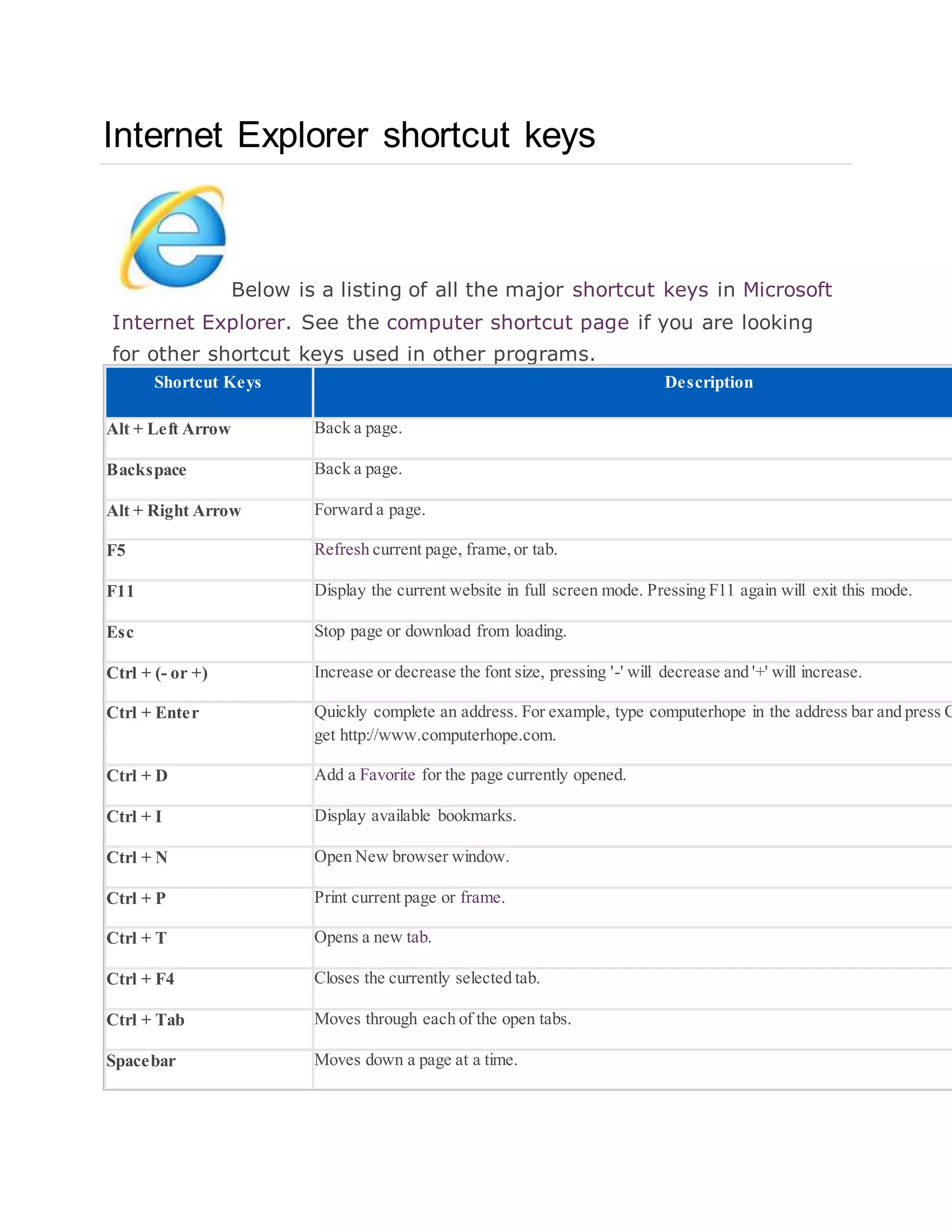
Internet Explorer shortcut keys
Below is a listing of all the major shortcut keys in Microsoft
Internet Explorer. See the computer shortcut page if you are looking
for other shortcut keys used in other programs.
Shortcut Keys Description
Alt + Left Arrow Back a page.
Backspace Back a page.
Alt + Right Arrow Forward a page.
F5 Refresh current page, frame,or tab.
F11 Display the current website in full screen mode. Pressing F11 again will exit this mode.
Esc Stop page or download from loading.
Ctrl + (- or +) Increase or decrease the font size, pressing '-' will decrease and '+' will increase.
Ctrl + Enter Quickly complete an address. For example, type computerhope in the address bar and press C
get http://www.computerhope.com.
Ctrl + D Add a Favorite for the page currently opened.
Ctrl + I Display available bookmarks.
Ctrl + N Open New browser window.
Ctrl + P Print current page or frame.
Ctrl + T Opens a new tab.
Ctrl + F4 Closes the currently selected tab.
Ctrl + Tab Moves through each of the open tabs.
Spacebar Moves down a page at a time.
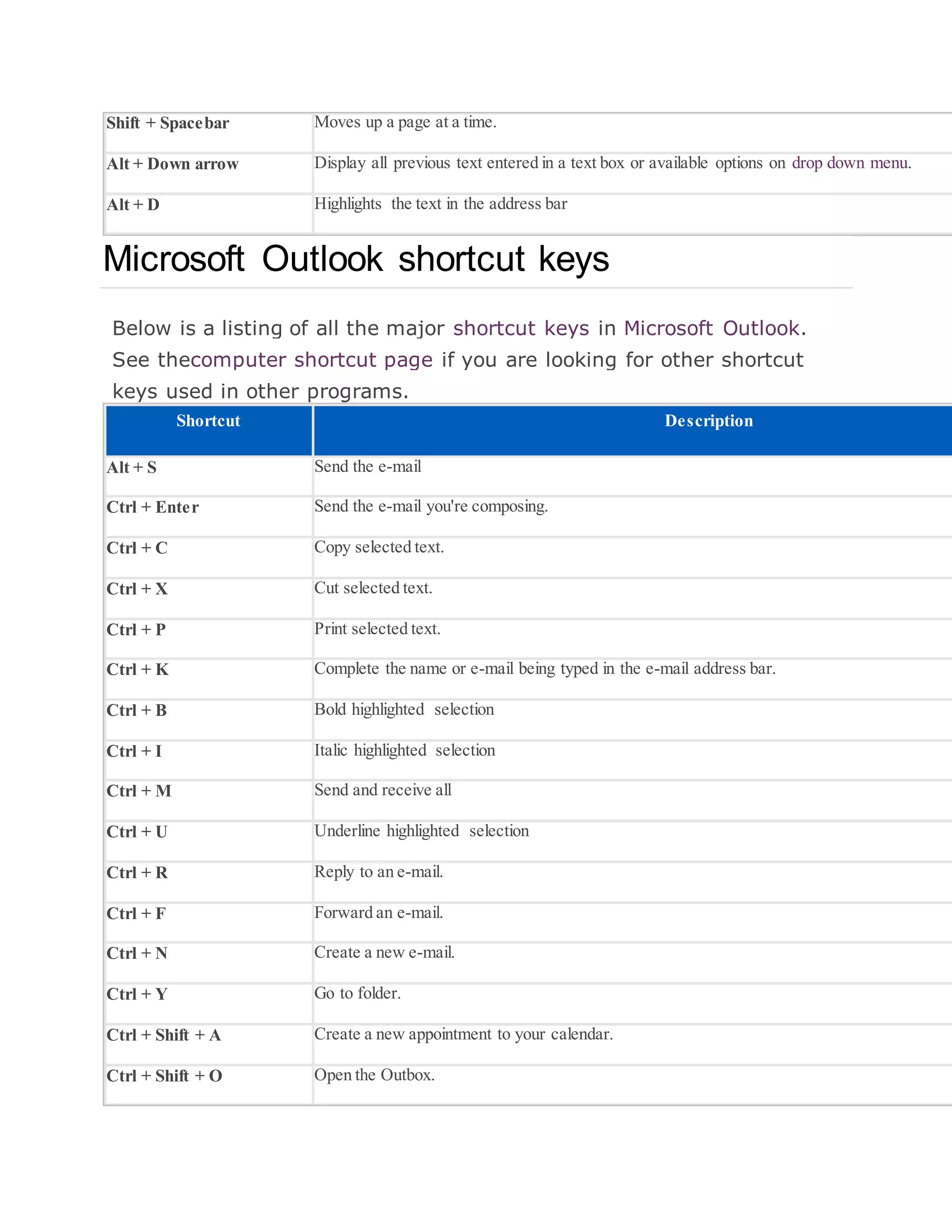
Shift + Spacebar Moves up a page at a time.
Alt + Down arrow Display all previous text entered in a text box or available options on drop down menu.
Alt + D Highlights the text in the address bar
Microsoft Outlook shortcut keys
Below is a listing of all the major shortcut keys in Microsoft Outlook.
See thecomputer shortcut page if you are looking for other shortcut
keys used in other programs.
Shortcut Description
Alt + S Send the e-mail
Ctrl + Enter Send the e-mail you're composing.
Ctrl + C Copy selected text.
Ctrl + X Cut selected text.
Ctrl + P Print selected text.
Ctrl + K Complete the name or e-mail being typed in the e-mail address bar.
Ctrl + B Bold highlighted selection
Ctrl + I Italic highlighted selection
Ctrl + M Send and receive all
Ctrl + U Underline highlighted selection
Ctrl + R Reply to an e-mail.
Ctrl + F Forward an e-mail.
Ctrl + N Create a new e-mail.
Ctrl + Y Go to folder.
Ctrl + Shift + A Create a new appointment to your calendar.
Ctrl + Shift + O Open the Outbox.
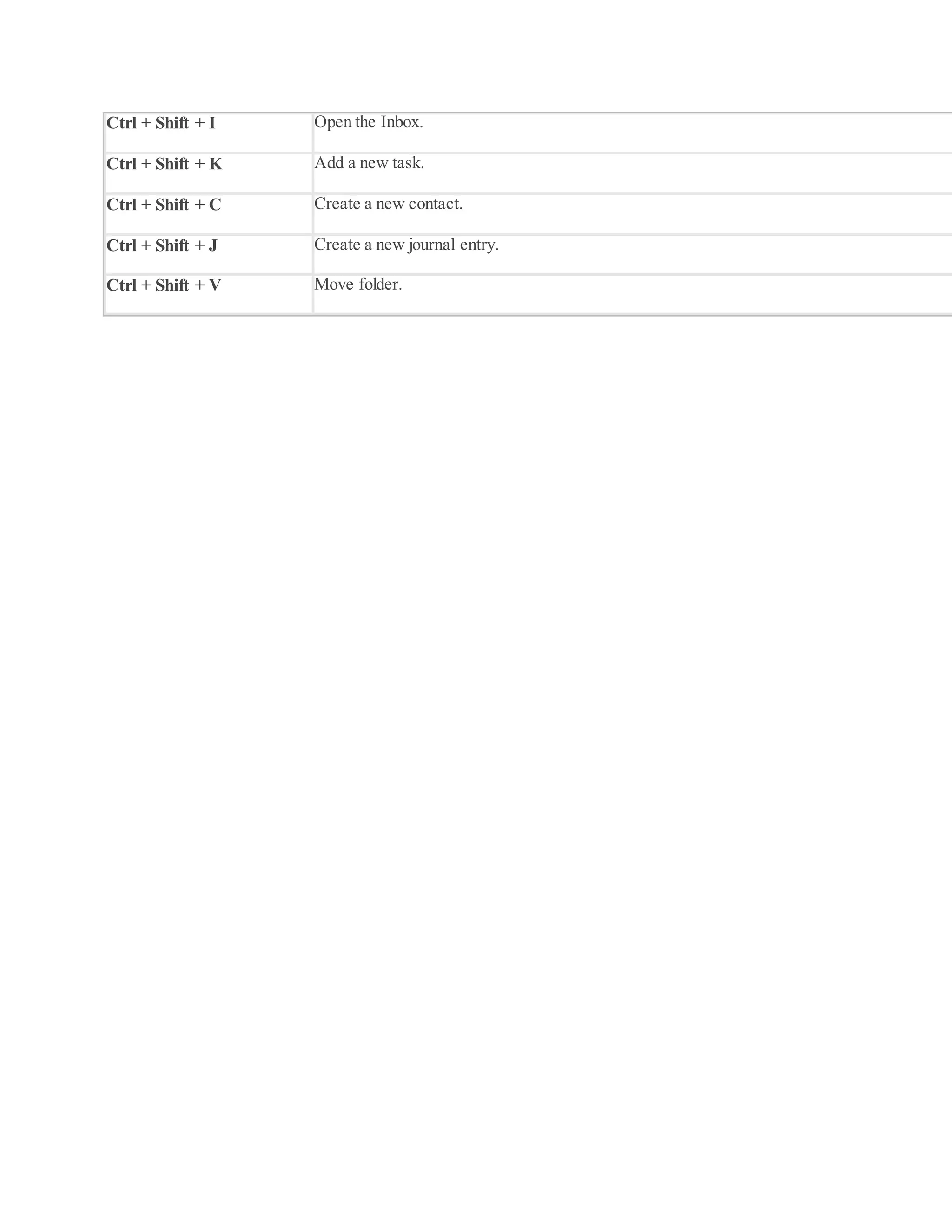
Ctrl + Shift + I Open the Inbox.
Ctrl + Shift + K Add a new task.
Ctrl + Shift + C Create a new contact.
Ctrl + Shift + J Create a new journal entry.
Ctrl + Shift + V Move folder.

basic shortcut keys in computer

  • 1.
    Basic PC shortcutkeys: Shortcut Keys Description Alt + F File menu options in current program. Alt + E Edit options in current program Alt + Tab Switch between open programs F1 Universal Help in almost every Windows program. F2 Rename a selected file F5 Refresh the current program window Ctrl + N Create a new, blank document in some software programs Ctrl + O Open a file in current software program Ctrl + A Select all text. Ctrl + B Change selected text to be Bold Ctrl + I Change selected text to be in Italics Ctrl + U Change selected text to be Underlined Ctrl + F Open find window for current document or window. Ctrl + S Save current document file. Ctrl + X Cut selected item. Shift + Del Cut selected item. Ctrl + C Copy selected item. Ctrl + Ins Copy selected item Ctrl + V Paste Shift + Ins Paste Ctrl + K Insert hyperlink for selected text Ctrl + P Print the current page or document. Home Goes to beginning of current line. Ctrl + Home Goes to beginning of document. End Goes to end of current line. Ctrl + End Goes to end of document. Shift + Home Highlights from current position to beginning of line. Shift + End Highlights from current position to end of line. Ctrl + Left arrow Moves one word to the left at a time. Ctrl + Right arrow Moves one word to the right at a time. Ctrl + Esc Opens the START menu Ctrl + Shift + Esc Opens Windows Task Manager Alt + F4 Close the currently active program Alt + Enter Open the Properties for the selected item (file, folder, shortcut, etc.) PC shortcut keys for Special Characters
  • 2.
    There are manyspecial characters that can be created using keyboard shortcuts. Below are some of the more common and popular special characters and the keyboard shortcuts to create them. Shortcut Keys Special Character Alt + 0224 à Alt + 0232 è Alt + 0236 ì Alt + 0242 ò Alt + 0241 ñ Alt + 0228 ä Alt + 0246 ö Alt + 0252 ü Alt + 0248 ø Alt + 0223 ß Alt + 0198 Æ Alt + 0231 ç Alt + 0191 ¿ Alt + 0176 ° (degree symbol) Alt + 0177 ± (plus/minus symbol) Alt + 0153 ™ Alt + 0169 © Alt + 0174 ® Alt + 0128 € (Euro currency) Alt + 0162 ¢ (Cent symbol) Alt + 0163 £ (British Pound currency) Alt + 0165 ¥ (Japanese Yen currency) General Windows keyboard shortcuts Alt + Tab Switch between open applications in all versions of Windows. Reverse the direction by pressing Alt + Shift + Tab at the same time. Ctrl + Tab Switches between program groups, tabs, or document windows in applications that support this feature. Reverse the direction by pressing Ctrl + Shift + Tab at the same time. Alt + double-click
  • 3.
    Display the propertiesof the object you double-click on in Windows 95 and later. For example, doing this on a file would display its properties. Alt + Print Screen Create a screen shot only for the active program window in all versions of Windows. For example, if you opened the calculator and pressed these shortcut keys, only the calculator window would be created as a screen shot. If just the Print Screen key is pressed the whole screen will be made into a screen shot. Ctrl + Alt + Del Open the Windows option screen for locking computer, switching user, Task Manager, etc. in later versions of Windows. Pressing Ctrl+Alt+Del multiple times will reboot the computer. Ctrl + Shift + Esc Immediately bring up the Windows Task Manager in Windows 2000 and later. Ctrl + Esc Open the Windows Start menu in most versions of Windows. In Windows 8 this opens the Start screen and in Windows 3.x this would bring up the Task Manager. Alt + Esc Switch between open applications on Taskbar in Windows 95 and later. Alt + Space bar Drops down the window control menu for the currently open Windows program in Windows 95 and later. Alt + Enter Opens properties window of selected icon or program in Windows 95 and later. Shift + Del Will delete any file or other object without throwing it into the Recycle Bin in Windows 95 and later. Hold down the Shift key
  • 4.
    When putting inan audio or data CD that uses Autoplay, holding down the Shift key will prevent that CD from playing. Windows function key shortcuts Below is a listing of keyboard shortcuts that use the keyboard function keys. See ourwhat are F1 through F12 keys page for a full listing of what function keys do with all other programs. F1 Activates help for current open application. If you're at the Windows Desktop, this will activate the help for Windows. F2 Renames a highlighted icon, file, or folder in all versions of Windows. F3 Starts find or search when at the Windows Desktop in all versions of Windows. F4 In Windows 95 and later, this opens the drive selection or address bar when browsing files in Windows Explorer.  Pressing Alt + F4 closes the current open program window without a prompt in all versions of Windows.  Pressing Ctrl + F4 closes the open window within the current active window in Microsoft Windows. This only works in programs that support multiple windows or tabs in the same program window. F6 While in Windows Explorer, this will move the cursor to different Windows Explorer pane or in Windows 7 browse available drives. F8 Pressing F8 over and over as the computer is booting will start the computer in Safe Mode. F10 Activates the File menu bar in all versions of Windows.  Simulates a right-click on selected item. This is useful if right-click is difficult or impossible using the mouse. Windows keyboard key shortcuts
  • 5.
    Below is alisting of Windows keys that can be used on computers running a Microsoft Windows 95 or later and using a keyboard with a Windows key. In the below list of shortcuts, the Windows key is represented by "WINKEY." Because not all these shortcuts will work in every version of Windows, we've mentioned which versions of Windows support each shortcut key combination. All versions of Windows Windows XP only Windows 7 and 8 only Windows 8 only All versions of Windows WINKEY Pressing the Windows key alone opens or hides the Windows Start menu. In Windows 8, this opens or hides the Start screen. WINKEY + F1 Open the Microsoft Windows help and support center. WINKEY + Pause / Break key Open the System Properties window. WINKEY + D Opens the Desktop to the top of all other windows. WINKEY + E Open Microsoft Windows Explorer. WINKEY + F Display the Windows Search or Find feature. WINKEY + Ctrl + F Display the search for computers window. WINKEY + L Lock the computer and switch users if needed (Windows XP and above only). WINKEY + M Minimizes all windows. WINKEY + Shift + M
  • 6.
    Undo the minimizedone by WINKEY + M and WINKEY + D. WINKEY + R Open the run window. WINKEY + U Open Utility Manager or the Ease of Access Center. Windows XP only WINKEY + Tab Cycle through open programs through the Taskbar. Windows 7 and 8 only WINKEY + 1-0 Pressing the Windows key and any of the top row number keys from 1 to 0 opens the program corresponding to the number of icon on the Taskbar. For example, if the first icon on the Taskbar was Internet Explorer, pressing WINKEY + 1 would open that program or switch to it if already open. WINKEY + (Plus (+) or Minus (-)) Open Windows Magnifier and zoom in with the plus symbol (+) and zoom out with the minus symbol (-).  Press the WINKEY + ESC to close the Magnifier WINKEY + Home Minimize all windows except the active window. WINKEY + P Change between the monitor and projection display types or how second screen displays computer screen. WINKEY + T Set the focus on the Taskbar icons WINKEY + Left arrow Shrinks the window to 1/2 screen on the left side for side by side viewing. WINKEY + Right arrow Shrinks the window to 1/2 screen on the right side for side by side viewing. WINKEY + Up arrow When in the side by side viewing mode, this shortcut takes the screen back to full size.
  • 7.
    WINKEY + Downarrow Minimizes the screen. Also, when in the side by side viewing mode, this shortcut takes the screen back to a minimized size. Windows 8 only WINKEY + , Peek at the Windows Desktop. WINKEY + . Snap a Windows App to the sides of the screen. Pressing it multiple times will switch between the right and left-hand side of the screen or unsnap the app. WINKEY + Enter Open Windows Narrator WINKEY + C Open the Charms. WINKEY + G Cycle through Desktop gadgets. WINKEY + H Open Share in Charms. WINKEY + I Open the Settings in Charms. WINKEY + J Switch between snapped apps. WINKEY + K Open Devices in Charms. WINKEY + O Lock the screen orientation. WINKEY + X Open the power user menu, which gives you access to many of the features most power users would want to use such as Device Manager, Control Panel, Event Viewer, Command Prompt, and much more.
  • 8.
    Function keys: F1  Almostalways used as the help key, almost every program opens a help screen when this key is pressed.  Enter CMOS Setup.  Windows Key + F1 would open the Microsoft Windows help and support center.  Open the Task Pane. F2  In Windows renames a highlighted icon, file, or folder in all versions of Windows.  Alt + Ctrl + F2 opens document window in Microsoft Word.  Ctrl + F2 displays the print preview window in Microsoft Word.  Quickly rename a selected file or folder.  Enter CMOS Setup. F3  Often opens a search feature for many programs including Microsoft Windows when at the Windows Desktop.  In MS-DOS or Windows command line F3 will repeat the last command.  Shift + F3 will change the text in Microsoft Word from upper to lower case or a capital letter at the beginning of every word.  Windows Key + F3 opens the Advanced find window in Microsoft Outlook.  Open Mission Control on an Apple computer running Mac OS X. F4  Open find window in Windows 95 to XP.  Open the address bar in Windows Explorer and Internet Explorer.  Repeat the last action performed (Word 2000+).  Alt + F4 closes the program window currently active in Microsoft Windows.  Ctrl + F4 closes the open window within the current active window in Microsoft Windows. F5  In all modern Internet browsers, pressing F5 will refresh or reload the page or document window.  Open the find, replace, and go to window in Microsoft Word.  Starts a slideshow in PowerPoint. F6  Move the cursor to the address bar in Internet Explorer, Mozilla Firefox, and most other Internet browsers.  Ctrl + Shift + F6 opens to another open Microsoft Word document.
  • 9.
     Reduce laptopspeaker volume (on some laptops). F7  Commonly used to spell check and grammar check a document in Microsoft programs such as Microsoft Word, Outlook, etc.  Shift + F7 runs a Thesaurus check on the word highlighted.  Turns on Caret browsing in Mozilla Firefox.  Increase laptop speaker volume (on some laptops). F8  Function key used to enter the Windows startup menu, commonly used to access Windows Safe Mode.  Used by some computers to access the Windows recovery system, but may require a Windows installation CD.  Displays a thumbnail image for all workspaces in Mac OS. F9  Refresh document in Microsoft Word.  Send and receive e-mail in Microsoft Outlook.  Opens the Measurements toolbar in Quark 5.0.  Reduce laptop screen brightness (on some laptops).  With Mac OS 10.3 or later, displays a thumbnail for each window in a single workspace.  Using the Fn key and F9 at the same time opens Mission Control on an Apple computer running Mac OS X. F10  In Microsoft Windows activates the menu bar of an open application.  Shift + F10 is the same as right-clicking on a highlighted icon, file, or Internet link.  Access the hidden recovery partition on HP and Sony computers.  Enter CMOS Setup.  Increase laptop screen brightness (on some laptops)  With Mac OS 10.3 or later, shows all open Windows for the active program. F11  Enter and exit full screen mode in all modern Internet browsers.  Ctrl + F11 as computer is starting to access the hidden recovery partition on many Dell computers.  Access the hidden recovery partition on eMachines, Gateway, and Lenovo computers.  With Mac OS 10.4 or later, hides all open windows and shows the Desktop. F12  Open the Save as window in Microsoft Word.  Ctrl + F12 opens a document In Word.  Shift + F12 saves the Microsoft Word document (like Ctrl + S).
  • 10.
     Ctrl +Shift + F12 prints a document in Microsoft Word.  Preview a page in Microsoft Expression Web.  Open Firebug or browser debug tool.  With an Apple running Mac OS 10.4 or later, F12 shows or hides the Dashboard.  Access the list of bootable devices on a computer at startup, allowing you to select a different device to boot from (hard drive, CD or DVD drive, floppy drive, USB drive, and network). F13 - F24 Early IBM computers also had keyboards with F13 through F24 keys. However, because these keyboards are no longer used, they are not listed on this page. Microsoft Excel shortcut keys Below is a listing of all the major shortcut keys usable in Microsoft Excel. See thecomputer shortcut page if you are looking for shortcut keys used in other programs. Shortcut Description F2 Edit the selected cell. F3 After a name has been created,F3 will paste names. F4 Repeat last action. For example, if you changed the color of text in another cell, pressing F4 w cell to the same color. F5 Go to a specific cell. For example, C6. F7 Spell check selected text or document. F11 Create chart from selected data. Ctrl + Shift + ; Enter the current time. Ctrl + ; Enter the current date. Alt + Shift + F1 Insert New Worksheet. Alt + Enter While typing text in a cell, pressing Alt + Enter will move to the next line, allowing for multip one cell.
  • 11.
    Shift + F3Open the Excel formula window. Shift + F5 Bring up search box. Ctrl + 1 Open the Format Cells window. Ctrl + A Select all contents of the worksheet. Ctrl + B Bold highlighted selection. Ctrl + I Italic highlighted selection. Ctrl + K Insert link. Ctrl + S Save the open worksheet. Ctrl + U Underline highlighted selection. Ctrl + 1 Change the format of selected cells. Ctrl + 5 Strikethrough highlighted selection. Ctrl + P Bring up the print dialog box to begin the printing process. Ctrl + Z Undo last action. Ctrl + F3 Open Excel Name Manager. Ctrl + F9 Minimize current window. Ctrl + F10 Maximize currently selected window. Ctrl + F6 Switch between open workbooks or windows. Ctrl + Page up Move between work sheets in the same document. Ctrl + Page down Move between work sheets in the same document. Ctrl + Tab Move between Two or more open Excel files. Alt + = Create a formula to sum all of the above cells. Ctrl + ' Insert the value of the above cell into the cell currently selected. Ctrl + Shift + 1 Format number in comma format. Ctrl + Shift + 4 Format number in currency format.
  • 12.
    Ctrl + Shift+ 3 Format number in date format. Ctrl + Shift + 5 Format number in percentage format. Ctrl + Shift + 6 Format number in scientific format. Ctrl + Shift + 2 Format number in time format. Ctrl + Arrow key Move to next section of text. Ctrl + Space Select entire column. Shift + Space Select entire row. Ctrl + - Delete the selected column or row. Ctrl + Shift + = Insert a new column or row. Ctrl + Home Move to cell A1. Ctrl + ~ Switch between showing Excel formulas or their values in cells. Microsoft Word shortcut keys Below is a listing of most of the major shortcut keys in Microsoft Word. See thecomputer shortcut page if you are looking for a list of shortcut keys used in other programs. Please be aware that some of these shortcuts may not work in all versions of Microsoft Word. Note: If the device you are using does not have function keys (F1-F12) on its keyboard, like a Chromebook, certain shortcuts will be unavailable to you. Shortcut Description Ctrl + 0 Toggles 6pts of spacing before a paragraph. Ctrl + A Select all contents of the page. Ctrl + B Bold highlighted selection. Ctrl + C Copy selected text. Ctrl + D Open the font preferences window. Ctrl + E Aligns the line or selected text to the center of the screen.
  • 13.
    Ctrl + FOpen find box. Ctrl + I Italic highlighted selection. Ctrl + J Aligns the selected text or line to justify the screen. Ctrl + K Insert link. Ctrl + L Aligns the line or selected text to the left of the screen. Ctrl + M Indent the paragraph. Ctrl + P Open the print window. Ctrl + R Aligns the line or selected text to the right of the screen. Ctrl + S Save the open document. Just like Shift + F12. Ctrl + T Create a hanging indent. Ctrl + U Underline the selected text. Ctrl + V Paste. Ctrl + X Cut selected text. Ctrl + Y Redo the last action performed. Ctrl + Z Undo last action. Ctrl + Shift + L Quickly create a bullet point. Ctrl + Shift + F Change the font. Ctrl + Shift + > Increase selected font +1pts up to 12pt and then increase font +2pts. Ctrl + ] Increase selected font +1pts. Ctrl + Shift + < Decrease selected font -1pts if 12pt or lower; if above 12, decreases font by +2pt. Ctrl + [ Decrease selected font -1pts. Ctrl + / + c Insert a cent sign (¢). Ctrl + ' + <char> Insert a character with an accent (grave) mark, where <char> is the character you want. For ex wanted an accented è you would use Ctrl + ' + e as your shortcut key. To reverse the accent m accent mark, often on the tilde key.
  • 14.
    Ctrl + Shift+ * View or hide non printing characters. Ctrl + <left arrow> Moves one word to the left. Ctrl + <right arrow> Moves one word to the right. Ctrl + <up arrow> Moves to the beginning of the line or paragraph. Ctrl + <down arrow> Moves to the end of the paragraph. Ctrl + Del Deletes word to right of cursor. Ctrl + Backspace Deletes word to left of cursor. Ctrl + End Moves the cursor to the end of the document. Ctrl + Home Moves the cursor to the beginning of the document. Ctrl + Spacebar Reset highlighted text to the default font. Ctrl + 1 Single-space lines. Ctrl + 2 Double-space lines. Ctrl + 5 1.5-line spacing. Ctrl + Alt + 1 Changes text to heading 1. Ctrl + Alt + 2 Changes text to heading 2. Ctrl + Alt + 3 Changes text to heading 3. Alt + Ctrl + F2 Open new document. Ctrl + F1 Open the Task Pane. Ctrl + F2 Display the print preview. Ctrl + Shift + > Increases the selected text size by one. Ctrl + Shift + < Decreasesthe selected text size by one. Ctrl + Shift + F6 Switches to another open Microsoft Word document. Ctrl + Shift + F12 Prints the document. F1 Open Help.
  • 15.
    F4 Repeat thelast action performed (Word 2000+) F5 Open the Find, Replace, and Go To window in Microsoft Word. F7 Spellcheck and grammar check selected text or document. F12 Save As. Shift + F3 Change the text in Microsoft Word from uppercase to lowercase or a capital letter at the begin Shift + F7 Runs a Thesaurus check on the selected word. Shift + F12 Save the open document. Just like Ctrl + S. Shift + Enter Create a soft break instead of a new paragraph. Shift + Insert Paste. Shift + Alt + D Insert the current date. Shift + Alt + T Insert the current time. You can also utilize the mouse to perform some common actions. The following section contains examples of mouse shortcuts. Mouse shortcuts Description Click, hold, and drag Selects text from where you click and hold to the point you drag and let go. Double-click If double-clicking a word, selects the complete word. Double-click Double-clicking on the left, center,or right of a blank line makes the alignment of the text lef aligned. Double-click Double-clicking anywhere after text on a line will set a tab stop. Triple-click Selects the line or paragraph of the text that the mouse triple-clicked on. Ctrl + Mouse wheel Zooms in and out of document.
  • 16.
    Internet Explorer shortcutkeys Below is a listing of all the major shortcut keys in Microsoft Internet Explorer. See the computer shortcut page if you are looking for other shortcut keys used in other programs. Shortcut Keys Description Alt + Left Arrow Back a page. Backspace Back a page. Alt + Right Arrow Forward a page. F5 Refresh current page, frame,or tab. F11 Display the current website in full screen mode. Pressing F11 again will exit this mode. Esc Stop page or download from loading. Ctrl + (- or +) Increase or decrease the font size, pressing '-' will decrease and '+' will increase. Ctrl + Enter Quickly complete an address. For example, type computerhope in the address bar and press C get http://www.computerhope.com. Ctrl + D Add a Favorite for the page currently opened. Ctrl + I Display available bookmarks. Ctrl + N Open New browser window. Ctrl + P Print current page or frame. Ctrl + T Opens a new tab. Ctrl + F4 Closes the currently selected tab. Ctrl + Tab Moves through each of the open tabs. Spacebar Moves down a page at a time.
  • 17.
    Shift + SpacebarMoves up a page at a time. Alt + Down arrow Display all previous text entered in a text box or available options on drop down menu. Alt + D Highlights the text in the address bar Microsoft Outlook shortcut keys Below is a listing of all the major shortcut keys in Microsoft Outlook. See thecomputer shortcut page if you are looking for other shortcut keys used in other programs. Shortcut Description Alt + S Send the e-mail Ctrl + Enter Send the e-mail you're composing. Ctrl + C Copy selected text. Ctrl + X Cut selected text. Ctrl + P Print selected text. Ctrl + K Complete the name or e-mail being typed in the e-mail address bar. Ctrl + B Bold highlighted selection Ctrl + I Italic highlighted selection Ctrl + M Send and receive all Ctrl + U Underline highlighted selection Ctrl + R Reply to an e-mail. Ctrl + F Forward an e-mail. Ctrl + N Create a new e-mail. Ctrl + Y Go to folder. Ctrl + Shift + A Create a new appointment to your calendar. Ctrl + Shift + O Open the Outbox.
  • 18.
    Ctrl + Shift+ I Open the Inbox. Ctrl + Shift + K Add a new task. Ctrl + Shift + C Create a new contact. Ctrl + Shift + J Create a new journal entry. Ctrl + Shift + V Move folder.