Deeksha M, Deptof CSE, AIET 2
Key Management and Distribution
Topics covered
Symmetric Key Distribution Using Symmetric Encryption
Symmetric Key Distribution Using Asymmetric Encryption
Distribution of Public Keys
3.
Deeksha M, Deptof CSE, AIET 3
Symmetric Key Distribution Using Symmetric Encryption
For symmetric encryption to work, the two parties to an exchange must share the same key, and
that key must be protected from access by others.
Frequent key changes are usually desirable to limit the amount of data compromised if an attacker
learns the key.
The strength of any cryptographic system rests with the key distribution technique
4.
Deeksha M, Deptof CSE, AIET 4
For two parties A and B, key distribution can be achieved in a number of ways, as follows:
1. A can select a key and physically deliver it to B.
2. A third party can select the key and physically deliver it to A and B.
3. If A and B have previously and recently used a key, one party can transmit the new key to the
other, encrypted using the old key.
4. If A and B each has an encrypted connection to a third party C, C can deliver a key on the
encrypted links to A and B.
5.
Deeksha M, Deptof CSE, AIET 5
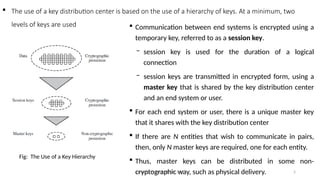
The use of a key distribution center is based on the use of a hierarchy of keys. At a minimum, two
levels of keys are used Communication between end systems is encrypted using a
temporary key, referred to as a session key.
− session key is used for the duration of a logical
connection
− session keys are transmitted in encrypted form, using a
master key that is shared by the key distribution center
and an end system or user.
For each end system or user, there is a unique master key
that it shares with the key distribution center
If there are N entities that wish to communicate in pairs,
then, only N master keys are required, one for each entity.
Thus, master keys can be distributed in some non-
cryptographic way, such as physical delivery.
Fig: The Use of a Key Hierarchy
6.
Deeksha M, Deptof CSE, AIET 6
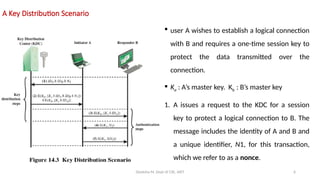
A Key Distribution Scenario
user A wishes to establish a logical connection
with B and requires a one-time session key to
protect the data transmitted over the
connection.
Ka : A’s master key. Kb : B’s master key
1. A issues a request to the KDC for a session
key to protect a logical connection to B. The
message includes the identity of A and B and
a unique identifier, N1, for this transaction,
which we refer to as a nonce.
7.
Deeksha M, Deptof CSE, AIET 7
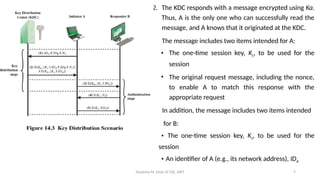
2. The KDC responds with a message encrypted using Ka.
Thus, A is the only one who can successfully read the
message, and A knows that it originated at the KDC.
The message includes two items intended for A:
• The one-time session key, Ks, to be used for the
session
• The original request message, including the nonce,
to enable A to match this response with the
appropriate request
In addition, the message includes two items intended
for B:
• The one-time session key, Ks, to be used for the
session
• An identifier of A (e.g., its network address), IDA
8.
Deeksha M, Deptof CSE, AIET 8
3. A stores the session key for use in the upcoming
session and forwards to B the information that
originated at the KDC for B, namely, E(Kb,[Ks }
IDA]).
4. Using the new session key for encryption, B sends
a nonce, N2, to A.
5. Also, using Ks, A responds with f(N2), where f is a
function that performs some transformation on
N2
9.
Deeksha M, Deptof CSE, AIET 9
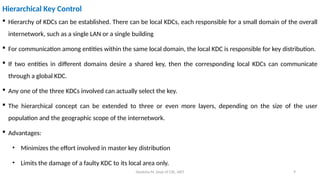
Hierarchical Key Control
Hierarchy of KDCs can be established. There can be local KDCs, each responsible for a small domain of the overall
internetwork, such as a single LAN or a single building
For communication among entities within the same local domain, the local KDC is responsible for key distribution.
If two entities in different domains desire a shared key, then the corresponding local KDCs can communicate
through a global KDC.
Any one of the three KDCs involved can actually select the key.
The hierarchical concept can be extended to three or even more layers, depending on the size of the user
population and the geographic scope of the internetwork.
Advantages:
• Minimizes the effort involved in master key distribution
• Limits the damage of a faulty KDC to its local area only.
10.
Deeksha M, Deptof CSE, AIET 10
Session Key Lifetime
For connection-oriented protocols, use the same session key for the length of time that the connection
is open, using a new session key for each new session.
If a logical connection has a very long lifetime, then it would be prudent to change the session key
periodically
For a connectionless protocol, there is no explicit connection initiation or termination. Thus, it is not
obvious how often one needs to change the session key.
The most secure approach is to use a new session key for each exchange.
However, this negates one of the principal benefits of connectionless protocols, which is minimum
overhead and delay for each transaction.
• A better strategy is to use a given session key for a certain fixed period only or for a certain number of
transactions.
11.
Deeksha M, Deptof CSE, AIET 11
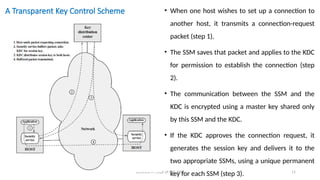
A Transparent Key Control Scheme • When one host wishes to set up a connection to
another host, it transmits a connection-request
packet (step 1).
• The SSM saves that packet and applies to the KDC
for permission to establish the connection (step
2).
• The communication between the SSM and the
KDC is encrypted using a master key shared only
by this SSM and the KDC.
• If the KDC approves the connection request, it
generates the session key and delivers it to the
two appropriate SSMs, using a unique permanent
key for each SSM (step 3).
12.
Deeksha M, Deptof CSE, AIET 12
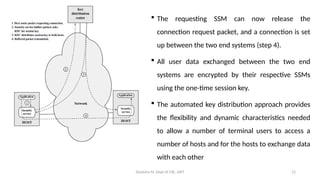
The requesting SSM can now release the
connection request packet, and a connection is set
up between the two end systems (step 4).
All user data exchanged between the two end
systems are encrypted by their respective SSMs
using the one-time session key.
The automated key distribution approach provides
the flexibility and dynamic characteristics needed
to allow a number of terminal users to access a
number of hosts and for the hosts to exchange data
with each other
13.
Deeksha M, Deptof CSE, AIET 13
Decentralized Key Control
The use of a key distribution center imposes the requirement that the KDC be trusted and be
protected from subversion.
This requirement can be avoided if key distribution is fully decentralized.
A decentralized approach requires that each end system be able to communicate in a secure
manner with all potential partner end systems for purposes of session key distribution.
Thus, there may need to be as many as [n(n - 1)]/2 master keys for a configuration with n end
systems.
14.
Deeksha M, Deptof CSE, AIET 14
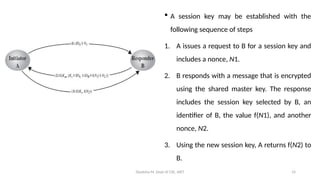
A session key may be established with the
following sequence of steps
1. A issues a request to B for a session key and
includes a nonce, N1.
2. B responds with a message that is encrypted
using the shared master key. The response
includes the session key selected by B, an
identifier of B, the value f(N1), and another
nonce, N2.
3. Using the new session key, A returns f(N2) to
B.
15.
Deeksha M, Deptof CSE, AIET 15
Controlling Key Usage
It is desirable to impose some control on the way in which automatically distributed keys are used.
For example, in addition to separating master keys from session keys, we may wish to define
different types of session keys on the basis of use, such as
− Data-encrypting key, for general communication across a network
− PIN-encrypting key, for personal identification numbers (PINs) used in electronic funds transfer
and point-of-sale applications
− File-encrypting key, for encrypting files stored in publicly accessible locations
16.
Deeksha M, Deptof CSE, AIET 16
It may be desirable to institute controls in systems that limit the ways in which keys are used, based
on characteristics associated with those keys.
One simple plan is to associate a tag with each key
• use extra 8 bits in each key to from the key tag.
• The bits have the following interpretation:
− One bit indicates whether the key is a session key or a master key.
− One bit indicates whether the key can be used for encryption.
− One bit indicates whether the key can be used for decryption.
− The remaining bits are spares for future use.
17.
Deeksha M, Deptof CSE, AIET 17
Drawbacks :
1.The tag length is limited to 8 bits, limiting its flexibility and functionality.
2.Because the tag is not transmitted in clear form, it can be used only at the point of decryption,
limiting the ways in which key use can be controlled.
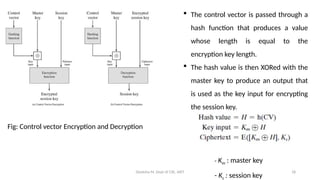
Control vector
• Each session key has an associated control vector consisting of a number of fields that specify the
uses and restrictions for that session key.
• The length of the control vector may vary.
• The control vector is cryptographically coupled with the key at the time of key generation at the KDC
18.
Deeksha M, Deptof CSE, AIET 18
Fig: Control vector Encryption and Decryption
The control vector is passed through a
hash function that produces a value
whose length is equal to the
encryption key length.
The hash value is then XORed with the
master key to produce an output that
is used as the key input for encrypting
the session key.
- Km : master key
- Ks : session key
19.
Deeksha M, Deptof CSE, AIET 19
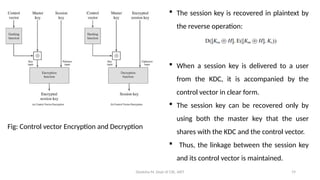
Fig: Control vector Encryption and Decryption
The session key is recovered in plaintext by
the reverse operation:
When a session key is delivered to a user
from the KDC, it is accompanied by the
control vector in clear form.
The session key can be recovered only by
using both the master key that the user
shares with the KDC and the control vector.
Thus, the linkage between the session key
and its control vector is maintained.
20.
Deeksha M, Deptof CSE, AIET 20
Use of the control vector has two advantages over use of an 8-bit tag.
1. There is no restriction on length of the control vector, which enables arbitrarily complex
controls to be imposed on key use.
2. The control vector is available in clear form at all stages of operation. Thus, control of key use
can be exercised in multiple locations.
21.
Deeksha M, Deptof CSE, AIET 21
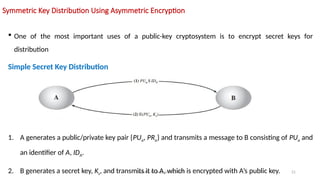
Symmetric Key Distribution Using Asymmetric Encryption
One of the most important uses of a public-key cryptosystem is to encrypt secret keys for
distribution
Simple Secret Key Distribution
1. A generates a public/private key pair {PUa, PRa} and transmits a message to B consisting of PUa and
an identifier of A, IDA.
2. B generates a secret key, Ks, and transmits it to A, which is encrypted with A’s public key.
22.
Deeksha M, Deptof CSE, AIET 22
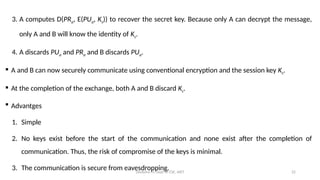
3. A computes D(PRa, E(PUa, Ks)) to recover the secret key. Because only A can decrypt the message,
only A and B will know the identity of Ks.
4. A discards PUa and PRa and B discards PUa.
A and B can now securely communicate using conventional encryption and the session key Ks.
At the completion of the exchange, both A and B discard Ks.
Advantges
1. Simple
2. No keys exist before the start of the communication and none exist after the completion of
communication. Thus, the risk of compromise of the keys is minimal.
3. The communication is secure from eavesdropping.
23.
Deeksha M, Deptof CSE, AIET 23
Drawback
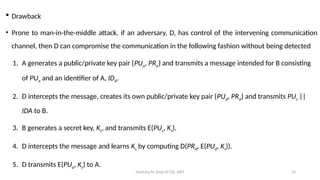
• Prone to man-in-the-middle attack. if an adversary, D, has control of the intervening communication
channel, then D can compromise the communication in the following fashion without being detected
1. A generates a public/private key pair {PUa, PRa} and transmits a message intended for B consisting
of PUa and an identifier of A, IDA.
2. D intercepts the message, creates its own public/private key pair {PUd, PRd} and transmits PUs ||
IDA to B.
3. B generates a secret key, Ks, and transmits E(PUs, Ks).
4. D intercepts the message and learns Ks by computing D(PRd, E(PUd, Ks)).
5. D transmits E(PUa, Ks) to A.
24.
Deeksha M, Deptof CSE, AIET 24
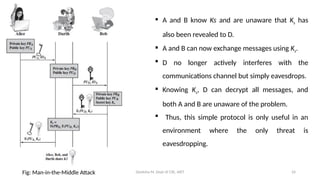
Fig: Man-in-the-Middle Attack
A and B know Ks and are unaware that Ks has
also been revealed to D.
A and B can now exchange messages using Ks.
D no longer actively interferes with the
communications channel but simply eavesdrops.
Knowing Ks, D can decrypt all messages, and
both A and B are unaware of the problem.
Thus, this simple protocol is only useful in an
environment where the only threat is
eavesdropping.
25.
Deeksha M, Deptof CSE, AIET 25
Secret Key Distribution with Confidentiality and Authentication
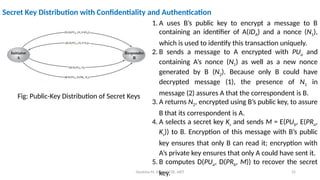
Fig: Public-Key Distribution of Secret Keys
1. A uses B’s public key to encrypt a message to B
containing an identifier of A(IDA) and a nonce (N1),
which is used to identify this transaction uniquely.
2. B sends a message to A encrypted with PUa and
containing A’s nonce (N1) as well as a new nonce
generated by B (N2). Because only B could have
decrypted message (1), the presence of N1 in
message (2) assures A that the correspondent is B.
3. A returns N2, encrypted using B’s public key, to assure
B that its correspondent is A.
4. A selects a secret key Ks and sends M = E(PUb, E(PRa,
Ks)) to B. Encryption of this message with B’s public
key ensures that only B can read it; encryption with
A’s private key ensures that only A could have sent it.
5. B computes D(PUa, D(PRb, M)) to recover the secret
key.
26.
Deeksha M, Deptof CSE, AIET 26
A Hybrid Scheme
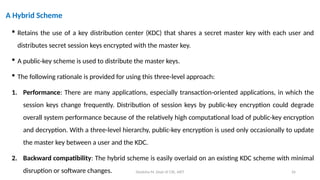
Retains the use of a key distribution center (KDC) that shares a secret master key with each user and
distributes secret session keys encrypted with the master key.
A public-key scheme is used to distribute the master keys.
The following rationale is provided for using this three-level approach:
1. Performance: There are many applications, especially transaction-oriented applications, in which the
session keys change frequently. Distribution of session keys by public-key encryption could degrade
overall system performance because of the relatively high computational load of public-key encryption
and decryption. With a three-level hierarchy, public-key encryption is used only occasionally to update
the master key between a user and the KDC.
2. Backward compatibility: The hybrid scheme is easily overlaid on an existing KDC scheme with minimal
disruption or software changes.
27.
Deeksha M, Deptof CSE, AIET 27
Distribution Of Public Keys
Several techniques have been proposed for the distribution of public keys. Virtually all these
proposals can be grouped into the following general schemes:
•Public announcement
•Publicly available directory
•Public-key authority
•Public-key certificates
28.
Deeksha M, Deptof CSE, AIET 28
Public Announcement of Public Keys
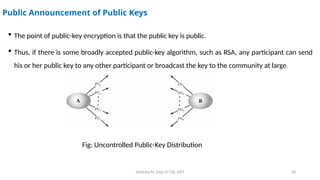
The point of public-key encryption is that the public key is public.
Thus, if there is some broadly accepted public-key algorithm, such as RSA, any participant can send
his or her public key to any other participant or broadcast the key to the community at large
Fig: Uncontrolled Public-Key Distribution
29.
Deeksha M, Deptof CSE, AIET 29
Drawback:
Anyone can forge such a public announcement
User could pretend to be user A and send a public key to another participant or broadcast such a
public key.
Until such time as user A discovers the forgery and alerts other participants, the forger is able to read
all encrypted messages intended for A and can use the forged keys for authentication
30.
Deeksha M, Deptof CSE, AIET 30
Publicly Available Directory
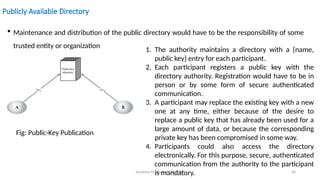
Maintenance and distribution of the public directory would have to be the responsibility of some
trusted entity or organization
Fig: Public-Key Publication
1. The authority maintains a directory with a {name,
public key} entry for each participant.
2. Each participant registers a public key with the
directory authority. Registration would have to be in
person or by some form of secure authenticated
communication.
3. A participant may replace the existing key with a new
one at any time, either because of the desire to
replace a public key that has already been used for a
large amount of data, or because the corresponding
private key has been compromised in some way.
4. Participants could also access the directory
electronically. For this purpose, secure, authenticated
communication from the authority to the participant
is mandatory.
31.
Deeksha M, Deptof CSE, AIET 31
Advantages:
• more secure than individual public announcements
Disadvantages:
• If an adversary succeeds in obtaining or computing the private key of the directory authority, the
adversary could authoritatively pass out counterfeit public keys and subsequently impersonate any
participant and eavesdrop on messages sent to any participant.
• Tamper with the records kept by the authority.
32.
Deeksha M, Deptof CSE, AIET 32
Public-Key Authority
Stronger security for public-key distribution can be achieved by providing tighter control over the
distribution of public keys from the directory
Assume that a central authority maintains a dynamic directory of public keys of all participants.
Each participant reliably knows a public key for the authority, with only the authority knowing the
corresponding private key.
The following steps occur:
1. A sends a timestamped message to the public-key authority containing a request for the current
public key of B.
33.
Deeksha M, Deptof CSE, AIET 33
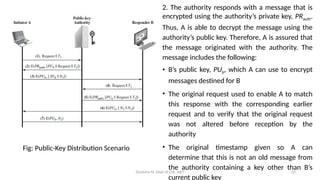
2. The authority responds with a message that is
encrypted using the authority’s private key, PRauth.
Thus, A is able to decrypt the message using the
authority’s public key. Therefore, A is assured that
the message originated with the authority. The
message includes the following:
• B’s public key, PUb, which A can use to encrypt
messages destined for B
• The original request used to enable A to match
this response with the corresponding earlier
request and to verify that the original request
was not altered before reception by the
authority
• The original timestamp given so A can
determine that this is not an old message from
the authority containing a key other than B’s
current public key
Fig: Public-Key Distribution Scenario
34.
Deeksha M, Deptof CSE, AIET 34
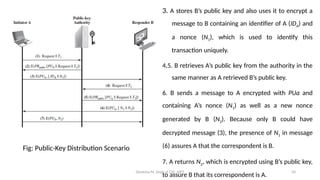
3. A stores B’s public key and also uses it to encrypt a
message to B containing an identifier of A (IDA) and
a nonce (N1), which is used to identify this
transaction uniquely.
4,5. B retrieves A’s public key from the authority in the
same manner as A retrieved B’s public key.
6. B sends a message to A encrypted with PUa and
containing A’s nonce (N1) as well as a new nonce
generated by B (N2). Because only B could have
decrypted message (3), the presence of N1 in message
(6) assures A that the correspondent is B.
7. A returns N2, which is encrypted using B’s public key,
to assure B that its correspondent is A.
Fig: Public-Key Distribution Scenario
35.
Deeksha M, Deptof CSE, AIET 35
Drawbacks:
The public-key authority could be somewhat of a bottleneck in the system, for a user must appeal to
the authority for a public key for every other user that it wishes to contact.
The directory of names and public keys maintained by the authority is vulnerable to tampering.
36.
Deeksha M, Deptof CSE, AIET 36
Public-Key Certificates
Use certificates that can be used by participants to exchange keys without contacting a public-key
authority, in a way that is as reliable as if the keys were obtained directly from a public-key authority.
A certificate consists of a public key, an identifier of the key owner, and the whole block signed by a
trusted third party.
A user can present his or her public key to the authority in a secure manner and obtain a certificate.
The user can then publish the certificate. Anyone needing this user’s public key can obtain the
certificate and verify that it is valid by way of the attached trusted signature.
A participant can also convey its key information to another by transmitting its certificate. Other
participants can verify that the certificate was created by the authority
37.
Deeksha M, Deptof CSE, AIET 37
1. Any participant can read a certificate to determine the name and public key of the certificate’s
owner.
2. Any participant can verify that the certificate originated from the certificate authority
3. Only the certificate authority can create and update certificates.
4. Any participant can verify the currency of the certificate.
38.
Deeksha M, Deptof CSE, AIET 38
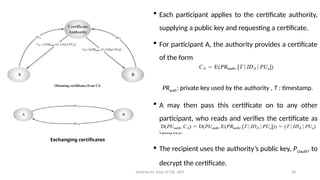
Each participant applies to the certificate authority,
supplying a public key and requesting a certificate.
For participant A, the authority provides a certificate
of the form
PRauth: private key used by the authority , T : timestamp.
A may then pass this certificate on to any other
participant, who reads and verifies the certificate as
follows:
The recipient uses the authority’s public key, PUauth, to
decrypt the certificate.
Exchanging certificates
39.
Deeksha M, Deptof CSE, AIET 39
Because the certificate is readable only using the authority’s public key, this verifies that the
certificate came from the certificate authority.
The elements IDA and Pua provide the recipient with the name and public key of the certificate’s
holder.
The timestamp T validates the currency of the certificate.

![Deeksha M, Dept of CSE, AIET 8
3. A stores the session key for use in the upcoming
session and forwards to B the information that
originated at the KDC for B, namely, E(Kb,[Ks }
IDA]).
4. Using the new session key for encryption, B sends
a nonce, N2, to A.
5. Also, using Ks, A responds with f(N2), where f is a
function that performs some transformation on
N2](https://image.slidesharecdn.com/module-3-251222072716-72177bcf/85/Key-management-and-Distribution-in-Cryptography-pptx-8-320.jpg)
![Deeksha M, Dept of CSE, AIET 13
Decentralized Key Control
The use of a key distribution center imposes the requirement that the KDC be trusted and be
protected from subversion.
This requirement can be avoided if key distribution is fully decentralized.
A decentralized approach requires that each end system be able to communicate in a secure
manner with all potential partner end systems for purposes of session key distribution.
Thus, there may need to be as many as [n(n - 1)]/2 master keys for a configuration with n end
systems.](https://image.slidesharecdn.com/module-3-251222072716-72177bcf/85/Key-management-and-Distribution-in-Cryptography-pptx-13-320.jpg)