�
Copyright © 2015 Fedegari Group
fedegari.com
Key factors in the choice and
development of a cleaning strategy
M. L. Bernuzzi
Manager, R&D, Fedegari Autoclavi SpA
Many aspects need to be considered in setting up a cleaning procedure. This is certainly a
multidisciplinary issue that involves various company areas: from “Regulations” to Engineering, from
Quality Control lab to Production department. Contributions of all these areas together can lead to a
robust and reproducible cleaning process.
Key words: Cleaning, COP, cleaning equipment.
Introduction
Cleaning is an essential practice for any
pharmaceutical activity: it is impossible to
manufacture drugs in dirty conditions, even if
dirt is not evident. Defining differences between a
sterilization and a cleaning treatment is important
in order to understand in depth the main problems
and peculiarities when defining a cleaning
strategy. To sterilize means to destroy or inactivate
microorganisms: we know the target and we can
define it in terms of a number (UCF/unit) and
resistance (D, z). The definition of sterile product/
item (PNSU – Probability of Non-Sterile Unit or
SAL – Sterility Assurance Level), is probabilistic
butisuniversallyaccepted.Thekineticsofordinary
sterilization processes are well understood and as
a result so is the determination of the lethal dose
to be administered.
On the other hand, for a cleaning process, the
“enemy” is not defined and in any case can vary
on a case-by-case basis: residue of previously
processed product, diluents, solvents, various
chemicals, lubricants, generic dirt, m.o., etc.
There is no absolute definition of cleanliness. The
kinetics of the cleaning procedure is unknown.
Consequently, also the definition of “cleaning
dose” to be provided is undetermined.
In these conditions, even regulatory bodies
struggle. Essentially, they allow manufacturers
considerable flexibility in establishing their own
cleaning specifications. The FDA, for example,
does not define methods describing how a cleaning
process should be validated. FDA inspectors have
to assess the rationale used to set the cleaning
limits, making sure that their basis are scientifically
justifiable and grounded on adequate knowledge
of the materials involved.
DOC. 371450.22
1/7
Brief glossary
Cleaning equipment - system, device or even simple tool
used for cleaning.
Equipment - fixed or movable system or equipment or even
tool to be cleaned.
m.o - microorganism(s)
CIP - Cleaning in place, i.e., cleaning performed without
removing the item from its usual location.
COP - Cleaning out of place, i.e., cleaning performed on
the item removed from its usual location.
FDA - Food and Drugs Administration
PDA - Parenteral Drugs Association
�
Copyright © 2015 Fedegari Group
fedegari.com
PDA Technical Report no. 29 suggests a Cleaning
Spectrum, which includes cleaning program
development criteria, equipment characteristics,
All above listed factors directly influence the
cleaning capacity of the considered process; their
importance and criticality however, can have
different impact depending on the case study.
This Cleaning Spectrum can be useful to assess
the most challenging factors affecting the process
and it can allow the manufacturer to set a scale of
priorities, outlining the cleaning rationale.
Therefore, there are many aspects to be considered
when approaching the issue of cleaning. First of
all, one has to consider where to perform cleaning
activity: in-place (CIP) or out-of-place (COP).
1. Main aspects distinguishing
a cleaning process
1.1	 CLEANING LOCATION: CIP VS. COP
CIPis performed on equipment in its usual location
and configuration. The process can be manual or
automated and is used for large components and
equipment: fermentation reactors, fluid bed dryers,
etc.
Sterility Test Isolator
COP is performed on generally smaller machine
parts, which are carried to aa dedicated area or
room. Usually, these are parts of small devices,
which can be disassembled easily and are difficult
to clean.
Transport itself entails particular attention to
identify the item and its components (in fact
it usually entails disassembly operations) and
precautions for cross-contamination during
transport, final drying, and storage after cleaning.
COP of easily transportable objects is often
performed with fully automatic machines. When
it comes to treating various objects not clearly
similar a careful sorting into families is required
to obtain uniform results. If all the precautions are
followed, the procedure can be highly effective
and repeatable.
1.2	 AUTOMATIC VS. MANUAL CLEANING
Manual cleaning is considered quite common, but
challenges regarding inefficiency, inconsistency
2/7
Automated cleaning Manual cleaning
In-place cleaning Out-of-place cleaning
Dedicated equipment Non-dedicated equipment
Indirect product contact surfaces Product contact surfaces
Low risk site High risk site
Minor equipment Major equipment
Low risk drugs High risk drugs
Highly characterized Poorly characterized
Liquid formulations Solid formulations
Easy to clean product Difficult to clean product
Materials with a smooth, non-porous surface Porous materials
Single product facility Multiple product facility
Non-campaigned production Campaigned production
formulation/product characteristics and
production/process characteristics (see Table 1).
Table 1 Cleaning Spectrum - PDA Technical Report no. 29
�
Copyright © 2015 Fedegari Group
fedegari.com
and difficulties to trace and document the process
are often reported. The risk of cross-contamination
increases if cleaning is performed with manual
or semi-automatic equipment due to the margin
of error of the operator who is responsible for
the activity. Automatic systems typically do not
involve human intervention, except for selecting
a cycle and starting and/or shutting down the
equipment at the end of activity.
For cleaning validation, as with validation of
other processes, at the end of the process you
should provide scientific data showing that the
system works as expected with an outcome that
consistently meets predetermined requirements.
The use of automation provides data reliability,
process uniformity and robustness for cycles and
parameters control and monitoring. Consequently,
the standardization and reproducibility of
procedures might facilitate the process validation.
Another point to be considered, especially
focusing on validation is the overall effectiveness
of the process. Does it have to be scrubbed by
hand to achieve an effective cleaning? For the
most challenging loads, it is suggested the use of
innovative dedicated washing racks with spray
nozzles. These devices, designed for automatic
washers, are engineered to cover all load surfaces
and customized for cleaning peculiarities, thus
simplifying validation even for worst cases (see
section 3.4).
In addition, an automatic cleaning system can
offer several advantages regarding the reduction
of total process time, optimization of material
flows, traceability and documentation, increased
throughput and reduction of overall energy
consumption and operating costs.
1.3	 CRITICAL VS. NON-CRITICAL SITES
Risk is a function of:
•	 the identification of a danger
•	 the possibility to detect a danger
•	 the exposure to the identified danger.
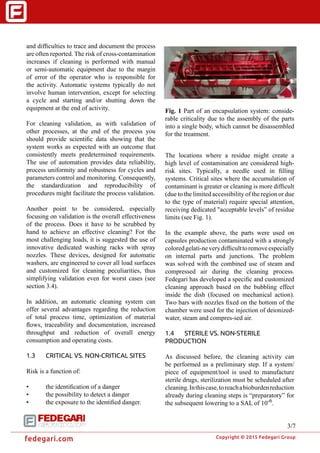
The locations where a residue might create a
high level of contamination are considered high-
risk sites. Typically, a needle used in filling
systems. Critical sites where the accumulation of
contaminant is greater or cleaning is more difficult
(due to the limited accessibility of the region or due
to the type of material) require special attention,
receiving dedicated "acceptable levels” of residue
limits (see Fig. 1).
In the example above, the parts were used on
capsules production contaminated with a strongly
coloredgelati-neverydifficulttoremoveespecially
on internal parts and junctions. The problem
was solved with the combined use of steam and
compressed air during the cleaning process.
Fedegari has developed a specific and customized
cleaning approach based on the bubbling effect
inside the dish (focused on mechanical action).
Two bars with nozzles fixed on the bottom of the
chamber were used for the injection of deionized-
water, steam and compres-sed air.
1.4	 STERILE VS. NON-STERILE
PRODUCTION
As discussed before, the cleaning activity can
be performed as a preliminary step. If a system/
piece of equipment/tool is used to manufacture
sterile drugs, sterilization must be scheduled after
cleaning.Inthiscase,toreachabioburdenreduction
already during cleaning steps is “preparatory” for
the subsequent lowering to a SAL of 10-6
.
Fig. 1 Part of an encapsulation system: conside-
rable criticality due to the assembly of the parts
into a single body, which cannot be disassembled
for the treatment.
3/7
�
Copyright © 2015 Fedegari Group
fedegari.com
At the same time, by eliminating dirt, the
microorganism is deprived both of a growth
medium and of a “protection” from the biocidal
agent. Residues of organic material can often
cause the failure of a microbial burden inactivation
treatment.
Addressing an ever increasing need for flexibility
and cost-effectiveness in pharma manufacturing,
Fedegari, for example, has developed a washer-
sterilizer. It is capable of operating in different
modes to optimize processes where both cleaning
and/or sterilization are needed. This machine
brings features and performances typical of a
steam sterilizer into a jet washer, using steam
for improving washing/degreasing performances
and vacuum for drying. Thus, representing a
more environmental-friendly machine with lower
energy consumption than tradi-tional alternatives.
1.5	 EQUIPMENT CONSIDERATIONS:
DEDICATED VS. NON-DEDICATED
PRODUC-TION SYSTEMS
Dedicated production systems sharply reduce
both cross-contamination and cleaning problems
but entail large investments. They are used for the
treatment of a single product or, in rare instances,
for a range of products. Dedicated systems are
required for:
•	 Products that are difficult to remove: tar-
like, rubber-like, etc.
•	 Elements that are difficult to clean: filters,
convoluted structures with small lumens
•	 High-risk/high-activity products.
Cleaning procedures should minimize the residual
limits of high-risk/high-activity drugs that might
contaminate production batches.
When the same equipment is used for different
product formulations, preventing the risk of
carryover becomes a priority. In such cases,
systems for preventing cross-contaminations must
be adopted and maintained rigorously. Moreover,
for non-dedicated production system the design of
the washing racks (e.g. part cleaning unit), must
be modified according to the load.
1.6	 PREVENTING MALFUNCTION
THROUGH ADEQUATE CLEANING STRATEGY
CFR (Code of Federal Regulation) 21 part 211.67,
“Current good manufacturing practice for finished
pharmaceuticals”, on the subject of Equipment
Cleaning and maintenance, states:
First, the cleaning process might assure the safety
and quality of the manufactured drugs. However,
a cleaning strategy should take into consideration
the most suitable process development avoiding
damages and contamination to the treated parts
and to the cleaning equipment.
Accordingly, temperature, pressure, flows and
chemical agent aggressiveness applied during the
process must be tailored and validated according
to type of load and production.
For example, Fedegari has recently developed a
series of industrial washers using the experience
with steam to reduce the need for detergents and
chemical agents but maintaining the cleaning
effectiveness. An adequate cleaning strategy is
studied by the R&D department for each case
to assure a correct balancing between process
parameters (e.g. pressure, temperature) and
cleaning target.
1.7	 ASPECTS OF
MICROBIAL PROLIFERATION
Items subjected to cleaning must be stored dry, in
order to avoid the risk of microbiological growth.
Equipment and utensils shall be cleaned,
maintained, and, as appropriate for the nature
of the drug, sanitized and/or sterilized at
appropriate intervals to prevent malfunctions
or contamination that would alter the safety,
identity, strength, quality, or purity of the drug
product beyond the official or other established
requirements.
4/7
�
Copyright © 2015 Fedegari Group
fedegari.com
There are various types of cleaning agent (which
can be combined or used individually):
•	 water of various purity (the lower the
conductivity of the water, the lower the risk of
seeing halos which appear on the treated object
due to salt deposits), cold or warm
•	 organic solvents
•	 acid or basic detergents
•	 organic/inorganic complexing agents
•	 dispersants, surfactants, wetting agents
•	 sanitizers of various kinds
•	 pressurized water vapor or superheated
water.
2.1	 THE “CHEMISTRY” OF THE PRODUCT
AS A GUIDE FOR THE CHOICE OF PROCESS/
DETERGENT
Today, the “Green Policies” of companies are
leading to the search for cleaning systems that
have a reduced use of chemical agents and,
consequently, a lower environmental impact.
While water soluble products might require the
use of water alone as “detergent”, other lipophilic
products represent a great challenge if one wishes
to reduce or eliminate the use of chemical agents.
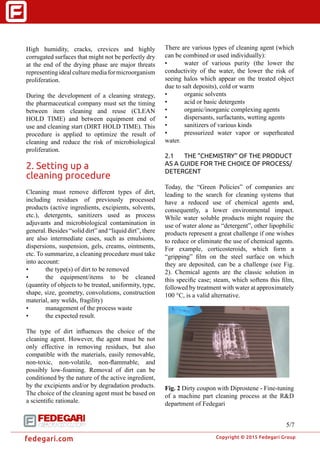
For example, corticosteroids, which form a
“gripping” film on the steel surface on which
they are deposited, can be a challenge (see Fig.
2). Chemical agents are the classic solution in
this specific case; steam, which softens this film,
followed by treatment with water at approximately
100 °C, is a valid alternative.
Fig. 2 Dirty coupon with Diprostene - Fine-tuning
of a machine part cleaning process at the R&D
department of Fedegari
High humidity, cracks, crevices and highly
corrugated surfaces that might not be perfectly dry
at the end of the drying phase are major threats
representingidealculturemediaformicroorganism
proliferation.
During the development of a cleaning strategy,
the pharmaceutical company must set the timing
between item cleaning and reuse (CLEAN
HOLD TIME) and between equipment end of
use and cleaning start (DIRT HOLD TIME). This
procedure is applied to optimize the result of
cleaning and reduce the risk of microbiological
proliferation.
2. Setting up a
cleaning procedure
Cleaning must remove different types of dirt,
including residues of previously processed
products (active ingredients, excipients, solvents,
etc.), detergents, sanitizers used as process
adjuvants and microbiological contamination in
general. Besides “solid dirt” and “liquid dirt”, there
are also intermediate cases, such as emulsions,
dispersions, suspension, gels, creams, ointments,
etc. To summarize, a cleaning procedure must take
into account:
•	 the type(s) of dirt to be removed
•	 the equipment/items to be cleaned
(quantity of objects to be treated, uniformity, type,
shape, size, geometry, convolutions, construction
material, any welds, fragility)
•	 management of the process waste
•	 the expected result.
The type of dirt influences the choice of the
cleaning agent. However, the agent must be not
only effective in removing residues, but also
compatible with the materials, easily removable,
non-toxic, non-volatile, non-flammable, and
possibly low-foaming. Removal of dirt can be
conditioned by the nature of the active ingredient,
by the excipients and/or by degradation products.
The choice of the cleaning agent must be based on
a scientific rationale.
5/7
�
Copyright © 2015 Fedegari Group
fedegari.com
The use of superheated water, in the specific case,
also eliminates the deposited dirt.
However, it should be stressed that the good
outcome of a cleaning process often depends on
the customization of the cleaning equipment.
For example, if the water jets are not adequately
directed to strike the dirty surfaces, the result
might not be optimum.
Sometimes the use or not of high temperatures
in the various steps of the process can hinder
the achievement of the goal instead of aiding it.
Knowing the chemical structure of the product to
be removed will help us to avoid mistakes. A few
examples:
Therefore, in the case of sugars and proteins
preference is given to cleaning processes that do
not use high temperatures.
2.2	 MAJOR VS. MINOR EQUIPMENT/
PARTS
This definition might not be clear since it is not
related to a cleaning challenge. “Minor” equipment
or tools can constitute a high risk if considering
the need to assure effective cleaning for each
single item. Typically, the cleaning of a “major”
equipment is individual and subject of specific
SOP (Standard Operating Procedure), whereas
minor tools can be grouped, especially if the
cleaning operation is performed with automatic
machines.
2.3	SURFACES
Surface type and finish can affect the ability
to clean the material. Depending on the level
of roughness (Ra), the surface will represent a
better or worse “hiding place” for contaminants,
including biological ones. For example, an electro-
polished steel surface has a distinctly lower degree
of roughness than “raw” steel resulting in an easier
cleaning process.
Scratches and cracks of the material are difficult
to clean. Particularly porous materials, such as
filters, which are very delicate, require particular
precautions.
2.4	 EQUIPMENT DESIGN
& PERFORMANCE
The complexity of machines/machine parts, of
tools intended for cleaning, the convoluted shape
of some structures, the presence of recesses, can
make it difficult to achieve the intended cleaning
target.Typically, cleaning validation relates to
the surfaces in contact with the product, but it is
difficult to exclude migrations of contaminant
toward regions that theoretically entail no
contact, especially if they are segregated and
where accumulations can occur (e.g., gaskets and
their seats). This leads to the need for a cleaning
apparatus that is dedicated to the item/items and
can ensure that the cleaning medium reaches every
surface to be treated. Its customization is often the
keystone of a good cleaning outcome; therefore,
not only the process, but also the dedicated
equipment, are developed around the item to be
cleaned.
Operating pressures, process fluids, type and
adequate inclination of the nozzles from which the
cleaning medium exits, suitable receptacles for the
parts to be cleaned (in the case, for example, of a
parts cleaning unit) are some of the key elements
of the definition of a cleaning machine and of the
consequent process.
Dirt Solubility Removal Changes due to
heat
Sugars Soluble in water Simple Caramelization,
harder to clean
Protein Insoluble in
water/Soluble
in alkali/Scar-
cely soluble in
acids
Difficult Denaturation,
harder to clean
6/7
�
Copyright © 2015 Fedegari Group
fedegari.com
An interesting case to illustrate the use of a custom
designed accessory for improving cleaning results
can be seen below (Fig. 3). This steel wheel, with
complex internal channels and holes to be washed
is an example of challenging load in which the
result of the process is inevitably tied to an accurate
study of the cleaning apparatus.
Fig. 3 Steel wheel from which Carbapenem is to
be removed
Given the structural complexity of the load, a
“distribution spider” (Fig. 4), with small holes
alongthesteelarmshasbeendevelopedtoallowthe
injection of the cleaning medium in the channels.
The device is used also to feed the air through the
machine part in the subsequent drying step. This
dedicated solution turned out to be essential for
effectively cleaning the internal parts of the wheel.
Fig. 4 In gray, system for injection of the cleaning
medium within the channels of the steel wheel. The
system is also useful for conveying compressed
air during load drying phases.
2.5	 PROCESS WASTE
Today, the environmental aspect of every process
is a pivotal point in its provision. This way, a
cleaning practice must also consider process
waste. If the product to be removed is harmful, the
waste produced by each cleaning step have to be
conveyed in a dedicated tank in order to perform
its inactivation in a later phase.
If instead there are no problems in this regard,
the free waste can become a means for assessing
cleaning effectiveness: a small amount drawn and
analyzed with on-line monitoring systems can
give an idea of the level of removal of the active
ingredient and/or of the detergent used.
References
CFR - Code of Federal Regulations Title 21,
Volume 4 Part 211 - Current good manufacturing
practice for finished pharmaceuticals; revised as
of April 1, 2014 -11
Technical Report no. 29 - Points to Consider for
Cleaning Validation - revised 2012
Technical Report no. 49 - Points to Consider for
Biotechnology Cleaning Validation - 2010
Brugali G. “Biofilm e protocollo di detergenza
e disinfezione delle superfici ed attrezzature in
ambito alimentare” Igiene Alim. - Disinfest. & Ig.
Amb. May/June 1999, pages 13-16
7/7

White paper - Key factors for developing a pharmaceutical cleaning strategy

  • 1.
    � Copyright © 2015Fedegari Group fedegari.com Key factors in the choice and development of a cleaning strategy M. L. Bernuzzi Manager, R&D, Fedegari Autoclavi SpA Many aspects need to be considered in setting up a cleaning procedure. This is certainly a multidisciplinary issue that involves various company areas: from “Regulations” to Engineering, from Quality Control lab to Production department. Contributions of all these areas together can lead to a robust and reproducible cleaning process. Key words: Cleaning, COP, cleaning equipment. Introduction Cleaning is an essential practice for any pharmaceutical activity: it is impossible to manufacture drugs in dirty conditions, even if dirt is not evident. Defining differences between a sterilization and a cleaning treatment is important in order to understand in depth the main problems and peculiarities when defining a cleaning strategy. To sterilize means to destroy or inactivate microorganisms: we know the target and we can define it in terms of a number (UCF/unit) and resistance (D, z). The definition of sterile product/ item (PNSU – Probability of Non-Sterile Unit or SAL – Sterility Assurance Level), is probabilistic butisuniversallyaccepted.Thekineticsofordinary sterilization processes are well understood and as a result so is the determination of the lethal dose to be administered. On the other hand, for a cleaning process, the “enemy” is not defined and in any case can vary on a case-by-case basis: residue of previously processed product, diluents, solvents, various chemicals, lubricants, generic dirt, m.o., etc. There is no absolute definition of cleanliness. The kinetics of the cleaning procedure is unknown. Consequently, also the definition of “cleaning dose” to be provided is undetermined. In these conditions, even regulatory bodies struggle. Essentially, they allow manufacturers considerable flexibility in establishing their own cleaning specifications. The FDA, for example, does not define methods describing how a cleaning process should be validated. FDA inspectors have to assess the rationale used to set the cleaning limits, making sure that their basis are scientifically justifiable and grounded on adequate knowledge of the materials involved. DOC. 371450.22 1/7 Brief glossary Cleaning equipment - system, device or even simple tool used for cleaning. Equipment - fixed or movable system or equipment or even tool to be cleaned. m.o - microorganism(s) CIP - Cleaning in place, i.e., cleaning performed without removing the item from its usual location. COP - Cleaning out of place, i.e., cleaning performed on the item removed from its usual location. FDA - Food and Drugs Administration PDA - Parenteral Drugs Association
  • 2.
    � Copyright © 2015Fedegari Group fedegari.com PDA Technical Report no. 29 suggests a Cleaning Spectrum, which includes cleaning program development criteria, equipment characteristics, All above listed factors directly influence the cleaning capacity of the considered process; their importance and criticality however, can have different impact depending on the case study. This Cleaning Spectrum can be useful to assess the most challenging factors affecting the process and it can allow the manufacturer to set a scale of priorities, outlining the cleaning rationale. Therefore, there are many aspects to be considered when approaching the issue of cleaning. First of all, one has to consider where to perform cleaning activity: in-place (CIP) or out-of-place (COP). 1. Main aspects distinguishing a cleaning process 1.1 CLEANING LOCATION: CIP VS. COP CIPis performed on equipment in its usual location and configuration. The process can be manual or automated and is used for large components and equipment: fermentation reactors, fluid bed dryers, etc. Sterility Test Isolator COP is performed on generally smaller machine parts, which are carried to aa dedicated area or room. Usually, these are parts of small devices, which can be disassembled easily and are difficult to clean. Transport itself entails particular attention to identify the item and its components (in fact it usually entails disassembly operations) and precautions for cross-contamination during transport, final drying, and storage after cleaning. COP of easily transportable objects is often performed with fully automatic machines. When it comes to treating various objects not clearly similar a careful sorting into families is required to obtain uniform results. If all the precautions are followed, the procedure can be highly effective and repeatable. 1.2 AUTOMATIC VS. MANUAL CLEANING Manual cleaning is considered quite common, but challenges regarding inefficiency, inconsistency 2/7 Automated cleaning Manual cleaning In-place cleaning Out-of-place cleaning Dedicated equipment Non-dedicated equipment Indirect product contact surfaces Product contact surfaces Low risk site High risk site Minor equipment Major equipment Low risk drugs High risk drugs Highly characterized Poorly characterized Liquid formulations Solid formulations Easy to clean product Difficult to clean product Materials with a smooth, non-porous surface Porous materials Single product facility Multiple product facility Non-campaigned production Campaigned production formulation/product characteristics and production/process characteristics (see Table 1). Table 1 Cleaning Spectrum - PDA Technical Report no. 29
  • 3.
    � Copyright © 2015Fedegari Group fedegari.com and difficulties to trace and document the process are often reported. The risk of cross-contamination increases if cleaning is performed with manual or semi-automatic equipment due to the margin of error of the operator who is responsible for the activity. Automatic systems typically do not involve human intervention, except for selecting a cycle and starting and/or shutting down the equipment at the end of activity. For cleaning validation, as with validation of other processes, at the end of the process you should provide scientific data showing that the system works as expected with an outcome that consistently meets predetermined requirements. The use of automation provides data reliability, process uniformity and robustness for cycles and parameters control and monitoring. Consequently, the standardization and reproducibility of procedures might facilitate the process validation. Another point to be considered, especially focusing on validation is the overall effectiveness of the process. Does it have to be scrubbed by hand to achieve an effective cleaning? For the most challenging loads, it is suggested the use of innovative dedicated washing racks with spray nozzles. These devices, designed for automatic washers, are engineered to cover all load surfaces and customized for cleaning peculiarities, thus simplifying validation even for worst cases (see section 3.4). In addition, an automatic cleaning system can offer several advantages regarding the reduction of total process time, optimization of material flows, traceability and documentation, increased throughput and reduction of overall energy consumption and operating costs. 1.3 CRITICAL VS. NON-CRITICAL SITES Risk is a function of: • the identification of a danger • the possibility to detect a danger • the exposure to the identified danger. The locations where a residue might create a high level of contamination are considered high- risk sites. Typically, a needle used in filling systems. Critical sites where the accumulation of contaminant is greater or cleaning is more difficult (due to the limited accessibility of the region or due to the type of material) require special attention, receiving dedicated "acceptable levels” of residue limits (see Fig. 1). In the example above, the parts were used on capsules production contaminated with a strongly coloredgelati-neverydifficulttoremoveespecially on internal parts and junctions. The problem was solved with the combined use of steam and compressed air during the cleaning process. Fedegari has developed a specific and customized cleaning approach based on the bubbling effect inside the dish (focused on mechanical action). Two bars with nozzles fixed on the bottom of the chamber were used for the injection of deionized- water, steam and compres-sed air. 1.4 STERILE VS. NON-STERILE PRODUCTION As discussed before, the cleaning activity can be performed as a preliminary step. If a system/ piece of equipment/tool is used to manufacture sterile drugs, sterilization must be scheduled after cleaning.Inthiscase,toreachabioburdenreduction already during cleaning steps is “preparatory” for the subsequent lowering to a SAL of 10-6 . Fig. 1 Part of an encapsulation system: conside- rable criticality due to the assembly of the parts into a single body, which cannot be disassembled for the treatment. 3/7
  • 4.
    � Copyright © 2015Fedegari Group fedegari.com At the same time, by eliminating dirt, the microorganism is deprived both of a growth medium and of a “protection” from the biocidal agent. Residues of organic material can often cause the failure of a microbial burden inactivation treatment. Addressing an ever increasing need for flexibility and cost-effectiveness in pharma manufacturing, Fedegari, for example, has developed a washer- sterilizer. It is capable of operating in different modes to optimize processes where both cleaning and/or sterilization are needed. This machine brings features and performances typical of a steam sterilizer into a jet washer, using steam for improving washing/degreasing performances and vacuum for drying. Thus, representing a more environmental-friendly machine with lower energy consumption than tradi-tional alternatives. 1.5 EQUIPMENT CONSIDERATIONS: DEDICATED VS. NON-DEDICATED PRODUC-TION SYSTEMS Dedicated production systems sharply reduce both cross-contamination and cleaning problems but entail large investments. They are used for the treatment of a single product or, in rare instances, for a range of products. Dedicated systems are required for: • Products that are difficult to remove: tar- like, rubber-like, etc. • Elements that are difficult to clean: filters, convoluted structures with small lumens • High-risk/high-activity products. Cleaning procedures should minimize the residual limits of high-risk/high-activity drugs that might contaminate production batches. When the same equipment is used for different product formulations, preventing the risk of carryover becomes a priority. In such cases, systems for preventing cross-contaminations must be adopted and maintained rigorously. Moreover, for non-dedicated production system the design of the washing racks (e.g. part cleaning unit), must be modified according to the load. 1.6 PREVENTING MALFUNCTION THROUGH ADEQUATE CLEANING STRATEGY CFR (Code of Federal Regulation) 21 part 211.67, “Current good manufacturing practice for finished pharmaceuticals”, on the subject of Equipment Cleaning and maintenance, states: First, the cleaning process might assure the safety and quality of the manufactured drugs. However, a cleaning strategy should take into consideration the most suitable process development avoiding damages and contamination to the treated parts and to the cleaning equipment. Accordingly, temperature, pressure, flows and chemical agent aggressiveness applied during the process must be tailored and validated according to type of load and production. For example, Fedegari has recently developed a series of industrial washers using the experience with steam to reduce the need for detergents and chemical agents but maintaining the cleaning effectiveness. An adequate cleaning strategy is studied by the R&D department for each case to assure a correct balancing between process parameters (e.g. pressure, temperature) and cleaning target. 1.7 ASPECTS OF MICROBIAL PROLIFERATION Items subjected to cleaning must be stored dry, in order to avoid the risk of microbiological growth. Equipment and utensils shall be cleaned, maintained, and, as appropriate for the nature of the drug, sanitized and/or sterilized at appropriate intervals to prevent malfunctions or contamination that would alter the safety, identity, strength, quality, or purity of the drug product beyond the official or other established requirements. 4/7
  • 5.
    � Copyright © 2015Fedegari Group fedegari.com There are various types of cleaning agent (which can be combined or used individually): • water of various purity (the lower the conductivity of the water, the lower the risk of seeing halos which appear on the treated object due to salt deposits), cold or warm • organic solvents • acid or basic detergents • organic/inorganic complexing agents • dispersants, surfactants, wetting agents • sanitizers of various kinds • pressurized water vapor or superheated water. 2.1 THE “CHEMISTRY” OF THE PRODUCT AS A GUIDE FOR THE CHOICE OF PROCESS/ DETERGENT Today, the “Green Policies” of companies are leading to the search for cleaning systems that have a reduced use of chemical agents and, consequently, a lower environmental impact. While water soluble products might require the use of water alone as “detergent”, other lipophilic products represent a great challenge if one wishes to reduce or eliminate the use of chemical agents. For example, corticosteroids, which form a “gripping” film on the steel surface on which they are deposited, can be a challenge (see Fig. 2). Chemical agents are the classic solution in this specific case; steam, which softens this film, followed by treatment with water at approximately 100 °C, is a valid alternative. Fig. 2 Dirty coupon with Diprostene - Fine-tuning of a machine part cleaning process at the R&D department of Fedegari High humidity, cracks, crevices and highly corrugated surfaces that might not be perfectly dry at the end of the drying phase are major threats representingidealculturemediaformicroorganism proliferation. During the development of a cleaning strategy, the pharmaceutical company must set the timing between item cleaning and reuse (CLEAN HOLD TIME) and between equipment end of use and cleaning start (DIRT HOLD TIME). This procedure is applied to optimize the result of cleaning and reduce the risk of microbiological proliferation. 2. Setting up a cleaning procedure Cleaning must remove different types of dirt, including residues of previously processed products (active ingredients, excipients, solvents, etc.), detergents, sanitizers used as process adjuvants and microbiological contamination in general. Besides “solid dirt” and “liquid dirt”, there are also intermediate cases, such as emulsions, dispersions, suspension, gels, creams, ointments, etc. To summarize, a cleaning procedure must take into account: • the type(s) of dirt to be removed • the equipment/items to be cleaned (quantity of objects to be treated, uniformity, type, shape, size, geometry, convolutions, construction material, any welds, fragility) • management of the process waste • the expected result. The type of dirt influences the choice of the cleaning agent. However, the agent must be not only effective in removing residues, but also compatible with the materials, easily removable, non-toxic, non-volatile, non-flammable, and possibly low-foaming. Removal of dirt can be conditioned by the nature of the active ingredient, by the excipients and/or by degradation products. The choice of the cleaning agent must be based on a scientific rationale. 5/7
  • 6.
    � Copyright © 2015Fedegari Group fedegari.com The use of superheated water, in the specific case, also eliminates the deposited dirt. However, it should be stressed that the good outcome of a cleaning process often depends on the customization of the cleaning equipment. For example, if the water jets are not adequately directed to strike the dirty surfaces, the result might not be optimum. Sometimes the use or not of high temperatures in the various steps of the process can hinder the achievement of the goal instead of aiding it. Knowing the chemical structure of the product to be removed will help us to avoid mistakes. A few examples: Therefore, in the case of sugars and proteins preference is given to cleaning processes that do not use high temperatures. 2.2 MAJOR VS. MINOR EQUIPMENT/ PARTS This definition might not be clear since it is not related to a cleaning challenge. “Minor” equipment or tools can constitute a high risk if considering the need to assure effective cleaning for each single item. Typically, the cleaning of a “major” equipment is individual and subject of specific SOP (Standard Operating Procedure), whereas minor tools can be grouped, especially if the cleaning operation is performed with automatic machines. 2.3 SURFACES Surface type and finish can affect the ability to clean the material. Depending on the level of roughness (Ra), the surface will represent a better or worse “hiding place” for contaminants, including biological ones. For example, an electro- polished steel surface has a distinctly lower degree of roughness than “raw” steel resulting in an easier cleaning process. Scratches and cracks of the material are difficult to clean. Particularly porous materials, such as filters, which are very delicate, require particular precautions. 2.4 EQUIPMENT DESIGN & PERFORMANCE The complexity of machines/machine parts, of tools intended for cleaning, the convoluted shape of some structures, the presence of recesses, can make it difficult to achieve the intended cleaning target.Typically, cleaning validation relates to the surfaces in contact with the product, but it is difficult to exclude migrations of contaminant toward regions that theoretically entail no contact, especially if they are segregated and where accumulations can occur (e.g., gaskets and their seats). This leads to the need for a cleaning apparatus that is dedicated to the item/items and can ensure that the cleaning medium reaches every surface to be treated. Its customization is often the keystone of a good cleaning outcome; therefore, not only the process, but also the dedicated equipment, are developed around the item to be cleaned. Operating pressures, process fluids, type and adequate inclination of the nozzles from which the cleaning medium exits, suitable receptacles for the parts to be cleaned (in the case, for example, of a parts cleaning unit) are some of the key elements of the definition of a cleaning machine and of the consequent process. Dirt Solubility Removal Changes due to heat Sugars Soluble in water Simple Caramelization, harder to clean Protein Insoluble in water/Soluble in alkali/Scar- cely soluble in acids Difficult Denaturation, harder to clean 6/7
  • 7.
    � Copyright © 2015Fedegari Group fedegari.com An interesting case to illustrate the use of a custom designed accessory for improving cleaning results can be seen below (Fig. 3). This steel wheel, with complex internal channels and holes to be washed is an example of challenging load in which the result of the process is inevitably tied to an accurate study of the cleaning apparatus. Fig. 3 Steel wheel from which Carbapenem is to be removed Given the structural complexity of the load, a “distribution spider” (Fig. 4), with small holes alongthesteelarmshasbeendevelopedtoallowthe injection of the cleaning medium in the channels. The device is used also to feed the air through the machine part in the subsequent drying step. This dedicated solution turned out to be essential for effectively cleaning the internal parts of the wheel. Fig. 4 In gray, system for injection of the cleaning medium within the channels of the steel wheel. The system is also useful for conveying compressed air during load drying phases. 2.5 PROCESS WASTE Today, the environmental aspect of every process is a pivotal point in its provision. This way, a cleaning practice must also consider process waste. If the product to be removed is harmful, the waste produced by each cleaning step have to be conveyed in a dedicated tank in order to perform its inactivation in a later phase. If instead there are no problems in this regard, the free waste can become a means for assessing cleaning effectiveness: a small amount drawn and analyzed with on-line monitoring systems can give an idea of the level of removal of the active ingredient and/or of the detergent used. References CFR - Code of Federal Regulations Title 21, Volume 4 Part 211 - Current good manufacturing practice for finished pharmaceuticals; revised as of April 1, 2014 -11 Technical Report no. 29 - Points to Consider for Cleaning Validation - revised 2012 Technical Report no. 49 - Points to Consider for Biotechnology Cleaning Validation - 2010 Brugali G. “Biofilm e protocollo di detergenza e disinfezione delle superfici ed attrezzature in ambito alimentare” Igiene Alim. - Disinfest. & Ig. Amb. May/June 1999, pages 13-16 7/7