GRAMMAR
strategies
Marta gort paniello
WHAT IS GRAMMAR?
• A set of rules which transforms a chaotic
list of words into an understandable
phrase.
• Look for patterns, don’t expect all the
languages to work as the same.
• Form hypothesis, make up possible
explanations of why things operate as
they do.
• Check your hypothesis and accept that
some times you will get wrong.
REASONS FOR STUDYING
GRAMMAR
• When you learn a foreign language, it makes the proccess
faster. (However, it’s not essential.)
• Prestige: proficiency in a language is based on grammar.
• Meaning can be more accurated (past simple, present perfect)
• It is helpful for comunicating
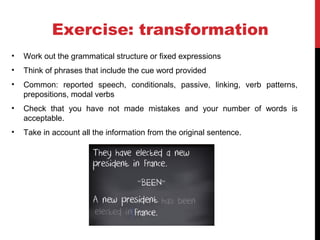
• Work out the grammatical structure or fixed expressions
• Think of phrases that include the cue word provided
• Common: reported speech, conditionals, passive, linking, verb patterns,
prepositions, modal verbs
• Check that you have not made mistakes and your number of words is
acceptable.
• Take in account all the information from the original sentence.
Exercise: transformation
Exercise: Gap- filling
(with and without multiple choice) I
• In each gap you cannot write more than one word.
• This exercise also tests your reading skills.
• It's important to take in consideration the register of the text
• You should read the whole text before starting to fill the gaps.
Exercise: Gap- filling
(with and without multiple choice) II
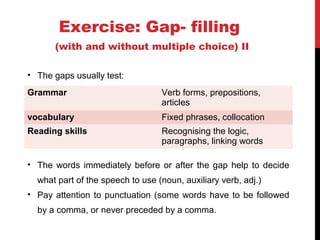
• The gaps usually test:
• The words immediately before or after the gap help to decide
what part of the speech to use (noun, auxiliary verb, adj.)
• Pay attention to punctuation (some words have to be followed
by a comma, or never preceded by a comma.
Grammar Verb forms, prepositions,
articles
vocabulary Fixed phrases, collocation
Reading skills Recognising the logic,
paragraphs, linking words
Exercise: ERROR CORRECTION
• Read the whole text first.
• Search unnecessary words and cross them out. They can be:
determiners, prepositions, relative pronouns, auxiliaries,
pronouns, lining words.
• Expect at least 3 of the lines to be correct, but not more than 6.
ORAL – WRITTEN GRAMMAR
• They are not the same
• Written grammar is more formal, while oral grammar is more
informal.
• Speaking implies more fluency
Grammar
Grammar

Grammar

  • 1.
  • 2.
    WHAT IS GRAMMAR? •A set of rules which transforms a chaotic list of words into an understandable phrase. • Look for patterns, don’t expect all the languages to work as the same. • Form hypothesis, make up possible explanations of why things operate as they do. • Check your hypothesis and accept that some times you will get wrong.
  • 3.
    REASONS FOR STUDYING GRAMMAR •When you learn a foreign language, it makes the proccess faster. (However, it’s not essential.) • Prestige: proficiency in a language is based on grammar. • Meaning can be more accurated (past simple, present perfect) • It is helpful for comunicating
  • 4.
    • Work outthe grammatical structure or fixed expressions • Think of phrases that include the cue word provided • Common: reported speech, conditionals, passive, linking, verb patterns, prepositions, modal verbs • Check that you have not made mistakes and your number of words is acceptable. • Take in account all the information from the original sentence. Exercise: transformation
  • 5.
    Exercise: Gap- filling (withand without multiple choice) I • In each gap you cannot write more than one word. • This exercise also tests your reading skills. • It's important to take in consideration the register of the text • You should read the whole text before starting to fill the gaps.
  • 6.
    Exercise: Gap- filling (withand without multiple choice) II • The gaps usually test: • The words immediately before or after the gap help to decide what part of the speech to use (noun, auxiliary verb, adj.) • Pay attention to punctuation (some words have to be followed by a comma, or never preceded by a comma. Grammar Verb forms, prepositions, articles vocabulary Fixed phrases, collocation Reading skills Recognising the logic, paragraphs, linking words
  • 7.
    Exercise: ERROR CORRECTION •Read the whole text first. • Search unnecessary words and cross them out. They can be: determiners, prepositions, relative pronouns, auxiliaries, pronouns, lining words. • Expect at least 3 of the lines to be correct, but not more than 6.
  • 8.
    ORAL – WRITTENGRAMMAR • They are not the same • Written grammar is more formal, while oral grammar is more informal. • Speaking implies more fluency