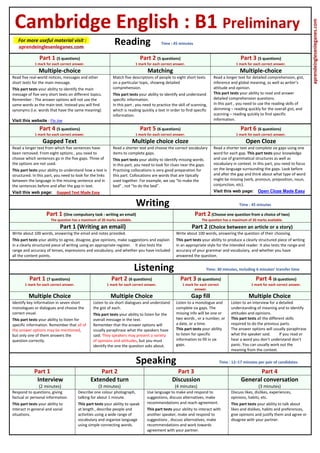
Cambridge English : B1 Preliminary
Reading Time : 45 minutes
FFFor more useful material visit :
Part 1 (5 questions)
1 mark for each correct answer.
Part 2 (5 questions)
1 mark for each correct answer.
Part 3 (5 questions)
1 mark for each correct answer.
Multiple-choice Matching Multiple-choice
Read five real-world notices, messages and other
short texts for the main message.
This part tests your ability to identify the main
message of five very short texts on different topics.
Remember : The answer options will not use the
same words as the main text. Instead you will find
synonyms (i.e. words that have the same meaning)
Visit this website : Flo Joe
Match five descriptions of people to eight short texts
on a particular topic, showing detailed
comprehension.
This part tests your ability to identify and understand
specific information.
In this part , you need to practice the skill of scanning,
which is reading quickly a text in order to find specific
information.
Read a longer text for detailed comprehension, gist,
inference and global meaning, as well as writer’s
attitude and opinion.
This part tests your ability to read and answer
detailed comprehension questions.
In this part , you need to use the reading skills of
skimming – reading quickly for the overall gist, and
scanning – reading quickly to find specific
information.
Part 4 (5 questions)
1 mark for each correct answer.
Part 5 (6 questions)
1 mark for each correct answer.
Part 6 (6 questions)
1 mark for each correct answer.
Gapped Text Multiple choice cloze Open Cloze
Read a longer text from which five sentences have
been removed. From eight options , you need to
choose which sentences go in the five gaps. Three of
the options are not used.
This part tests your ability to understand how a text is
structured. In this part, you need to look for the links
between the language in the missing sentence and in
the sentences before and after the gap in text.
Visit this web page: Gapped Text Made Easy
Read a shorter text and choose the correct vocabulary
items to complete gaps.
This part tests your ability to identify missing words.
In this part, you need to look for clues near the gaps.
Practising collocations is very good preparation for
this part. Collocations are words that are tipically
used together. For example, we say “to make the
bed” , not “to do the bed”.
Read a shorter text and complete six gaps using one
word for each gap. This part tests your knowledge
and use of grammatical structures as well as
vocabulary in context. In this part, you need to focus
on the language surrounding the gaps. Look before
and after the gap and think about what type of word
might be missing (verb, pronoun, preposition, noun,
conjunction, etc).
Visit this web page: Open Cloze Made Easy
Writing Time : 45 minutes
Part 1 (One compulsory task : writing an email)
The question has a maximum of 20 marks available.
Part 2(Choose one question from a choice of two)
The question has a maximum of 20 marks available.
Part 1 (Writing an email) Part 2 (Choice between an article or a story)
Write about 100 words, answering the email and notes provided.
This part tests your ability to agree, disagree, give opinions, make suggestions and explain
in a clearly structured piece of writing using an appropriate register. It also tests the
range and accuracy of tenses, expressions and vocabulary, and whether you have included
all the content points.
Write about 100 words, answering the question of their choosing.
This part tests your ability to produce a clearly structured piece of writing
in an appropriate style for the intended reader. It also tests the range and
accuracy of your grammar and vocabulary, and whether you have
answered the question.
Listening Time: 30 minutes, including 6 minutes’ transfer time
Part 1 (7 questions)
1 mark for each correct answer.
Part 2 (6 questions)
1 mark for each correct answer.
Part 3 (6 questions)
1 mark for each correct
answer.
Part 4 (6 questions)
1 mark for each correct answer.
Multiple Choice Multiple Choice Gap fill Multiple Choice
Identify key information in seven short
monologues or dialogues and choose the
correct visual.
This part tests your ability to listen for
specific information. Remember that all of
the answer options may be mentioned,
but only one of them answers the
question correctly.
Listen to six short dialogues and understand
the gist of each.
This part tests your ability to listen for the
overall message in the text.
Remember that the answer options will
usually paraphrase what the speakers have
said. They speakers may present a variety
of opinions and attitudes, but you must
identify the one the question asks about.
Listen to a monologue and
complete six gaps. The
missing info will be one or
two words , or a number, or
a date, or a time.
This part tests your ability
to listen for specific
information to fill in six
gaps.
Listen to an interview for a detailed
understanding of meaning and to identify
attitudes and opinions.
This part tests all the different skills
required to do the previous parts.
The answer options will usually paraphrase
what the speaker said. If you read or
hear a word you don’t understand don’t
panic. You can usually work out the
meaning from the context.
Speaking Time : 12–17 minutes per pair of candidates
Part 1 Part 2 Part 3 Part 4
Interview
(2 minutes)
Extended turn
(3 minutes)
Discussion
(4 minutes)
General conversation
(3 minutes)
Respond to questions, giving
factual or personal information.
This part tests your ability to
interact in general and social
situations.
Describe one colour photograph,
talking for about 1 minute.
This part tests your ability to speak
at length , describe people and
activities using a wide range of
vocabulary and organize language
using simple connecting words.
Use language to make and respond to
suggestions, discuss alternatives, make
recommendations and reach agreement.
This part tests your ability to interact with
another speaker, make and respond to
suggestions , discuss alternatives, make
recommendations and work towards
agreement with your partner.
Discuss likes, dislikes, experiences,
opinions, habits, etc.
This part tests your ability to talk about
likes and dislikes, habits and preferences,
give opinions and justify them and agree or
disagree with your partner.

B1 Pet- Table.pdf

  • 1.
    Cambridge English :B1 Preliminary Reading Time : 45 minutes FFFor more useful material visit : Part 1 (5 questions) 1 mark for each correct answer. Part 2 (5 questions) 1 mark for each correct answer. Part 3 (5 questions) 1 mark for each correct answer. Multiple-choice Matching Multiple-choice Read five real-world notices, messages and other short texts for the main message. This part tests your ability to identify the main message of five very short texts on different topics. Remember : The answer options will not use the same words as the main text. Instead you will find synonyms (i.e. words that have the same meaning) Visit this website : Flo Joe Match five descriptions of people to eight short texts on a particular topic, showing detailed comprehension. This part tests your ability to identify and understand specific information. In this part , you need to practice the skill of scanning, which is reading quickly a text in order to find specific information. Read a longer text for detailed comprehension, gist, inference and global meaning, as well as writer’s attitude and opinion. This part tests your ability to read and answer detailed comprehension questions. In this part , you need to use the reading skills of skimming – reading quickly for the overall gist, and scanning – reading quickly to find specific information. Part 4 (5 questions) 1 mark for each correct answer. Part 5 (6 questions) 1 mark for each correct answer. Part 6 (6 questions) 1 mark for each correct answer. Gapped Text Multiple choice cloze Open Cloze Read a longer text from which five sentences have been removed. From eight options , you need to choose which sentences go in the five gaps. Three of the options are not used. This part tests your ability to understand how a text is structured. In this part, you need to look for the links between the language in the missing sentence and in the sentences before and after the gap in text. Visit this web page: Gapped Text Made Easy Read a shorter text and choose the correct vocabulary items to complete gaps. This part tests your ability to identify missing words. In this part, you need to look for clues near the gaps. Practising collocations is very good preparation for this part. Collocations are words that are tipically used together. For example, we say “to make the bed” , not “to do the bed”. Read a shorter text and complete six gaps using one word for each gap. This part tests your knowledge and use of grammatical structures as well as vocabulary in context. In this part, you need to focus on the language surrounding the gaps. Look before and after the gap and think about what type of word might be missing (verb, pronoun, preposition, noun, conjunction, etc). Visit this web page: Open Cloze Made Easy Writing Time : 45 minutes Part 1 (One compulsory task : writing an email) The question has a maximum of 20 marks available. Part 2(Choose one question from a choice of two) The question has a maximum of 20 marks available. Part 1 (Writing an email) Part 2 (Choice between an article or a story) Write about 100 words, answering the email and notes provided. This part tests your ability to agree, disagree, give opinions, make suggestions and explain in a clearly structured piece of writing using an appropriate register. It also tests the range and accuracy of tenses, expressions and vocabulary, and whether you have included all the content points. Write about 100 words, answering the question of their choosing. This part tests your ability to produce a clearly structured piece of writing in an appropriate style for the intended reader. It also tests the range and accuracy of your grammar and vocabulary, and whether you have answered the question. Listening Time: 30 minutes, including 6 minutes’ transfer time Part 1 (7 questions) 1 mark for each correct answer. Part 2 (6 questions) 1 mark for each correct answer. Part 3 (6 questions) 1 mark for each correct answer. Part 4 (6 questions) 1 mark for each correct answer. Multiple Choice Multiple Choice Gap fill Multiple Choice Identify key information in seven short monologues or dialogues and choose the correct visual. This part tests your ability to listen for specific information. Remember that all of the answer options may be mentioned, but only one of them answers the question correctly. Listen to six short dialogues and understand the gist of each. This part tests your ability to listen for the overall message in the text. Remember that the answer options will usually paraphrase what the speakers have said. They speakers may present a variety of opinions and attitudes, but you must identify the one the question asks about. Listen to a monologue and complete six gaps. The missing info will be one or two words , or a number, or a date, or a time. This part tests your ability to listen for specific information to fill in six gaps. Listen to an interview for a detailed understanding of meaning and to identify attitudes and opinions. This part tests all the different skills required to do the previous parts. The answer options will usually paraphrase what the speaker said. If you read or hear a word you don’t understand don’t panic. You can usually work out the meaning from the context. Speaking Time : 12–17 minutes per pair of candidates Part 1 Part 2 Part 3 Part 4 Interview (2 minutes) Extended turn (3 minutes) Discussion (4 minutes) General conversation (3 minutes) Respond to questions, giving factual or personal information. This part tests your ability to interact in general and social situations. Describe one colour photograph, talking for about 1 minute. This part tests your ability to speak at length , describe people and activities using a wide range of vocabulary and organize language using simple connecting words. Use language to make and respond to suggestions, discuss alternatives, make recommendations and reach agreement. This part tests your ability to interact with another speaker, make and respond to suggestions , discuss alternatives, make recommendations and work towards agreement with your partner. Discuss likes, dislikes, experiences, opinions, habits, etc. This part tests your ability to talk about likes and dislikes, habits and preferences, give opinions and justify them and agree or disagree with your partner.