(Cloud computing platform)
Nebula
Feature
History
 Is an open-source cloud computing platform that was
developed to provide alternative to building additional
expensive data centers and to provide an easier way for
NASA scientist and researchers to share information
with external partners and public.
 Nebula is an excellent example of how NASA is
championing ongoing partnerships with private
industry and academia.
“When information is shared, everyone benefits.”
- NASA Chief Technology Officer for IT Chris
C. Kemp
 The Ames Internet Exchange (AIX), which hosts the
cloud, was formerly known as "Mae West," as one of
the original nodes of the Internet.
 Nebula's revolutionary container infrastructure
features engineering for maximum flexibility,
efficiency and scalability. Supporting NASA's missions,
typically in collaboration with universities and other
research organizations, Nebula's cloud computing
approach to physical infrastructure must be as flexible
as the services our partners host.
 Nebula's modular infrastructure can be modified,
upgraded, expanded and even physically relocated as
needs evolve. Additionally, each container holds up to
30,000 CPU cores or 30 petabytes (one petabyte equals
one million gigabytes), which is 50 percent more
energy efficient than commercial clouds.
 The Nebula launch was as a pilot project at Ames
Research Center. NASA's goal is that Nebula will serve
as a Federal testbed for cloud technology. The Office of
Management and Budget (OMB) recognizes the value
of pilots, and is encouraging Federal Agencies to
investigate how to take advantage of cloud computing.
 Nebula is one of the very first government clouds that
meets all Federal security requirements, including
FISMA. It is one of the few clouds physically located
within a Federally-secured perimeter. Nebula will
address key IT concerns involving security, portability
and interoperability that all government Agencies will
face in implementing cloud computing.
"When development is open, everyone benefits.” - NASA Chief Technology
Officer for IT Chris C. Kemp
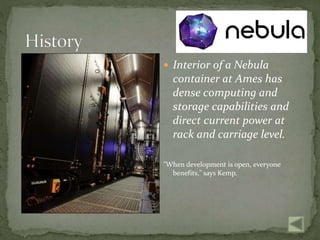
 Interior of a Nebula
container at Ames has
dense computing and
storage capabilities and
direct current power at
rack and carriage level.
"When development is open, everyone
benefits," says Kemp.
 Cloud Computing - Features and BenefitsThe
National Institute of Standards and Technology
(NIST) describes cloud computing as "...a model for
enabling convenient, on-demand network access to a
shared pool of configurable computing resources (e.g.,
networks, servers, storage, applications and services)
that can be rapidly provisioned and released with
minimal management effort or service provider
interaction."
 Scalability
Because computer and storage resources are provided
through an abstracted interface, a cloud computing
architecture allows the supported load on your web
application to scale up dramatically, without the costs
and delays of provisioning new infrastructure, re-
engineering code, etc.
 Cost Savings
Cloud computing systems can easily provide "pay-as-
you-go" storage, processing and bandwidth services
that fit your present needs. This means that you pay
for only what you need, and you share economies of
scale with the other cloud "tenants." Resource usage
can be monitored, controlled and reported providing
transparency for both the provider and consumer of
the services.
 Deployment Speed
The integrated nature of hardware, software and
resource provisioning allows rapid development and
deployment of policy-compliant and secure web
applications. Customers can unilaterally provision
computing capabilities (virtual machine instances,
storage, etc.) as needed automatically, without
requiring human interaction. Also, a consistent set of
frameworks, code repositories and web services means
that your developers can concentrate on turning out
quality applications without "reinventing the wheel"
for low-level infrastructure requirements.
 Resource Elasticity
Computing resources are aggregated to serve multiple
consumers using a multi-tenant model, with different
physical and virtual resources dynamically assigned
and reassigned according to demand. This means that
your web applications are supported by the full
strength of the cloud's resources and will remain
available during demand spikes.
 Integrated Reporting and Policy Compliance
A cloud computing architecture provides a large
organization with a single platform for reporting and
policy compliance purposes. Managers can obtain
detailed reports on resource use for all of their
organizational elements, and can set boundaries
within the cloud service levels to accomplish IT policy
objectives while still delegating the day-to-day control
of content and application development.
 https://www.nasa.gov/offices/ocio/ittalk/06-
2010_cloud_computing.html
 https://www.nasa.gov/open/heo.html
 https://en.wikipedia.org/wiki/Nebula_(computing_pl
atform)

Ict01 g113 cloud-computing_castillo

  • 1.
  • 2.
  • 3.
     Is anopen-source cloud computing platform that was developed to provide alternative to building additional expensive data centers and to provide an easier way for NASA scientist and researchers to share information with external partners and public.  Nebula is an excellent example of how NASA is championing ongoing partnerships with private industry and academia. “When information is shared, everyone benefits.” - NASA Chief Technology Officer for IT Chris C. Kemp
  • 4.
     The AmesInternet Exchange (AIX), which hosts the cloud, was formerly known as "Mae West," as one of the original nodes of the Internet.  Nebula's revolutionary container infrastructure features engineering for maximum flexibility, efficiency and scalability. Supporting NASA's missions, typically in collaboration with universities and other research organizations, Nebula's cloud computing approach to physical infrastructure must be as flexible as the services our partners host.
  • 5.
     Nebula's modularinfrastructure can be modified, upgraded, expanded and even physically relocated as needs evolve. Additionally, each container holds up to 30,000 CPU cores or 30 petabytes (one petabyte equals one million gigabytes), which is 50 percent more energy efficient than commercial clouds.  The Nebula launch was as a pilot project at Ames Research Center. NASA's goal is that Nebula will serve as a Federal testbed for cloud technology. The Office of Management and Budget (OMB) recognizes the value of pilots, and is encouraging Federal Agencies to investigate how to take advantage of cloud computing.
  • 6.
     Nebula isone of the very first government clouds that meets all Federal security requirements, including FISMA. It is one of the few clouds physically located within a Federally-secured perimeter. Nebula will address key IT concerns involving security, portability and interoperability that all government Agencies will face in implementing cloud computing. "When development is open, everyone benefits.” - NASA Chief Technology Officer for IT Chris C. Kemp
  • 7.
     Interior ofa Nebula container at Ames has dense computing and storage capabilities and direct current power at rack and carriage level. "When development is open, everyone benefits," says Kemp.
  • 8.
     Cloud Computing- Features and BenefitsThe National Institute of Standards and Technology (NIST) describes cloud computing as "...a model for enabling convenient, on-demand network access to a shared pool of configurable computing resources (e.g., networks, servers, storage, applications and services) that can be rapidly provisioned and released with minimal management effort or service provider interaction."
  • 9.
     Scalability Because computerand storage resources are provided through an abstracted interface, a cloud computing architecture allows the supported load on your web application to scale up dramatically, without the costs and delays of provisioning new infrastructure, re- engineering code, etc.
  • 10.
     Cost Savings Cloudcomputing systems can easily provide "pay-as- you-go" storage, processing and bandwidth services that fit your present needs. This means that you pay for only what you need, and you share economies of scale with the other cloud "tenants." Resource usage can be monitored, controlled and reported providing transparency for both the provider and consumer of the services.
  • 11.
     Deployment Speed Theintegrated nature of hardware, software and resource provisioning allows rapid development and deployment of policy-compliant and secure web applications. Customers can unilaterally provision computing capabilities (virtual machine instances, storage, etc.) as needed automatically, without requiring human interaction. Also, a consistent set of frameworks, code repositories and web services means that your developers can concentrate on turning out quality applications without "reinventing the wheel" for low-level infrastructure requirements.
  • 12.
     Resource Elasticity Computingresources are aggregated to serve multiple consumers using a multi-tenant model, with different physical and virtual resources dynamically assigned and reassigned according to demand. This means that your web applications are supported by the full strength of the cloud's resources and will remain available during demand spikes.
  • 13.
     Integrated Reportingand Policy Compliance A cloud computing architecture provides a large organization with a single platform for reporting and policy compliance purposes. Managers can obtain detailed reports on resource use for all of their organizational elements, and can set boundaries within the cloud service levels to accomplish IT policy objectives while still delegating the day-to-day control of content and application development.
  • 14.