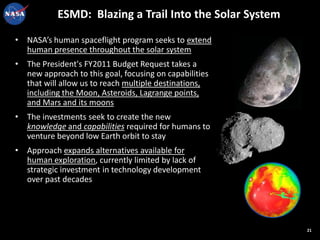
Investments in the Future: NASA’s Technology ProgramsRobert D. BraunNASA Chief TechnologistMarch 11, 20101
OutlineNASA Innovation and Technology InitiativeNASA Office of the Chief TechnologistSpace Technology ProgramTechnology Integration2
Augustine Committee InputIn 2009, the Augustine Committee strongly endorsed increased investment in innovative technologies and approaches to achieving broadly defined NASA and national goalsThis technology and innovation investment was included in all new Program Options suggested by the Augustine Committee  The Committee strongly believes it is time for NASA to reassume its crucial role of developing new technologies for space. Today, the alternatives available for exploration systems are severely limited because of the lack of a strategic investment in technology development in past decades. NASA now has an opportunity to develop a technology roadmap that is aligned with an exploration mission that will last for decades. If appropriately funded, a technology development program would re-engage the minds at American universities, in industry and within NASA. The investments should be designed to increase the capabilities and reduce the costs of future exploration. This will benefit human and robotic exploration, the commercial space community, and other U.S. government users.3http://www.nasa.gov/pdf/396093main_HSF_Cmte_FinalReport.pdf*Underline highlight added.
Recent NRC Recommendations (1 of 2)In 2009, the NRC report “America’s Future in Space” specifically speaks to this issue in one of its six key recommendations: 4. Advanced space technology. NASA should revitalize its advanced technology development program by establishing a DARPA-like organization within NASA as a priority mission area to support preeminent civil, national security (if dual-use), and commercial space programs. The resulting program should:a. Be organizationally independent of major development programs;b. Serve all civil space customers, including the commercial sector;c. Conduct an extensive assessment of the current state and potential of civil space technology; andd. Conduct cutting-edge fundamental research in support of the nation’s space technology base.4http://www.nap.edu/catalog.php?record_id=12701*Underline highlight added.
Recent NRC Recommendations (2 of 2)In 2009, the Congressionally mandated NRC report “Fostering Visions for the Future:  A Review of the NASA Institute for Advanced Concepts” also speaks to this issue: Key Recommendations:NASA should reestablish a NIAC-like entity (“NIAC2”)…to seek out visionary, far-reaching, advanced concepts with the potential of significant benefit to accomplishing NASA’s charter and to begin the process of maturing these advanced concepts for infusion into NASA’s missions
NIAC2 should report to the Office of the Administrator, be outside mission directorates, and be chartered to address NASA-wide mission and technology needs. To increase NIAC2’s relevance, NASA mission directorates should contribute thematic areas for consideration.  The committee also recommends that a NIAC2 organization should be funded and administered separately from NASA development programs, mission directorates, and institutional constraints.
Future NIAC2 proposal opportunities be open to principal investigators or teams both internal and external to NASA*Underline highlight added. http://www.nap.edu/catalog.php?record_id=127025
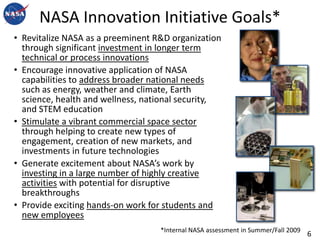
NASA Innovation Initiative Goals*Revitalize NASA as a preeminent R&D organization through significant investment in longer term technical or process innovations
Encourage innovative application of NASA capabilities to address broader national needs such as energy, weather and climate, Earth science, health and wellness, national security, and STEM education
Stimulate a vibrant commercial space sector through helping to create new types of engagement, creation of new markets, and investments in future technologies
Generate excitement about NASA’s work by investing in a large number of highly creative activities with potential for disruptive breakthroughs
Provide exciting hands-on work for students and new employees*Internal NASA assessment in Summer/Fall 20096
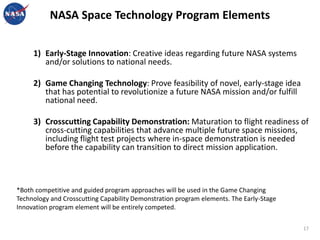
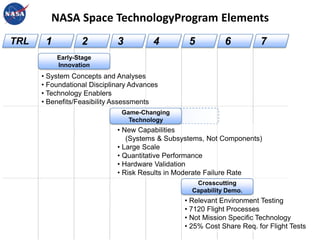
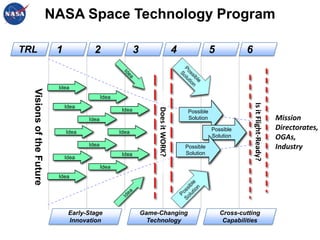
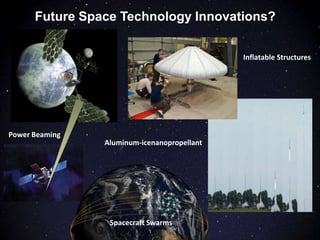
Why Invest in Technology & Innovation?Many positive outcomes are likely from a long-term NASA advanced concepts & broad technology development program with mission-focused, crosscutting, game-changing and early-stage innovation components.A more vital and productive aeronautics and space future than our country has today A means to focus NASA intellectual capital on significant national needsA spark to a technology-based economyAn international symbol of our country’s scientific and technological leadershipA motivation for many of the country’s best young minds to pursue educational programs and careers in engineering and scienceWhile these efforts are high risk and not all will succeed, when taken in total, the benefits will be significant for NASA and the Nation. Individual project failure must be acceptable for innovation to flourishWe must develop a program that extracts knowledge even in cases of failureConsider the following examples:Mars PathfinderOrion Thermal Protection System DevelopmentHuman Mars explorationBloom Energy7
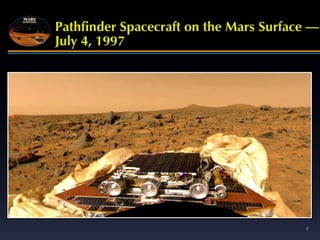
8
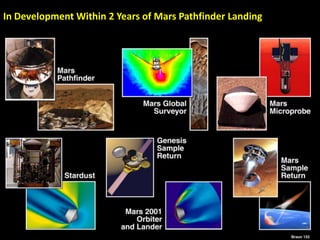
Planetary Exploration Flight ProjectsIn Development Within 2 Years of Mars Pathfinder Landing9
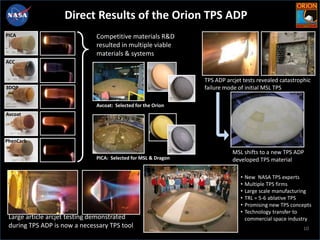
Direct Results of the Orion TPS ADPPICACompetitive materials R&D resulted in multiple viable materials & systems  ACCTPS ADP arcjet tests revealed catastrophic failure mode of initial MSL TPS  3DQPAvcoat:  Selected for the OrionAvcoatPhenCarbMSL shifts to a new TPS ADP developed TPS material PICA:  Selected for MSL & DragonNew  NASA TPS experts
Multiple TPS firms
Large scale manufacturing
TRL = 5-6 ablative TPS
Promising new TPS concepts
Technology transfer to commercial space industryLarge article arcjet testing demonstrated during TPS ADP is now a necessary TPS tool10
The Value of Technology InvestmentsMars Mission ExampleNotes:Approximate results only.
Further assessments required.
Results are cumulative and thus dependent on combinations/sequences of technologies applied
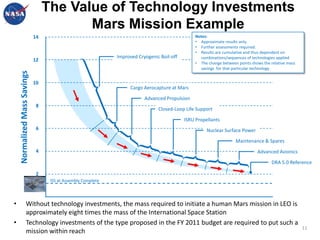
The change between points shows the relative mass savings  for that particular technology14Improved Cryogenic Boil-off12Cargo Aerocapture at Mars10Advanced PropulsionClosed-Loop Life Support8ISRU PropellantsNormalized Mass SavingsNuclear Surface Power6Maintenance & SparesAdvanced AvionicsDRA 5.0 Reference4ISS at Assembly Complete2Without technology investments, the mass required to initiate a human Mars mission in LEO is approximately eight times the mass of the International Space StationTechnology investments of the type proposed in the FY 2011 budget are required to put such a mission within reach11
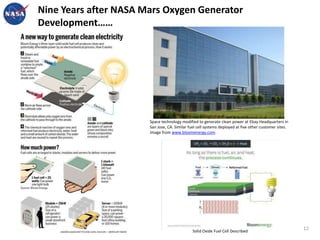
Nine Years after NASA Mars Oxygen Generator Development……12Space technology modified to generate clean power at Ebay Headquarters in San Jose, CA. Similar fuel cell systems deployed at five other customer sites. Image from www.bloomenergy.com.Solid Oxide Fuel Cell Described

Investments in the Future: NASA's Technology Programs

  • 1.
    Investments in theFuture: NASA’s Technology ProgramsRobert D. BraunNASA Chief TechnologistMarch 11, 20101
  • 2.
    OutlineNASA Innovation andTechnology InitiativeNASA Office of the Chief TechnologistSpace Technology ProgramTechnology Integration2
  • 3.
    Augustine Committee InputIn2009, the Augustine Committee strongly endorsed increased investment in innovative technologies and approaches to achieving broadly defined NASA and national goalsThis technology and innovation investment was included in all new Program Options suggested by the Augustine Committee The Committee strongly believes it is time for NASA to reassume its crucial role of developing new technologies for space. Today, the alternatives available for exploration systems are severely limited because of the lack of a strategic investment in technology development in past decades. NASA now has an opportunity to develop a technology roadmap that is aligned with an exploration mission that will last for decades. If appropriately funded, a technology development program would re-engage the minds at American universities, in industry and within NASA. The investments should be designed to increase the capabilities and reduce the costs of future exploration. This will benefit human and robotic exploration, the commercial space community, and other U.S. government users.3http://www.nasa.gov/pdf/396093main_HSF_Cmte_FinalReport.pdf*Underline highlight added.
  • 4.
    Recent NRC Recommendations(1 of 2)In 2009, the NRC report “America’s Future in Space” specifically speaks to this issue in one of its six key recommendations: 4. Advanced space technology. NASA should revitalize its advanced technology development program by establishing a DARPA-like organization within NASA as a priority mission area to support preeminent civil, national security (if dual-use), and commercial space programs. The resulting program should:a. Be organizationally independent of major development programs;b. Serve all civil space customers, including the commercial sector;c. Conduct an extensive assessment of the current state and potential of civil space technology; andd. Conduct cutting-edge fundamental research in support of the nation’s space technology base.4http://www.nap.edu/catalog.php?record_id=12701*Underline highlight added.
  • 5.
    Recent NRC Recommendations(2 of 2)In 2009, the Congressionally mandated NRC report “Fostering Visions for the Future: A Review of the NASA Institute for Advanced Concepts” also speaks to this issue: Key Recommendations:NASA should reestablish a NIAC-like entity (“NIAC2”)…to seek out visionary, far-reaching, advanced concepts with the potential of significant benefit to accomplishing NASA’s charter and to begin the process of maturing these advanced concepts for infusion into NASA’s missions
  • 6.
    NIAC2 should reportto the Office of the Administrator, be outside mission directorates, and be chartered to address NASA-wide mission and technology needs. To increase NIAC2’s relevance, NASA mission directorates should contribute thematic areas for consideration. The committee also recommends that a NIAC2 organization should be funded and administered separately from NASA development programs, mission directorates, and institutional constraints.
  • 7.
    Future NIAC2 proposalopportunities be open to principal investigators or teams both internal and external to NASA*Underline highlight added. http://www.nap.edu/catalog.php?record_id=127025
  • 8.
    NASA Innovation InitiativeGoals*Revitalize NASA as a preeminent R&D organization through significant investment in longer term technical or process innovations
  • 9.
    Encourage innovative applicationof NASA capabilities to address broader national needs such as energy, weather and climate, Earth science, health and wellness, national security, and STEM education
  • 10.
    Stimulate a vibrantcommercial space sector through helping to create new types of engagement, creation of new markets, and investments in future technologies
  • 11.
    Generate excitement aboutNASA’s work by investing in a large number of highly creative activities with potential for disruptive breakthroughs
  • 12.
    Provide exciting hands-onwork for students and new employees*Internal NASA assessment in Summer/Fall 20096
  • 13.
    Why Invest inTechnology & Innovation?Many positive outcomes are likely from a long-term NASA advanced concepts & broad technology development program with mission-focused, crosscutting, game-changing and early-stage innovation components.A more vital and productive aeronautics and space future than our country has today A means to focus NASA intellectual capital on significant national needsA spark to a technology-based economyAn international symbol of our country’s scientific and technological leadershipA motivation for many of the country’s best young minds to pursue educational programs and careers in engineering and scienceWhile these efforts are high risk and not all will succeed, when taken in total, the benefits will be significant for NASA and the Nation. Individual project failure must be acceptable for innovation to flourishWe must develop a program that extracts knowledge even in cases of failureConsider the following examples:Mars PathfinderOrion Thermal Protection System DevelopmentHuman Mars explorationBloom Energy7
  • 14.
  • 15.
    Planetary Exploration FlightProjectsIn Development Within 2 Years of Mars Pathfinder Landing9
  • 16.
    Direct Results ofthe Orion TPS ADPPICACompetitive materials R&D resulted in multiple viable materials & systems ACCTPS ADP arcjet tests revealed catastrophic failure mode of initial MSL TPS 3DQPAvcoat: Selected for the OrionAvcoatPhenCarbMSL shifts to a new TPS ADP developed TPS material PICA: Selected for MSL & DragonNew NASA TPS experts
  • 17.
  • 18.
  • 19.
    TRL = 5-6ablative TPS
  • 20.
  • 21.
    Technology transfer tocommercial space industryLarge article arcjet testing demonstrated during TPS ADP is now a necessary TPS tool10
  • 22.
    The Value ofTechnology InvestmentsMars Mission ExampleNotes:Approximate results only.
  • 23.
  • 24.
    Results are cumulativeand thus dependent on combinations/sequences of technologies applied
  • 25.
    The change betweenpoints shows the relative mass savings for that particular technology14Improved Cryogenic Boil-off12Cargo Aerocapture at Mars10Advanced PropulsionClosed-Loop Life Support8ISRU PropellantsNormalized Mass SavingsNuclear Surface Power6Maintenance & SparesAdvanced AvionicsDRA 5.0 Reference4ISS at Assembly Complete2Without technology investments, the mass required to initiate a human Mars mission in LEO is approximately eight times the mass of the International Space StationTechnology investments of the type proposed in the FY 2011 budget are required to put such a mission within reach11
  • 26.
    Nine Years afterNASA Mars Oxygen Generator Development……12Space technology modified to generate clean power at Ebay Headquarters in San Jose, CA. Similar fuel cell systems deployed at five other customer sites. Image from www.bloomenergy.com.Solid Oxide Fuel Cell Described