Skin Complications
in
Scleroderma
Emily L Keimig, MS, MD
Clinical Instructor
Department of Dermatology
Objectives

• To address the various cutaneous complications of
scleroderma
• Discuss treatment options for these various
complications
• Discuss gentle skin care
Raynaud’s Phenomenon

• First described in 1862 as Raynaud’s Disease
• 40 years later, proposed that ‘phenomenon’ was
more appropriate
– Multiple causes of vasospasm

• Today classified as primary or secondary Raynaud’s
phenomenon
– Primary
– Secondary
Bakst R et al. Raynaud's phenomenon: pathogenesis and management. J Am Acad
Dermatol 2008;59:633-53
Primary Raynaud’s Phenomenon

• Younger age of onset
• Normal nail fold capillaries
– cuticles

• Negative or low titers of auto-antibodies
• All fingers symmetrically affected
• Minimal pain

Bakst R et al. Raynaud's phenomenon: pathogenesis and management. J Am Acad
Dermatol 2008;59:633-53
Secondary Raynaud’s Phenomenon

•
•
•
•
•
•
•

Associated with autoimmune disease
Onset >30 years of age
Frequently attacks are painful
Asymmetric finger involvement
Nail fold capillary abnormalities
Pits and ulcers on the finger tips
Elevated auto-antibodies
N Engl J Med 360;19

Bakst R et al. Raynaud's phenomenon: pathogenesis and management. J Am Acad
Dermatol 2008;59:633-53
Digital Pits

Bolognia J et al. Dermatology, 3rd Edition
Nail fold Capillary Changes
Cause

• Reversible vasospasm
– Vessels have altered responsiveness to vasoconstrictive
and vasodilatory stimuli
– Abnormal release of vasoconstricting and vasodilating
molecules
– Overactive sympathetic nerve receptors

• Arterial damage
– Thickening of the walls of the arteries
– Obstruction or blockage of the blood vessel
Raynaud’s Phenomenon

• Episodic attacks
– Hands, feet, nose, ears
– Minutes to hours

• Cold exposure
• Emotional stimuli
• Tri-color change
– White/Pale
– Blue
– Red

• Numbness
• Re-warming
– Can be painful
Lifestyle Modifications

• Minimize cold exposure
– 65F

• Limit time outdoors
– Insulated mittens
– Hand/foot warmers

• Dress warmly
– Loose-fitting
– Layered clothing

• Thermostat
– Few degrees higher
Lifestyle Modifications

• Keep whole body warm
– NOT just hands and feet

• Keep gloves everywhere
– Kitchen
– Car
– Work

• Extra layers of clothing
– Air conditioning can trigger

• Space heater
• Car warmed up
Lifestyle Modifications

• Smoking
– Stop
– Avoidance of secondhand

• Stress modification
– Social support
– Relaxation techniques
Other Things to Avoid

• Cold preparations
– Containing sympathomimetics
– Ephedrine

•
•
•
•

Caffeinated beverages
Ergots (migraine medications)
Smoking
Epinephrine
Treatment

• Re-warming
– Warm environment
– Local heat
• Warm water
• Warm hair dryer

• Medical intervention
– Medical
– Surgical
Medical Treatment

• Topical therapy
– Nitroglycerin paste

•
•
•
•
•

Calcium channel blockers
Sildenafil
Losartan
Botox injection
Peripheral digital sympathectomy
Ischemic Ulcerations

• Severe Raynaud’s Phenomenon
• Common complication
• Nail fold changes a risk factor
– Dilatation and dropout

• Due to decreased blood flow
– Leads to decreased oxygenation of skin

Alivernini S et al. Skin ulcers in systemic sclerosis: determinants of presence and
predictive factors of healing. J Amer Acad Dermatol. 2009;60:426-35
Prevention

• Avoidance of trauma
• Properly fitting shoes
– ½ inch between front of
shoe and toes
– All toes should be
extended
– Good heel support

• Avoid medications that
cause vasoconstriction
Treatment

• Therapies aimed at improving
blood flow and controlling
infection
• Wound care
– Hydrocolloid dressings
• Topical nitroglycerin
• Calcium channel blocker
• IV therapies
– Prostanoids
• Bosentan
• Peripheral digital sympathectomy
Alivernini S et al. Skin ulcers in systemic sclerosis: determinants of presence and predictive factors of healing. J Amer Acad Dermatol.
2009;60:426-35
Bakst R et al. Raynaud's phenomenon: pathogenesis and management. J Am Acad Dermatol 2008;59:633-53
Calcinosis Cutis

•
•
•
•

Deposits of calcium within the skin
Result of local tissue damage or abnormalities
Occurs in various conditions
25-40% of patients with limited cutaneous systemic
sclerosis
• Local irritation, inflammation, ulceration
• Fingers, forearms, elbows
Reiter N et al. Calcinosis cutis part I: diagnostic pathway. J Amer Acad Dermatol.
2011;65-1-12.
Calcinosis Cutis

Bolognia et al. Dermatology. 3rd edition
Treatment Calcinosis Cutis

• Warfarin
• Bisphosphonates
• Antibiotics
– Minocycline
– Decreased inflammation
• Diltiazem
• IVIg
– Decreased inflammation and symptoms
• Surgical Excision
• CO2 laser destruction
Reiter N et al. Calcinosis cutis, part II: treatment options. J Amer Acad Dermatol. 2010;65:15-22
Telangiectasia

• Widened blood vessels
• Hands and face
– But can be anywhere

• Laser treatments
– Target the vessels
– Tend to come back

• Make up to cover
– Dermablend

Bolognia et al. Dermatology. 3rd edition
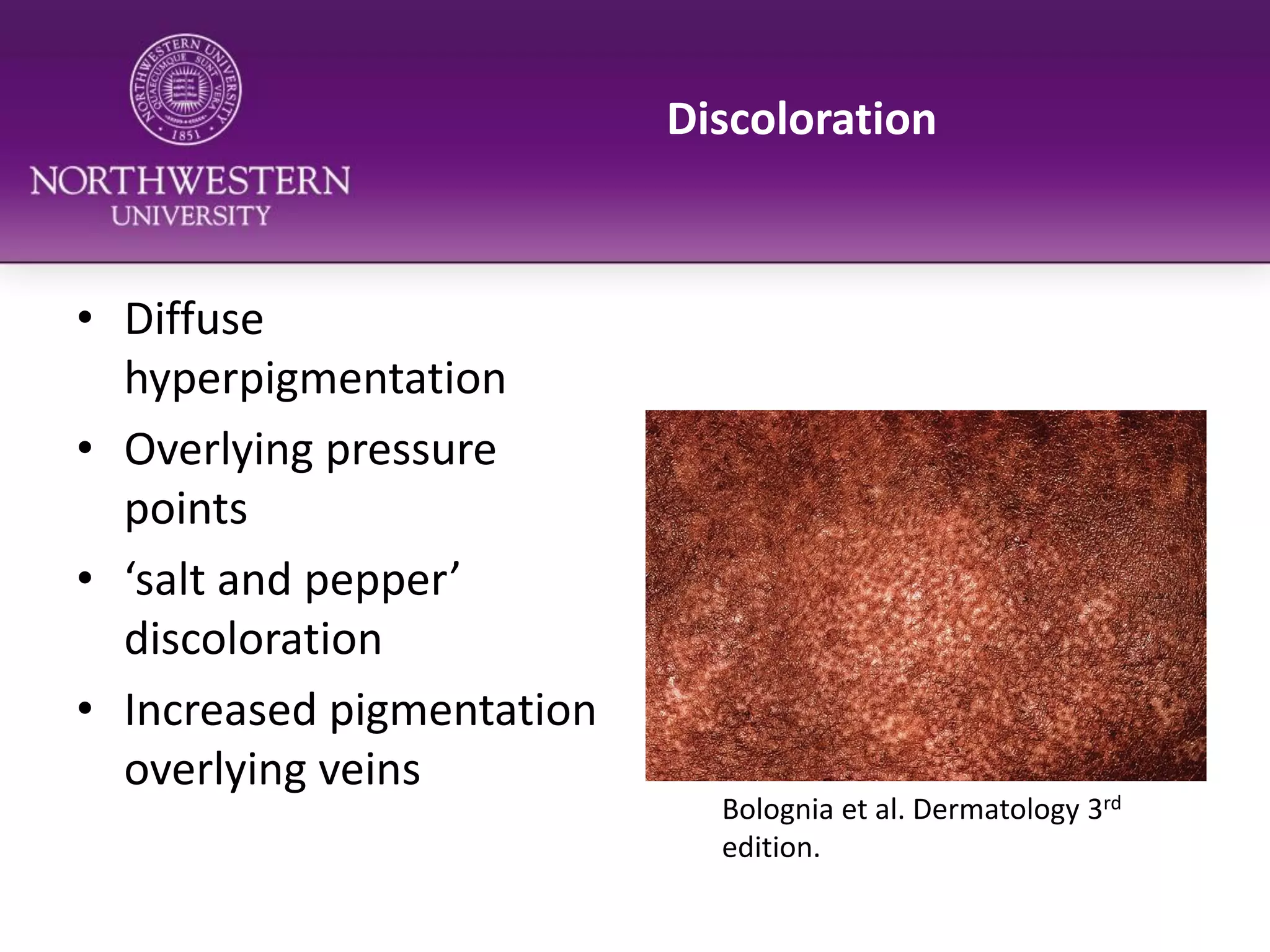
Discoloration

• Diffuse
hyperpigmentation
• Overlying pressure
points
• ‘salt and pepper’
discoloration
• Increased pigmentation
overlying veins

Bolognia et al. Dermatology 3rd
edition.
Mobility

• Physical therapy
• Yoga
• Maintaining physical
activity
– Low impact exercise
– Stretch
Dry Skin

•
•
•
•

Very common
Decreased sweat glands
Decreased oil glands
Itching
Itching = Pruritus

• Almost half of all patients
• Significant impact on quality of life
–
–
–
–
–
–

Affects ability to fall and stay asleep
Affects ability to concentrate
Can lead to anxiety and depression
Affects daily activities
Affects personal relationships
Impacts social functions

Ghassan EB et al. Association of Pruritus with Quality of Life and Disability in Systemic
Sclerosis. Arthritis Care & Research. 2010; 62: 1489-95
Itching

• Can result from dry skin
and irritation
• Emollients
– After bathing
– Locks in moisture

• Gentle skin care
• Medical treatment
– Anti-histamines
– Light treatments
– Prescription therapy
Gentle Skin Care

• Bathe at MOST once daily
– Every other day is fine

• Short showers or baths
– 5-10 minutes

• Lukewarm showers
• Do not scrub vigorously
– No brushes, loofahs, sponges
– Gently lather the soap

• Pat the skin dry
Gentle Skin Care

•
•
•
•

Avoid rubbing alcohol
Avoid perfumes
Rub don’t scratch
Soothing baths
– Oatmeal baths
– No bubble baths

• Cooling agents
– Sarna (camphor)
– Menthol
Moisturizers

• Oil based
– Petrolatum

• Water in oil products
– Heavier creams as opposed to lotions

• Products containing lipids found in the stratum
corneum
– Lipids, ceramides, fatty acids

• Avoidance of fragrances, dyes, perfumes
• Apply to entire body within 2-3 minutes of bathing
References

• Bakst R et al. Raynaud's phenomenon: pathogenesis and management. J
Am Acad Dermatol 2008;59:633-53
• Gabrielli A et al. Scleroderma. N Engl J Med. 2009;360:1989-2003.
• Ghassan EB et al. Association of Pruritus with Quality of Life and Disability
in Systemic Sclerosis. Arthritis Care & Research. 2010; 62: 1489-95
• Alivernini S et al. Skin ulcers in systemic sclerosis: determinants of
presence and predictive factors of healing. J Amer Acad Dermatol.
2009;60:426-35
• Reiter N et al. Calcinosis cutis part I: diagnostic pathway. J Amer Acad
Dermatol. 2011;65-1-12.
• Reiter N et al. Calcinosis cutis, part II: treatment options. J Amer Acad
Dermatol. 2010;65:15-22

Skin Complications in Scleroderma

  • 1.
    Skin Complications in Scleroderma Emily LKeimig, MS, MD Clinical Instructor Department of Dermatology
  • 2.
    Objectives • To addressthe various cutaneous complications of scleroderma • Discuss treatment options for these various complications • Discuss gentle skin care
  • 3.
    Raynaud’s Phenomenon • Firstdescribed in 1862 as Raynaud’s Disease • 40 years later, proposed that ‘phenomenon’ was more appropriate – Multiple causes of vasospasm • Today classified as primary or secondary Raynaud’s phenomenon – Primary – Secondary Bakst R et al. Raynaud's phenomenon: pathogenesis and management. J Am Acad Dermatol 2008;59:633-53
  • 4.
    Primary Raynaud’s Phenomenon •Younger age of onset • Normal nail fold capillaries – cuticles • Negative or low titers of auto-antibodies • All fingers symmetrically affected • Minimal pain Bakst R et al. Raynaud's phenomenon: pathogenesis and management. J Am Acad Dermatol 2008;59:633-53
  • 5.
    Secondary Raynaud’s Phenomenon • • • • • • • Associatedwith autoimmune disease Onset >30 years of age Frequently attacks are painful Asymmetric finger involvement Nail fold capillary abnormalities Pits and ulcers on the finger tips Elevated auto-antibodies N Engl J Med 360;19 Bakst R et al. Raynaud's phenomenon: pathogenesis and management. J Am Acad Dermatol 2008;59:633-53
  • 6.
    Digital Pits Bolognia Jet al. Dermatology, 3rd Edition
  • 7.
  • 8.
    Cause • Reversible vasospasm –Vessels have altered responsiveness to vasoconstrictive and vasodilatory stimuli – Abnormal release of vasoconstricting and vasodilating molecules – Overactive sympathetic nerve receptors • Arterial damage – Thickening of the walls of the arteries – Obstruction or blockage of the blood vessel
  • 9.
    Raynaud’s Phenomenon • Episodicattacks – Hands, feet, nose, ears – Minutes to hours • Cold exposure • Emotional stimuli • Tri-color change – White/Pale – Blue – Red • Numbness • Re-warming – Can be painful
  • 10.
    Lifestyle Modifications • Minimizecold exposure – 65F • Limit time outdoors – Insulated mittens – Hand/foot warmers • Dress warmly – Loose-fitting – Layered clothing • Thermostat – Few degrees higher
  • 11.
    Lifestyle Modifications • Keepwhole body warm – NOT just hands and feet • Keep gloves everywhere – Kitchen – Car – Work • Extra layers of clothing – Air conditioning can trigger • Space heater • Car warmed up
  • 12.
    Lifestyle Modifications • Smoking –Stop – Avoidance of secondhand • Stress modification – Social support – Relaxation techniques
  • 13.
    Other Things toAvoid • Cold preparations – Containing sympathomimetics – Ephedrine • • • • Caffeinated beverages Ergots (migraine medications) Smoking Epinephrine
  • 14.
    Treatment • Re-warming – Warmenvironment – Local heat • Warm water • Warm hair dryer • Medical intervention – Medical – Surgical
  • 15.
    Medical Treatment • Topicaltherapy – Nitroglycerin paste • • • • • Calcium channel blockers Sildenafil Losartan Botox injection Peripheral digital sympathectomy
  • 16.
    Ischemic Ulcerations • SevereRaynaud’s Phenomenon • Common complication • Nail fold changes a risk factor – Dilatation and dropout • Due to decreased blood flow – Leads to decreased oxygenation of skin Alivernini S et al. Skin ulcers in systemic sclerosis: determinants of presence and predictive factors of healing. J Amer Acad Dermatol. 2009;60:426-35
  • 17.
    Prevention • Avoidance oftrauma • Properly fitting shoes – ½ inch between front of shoe and toes – All toes should be extended – Good heel support • Avoid medications that cause vasoconstriction
  • 18.
    Treatment • Therapies aimedat improving blood flow and controlling infection • Wound care – Hydrocolloid dressings • Topical nitroglycerin • Calcium channel blocker • IV therapies – Prostanoids • Bosentan • Peripheral digital sympathectomy Alivernini S et al. Skin ulcers in systemic sclerosis: determinants of presence and predictive factors of healing. J Amer Acad Dermatol. 2009;60:426-35 Bakst R et al. Raynaud's phenomenon: pathogenesis and management. J Am Acad Dermatol 2008;59:633-53
  • 19.
    Calcinosis Cutis • • • • Deposits ofcalcium within the skin Result of local tissue damage or abnormalities Occurs in various conditions 25-40% of patients with limited cutaneous systemic sclerosis • Local irritation, inflammation, ulceration • Fingers, forearms, elbows Reiter N et al. Calcinosis cutis part I: diagnostic pathway. J Amer Acad Dermatol. 2011;65-1-12.
  • 20.
    Calcinosis Cutis Bolognia etal. Dermatology. 3rd edition
  • 21.
    Treatment Calcinosis Cutis •Warfarin • Bisphosphonates • Antibiotics – Minocycline – Decreased inflammation • Diltiazem • IVIg – Decreased inflammation and symptoms • Surgical Excision • CO2 laser destruction Reiter N et al. Calcinosis cutis, part II: treatment options. J Amer Acad Dermatol. 2010;65:15-22
  • 22.
    Telangiectasia • Widened bloodvessels • Hands and face – But can be anywhere • Laser treatments – Target the vessels – Tend to come back • Make up to cover – Dermablend Bolognia et al. Dermatology. 3rd edition
  • 23.
    Discoloration • Diffuse hyperpigmentation • Overlyingpressure points • ‘salt and pepper’ discoloration • Increased pigmentation overlying veins Bolognia et al. Dermatology 3rd edition.
  • 24.
    Mobility • Physical therapy •Yoga • Maintaining physical activity – Low impact exercise – Stretch
  • 25.
    Dry Skin • • • • Very common Decreasedsweat glands Decreased oil glands Itching
  • 26.
    Itching = Pruritus •Almost half of all patients • Significant impact on quality of life – – – – – – Affects ability to fall and stay asleep Affects ability to concentrate Can lead to anxiety and depression Affects daily activities Affects personal relationships Impacts social functions Ghassan EB et al. Association of Pruritus with Quality of Life and Disability in Systemic Sclerosis. Arthritis Care & Research. 2010; 62: 1489-95
  • 27.
    Itching • Can resultfrom dry skin and irritation • Emollients – After bathing – Locks in moisture • Gentle skin care • Medical treatment – Anti-histamines – Light treatments – Prescription therapy
  • 28.
    Gentle Skin Care •Bathe at MOST once daily – Every other day is fine • Short showers or baths – 5-10 minutes • Lukewarm showers • Do not scrub vigorously – No brushes, loofahs, sponges – Gently lather the soap • Pat the skin dry
  • 29.
    Gentle Skin Care • • • • Avoidrubbing alcohol Avoid perfumes Rub don’t scratch Soothing baths – Oatmeal baths – No bubble baths • Cooling agents – Sarna (camphor) – Menthol
  • 30.
    Moisturizers • Oil based –Petrolatum • Water in oil products – Heavier creams as opposed to lotions • Products containing lipids found in the stratum corneum – Lipids, ceramides, fatty acids • Avoidance of fragrances, dyes, perfumes • Apply to entire body within 2-3 minutes of bathing
  • 31.
    References • Bakst Ret al. Raynaud's phenomenon: pathogenesis and management. J Am Acad Dermatol 2008;59:633-53 • Gabrielli A et al. Scleroderma. N Engl J Med. 2009;360:1989-2003. • Ghassan EB et al. Association of Pruritus with Quality of Life and Disability in Systemic Sclerosis. Arthritis Care & Research. 2010; 62: 1489-95 • Alivernini S et al. Skin ulcers in systemic sclerosis: determinants of presence and predictive factors of healing. J Amer Acad Dermatol. 2009;60:426-35 • Reiter N et al. Calcinosis cutis part I: diagnostic pathway. J Amer Acad Dermatol. 2011;65-1-12. • Reiter N et al. Calcinosis cutis, part II: treatment options. J Amer Acad Dermatol. 2010;65:15-22