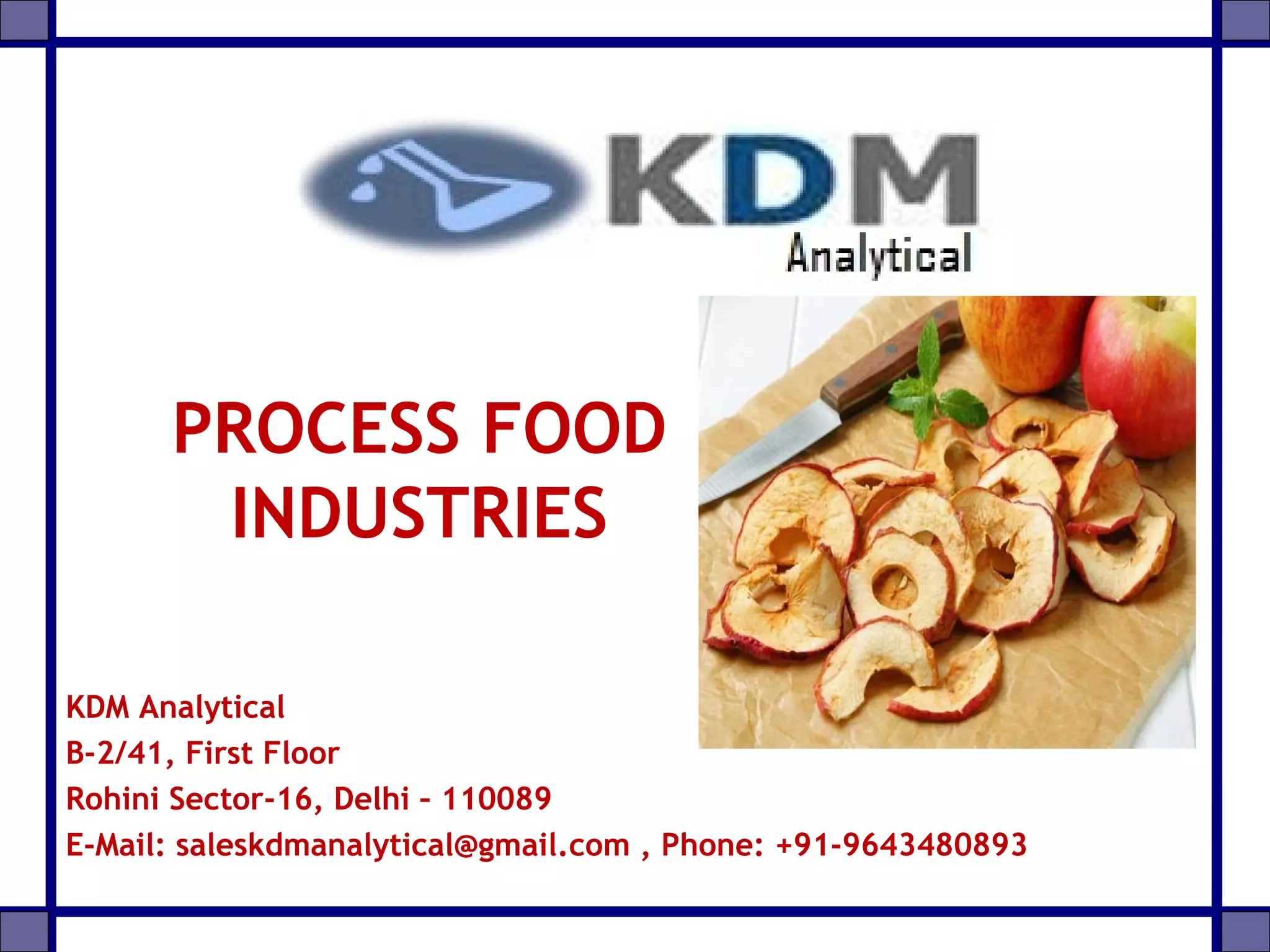
PROCESS FOOD
INDUSTRIES
KDM Analytical
B-2/41, First Floor
Rohini Sector-16, Delhi – 110089
E-Mail: saleskdmanalytical@gmail.com , Phone: +91-9643480893
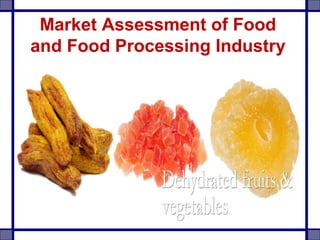
Market Assessment of Food
and Food Processing Industry
in India
 Processed Food Industry in India
 Processed Food Distribution Formats in India
 Processed Food Industry Overview
 Competition Analysis
 Developments in Processed Food Industry
 Regulatory and Custom Duties Analysis
 Food Processing Machinery
 Industry Overview
 Major Target Industries for Machinery Manufacturers
 Customer Concentration
 Cold Storage Overview
 Packaging Machinery Overview
 Conclusion and Recommendation
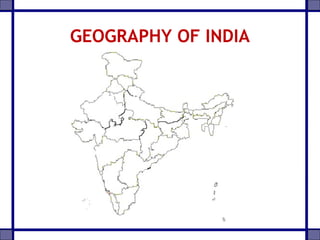
GEOGRAPHY OF INDIA
WHY PROCESS FOODS?
1. EXTEND SHELF LIFE
2. MAINTAIN SENSORY PROPERTIES
3. MAINTAIN OR IMPROVE NUTRITIVE
PROPERTIES
4. ENSURE SAFETY
5. MAKE MORE CONVENIENT
6. ECONOMIC VALUE
BUSINESS MODEL
• Organic Food / Wellness : Foods which are not
processed using industrial solvents or synthetic
additives.
• Ready To Cook / Ready to Eat : Commercially
prepared ingredients / food to optimise ease of
consumption.
• Cold Pressed Juices / Salads : Refers to juices that
use a hydraulic press to extract juices from fruits
and vegetables.
• Functional Drinks : Sports drinks, energy drinks,
probiotic, alkaline water.
COMPANIES OVERVIEW
• Organic India, Just Organik, Nimble
Organics.
• MTR, Mc Cain, Knorr, Sumeru.
• Raw Juices, Just Pressed, Juice Up,
Salad days.
• Gatorade, Body Fuelz, Unived, Red
Bull, Yakult.
SERVICES
• Discovery Services : Helps find nearby
restaurants and food points based on
selected criteria.
• Delivery Services : Helps in delivery of food
from nearby restaurants and food
cooperatives.
• E-Commerce Services : Helps purchase food
products online.
• Boxed Meal Services: Subscription or random
selection based home – cooked food delivery
services
COMPANIES OVERVIEW
• Zomato
• Swiggy, Foodpanda, Faasos, Burrp
• Bigbasket
• Greenchef, Homechef, MC’s
Lunchbox
COMPANIES OVERVIEW
• Cremica: Manufacturer of snacks.
• Bikaji Foods Int. Ltd: Manufacturer and wholesale
snacks.
• VKL Seasonings: Seasonings.
• Hari on Biofoods Pvt. Ltd: Vacuum dried fruits and
vegetables.
• K2B: Vacuum Dried and Freeze Dried Food Products
• Mitthi Foods: Freeze Dried Food Products.
• Bush Foods: Rice Processing.
Food Processing Policy 2015-2020
o Power Subsidy:
• Power subsidy is provided to eligible units on power
tariff paid by the unit on actual units consumed for a
period of 5 years from the date of commercial
production.
• 25% of the cost payable to State Power Distribution
Company for drawl of power line to the premises of
the unit including the cost of transformer is subsidized
to Micro and Small industrial units
o *Capital Investment Subsidy: Capital Investment
Subsidy of 30% on the investment in plant and
machinery and the limit for automatic approval of
subsidy at this rate is INR 1.5 Cr. Per unit.
o *Interest Subsidy:
o Working capital - Interest subsidy is made
available at 3% on working capital loan under
NEIIPP, 2007
o Capex: Interest subsidy is provided to Micro
industrial units @ 30% of the amount of interest
paid on term loan to Bank/Financial Institutions for
a period of 5 years from the date of commercial
production subject to a ceiling of Rs. 1.00 lakhs
per unit/year
o NABAR Scheme: Loans to entities in Mega Food
Park to be available at 9.5% -10% p.a.
o Transport Subsidy: 90% of the
transportation cost of raw materials and
finished goods to and from the location of the
unit and the designated rail head (for
movement of goods within NER, the subsidy
is 50%) – for a period of 5 years from
commercial production
o License Fee Subsidy: The fees payable for
obtaining BIS/ISO/FPO/AGMARK and fees
payable for getting the technical know-how
from recognized research laboratory /
institutions like CFTRI, CIPET etc. by eligible
units is subsidized to the extent of 50%
Food HabitsFood Habits
 India is a culturally rich & diverse nation having varied lifestyles,
religions, art, culture, attire & food.
 Weather & topography vary widely with region:
 North: Closest to the Himalayan range, hilly regions with extreme
weather conditions; high fertility area with high wheat production
 West: Arid areas of Rajasthan and Gujarat – which are dry and hot
through most of the year. In some coastal areas of Maharashtra, fish is
the staple diet
 South: Temperate climatic condition all through the year; high rice
production & consumption area
 East: Hilly regions with varying weather conditions; East is the poorest
regions of the country
 Indians take food very passionately
 Mealtimes are considered as occasions and time for
families to get together and spend quality time.
 Fresh cooking is essential in most Indian homes,
with limited preference for stocked food
 Most meals comprise of several dishes ranging from
staples like rice and breads, to meat or vegetables,
rounded off with a dessert
Regional Food Habits – NorthRegional Food Habits – North
 North Region – Madhya Pradesh, Uttar Pradesh, Haryana, Punjab,
Himachal Pradesh, and Jammu and Kashmir
 Wheat-breads are the staple diet which accompany all meals
 Largely meat-based diet characterized by tandoori-style cooking
methods
 Fair amount of cooking is done using deep frying in oil
 High consumption of milk and milk-based products
 High consumption of fresh fruits such as apples, cherries, plums
and strawberries which are unique to this region due to its cooler
climate.
 Increasing number of households are shifting toward replacing
traditionally made food items such as curd and cottage cheese with
packaged items (packaged curd or cottage cheese)
Regional Food Habits – SouthRegional Food Habits – South
 Southern India – Andhra Pradesh, Karnataka, Goa, Tamil Nadu, and Kerala
 Primarily vegetarian population barring coastal areas where fish is a
staple diet
 Rice is abundant & appears in almost every dish during a meal & are eaten
in multiple forms
 Tamarind and coconut form the base for most preparations, with most
curries based in coconut gravy
 Hot spicy foods are cooked, with chettinad cuisine being one of the most
fiery
 Food is often eaten on banana leaves
 Major shift is seen in people moving towards ready-to-use packaged food
items for idlis and dosas, rather than going through the relatively longer
process of preparing the batter in-house
Regional Food Habits – WestRegional Food Habits – West
 Western India – Rajasthan, Gujarat, and Maharashtra
 High demand of dairy products, including yoghurt, buttermilk,
cow's milk, and goat's milk
 Rice is the staple food grain
 Goan cuisine is dominated by rice, coconut, fish and seafood
 Gujarati cuisine is largely vegetarian, with a hint of sugar or
jaggery in every preparation
 Peanuts and coconut are widely used
 Other popular cereals include gram flour, bajra and corn
Regional Food Habits – EastRegional Food Habits – East
 Eastern India - Orissa, Bihar, West Bengal, Assam, Meghalaya,
Tripura, Mizoram, Manipur Nagaland, and Arunachal Pradesh
 Relatively more simplistic and less elaborate food
 Characterized by a variety of different types of rice
 Predominantly fish eating population in coastal areas
 Common practice to eat steamed food, e.g.: momos
 Curries include lot of poppy, mustard and cumin seeds, cumin
seeds
 World famous for sweets
Changing Trends for FoodChanging Trends for Food
 Growing middle class population and household incomes are
driving people to spend more on food
 Increasing cases of lifestyle diseases have resulted in shift
towards healthier food options such as fruit juices, pro-
biotics, cereals and oats
 Shift in consumption preferences & increasing demand is
driving the food companies to introduce innovative products
such as digestive biscuits, fortified dairy products, etc.
 Increased demand for processed & packaged
products with high shelf-life
 Willingness to pay a premium for value-added
products such as cheese, butter, flavoured milk
 Overall change in palate and preference for newer
varieties of food due to western influence
Key Markets
• West
 Being the key port region, majority of players have a
presence in this region
 Market is led by Modern retail channels and HORECA
segment, also has a significant grey channel
• Product Preference
 Biggest market for candies and confectionary
 Key market for fruit based flavours, especially
strawberry and orange
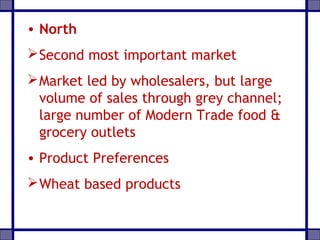
• North
Second most important market
Market led by wholesalers, but large
volume of sales through grey channel;
large number of Modern Trade food &
grocery outlets
• Product Preferences
Wheat based products
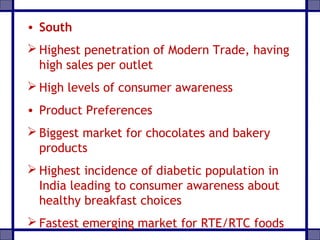
• South
 Highest penetration of Modern Trade, having
high sales per outlet
 High levels of consumer awareness
• Product Preferences
 Biggest market for chocolates and bakery
products
 Highest incidence of diabetic population in
India leading to consumer awareness about
healthy breakfast choices
 Fastest emerging market for RTE/RTC foods
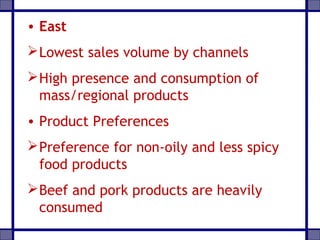
• East
Lowest sales volume by channels
High presence and consumption of
mass/regional products
• Product Preferences
Preference for non-oily and less spicy
food products
Beef and pork products are heavily
consumed
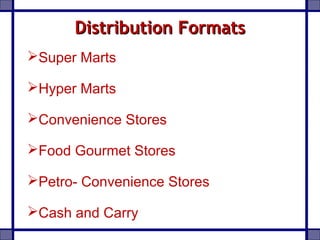
Distribution FormatsDistribution Formats
Super Marts
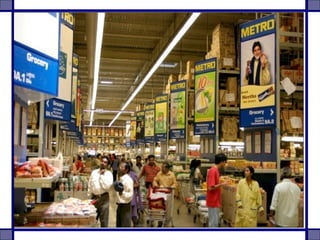
Hyper Marts
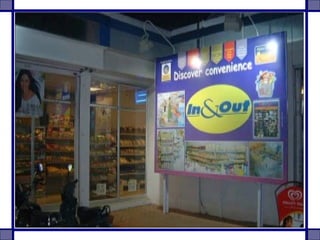
Convenience Stores
Food Gourmet Stores
Petro- Convenience Stores
Cash and Carry
Railways and Airlines
Hotels, Restaurants and Catering
(HORECA)
Canteen Store Department
Others (Schools, Colleges, Offices and
Hospitals)
Railways and Airlines
Work on contract based arrangements
Contracts are based on volume & price
negotiations/tenders
CSD Canteens
CSD (Canteen Stores Department), run by the
Ministry of Defense catering to the Armed forces
Assortment of food and non food products at
subsidized rates and differentiated packaging
Work on Tender based arrangements
Hotels
Indian Hotel and Restaurant industry is growing @
20-25% due to increase in foreign tourists and
business-related travel
Multiple consumption points (Breakfast Buffet,
Restaurant, Gym, Bar, Mini-bar)
Others (Schools, College, Offices & Hospitals)
Products such as yoghurt, juices etc.. are gaining
popularity on back of its health proposition
Companies are tying up with institutions such as
Schools, Hospitals, Offices etc. to club their
products along with meals
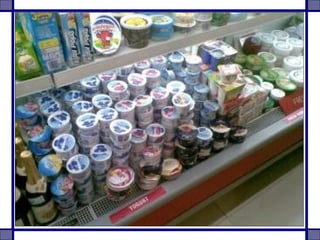
Modern Trade FormatsModern Trade Formats
Large retail store offering wide range of products and
brands
Average size between 4,000 – 10,000 sq. mtr.
E.g. Big Bazaar, Spencer Hyper etc.
Smaller version of a Hyper marts with a average
size of 300 to 1,000 sq. mtr.
Mainly offers food items like groceries along with
non food items
E.g. – Food Bazaar, Reliance Fresh etc.
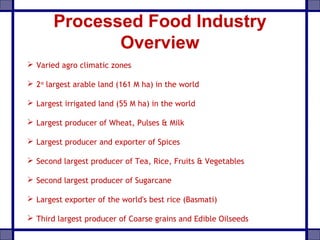
Processed Food Industry
Overview
 Varied agro climatic zones
 2nd
largest arable land (161 M ha) in the world
 Largest irrigated land (55 M ha) in the world
 Largest producer of Wheat, Pulses & Milk
 Largest producer and exporter of Spices
 Second largest producer of Tea, Rice, Fruits & Vegetables
 Second largest producer of Sugarcane
 Largest exporter of the world's best rice (Basmati)
 Third largest producer of Coarse grains and Edible Oilseeds
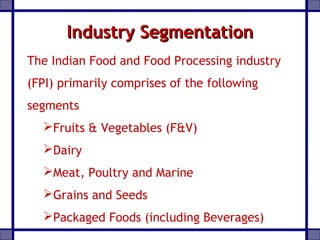
Industry SegmentationIndustry Segmentation
The Indian Food and Food Processing industry
(FPI) primarily comprises of the following
segments
Fruits & Vegetables (F&V)
Dairy
Meat, Poultry and Marine
Grains and Seeds
Packaged Foods (including Beverages)
Food Processing Industry –Food Processing Industry –
Market SizeMarket Size
The size of the processed food sector in India was approximately
US$105 billion in 2011
Includes both the organized and unorganized sector where organized
forms 50-55% of the overall market
Sector is growing by 13-15%, but is expected to grow by ~25% in the
coming years to reach size of US$530-550 billion by 2020
Within the food processing sector, segments like meat, and packaged
foods are expected to witness high growth rates
Historically, food processing industry has contributed around 1.5% to
Indian GDP
Food and Food ProcessingFood and Food Processing
Industry in IndiaIndustry in India
• Strength
Huge domestic consumption market
Large production base of raw material
Breadth in crop base offering scope for
varied processing activities
Food and Food ProcessingFood and Food Processing
Industry in IndiaIndustry in India
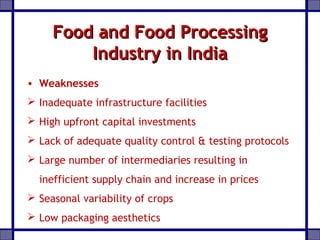
• Weaknesses
 Inadequate infrastructure facilities
 High upfront capital investments
 Lack of adequate quality control & testing protocols
 Large number of intermediaries resulting in
inefficient supply chain and increase in prices
 Seasonal variability of crops
 Low packaging aesthetics
Food and Food ProcessingFood and Food Processing
Industry in IndiaIndustry in India
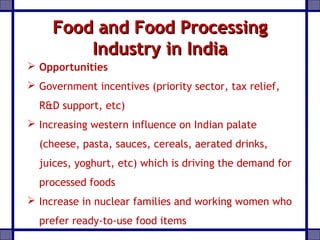
 Opportunities
 Government incentives (priority sector, tax relief,
R&D support, etc)
 Increasing western influence on Indian palate
(cheese, pasta, sauces, cereals, aerated drinks,
juices, yoghurt, etc) which is driving the demand for
processed foods
 Increase in nuclear families and working women who
prefer ready-to-use food items
Food and Food ProcessingFood and Food Processing
Industry in IndiaIndustry in India
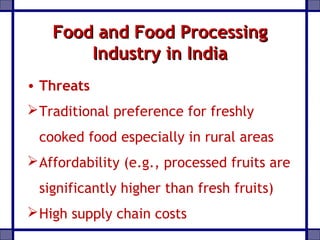
• Threats
Traditional preference for freshly
cooked food especially in rural areas
Affordability (e.g., processed fruits are
significantly higher than fresh fruits)
High supply chain costs
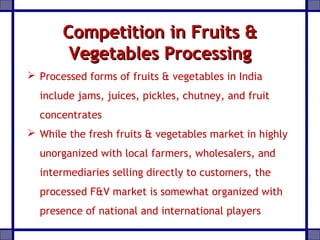
Competition in Fruits &Competition in Fruits &
Vegetables ProcessingVegetables Processing
 Processed forms of fruits & vegetables in India
include jams, juices, pickles, chutney, and fruit
concentrates
 While the fresh fruits & vegetables market in highly
unorganized with local farmers, wholesalers, and
intermediaries selling directly to customers, the
processed F&V market is somewhat organized with
presence of national and international players
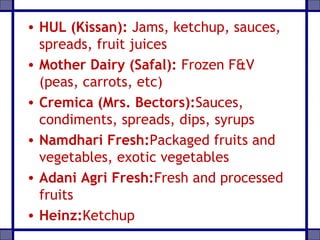
• HUL (Kissan): Jams, ketchup, sauces,
spreads, fruit juices
• Mother Dairy (Safal): Frozen F&V
(peas, carrots, etc)
• Cremica (Mrs. Bectors):Sauces,
condiments, spreads, dips, syrups
• Namdhari Fresh:Packaged fruits and
vegetables, exotic vegetables
• Adani Agri Fresh:Fresh and processed
fruits
• Heinz:Ketchup
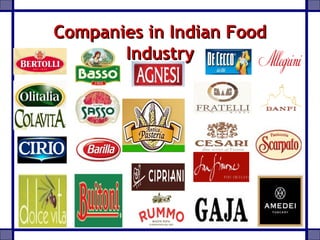
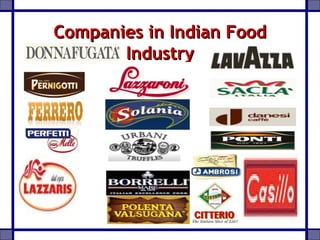
Companies in Indian FoodCompanies in Indian Food
IndustryIndustry
Companies in Indian FoodCompanies in Indian Food
IndustryIndustry
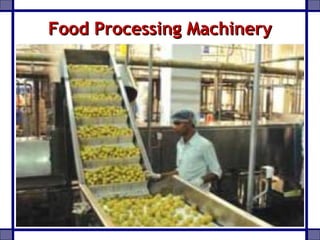
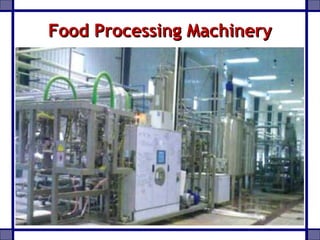
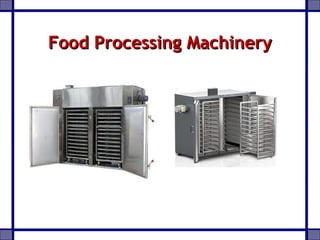
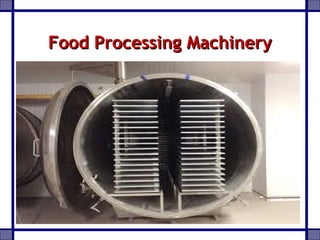
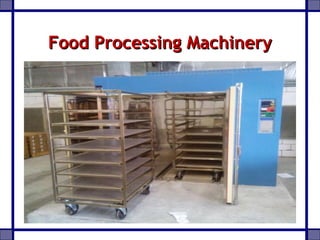
Food Processing MachineryFood Processing Machinery
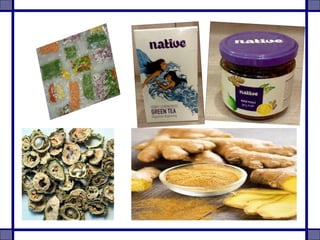
Dehydrated Food Products
KEY OF SUCCESS
Thank You
KDM Analytical
B-2/41, First Floor
Rohini Sector-16
Delhi-110089, India
E-Mail: saleskdmanalytical@gmail.com
Phone: +91-9643480893

Kdm analytical process food industry overview ppt

  • 1.
    PROCESS FOOD INDUSTRIES KDM Analytical B-2/41,First Floor Rohini Sector-16, Delhi – 110089 E-Mail: saleskdmanalytical@gmail.com , Phone: +91-9643480893
  • 2.
    Market Assessment ofFood and Food Processing Industry in India
  • 3.
     Processed FoodIndustry in India  Processed Food Distribution Formats in India  Processed Food Industry Overview  Competition Analysis  Developments in Processed Food Industry  Regulatory and Custom Duties Analysis  Food Processing Machinery  Industry Overview  Major Target Industries for Machinery Manufacturers  Customer Concentration  Cold Storage Overview  Packaging Machinery Overview  Conclusion and Recommendation
  • 4.
  • 5.
    WHY PROCESS FOODS? 1.EXTEND SHELF LIFE 2. MAINTAIN SENSORY PROPERTIES 3. MAINTAIN OR IMPROVE NUTRITIVE PROPERTIES 4. ENSURE SAFETY 5. MAKE MORE CONVENIENT 6. ECONOMIC VALUE
  • 6.
    BUSINESS MODEL • OrganicFood / Wellness : Foods which are not processed using industrial solvents or synthetic additives. • Ready To Cook / Ready to Eat : Commercially prepared ingredients / food to optimise ease of consumption. • Cold Pressed Juices / Salads : Refers to juices that use a hydraulic press to extract juices from fruits and vegetables. • Functional Drinks : Sports drinks, energy drinks, probiotic, alkaline water.
  • 7.
    COMPANIES OVERVIEW • OrganicIndia, Just Organik, Nimble Organics. • MTR, Mc Cain, Knorr, Sumeru. • Raw Juices, Just Pressed, Juice Up, Salad days. • Gatorade, Body Fuelz, Unived, Red Bull, Yakult.
  • 8.
    SERVICES • Discovery Services: Helps find nearby restaurants and food points based on selected criteria. • Delivery Services : Helps in delivery of food from nearby restaurants and food cooperatives. • E-Commerce Services : Helps purchase food products online. • Boxed Meal Services: Subscription or random selection based home – cooked food delivery services
  • 9.
    COMPANIES OVERVIEW • Zomato •Swiggy, Foodpanda, Faasos, Burrp • Bigbasket • Greenchef, Homechef, MC’s Lunchbox
  • 10.
    COMPANIES OVERVIEW • Cremica:Manufacturer of snacks. • Bikaji Foods Int. Ltd: Manufacturer and wholesale snacks. • VKL Seasonings: Seasonings. • Hari on Biofoods Pvt. Ltd: Vacuum dried fruits and vegetables. • K2B: Vacuum Dried and Freeze Dried Food Products • Mitthi Foods: Freeze Dried Food Products. • Bush Foods: Rice Processing.
  • 11.
    Food Processing Policy2015-2020 o Power Subsidy: • Power subsidy is provided to eligible units on power tariff paid by the unit on actual units consumed for a period of 5 years from the date of commercial production. • 25% of the cost payable to State Power Distribution Company for drawl of power line to the premises of the unit including the cost of transformer is subsidized to Micro and Small industrial units o *Capital Investment Subsidy: Capital Investment Subsidy of 30% on the investment in plant and machinery and the limit for automatic approval of subsidy at this rate is INR 1.5 Cr. Per unit.
  • 12.
    o *Interest Subsidy: oWorking capital - Interest subsidy is made available at 3% on working capital loan under NEIIPP, 2007 o Capex: Interest subsidy is provided to Micro industrial units @ 30% of the amount of interest paid on term loan to Bank/Financial Institutions for a period of 5 years from the date of commercial production subject to a ceiling of Rs. 1.00 lakhs per unit/year o NABAR Scheme: Loans to entities in Mega Food Park to be available at 9.5% -10% p.a.
  • 13.
    o Transport Subsidy:90% of the transportation cost of raw materials and finished goods to and from the location of the unit and the designated rail head (for movement of goods within NER, the subsidy is 50%) – for a period of 5 years from commercial production o License Fee Subsidy: The fees payable for obtaining BIS/ISO/FPO/AGMARK and fees payable for getting the technical know-how from recognized research laboratory / institutions like CFTRI, CIPET etc. by eligible units is subsidized to the extent of 50%
  • 16.
    Food HabitsFood Habits India is a culturally rich & diverse nation having varied lifestyles, religions, art, culture, attire & food.  Weather & topography vary widely with region:  North: Closest to the Himalayan range, hilly regions with extreme weather conditions; high fertility area with high wheat production  West: Arid areas of Rajasthan and Gujarat – which are dry and hot through most of the year. In some coastal areas of Maharashtra, fish is the staple diet  South: Temperate climatic condition all through the year; high rice production & consumption area  East: Hilly regions with varying weather conditions; East is the poorest regions of the country
  • 17.
     Indians takefood very passionately  Mealtimes are considered as occasions and time for families to get together and spend quality time.  Fresh cooking is essential in most Indian homes, with limited preference for stocked food  Most meals comprise of several dishes ranging from staples like rice and breads, to meat or vegetables, rounded off with a dessert
  • 18.
    Regional Food Habits– NorthRegional Food Habits – North  North Region – Madhya Pradesh, Uttar Pradesh, Haryana, Punjab, Himachal Pradesh, and Jammu and Kashmir  Wheat-breads are the staple diet which accompany all meals  Largely meat-based diet characterized by tandoori-style cooking methods  Fair amount of cooking is done using deep frying in oil  High consumption of milk and milk-based products  High consumption of fresh fruits such as apples, cherries, plums and strawberries which are unique to this region due to its cooler climate.  Increasing number of households are shifting toward replacing traditionally made food items such as curd and cottage cheese with packaged items (packaged curd or cottage cheese)
  • 19.
    Regional Food Habits– SouthRegional Food Habits – South  Southern India – Andhra Pradesh, Karnataka, Goa, Tamil Nadu, and Kerala  Primarily vegetarian population barring coastal areas where fish is a staple diet  Rice is abundant & appears in almost every dish during a meal & are eaten in multiple forms  Tamarind and coconut form the base for most preparations, with most curries based in coconut gravy  Hot spicy foods are cooked, with chettinad cuisine being one of the most fiery  Food is often eaten on banana leaves  Major shift is seen in people moving towards ready-to-use packaged food items for idlis and dosas, rather than going through the relatively longer process of preparing the batter in-house
  • 20.
    Regional Food Habits– WestRegional Food Habits – West  Western India – Rajasthan, Gujarat, and Maharashtra  High demand of dairy products, including yoghurt, buttermilk, cow's milk, and goat's milk  Rice is the staple food grain  Goan cuisine is dominated by rice, coconut, fish and seafood  Gujarati cuisine is largely vegetarian, with a hint of sugar or jaggery in every preparation  Peanuts and coconut are widely used  Other popular cereals include gram flour, bajra and corn
  • 21.
    Regional Food Habits– EastRegional Food Habits – East  Eastern India - Orissa, Bihar, West Bengal, Assam, Meghalaya, Tripura, Mizoram, Manipur Nagaland, and Arunachal Pradesh  Relatively more simplistic and less elaborate food  Characterized by a variety of different types of rice  Predominantly fish eating population in coastal areas  Common practice to eat steamed food, e.g.: momos  Curries include lot of poppy, mustard and cumin seeds, cumin seeds  World famous for sweets
  • 22.
    Changing Trends forFoodChanging Trends for Food  Growing middle class population and household incomes are driving people to spend more on food  Increasing cases of lifestyle diseases have resulted in shift towards healthier food options such as fruit juices, pro- biotics, cereals and oats  Shift in consumption preferences & increasing demand is driving the food companies to introduce innovative products such as digestive biscuits, fortified dairy products, etc.
  • 23.
     Increased demandfor processed & packaged products with high shelf-life  Willingness to pay a premium for value-added products such as cheese, butter, flavoured milk  Overall change in palate and preference for newer varieties of food due to western influence
  • 24.
    Key Markets • West Being the key port region, majority of players have a presence in this region  Market is led by Modern retail channels and HORECA segment, also has a significant grey channel • Product Preference  Biggest market for candies and confectionary  Key market for fruit based flavours, especially strawberry and orange
  • 25.
    • North Second mostimportant market Market led by wholesalers, but large volume of sales through grey channel; large number of Modern Trade food & grocery outlets • Product Preferences Wheat based products
  • 26.
    • South  Highestpenetration of Modern Trade, having high sales per outlet  High levels of consumer awareness • Product Preferences  Biggest market for chocolates and bakery products  Highest incidence of diabetic population in India leading to consumer awareness about healthy breakfast choices  Fastest emerging market for RTE/RTC foods
  • 27.
    • East Lowest salesvolume by channels High presence and consumption of mass/regional products • Product Preferences Preference for non-oily and less spicy food products Beef and pork products are heavily consumed
  • 28.
    Distribution FormatsDistribution Formats SuperMarts Hyper Marts Convenience Stores Food Gourmet Stores Petro- Convenience Stores Cash and Carry
  • 29.
    Railways and Airlines Hotels,Restaurants and Catering (HORECA) Canteen Store Department Others (Schools, Colleges, Offices and Hospitals)
  • 30.
    Railways and Airlines Workon contract based arrangements Contracts are based on volume & price negotiations/tenders CSD Canteens CSD (Canteen Stores Department), run by the Ministry of Defense catering to the Armed forces Assortment of food and non food products at subsidized rates and differentiated packaging Work on Tender based arrangements
  • 31.
    Hotels Indian Hotel andRestaurant industry is growing @ 20-25% due to increase in foreign tourists and business-related travel Multiple consumption points (Breakfast Buffet, Restaurant, Gym, Bar, Mini-bar) Others (Schools, College, Offices & Hospitals) Products such as yoghurt, juices etc.. are gaining popularity on back of its health proposition Companies are tying up with institutions such as Schools, Hospitals, Offices etc. to club their products along with meals
  • 32.
    Modern Trade FormatsModernTrade Formats Large retail store offering wide range of products and brands Average size between 4,000 – 10,000 sq. mtr. E.g. Big Bazaar, Spencer Hyper etc. Smaller version of a Hyper marts with a average size of 300 to 1,000 sq. mtr. Mainly offers food items like groceries along with non food items E.g. – Food Bazaar, Reliance Fresh etc.
  • 37.
    Processed Food Industry Overview Varied agro climatic zones  2nd largest arable land (161 M ha) in the world  Largest irrigated land (55 M ha) in the world  Largest producer of Wheat, Pulses & Milk  Largest producer and exporter of Spices  Second largest producer of Tea, Rice, Fruits & Vegetables  Second largest producer of Sugarcane  Largest exporter of the world's best rice (Basmati)  Third largest producer of Coarse grains and Edible Oilseeds
  • 38.
    Industry SegmentationIndustry Segmentation TheIndian Food and Food Processing industry (FPI) primarily comprises of the following segments Fruits & Vegetables (F&V) Dairy Meat, Poultry and Marine Grains and Seeds Packaged Foods (including Beverages)
  • 39.
    Food Processing Industry–Food Processing Industry – Market SizeMarket Size The size of the processed food sector in India was approximately US$105 billion in 2011 Includes both the organized and unorganized sector where organized forms 50-55% of the overall market Sector is growing by 13-15%, but is expected to grow by ~25% in the coming years to reach size of US$530-550 billion by 2020 Within the food processing sector, segments like meat, and packaged foods are expected to witness high growth rates Historically, food processing industry has contributed around 1.5% to Indian GDP
  • 40.
    Food and FoodProcessingFood and Food Processing Industry in IndiaIndustry in India • Strength Huge domestic consumption market Large production base of raw material Breadth in crop base offering scope for varied processing activities
  • 41.
    Food and FoodProcessingFood and Food Processing Industry in IndiaIndustry in India • Weaknesses  Inadequate infrastructure facilities  High upfront capital investments  Lack of adequate quality control & testing protocols  Large number of intermediaries resulting in inefficient supply chain and increase in prices  Seasonal variability of crops  Low packaging aesthetics
  • 42.
    Food and FoodProcessingFood and Food Processing Industry in IndiaIndustry in India  Opportunities  Government incentives (priority sector, tax relief, R&D support, etc)  Increasing western influence on Indian palate (cheese, pasta, sauces, cereals, aerated drinks, juices, yoghurt, etc) which is driving the demand for processed foods  Increase in nuclear families and working women who prefer ready-to-use food items
  • 43.
    Food and FoodProcessingFood and Food Processing Industry in IndiaIndustry in India • Threats Traditional preference for freshly cooked food especially in rural areas Affordability (e.g., processed fruits are significantly higher than fresh fruits) High supply chain costs
  • 44.
    Competition in Fruits&Competition in Fruits & Vegetables ProcessingVegetables Processing  Processed forms of fruits & vegetables in India include jams, juices, pickles, chutney, and fruit concentrates  While the fresh fruits & vegetables market in highly unorganized with local farmers, wholesalers, and intermediaries selling directly to customers, the processed F&V market is somewhat organized with presence of national and international players
  • 45.
    • HUL (Kissan):Jams, ketchup, sauces, spreads, fruit juices • Mother Dairy (Safal): Frozen F&V (peas, carrots, etc) • Cremica (Mrs. Bectors):Sauces, condiments, spreads, dips, syrups • Namdhari Fresh:Packaged fruits and vegetables, exotic vegetables • Adani Agri Fresh:Fresh and processed fruits • Heinz:Ketchup
  • 46.
    Companies in IndianFoodCompanies in Indian Food IndustryIndustry
  • 47.
    Companies in IndianFoodCompanies in Indian Food IndustryIndustry
  • 48.
    Food Processing MachineryFoodProcessing Machinery
  • 49.
    Food Processing MachineryFoodProcessing Machinery
  • 50.
    Food Processing MachineryFoodProcessing Machinery
  • 51.
    Food Processing MachineryFoodProcessing Machinery
  • 52.
    Food Processing MachineryFoodProcessing Machinery
  • 53.
    Food Processing MachineryFoodProcessing Machinery
  • 54.
    Food Processing MachineryFoodProcessing Machinery
  • 55.
  • 56.
  • 57.
    Thank You KDM Analytical B-2/41,First Floor Rohini Sector-16 Delhi-110089, India E-Mail: saleskdmanalytical@gmail.com Phone: +91-9643480893