Report
On
The Study
Of
Food Processing
Industry
Submitted by:
Shivangi Thakkar (16531014)
Siddhi Modi (16531003)
Index
Sr No. Title Page No.
1 History Of Food Processing Industry 1
2 Food Processing Industry In India 2
3 Market Size 4
4 CAGR 5
5 Top 10 Companies Of The Industry 6
6 Challenges Faced by The Industry 10
7 Future Of The Industry 11
8 Conclusion 12
9 References 13
History of Food Processing Industry
Food processing dates back to the prehistoric ages when crude processing incorporated
fermenting, sun drying, preserving with salt, and various types of cooking (such as roasting,
smoking, steaming, and oven baking). Salt-preservation was especially common for foods that
constituted warrior and sailors' diets until the introduction of canning methods. These tried and
tested processing techniques remained essentially the same until the advent of the industrial
revolution. Examples of ready-meals also date back to before the preindustrial revolution.
Modern food processing technology developed in the 19th and 20th centuries was developed
in a large part to serve military needs. In Although initially expensive and somewhat hazardous
due to the lead used in cans, canned goods would later become a staple around the
world. Pasteurization, discovered by Louis Pasteur in 1864, improved the quality of preserved
foods and introduced the wine, beer, and milk preservation.
In the 20th century, World War II, the space race and the rising consumer society in developed
countries contributed to the growth of food processing with such advances as spray
drying, evaporation, juice concentrates, freeze drying and the introduction of artificial
sweeteners, colouring agents, and such preservatives as sodium benzoate.
In western Europe and North America, the second half of the 20th century witnessed a rise in
the pursuit of convenience. Food processing companies marketed their products especially
towards middle-class working wives and mothers. Frozen foods found their success in sales of
juice concentrates and "TV dinners".
Food Processing Industry In India
Food Processing Industry (FPI) in India is a sunrise sector that has gained prominence in the
recent years. Easy availability of raw materials, changing lifestyles and favourable fiscal
policies has given a considerable push to the industry’s growth. FPI serves as a vital link
between the agriculture and manufacturing sectors of the economy. Strengthening this link is
critical to reduce wastage of agricultural raw materials, improve the value of agricultural
produce by increasing shelf-life as well as by fortifying the nutritive value of the food products
and ensure remunerative prices to farmers as well as affordable prices to consumers.
India is one of the leading exporters of the processed food products. It has a competitive edge
over other countries due to the wide variety of crops cultivated as a result of geographical and
climatic diversity. Government too is trying to support the industry by formulating favourable
policies. With adequate government focus on the infrastructural support, research and
development and technological innovation in this sector.
The Indian food industry is poised for huge growth, increasing its contribution to world food
trade every year. In India, the food sector has emerged as a high-growth and high-profit sector
due to its immense potential for value addition, particularly within the food processing industry.
The food industry, which is currently valued at US$ 39.71 billion! is expected to grow at a
Compounded Annual Growth Rate (CAGR) of 11 per cent to US$65.4 billion by 2018. Food
and grocery account for around 31 per cent of India’s consumption basket.
Accounting for about 32 per cent of the country’s total food market, The Government of India
has been instrumental in the growth and development of the food processing industry. The
government through the Ministry of Food Processing Industries (MoFPI) is making all efforts
to encourage investments in the business. It has approved proposals for joint ventures (JV),
foreign collaborations, industrial licenses and 100 per cent export oriented units.
The food processing sector comprises of six major segments.
 Fruits and vegetables
 Milk
 Meat and poultry
 Marine Products
 Grain Processing
 Consumer Food
Market Size
The Indian food and grocery market is the world’s sixth largest, with retail contributing 70 per
cent of the sales. The Indian food retail market is expected to reach Rs 61 lakh crore (US$ 915
billion) by 2020.
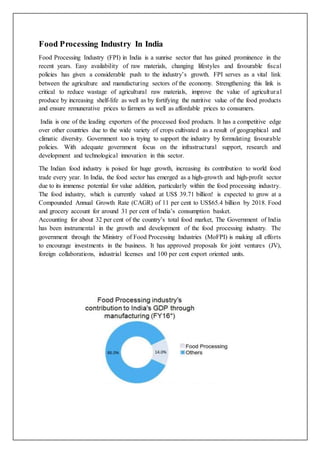
The Indian food processing industry accounts for 32 per cent of the country’s total food market,
one of the largest industries in India and is ranked fifth in terms of production, consumption,
export and expected growth. It contributes around 14 per cent of manufacturing Gross
Domestic Product (GDP), 13 per cent of India’s exports and six per cent of total industrial
investment.
Indian food service industry is expected to reach US$ 78 billion by 2018.The Indian gourmet
food market is currently valued at US$ 1.3 billion and is growing at a Compound Annual
Growth Rate (CAGR) of 20 per cent. India's organic food market is expected to increase by
three times by 2020.
The online food ordering business in India is in its beginning stage, but witnessing exponential
growth. The organised food business in India is worth US$ 48 billion, of which food delivery
is valued at US$ 15 billion. With online food delivery players like FoodPanda, Zomato,
TinyOwl and Swiggy building scale through partnerships, the organised food business has a
huge potential and a promising future.
CAGR (Compound Annual Growth Rate)
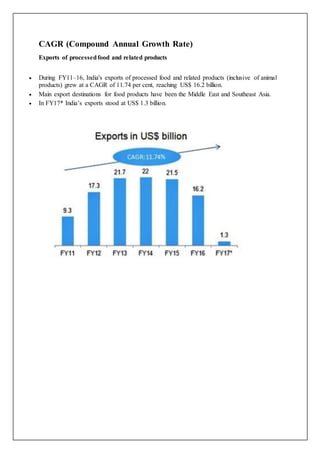
Exports of processedfood and related products
 During FY11–16, India's exports of processed food and related products (inclusive of animal
products) grew at a CAGR of 11.74 per cent, reaching US$ 16.2 billion.
 Main export destinations for food products have been the Middle East and Southeast Asia.
 In FY17* India’s exports stood at US$ 1.3 billion.
Top Major Players of the industry
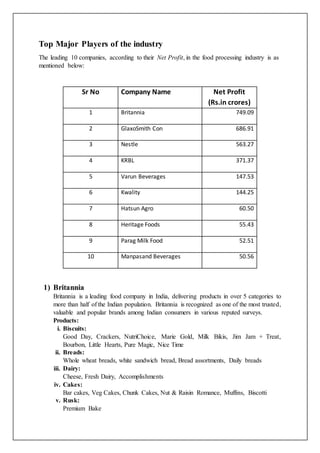
The leading 10 companies, according to their Net Profit, in the food processing industry is as
mentioned below:
Sr No Company Name Net Profit
(Rs.in crores)
1 Britannia 749.09
2 GlaxoSmith Con 686.91
3 Nestle 563.27
4 KRBL 371.37
5 Varun Beverages 147.53
6 Kwality 144.25
7 Hatsun Agro 60.50
8 Heritage Foods 55.43
9 Parag Milk Food 52.51
10 Manpasand Beverages 50.56
1) Britannia
Britannia is a leading food company in India, delivering products in over 5 categories to
more than half of the Indian population. Britannia is recognized as one of the most trusted,
valuable and popular brands among Indian consumers in various reputed surveys.
Products:
i. Biscuits:
Good Day, Crackers, NutriChoice, Marie Gold, Milk Bikis, Jim Jam + Treat,
Bourbon, Little Hearts, Pure Magic, Nice Time
ii. Breads:
Whole wheat breads, white sandwich bread, Bread assortments, Daily breads
iii. Dairy:
Cheese, Fresh Dairy, Accomplishments
iv. Cakes:
Bar cakes, Veg Cakes, Chunk Cakes, Nut & Raisin Romance, Muffins, Biscotti
v. Rusk:
Premium Bake
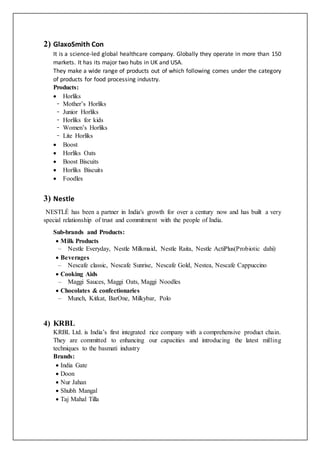
2) GlaxoSmith Con
It is a science-led global healthcare company. Globally they operate in more than 150
markets. It has its major two hubs in UK and USA.
They make a wide range of products out of which following comes under the category
of products for food processing industry.
Products:
 Horliks
̵ Mother’s Horliks
̵ Junior Horliks
̵ Horliks for kids
̵ Women’s Horliks
̵ Lite Horliks
 Boost
 Horliks Oats
 Boost Biscuits
 Horliks Biscuits
 Foodles
3) Nestle
NESTLÉ has been a partner in India's growth for over a century now and has built a very
special relationship of trust and commitment with the people of India.
Sub-brands and Products:
 Milk Products
– Nestle Everyday, Nestle Milkmaid, Nestle Raita, Nestle ActiPlus(Probiotic dahi)
 Beverages
– Nescafe classic, Nescafe Sunrise, Nescafe Gold, Nestea, Nescafe Cappuccino
 Cooking Aids
– Maggi Sauces, Maggi Oats, Maggi Noodles
 Chocolates & confectionaries
– Munch, Kitkat, BarOne, Milkybar, Polo
4) KRBL
KRBL Ltd. is India’s first integrated rice company with a comprehensive product chain.
They are committed to enhancing our capacities and introducing the latest milling
techniques to the basmati industry
Brands:
 India Gate
 Doon
 Nur Jahan
 Shubh Mangal
 Taj Mahal Tilla
5) Varun Beverages
They are one of the largest franchisee in the world (outside US) of carbonated soft drinks
(“CSDs”) and non-carbonated beverages (“NCBs”) sold under trademarks owned by
PepsiCo. They produce and distribute a wide range of CSDs, as well as a large selection
of NCBs, including packaged drinking water.
Products
 Pepsi
 Diet Pepsi
 Seven-up
 Mirinda
 Mountain Dew
 Nimbooz masala soda
 Tropicana Frutz (Lychee, Apple and Mango)
 Aquafina
6) Kwality
Kwality is one of the fastest growing private sector dairy companies with a new range of
innovative products. Every new quality product passes through a test for its life and
overall performance under a wide range of environmental conditions. The company is
working towards brand development, enhancement of product portfolio, and
strengthening of retail distribution network.
Products:
 Kwality Milk
 Kwality chaach
 Kwality Dahi
 Kwality ice-creams
 Kwality cream
 Dairy Best(Desi Ghee)
7) Hatsun Agro
HAP manufactures and markets products that cater to both cooking and consumption.
Their key focus is on delivering quality, and to that end, we have a technically advanced
system that works in accordance with a time-tested business processes. For over 4
decades they have been pioneering dairy products in the market.
Brands and products
 Hatsun Curd
 Hatsun Paneer
 Hatsun Ghee
 Hatsun Butter
 Hatsun Dairy Whitener
 Hatsun Skimmed Milk Powder
8) Heritage Foods
The Heritage group is one of the fastest growing public listed companies in India, under
its flagship company Heritage Foods Ltd. Their vision is delighting every home with
Fresh & Healthy products and empowering the Farmer.
Products
 Milk
 Curd
 Butter Milk
 Paneer
 Butter
 Milk Cake
 Ghee
 Skimmed Milk Powder
 Lassi
 Flavored Milk
9) Parag Milk Foods
Parag Milk Foods Ltd is one of India's elite private sector dairy company. Food quality
is a fundamental requirement for Parag. They make every effort to ensure that our
processes are safe, and that high quality standards are maintained throughout the supply
chain.
Brands and products
 Goverdhan
– Ghee, Milk, Paneer, Dahi, Butter, Dairy Whitener, Gulab Jamun Mix
 Go
– Cheese spread, Cheese cube, Cheese slice, Mozzarella Cheese, Cheese Sause
 Pride Of Cows
– Cow’s Milk
 Topp Up
– Flavoured Protein Milk
10) Manpasand Beverages
They are a fruit drink manufacturing company with a primary focus on mango
fruit, which is the leading flavour for juice drinks in India. With a view to
expand product portfolio, they have launched two new brands, ‘Fruits Up’-
fruit drinks and carbonated fruit drinks and ‘Manpasand ORS’- fruit drinks
with energy replenishing qualities.
Brands
 Mango Sip
 Fruits Up
 Manpasand ORS
 Pure Sip
Majorinvestors
Some of the major investments in this sector in the recent past are:
 US-based food company Cargill Inc, aims to become national leader in the sunflower
oil category which will help the company be among the top three leading brands in
India.
 Mad Over Donuts(MoD), outlined plans of expanding its operations in India by opening
new MOD stores.
 Uber Technologies Inc plans to launch UberEATS, its food delivery service to India,
with investments made across multiple cities and regions.
 Mondelez International, the US-based confectionery, food, and beverage major,
inaugurated its new manufacturing plant in Andhra Pradesh..
 Gujarat Cooperative Milk Marketing Federation (GCMMF), popularly known as
'Amul', plans to establish ten new processing plants by 2020.
 Private Equity (PE) firm India Value Fund Advisors (IVFA) plans to invest around US$
100-150 million in the food business in India over the next two years.
 Zomato, a restaurant search and discovery platform, has raised funds from Singapore
government-owned investment company Temasek, along with existing investor Vy
Capital, in order to explore new business verticals.
 ITC Limited plans to invest to set up a world-class food processing facility. The
company has also formulated plans to enter the dairy market.
Other foreign investors
 Kraft (USA)
 Mars (USA)
 Nestle (Switzerland)
 McCain (Canada)
 Danone (France)
 Ferrero (Italy)
 Del Monte (USA)
 Kagome (Japan)
 Kelloggs (USA)
 Pepsi (USA)
 Unilever (United Kingdom)
 Perfetti (Italy)
 Cargill (USA)
 Coca Cola (USA)
 Hershey (USA)
 Metro Cash & Carry (Germany)
 Walmart (US)
 Yakult (Japan)
 Amazon (USA)
Challenges faced by the Industry
High level of wastage of agricultural produces in primarily on account of the inherent
disadvantages faced by the sector. The sector is characterized by preponderance of small
farmers, small scale and tiny processors, outdated technology, poor infrastructure which
individual farmers and processors will not be in a position to create and sustain.
Further there is also a need for strengthening R&D activities in food processing sector for
innovation of technology which suits local need, popularization of appropriate technology, skill
development and creation of an institutional framework supportive of the industry.
The major challenges faced by the sectors are:
 Supply side bottlenecks: Small and dispersed marketable surplus due to fragmented
holdings, low farm productivity, high seasonality, perishability and intermediation result
in lack of distribution on supply and quality, and in turn, impede processing and exports.
 Infrastructure bottlenecks: More than 30 per cent of the produce from farm gate is lost
due to inadequate cold chain infrastructure and inadequate logistics.
 Deficiencies in the regulatory environment: Lack of integration & clarity: Numerous
laws, under the jurisdiction of different ministries and departments, govern food safety and
packaging. The multiplicity of legislation leads to contradictions in specifications,
conflicting approach, lack of co-ordination and administrative delays.
 Lack of holistic approach: Despite conferring numerous incentives for establishing new
processing units, proportionate results have not been achieved. This can be credited to the
absence of vital infrastructural linkages and legislation for contract and corporate farming,
inadequate implementation of the APMC(Agricultural Produce Market Committee) Act
and unmanageable procedures to avail grants. Also, unlike for small scale industries, fewer
schemes have been designed to promote scale by incentivising large scale investors.
Future Of The Industry
India is a diverse country with interesting food culture, and this feature opens doors for food
processing machine manufactures from across the world. Acknowledging the Indian mind-set,
numerous German companies have been working in India in this field. Alternatively, ‘Made in
Germany’ technology is well-accepted by Indian buyers. Here is Clemens’ take on the future
of the food processing industry in India.
In recent years, the worldwide production of food products has been continuously increasing,
which is also a norm in India. Also, globalization has given us new opportunities. The demand
for food processing and packaging related machinery and plants have grown incrementally.
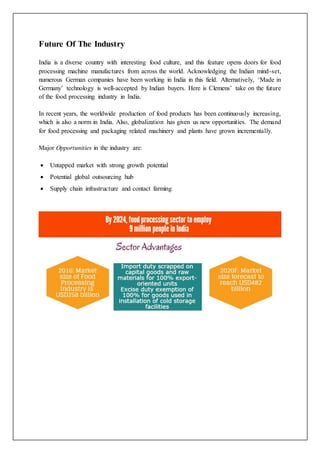
Major Opportunities in the industry are:
 Untapped market with strong growth potential
 Potential global outsourcing hub
 Supply chain infrastructure and contact farming
Conclusion
Indian food processing industry has seen significant growth and changes over the past few
years, driven by changing trends in markets, consumer segments and regulations such as
changing demographics, growing population and rapid urbanisation are expected to continue
in the future and therefore, will shape the demand for value added products and thus for food
processing industry in India. Some of the sectors which are relatively more attractive include
Fruits and Vegetables, Meat, poultry and fisheries, dairy products, snack foods and ready-to-
make items. Many foreign MNC’s such as Nestle, Kissan, McCain etc have been successful by
leveraging the India-advantage. The future of the food processing industry is dazzling, with
food safety, quality assurance and hygiene norms gaining importance. The stringent rules laid
by the government are sure to take this industry to global standards.
Hence it will be a good idea to invest in this industry or to initiate a start-up if one desires.
References
 http://foodprocessingindia.co.in/
 http://www.makeinindia.com/sector/food-processing
 http://www.indianmirror.com
 http://www.ibef.org
 http://www.caaa.in
 http://britannia.co.in
 http://india-consumer.gsk.com
 https://www.nestle.in
 http://www.krblrice.com
 http://varunpepsi.com/
 http://www.kwality.com
 http://hap.in/
 http://www.heritagefoods.in/
 http://www.paragmilkfoods.com/
 http://manpasand.co.in/

Food processing industry

  • 1.
    Report On The Study Of Food Processing Industry Submittedby: Shivangi Thakkar (16531014) Siddhi Modi (16531003)
  • 2.
    Index Sr No. TitlePage No. 1 History Of Food Processing Industry 1 2 Food Processing Industry In India 2 3 Market Size 4 4 CAGR 5 5 Top 10 Companies Of The Industry 6 6 Challenges Faced by The Industry 10 7 Future Of The Industry 11 8 Conclusion 12 9 References 13
  • 3.
    History of FoodProcessing Industry Food processing dates back to the prehistoric ages when crude processing incorporated fermenting, sun drying, preserving with salt, and various types of cooking (such as roasting, smoking, steaming, and oven baking). Salt-preservation was especially common for foods that constituted warrior and sailors' diets until the introduction of canning methods. These tried and tested processing techniques remained essentially the same until the advent of the industrial revolution. Examples of ready-meals also date back to before the preindustrial revolution. Modern food processing technology developed in the 19th and 20th centuries was developed in a large part to serve military needs. In Although initially expensive and somewhat hazardous due to the lead used in cans, canned goods would later become a staple around the world. Pasteurization, discovered by Louis Pasteur in 1864, improved the quality of preserved foods and introduced the wine, beer, and milk preservation. In the 20th century, World War II, the space race and the rising consumer society in developed countries contributed to the growth of food processing with such advances as spray drying, evaporation, juice concentrates, freeze drying and the introduction of artificial sweeteners, colouring agents, and such preservatives as sodium benzoate. In western Europe and North America, the second half of the 20th century witnessed a rise in the pursuit of convenience. Food processing companies marketed their products especially towards middle-class working wives and mothers. Frozen foods found their success in sales of juice concentrates and "TV dinners".
  • 4.
    Food Processing IndustryIn India Food Processing Industry (FPI) in India is a sunrise sector that has gained prominence in the recent years. Easy availability of raw materials, changing lifestyles and favourable fiscal policies has given a considerable push to the industry’s growth. FPI serves as a vital link between the agriculture and manufacturing sectors of the economy. Strengthening this link is critical to reduce wastage of agricultural raw materials, improve the value of agricultural produce by increasing shelf-life as well as by fortifying the nutritive value of the food products and ensure remunerative prices to farmers as well as affordable prices to consumers. India is one of the leading exporters of the processed food products. It has a competitive edge over other countries due to the wide variety of crops cultivated as a result of geographical and climatic diversity. Government too is trying to support the industry by formulating favourable policies. With adequate government focus on the infrastructural support, research and development and technological innovation in this sector. The Indian food industry is poised for huge growth, increasing its contribution to world food trade every year. In India, the food sector has emerged as a high-growth and high-profit sector due to its immense potential for value addition, particularly within the food processing industry. The food industry, which is currently valued at US$ 39.71 billion! is expected to grow at a Compounded Annual Growth Rate (CAGR) of 11 per cent to US$65.4 billion by 2018. Food and grocery account for around 31 per cent of India’s consumption basket. Accounting for about 32 per cent of the country’s total food market, The Government of India has been instrumental in the growth and development of the food processing industry. The government through the Ministry of Food Processing Industries (MoFPI) is making all efforts to encourage investments in the business. It has approved proposals for joint ventures (JV), foreign collaborations, industrial licenses and 100 per cent export oriented units.
  • 5.
    The food processingsector comprises of six major segments.  Fruits and vegetables  Milk  Meat and poultry  Marine Products  Grain Processing  Consumer Food
  • 6.
    Market Size The Indianfood and grocery market is the world’s sixth largest, with retail contributing 70 per cent of the sales. The Indian food retail market is expected to reach Rs 61 lakh crore (US$ 915 billion) by 2020. The Indian food processing industry accounts for 32 per cent of the country’s total food market, one of the largest industries in India and is ranked fifth in terms of production, consumption, export and expected growth. It contributes around 14 per cent of manufacturing Gross Domestic Product (GDP), 13 per cent of India’s exports and six per cent of total industrial investment. Indian food service industry is expected to reach US$ 78 billion by 2018.The Indian gourmet food market is currently valued at US$ 1.3 billion and is growing at a Compound Annual Growth Rate (CAGR) of 20 per cent. India's organic food market is expected to increase by three times by 2020. The online food ordering business in India is in its beginning stage, but witnessing exponential growth. The organised food business in India is worth US$ 48 billion, of which food delivery is valued at US$ 15 billion. With online food delivery players like FoodPanda, Zomato, TinyOwl and Swiggy building scale through partnerships, the organised food business has a huge potential and a promising future.
  • 7.
    CAGR (Compound AnnualGrowth Rate) Exports of processedfood and related products  During FY11–16, India's exports of processed food and related products (inclusive of animal products) grew at a CAGR of 11.74 per cent, reaching US$ 16.2 billion.  Main export destinations for food products have been the Middle East and Southeast Asia.  In FY17* India’s exports stood at US$ 1.3 billion.
  • 8.
    Top Major Playersof the industry The leading 10 companies, according to their Net Profit, in the food processing industry is as mentioned below: Sr No Company Name Net Profit (Rs.in crores) 1 Britannia 749.09 2 GlaxoSmith Con 686.91 3 Nestle 563.27 4 KRBL 371.37 5 Varun Beverages 147.53 6 Kwality 144.25 7 Hatsun Agro 60.50 8 Heritage Foods 55.43 9 Parag Milk Food 52.51 10 Manpasand Beverages 50.56 1) Britannia Britannia is a leading food company in India, delivering products in over 5 categories to more than half of the Indian population. Britannia is recognized as one of the most trusted, valuable and popular brands among Indian consumers in various reputed surveys. Products: i. Biscuits: Good Day, Crackers, NutriChoice, Marie Gold, Milk Bikis, Jim Jam + Treat, Bourbon, Little Hearts, Pure Magic, Nice Time ii. Breads: Whole wheat breads, white sandwich bread, Bread assortments, Daily breads iii. Dairy: Cheese, Fresh Dairy, Accomplishments iv. Cakes: Bar cakes, Veg Cakes, Chunk Cakes, Nut & Raisin Romance, Muffins, Biscotti v. Rusk: Premium Bake
  • 9.
    2) GlaxoSmith Con Itis a science-led global healthcare company. Globally they operate in more than 150 markets. It has its major two hubs in UK and USA. They make a wide range of products out of which following comes under the category of products for food processing industry. Products:  Horliks ̵ Mother’s Horliks ̵ Junior Horliks ̵ Horliks for kids ̵ Women’s Horliks ̵ Lite Horliks  Boost  Horliks Oats  Boost Biscuits  Horliks Biscuits  Foodles 3) Nestle NESTLÉ has been a partner in India's growth for over a century now and has built a very special relationship of trust and commitment with the people of India. Sub-brands and Products:  Milk Products – Nestle Everyday, Nestle Milkmaid, Nestle Raita, Nestle ActiPlus(Probiotic dahi)  Beverages – Nescafe classic, Nescafe Sunrise, Nescafe Gold, Nestea, Nescafe Cappuccino  Cooking Aids – Maggi Sauces, Maggi Oats, Maggi Noodles  Chocolates & confectionaries – Munch, Kitkat, BarOne, Milkybar, Polo 4) KRBL KRBL Ltd. is India’s first integrated rice company with a comprehensive product chain. They are committed to enhancing our capacities and introducing the latest milling techniques to the basmati industry Brands:  India Gate  Doon  Nur Jahan  Shubh Mangal  Taj Mahal Tilla
  • 10.
    5) Varun Beverages Theyare one of the largest franchisee in the world (outside US) of carbonated soft drinks (“CSDs”) and non-carbonated beverages (“NCBs”) sold under trademarks owned by PepsiCo. They produce and distribute a wide range of CSDs, as well as a large selection of NCBs, including packaged drinking water. Products  Pepsi  Diet Pepsi  Seven-up  Mirinda  Mountain Dew  Nimbooz masala soda  Tropicana Frutz (Lychee, Apple and Mango)  Aquafina 6) Kwality Kwality is one of the fastest growing private sector dairy companies with a new range of innovative products. Every new quality product passes through a test for its life and overall performance under a wide range of environmental conditions. The company is working towards brand development, enhancement of product portfolio, and strengthening of retail distribution network. Products:  Kwality Milk  Kwality chaach  Kwality Dahi  Kwality ice-creams  Kwality cream  Dairy Best(Desi Ghee) 7) Hatsun Agro HAP manufactures and markets products that cater to both cooking and consumption. Their key focus is on delivering quality, and to that end, we have a technically advanced system that works in accordance with a time-tested business processes. For over 4 decades they have been pioneering dairy products in the market. Brands and products  Hatsun Curd  Hatsun Paneer  Hatsun Ghee  Hatsun Butter  Hatsun Dairy Whitener  Hatsun Skimmed Milk Powder
  • 11.
    8) Heritage Foods TheHeritage group is one of the fastest growing public listed companies in India, under its flagship company Heritage Foods Ltd. Their vision is delighting every home with Fresh & Healthy products and empowering the Farmer. Products  Milk  Curd  Butter Milk  Paneer  Butter  Milk Cake  Ghee  Skimmed Milk Powder  Lassi  Flavored Milk 9) Parag Milk Foods Parag Milk Foods Ltd is one of India's elite private sector dairy company. Food quality is a fundamental requirement for Parag. They make every effort to ensure that our processes are safe, and that high quality standards are maintained throughout the supply chain. Brands and products  Goverdhan – Ghee, Milk, Paneer, Dahi, Butter, Dairy Whitener, Gulab Jamun Mix  Go – Cheese spread, Cheese cube, Cheese slice, Mozzarella Cheese, Cheese Sause  Pride Of Cows – Cow’s Milk  Topp Up – Flavoured Protein Milk 10) Manpasand Beverages They are a fruit drink manufacturing company with a primary focus on mango fruit, which is the leading flavour for juice drinks in India. With a view to expand product portfolio, they have launched two new brands, ‘Fruits Up’- fruit drinks and carbonated fruit drinks and ‘Manpasand ORS’- fruit drinks with energy replenishing qualities. Brands  Mango Sip  Fruits Up  Manpasand ORS  Pure Sip
  • 12.
    Majorinvestors Some of themajor investments in this sector in the recent past are:  US-based food company Cargill Inc, aims to become national leader in the sunflower oil category which will help the company be among the top three leading brands in India.  Mad Over Donuts(MoD), outlined plans of expanding its operations in India by opening new MOD stores.  Uber Technologies Inc plans to launch UberEATS, its food delivery service to India, with investments made across multiple cities and regions.  Mondelez International, the US-based confectionery, food, and beverage major, inaugurated its new manufacturing plant in Andhra Pradesh..  Gujarat Cooperative Milk Marketing Federation (GCMMF), popularly known as 'Amul', plans to establish ten new processing plants by 2020.  Private Equity (PE) firm India Value Fund Advisors (IVFA) plans to invest around US$ 100-150 million in the food business in India over the next two years.  Zomato, a restaurant search and discovery platform, has raised funds from Singapore government-owned investment company Temasek, along with existing investor Vy Capital, in order to explore new business verticals.  ITC Limited plans to invest to set up a world-class food processing facility. The company has also formulated plans to enter the dairy market. Other foreign investors  Kraft (USA)  Mars (USA)  Nestle (Switzerland)  McCain (Canada)  Danone (France)  Ferrero (Italy)  Del Monte (USA)  Kagome (Japan)  Kelloggs (USA)  Pepsi (USA)  Unilever (United Kingdom)  Perfetti (Italy)  Cargill (USA)  Coca Cola (USA)  Hershey (USA)  Metro Cash & Carry (Germany)  Walmart (US)  Yakult (Japan)  Amazon (USA)
  • 13.
    Challenges faced bythe Industry High level of wastage of agricultural produces in primarily on account of the inherent disadvantages faced by the sector. The sector is characterized by preponderance of small farmers, small scale and tiny processors, outdated technology, poor infrastructure which individual farmers and processors will not be in a position to create and sustain. Further there is also a need for strengthening R&D activities in food processing sector for innovation of technology which suits local need, popularization of appropriate technology, skill development and creation of an institutional framework supportive of the industry. The major challenges faced by the sectors are:  Supply side bottlenecks: Small and dispersed marketable surplus due to fragmented holdings, low farm productivity, high seasonality, perishability and intermediation result in lack of distribution on supply and quality, and in turn, impede processing and exports.  Infrastructure bottlenecks: More than 30 per cent of the produce from farm gate is lost due to inadequate cold chain infrastructure and inadequate logistics.  Deficiencies in the regulatory environment: Lack of integration & clarity: Numerous laws, under the jurisdiction of different ministries and departments, govern food safety and packaging. The multiplicity of legislation leads to contradictions in specifications, conflicting approach, lack of co-ordination and administrative delays.  Lack of holistic approach: Despite conferring numerous incentives for establishing new processing units, proportionate results have not been achieved. This can be credited to the absence of vital infrastructural linkages and legislation for contract and corporate farming, inadequate implementation of the APMC(Agricultural Produce Market Committee) Act and unmanageable procedures to avail grants. Also, unlike for small scale industries, fewer schemes have been designed to promote scale by incentivising large scale investors.
  • 14.
    Future Of TheIndustry India is a diverse country with interesting food culture, and this feature opens doors for food processing machine manufactures from across the world. Acknowledging the Indian mind-set, numerous German companies have been working in India in this field. Alternatively, ‘Made in Germany’ technology is well-accepted by Indian buyers. Here is Clemens’ take on the future of the food processing industry in India. In recent years, the worldwide production of food products has been continuously increasing, which is also a norm in India. Also, globalization has given us new opportunities. The demand for food processing and packaging related machinery and plants have grown incrementally. Major Opportunities in the industry are:  Untapped market with strong growth potential  Potential global outsourcing hub  Supply chain infrastructure and contact farming
  • 15.
    Conclusion Indian food processingindustry has seen significant growth and changes over the past few years, driven by changing trends in markets, consumer segments and regulations such as changing demographics, growing population and rapid urbanisation are expected to continue in the future and therefore, will shape the demand for value added products and thus for food processing industry in India. Some of the sectors which are relatively more attractive include Fruits and Vegetables, Meat, poultry and fisheries, dairy products, snack foods and ready-to- make items. Many foreign MNC’s such as Nestle, Kissan, McCain etc have been successful by leveraging the India-advantage. The future of the food processing industry is dazzling, with food safety, quality assurance and hygiene norms gaining importance. The stringent rules laid by the government are sure to take this industry to global standards. Hence it will be a good idea to invest in this industry or to initiate a start-up if one desires.
  • 16.
    References  http://foodprocessingindia.co.in/  http://foodprocessingindia.co.in/ http://www.makeinindia.com/sector/food-processing  http://www.makeinindia.com/sector/food-processing  http://www.indianmirror.com  http://www.ibef.org  http://www.caaa.in  http://britannia.co.in  http://india-consumer.gsk.com  https://www.nestle.in  http://www.krblrice.com  http://varunpepsi.com/  http://www.kwality.com  http://hap.in/  http://www.heritagefoods.in/  http://www.paragmilkfoods.com/  http://manpasand.co.in/