ICT and teacher training in Hungary Katalin Csoma Academic, Cultural and Public Affairs Officer Embassy of Canada, Budapest
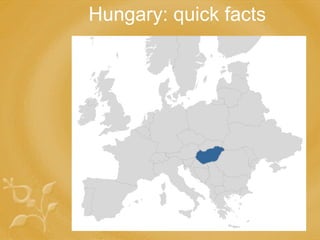
Hungary: quick facts
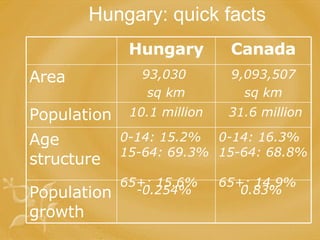
Hungary: quick facts 0.83%  -0.254%  Population growth  0-14: 16.3%  15-64: 68.8%  65 + : 14.9% 0-14: 15.2% 15-64:   69.3%  65 + : 15.6% Age structure 31 . 6  million 10.1 million Population 9,093,507  sq km 93,030  sq km Area  Canada Hungary
History 1945-1989: communism (behind the ‘Iron Curtain’) now a free republic member of the European Union (2004)
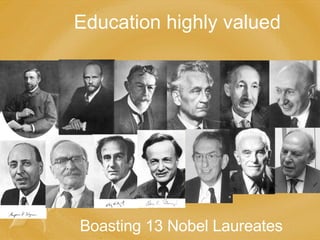
Education highly valued Boasting 13 Nobel Laureates
 
The Bologna Process creating “ the most competitive and dynamic knowledge-based economy in the world ’’ European Higher Education Area by 2010 comparability  and transparency  international cooperation
Institutes of Higher Education regulated by government decrees  30 state colleges/universities 51 state-recognised private institutions 444 programs  (state-funded or self-funded) enrolment more than quadrupled between 1989 and 200 5 teacher trainee numbers  have recently  plummeted
Teacher education in higher education
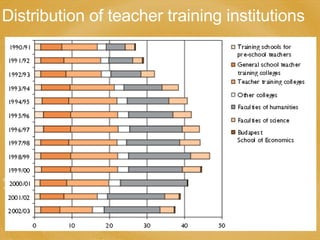
Distribution of teacher training institutions
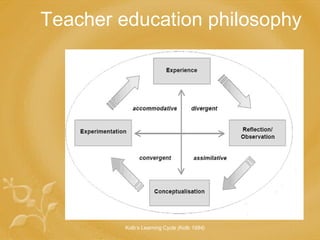
Teacher education philosophy Kolb’s Learning Cycle  ( Kolb  1984)
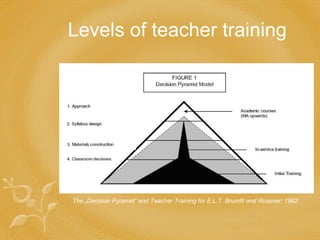
Levels of teacher training The „Decision Pyramid” and Teacher Training for E.L.T. Brumfit and Rossner: 1982
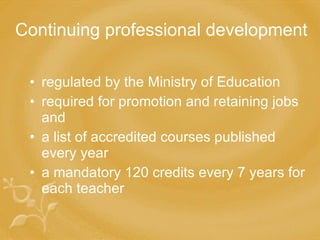
Continuing professional development regulated by the Ministry of Education required for promotion and retaining jobs and a list of accredited courses published every year a mandatory 120 credits every 7 years for each teacher
Educational Information Strategy ( 1996 –2006)   delivery  methods supported by ICT at all levels of education  ( Schoolnet  Program ) d igitali s ation of learning content  (LMS) , providing access  ( Digital   Knowledge   Base ) institutional  and individual IT  infrastructure  development (Sulinet Express) a  unified educational identification, infrastructure and IT applications  for  educational and administrative processes  monitoring and  analysis
ICT in education courses offered by   professional teachers’ organisations Schoolnet textbook publishers hardware and software developers private trainers e mbassies and cultural institutes
Two projects in ICT and teacher training
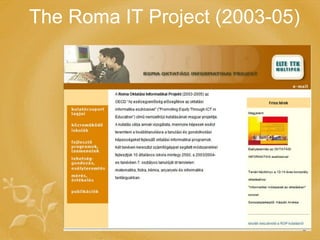
The Roma IT Project (2003-05)
The Roma IT Project (ROIP) OECD-funded research project  (2003-2005) focussing on equal opportunities involving teachers from disadvantaged schools subject-specific (11) contact course based on practitioners’ projects material incentives
ROIP: method goal: content development and introduction to new media literacy ‘ mentored innovation ’ teachers receive input and experiment performance measured primarily through children’s results case studies collection of best practices
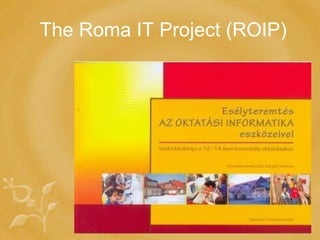
The Roma IT Project (ROIP)
ROIP: Findings cognitive development (inductive,combinative thinking, reading) persoonal development (self-assessment test) increase in motivation (time spent on homework) sustainability?
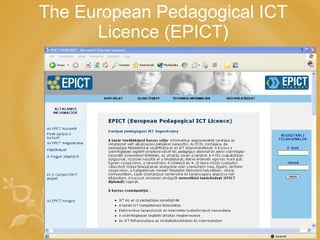
The European Pedagogical ICT Licence (EPICT)
The European Pedagogical ICT Licence (ePICT) a web-based service for the professional development of teachers original licence: UNI.C. Danish IT Centre for Education and Research in Hungary since 2006 country adaptations updated yearly ICT skills through hands-on school-based examples (handling, understanding, reflecting upon technology) teamwork via blended learning
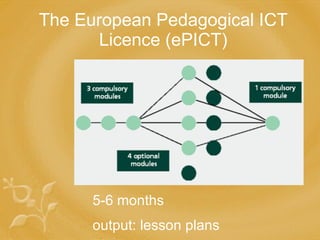
The European Pedagogical ICT Licence (ePICT) 5-6 months output: lesson plans
The European Pedagogical ICT Licence (ePICT) Compulsory modules Let’s find something on the net Type a text Where are you now? Communication and collaboration on the Internet The choice is yours Optional modules Pictures tell the story – working with images on the computer It does its own calculations - spreadsheets Information on the screen – presentation tools and interactive stories Get it out on the net – web pages and dissemination on the Internet Into the database – internal databases The die is cast – models and simulation Columns? – layout and desktop publishing Is it not possible to learn it on the computer? – educational software It is easy on a computer? – working methods and ICT ICT as a compensating tool ICT and reading skills Games and edutainment in education
The European Pedagogical ICT Licence (ePICT) accredited (popular) available in various delivery modes always current focus on pedagogy ICT viewed as an agent of change (innovation) certification: sense of achievement
References Brumfit, Cristopher és Richard Rossner (1982): The ‘Decision Pyramid’ and Teacher Training for E.L.T. English Language Teaching Journal, 36/4, 226-231 EPICT, www.epict.org Euridyce: The information network on education in Europe,  www.eurydice.org Hungarian Ministry of Education and Culture,  www.okm.gov.hu Kárpáti Andrea: Travellers In Cyberspace: ICT In Hungarian Roma Schools. In Kárpáti Andrea ( ed .): Promoting Equity Through ICT in Education. Paris: OECD, 2004, 141–156.  Kolb, David. A. (1984): Experiential learning: Experience as the source of learning and development. Englewood Cliffs, NJ: Prentice Hall. ROIP, edutech.eltel.hu/roip
Thank you for your attention. Merci de votre attention. Köszönöm  a figyelmet! [email_address] [email_address] download: csoma.eu/CNIE
Hope to see you in Hungary soon!

Katalin Csoma's presentation from Hungary

  • 1.
    ICT and teachertraining in Hungary Katalin Csoma Academic, Cultural and Public Affairs Officer Embassy of Canada, Budapest
  • 2.
  • 3.
    Hungary: quick facts0.83% -0.254% Population growth 0-14: 16.3% 15-64: 68.8% 65 + : 14.9% 0-14: 15.2% 15-64: 69.3% 65 + : 15.6% Age structure 31 . 6 million 10.1 million Population 9,093,507 sq km 93,030 sq km Area Canada Hungary
  • 4.
    History 1945-1989: communism(behind the ‘Iron Curtain’) now a free republic member of the European Union (2004)
  • 5.
    Education highly valuedBoasting 13 Nobel Laureates
  • 6.
  • 7.
    The Bologna Processcreating “ the most competitive and dynamic knowledge-based economy in the world ’’ European Higher Education Area by 2010 comparability and transparency international cooperation
  • 8.
    Institutes of HigherEducation regulated by government decrees 30 state colleges/universities 51 state-recognised private institutions 444 programs (state-funded or self-funded) enrolment more than quadrupled between 1989 and 200 5 teacher trainee numbers have recently plummeted
  • 9.
    Teacher education inhigher education
  • 10.
    Distribution of teachertraining institutions
  • 11.
    Teacher education philosophyKolb’s Learning Cycle ( Kolb 1984)
  • 12.
    Levels of teachertraining The „Decision Pyramid” and Teacher Training for E.L.T. Brumfit and Rossner: 1982
  • 13.
    Continuing professional developmentregulated by the Ministry of Education required for promotion and retaining jobs and a list of accredited courses published every year a mandatory 120 credits every 7 years for each teacher
  • 14.
    Educational Information Strategy( 1996 –2006) delivery methods supported by ICT at all levels of education ( Schoolnet Program ) d igitali s ation of learning content (LMS) , providing access ( Digital Knowledge Base ) institutional and individual IT infrastructure development (Sulinet Express) a unified educational identification, infrastructure and IT applications for educational and administrative processes monitoring and analysis
  • 15.
    ICT in educationcourses offered by professional teachers’ organisations Schoolnet textbook publishers hardware and software developers private trainers e mbassies and cultural institutes
  • 16.
    Two projects inICT and teacher training
  • 17.
    The Roma ITProject (2003-05)
  • 18.
    The Roma ITProject (ROIP) OECD-funded research project (2003-2005) focussing on equal opportunities involving teachers from disadvantaged schools subject-specific (11) contact course based on practitioners’ projects material incentives
  • 19.
    ROIP: method goal:content development and introduction to new media literacy ‘ mentored innovation ’ teachers receive input and experiment performance measured primarily through children’s results case studies collection of best practices
  • 20.
    The Roma ITProject (ROIP)
  • 21.
    ROIP: Findings cognitivedevelopment (inductive,combinative thinking, reading) persoonal development (self-assessment test) increase in motivation (time spent on homework) sustainability?
  • 22.
    The European PedagogicalICT Licence (EPICT)
  • 23.
    The European PedagogicalICT Licence (ePICT) a web-based service for the professional development of teachers original licence: UNI.C. Danish IT Centre for Education and Research in Hungary since 2006 country adaptations updated yearly ICT skills through hands-on school-based examples (handling, understanding, reflecting upon technology) teamwork via blended learning
  • 24.
    The European PedagogicalICT Licence (ePICT) 5-6 months output: lesson plans
  • 25.
    The European PedagogicalICT Licence (ePICT) Compulsory modules Let’s find something on the net Type a text Where are you now? Communication and collaboration on the Internet The choice is yours Optional modules Pictures tell the story – working with images on the computer It does its own calculations - spreadsheets Information on the screen – presentation tools and interactive stories Get it out on the net – web pages and dissemination on the Internet Into the database – internal databases The die is cast – models and simulation Columns? – layout and desktop publishing Is it not possible to learn it on the computer? – educational software It is easy on a computer? – working methods and ICT ICT as a compensating tool ICT and reading skills Games and edutainment in education
  • 26.
    The European PedagogicalICT Licence (ePICT) accredited (popular) available in various delivery modes always current focus on pedagogy ICT viewed as an agent of change (innovation) certification: sense of achievement
  • 27.
    References Brumfit, Cristopherés Richard Rossner (1982): The ‘Decision Pyramid’ and Teacher Training for E.L.T. English Language Teaching Journal, 36/4, 226-231 EPICT, www.epict.org Euridyce: The information network on education in Europe, www.eurydice.org Hungarian Ministry of Education and Culture, www.okm.gov.hu Kárpáti Andrea: Travellers In Cyberspace: ICT In Hungarian Roma Schools. In Kárpáti Andrea ( ed .): Promoting Equity Through ICT in Education. Paris: OECD, 2004, 141–156. Kolb, David. A. (1984): Experiential learning: Experience as the source of learning and development. Englewood Cliffs, NJ: Prentice Hall. ROIP, edutech.eltel.hu/roip
  • 28.
    Thank you foryour attention. Merci de votre attention. Köszönöm a figyelmet! [email_address] [email_address] download: csoma.eu/CNIE
  • 29.
    Hope to seeyou in Hungary soon!