The European Commission’s
science and knowledge service
Joint Research Centre
Promoting Open and
Effective Digital-Age
Learning in Europe: Results
from research to support
policy
Y. Punie, J. Castaño & A. Inamorato dos
Santos
DG JRC – Directorate Innovation and Growth
Unit B4 Human Capital and Employment
1. Grand challenges
2. MOOCs: institutional take-up
3. Evidence on MOOC learners
4. MOOCs and skills for migrants and refugees
5. Open Education framework for HEIs
6. Final remark
Content
1. Grand challenges
 About 70 million Europeans lack sufficient reading, writing and
numeracy skills
 24% of EU population has no upper secondary education diploma
 45% of EU population and 37% of UE labour force have
unsufficient digital skills
 40% of European employers report they cannot find people with
the right skills for growth and innovation
 A large number of high-qualified young people work in jobs that do
not match their talents
 Youth unemployment rates remain high (EU: 19% - GR: 50%)
 The refugee crisis and the European project
2. MOOCs: institutional take-up
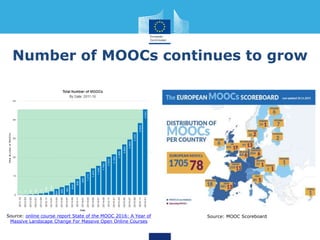
Number of MOOCs continues to grow
Source: online course report State of the MOOC 2016: A Year of
Massive Landscape Change For Massive Open Online Courses
Source: MOOC Scoreboard
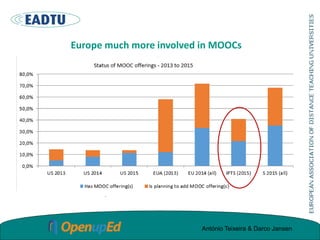
Europe much more involved in MOOCs
António Teixeira & Darco Jansen
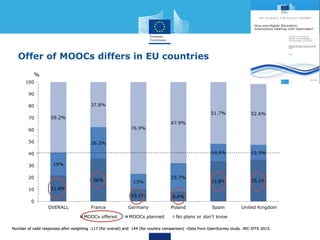
Offer of MOOCs differs in EU countries
21.8%
36%
10.1% 8.4%
33.8% 35.1%
19%
26.2%
13%
23.7%
14.5% 12.3%
59.2%
37.8%
76.9%
67.9%
51.7% 52.6%
0
10
20
30
40
50
60
70
80
90
100
OVERALL France Germany Poland Spain United Kingdom
MOOCs offered MOOCs planned No plans or don't know
%
Number of valid responses after weighting :117 (for overall) and 144 (for country comparison) –Data from OpenSurvey study. JRC-IPTS 2015.
9
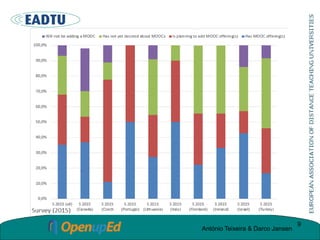
António Teixeira & Darco Jansen
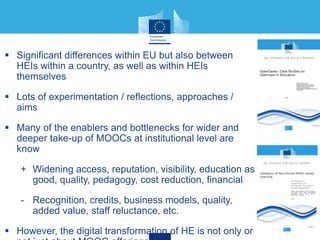
 Significant differences within EU but also between
HEIs within a country, as well as within HEIs
themselves
 Lots of experimentation / reflections, approaches /
aims
 Many of the enablers and bottlenecks for wider and
deeper take-up of MOOCs at institutional level are
know
+ Widening access, reputation, visibility, education as
good, quality, pedagogy, cost reduction, financial
- Recognition, credits, business models, quality,
added value, staff reluctance, etc.
 However, the digital transformation of HE is not only or
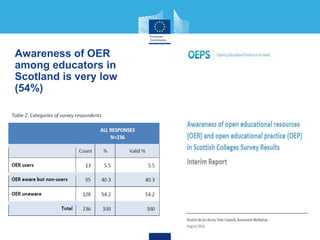
Awareness of OER
among educators in
Scotland is very low
(54%)
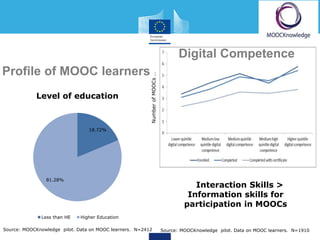
3. Evidence on MOOC learners
18.72%
81.28%
Level of education
Less than HE Higher Education
NumberofMOOCs…
Source: MOOCKnowledge pilot. Data on MOOC learners. N=2412 Source: MOOCKnowledge pilot. Data on MOOC learners. N=1910
Profile of MOOC learners
Digital Competence
Interaction Skills >
Information skills for
participation in MOOCs
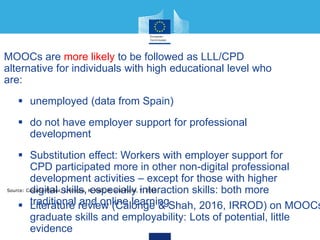
MOOCs are more likely to be followed as LLL/CPD
alternative for individuals with high educational level who
are:
 unemployed (data from Spain)
 do not have employer support for professional
development
 Substitution effect: Workers with employer support for
CPD participated more in other non-digital professional
development activities – except for those with higher
digital skills, especially interaction skills: both more
traditional and online learning
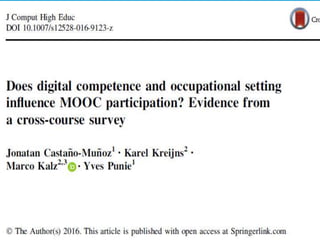
Source: Castaño-Muñoz, J; Kreijns, K; Kalz, M; and Punie, Y. 2016
 Literature review (Calonge & Shah, 2016, IRROD) on MOOCs
graduate skills and employability: Lots of potential, little
evidence
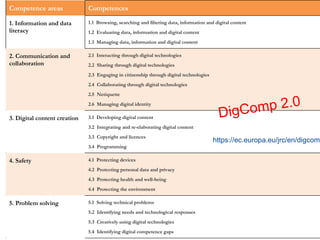
Competence areas Competences
1. Information and data
literacy
1.1 Browsing, searching and filtering data, information and digital content
1.2 Evaluating data, information and digital content
1.3 Managing data, information and digital content
2. Communication and
collaboration
2.1 Interacting through digital technologies
2.2 Sharing through digital technologies
2.3 Engaging in citizenship through digital technologies
2.4 Collaborating through digital technologies
2.5 Netiquette
2.6 Managing digital identity
3. Digital content creation 3.1 Developing digital content
3.2 Integrating and re-elaborating digital content
3.3 Copyright and licences
3.4 Programming
4. Safety 4.1 Protecting devices
4.2 Protecting personal data and privacy
4.3 Protecting health and well-being
4.4 Protecting the environment
5. Problem solving 5.1 Solving technical problems
5.2 Identifying needs and technological responses
5.3 Creatively using digital technologies
5.4 Identifying digital competence gaps
https://ec.europa.eu/jrc/en/digcomp
4. MOOCs and skills for migrants and
refugees
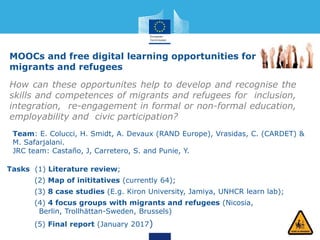
MOOCs and free digital learning opportunities for
migrants and refugees
Tasks (1) Literature review;
(2) Map of inititatives (currently 64);
(3) 8 case studies (E.g. Kiron University, Jamiya, UNHCR learn lab);
(4) 4 focus groups with migrants and refugees (Nicosia,
Berlin, Trollhättan-Sweden, Brussels)
(5) Final report (January 2017)
How can these opportunites help to develop and recognise the
skills and competences of migrants and refugees for inclusion,
integration, re-engagement in formal or non-formal education,
employability and civic participation?
Team: E. Colucci, H. Smidt, A. Devaux (RAND Europe), Vrasidas, C. (CARDET) &
M. Safarjalani.
JRC team: Castaño, J, Carretero, S. and Punie, Y.
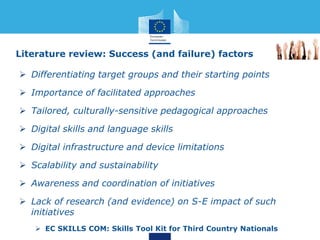
 Differentiating target groups and their starting points
 Importance of facilitated approaches
 Tailored, culturally-sensitive pedagogical approaches
 Digital skills and language skills
 Digital infrastructure and device limitations
 Scalability and sustainability
 Awareness and coordination of initiatives
 Lack of research (and evidence) on S-E impact of such
initiatives
 EC SKILLS COM: Skills Tool Kit for Third Country Nationals
Literature review: Success (and failure) factors
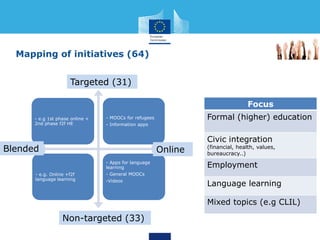
- e.g 1st phase online +
2nd phase f2f HE
- MOOCs for refugees
- Information apps
- e.g. Online +f2f
language learning
- Apps for language
learning
- General MOOCs
-Videos
OnlineBlended
Non-targeted (33)
Targeted (31)
Focus
Formal (higher) education
Civic integration
(financial, health, values,
bureaucracy..)
Employment
Language learning
Mixed topics (e.g CLIL)
Mapping of initiatives (64)
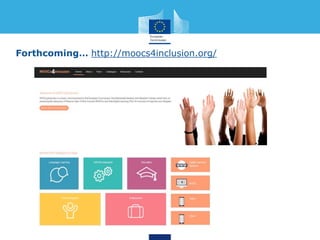
Forthcoming… http://moocs4inclusion.org/
5. Open Education framework for HEIs
JRC OpenEdu framework
The framework was designed to support HEIs in Europe to
make strategic decisions on open education.
It defines and describes what OE is, highlighting the specific
relevance of each element for HEIs.
It is a hands-on tool created by the OpenEdu Project as a
response to the 2013 EC COM on 'Opening up Education', on
behalf of DG EAC.
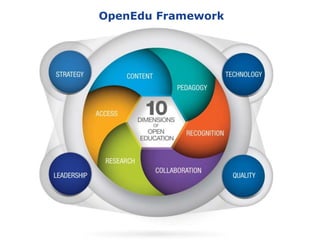
OpenEdu Framework
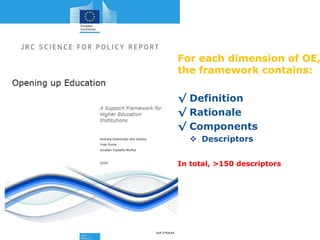
For each dimension of OE,
the framework contains:
√ Definition
√ Rationale
√ Components
 Descriptors
In total, >150 descriptors
 JRC study on "Policy Recommendations for opening up
education", on behalf of DG EAC
 Research and analysis of open education polices at regional
and national levels covering all 28 Member States.
 Carried out by JRC Seville (Inamorato dos Santos, Punie) in
collaboration with Universidad Internacional de La Rioja
(Burgos, Nascimbeni, Aceto, Bacsich, Atenas et al).
 Final report with analysis and recommendatins by spring
2017
What's next?
6. Final remark
• Digital learning is becoming more widespread and
having a deeper impact on learning and on HEIs
• But still need more progress on all levels (holistic)
to realise full potential for more inclusive and
relevant learning in Europe
• Addressing "grand challenges" is important
• Need for strong scientific evidence and multi-
stakeholder (longer term) commitment to
accompany the process of change
https://ec.europa.eu/jrc/en/digcomp
https://ec.europa.eu/jrc/en/entrecomp
https://ec.europa.eu/jrc/en/digcompconsumers
https://ec.europa.eu/jrc/en/digcomporg
https://ec.europa.eu/jrc/en/computational-thinking
https://ec.europa.eu/jrc/en/open-education
https://ec.europa.eu/jrc/en/digital-education-policies
https://ec.europa.eu/jrc/en/research-topic/learning-and-
skills
http://moocs4inclusion.org/
Thank you
yves.punie@ec.europa.eu

Keynote presentation OOFHEC2016: Yves punie

  • 1.
    The European Commission’s scienceand knowledge service Joint Research Centre Promoting Open and Effective Digital-Age Learning in Europe: Results from research to support policy Y. Punie, J. Castaño & A. Inamorato dos Santos DG JRC – Directorate Innovation and Growth Unit B4 Human Capital and Employment
  • 2.
    1. Grand challenges 2.MOOCs: institutional take-up 3. Evidence on MOOC learners 4. MOOCs and skills for migrants and refugees 5. Open Education framework for HEIs 6. Final remark Content
  • 3.
  • 4.
     About 70million Europeans lack sufficient reading, writing and numeracy skills  24% of EU population has no upper secondary education diploma  45% of EU population and 37% of UE labour force have unsufficient digital skills  40% of European employers report they cannot find people with the right skills for growth and innovation  A large number of high-qualified young people work in jobs that do not match their talents  Youth unemployment rates remain high (EU: 19% - GR: 50%)  The refugee crisis and the European project
  • 5.
  • 6.
    Number of MOOCscontinues to grow Source: online course report State of the MOOC 2016: A Year of Massive Landscape Change For Massive Open Online Courses Source: MOOC Scoreboard
  • 7.
    Europe much moreinvolved in MOOCs António Teixeira & Darco Jansen
  • 8.
    Offer of MOOCsdiffers in EU countries 21.8% 36% 10.1% 8.4% 33.8% 35.1% 19% 26.2% 13% 23.7% 14.5% 12.3% 59.2% 37.8% 76.9% 67.9% 51.7% 52.6% 0 10 20 30 40 50 60 70 80 90 100 OVERALL France Germany Poland Spain United Kingdom MOOCs offered MOOCs planned No plans or don't know % Number of valid responses after weighting :117 (for overall) and 144 (for country comparison) –Data from OpenSurvey study. JRC-IPTS 2015.
  • 9.
  • 10.
     Significant differenceswithin EU but also between HEIs within a country, as well as within HEIs themselves  Lots of experimentation / reflections, approaches / aims  Many of the enablers and bottlenecks for wider and deeper take-up of MOOCs at institutional level are know + Widening access, reputation, visibility, education as good, quality, pedagogy, cost reduction, financial - Recognition, credits, business models, quality, added value, staff reluctance, etc.  However, the digital transformation of HE is not only or
  • 11.
    Awareness of OER amongeducators in Scotland is very low (54%)
  • 12.
    3. Evidence onMOOC learners
  • 14.
    18.72% 81.28% Level of education Lessthan HE Higher Education NumberofMOOCs… Source: MOOCKnowledge pilot. Data on MOOC learners. N=2412 Source: MOOCKnowledge pilot. Data on MOOC learners. N=1910 Profile of MOOC learners Digital Competence Interaction Skills > Information skills for participation in MOOCs
  • 15.
    MOOCs are morelikely to be followed as LLL/CPD alternative for individuals with high educational level who are:  unemployed (data from Spain)  do not have employer support for professional development  Substitution effect: Workers with employer support for CPD participated more in other non-digital professional development activities – except for those with higher digital skills, especially interaction skills: both more traditional and online learning Source: Castaño-Muñoz, J; Kreijns, K; Kalz, M; and Punie, Y. 2016  Literature review (Calonge & Shah, 2016, IRROD) on MOOCs graduate skills and employability: Lots of potential, little evidence
  • 16.
    Competence areas Competences 1.Information and data literacy 1.1 Browsing, searching and filtering data, information and digital content 1.2 Evaluating data, information and digital content 1.3 Managing data, information and digital content 2. Communication and collaboration 2.1 Interacting through digital technologies 2.2 Sharing through digital technologies 2.3 Engaging in citizenship through digital technologies 2.4 Collaborating through digital technologies 2.5 Netiquette 2.6 Managing digital identity 3. Digital content creation 3.1 Developing digital content 3.2 Integrating and re-elaborating digital content 3.3 Copyright and licences 3.4 Programming 4. Safety 4.1 Protecting devices 4.2 Protecting personal data and privacy 4.3 Protecting health and well-being 4.4 Protecting the environment 5. Problem solving 5.1 Solving technical problems 5.2 Identifying needs and technological responses 5.3 Creatively using digital technologies 5.4 Identifying digital competence gaps https://ec.europa.eu/jrc/en/digcomp
  • 17.
    4. MOOCs andskills for migrants and refugees
  • 18.
    MOOCs and freedigital learning opportunities for migrants and refugees Tasks (1) Literature review; (2) Map of inititatives (currently 64); (3) 8 case studies (E.g. Kiron University, Jamiya, UNHCR learn lab); (4) 4 focus groups with migrants and refugees (Nicosia, Berlin, Trollhättan-Sweden, Brussels) (5) Final report (January 2017) How can these opportunites help to develop and recognise the skills and competences of migrants and refugees for inclusion, integration, re-engagement in formal or non-formal education, employability and civic participation? Team: E. Colucci, H. Smidt, A. Devaux (RAND Europe), Vrasidas, C. (CARDET) & M. Safarjalani. JRC team: Castaño, J, Carretero, S. and Punie, Y.
  • 19.
     Differentiating targetgroups and their starting points  Importance of facilitated approaches  Tailored, culturally-sensitive pedagogical approaches  Digital skills and language skills  Digital infrastructure and device limitations  Scalability and sustainability  Awareness and coordination of initiatives  Lack of research (and evidence) on S-E impact of such initiatives  EC SKILLS COM: Skills Tool Kit for Third Country Nationals Literature review: Success (and failure) factors
  • 20.
    - e.g 1stphase online + 2nd phase f2f HE - MOOCs for refugees - Information apps - e.g. Online +f2f language learning - Apps for language learning - General MOOCs -Videos OnlineBlended Non-targeted (33) Targeted (31) Focus Formal (higher) education Civic integration (financial, health, values, bureaucracy..) Employment Language learning Mixed topics (e.g CLIL) Mapping of initiatives (64)
  • 21.
  • 22.
    5. Open Educationframework for HEIs
  • 23.
    JRC OpenEdu framework Theframework was designed to support HEIs in Europe to make strategic decisions on open education. It defines and describes what OE is, highlighting the specific relevance of each element for HEIs. It is a hands-on tool created by the OpenEdu Project as a response to the 2013 EC COM on 'Opening up Education', on behalf of DG EAC.
  • 24.
  • 25.
    For each dimensionof OE, the framework contains: √ Definition √ Rationale √ Components  Descriptors In total, >150 descriptors
  • 26.
     JRC studyon "Policy Recommendations for opening up education", on behalf of DG EAC  Research and analysis of open education polices at regional and national levels covering all 28 Member States.  Carried out by JRC Seville (Inamorato dos Santos, Punie) in collaboration with Universidad Internacional de La Rioja (Burgos, Nascimbeni, Aceto, Bacsich, Atenas et al).  Final report with analysis and recommendatins by spring 2017 What's next?
  • 27.
  • 28.
    • Digital learningis becoming more widespread and having a deeper impact on learning and on HEIs • But still need more progress on all levels (holistic) to realise full potential for more inclusive and relevant learning in Europe • Addressing "grand challenges" is important • Need for strong scientific evidence and multi- stakeholder (longer term) commitment to accompany the process of change
  • 29.
  • 30.