International Journal on Integrating Technology in Education (IJITE) Vol.14, No.1, March 2025
DOI:10.5121/ijite.2025.14101 1
PROBLEMS OF ACTIVATING STUDENTS AS
TEACHERS WITH ICT-BASED TRAINING
Khishigbayar. G.1
, Chuluun-Erdene. B. 2
, Azjargal. D.2
, Ichinhorloo. A.2
,
Batkhishig. A 2
, Sarantsatsralt. B.2
and Tserennadmid. L.2
1
Department of Primary Education Methodology,
School of Arkhangai Teacher's school, Mongolian State University of Education
Arkhangai province, Mongolia
2
School of Arkhangai Teacher's school, Mongolian State University of Education
Arkhangai province, Mongolia
ABSTRACT
Through this study, we organized mixed training based on information and communications technology
and conducted experiments on how students’ age, gender, course difference, level of language, and other
factors influenced learning skills via active training. The collected information was divided into four parts,
and the analysis was undertaken using ANOVA (a method that shows differences between two or more
items using variation analysis). From the results of the research, it became clear that learners' skills
increased through the use of content administrative systems, generally independent of age and gender.
KEYWORDS
ICT-based Training, Knowledge Creation, Active Training, Electronic Training, Constructivism
1. INTRODUCTION
In the Fourth Industrial Revolution, technology-based concepts and attitudes prevail in all areas
of society, especially in the field of education. Mongolia's long-term development policy "Vision
2050" states that "everyone will have the opportunity to acquire quality education, which is the
basis of the country's development." Examples include the use of information and
communications technology (ICT) by teachers in training, conducting online and distance
learning, improving English language skills, raising the content and standards of ICT training in
high schools to an international level, providing students with e-literacy education, and creating a
safe online environment. Moreover, it indicated that the promoting co-work with all kinds of
organizations that provide training and organize activities to empower citizens and improve their
ICT skills.
The main force that implements the national development policy is the teacher. Therefore, there
is a need to provide ICT-based support through the educational process to bring the ICT
knowledge and skills of teaching students closer to the international level.
To introduce ICT in the education sector, policy documents such as “Vision 2050,” “National
Distance Learning Program,” “Basic Directions for Introducing ICT in Primary and Secondary
Education by 2015,” “Basic Directions for Introducing ICT in the Education Sector of Mongolia
by 2010,” “Master Plan for Developing Mongolian Education in 2006-2015,” “National
Education Program,” “Electronic Mongolia National Program,” “Right Mongolian Child National
International Journal on Integrating Technology in Education (IJITE) Vol.14, No.1, March 2025
2
Program,” and “Teacher Development Sub-Program” have been implemented, achieving
currently available results. Within the framework of implementing these policies, the
Government of Mongolia is working to set specific goals vis-à-vis the use of ICT to increase the
quality, accessibility, equity, and competitiveness of education.
Depending on the effects of the electronic transition of education, the need for technology, and
the availability of equipment, there is a real need for technological and methodological support
for teachers in the process of learning and using new technologies in training. It is not enough for
teachers to teach students the knowledge and skills of ICT; the former needs to be able to guide
the latter to become creative learners who are able to learn collaboratively and solve problems
through the use of ICT. Therefore, teacher electronics in the form of training materials, didactics
material development, web content, social networks, and electronic collective operation tools
used to learn the degrees and abilities possessed are essential.
Teaching is an important profession that creates social wealth for the country and educates the
young generation. In the works of scientists, there are quite a few descriptions of the
characteristics of the teaching profession. For example, "A teacher is a person who continuously
leads the younger generation to a new life and a new creation, a guide of their ideals, a helper,
and a mentor" and "The teacher is the person who conducts the training. The teaching profession
is the most humanitarian in the sense that you work with people, especially children and
teenagers, and the goal of your work is to develop intelligent citizens who can live in any cultural
environment”. "The main characteristic of the teaching profession is the subject-subject
relationship (human-to-human interaction. "Teaching is, first of all, to teach people science; it is a
one-time, not temporary, permanent, and stable activity, which is carried out in accordance with
pre-planned agreements and rules, and it is a purposeful activity”. "A teacher is an expert who
provides educational services to the public, cultivates individuals, develops intelligence and work
skills, and produces knowledge together with students”. According to the abovementioned
definitions, a teacher is an expert who directs learning and trains students in learning methods.
Our country is doing certain things to improve the quality of teacher education. A higher
education reform project funded by the Asian Development Bank was implemented. The goal of
the project is to meet the demands of Mongolia's university graduates' labor market and make
progress toward becoming globally competitive. Within the framework of the project, courses
were organized to support the ICT knowledge and skills of teachers at teacher training
universities. For example, the introduction of the CDIO training program into university courses
was organized based on the Distance Learning Center of MSU. However, the quality and
accessibility of higher education remain problematic. One of such is the problem of acquiring the
knowledge and skills of a graduate student teacher to use ICT in professional activities. Mongolia
is characterized by its vast territory and sparsely populated areas. This feature creates a distinct
difference in the ICT environment. One way to increase access to education in the context of
mutually different environments is to use ICT in teaching in accordance with the teaching content
and methodology. To do this, teachers need the knowledge and skills to use ICT in combination
with professional activities. In order to meet this requirement, teacher training universities focus
on the process of ICT education of graduate students.
In 2011, UNESCO released a comprehensive ICT competency framework and made
recommendations for teachers. Such recommendations include the following six modules and
three levels: Countries apply a framework of the recommendations in accordance with the
specifics of ICT development in the education sector. In our country, the Minister of Education,
Culture, Science, and Sports approved the common requirements for 2020 (Annex A/67 order)
under the name ICT common requirements for teachers in elementary schools. Common
requirements are being implemented in stages, starting from the 3rd term of the 2019–2020
International Journal on Integrating Technology in Education (IJITE) Vol.14, No.1, March 2025
3
school year. It is important for universities and colleges to prepare teachers and specialists to
organize their own teaching methods in accordance with these common requirements.
Universities face problems in the sustainable development of ICT-based learning methods.
According to a recent survey, 70% of respondents believe that ICT-based training is more
effective in universities, and 69.1% of academic leaders believe that the long-term strategy of
online training has been important in the last ten years.
According to research,
 49% of all students worldwide have taken some form of online course.
 70% of students report that online learning is better than traditional classroom learning.
 63% of US students participate in online learning activities every day.
 Online learning is expected to increase by more than 200% between 2020 and 2025 (Peck
2024).
As seen from the aforementioned, the number of students receiving ICT-based training shows a
constant increase. According to researchers, ICT-based training has become one of the main
methods of active learning. For example, active learning focuses on (Koohang 2005) creating
new knowledge. Active learning entails the concept of the continuous creation of new knowledge
based on real-life problem-based data learning skills, inquiry, and fine-tuning.
Active learning creates opportunities for students to acquire knowledge during social interactions
(Koohang 2012), daily activities, assignments, and projects.
Four research questions are identified as follows:
 ST_ Q1: What is the impact of the age difference of students (18–23, 24–30) on active
learning in an ICT-based learning environment?
 ST_Q2: Does the difference between the genders of students (male and female) have an
effect on advanced training?
 ST_Q3: Based on the content management system of the development, is the level of
students' improved language skills (excellent, good, average, or weak) affected?
 ST_Q4: Does active learning in an ICT-based learning environment influence the difference
in knowledge between students' course levels (1st and 2nd year students, 3rd and 4th year
students)?
2. RESEARCH SCOPE AND METHODOLOGY
ICT-based training centers on information technology, such as electronic tools, and includes
features of e-learning. The ICT-based learning process comprises three stages: preparatory,
mastery, and attention.
2.1. Elements of Active Learning
Preparation stage
 The real world and related examples
 Search
 Higher order thinking skills (analysis, evaluation, and synthesis)
 Core concepts (they often build on what they already know)
International Journal on Integrating Technology in Education (IJITE) Vol.14, No.1, March 2025
4
Owner phase
 Goals and objectives of competitors
 Learning control of students' self-confidence
 Students' self-analysis, self-expression, own knowledge
 Personal experience of students
 Students' self-evaluation, self-representation of ideas and concepts
Attention stage
 Assessment of learner collaboration
 Active analysis, evaluation and synthesis of the student from many aspects
 Empirical research has confirmed its overall coherence, accuracy, and causality
Students' mastery of the skills:
 High level of critical thinking skills (analysis, evaluation, and synthesis) to work on online
activities, tasks, and projects
 Explore and independently construct knowledge through online course activities,
assignments, or projects
 Develop your online activities and tasks based on what you have learned
 Set learning goals and objectives for oneself and learn better through online activities,
assignments, or projects to solve problems
 Participate through online activities, assignments, or projects
 Engage in online activities, homework, and projects by analyzing and motivating oneself
 Solve problems based on ones previous experience of solving online activities, tasks, and
projects
 Self-assess online activities, assignments, and projects while learning
Studies were conducted to clarify the learning process of ICT-based students studying to become
primary school teachers. A total of 138 students of Years I, II, III and IV of teacher-primary
education participated in the research. The survey questionnaire comprised closed and open-
ended questionnaires, and it was administered online.
2.2. Data Analysis
The data collected were analyzed using SPSS. A four-way univariate analysis was conducted to
extract group differences.
3. RESEARCH RESULTS
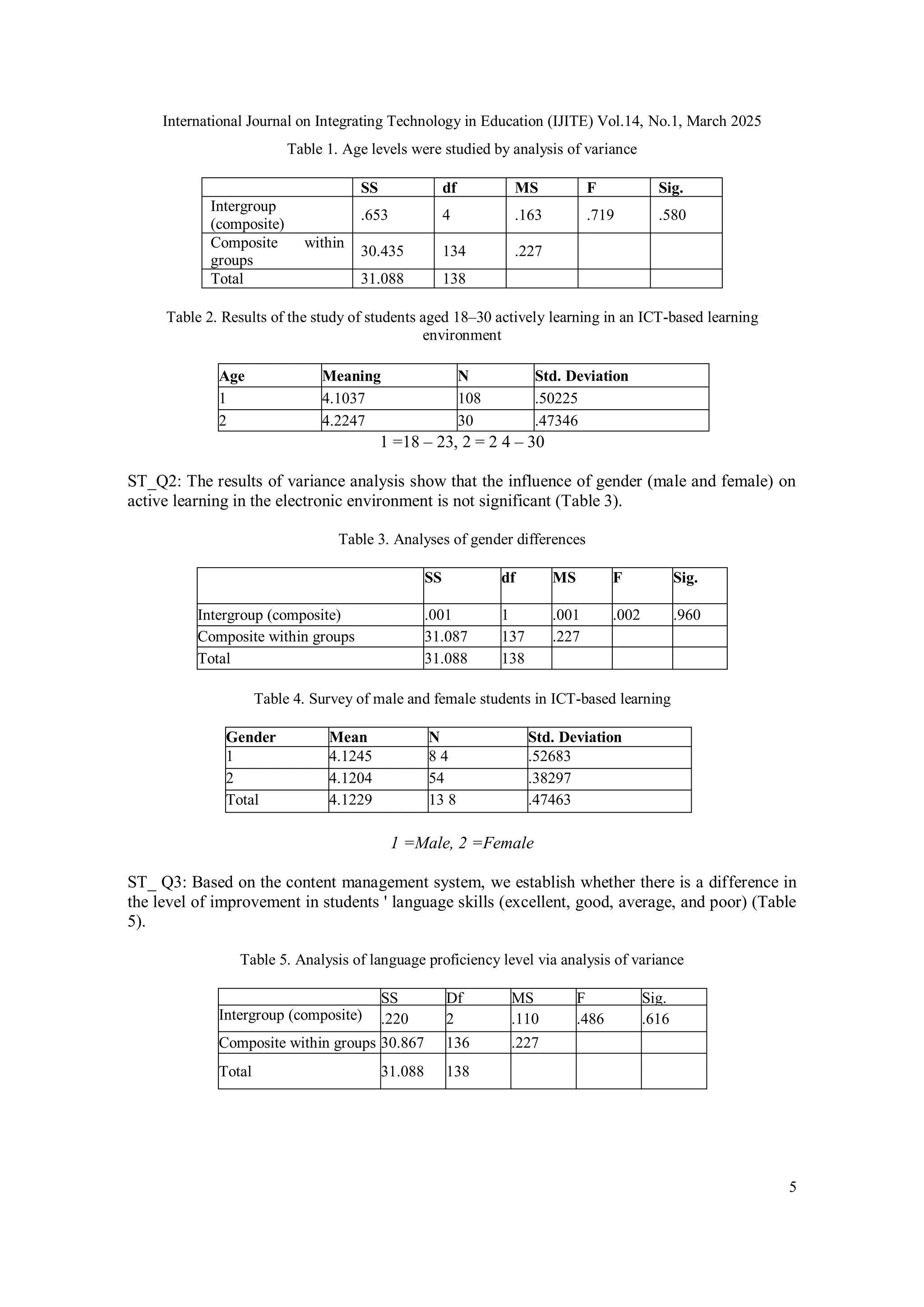
ST_Q1: When clarifying whether there is a difference in the age of students in active learning in
an ICT-based learning environment, the results of the variance analysis show that the difference
in age is not significant in ST_Q1 (Table 1).
International Journal on Integrating Technology in Education (IJITE) Vol.14, No.1, March 2025
5
Table 1. Age levels were studied by analysis of variance
SS df MS F Sig.
Intergroup
(composite)
.653 4 .163 .719 .580
Composite within
groups
30.435 134 .227
Total 31.088 138
Table 2. Results of the study of students aged 18–30 actively learning in an ICT-based learning
environment
Age Meaning N Std. Deviation
1 4.1037 108 .50225
2 4.2247 30 .47346
1 =18 – 23, 2 = 2 4 – 30
ST_Q2: The results of variance analysis show that the influence of gender (male and female) on
active learning in the electronic environment is not significant (Table 3).
Table 3. Analyses of gender differences
SS df MS F Sig.
Intergroup (composite) .001 1 .001 .002 .960
Composite within groups 31.087 137 .227
Total 31.088 138
Table 4. Survey of male and female students in ICT-based learning
Gender Mean N Std. Deviation
1 4.1245 8 4 .52683
2 4.1204 54 .38297
Total 4.1229 13 8 .47463
1 =Male, 2 =Female
ST_ Q3: Based on the content management system, we establish whether there is a difference in
the level of improvement in students ' language skills (excellent, good, average, and poor) (Table
5).
Table 5. Analysis of language proficiency level via analysis of variance
SS Df MS F Sig.
Intergroup (composite) .220 2 .110 .486 .616
Composite within groups 30.867 136 .227
Total 31.088 138
International Journal on Integrating Technology in Education (IJITE) Vol.14, No.1, March 2025
6
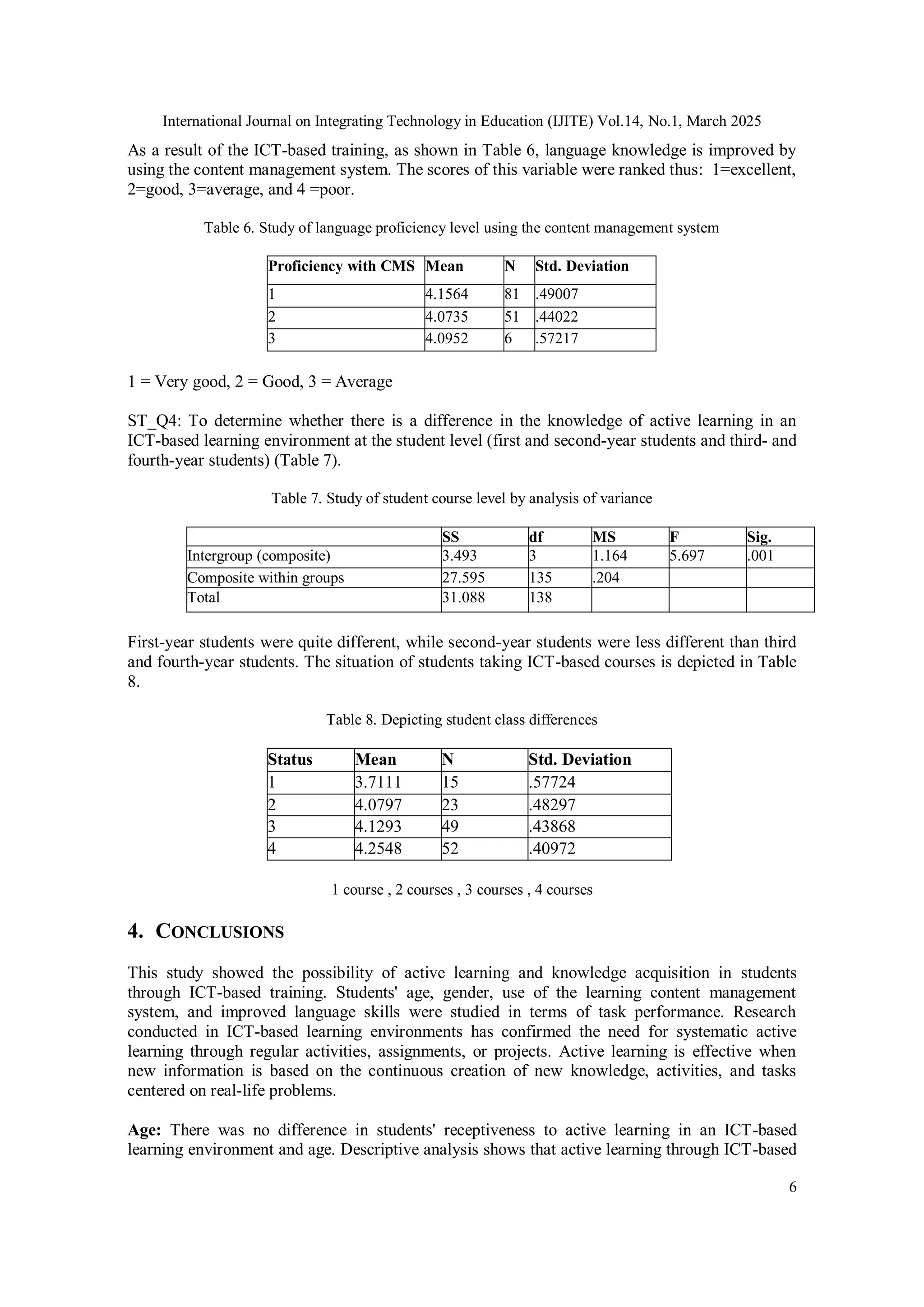
As a result of the ICT-based training, as shown in Table 6, language knowledge is improved by
using the content management system. The scores of this variable were ranked thus: 1=excellent,
2=good, 3=average, and 4 =poor.
Table 6. Study of language proficiency level using the content management system
Proficiency with CMS Mean N Std. Deviation
1 4.1564 81 .49007
2 4.0735 51 .44022
3 4.0952 6 .57217
1 = Very good, 2 = Good, 3 = Average
ST_Q4: To determine whether there is a difference in the knowledge of active learning in an
ICT-based learning environment at the student level (first and second-year students and third- and
fourth-year students) (Table 7).
Table 7. Study of student course level by analysis of variance
SS df MS F Sig.
Intergroup (composite) 3.493 3 1.164 5.697 .001
Composite within groups 27.595 135 .204
Total 31.088 138
First-year students were quite different, while second-year students were less different than third
and fourth-year students. The situation of students taking ICT-based courses is depicted in Table
8.
Table 8. Depicting student class differences
Status Mean N Std. Deviation
1 3.7111 15 .57724
2 4.0797 23 .48297
3 4.1293 49 .43868
4 4.2548 52 .40972
1 course , 2 courses , 3 courses , 4 courses
4. CONCLUSIONS
This study showed the possibility of active learning and knowledge acquisition in students
through ICT-based training. Students' age, gender, use of the learning content management
system, and improved language skills were studied in terms of task performance. Research
conducted in ICT-based learning environments has confirmed the need for systematic active
learning through regular activities, assignments, or projects. Active learning is effective when
new information is based on the continuous creation of new knowledge, activities, and tasks
centered on real-life problems.
Age: There was no difference in students' receptiveness to active learning in an ICT-based
learning environment and age. Descriptive analysis shows that active learning through ICT-based
International Journal on Integrating Technology in Education (IJITE) Vol.14, No.1, March 2025
7
learning has high receptivity across all age groups. Finally, we observe that differences in
receptiveness and age do not play a significant role in active learning through ICT-based
learning.
Gender: There was no difference in students' receptiveness to active learning in an ICT-based
learning environment according to gender.
Content management system: Active learning in an ICT-based learning environment did not
significantly improve students’ course experience nor their receptiveness. The analysis described
in this study shows that active learning in ICT-based learning improves experience at all course
levels.
Class: Active learning in an ICT-based learning environment differed significantly among
students' levels (1st year, 2nd year, 3rd year, 4th year) and receptivity. Freshmen scored lower
than in all other sections. The next sophomore scored lower than the third- and fourth-year
students. The receptiveness of students to active learning in an ICT-based learning environment
changes from the first to the second year, second to the third year, and third to the fourth year. In
today's technology-dominated society, it is important to be able to learn actively in an ICT-based
learning environment. This is because students use information and communication technology,
such as applications and the Internet; however, this is insufficient in today's fast-paced
technology world, which is another way of learning.
REFERENCES
[1] Koohang, A. (2012). Active learning in e-learning: advancing systemic models. Issues in Information
Systems, 68-76.
[2] Koohang, A. (2005). Open source: A metaphor for e-learning. Informing Science Journal, 75-86.
[3] Peck, D. (2024, 1 24). www.devlinpeck.com. Retrieved from Online Learning Statistics: The
Ultimate List in 2024: https://www.devlinpeck.com/content/online-learning-statistics
[4] Government of Mongolia. (2019). Vision 2050: Mongolia's long-term development policy.
Ulaanbaatar: Government of Mongolia.
[5] UNESCO. (2011). Teacher ICT Competency Framework. Unesco & Microsoft.
[6] Robert Reiser. (2014). Learning Modeling and Technology Approaches. Ulaanbaatar
[7] Khishigbayar, G. (2017). Methodological Guide for Developing Electronic Learning Support Tools.
Ulaanbaatar

PROBLEMS OF ACTIVATING STUDENTS AS TEACHERS WITH ICT-BASED TRAINING

  • 1.
    International Journal onIntegrating Technology in Education (IJITE) Vol.14, No.1, March 2025 DOI:10.5121/ijite.2025.14101 1 PROBLEMS OF ACTIVATING STUDENTS AS TEACHERS WITH ICT-BASED TRAINING Khishigbayar. G.1 , Chuluun-Erdene. B. 2 , Azjargal. D.2 , Ichinhorloo. A.2 , Batkhishig. A 2 , Sarantsatsralt. B.2 and Tserennadmid. L.2 1 Department of Primary Education Methodology, School of Arkhangai Teacher's school, Mongolian State University of Education Arkhangai province, Mongolia 2 School of Arkhangai Teacher's school, Mongolian State University of Education Arkhangai province, Mongolia ABSTRACT Through this study, we organized mixed training based on information and communications technology and conducted experiments on how students’ age, gender, course difference, level of language, and other factors influenced learning skills via active training. The collected information was divided into four parts, and the analysis was undertaken using ANOVA (a method that shows differences between two or more items using variation analysis). From the results of the research, it became clear that learners' skills increased through the use of content administrative systems, generally independent of age and gender. KEYWORDS ICT-based Training, Knowledge Creation, Active Training, Electronic Training, Constructivism 1. INTRODUCTION In the Fourth Industrial Revolution, technology-based concepts and attitudes prevail in all areas of society, especially in the field of education. Mongolia's long-term development policy "Vision 2050" states that "everyone will have the opportunity to acquire quality education, which is the basis of the country's development." Examples include the use of information and communications technology (ICT) by teachers in training, conducting online and distance learning, improving English language skills, raising the content and standards of ICT training in high schools to an international level, providing students with e-literacy education, and creating a safe online environment. Moreover, it indicated that the promoting co-work with all kinds of organizations that provide training and organize activities to empower citizens and improve their ICT skills. The main force that implements the national development policy is the teacher. Therefore, there is a need to provide ICT-based support through the educational process to bring the ICT knowledge and skills of teaching students closer to the international level. To introduce ICT in the education sector, policy documents such as “Vision 2050,” “National Distance Learning Program,” “Basic Directions for Introducing ICT in Primary and Secondary Education by 2015,” “Basic Directions for Introducing ICT in the Education Sector of Mongolia by 2010,” “Master Plan for Developing Mongolian Education in 2006-2015,” “National Education Program,” “Electronic Mongolia National Program,” “Right Mongolian Child National
  • 2.
    International Journal onIntegrating Technology in Education (IJITE) Vol.14, No.1, March 2025 2 Program,” and “Teacher Development Sub-Program” have been implemented, achieving currently available results. Within the framework of implementing these policies, the Government of Mongolia is working to set specific goals vis-à-vis the use of ICT to increase the quality, accessibility, equity, and competitiveness of education. Depending on the effects of the electronic transition of education, the need for technology, and the availability of equipment, there is a real need for technological and methodological support for teachers in the process of learning and using new technologies in training. It is not enough for teachers to teach students the knowledge and skills of ICT; the former needs to be able to guide the latter to become creative learners who are able to learn collaboratively and solve problems through the use of ICT. Therefore, teacher electronics in the form of training materials, didactics material development, web content, social networks, and electronic collective operation tools used to learn the degrees and abilities possessed are essential. Teaching is an important profession that creates social wealth for the country and educates the young generation. In the works of scientists, there are quite a few descriptions of the characteristics of the teaching profession. For example, "A teacher is a person who continuously leads the younger generation to a new life and a new creation, a guide of their ideals, a helper, and a mentor" and "The teacher is the person who conducts the training. The teaching profession is the most humanitarian in the sense that you work with people, especially children and teenagers, and the goal of your work is to develop intelligent citizens who can live in any cultural environment”. "The main characteristic of the teaching profession is the subject-subject relationship (human-to-human interaction. "Teaching is, first of all, to teach people science; it is a one-time, not temporary, permanent, and stable activity, which is carried out in accordance with pre-planned agreements and rules, and it is a purposeful activity”. "A teacher is an expert who provides educational services to the public, cultivates individuals, develops intelligence and work skills, and produces knowledge together with students”. According to the abovementioned definitions, a teacher is an expert who directs learning and trains students in learning methods. Our country is doing certain things to improve the quality of teacher education. A higher education reform project funded by the Asian Development Bank was implemented. The goal of the project is to meet the demands of Mongolia's university graduates' labor market and make progress toward becoming globally competitive. Within the framework of the project, courses were organized to support the ICT knowledge and skills of teachers at teacher training universities. For example, the introduction of the CDIO training program into university courses was organized based on the Distance Learning Center of MSU. However, the quality and accessibility of higher education remain problematic. One of such is the problem of acquiring the knowledge and skills of a graduate student teacher to use ICT in professional activities. Mongolia is characterized by its vast territory and sparsely populated areas. This feature creates a distinct difference in the ICT environment. One way to increase access to education in the context of mutually different environments is to use ICT in teaching in accordance with the teaching content and methodology. To do this, teachers need the knowledge and skills to use ICT in combination with professional activities. In order to meet this requirement, teacher training universities focus on the process of ICT education of graduate students. In 2011, UNESCO released a comprehensive ICT competency framework and made recommendations for teachers. Such recommendations include the following six modules and three levels: Countries apply a framework of the recommendations in accordance with the specifics of ICT development in the education sector. In our country, the Minister of Education, Culture, Science, and Sports approved the common requirements for 2020 (Annex A/67 order) under the name ICT common requirements for teachers in elementary schools. Common requirements are being implemented in stages, starting from the 3rd term of the 2019–2020
  • 3.
    International Journal onIntegrating Technology in Education (IJITE) Vol.14, No.1, March 2025 3 school year. It is important for universities and colleges to prepare teachers and specialists to organize their own teaching methods in accordance with these common requirements. Universities face problems in the sustainable development of ICT-based learning methods. According to a recent survey, 70% of respondents believe that ICT-based training is more effective in universities, and 69.1% of academic leaders believe that the long-term strategy of online training has been important in the last ten years. According to research,  49% of all students worldwide have taken some form of online course.  70% of students report that online learning is better than traditional classroom learning.  63% of US students participate in online learning activities every day.  Online learning is expected to increase by more than 200% between 2020 and 2025 (Peck 2024). As seen from the aforementioned, the number of students receiving ICT-based training shows a constant increase. According to researchers, ICT-based training has become one of the main methods of active learning. For example, active learning focuses on (Koohang 2005) creating new knowledge. Active learning entails the concept of the continuous creation of new knowledge based on real-life problem-based data learning skills, inquiry, and fine-tuning. Active learning creates opportunities for students to acquire knowledge during social interactions (Koohang 2012), daily activities, assignments, and projects. Four research questions are identified as follows:  ST_ Q1: What is the impact of the age difference of students (18–23, 24–30) on active learning in an ICT-based learning environment?  ST_Q2: Does the difference between the genders of students (male and female) have an effect on advanced training?  ST_Q3: Based on the content management system of the development, is the level of students' improved language skills (excellent, good, average, or weak) affected?  ST_Q4: Does active learning in an ICT-based learning environment influence the difference in knowledge between students' course levels (1st and 2nd year students, 3rd and 4th year students)? 2. RESEARCH SCOPE AND METHODOLOGY ICT-based training centers on information technology, such as electronic tools, and includes features of e-learning. The ICT-based learning process comprises three stages: preparatory, mastery, and attention. 2.1. Elements of Active Learning Preparation stage  The real world and related examples  Search  Higher order thinking skills (analysis, evaluation, and synthesis)  Core concepts (they often build on what they already know)
  • 4.
    International Journal onIntegrating Technology in Education (IJITE) Vol.14, No.1, March 2025 4 Owner phase  Goals and objectives of competitors  Learning control of students' self-confidence  Students' self-analysis, self-expression, own knowledge  Personal experience of students  Students' self-evaluation, self-representation of ideas and concepts Attention stage  Assessment of learner collaboration  Active analysis, evaluation and synthesis of the student from many aspects  Empirical research has confirmed its overall coherence, accuracy, and causality Students' mastery of the skills:  High level of critical thinking skills (analysis, evaluation, and synthesis) to work on online activities, tasks, and projects  Explore and independently construct knowledge through online course activities, assignments, or projects  Develop your online activities and tasks based on what you have learned  Set learning goals and objectives for oneself and learn better through online activities, assignments, or projects to solve problems  Participate through online activities, assignments, or projects  Engage in online activities, homework, and projects by analyzing and motivating oneself  Solve problems based on ones previous experience of solving online activities, tasks, and projects  Self-assess online activities, assignments, and projects while learning Studies were conducted to clarify the learning process of ICT-based students studying to become primary school teachers. A total of 138 students of Years I, II, III and IV of teacher-primary education participated in the research. The survey questionnaire comprised closed and open- ended questionnaires, and it was administered online. 2.2. Data Analysis The data collected were analyzed using SPSS. A four-way univariate analysis was conducted to extract group differences. 3. RESEARCH RESULTS ST_Q1: When clarifying whether there is a difference in the age of students in active learning in an ICT-based learning environment, the results of the variance analysis show that the difference in age is not significant in ST_Q1 (Table 1).
  • 5.
    International Journal onIntegrating Technology in Education (IJITE) Vol.14, No.1, March 2025 5 Table 1. Age levels were studied by analysis of variance SS df MS F Sig. Intergroup (composite) .653 4 .163 .719 .580 Composite within groups 30.435 134 .227 Total 31.088 138 Table 2. Results of the study of students aged 18–30 actively learning in an ICT-based learning environment Age Meaning N Std. Deviation 1 4.1037 108 .50225 2 4.2247 30 .47346 1 =18 – 23, 2 = 2 4 – 30 ST_Q2: The results of variance analysis show that the influence of gender (male and female) on active learning in the electronic environment is not significant (Table 3). Table 3. Analyses of gender differences SS df MS F Sig. Intergroup (composite) .001 1 .001 .002 .960 Composite within groups 31.087 137 .227 Total 31.088 138 Table 4. Survey of male and female students in ICT-based learning Gender Mean N Std. Deviation 1 4.1245 8 4 .52683 2 4.1204 54 .38297 Total 4.1229 13 8 .47463 1 =Male, 2 =Female ST_ Q3: Based on the content management system, we establish whether there is a difference in the level of improvement in students ' language skills (excellent, good, average, and poor) (Table 5). Table 5. Analysis of language proficiency level via analysis of variance SS Df MS F Sig. Intergroup (composite) .220 2 .110 .486 .616 Composite within groups 30.867 136 .227 Total 31.088 138
  • 6.
    International Journal onIntegrating Technology in Education (IJITE) Vol.14, No.1, March 2025 6 As a result of the ICT-based training, as shown in Table 6, language knowledge is improved by using the content management system. The scores of this variable were ranked thus: 1=excellent, 2=good, 3=average, and 4 =poor. Table 6. Study of language proficiency level using the content management system Proficiency with CMS Mean N Std. Deviation 1 4.1564 81 .49007 2 4.0735 51 .44022 3 4.0952 6 .57217 1 = Very good, 2 = Good, 3 = Average ST_Q4: To determine whether there is a difference in the knowledge of active learning in an ICT-based learning environment at the student level (first and second-year students and third- and fourth-year students) (Table 7). Table 7. Study of student course level by analysis of variance SS df MS F Sig. Intergroup (composite) 3.493 3 1.164 5.697 .001 Composite within groups 27.595 135 .204 Total 31.088 138 First-year students were quite different, while second-year students were less different than third and fourth-year students. The situation of students taking ICT-based courses is depicted in Table 8. Table 8. Depicting student class differences Status Mean N Std. Deviation 1 3.7111 15 .57724 2 4.0797 23 .48297 3 4.1293 49 .43868 4 4.2548 52 .40972 1 course , 2 courses , 3 courses , 4 courses 4. CONCLUSIONS This study showed the possibility of active learning and knowledge acquisition in students through ICT-based training. Students' age, gender, use of the learning content management system, and improved language skills were studied in terms of task performance. Research conducted in ICT-based learning environments has confirmed the need for systematic active learning through regular activities, assignments, or projects. Active learning is effective when new information is based on the continuous creation of new knowledge, activities, and tasks centered on real-life problems. Age: There was no difference in students' receptiveness to active learning in an ICT-based learning environment and age. Descriptive analysis shows that active learning through ICT-based
  • 7.
    International Journal onIntegrating Technology in Education (IJITE) Vol.14, No.1, March 2025 7 learning has high receptivity across all age groups. Finally, we observe that differences in receptiveness and age do not play a significant role in active learning through ICT-based learning. Gender: There was no difference in students' receptiveness to active learning in an ICT-based learning environment according to gender. Content management system: Active learning in an ICT-based learning environment did not significantly improve students’ course experience nor their receptiveness. The analysis described in this study shows that active learning in ICT-based learning improves experience at all course levels. Class: Active learning in an ICT-based learning environment differed significantly among students' levels (1st year, 2nd year, 3rd year, 4th year) and receptivity. Freshmen scored lower than in all other sections. The next sophomore scored lower than the third- and fourth-year students. The receptiveness of students to active learning in an ICT-based learning environment changes from the first to the second year, second to the third year, and third to the fourth year. In today's technology-dominated society, it is important to be able to learn actively in an ICT-based learning environment. This is because students use information and communication technology, such as applications and the Internet; however, this is insufficient in today's fast-paced technology world, which is another way of learning. REFERENCES [1] Koohang, A. (2012). Active learning in e-learning: advancing systemic models. Issues in Information Systems, 68-76. [2] Koohang, A. (2005). Open source: A metaphor for e-learning. Informing Science Journal, 75-86. [3] Peck, D. (2024, 1 24). www.devlinpeck.com. Retrieved from Online Learning Statistics: The Ultimate List in 2024: https://www.devlinpeck.com/content/online-learning-statistics [4] Government of Mongolia. (2019). Vision 2050: Mongolia's long-term development policy. Ulaanbaatar: Government of Mongolia. [5] UNESCO. (2011). Teacher ICT Competency Framework. Unesco & Microsoft. [6] Robert Reiser. (2014). Learning Modeling and Technology Approaches. Ulaanbaatar [7] Khishigbayar, G. (2017). Methodological Guide for Developing Electronic Learning Support Tools. Ulaanbaatar