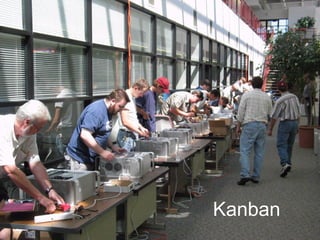
Kanban
THE KANBAN


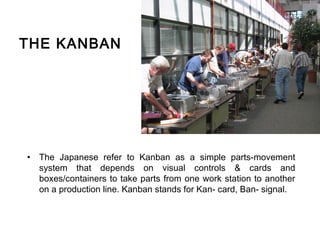
• The Japanese refer to Kanban as a simple parts-movement
  system that depends on visual controls & cards and
  boxes/containers to take parts from one work station to another
  on a production line. Kanban stands for Kan- card, Ban- signal.
THE KANBAN


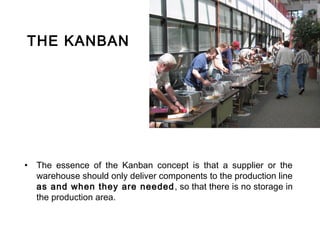
• The essence of the Kanban concept is that a supplier or the
  warehouse should only deliver components to the production line
  as and when they are needed , so that there is no storage in
  the production area.
THE KANBAN


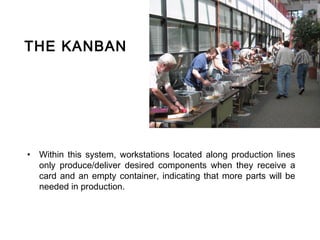
• Within this system, workstations located along production lines
  only produce/deliver desired components when they receive a
  card and an empty container, indicating that more parts will be
  needed in production.
THE KANBAN


•   In case of line interruptions, each work-station will only produce enough
    components to fill the container and then stop.
•   In addition, Kanban limits the amount of inventory in the process by
    acting as an authorization to produce more inventory. Since Kanban is
    a chain process in which orders flow from one process to another, the
    production or delivery of components are pulled to the production line.
    In contrast to the traditional forecast oriented method where parts are
    pushed to the line .
Advantages Of The Kanban
Process


1 A simple and understandable process
2 Provides quick and precise information
3 Low costs associated with the transfer of information
4 Provides quick response to changes
5 Limit of over-capacity in processes
6 Avoids overproduction
7 Minimizes waste
8 Control can be maintained
9 Delegates responsibility to line workers
Kanban

Kanban

  • 1.
  • 2.
    THE KANBAN • TheJapanese refer to Kanban as a simple parts-movement system that depends on visual controls & cards and boxes/containers to take parts from one work station to another on a production line. Kanban stands for Kan- card, Ban- signal.
  • 3.
    THE KANBAN • Theessence of the Kanban concept is that a supplier or the warehouse should only deliver components to the production line as and when they are needed , so that there is no storage in the production area.
  • 4.
    THE KANBAN • Withinthis system, workstations located along production lines only produce/deliver desired components when they receive a card and an empty container, indicating that more parts will be needed in production.
  • 5.
    THE KANBAN • In case of line interruptions, each work-station will only produce enough components to fill the container and then stop. • In addition, Kanban limits the amount of inventory in the process by acting as an authorization to produce more inventory. Since Kanban is a chain process in which orders flow from one process to another, the production or delivery of components are pulled to the production line. In contrast to the traditional forecast oriented method where parts are pushed to the line .
  • 6.
    Advantages Of TheKanban Process 1 A simple and understandable process 2 Provides quick and precise information 3 Low costs associated with the transfer of information 4 Provides quick response to changes 5 Limit of over-capacity in processes 6 Avoids overproduction 7 Minimizes waste 8 Control can be maintained 9 Delegates responsibility to line workers