KALYAN PHARMA LIMITED


       Presented By:
       Parth V. Purohit
2


INTRODUCTION
• Incorporated in 1907.
• Paid up capital:
   o Pre 1991: 5 lakhs.
   o Post 1991: 411 Lakhs.
• 60 different Products.
• 16 KRDs.
• 24 Branch Offices.
• 40 Distribution channels.
• 2000 Stockiest and Wholesalers.
• 687 Medical Representatives.
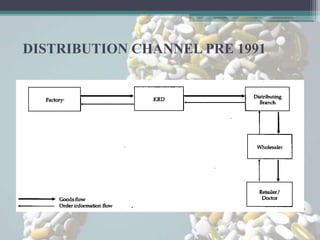
DISTRIBUTION CHANNEL PRE 1991
4


EFFECT OF DPCO ON CHANNELS
5


DPCO (1962)

• Published The price list of products by
  o Manufacturers
  o Importers
  o Distributors
  o Chemists.
6


DPCO (1963)
• Freezing of sales prices of drugs at the level obtained on 1st April 1963.
• In 1966 were as follows:
   o Manufacturers had to secure prior approval of the government before increasing
      the prices of any formulations in their lists as per the 30th June, 1966.
   o Prices of drugs sold in loose were regulated.
   o Manufacturers to stamp the retail selling prices on the containers of the drugs.
7


IMPACT OF DPCO (1963) ON PHARMACEUTICAL SECTOR


• Reduction in the profitability.
• Troubled long term growth.
• Voluntary price reductions.
8


DPCO (1970)
• To reduce the high prices of essential drugs.

• Providing sufficient incentives to the industry to facilitate its growth.

• To develop research facilities and expansion in a planned manner .

• To promote diversification of entrepreneurship in future development of industry
  thus providing better opportunity for technically qualified Indian personnel's.

• Restriction on excessive profits.

• Bulk Drugs were divided into “ Essential and Others”.

• Profit margin were dictated.
9


IMPACT OF DPCO (1970)

• Reduction in profitability due to price control in 1970.

• Increase in prices of some of the products.
10


DPCO (1979)

• The bulk drugs were grouped into three different categories.
• The maximum sale prices of selective bulk drugs were fixed:
  o Category 1 prices – 14% post tax on net worth.
  o Category 2 prices – 14% post tax on net worth.
  o Category 3 (Others) prices – 12% post tax on net worth.
11


IMPACT OF DPCO (1979)

• Mark up for three different categories turned out to be unrealistic:
   o Mark ups for category 1 and 2 were much lower than break even level
     hence they had no incentives to produce.
   o Considerable time taken for the revision of prices. As the cost increases
     remain uncompensated for some time, the profits as a results was even
     less.
   o While granting price approvals, cost accounting based on certain norms
     was favorable for some while penalized others.
12


IMPACT OF KPL CHANNELS AFTER DPCO 1979


• DPCO forced to reduce retailer margin from 25% to 15 %.
• Wholesalers were expected to give credit to retailers.
• The sales target linked discount for the wholesalers was from 2.5%-5%.
• Direct sales to retailers was stopped in 1982.
• This helped in lesser effort of invoicing and order processing.
13


DPCO (1987)
• Reclassification of three categories of drugs into two categories:
    a)   Category 1 – Drugs necessary for national health program ( 27 drugs
         – entitled to 75% MAPE Maximum Allowed Post Manufacturing
         Expenses).
    b)   Category 2 – Other essential drugs ( 139 drugs – entitled to 100%
         MAPE).
•    Results
    o    regulate reasonable distribution.
    o    Increase supply of produced bulk drugs.
14


IMPACT OF DPCO (1987)

• No attention on increase in costs of input, conversion and packaging while
  fixing prices in 1979.
15


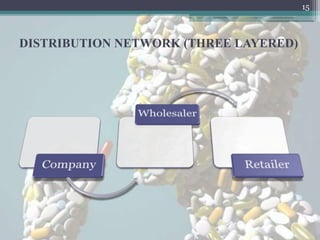
DISTRIBUTION NETWORK (THREE LAYERED)
16


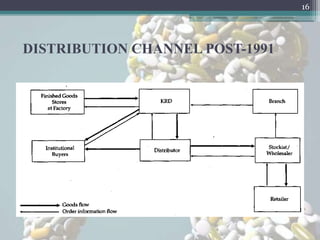
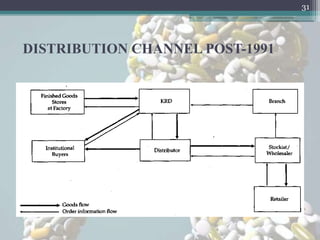
DISTRIBUTION CHANNEL POST-1991
17


OBJECTIVES OF NEW SYSTEM
• Improvements in:
  ▫ Customer service.
  ▫ Sales and profitability.
• Reduction in:
  ▫ Accounts receivable.
  ▫ The functions of receiving supplies,sorting,stocking and dispatching at
     various branches.
18


ACTIONS TAKEN BY KPL AFTER 1991
• Reduction in:
   o Inventory levels post 1991.
   o Book debts.
   o The distribution related staff.
   o Time consumption in logistics.
• Resulting in increase in profitability.
19


BENEFITS
• Reduction in inventory with increase in order frequency.
• Customer service increased.
• Faster order processing.
• Book Debt reduced from 90 days to 7 days of sales.
• Distribution staff reduced from 600 to 200.
20


OBJECTIVES

            PRE-1991                           POST-1991

• Reduces distribution costs        • Increase in customer service.
  (increased due to account         • Faster order processing.
  receivables from wholesalers).    • Reduction in the book debts.

• Wholesalers were not willing or
  prepared to handle sales
  promotion.

• To increase customer service.
21


OBJECTIVES OF ADDING NEW LAYER OF KRD

• Reduces distribution costs (increased due to account receivables from
  wholesalers).
• Wholesalers were not willing or equipped to handle sales promotion.
• To increase customer service.
• Debt collecting was a major duty of the branch staff.
22


REASONS OF FAILURE (PRE-1991)
• Higher cost of distribution.
• Poor customer service.
• Time of staff at branch level was spent on distribution and collections.
• Negligence in Sales promotions.
23


FUNCTIONS OF KRD POST-1991
I.e. After Introduction Of Distributors
 • Improved customer and wholesaler services.
 • Order processing.
 • Reducing accounts receivable.
 • Improving sales and profitability.
 • Branches no longer the part of physical flow.
 • Warehousing and infrastructure.
 • Book debts were reduced.
24


    COST ADVANTAGES
    Manpower related                Other costs                    Inventory related
•    Elimination of 200       •   Reduction in cost of         •    Cost incurred in inventory

     people employed at the       accounts receivable by            keeping by the KRD’s
                                                                    would be zero.
     KRD affecting to             elimination of the KRD .
                                                               •    Establishment costs in
     receiving supplies,      •   Reduction in the
                                                                    terms of infrastructure
     sorting, stocking and        transportation cost due to        would decrease.
     dispatching.                 elimination of one           •    Inventory costs affecting to
•    Order processing.            company level in the              the factory inventory would
                                  channel.                          be reduced.

                              •   Cost related to debt
                                  collection would be
                                  reduced.
25


SERVICE RELATED COST ADVANTAGES

• Improvement In:
  o The responsiveness of the order processing.
  o On time delivery.
  o Customer satisfaction.
  o Time consumption.
26


IMPLEMENTATION OF IT
• Improvement In:
  o The demand accuracy.
  o Order fulfillment satisfaction levels.
  o Inventory level control system and inventory turns across the network.
  o Profitability and productivity.
  o Sales and operations planning process through integration.
27


SOCIAL RESPONSIBILITY
• Category Distribution.
• Competition.
• Printing price on medicine.
28


S.W.O.T ANALYSIS
Strength                              Weakness
• Only Seller.                        • Unplanned Expansion.
• Large Product Line.                 • Distribution Channel.
• Credibility Period.                 • Delivery Period.
• No Control Over Price Earlier.      • Inventory Control.
• Large Sellers and Wholesalers.
• Large Group of M.R and Stockiest.
• KRD.
29


Cont.
Opportunity             Threat
• Global Expansion.     • DPCO.
• One of The Pioneer.   • Government.
                        • Receivables.
                        • Territorial Barrier.
                        • Completion.
30


STRATEGY
• Employees.
• Branch.
• Pricing product line.
• Monopoly.
• Distribution channel.
• Receivables.
• Cost .
• Export.
• Introduction of KRD.
• The flow of material pass through KRD.
• Is there really need for KRD?
31


DISTRIBUTION CHANNEL POST-1991
32


ETHICS

• Reducing Employees.
• Delivery time.
• Profit.
33


THANK YOU

Kalyan pharma ltd.

  • 1.
    KALYAN PHARMA LIMITED Presented By: Parth V. Purohit
  • 2.
    2 INTRODUCTION • Incorporated in1907. • Paid up capital: o Pre 1991: 5 lakhs. o Post 1991: 411 Lakhs. • 60 different Products. • 16 KRDs. • 24 Branch Offices. • 40 Distribution channels. • 2000 Stockiest and Wholesalers. • 687 Medical Representatives.
  • 3.
  • 4.
    4 EFFECT OF DPCOON CHANNELS
  • 5.
    5 DPCO (1962) • PublishedThe price list of products by o Manufacturers o Importers o Distributors o Chemists.
  • 6.
    6 DPCO (1963) • Freezingof sales prices of drugs at the level obtained on 1st April 1963. • In 1966 were as follows: o Manufacturers had to secure prior approval of the government before increasing the prices of any formulations in their lists as per the 30th June, 1966. o Prices of drugs sold in loose were regulated. o Manufacturers to stamp the retail selling prices on the containers of the drugs.
  • 7.
    7 IMPACT OF DPCO(1963) ON PHARMACEUTICAL SECTOR • Reduction in the profitability. • Troubled long term growth. • Voluntary price reductions.
  • 8.
    8 DPCO (1970) • Toreduce the high prices of essential drugs. • Providing sufficient incentives to the industry to facilitate its growth. • To develop research facilities and expansion in a planned manner . • To promote diversification of entrepreneurship in future development of industry thus providing better opportunity for technically qualified Indian personnel's. • Restriction on excessive profits. • Bulk Drugs were divided into “ Essential and Others”. • Profit margin were dictated.
  • 9.
    9 IMPACT OF DPCO(1970) • Reduction in profitability due to price control in 1970. • Increase in prices of some of the products.
  • 10.
    10 DPCO (1979) • Thebulk drugs were grouped into three different categories. • The maximum sale prices of selective bulk drugs were fixed: o Category 1 prices – 14% post tax on net worth. o Category 2 prices – 14% post tax on net worth. o Category 3 (Others) prices – 12% post tax on net worth.
  • 11.
    11 IMPACT OF DPCO(1979) • Mark up for three different categories turned out to be unrealistic: o Mark ups for category 1 and 2 were much lower than break even level hence they had no incentives to produce. o Considerable time taken for the revision of prices. As the cost increases remain uncompensated for some time, the profits as a results was even less. o While granting price approvals, cost accounting based on certain norms was favorable for some while penalized others.
  • 12.
    12 IMPACT OF KPLCHANNELS AFTER DPCO 1979 • DPCO forced to reduce retailer margin from 25% to 15 %. • Wholesalers were expected to give credit to retailers. • The sales target linked discount for the wholesalers was from 2.5%-5%. • Direct sales to retailers was stopped in 1982. • This helped in lesser effort of invoicing and order processing.
  • 13.
    13 DPCO (1987) • Reclassificationof three categories of drugs into two categories: a) Category 1 – Drugs necessary for national health program ( 27 drugs – entitled to 75% MAPE Maximum Allowed Post Manufacturing Expenses). b) Category 2 – Other essential drugs ( 139 drugs – entitled to 100% MAPE). • Results o regulate reasonable distribution. o Increase supply of produced bulk drugs.
  • 14.
    14 IMPACT OF DPCO(1987) • No attention on increase in costs of input, conversion and packaging while fixing prices in 1979.
  • 15.
  • 16.
  • 17.
    17 OBJECTIVES OF NEWSYSTEM • Improvements in: ▫ Customer service. ▫ Sales and profitability. • Reduction in: ▫ Accounts receivable. ▫ The functions of receiving supplies,sorting,stocking and dispatching at various branches.
  • 18.
    18 ACTIONS TAKEN BYKPL AFTER 1991 • Reduction in: o Inventory levels post 1991. o Book debts. o The distribution related staff. o Time consumption in logistics. • Resulting in increase in profitability.
  • 19.
    19 BENEFITS • Reduction ininventory with increase in order frequency. • Customer service increased. • Faster order processing. • Book Debt reduced from 90 days to 7 days of sales. • Distribution staff reduced from 600 to 200.
  • 20.
    20 OBJECTIVES PRE-1991 POST-1991 • Reduces distribution costs • Increase in customer service. (increased due to account • Faster order processing. receivables from wholesalers). • Reduction in the book debts. • Wholesalers were not willing or prepared to handle sales promotion. • To increase customer service.
  • 21.
    21 OBJECTIVES OF ADDINGNEW LAYER OF KRD • Reduces distribution costs (increased due to account receivables from wholesalers). • Wholesalers were not willing or equipped to handle sales promotion. • To increase customer service. • Debt collecting was a major duty of the branch staff.
  • 22.
    22 REASONS OF FAILURE(PRE-1991) • Higher cost of distribution. • Poor customer service. • Time of staff at branch level was spent on distribution and collections. • Negligence in Sales promotions.
  • 23.
    23 FUNCTIONS OF KRDPOST-1991 I.e. After Introduction Of Distributors • Improved customer and wholesaler services. • Order processing. • Reducing accounts receivable. • Improving sales and profitability. • Branches no longer the part of physical flow. • Warehousing and infrastructure. • Book debts were reduced.
  • 24.
    24 COST ADVANTAGES Manpower related Other costs Inventory related • Elimination of 200 • Reduction in cost of • Cost incurred in inventory people employed at the accounts receivable by keeping by the KRD’s would be zero. KRD affecting to elimination of the KRD . • Establishment costs in receiving supplies, • Reduction in the terms of infrastructure sorting, stocking and transportation cost due to would decrease. dispatching. elimination of one • Inventory costs affecting to • Order processing. company level in the the factory inventory would channel. be reduced. • Cost related to debt collection would be reduced.
  • 25.
    25 SERVICE RELATED COSTADVANTAGES • Improvement In: o The responsiveness of the order processing. o On time delivery. o Customer satisfaction. o Time consumption.
  • 26.
    26 IMPLEMENTATION OF IT •Improvement In: o The demand accuracy. o Order fulfillment satisfaction levels. o Inventory level control system and inventory turns across the network. o Profitability and productivity. o Sales and operations planning process through integration.
  • 27.
    27 SOCIAL RESPONSIBILITY • CategoryDistribution. • Competition. • Printing price on medicine.
  • 28.
    28 S.W.O.T ANALYSIS Strength Weakness • Only Seller. • Unplanned Expansion. • Large Product Line. • Distribution Channel. • Credibility Period. • Delivery Period. • No Control Over Price Earlier. • Inventory Control. • Large Sellers and Wholesalers. • Large Group of M.R and Stockiest. • KRD.
  • 29.
    29 Cont. Opportunity Threat • Global Expansion. • DPCO. • One of The Pioneer. • Government. • Receivables. • Territorial Barrier. • Completion.
  • 30.
    30 STRATEGY • Employees. • Branch. •Pricing product line. • Monopoly. • Distribution channel. • Receivables. • Cost . • Export. • Introduction of KRD. • The flow of material pass through KRD. • Is there really need for KRD?
  • 31.
  • 32.
    32 ETHICS • Reducing Employees. •Delivery time. • Profit.
  • 33.