TO IPO OR NOT TO IPO?
GOLDMANSACHS
Presented by
Arun Jose, IIMLucknow
Ayush Gutgutia, IIMLucknow
Why has GoldmanSachs enjoyedthe greatest reputation
among its peers?
Question #1
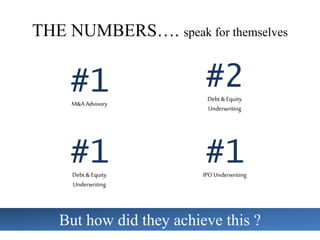
THE NUMBERS…. speak for themselves
#1M&AAdvisory
#2Debt &Equity
Underwriting
#1IPO Underwriting
#1Debt &Equity
Underwriting
But how didthey achieve this?But how did they achieve this ?
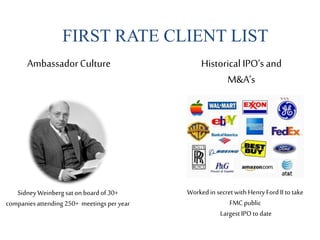
FIRST RATE CLIENT LIST
Historical IPO’s and
M&A’s
AmbassadorCulture
SidneyWeinbergsatonboardof30+
companiesattending250+ meetings per year
Workedin secret with HenryFordII totake
FMC public
LargestIPOto date
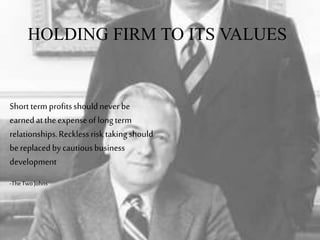
HOLDING FIRM TO ITS VALUES
Shorttermprofitsshouldnever be
earnedattheexpenseoflongterm
relationships.Recklessrisk takingshould
bereplacedbycautiousbusiness
development
-TheTwo Johns
HOLDING FIRM TO ITS VALUES
• Avoidedrecklessrisktaking
• 1st WSFirmtoinstitutionalizeethics
• Did notrepresenthostilebidders
• Whiteknightstrategy
• Intenselytrainedcustomer-centricworkforce
…..led to Goldman being viewed as a
trustworthy partner
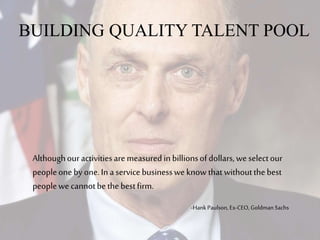
BUILDING QUALITY TALENT POOL
Althoughouractivitiesare measuredinbillionsofdollars,weselectour
peopleonebyone.In aservicebusinessweknowthatwithoutthebest
peoplewe cannotbethebestfirm.
-HankPaulson, Ex-CEO, Goldman Sachs
BUILDING QUALITY TALENT POOL
• Hiredthebesttalent
• Strong focus onretention
• Promotedtalentfromwithin it’sown ranks
• Interestingdealslowturnover
• Promotedteameffort(8th commandment)
• Compensationlinkedtosenioritynot performance
…..led to employees remaining loyal and
working hard to climb the ladder
Why did it take so longto decide onthe IPO issue?
Question #2
Thefirm doesnothavetofollowtherestofWall Street. Thechallengeis
keepingourculture,ourprofitabilityandourgrowth.Itishumannature
nottotinkerwitha goodthing
-JohnWeinberg, ManagingPartner, Goldman Sachs
IPO would bring many challenges
• Currently operating at a good level
• Capitalbase growing compared to competitors
• IPO could dilute culture and work ethics
• Increased regulatory scrutiny
• Dissolution of partnership model
• High compensations and voting rights
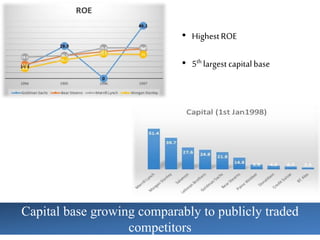
Capital base growing comparably to publicly traded
competitors
• HighestROE
• 5th largestcapitalbase
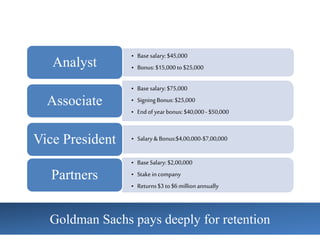
• Basesalary: $45,000
• Bonus:$15,000to $25,000Analyst
• Basesalary: $75,000
• SigningBonus:$25,000
• End of year bonus: $40,000-$50,000
Associate
• Salary&Bonus:$4,00,000-$7,00,000Vice President
• BaseSalary: $2,00,000
• Stake incompany
• Returns$3 to$6millionannually
Partners
Goldman Sachs pays deeply for retention
Did Goldman Sachs have enough capital to
grow? Can it grow fast enough to retain its
position?
Question #3
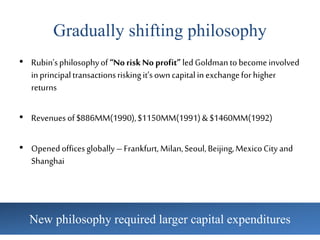
Gradually shifting philosophy
• Rubin’sphilosophyof“NoriskNoprofit”ledGoldmantobecomeinvolved
inprincipaltransactionsriskingit’sowncapitalinexchangeforhigher
returns
• Revenuesof$886MM(1990),$1150MM(1991)& $1460MM(1992)
• Openedofficesglobally–Frankfurt, Milan,Seoul,Beijing,MexicoCityand
Shanghai
New philosophy required larger capital expenditures
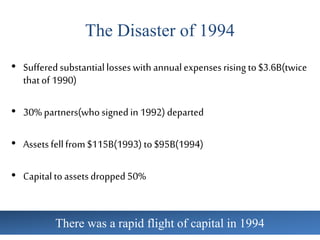
The Disaster of 1994
• Sufferedsubstantiallosseswith annualexpensesrising to$3.6B(twice
thatof1990)
• 30% partners(whosignedin 1992) departed
• Assetsfellfrom$115B(1993) to$95B(1994)
• Capitaltoassetsdropped50%
There was a rapid flight of capital in 1994
Youcannotruna multinationalglobalbusinessonpartnershipcapital…a
riskybusiness ontopofa riskycapitalstructure
-UnnamedFormerPartner, Goldman Sachs
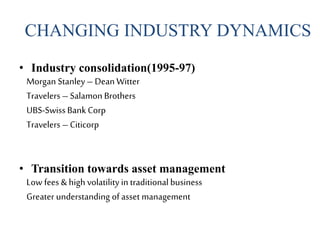
CHANGING INDUSTRY DYNAMICS
• Industry consolidation(1995-97)
Morgan Stanley– Dean Witter
Travelers – Salamon Brothers
UBS-Swiss Bank Corp
Travelers – Citicorp
• Transition towards asset management
Low fees & high volatilityin traditional business
Greater understanding of asset management
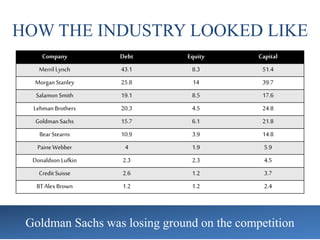
HOW THE INDUSTRY LOOKED LIKE
Company Debt Equity Capital
MerrilLynch 43.1 8.3 51.4
Morgan Stanley 25.8 14 39.7
Salamon Smith 19.1 8.5 17.6
LehmanBrothers 20.3 4.5 24.8
Goldman Sachs 15.7 6.1 21.8
Bear Stearns 10.9 3.9 14.8
Paine Webber 4 1.9 5.9
Donaldson Lufkin 2.3 2.3 4.5
Credit Suisse 2.6 1.2 3.7
BT AlexBrown 1.2 1.2 2.4
Goldman Sachs was losing ground on the competition
Although Goldman Sachs was against having a larger
organization for fear of culturedilution it was in need of capital
infusion so thatit could stay in competitionwith theother
players in themarket
Could they retaintheir capitalbase?
Question #4
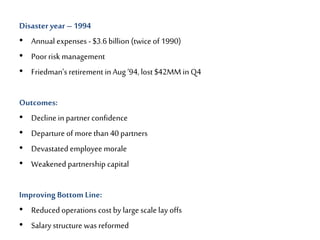
Disaster year –1994
• Annual expenses - $3.6 billion (twice of 1990)
• Poorrisk management
• Friedman’s retirement in Aug ‘94, lost $42MM in Q4
Outcomes:
• Decline in partnerconfidence
• Departure of more than 40 partners
• Devastated employee morale
• Weakenedpartnership capital
Improving Bottom Line:
• Reduced operations cost by large scale lay offs
• Salarystructure was reformed
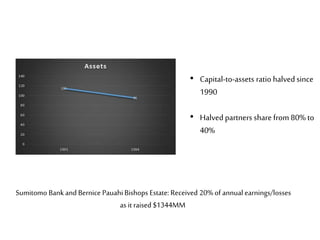
• Capital-to-assets ratio halved since
1990
• Halvedpartners sharefrom 80% to
40%
Sumitomo Bankand Bernice Pauahi Bishops Estate: Received 20%of annual earnings/losses
as it raised $1344MM
Would M&A be a better route?
Question #5
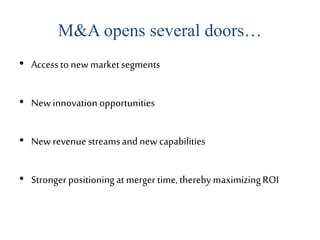
M&A opens several doors…
• Accesstonewmarketsegments
• Newinnovation opportunities
• Newrevenue streamsand new capabilities
• Stronger positioningatmerger time,therebymaximizingROI
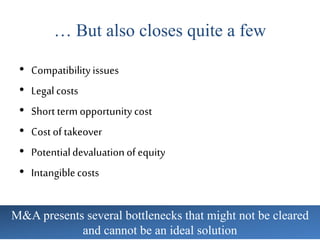
… But also closes quite a few
• Compatibilityissues
• Legal costs
• Short term opportunity cost
• Cost of takeover
• Potentialdevaluation of equity
• Intangiblecosts
M&A presents several bottlenecks that might not be cleared
and cannot be an ideal solution
Would increased scurrility in going public
damage Goldman Sachs?
Question #6
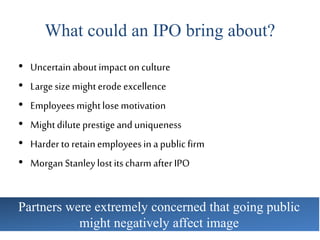
What could an IPO bring about?
• Uncertainaboutimpactonculture
• Largesize mighterodeexcellence
• Employeesmightlosemotivation
• Mightdiluteprestigeand uniqueness
• Harder to retainemployeesin apublic firm
• Morgan Stanleylostitscharm afterIPO
Partners were extremely concerned that going public
might negatively affect image
What willbe impactIPO onsenior partners, nonpartner employees
Sumitomoto &Bernice, Limited partners, shareholders, customer,
competitors?
Question #7
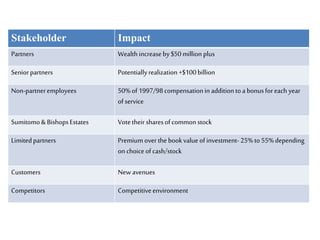
Stakeholder Impact
Partners Wealthincreaseby$50million plus
Seniorpartners Potentiallyrealization+$100billion
Non-partneremployees 50%of 1997/98compensationin additiontoa bonusforeach year
ofservice
Sumitomo& BishopsEstates Votetheir sharesofcommon stock
Limitedpartners Premium over thebookvalueofinvestment- 25%to 55%depending
onchoice ofcash/stock
Customers Newavenues
Competitors Competitiveenvironment
Would theagency problems increase or decrease after IPO? How
mightmoral hazard & selection (ESOPs) might arise?
Question #8
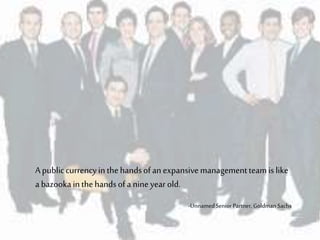
Apubliccurrencyinthehandsofanexpansivemanagementteamislike
a bazookainthehandsofa nineyearold.
-UnnamedSenior Partner, Goldman Sachs
Increasing Agency Problems
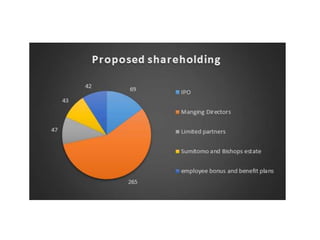
• Only14%equityisdilutedtothepublic
• Employeeswillbemoreconcernedwithincreasingtransactionalprofitsto
meet earningsexpectationsoverlong-termshareholderwealth
• Thelossoflucrativepaypackagesat partnerlevelwillleadtogreater
employeeturnover
• Lackofaccountabilityofcapitalwillleadtorecklessspending
….Hence Goldman incorporated ESOP’s with lock-in
period to reduce agency problems
But ESOP’s wont solve everything!
• Employeeswilltakedecisions ina bid toincrease short termshare
prices
• Moreriskier decisionswouldbetakentoimproveannual
profitabilitymetrics
• Valuesmightbecompromisedtoattainannual targets
….Hence ESOP’s could be a source of tremendous
moral hazard
Would thecontract monitoring be based on outcome or behavior
based (before and afterthe merger)?
Question #9
Behavioral changes to be expected
Before Merger: Behavior Based
• Monitoringmechanisms
• Equity of agentsat stake
• Partners are principals
Post Merger: Outcome Based
• Effectivein curbing agentopportunism
THANK YOU

Goldman sachs ipo dilemma - case study

  • 1.
    TO IPO ORNOT TO IPO? GOLDMANSACHS Presented by Arun Jose, IIMLucknow Ayush Gutgutia, IIMLucknow
  • 2.
    Why has GoldmanSachsenjoyedthe greatest reputation among its peers? Question #1
  • 3.
    THE NUMBERS…. speakfor themselves #1M&AAdvisory #2Debt &Equity Underwriting #1IPO Underwriting #1Debt &Equity Underwriting But how didthey achieve this?But how did they achieve this ?
  • 4.
    FIRST RATE CLIENTLIST Historical IPO’s and M&A’s AmbassadorCulture SidneyWeinbergsatonboardof30+ companiesattending250+ meetings per year Workedin secret with HenryFordII totake FMC public LargestIPOto date
  • 5.
    HOLDING FIRM TOITS VALUES Shorttermprofitsshouldnever be earnedattheexpenseoflongterm relationships.Recklessrisk takingshould bereplacedbycautiousbusiness development -TheTwo Johns
  • 6.
    HOLDING FIRM TOITS VALUES • Avoidedrecklessrisktaking • 1st WSFirmtoinstitutionalizeethics • Did notrepresenthostilebidders • Whiteknightstrategy • Intenselytrainedcustomer-centricworkforce …..led to Goldman being viewed as a trustworthy partner
  • 7.
    BUILDING QUALITY TALENTPOOL Althoughouractivitiesare measuredinbillionsofdollars,weselectour peopleonebyone.In aservicebusinessweknowthatwithoutthebest peoplewe cannotbethebestfirm. -HankPaulson, Ex-CEO, Goldman Sachs
  • 8.
    BUILDING QUALITY TALENTPOOL • Hiredthebesttalent • Strong focus onretention • Promotedtalentfromwithin it’sown ranks • Interestingdealslowturnover • Promotedteameffort(8th commandment) • Compensationlinkedtosenioritynot performance …..led to employees remaining loyal and working hard to climb the ladder
  • 9.
    Why did ittake so longto decide onthe IPO issue? Question #2
  • 10.
    Thefirm doesnothavetofollowtherestofWall Street.Thechallengeis keepingourculture,ourprofitabilityandourgrowth.Itishumannature nottotinkerwitha goodthing -JohnWeinberg, ManagingPartner, Goldman Sachs
  • 11.
    IPO would bringmany challenges • Currently operating at a good level • Capitalbase growing compared to competitors • IPO could dilute culture and work ethics • Increased regulatory scrutiny • Dissolution of partnership model • High compensations and voting rights
  • 12.
    Capital base growingcomparably to publicly traded competitors • HighestROE • 5th largestcapitalbase
  • 13.
    • Basesalary: $45,000 •Bonus:$15,000to $25,000Analyst • Basesalary: $75,000 • SigningBonus:$25,000 • End of year bonus: $40,000-$50,000 Associate • Salary&Bonus:$4,00,000-$7,00,000Vice President • BaseSalary: $2,00,000 • Stake incompany • Returns$3 to$6millionannually Partners Goldman Sachs pays deeply for retention
  • 14.
    Did Goldman Sachshave enough capital to grow? Can it grow fast enough to retain its position? Question #3
  • 15.
    Gradually shifting philosophy •Rubin’sphilosophyof“NoriskNoprofit”ledGoldmantobecomeinvolved inprincipaltransactionsriskingit’sowncapitalinexchangeforhigher returns • Revenuesof$886MM(1990),$1150MM(1991)& $1460MM(1992) • Openedofficesglobally–Frankfurt, Milan,Seoul,Beijing,MexicoCityand Shanghai New philosophy required larger capital expenditures
  • 16.
    The Disaster of1994 • Sufferedsubstantiallosseswith annualexpensesrising to$3.6B(twice thatof1990) • 30% partners(whosignedin 1992) departed • Assetsfellfrom$115B(1993) to$95B(1994) • Capitaltoassetsdropped50% There was a rapid flight of capital in 1994
  • 17.
    Youcannotruna multinationalglobalbusinessonpartnershipcapital…a riskybusiness ontopofariskycapitalstructure -UnnamedFormerPartner, Goldman Sachs
  • 18.
    CHANGING INDUSTRY DYNAMICS •Industry consolidation(1995-97) Morgan Stanley– Dean Witter Travelers – Salamon Brothers UBS-Swiss Bank Corp Travelers – Citicorp • Transition towards asset management Low fees & high volatilityin traditional business Greater understanding of asset management
  • 19.
    HOW THE INDUSTRYLOOKED LIKE Company Debt Equity Capital MerrilLynch 43.1 8.3 51.4 Morgan Stanley 25.8 14 39.7 Salamon Smith 19.1 8.5 17.6 LehmanBrothers 20.3 4.5 24.8 Goldman Sachs 15.7 6.1 21.8 Bear Stearns 10.9 3.9 14.8 Paine Webber 4 1.9 5.9 Donaldson Lufkin 2.3 2.3 4.5 Credit Suisse 2.6 1.2 3.7 BT AlexBrown 1.2 1.2 2.4 Goldman Sachs was losing ground on the competition
  • 20.
    Although Goldman Sachswas against having a larger organization for fear of culturedilution it was in need of capital infusion so thatit could stay in competitionwith theother players in themarket
  • 21.
    Could they retaintheircapitalbase? Question #4
  • 22.
    Disaster year –1994 •Annual expenses - $3.6 billion (twice of 1990) • Poorrisk management • Friedman’s retirement in Aug ‘94, lost $42MM in Q4 Outcomes: • Decline in partnerconfidence • Departure of more than 40 partners • Devastated employee morale • Weakenedpartnership capital Improving Bottom Line: • Reduced operations cost by large scale lay offs • Salarystructure was reformed
  • 23.
    • Capital-to-assets ratiohalved since 1990 • Halvedpartners sharefrom 80% to 40% Sumitomo Bankand Bernice Pauahi Bishops Estate: Received 20%of annual earnings/losses as it raised $1344MM
  • 24.
    Would M&A bea better route? Question #5
  • 25.
    M&A opens severaldoors… • Accesstonewmarketsegments • Newinnovation opportunities • Newrevenue streamsand new capabilities • Stronger positioningatmerger time,therebymaximizingROI
  • 26.
    … But alsocloses quite a few • Compatibilityissues • Legal costs • Short term opportunity cost • Cost of takeover • Potentialdevaluation of equity • Intangiblecosts M&A presents several bottlenecks that might not be cleared and cannot be an ideal solution
  • 27.
    Would increased scurrilityin going public damage Goldman Sachs? Question #6
  • 28.
    What could anIPO bring about? • Uncertainaboutimpactonculture • Largesize mighterodeexcellence • Employeesmightlosemotivation • Mightdiluteprestigeand uniqueness • Harder to retainemployeesin apublic firm • Morgan Stanleylostitscharm afterIPO Partners were extremely concerned that going public might negatively affect image
  • 29.
    What willbe impactIPOonsenior partners, nonpartner employees Sumitomoto &Bernice, Limited partners, shareholders, customer, competitors? Question #7
  • 31.
    Stakeholder Impact Partners Wealthincreaseby$50millionplus Seniorpartners Potentiallyrealization+$100billion Non-partneremployees 50%of 1997/98compensationin additiontoa bonusforeach year ofservice Sumitomo& BishopsEstates Votetheir sharesofcommon stock Limitedpartners Premium over thebookvalueofinvestment- 25%to 55%depending onchoice ofcash/stock Customers Newavenues Competitors Competitiveenvironment
  • 32.
    Would theagency problemsincrease or decrease after IPO? How mightmoral hazard & selection (ESOPs) might arise? Question #8
  • 33.
  • 34.
    Increasing Agency Problems •Only14%equityisdilutedtothepublic • Employeeswillbemoreconcernedwithincreasingtransactionalprofitsto meet earningsexpectationsoverlong-termshareholderwealth • Thelossoflucrativepaypackagesat partnerlevelwillleadtogreater employeeturnover • Lackofaccountabilityofcapitalwillleadtorecklessspending ….Hence Goldman incorporated ESOP’s with lock-in period to reduce agency problems
  • 35.
    But ESOP’s wontsolve everything! • Employeeswilltakedecisions ina bid toincrease short termshare prices • Moreriskier decisionswouldbetakentoimproveannual profitabilitymetrics • Valuesmightbecompromisedtoattainannual targets ….Hence ESOP’s could be a source of tremendous moral hazard
  • 36.
    Would thecontract monitoringbe based on outcome or behavior based (before and afterthe merger)? Question #9
  • 37.
    Behavioral changes tobe expected Before Merger: Behavior Based • Monitoringmechanisms • Equity of agentsat stake • Partners are principals Post Merger: Outcome Based • Effectivein curbing agentopportunism
  • 38.