KIPS NDT Device
Radiation Safety
Presentation Breakdown
• Device information & settings
• Licensing & registration
• Device exposure pattern
• Operator exposure to date
• Safety equipment
• Contacts
Presentation
Breakdown
About the KIPS NDT Device
Device
Information
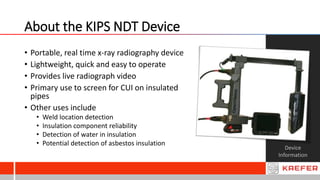
• Portable, real time x-ray radiography device
• Lightweight, quick and easy to operate
• Provides live radiograph video
• Primary use to screen for CUI on insulated
pipes
• Other uses include
• Weld location detection
• Insulation component reliability
• Detection of water in insulation
• Potential detection of asbestos insulation
Device Settings
Device
Settings
Voltage settings:
• 40 kV, 55 kV or 70 kV
Current:
• 0.1 mA, 0.2 mA or 0.3 mA
Beam collimation:
• The beam is tightly collimated towards the
detector
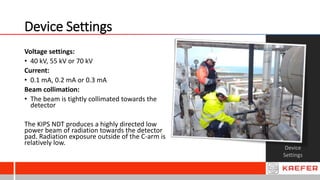
The KIPS NDT produces a highly directed low
power beam of radiation towards the detector
pad. Radiation exposure outside of the C-arm is
relatively low.
Licensing and Registration
Licensing and
Registration
As the KIPS NDT produces a radiation exposure, it is
considered a controlled device as per state/territory
radiation health guidelines.
Licensing and registration requirements (for each
state/territory)
• Use licence
• Possession licence
• Device registration
KAEFER and our operators are licensed to possess and
use this device in South Australia by the EPA
Device Radiation Exposure Pattern
Device Exposure
Pattern
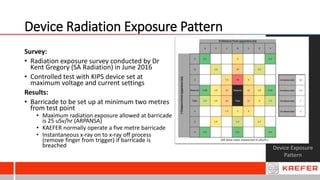
Survey:
• Radiation exposure survey conducted by Dr
Kent Gregory (SA Radiation) in June 2016
• Controlled test with KIPS device set at
maximum voltage and current settings
Results:
• Barricade to be set up at minimum two metres
from test point
• Maximum radiation exposure allowed at barricade
is 25 uSv/hr (ARPANSA)
• KAEFER normally operate a five metre barricade
• Instantaneous x-ray on to x-ray off process
(remove finger from trigger) if barricade is
breached
Operator Radiation Exposure Monitoring
Exposure
Monitoring
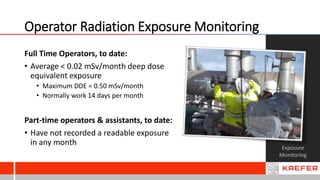
Full Time Operators, to date:
• Average < 0.02 mSv/month deep dose
equivalent exposure
• Maximum DDE = 0.50 mSv/month
• Normally work 14 days per month
Part-time operators & assistants, to date:
• Have not recorded a readable exposure
in any month
Safety Equipment
Safety
Equipment
Site Radiation Safety Equipment
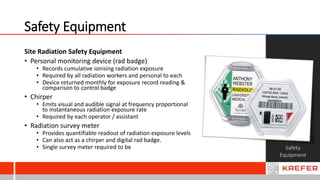
• Personal monitoring device (rad badge)
• Records cumulative ionising radiation exposure
• Required by all radiation workers and personal to each
• Device returned monthly for exposure record reading &
comparison to control badge
• Chirper
• Emits visual and audible signal at frequency proportional
to instantaneous radiation exposure rate
• Required by each operator / assistant
• Radiation survey meter
• Provides quantifiable readout of radiation exposure levels
• Can also act as a chirper and digital rad badge.
• Single survey meter required to be
Supplementary Equipment
Supplementary
Equipment
Site Supplementary Safety Equipment
• Barricade tape
• To barricade so non-radiation workers are not subject to doses
higher than 25 uSv/hr
• Required around work space or at entry point to alert of radiation
zone
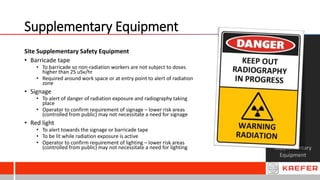
• Signage
• To alert of danger of radiation exposure and radiography taking
place
• Operator to confirm requirement of signage – lower risk areas
(controlled from public) may not necessitate a need for signage
• Red light
• To alert towards the signage or barricade tape
• To be lit while radiation exposure is active
• Operator to confirm requirement of lighting – lower risk areas
(controlled from public) may not necessitate a need for lighting
KAEFER Radiation Contacts
Radiation
Contacts
General Enquiries / Incidents / Accidents
Paul Miller – 0404472319
Project Engineer / Planner
Mitch Harris – 0450003530
Project supervisor / NDT Technician
Radiation Emergencies
Dr. Kent Gregory – 0410 388 018
KAEFER Radiation Safety Officer (SA Radiation)

KAEFER KIPS Safety Presentation

  • 1.
  • 2.
    Presentation Breakdown • Deviceinformation & settings • Licensing & registration • Device exposure pattern • Operator exposure to date • Safety equipment • Contacts Presentation Breakdown
  • 3.
    About the KIPSNDT Device Device Information • Portable, real time x-ray radiography device • Lightweight, quick and easy to operate • Provides live radiograph video • Primary use to screen for CUI on insulated pipes • Other uses include • Weld location detection • Insulation component reliability • Detection of water in insulation • Potential detection of asbestos insulation
  • 4.
    Device Settings Device Settings Voltage settings: •40 kV, 55 kV or 70 kV Current: • 0.1 mA, 0.2 mA or 0.3 mA Beam collimation: • The beam is tightly collimated towards the detector The KIPS NDT produces a highly directed low power beam of radiation towards the detector pad. Radiation exposure outside of the C-arm is relatively low.
  • 5.
    Licensing and Registration Licensingand Registration As the KIPS NDT produces a radiation exposure, it is considered a controlled device as per state/territory radiation health guidelines. Licensing and registration requirements (for each state/territory) • Use licence • Possession licence • Device registration KAEFER and our operators are licensed to possess and use this device in South Australia by the EPA
  • 6.
    Device Radiation ExposurePattern Device Exposure Pattern Survey: • Radiation exposure survey conducted by Dr Kent Gregory (SA Radiation) in June 2016 • Controlled test with KIPS device set at maximum voltage and current settings Results: • Barricade to be set up at minimum two metres from test point • Maximum radiation exposure allowed at barricade is 25 uSv/hr (ARPANSA) • KAEFER normally operate a five metre barricade • Instantaneous x-ray on to x-ray off process (remove finger from trigger) if barricade is breached
  • 7.
    Operator Radiation ExposureMonitoring Exposure Monitoring Full Time Operators, to date: • Average < 0.02 mSv/month deep dose equivalent exposure • Maximum DDE = 0.50 mSv/month • Normally work 14 days per month Part-time operators & assistants, to date: • Have not recorded a readable exposure in any month
  • 8.
    Safety Equipment Safety Equipment Site RadiationSafety Equipment • Personal monitoring device (rad badge) • Records cumulative ionising radiation exposure • Required by all radiation workers and personal to each • Device returned monthly for exposure record reading & comparison to control badge • Chirper • Emits visual and audible signal at frequency proportional to instantaneous radiation exposure rate • Required by each operator / assistant • Radiation survey meter • Provides quantifiable readout of radiation exposure levels • Can also act as a chirper and digital rad badge. • Single survey meter required to be
  • 9.
    Supplementary Equipment Supplementary Equipment Site SupplementarySafety Equipment • Barricade tape • To barricade so non-radiation workers are not subject to doses higher than 25 uSv/hr • Required around work space or at entry point to alert of radiation zone • Signage • To alert of danger of radiation exposure and radiography taking place • Operator to confirm requirement of signage – lower risk areas (controlled from public) may not necessitate a need for signage • Red light • To alert towards the signage or barricade tape • To be lit while radiation exposure is active • Operator to confirm requirement of lighting – lower risk areas (controlled from public) may not necessitate a need for lighting
  • 10.
    KAEFER Radiation Contacts Radiation Contacts GeneralEnquiries / Incidents / Accidents Paul Miller – 0404472319 Project Engineer / Planner Mitch Harris – 0450003530 Project supervisor / NDT Technician Radiation Emergencies Dr. Kent Gregory – 0410 388 018 KAEFER Radiation Safety Officer (SA Radiation)