Journées ABES, May 15, 2013
Maurits van der Graaf
Pleiade Management & Consultancy
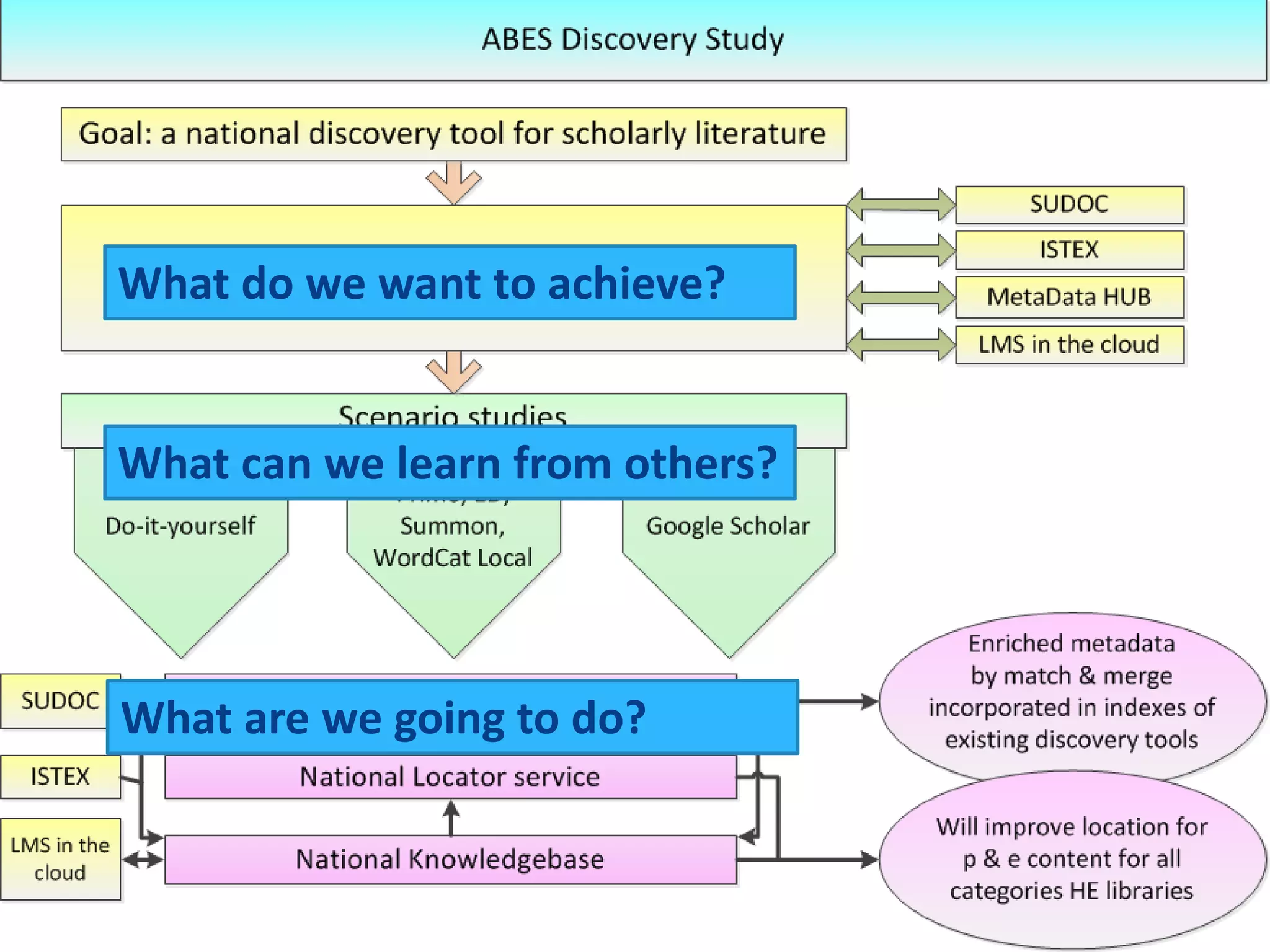
What do we want to achieve?
What can we learn from others?
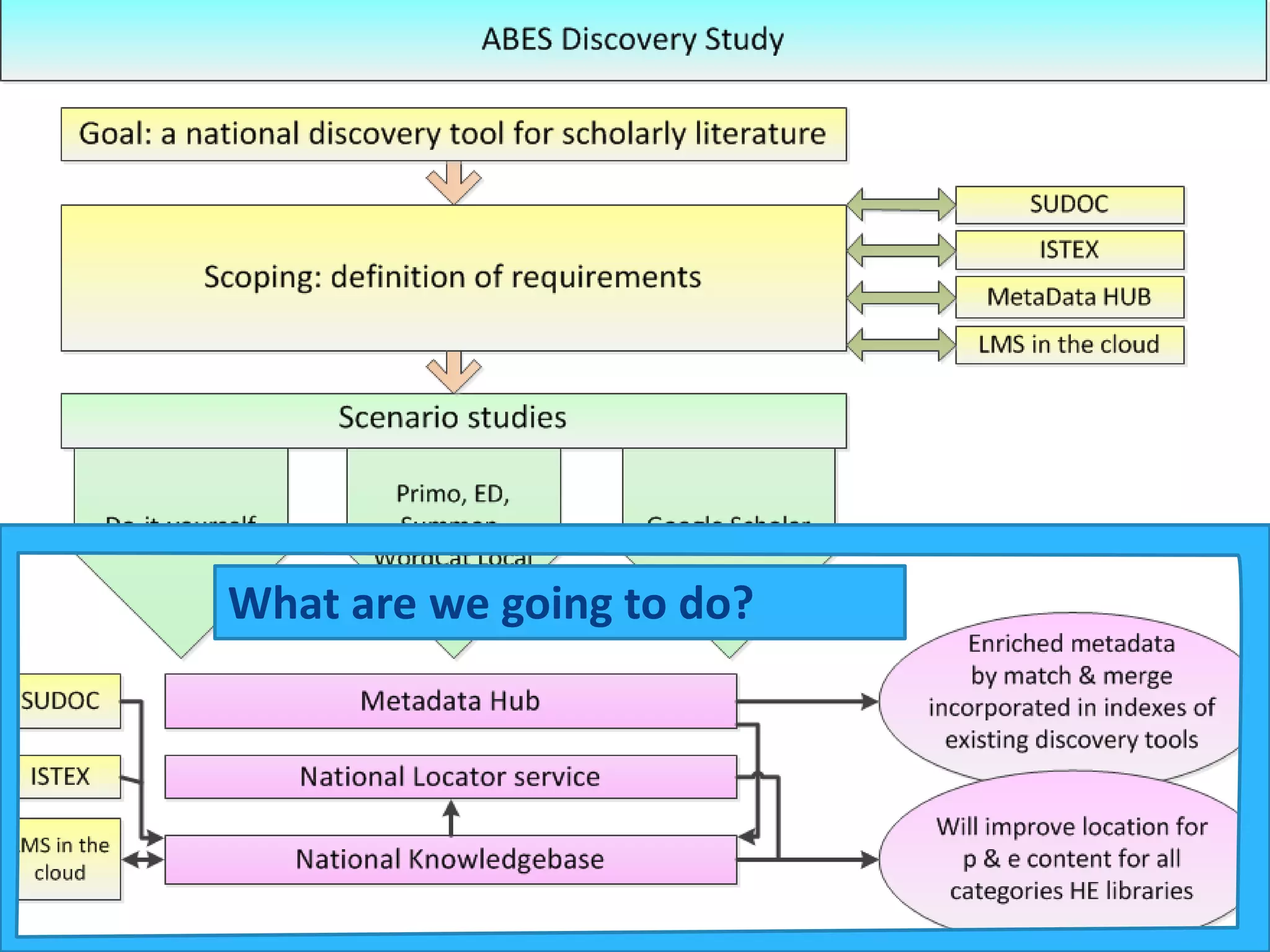
What are we going to do?
Whatdo we wantto achievefor:
end-usersin highereducationinstitutes
• Access to digital and print collection: an user-friendly
discovery tool that gives access to the digital and print
collection of their own library/institute at title and article level
• Access to other digital collections in France via ILL: if their
own library has no access to certain e-content, end-user is
directed to interlibrary loan to get access.
• Enhanced access to French e-content: enhanced access to
French language e-content and/or e-content by French
publishers.
• French language support in the discovery layer: an user-
friendly interface that support French language searching.
Whatdo we wantto achievefor:
the FrenchHE libraries
• Interact with the approx. 22 presently installed discovery
tools at French HE libraries
• Offer a discovery service for libraries with a local link
resolver/knowledgebase
• Offer a discovery service for libraries without a local link
resolver/knowledgebase
Whatdo wewanttoachievefor:
theFrenchnationallibraryinfrastructure
• Should fit in & enhance the French national library
infrastructure:
• The development of the shared ILS system in the cloud (with
shared electronic resource management functionality)
• The ISTEX platform with digital content licensed by national
licenses
• Discovery & access to e-content with focus on scholarly
literature:
• Complementary service to SUDOC with regard to access to e-
journals at article level; to e-books (title and chapter level);
access to other media types (f.e. enriched publications)
• Discovery & access to French scholarly e-content:
• Enhance discovery and access to French language e-content and
to e-content by French publishers.
Discoverysystemsor componentsstudied
• Self-built services:
• Trove – national discovery service (National Library of Australia)
• FINNA – national discovery service (Digital Library of Finland)
• Suchkiste – discovery service for national licences, Germany
• EZB link resolver – national link resolver, Germany
• Journals Online & Print – webservice indicating availability,
Germany
• University Library of Utrecht (new policy following self-built
discovery service)
• Existing webscale discovery services:
• RERO (Switzerland)
• Primo, ED, Summon, WordCat Local and Google Scholar
• Other relevant services:
• Resource discovery programme JISC, UK
• Knowledgebase + (JISC); GOKb
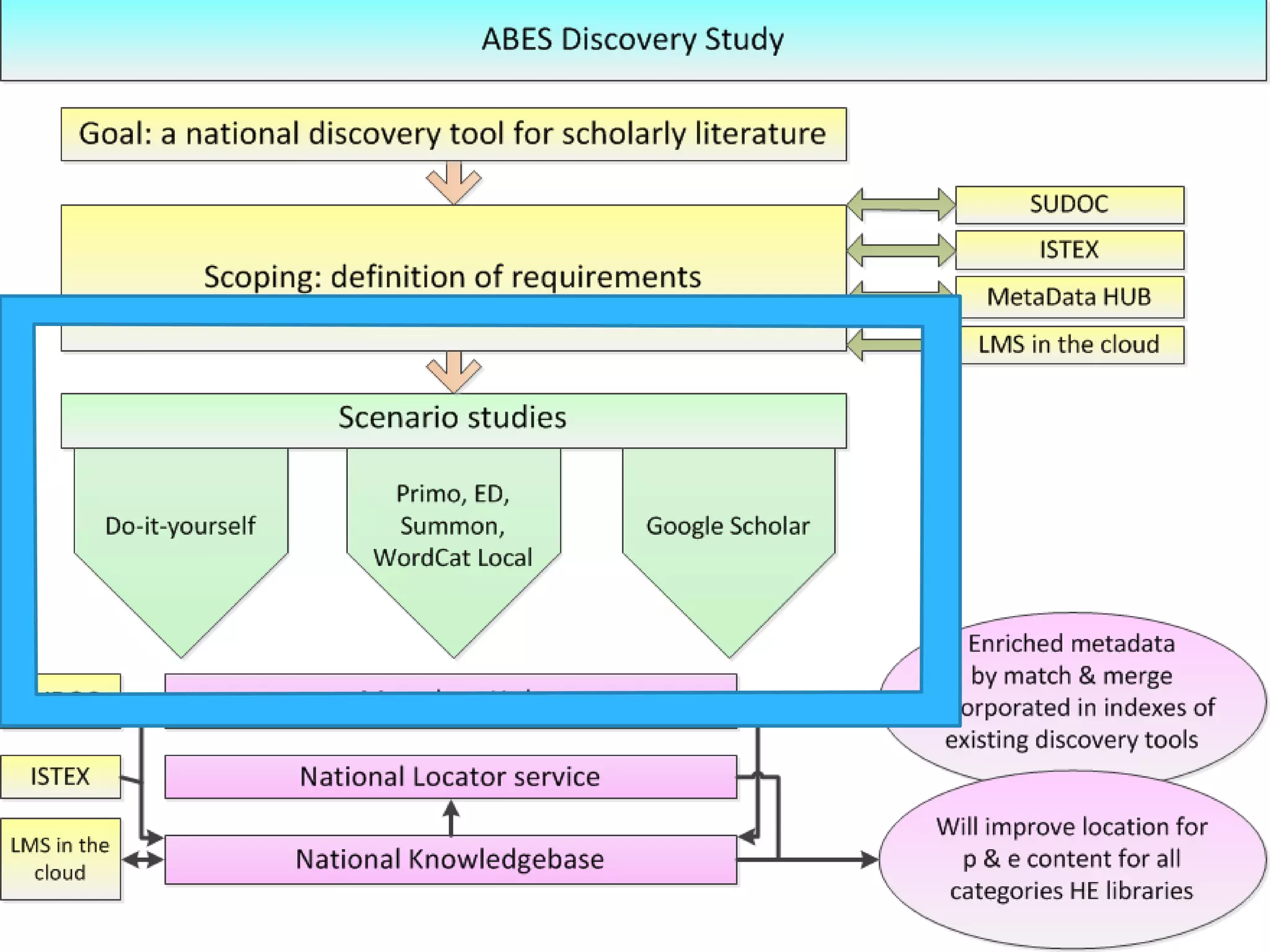
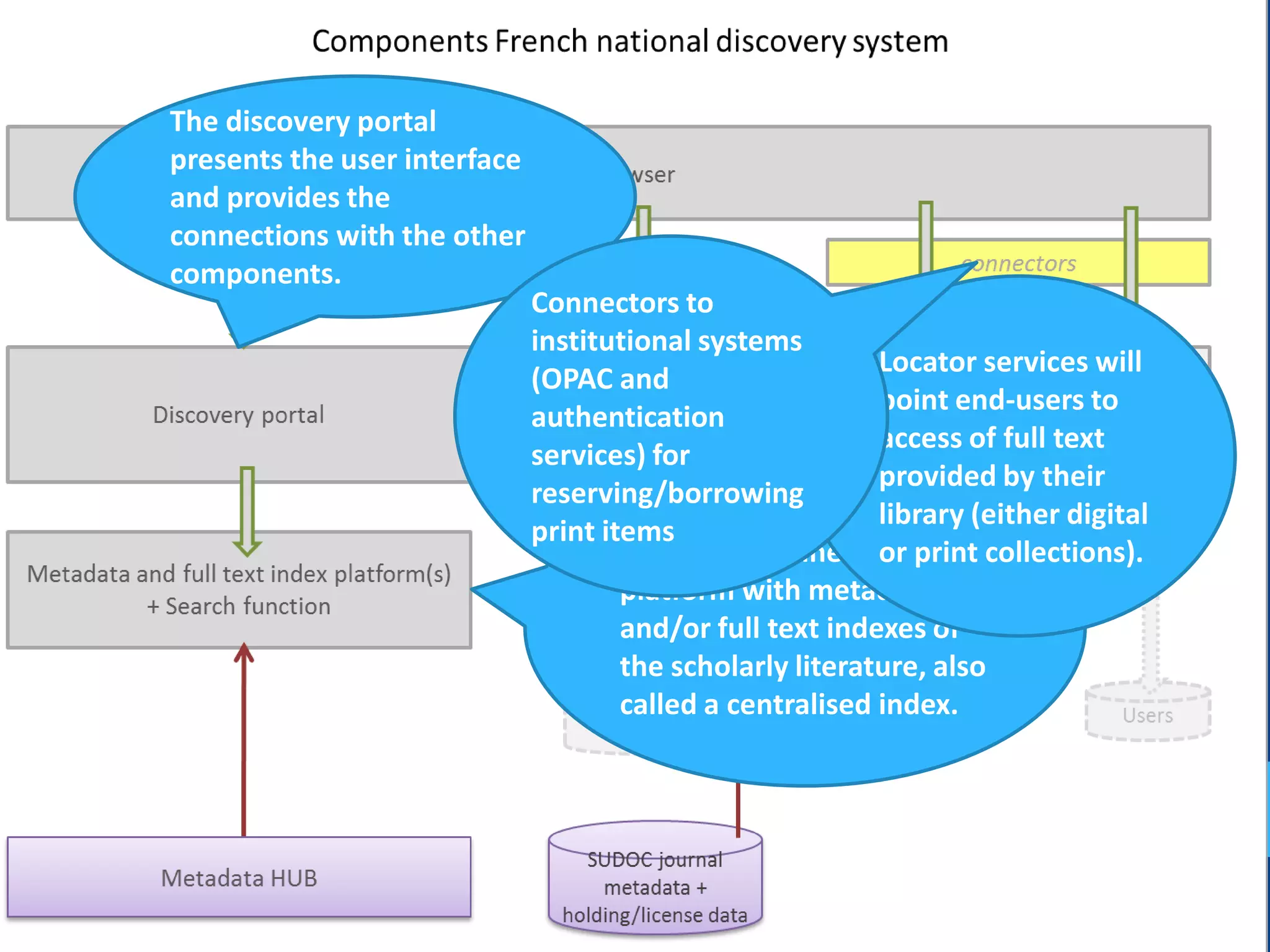
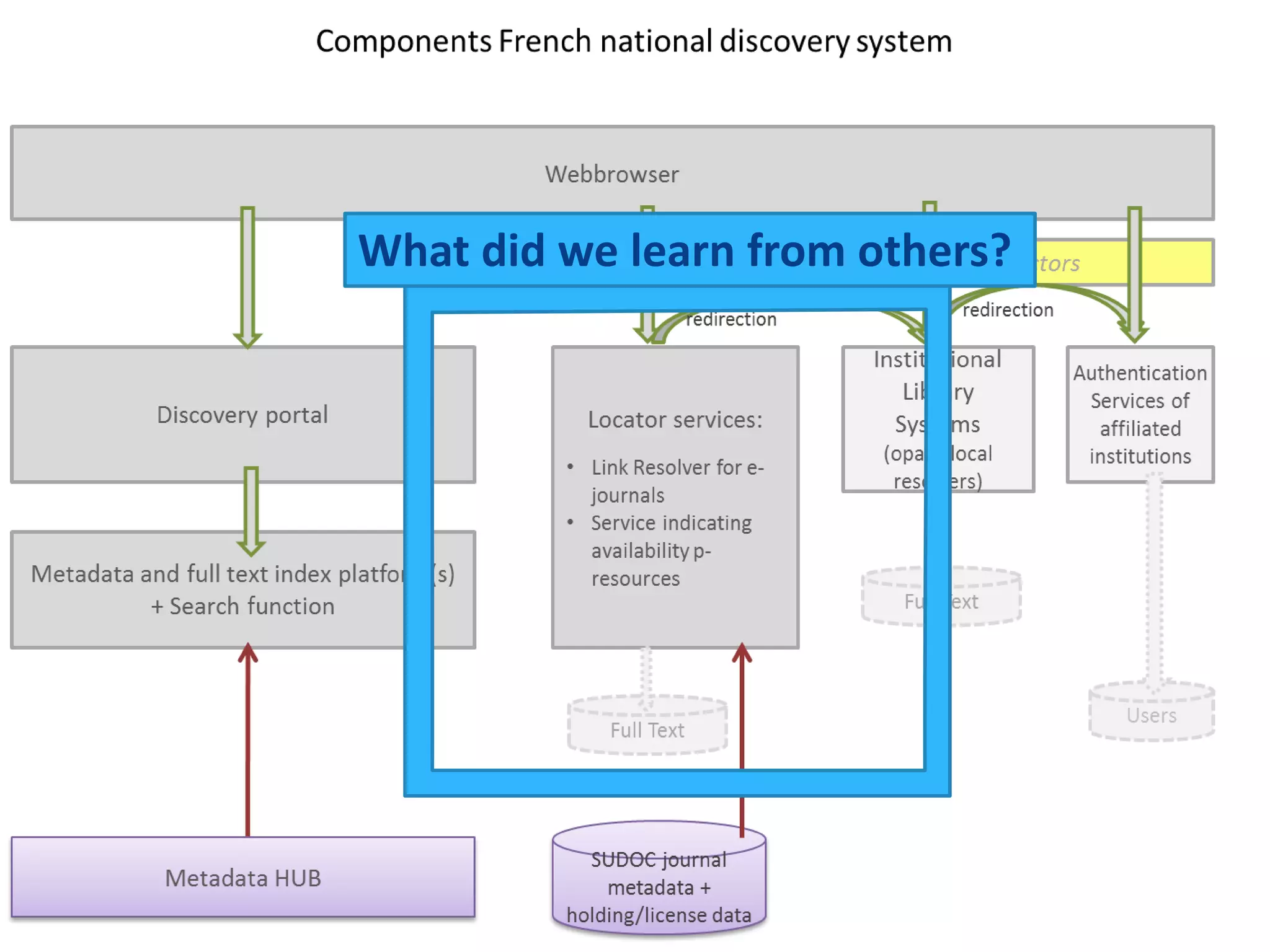
The discovery portal
presents the user interface
and provides the
connections with the other
components.
The portal connects to a
platform with metadata
and/or full text indexes of
the scholarly literature, also
called a centralised index.
Locator services will
point end-users to
access of full text
provided by their
library (either digital
or print collections).
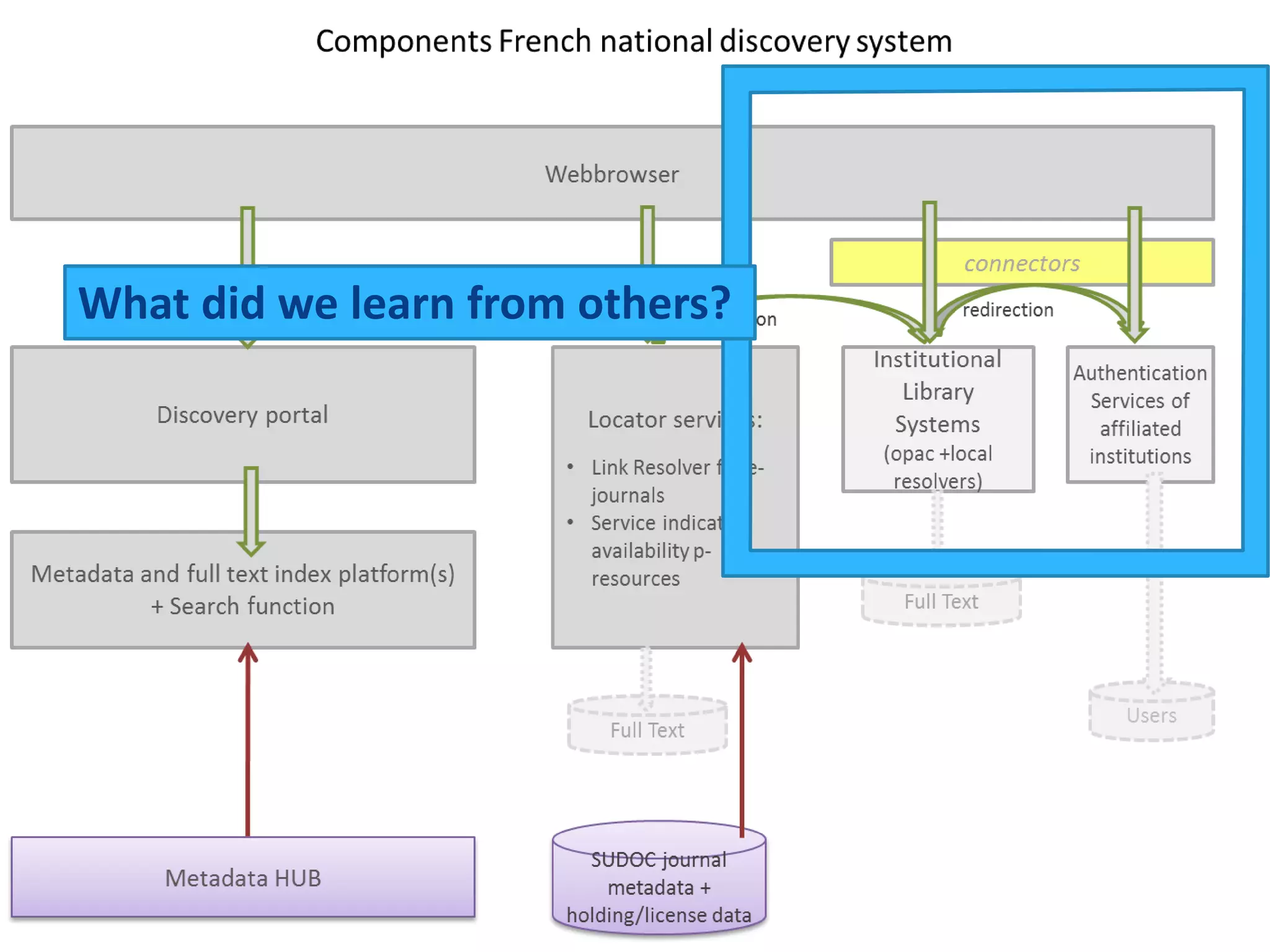
Connectors to
institutional systems
(OPAC and
authentication
services) for
reserving/borrowing
print items
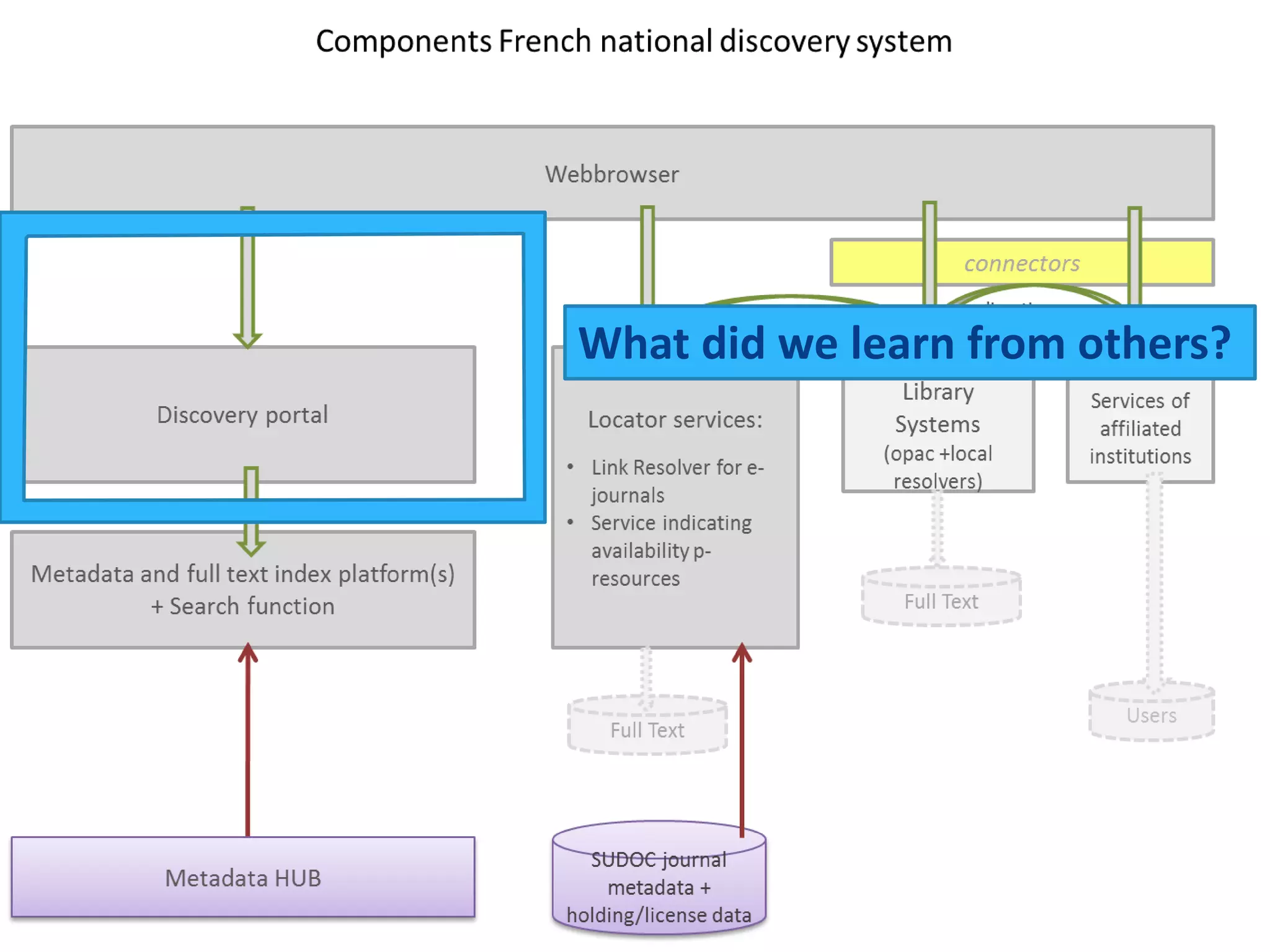
What did we learn from others?
Discoveryportal
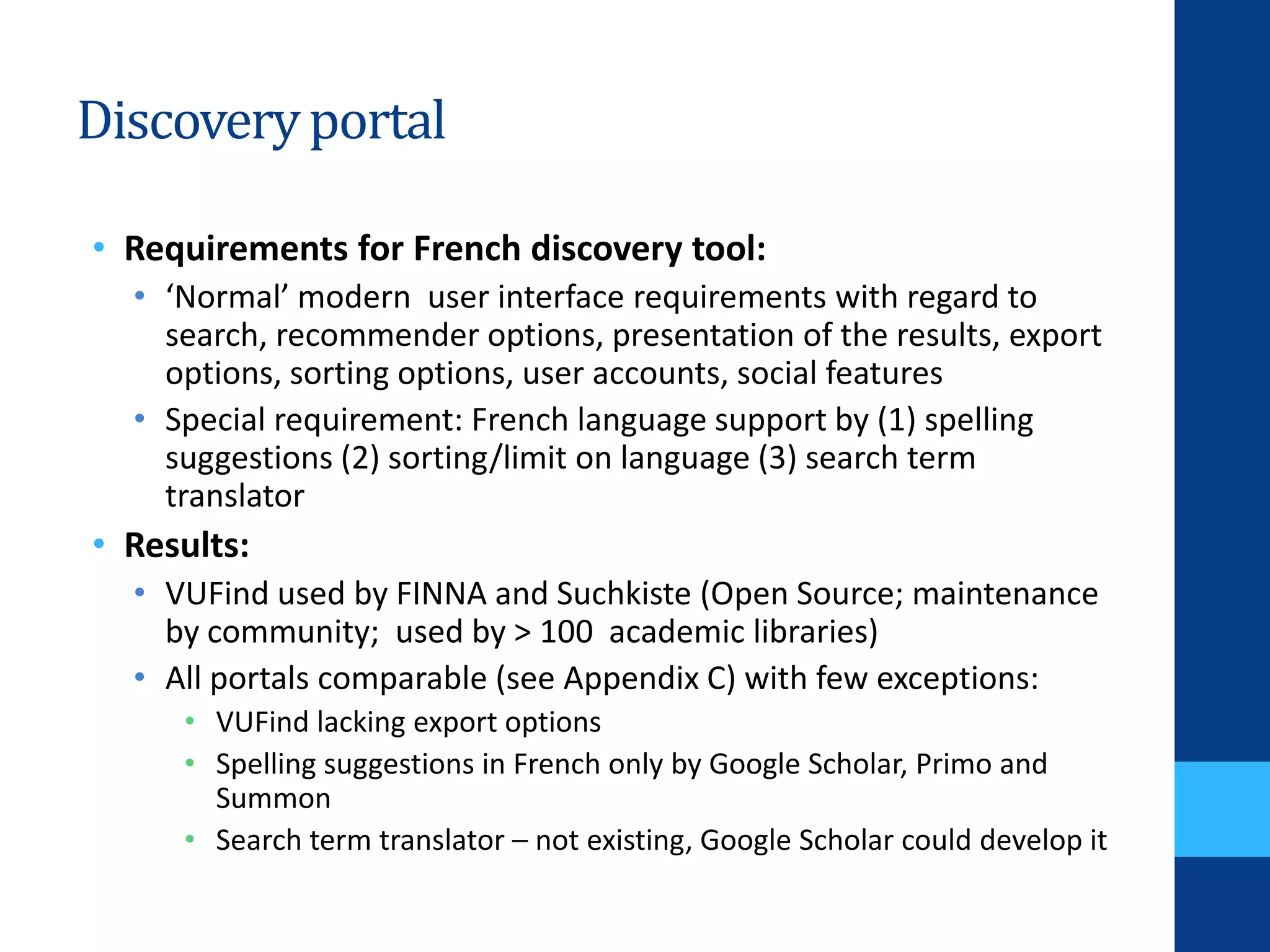
• Requirements for French discovery tool:
• ‘Normal’ modern user interface requirements with regard to
search, recommender options, presentation of the results, export
options, sorting options, user accounts, social features
• Special requirement: French language support by (1) spelling
suggestions (2) sorting/limit on language (3) search term
translator
• Results:
• VUFind used by FINNA and Suchkiste (Open Source; maintenance
by community; used by > 100 academic libraries)
• All portals comparable (see Appendix C) with few exceptions:
• VUFind lacking export options
• Spelling suggestions in French only by Google Scholar, Primo and
Summon
• Search term translator – not existing, Google Scholar could develop it
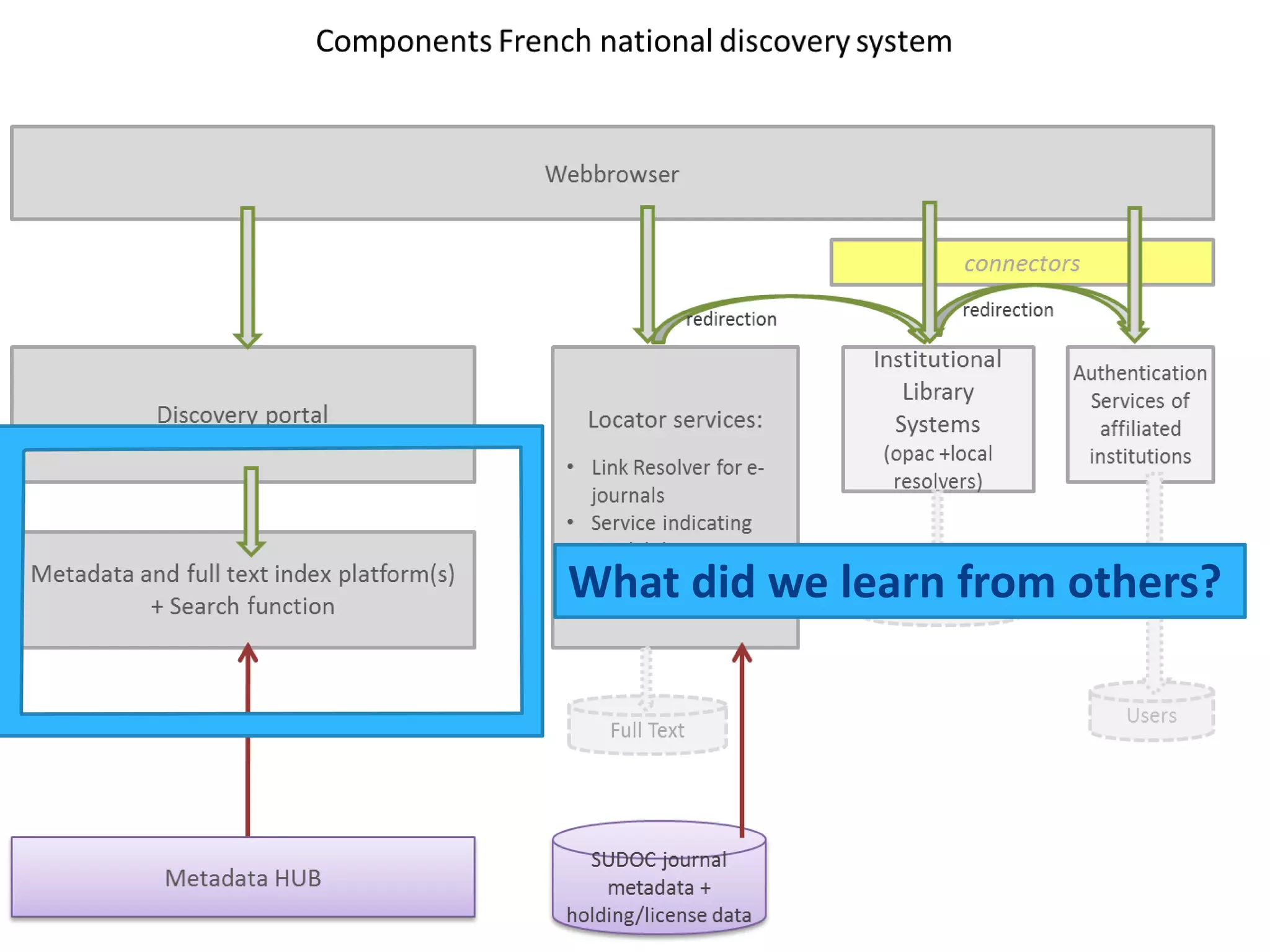
What did we learn from others?
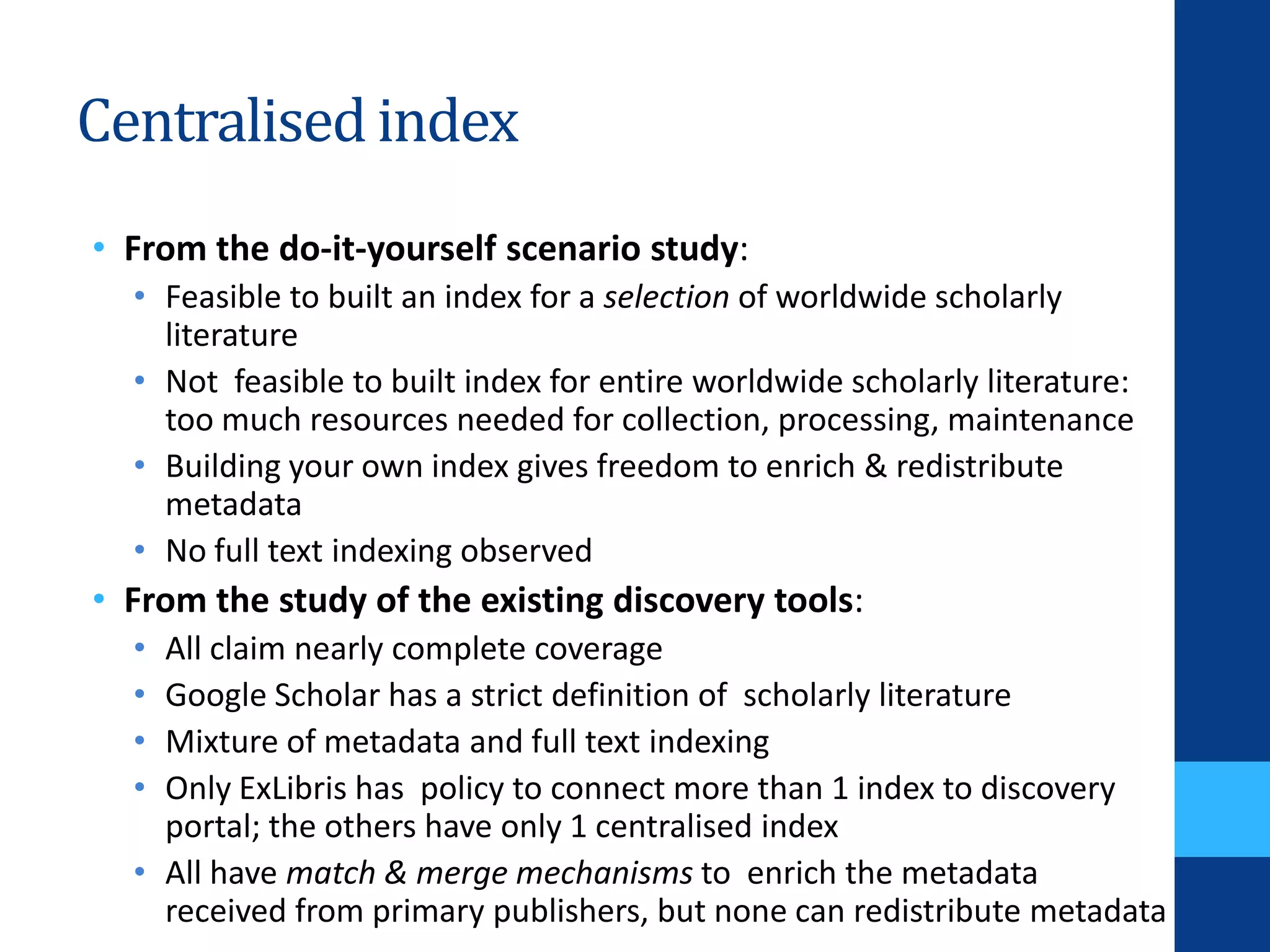
Centralised index
• From the do-it-yourself scenario study:
• Feasible to built an index for a selection of worldwide scholarly
literature
• Not feasible to built index for entire worldwide scholarly literature:
too much resources needed for collection, processing, maintenance
• Building your own index gives freedom to enrich & redistribute
metadata
• No full text indexing observed
• From the study of the existing discovery tools:
• All claim nearly complete coverage
• Google Scholar has a strict definition of scholarly literature
• Mixture of metadata and full text indexing
• Only ExLibris has policy to connect more than 1 index to discovery
portal; the others have only 1 centralised index
• All have match & merge mechanisms to enrich the metadata
received from primary publishers, but none can redistribute metadata
What did we learn from others?
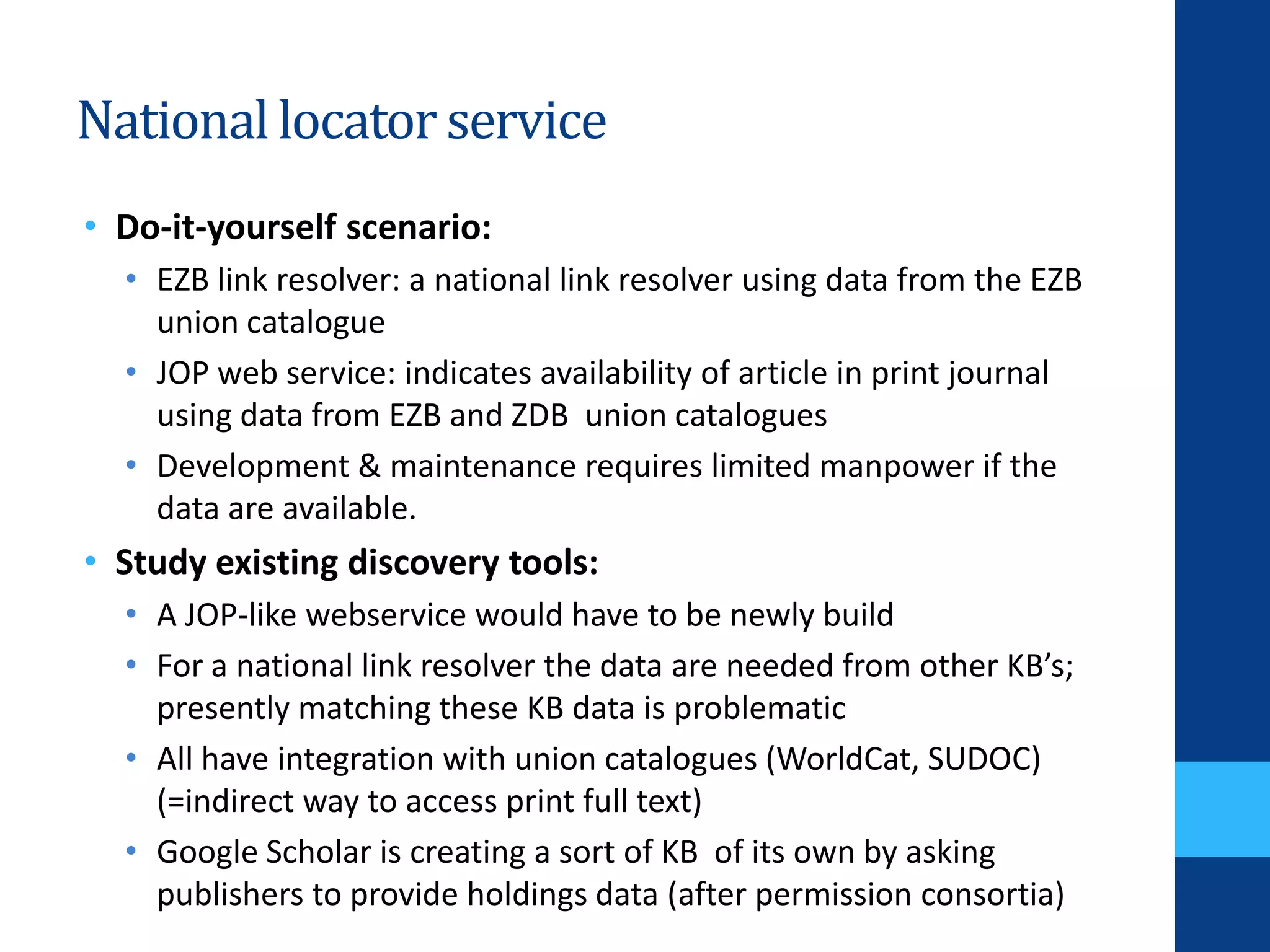
Nationallocator service
• Do-it-yourself scenario:
• EZB link resolver: a national link resolver using data from the EZB
union catalogue
• JOP web service: indicates availability of article in print journal
using data from EZB and ZDB union catalogues
• Development & maintenance requires limited manpower if the
data are available.
• Study existing discovery tools:
• A JOP-like webservice would have to be newly build
• For a national link resolver the data are needed from other KB’s;
presently matching these KB data is problematic
• All have integration with union catalogues (WorldCat, SUDOC)
(=indirect way to access print full text)
• Google Scholar is creating a sort of KB of its own by asking
publishers to provide holdings data (after permission consortia)
What did we learn from others?
Connectorsto institutionalOPACs
• FINNA: using VUFind – strives to replace local frontends
• Discovery tools by library system providers: mechanisms in
place to connect more or less all OPACs and to replace OPACs
as front-end for many library systems
• Google Scholar: no direct connections (only via Union
Catalogues – SUDOC and WorldCat)
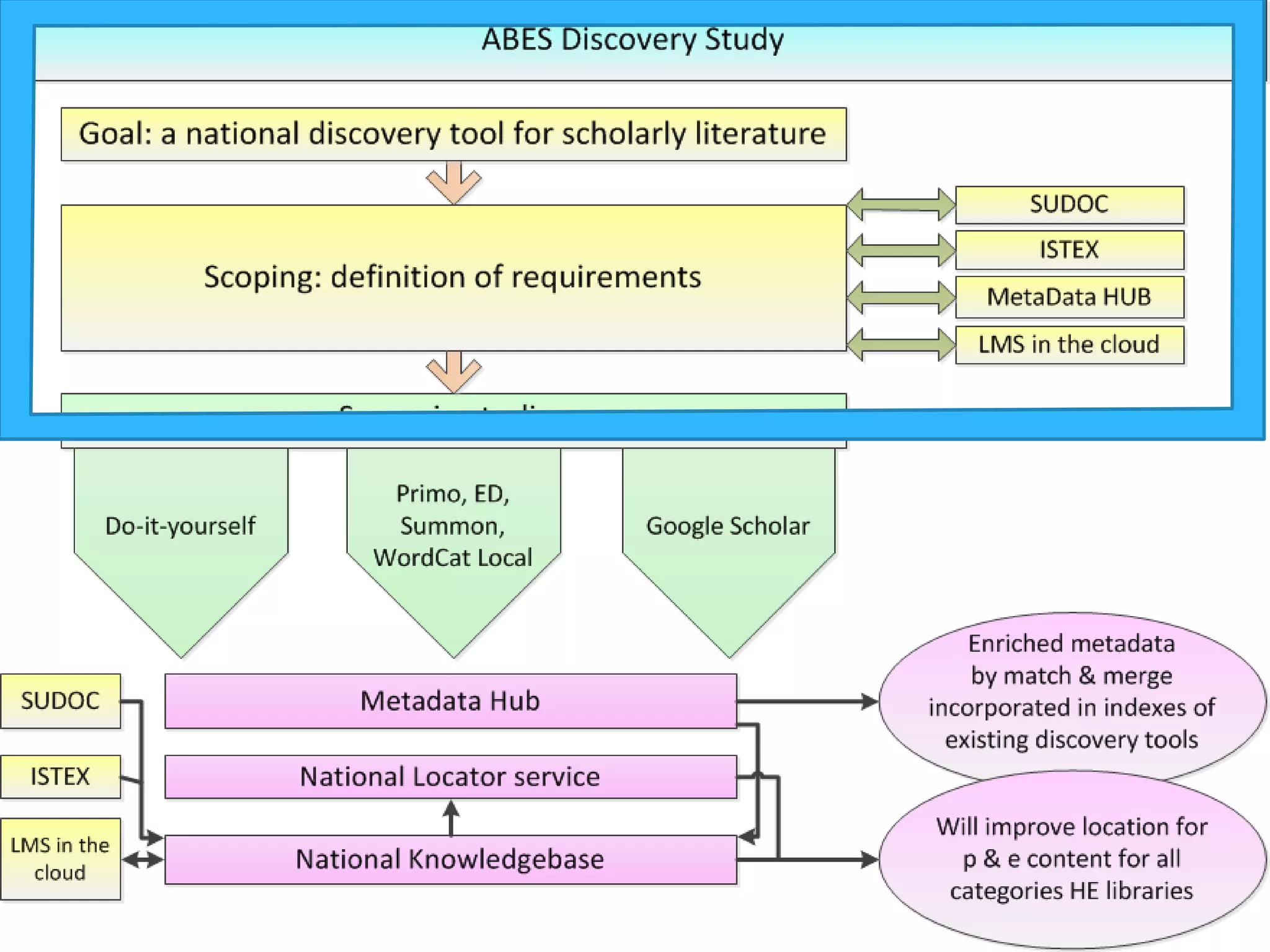
What are we going to do?
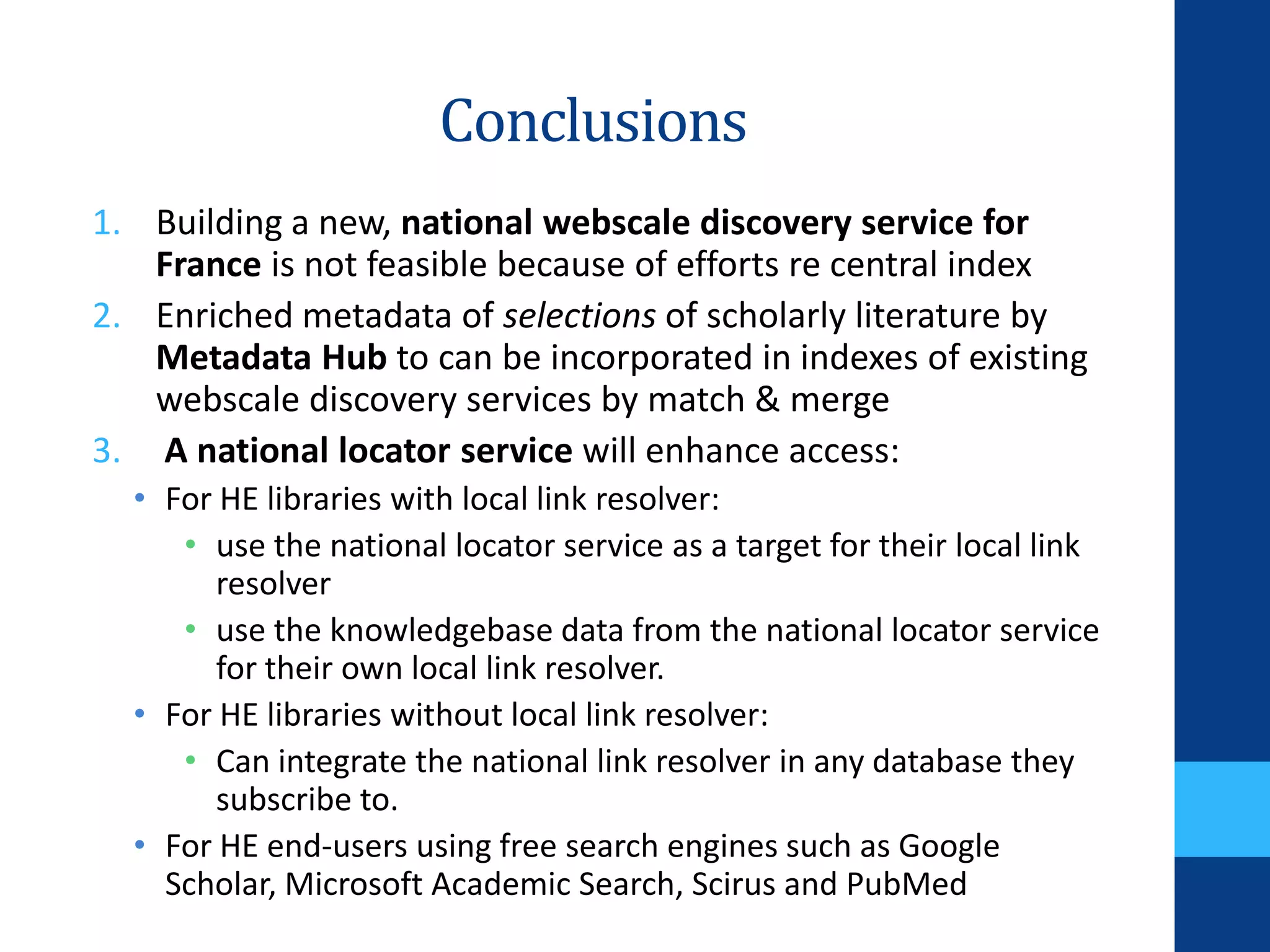
Conclusions
1. Building a new, national webscale discovery service for
France is not feasible because of efforts re central index
2. Enriched metadata of selections of scholarly literature by
Metadata Hub to can be incorporated in indexes of existing
webscale discovery services by match & merge
3. A national locator service will enhance access:
• For HE libraries with local link resolver:
• use the national locator service as a target for their local link
resolver
• use the knowledgebase data from the national locator service
for their own local link resolver.
• For HE libraries without local link resolver:
• Can integrate the national link resolver in any database they
subscribe to.
• For HE end-users using free search engines such as Google
Scholar, Microsoft Academic Search, Scirus and PubMed
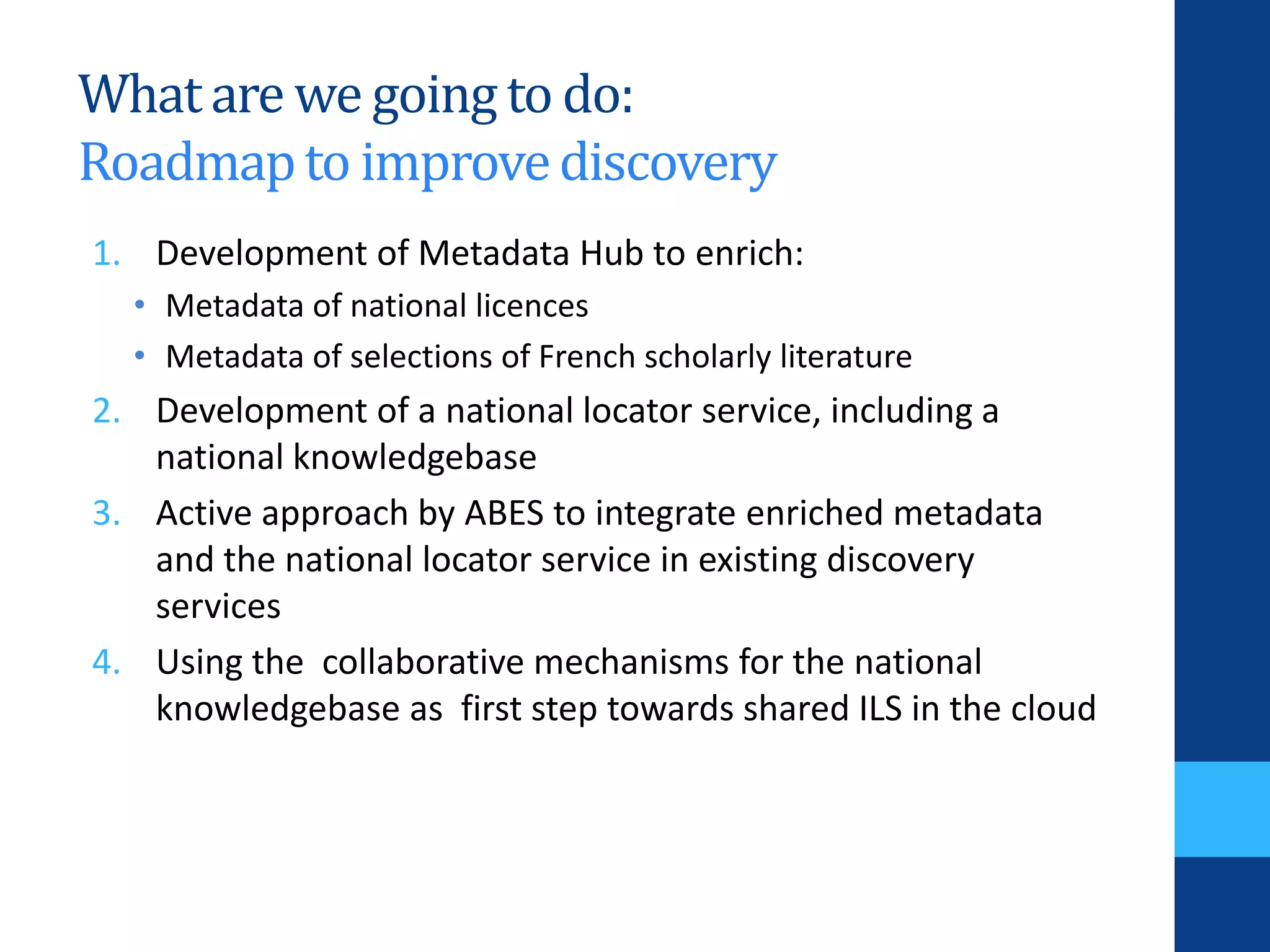
Whatare we going to do:
Roadmapto improvediscovery
1. Development of Metadata Hub to enrich:
• Metadata of national licences
• Metadata of selections of French scholarly literature
2. Development of a national locator service, including a
national knowledgebase
3. Active approach by ABES to integrate enriched metadata
and the national locator service in existing discovery
services
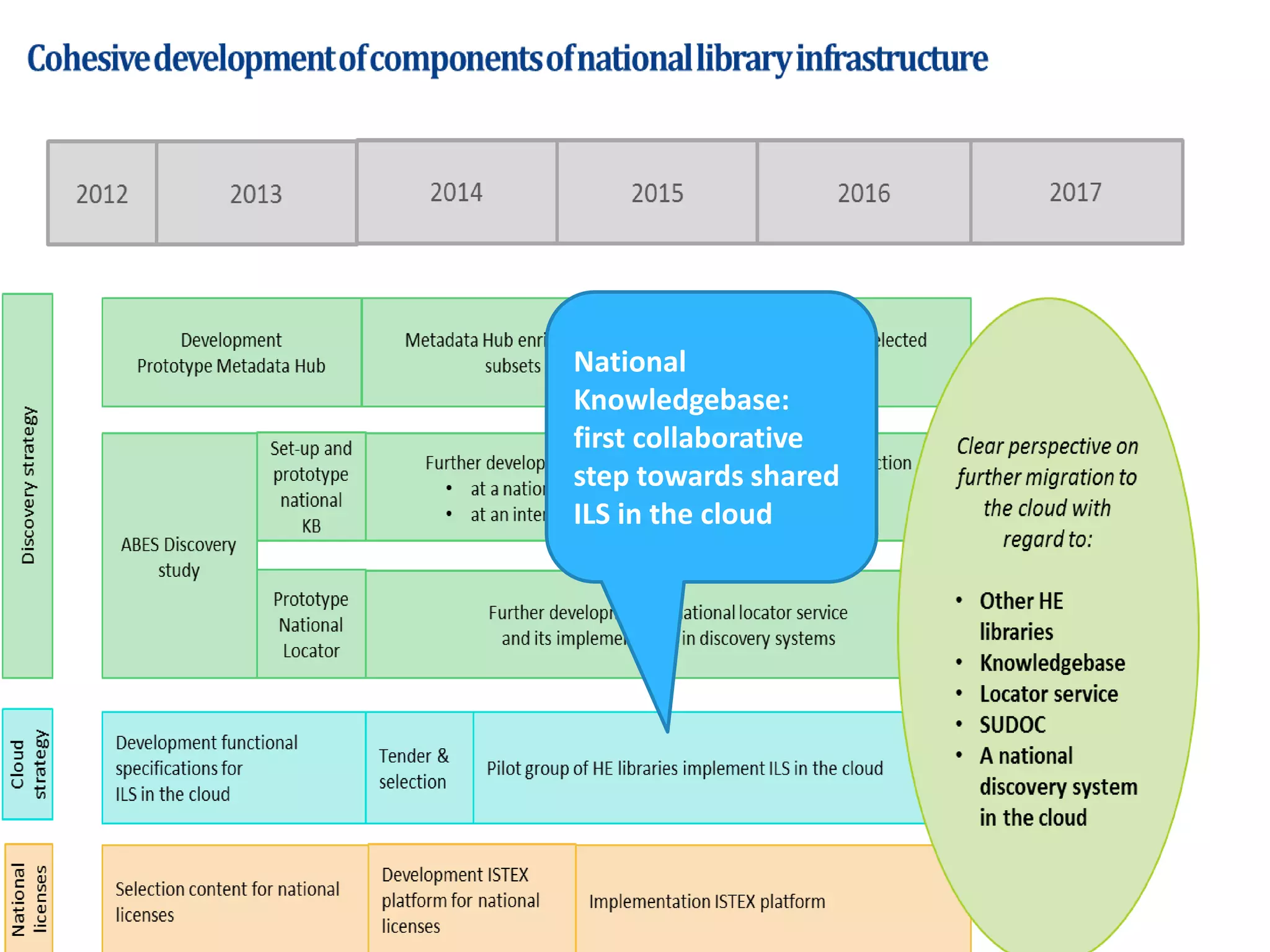
4. Using the collaborative mechanisms for the national
knowledgebase as first step towards shared ILS in the cloud
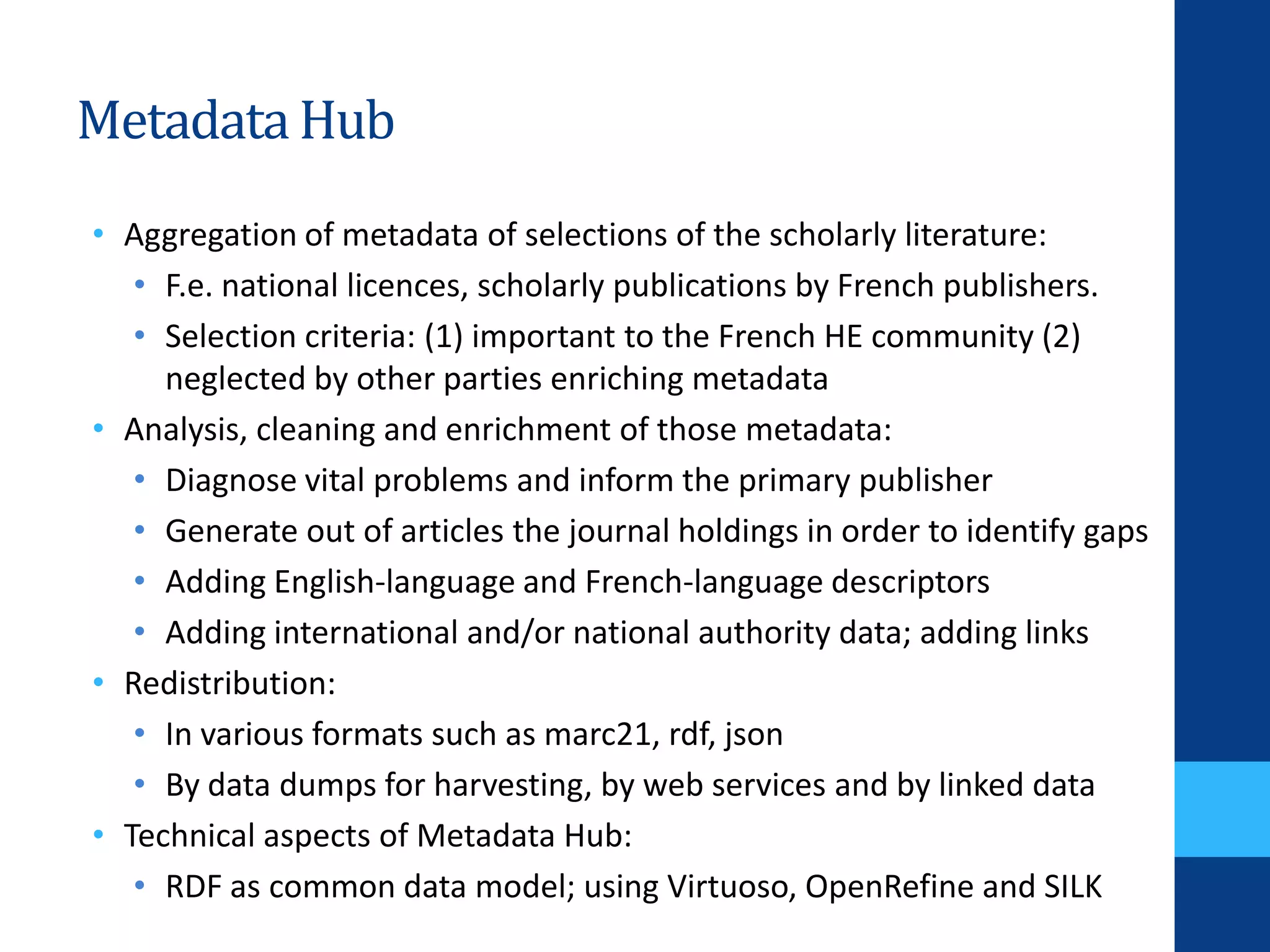
MetadataHub
• Aggregation of metadata of selections of the scholarly literature:
• F.e. national licences, scholarly publications by French publishers.
• Selection criteria: (1) important to the French HE community (2)
neglected by other parties enriching metadata
• Analysis, cleaning and enrichment of those metadata:
• Diagnose vital problems and inform the primary publisher
• Generate out of articles the journal holdings in order to identify gaps
• Adding English-language and French-language descriptors
• Adding international and/or national authority data; adding links
• Redistribution:
• In various formats such as marc21, rdf, json
• By data dumps for harvesting, by web services and by linked data
• Technical aspects of Metadata Hub:
• RDF as common data model; using Virtuoso, OpenRefine and SILK
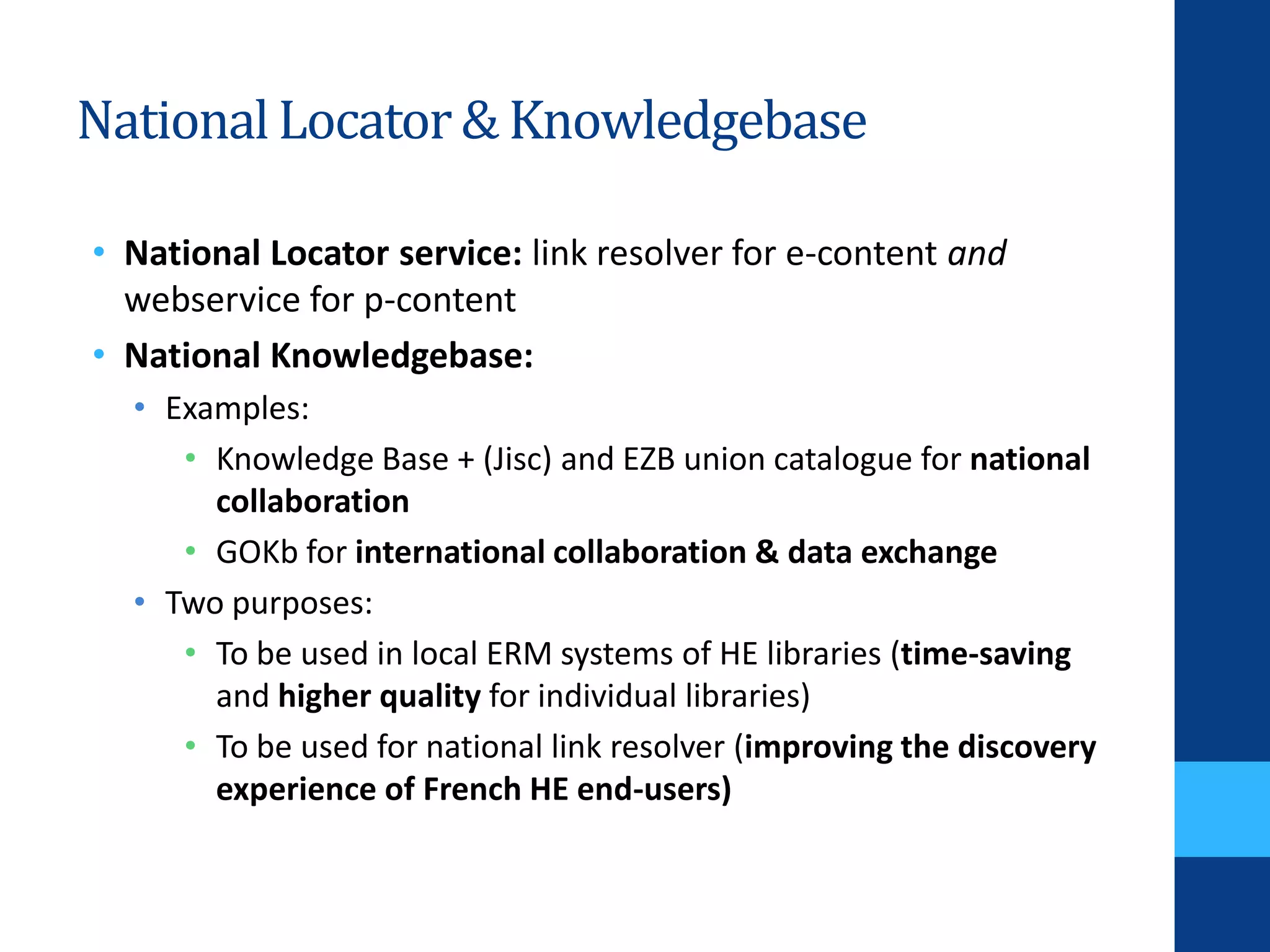
NationalLocator& Knowledgebase
• National Locator service: link resolver for e-content and
webservice for p-content
• National Knowledgebase:
• Examples:
• Knowledge Base + (Jisc) and EZB union catalogue for national
collaboration
• GOKb for international collaboration & data exchange
• Two purposes:
• To be used in local ERM systems of HE libraries (time-saving
and higher quality for individual libraries)
• To be used for national link resolver (improving the discovery
experience of French HE end-users)
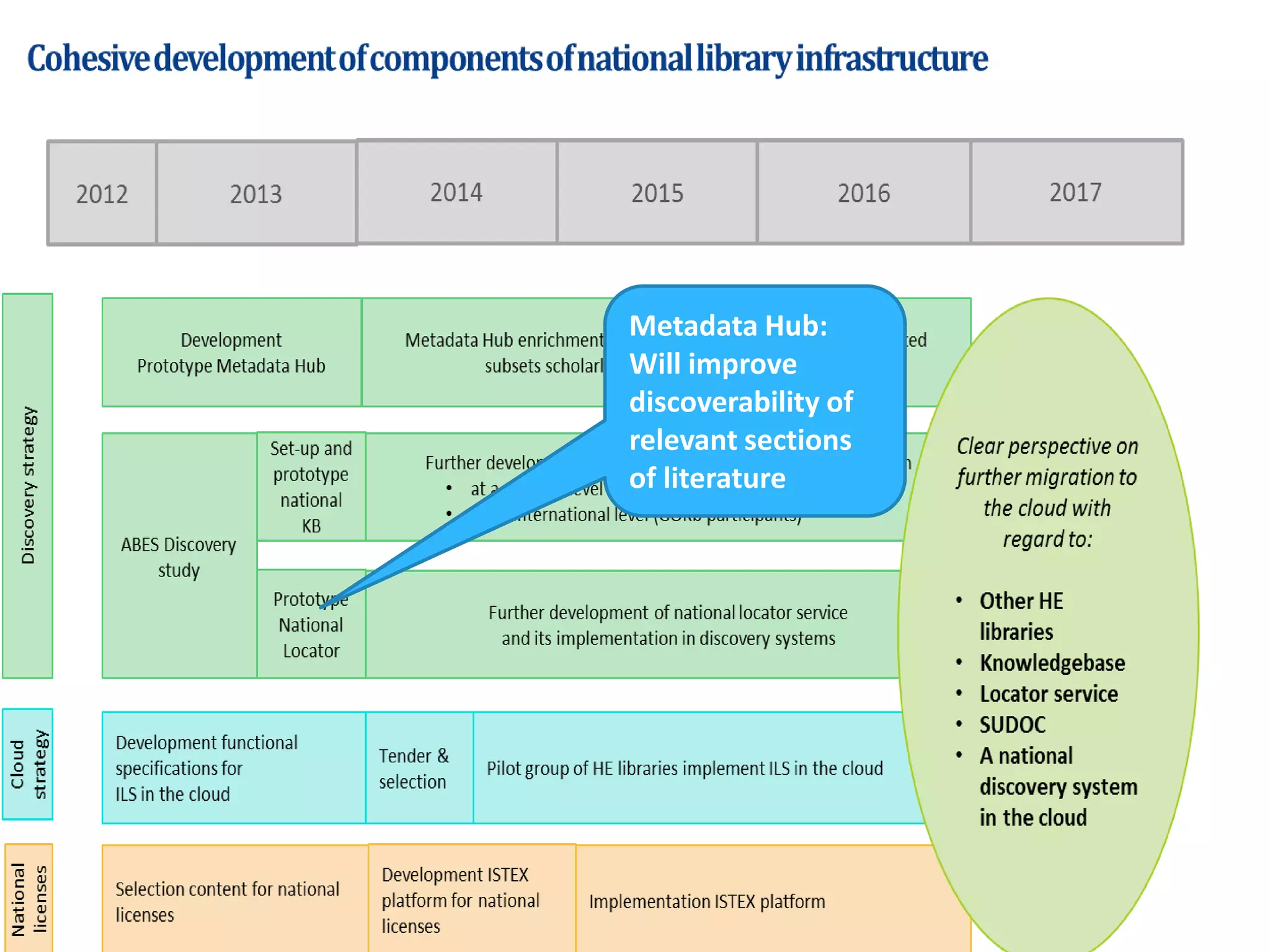
Metadata Hub:
Will improve
discoverability of
relevant sections
of literature
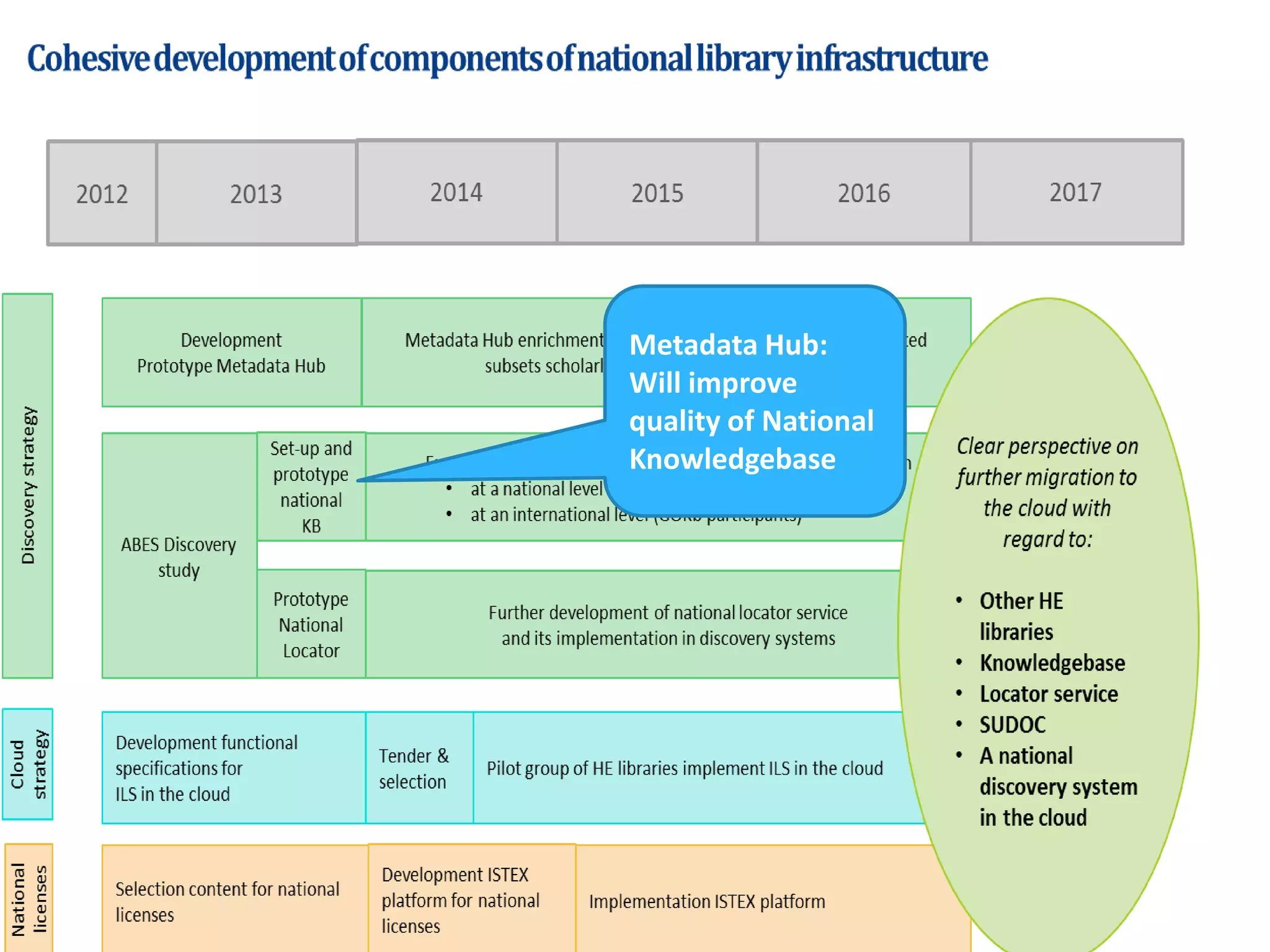
Metadata Hub:
Will improve
quality of National
Knowledgebase
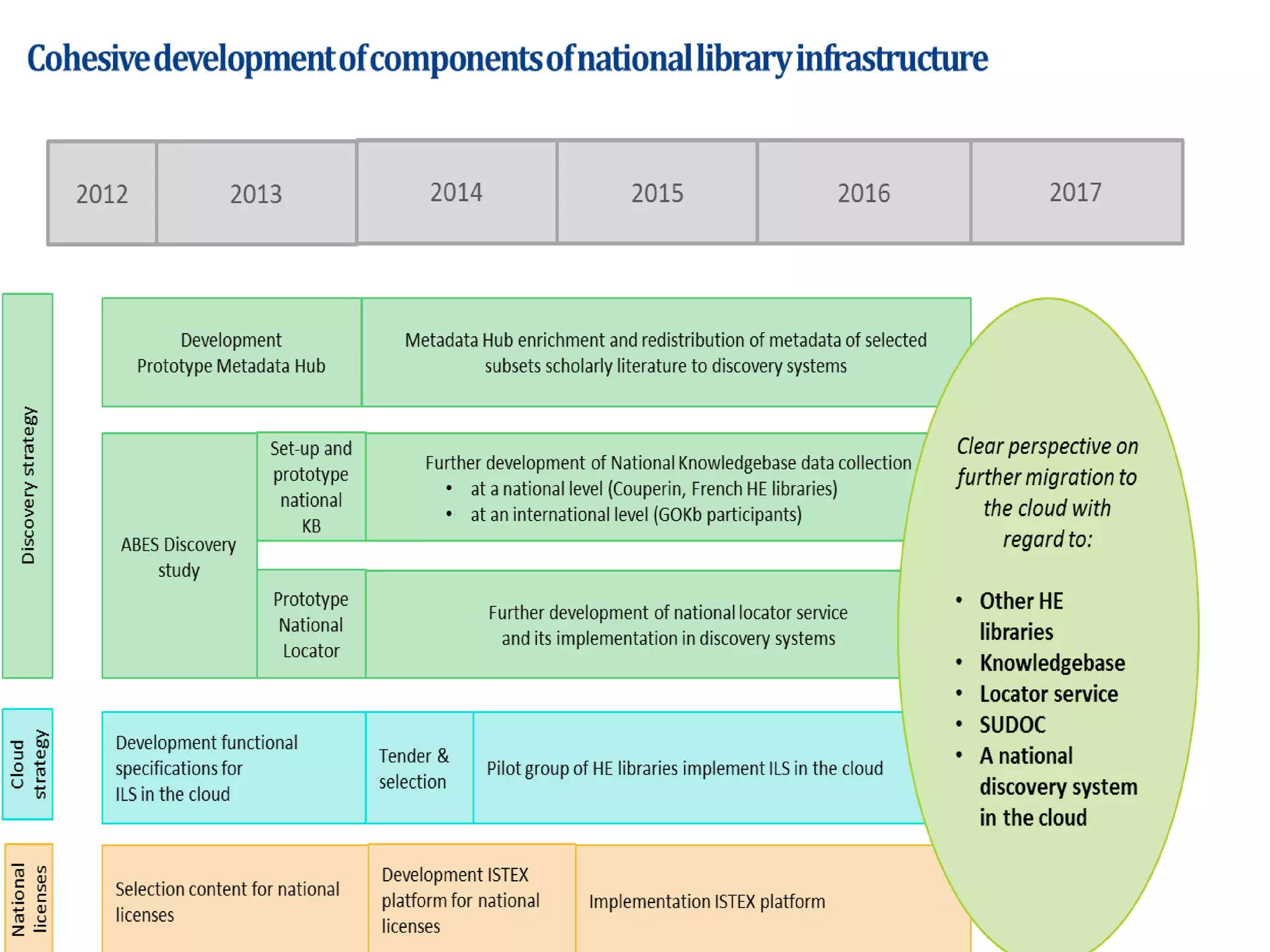
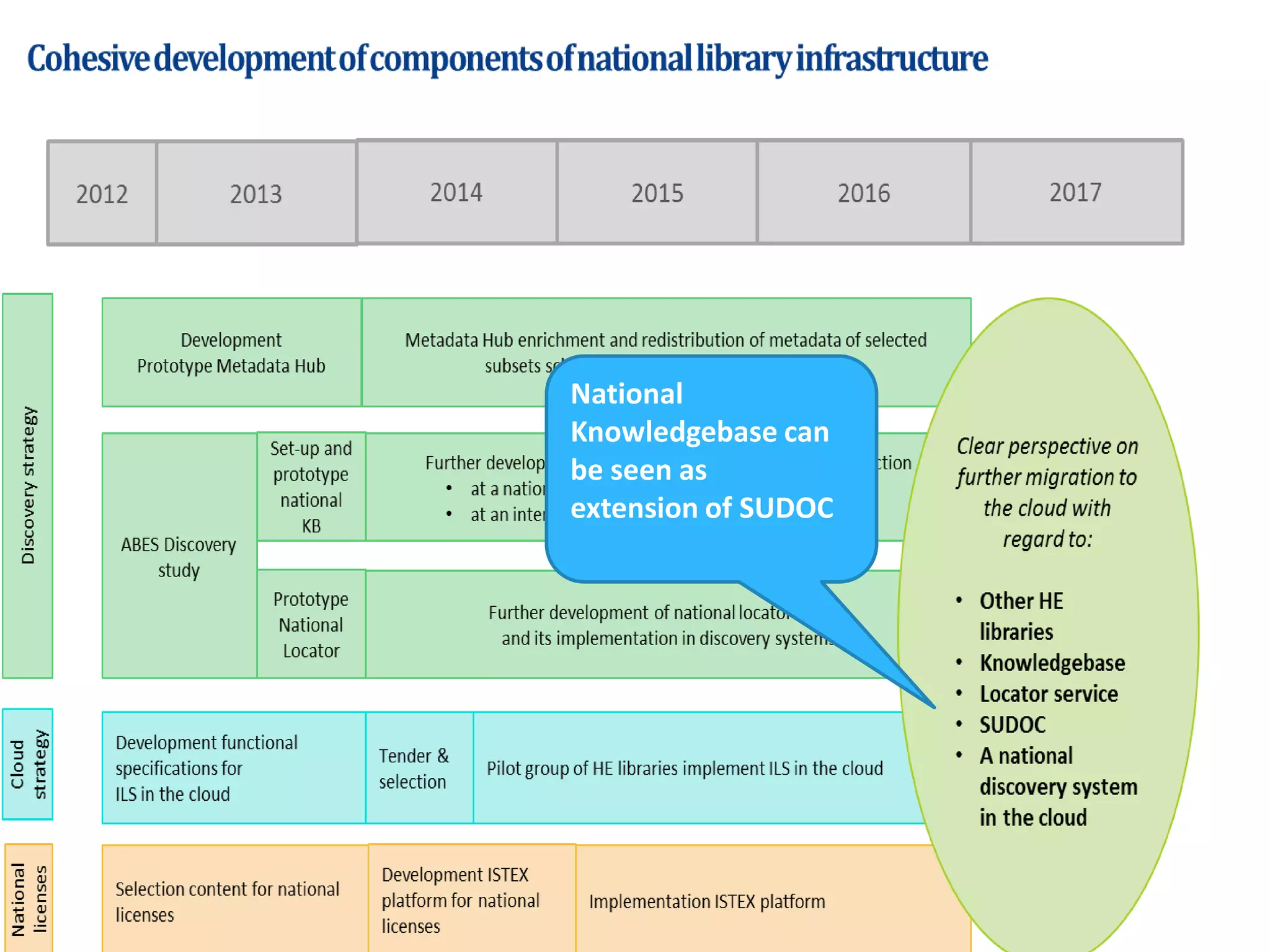
National
Knowledgebase can
be seen as
extension of SUDOC
National
Knowledgebase:
first collaborative
step towards shared
ILS in the cloud
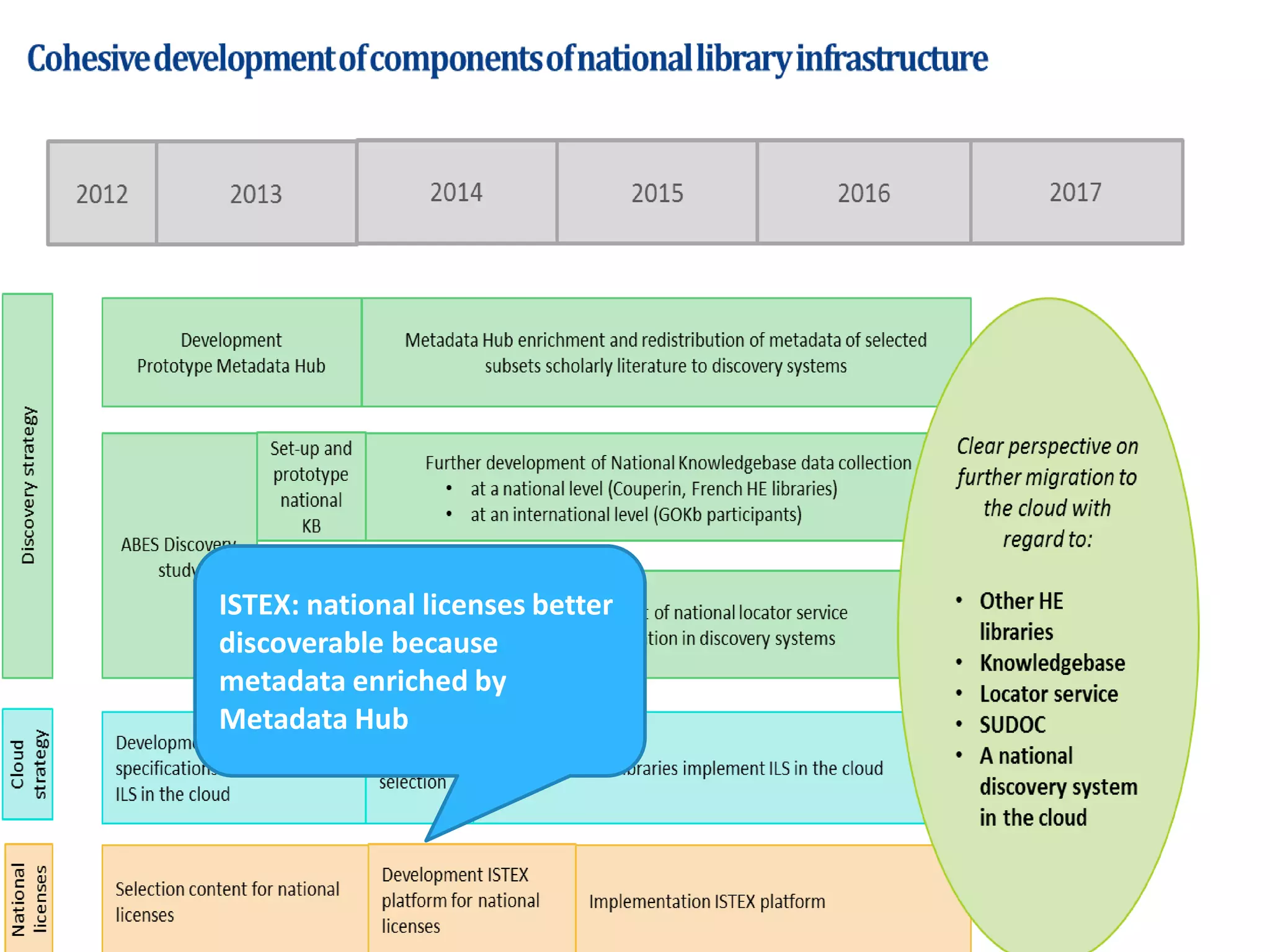
ISTEX: national licenses better
discoverable because
metadata enriched by
Metadata Hub
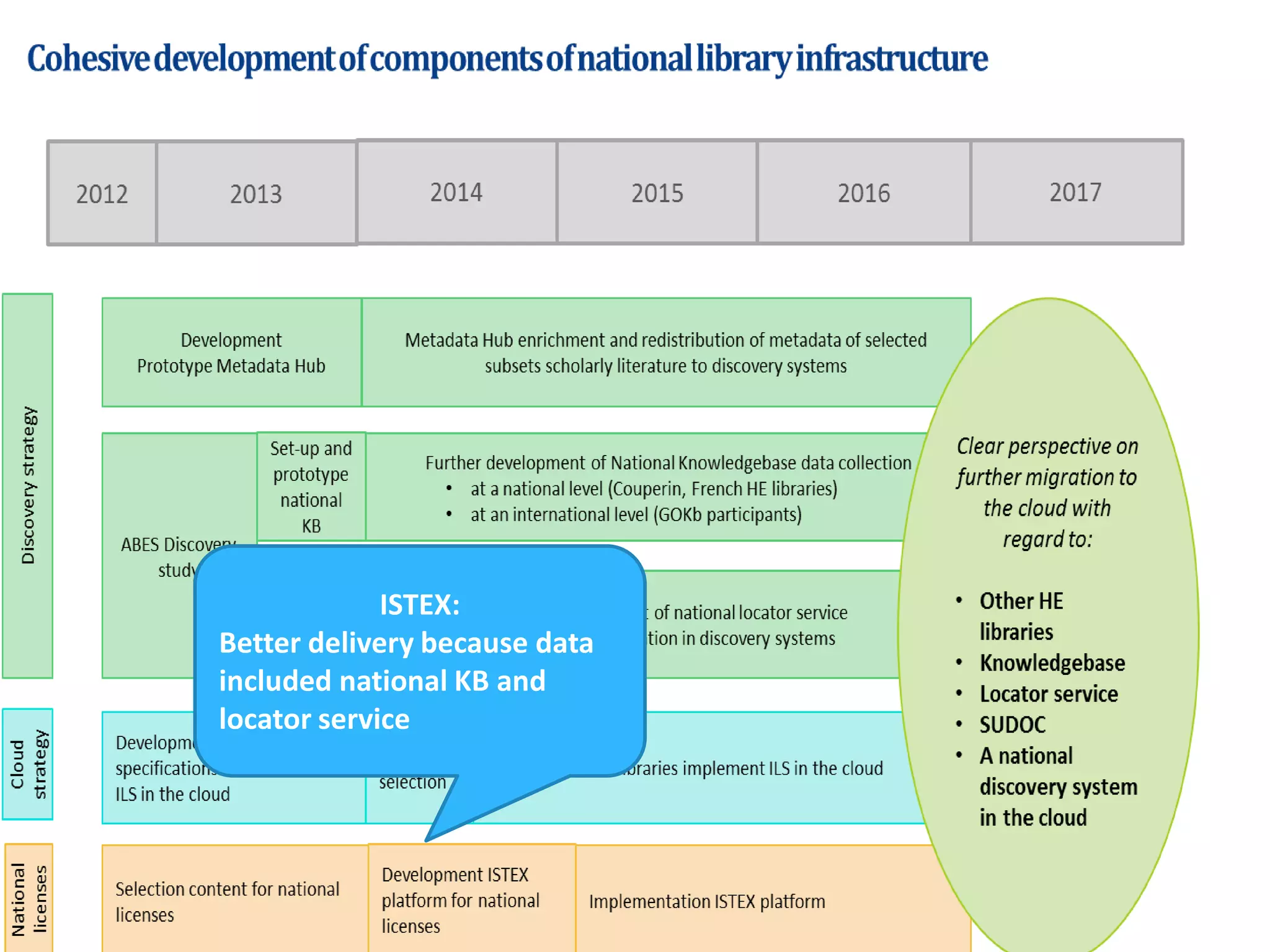
ISTEX:
Better delivery because data
included national KB and
locator service
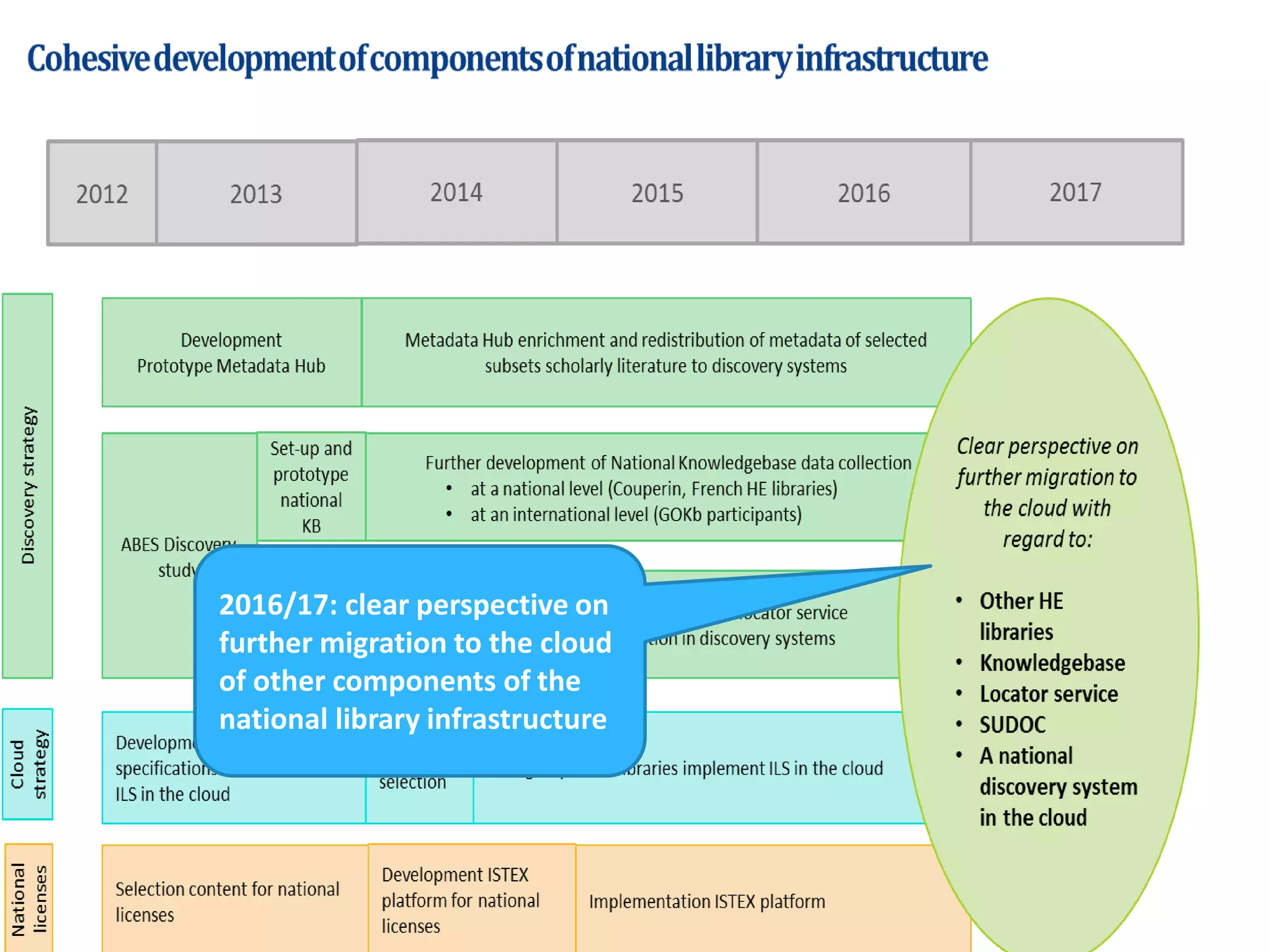
2016/17: clear perspective on
further migration to the cloud
of other components of the
national library infrastructure
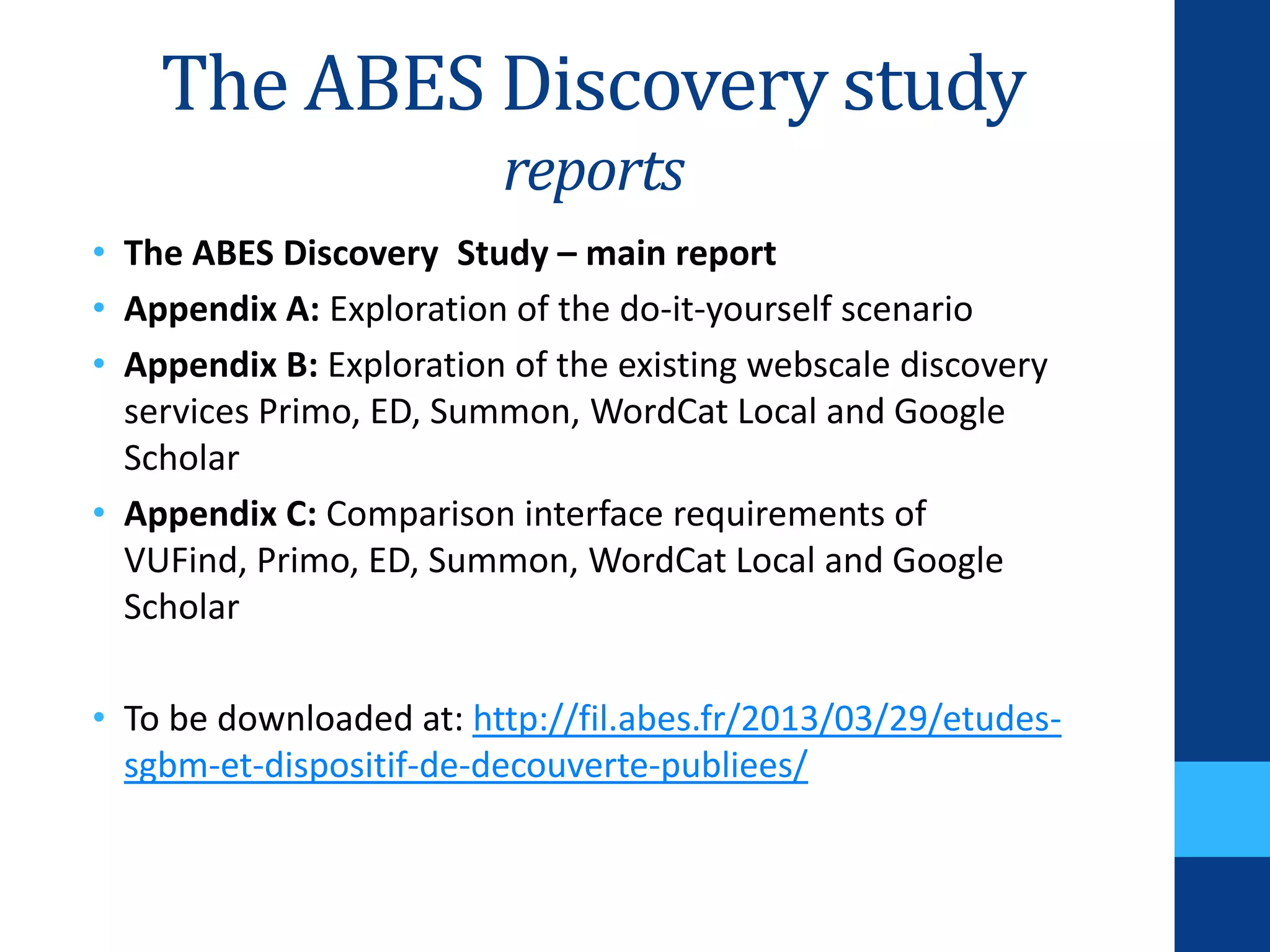
The ABES Discovery study
reports
• The ABES Discovery Study – main report
• Appendix A: Exploration of the do-it-yourself scenario
• Appendix B: Exploration of the existing webscale discovery
services Primo, ED, Summon, WordCat Local and Google
Scholar
• Appendix C: Comparison interface requirements of
VUFind, Primo, ED, Summon, WordCat Local and Google
Scholar
• To be downloaded at: http://fil.abes.fr/2013/03/29/etudes-
sgbm-et-dispositif-de-decouverte-publiees/
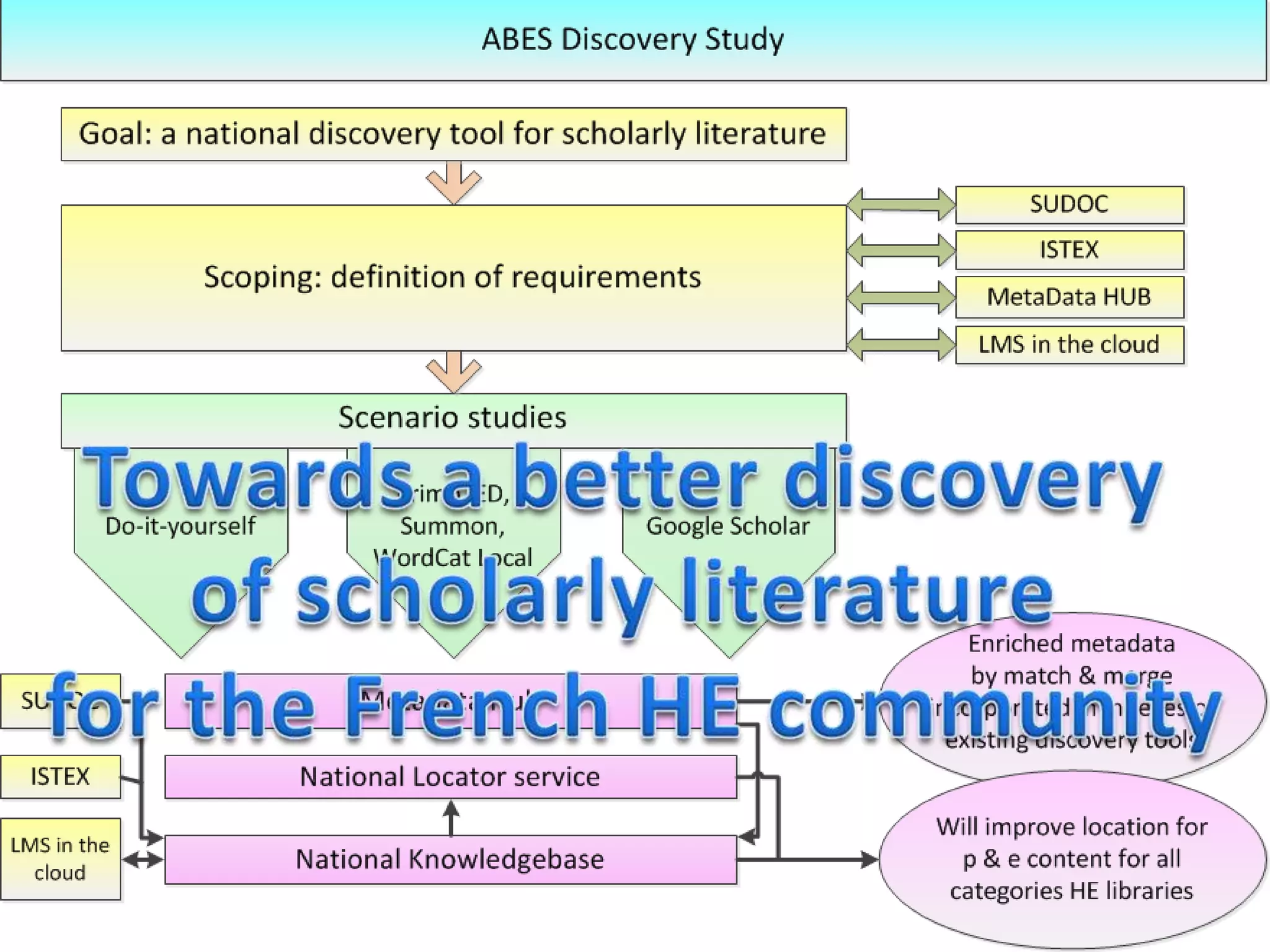
The ABES Discovery Study

The ABES Discovery Study

  • 1.
    Journées ABES, May15, 2013 Maurits van der Graaf Pleiade Management & Consultancy
  • 2.
    What do wewant to achieve? What can we learn from others? What are we going to do?
  • 4.
    Whatdo we wanttoachievefor: end-usersin highereducationinstitutes • Access to digital and print collection: an user-friendly discovery tool that gives access to the digital and print collection of their own library/institute at title and article level • Access to other digital collections in France via ILL: if their own library has no access to certain e-content, end-user is directed to interlibrary loan to get access. • Enhanced access to French e-content: enhanced access to French language e-content and/or e-content by French publishers. • French language support in the discovery layer: an user- friendly interface that support French language searching.
  • 5.
    Whatdo we wanttoachievefor: the FrenchHE libraries • Interact with the approx. 22 presently installed discovery tools at French HE libraries • Offer a discovery service for libraries with a local link resolver/knowledgebase • Offer a discovery service for libraries without a local link resolver/knowledgebase
  • 6.
    Whatdo wewanttoachievefor: theFrenchnationallibraryinfrastructure • Shouldfit in & enhance the French national library infrastructure: • The development of the shared ILS system in the cloud (with shared electronic resource management functionality) • The ISTEX platform with digital content licensed by national licenses • Discovery & access to e-content with focus on scholarly literature: • Complementary service to SUDOC with regard to access to e- journals at article level; to e-books (title and chapter level); access to other media types (f.e. enriched publications) • Discovery & access to French scholarly e-content: • Enhance discovery and access to French language e-content and to e-content by French publishers.
  • 8.
    Discoverysystemsor componentsstudied • Self-builtservices: • Trove – national discovery service (National Library of Australia) • FINNA – national discovery service (Digital Library of Finland) • Suchkiste – discovery service for national licences, Germany • EZB link resolver – national link resolver, Germany • Journals Online & Print – webservice indicating availability, Germany • University Library of Utrecht (new policy following self-built discovery service) • Existing webscale discovery services: • RERO (Switzerland) • Primo, ED, Summon, WordCat Local and Google Scholar • Other relevant services: • Resource discovery programme JISC, UK • Knowledgebase + (JISC); GOKb
  • 9.
    The discovery portal presentsthe user interface and provides the connections with the other components. The portal connects to a platform with metadata and/or full text indexes of the scholarly literature, also called a centralised index. Locator services will point end-users to access of full text provided by their library (either digital or print collections). Connectors to institutional systems (OPAC and authentication services) for reserving/borrowing print items
  • 10.
    What did welearn from others?
  • 11.
    Discoveryportal • Requirements forFrench discovery tool: • ‘Normal’ modern user interface requirements with regard to search, recommender options, presentation of the results, export options, sorting options, user accounts, social features • Special requirement: French language support by (1) spelling suggestions (2) sorting/limit on language (3) search term translator • Results: • VUFind used by FINNA and Suchkiste (Open Source; maintenance by community; used by > 100 academic libraries) • All portals comparable (see Appendix C) with few exceptions: • VUFind lacking export options • Spelling suggestions in French only by Google Scholar, Primo and Summon • Search term translator – not existing, Google Scholar could develop it
  • 12.
    What did welearn from others?
  • 13.
    Centralised index • Fromthe do-it-yourself scenario study: • Feasible to built an index for a selection of worldwide scholarly literature • Not feasible to built index for entire worldwide scholarly literature: too much resources needed for collection, processing, maintenance • Building your own index gives freedom to enrich & redistribute metadata • No full text indexing observed • From the study of the existing discovery tools: • All claim nearly complete coverage • Google Scholar has a strict definition of scholarly literature • Mixture of metadata and full text indexing • Only ExLibris has policy to connect more than 1 index to discovery portal; the others have only 1 centralised index • All have match & merge mechanisms to enrich the metadata received from primary publishers, but none can redistribute metadata
  • 14.
    What did welearn from others?
  • 15.
    Nationallocator service • Do-it-yourselfscenario: • EZB link resolver: a national link resolver using data from the EZB union catalogue • JOP web service: indicates availability of article in print journal using data from EZB and ZDB union catalogues • Development & maintenance requires limited manpower if the data are available. • Study existing discovery tools: • A JOP-like webservice would have to be newly build • For a national link resolver the data are needed from other KB’s; presently matching these KB data is problematic • All have integration with union catalogues (WorldCat, SUDOC) (=indirect way to access print full text) • Google Scholar is creating a sort of KB of its own by asking publishers to provide holdings data (after permission consortia)
  • 16.
    What did welearn from others?
  • 17.
    Connectorsto institutionalOPACs • FINNA:using VUFind – strives to replace local frontends • Discovery tools by library system providers: mechanisms in place to connect more or less all OPACs and to replace OPACs as front-end for many library systems • Google Scholar: no direct connections (only via Union Catalogues – SUDOC and WorldCat)
  • 18.
    What are wegoing to do?
  • 19.
    Conclusions 1. Building anew, national webscale discovery service for France is not feasible because of efforts re central index 2. Enriched metadata of selections of scholarly literature by Metadata Hub to can be incorporated in indexes of existing webscale discovery services by match & merge 3. A national locator service will enhance access: • For HE libraries with local link resolver: • use the national locator service as a target for their local link resolver • use the knowledgebase data from the national locator service for their own local link resolver. • For HE libraries without local link resolver: • Can integrate the national link resolver in any database they subscribe to. • For HE end-users using free search engines such as Google Scholar, Microsoft Academic Search, Scirus and PubMed
  • 20.
    Whatare we goingto do: Roadmapto improvediscovery 1. Development of Metadata Hub to enrich: • Metadata of national licences • Metadata of selections of French scholarly literature 2. Development of a national locator service, including a national knowledgebase 3. Active approach by ABES to integrate enriched metadata and the national locator service in existing discovery services 4. Using the collaborative mechanisms for the national knowledgebase as first step towards shared ILS in the cloud
  • 21.
    MetadataHub • Aggregation ofmetadata of selections of the scholarly literature: • F.e. national licences, scholarly publications by French publishers. • Selection criteria: (1) important to the French HE community (2) neglected by other parties enriching metadata • Analysis, cleaning and enrichment of those metadata: • Diagnose vital problems and inform the primary publisher • Generate out of articles the journal holdings in order to identify gaps • Adding English-language and French-language descriptors • Adding international and/or national authority data; adding links • Redistribution: • In various formats such as marc21, rdf, json • By data dumps for harvesting, by web services and by linked data • Technical aspects of Metadata Hub: • RDF as common data model; using Virtuoso, OpenRefine and SILK
  • 22.
    NationalLocator& Knowledgebase • NationalLocator service: link resolver for e-content and webservice for p-content • National Knowledgebase: • Examples: • Knowledge Base + (Jisc) and EZB union catalogue for national collaboration • GOKb for international collaboration & data exchange • Two purposes: • To be used in local ERM systems of HE libraries (time-saving and higher quality for individual libraries) • To be used for national link resolver (improving the discovery experience of French HE end-users)
  • 24.
    Metadata Hub: Will improve discoverabilityof relevant sections of literature
  • 25.
    Metadata Hub: Will improve qualityof National Knowledgebase
  • 26.
  • 27.
  • 28.
    ISTEX: national licensesbetter discoverable because metadata enriched by Metadata Hub
  • 29.
    ISTEX: Better delivery becausedata included national KB and locator service
  • 30.
    2016/17: clear perspectiveon further migration to the cloud of other components of the national library infrastructure
  • 31.
    The ABES Discoverystudy reports • The ABES Discovery Study – main report • Appendix A: Exploration of the do-it-yourself scenario • Appendix B: Exploration of the existing webscale discovery services Primo, ED, Summon, WordCat Local and Google Scholar • Appendix C: Comparison interface requirements of VUFind, Primo, ED, Summon, WordCat Local and Google Scholar • To be downloaded at: http://fil.abes.fr/2013/03/29/etudes- sgbm-et-dispositif-de-decouverte-publiees/