Barbara Soots
Open Educational Resources Program Manager
Office of Superintendent of Public Instruction
barbara.soots@k12.wa.us
Liisa Moilanen Potts
Literacy and Professional Learning Integration Director
Office of Superintendent of Public Instruction
Liisa.MoilanenPotts@k12.wa.us
OER and the Common Core
2015 Northwest Council for Computer Education Conference
CC BY-SA Beyond definitions http://www.flickr.com/photos/opensourceway/6554315179/
OER are…
resources that reside in the public domain or have been released
under an intellectual property license that permits their FREE
USE and RE-PURPOSING by others.
Photo by nickwheeleroz - Creative Commons Attribution-NonCommercial-ShareAlike License https://www.flickr.com/photos/7762644@N04 Created with Haiku Deck
OPEN is not the same as FREE
Photo by Leo Reynolds - Creative Commons Attribution-NonCommercial-ShareAlike License https://www.flickr.com/photos/49968232@N00
The 5 Rs of OER
Reuse — copy verbatim
Redistribute — share with others
Revise — adapt and edit
Remix — combine resources
Retain — make, own, & control copies
Photo by designsbykari – CC BY NC http://www.flickr.com/photos/43726999@N06
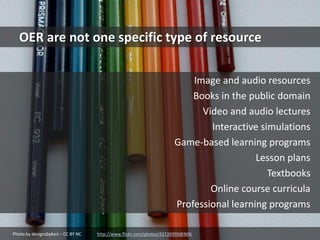
OER are not one specific type of resource
Image and audio resources
Books in the public domain
Video and audio lectures
Interactive simulations
Game-based learning programs
Lesson plans
Textbooks
Online course curricula
Professional learning programs
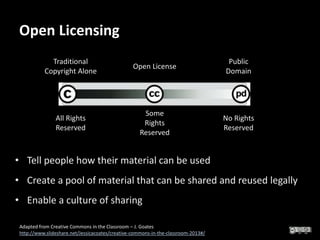
Open Licensing
• Tell people how their material can be used
• Create a pool of material that can be shared and reused legally
• Enable a culture of sharing
All Rights
Reserved
No Rights
Reserved
Traditional
Copyright Alone
Public
Domain
Some
Rights
Reserved
Open License
Adapted from Creative Commons in the Classroom – J. Goates
http://www.slideshare.net/Jessicacoates/creative-commons-in-the-classroom-2013#/
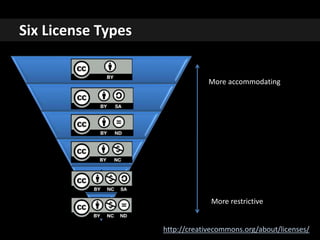
http://creativecommons.org/about/licenses/
cc by
cc by-sa
cc by-nd
cc by-nc
cc by-
nc-sa
cc by-
nc-nd
More accommodating
More restrictive
Six License Types
Photo by Captain Chaos - Creative Commons Attribution-NonCommercial-ShareAlike License http://www.flickr.com/photos/53836246@N00
Cost shift from textbooks to other critical areas
Up to date, innovative materials
Collaboration and partnerships
Continual quality improvement and standards alignment
Support for independent and differentiated learning
Solve legal concerns with distribution and adaptation
Benefits of OER
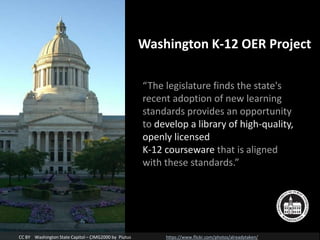
“The legislature finds the state's
recent adoption of new learning
standards provides an opportunity
to develop a library of high-quality,
openly licensed
K-12 courseware that is aligned
with these standards.”
CC BY Washington State Capitol – CIMG2000 by Piutus https://www.flickr.com/photos/alreadytaken/
Washington K-12 OER Project
CC BY Rhino Roadblock by Chris Ingrassia http://www.flickr.com/photos/andryone/445139454/in/photostream/
Challenges with OER
Finding target resources
Access and security issues
District policies that don’t recognize OER as an option
Evaluating quality and alignment
CC BY Leszek Leszczynski http://www.flickr.com/photos/leszekleszczynski/5068940056/in/photostream/
Finding OER
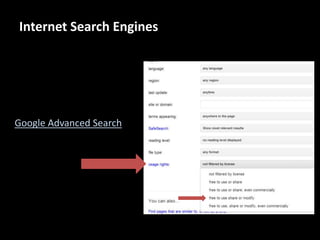
Internet Search Engines
Google Advanced Search
OER Repositories
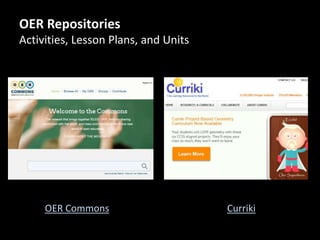
Activities, Lesson Plans, and Units
OER Commons Curriki
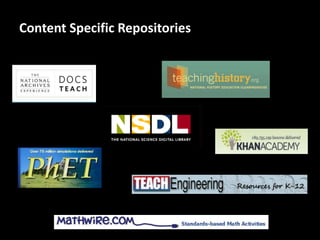
Content Specific Repositories
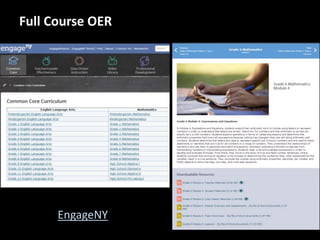
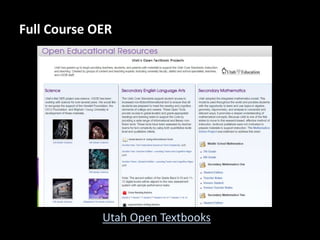
Full Course OER
EngageNY
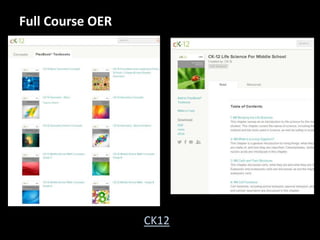
Full Course OER
CK12
Full Course OER
Utah Open Textbooks
Reviewing OER
Help educators select high quality materials
Provide information for materials adoptions
Identify gaps in Common Core alignment
CC BY NC SA apples by msr http://www.flickr.com/photos/msr/448820990/
What OER to review?
Unlimited access and redistribution
Permission to adapt
Defined content area and grade band scope
CCSS Worksheet
IMET Rubric
EQuIP Rubrics
Achieve OER Rubrics
Reviewers Comments
How to Evaluate Quality
English Language Arts OER
Washington State
Learning Standards
for ELA (CCSS-ELA)
Why OER for ELA?
What (and how many) materials do teachers of ELA have:
… in their classrooms?
… in their book rooms at school?
… in their homes?
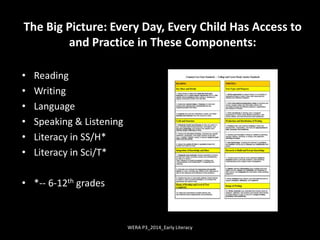
The Big Picture: Every Day, Every Child Has Access to
and Practice in These Components:
WERA P3_2014_Early Literacy
• Reading
• Writing
• Language
• Speaking & Listening
• Literacy in SS/H*
• Literacy in Sci/T*
• *-- 6-12th grades
Three Shifts in English Language Arts
• Building content knowledge through
content-rich nonfiction
• Reading, writing, and speaking grounded
in evidence from text, both literary and
informational
• Regular practice with complex text and
its academic language
WERA P3_2014_Early Literacy
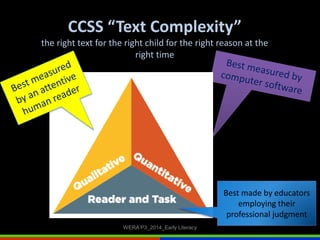
CCSS “Text Complexity”
the right text for the right child for the right reason at the
right time
WERA P3_2014_Early Literacy
Best made by educators
employing their
professional judgment
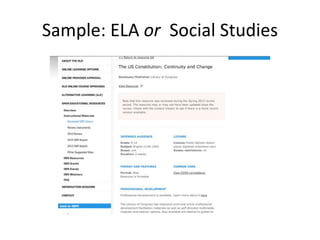
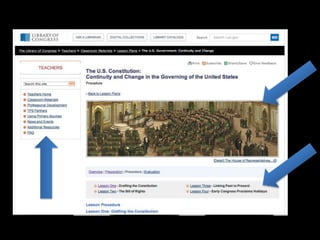
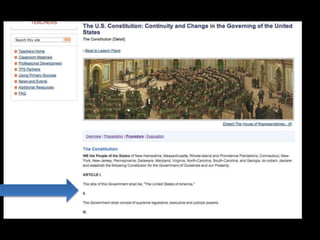
Sample: ELA or Social Studies
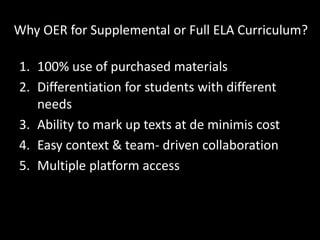
Why OER for Supplemental or Full ELA Curriculum?
1. 100% use of purchased materials
2. Differentiation for students with different
needs
3. Ability to mark up texts at de minimis cost
4. Easy context & team- driven collaboration
5. Multiple platform access
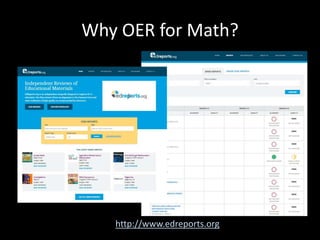
Why OER for Math?
http://www.edreports.org
/
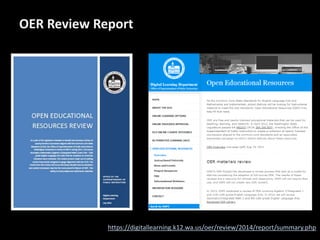
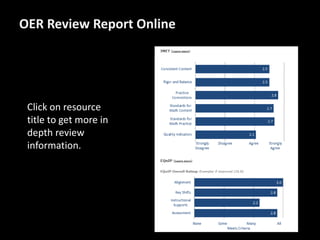
OER Review Report
https://digitallearning.k12.wa.us/oer/review/2014/report/summary.php
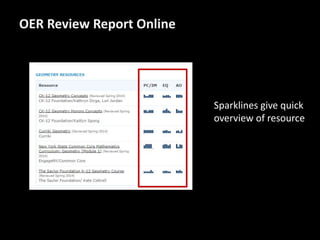
Sparklines give quick
overview of resource
OER Review Report Online
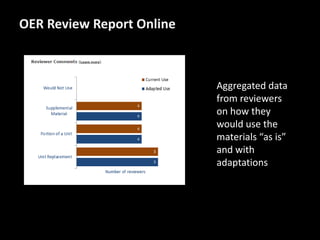
Click on resource
title to get more in
depth review
information.
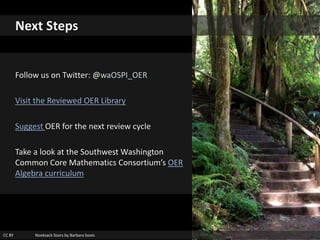
OER Review Report Online
Aggregated data
from reviewers
on how they
would use the
materials “as is”
and with
adaptations
OER Review Report Online
CC BY Nooksack Stairs by Barbara Soots
Next Steps
Follow us on Twitter: @waOSPI_OER
Visit the Reviewed OER Library
Suggest OER for the next review cycle
Take a look at the Southwest Washington
Common Core Mathematics Consortium’s OER
Algebra curriculum
Website: http://digitallearning.k12.wa.us/oer
Twitter: waOSPI_OER
OER Project Email: barbara.soots@k12.wa.us
ELA Questions: Liisa.MoilanenPotts@k12.wa.us
Stay Involved with the Project

2015 NCCE Conference - OER and Common Core

  • 1.
    Barbara Soots Open EducationalResources Program Manager Office of Superintendent of Public Instruction barbara.soots@k12.wa.us Liisa Moilanen Potts Literacy and Professional Learning Integration Director Office of Superintendent of Public Instruction Liisa.MoilanenPotts@k12.wa.us OER and the Common Core 2015 Northwest Council for Computer Education Conference
  • 2.
    CC BY-SA Beyonddefinitions http://www.flickr.com/photos/opensourceway/6554315179/ OER are… resources that reside in the public domain or have been released under an intellectual property license that permits their FREE USE and RE-PURPOSING by others.
  • 3.
    Photo by nickwheeleroz- Creative Commons Attribution-NonCommercial-ShareAlike License https://www.flickr.com/photos/7762644@N04 Created with Haiku Deck OPEN is not the same as FREE
  • 4.
    Photo by LeoReynolds - Creative Commons Attribution-NonCommercial-ShareAlike License https://www.flickr.com/photos/49968232@N00 The 5 Rs of OER Reuse — copy verbatim Redistribute — share with others Revise — adapt and edit Remix — combine resources Retain — make, own, & control copies
  • 5.
    Photo by designsbykari– CC BY NC http://www.flickr.com/photos/43726999@N06 OER are not one specific type of resource Image and audio resources Books in the public domain Video and audio lectures Interactive simulations Game-based learning programs Lesson plans Textbooks Online course curricula Professional learning programs
  • 6.
    Open Licensing • Tellpeople how their material can be used • Create a pool of material that can be shared and reused legally • Enable a culture of sharing All Rights Reserved No Rights Reserved Traditional Copyright Alone Public Domain Some Rights Reserved Open License Adapted from Creative Commons in the Classroom – J. Goates http://www.slideshare.net/Jessicacoates/creative-commons-in-the-classroom-2013#/
  • 7.
    http://creativecommons.org/about/licenses/ cc by cc by-sa ccby-nd cc by-nc cc by- nc-sa cc by- nc-nd More accommodating More restrictive Six License Types
  • 8.
    Photo by CaptainChaos - Creative Commons Attribution-NonCommercial-ShareAlike License http://www.flickr.com/photos/53836246@N00 Cost shift from textbooks to other critical areas Up to date, innovative materials Collaboration and partnerships Continual quality improvement and standards alignment Support for independent and differentiated learning Solve legal concerns with distribution and adaptation Benefits of OER
  • 9.
    “The legislature findsthe state's recent adoption of new learning standards provides an opportunity to develop a library of high-quality, openly licensed K-12 courseware that is aligned with these standards.” CC BY Washington State Capitol – CIMG2000 by Piutus https://www.flickr.com/photos/alreadytaken/ Washington K-12 OER Project
  • 10.
    CC BY RhinoRoadblock by Chris Ingrassia http://www.flickr.com/photos/andryone/445139454/in/photostream/ Challenges with OER Finding target resources Access and security issues District policies that don’t recognize OER as an option Evaluating quality and alignment
  • 11.
    CC BY LeszekLeszczynski http://www.flickr.com/photos/leszekleszczynski/5068940056/in/photostream/ Finding OER
  • 12.
  • 13.
    OER Repositories Activities, LessonPlans, and Units OER Commons Curriki
  • 14.
  • 15.
  • 16.
  • 17.
    Full Course OER UtahOpen Textbooks
  • 18.
    Reviewing OER Help educatorsselect high quality materials Provide information for materials adoptions Identify gaps in Common Core alignment CC BY NC SA apples by msr http://www.flickr.com/photos/msr/448820990/
  • 19.
    What OER toreview? Unlimited access and redistribution Permission to adapt Defined content area and grade band scope
  • 20.
    CCSS Worksheet IMET Rubric EQuIPRubrics Achieve OER Rubrics Reviewers Comments How to Evaluate Quality
  • 21.
    English Language ArtsOER Washington State Learning Standards for ELA (CCSS-ELA)
  • 22.
    Why OER forELA? What (and how many) materials do teachers of ELA have: … in their classrooms? … in their book rooms at school? … in their homes?
  • 23.
    The Big Picture:Every Day, Every Child Has Access to and Practice in These Components: WERA P3_2014_Early Literacy • Reading • Writing • Language • Speaking & Listening • Literacy in SS/H* • Literacy in Sci/T* • *-- 6-12th grades
  • 24.
    Three Shifts inEnglish Language Arts • Building content knowledge through content-rich nonfiction • Reading, writing, and speaking grounded in evidence from text, both literary and informational • Regular practice with complex text and its academic language WERA P3_2014_Early Literacy
  • 25.
    CCSS “Text Complexity” theright text for the right child for the right reason at the right time WERA P3_2014_Early Literacy Best made by educators employing their professional judgment
  • 26.
    Sample: ELA orSocial Studies
  • 29.
    Why OER forSupplemental or Full ELA Curriculum? 1. 100% use of purchased materials 2. Differentiation for students with different needs 3. Ability to mark up texts at de minimis cost 4. Easy context & team- driven collaboration 5. Multiple platform access
  • 30.
    Why OER forMath? http://www.edreports.org /
  • 31.
  • 32.
    Sparklines give quick overviewof resource OER Review Report Online
  • 33.
    Click on resource titleto get more in depth review information. OER Review Report Online
  • 34.
    Aggregated data from reviewers onhow they would use the materials “as is” and with adaptations OER Review Report Online
  • 35.
    CC BY NooksackStairs by Barbara Soots Next Steps Follow us on Twitter: @waOSPI_OER Visit the Reviewed OER Library Suggest OER for the next review cycle Take a look at the Southwest Washington Common Core Mathematics Consortium’s OER Algebra curriculum
  • 36.
    Website: http://digitallearning.k12.wa.us/oer Twitter: waOSPI_OER OERProject Email: barbara.soots@k12.wa.us ELA Questions: Liisa.MoilanenPotts@k12.wa.us Stay Involved with the Project

Editor's Notes

  • #9 8
  • #15 http://www.mathematicsvisionproject.org/index.html http://mathwire.com/index.html  http://www.scoilnet.ie/TeachersSecondLevel.aspx http://www.adaptedmind.com/ http://www.teachengineering.org http://www.khanacademy.org/ http://phet.colorado.edu  http://www.hippocampus.org/ http://www.mathopenref.com 
  • #24 Standards 1-3: Key ideas and details Standards 4-6: Craft and structure Standards 7-9: Integration of knowledge and ideas The “What”– the CCSS provides standards outlining skills – but they work together. They aren’t separate pieces– they are comprehensive What you will see next are the biggest instructional shifts for teaching, for learning, for departments, for teams, for schools, and for systems. Keep in mind the comprehensive nature of CCSS– the shifts aren’t everything. They’re just the biggest pivot points, and hopefully they will leverage your good work together in strong ways.
  • #25  Overview: the big speech, how all the practical components work together to move us from now to better. Shifts represent things that are… shifts! They are moves from one skill set and knowledge base to another What we are continuing to strengthen aren’t shifts– things like foundational reading skills, like working with plot and theme, character development in fiction– those components still live as important, but are not identified as SHIFTS The shifts represent a re-framing of how we think about literacy– fewer discrete skills, and now a more comprehensive, authentic way to think about literacy
  • #26 “difficult” is not the same as “complex”