JWBC/NFDO
QUARTERLYBUSINES
FORUM
August 12, 2021
JWBC/NFDO
QUARTERLY
BUSINESS FORUM
FEATURING
FRANNET,
ACTIONCOACH,
AND SCORE!
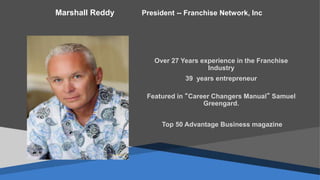
Over 27 Years experience in the Franchise
Industry
39 years entrepreneur
Featured in “Career Changers Manual” Samuel
Greengard.
Top 50 Advantage Business magazine
Marshall Reddy President -- Franchise Network, Inc
New Year New You
Your Dream of
Business Ownership
AGENDA (60 MINUTES)
• Why Business Ownership?
• Options for Getting Into Business
• Risks & Rewards of Business Ownership
• Myths & Realities of Franchising
• How to Identify the Best Business Option forYou
• BuildingYour Personal Business Model
WHO IS FRANNET?
• 30+ year old International Franchise Consulting firm
• Over 100 locally-based consultants across North America
• National partnerships with SCORE & SBDC.
• We match people who want to be in business with a franchise that
meets their needs.
• Our services are always 100% free to you, the client
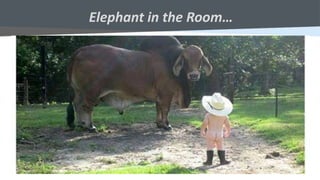
Elephant in the Room…
• Risk:
• A job is safer than a business
• I’ll wait until the economy is better
• Money:
• A business costs a lot of money to start and run
• Knowledge:
• I don’t know where to start or find what I’m looking for
• Skills:
• Running a business takes specific talents and skills
SOME OFTHE CONCERNS
POINTS OF CONSIDERATION
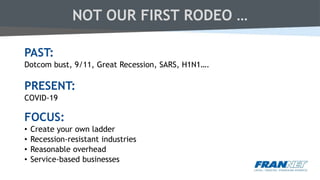
NOT OUR FIRST RODEO …
PAST:
Dotcom bust, 9/11, Great Recession, SARS, H1N1….
PRESENT:
COVID-19
FOCUS:
• Create your own ladder
• Recession-resistant industries
• Reasonable overhead
• Service-based businesses
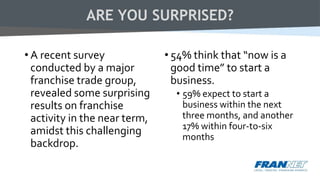
ARE YOU SURPRISED?
• A recent survey
conducted by a major
franchise trade group,
revealed some surprising
results on franchise
activity in the near term,
amidst this challenging
backdrop.
• 54% think that “now is a
good time” to start a
business.
• 59% expect to start a
business within the next
three months, and another
17% within four-to-six
months
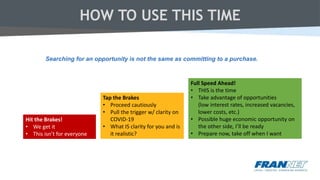
HOW TO USE THIS TIME
Hit the Brakes!
• We get it
• This isn’t for everyone
Tap the Brakes
• Proceed cautiously
• Pull the trigger w/ clarity on
COVID-19
• What IS clarity for you and is
it realistic?
Full Speed Ahead!
• THIS is the time
• Take advantage of opportunities
(low interest rates, increased vacancies,
lower costs, etc.)
• Possible huge economic opportunity on
the other side, I’ll be ready
• Prepare now, take off when I want
Searching for an opportunity is not the same as committing to a purchase.
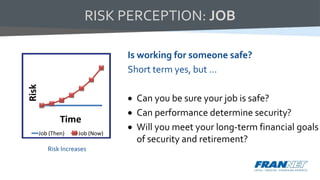
Risk
Time
Job (Then) Job (Now)
Risk Increases
Is working for someone safe?
Short term yes, but …
 Can you be sure your job is safe?
 Can performance determine security?
 Will you meet your long-term financial goals
of security and retirement?
RISK PERCEPTION: JOB
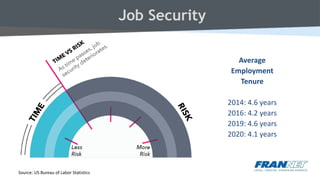
Job Security
Average
Employment
Tenure
2014: 4.6 years
2016: 4.2 years
2019: 4.6 years
2020: 4.1 years
Source: US Bureau of Labor Statistics
Career Paths of Yesteryear
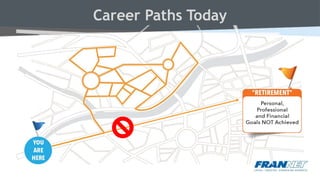
Career Paths Today
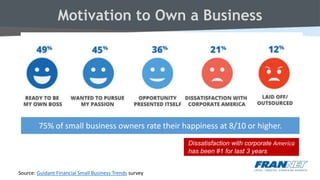
Motivation to Own a Business
Source: Guidant Financial Small Business Trends survey
Dissatisfaction with corporate America
has been #1 for last 3 years
75% of small business owners rate their happiness at 8/10 or higher.
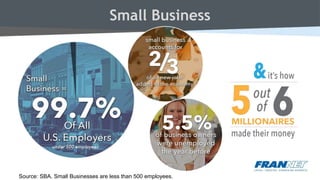
Small Business
Source: SBA. Small Businesses are less than 500 employees.
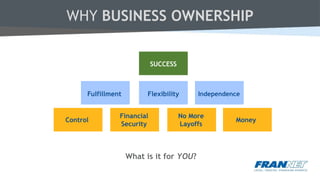
What is it for YOU?
Control
Financial
Security
No More
Layoffs
Money
Fulfillment Flexibility Independence
SUCCESS
WHY BUSINESS OWNERSHIP
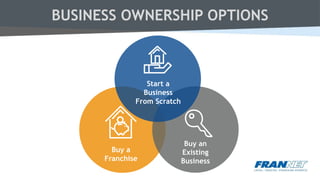
BUSINESS OWNERSHIP OPTIONS
Start a
Business
From Scratch
Buy an
Existing
Business
Buy a
Franchise
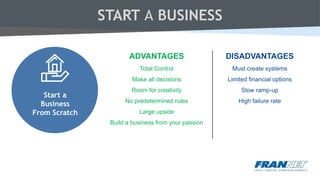
START A BUSINESS
ADVANTAGES
Total Control
Make all decisions
Room for creativity
No predetermined rules
Large upside
Build a business from your passion
Start a
Business
From Scratch
DISADVANTAGES
Must create systems
Limited financial options
Slow ramp-up
High failure rate
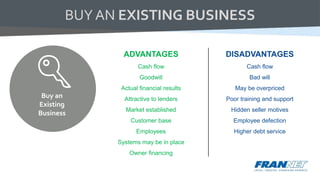
BUY AN EXISTING BUSINESS
ADVANTAGES
Cash flow
Goodwill
Actual financial results
Attractive to lenders
Market established
Customer base
Employees
Systems may be in place
Owner financing
Buy an
Existing
Business
DISADVANTAGES
Cash flow
Bad will
May be overpriced
Poor training and support
Hidden seller motives
Employee defection
Higher debt service
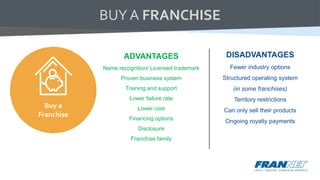
BUY A FRANCHISE
ADVANTAGES
Name recognition/ Licensed trademark
Proven business system
Training and support
Lower failure rate
Lower cost
Financing options
Disclosure
Franchise family
Buy a
Franchise
DISADVANTAGES
Fewer industry options
Structured operating system
(in some franchises)
Territory restrictions
Can only sell their products
Ongoing royalty payments
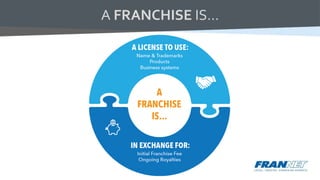
A FRANCHISE IS…
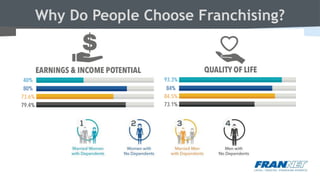
Why Do People Choose Franchising?
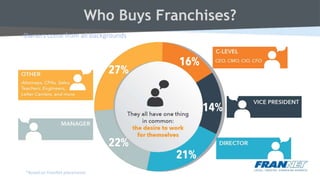
Owners come from all backgrounds
*Based on FranNet placements
Who Buys Franchises?
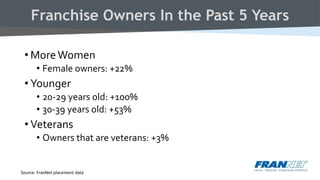
Franchise Owners In the Past 5 Years
• MoreWomen
• Female owners: +22%
• Younger
• 20-29 years old: +100%
• 30-39 years old: +53%
• Veterans
• Owners that are veterans: +3%
Source: FranNet placement data
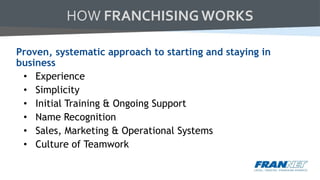
Proven, systematic approach to starting and staying in
business
• Experience
• Simplicity
• Initial Training & Ongoing Support
• Name Recognition
• Sales, Marketing & Operational Systems
• Culture of Teamwork
HOW FRANCHISING WORKS
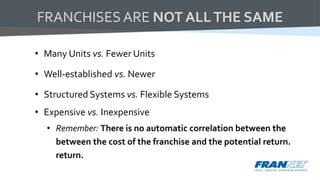
• Many Units vs. Fewer Units
• Well-established vs. Newer
• Structured Systems vs. Flexible Systems
• Expensive vs. Inexpensive
• Remember: There is no automatic correlation between the
between the cost of the franchise and the potential return.
return.
FRANCHISES ARE NOT ALLTHE SAME
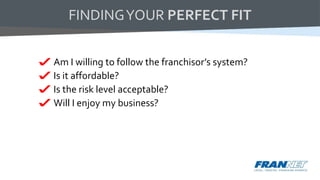
Am I willing to follow the franchisor’s system?
Is it affordable?
Is the risk level acceptable?
Will I enjoy my business?
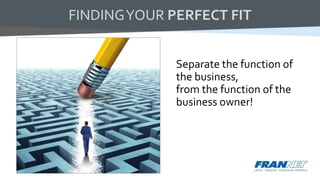
FINDINGYOUR PERFECT FIT
Separate the function of
the business,
from the function of the
business owner!
FINDINGYOUR PERFECT FIT
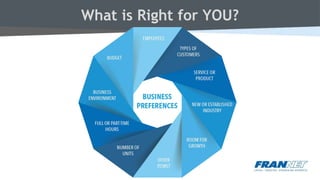
What is Right for YOU?
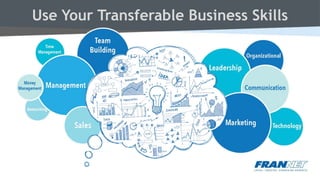
Use Your Transferable Business Skills
• Challenge, recognition,
prestige
• Build equity for retirement
• Time for family and interests
• Independence and control
• Financial security
WHAT IS IMPORTANTTOYOU?
Government Disclosure: FDD
• “Franchise Disclosure Document”
• Mandatory Information
• Franchisor Info
• Time in business, experience
• Bankruptcies, Litigation
• Franchise Contract
• Contact Info For:
• Current franchisees
• Past franchisees
• Policies
• Renewal,Termination &Transfer, Etc.
• Financial
• Earnings Claims
• Investment
• Franchise & other fees, capital
• Royalties
Government Disclosure: FDD
FRANCHISING
MYTHS
MYTH #1:
FRANCHISING IS
ONLY FAST FOOD
& RETAIL
FRANCHISING FACT
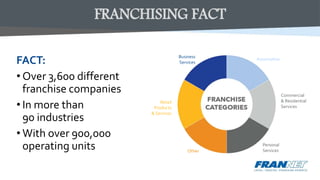
FACT:
• Over 3,600 different
franchise companies
• In more than
90 industries
• With over 900,000
operating units
Automotive
Commercial
& Residential
Services
Personal
Services
Business
Services
Retail
Products
& Services
Other
MYTH #2:
FRANCHISES SUCCEED
BECAUSE OFTHE QUALITY OF
THE PRODUCT
Can you make a hamburger?
Is your hamburger better than
McDonald’s?
If it is not the product, then what is it?
FRANCHISING FACT
FACT: It is all about the Business System
• Marketing
• Sales
• Operations
• Accounting
FRANCHISING FACT
SUCCESSFUL FRANCHISES
EMERGE IN NEW INDUSTRIES
WITH NO NEW COMPETITORS
MYTH #3:
FACT: It’s the SYSTEM!
• McDonald’s started when there was a burger joint
every corner.
• More recent examples are in Consumer and Business
Services.
FRANCHISING FACT
FRANCHISES
ARE EXPENSIVE
MYTH #4:
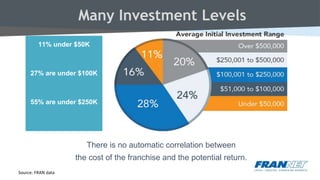
There is no automatic correlation between
the cost of the franchise and the potential return.
Source: FRAN data
11% under $50K
27% are under $100K
55% are under $250K
Many Investment Levels
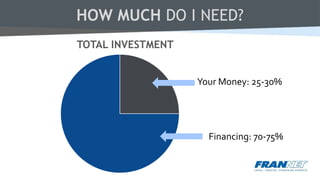
HOW MUCH DO I NEED?
TOTAL INVESTMENT
Your Money: 25-30%
Financing: 70-75%
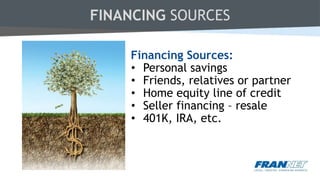
FINANCING SOURCES
Financing Sources:
• Personal savings
• Friends, relatives or partner
• Home equity line of credit
• Seller financing – resale
• 401K, IRA, etc.
HIGH RETURN
REQUIRES A HIGH
INVESTMENT
MYTH #5:
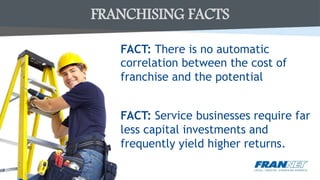
FACT: There is no automatic
correlation between the cost of
franchise and the potential
FRANCHISING FACTS
FACT: Service businesses require far
less capital investments and
frequently yield higher returns.
INDUSTRY EXPERIENCE
IS REQUIRED
MYTH #6:
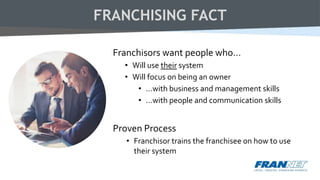
FRANCHISING FACT
Franchisors want people who…
• Will use their system
• Will focus on being an owner
• …with business and management skills
• …with people and communication skills
Proven Process
• Franchisor trains the franchisee on how to use
their system
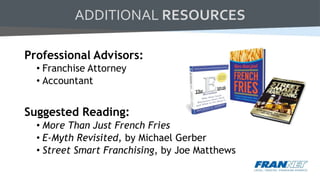
ADDITIONAL RESOURCES
Professional Advisors:
• Franchise Attorney
• Accountant
Suggested Reading:
• More Than Just French Fries
• E-Myth Revisited, by Michael Gerber
• Street Smart Franchising, by Joe Matthews
For Additional Information
Marshall Reddy
Marshall@Whatthefranchise.com
Whatthefranchise.com
904.249.1820
STEVE
GORANSON:
ACTIONCOAC
H
• Steve Goranson, has owned and operated the North Florida
office of ActionCOACH Business Coaching since 2004
• Established in 1993, ActionCOACH is the world’s largest
coaching franchise with over 1000 offices in 70+ different
countries.
• They coach over 15,000 businesses each week across the
Globe
• ActionCOACH offers more than just coaching. It offers a
change of lifestyle the opportunity to make more money
and an improve work-life balance. Helping Business owners
Work Smarter Not Harder!
• ActionCOACH doesn’t offer the quick fix. It promises a
change of lifestyle for those that use and embrace its
systems and culture
• Steve has lived in Jacksonville for over 30 years with his
wife Shari and 4 kids. Over the years he has worked with
small business owners in the areas of sales, advertising,
marketing & marketing research.
• Steve’s vision is to bring Success & Prosperity to Northeast
Florida thru Business Re-Education.
• He is committed to helping business owners make a better
life for themselves and their families
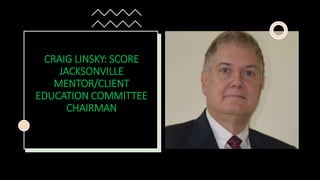
CRAIG LINSKY:
SCORE
JACKSONVILLE
MENTOR & CLIENT
EDUCATION
COMMITTEE
CHAIRMAN
Craig Linsky is a SCORE mentor
and Chairman of the Client
Education Committee at SCORE
in Jacksonville. Craig worked in
the financial services industry
for nearly thirty years. For the
past ten years, he has designed
and taught marketing and other
business topics both
domestically through SCORE
and internationally through the
Financial Services Volunteer
Corp.
CRAIG LINSKY: SCORE
JACKSONVILLE
MENTOR/CLIENT
EDUCATION COMMITTEE
CHAIRMAN
Understanding
Financial Statements
Jacksonville.score.org
What is SCORE?
A nonprofit organization with the largest network of free
business experts in the United States.
• In association with the SBA,
SCORE is dedicated to helping
small businesses get started, grow
and achieve their goals through
education and mentorship.
• Over 11,000 volunteers in over 250
chapters nationwide.
• Dedicated to entrepreneur
education, the formation, growth
and success of small business.

• Over 70 volunteers in the
Northeast Florida chapter.
Jacksonville Chapter
Jacksonville.score.org
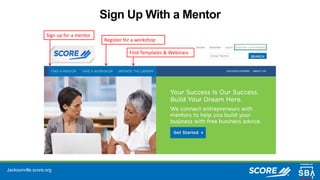
Sign Up With a Mentor
Costs only
$99
Sign up for a mentor
Register for a workshop
Find Templates & Webinars
Jacksonville.score.org
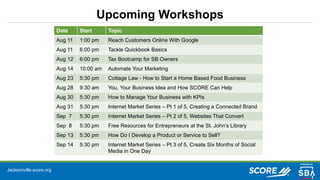
Upcoming Workshops
Date Start Topic
Aug 11 1:00 pm Reach Customers Online With Google
Aug 11 6:00 pm Tackle Quickbook Basics
Aug 12 6:00 pm Tax Bootcamp for SB Owners
Aug 14 10:00 am Automate Your Marketing
Aug 23 5:30 pm Cottage Law - How to Start a Home Based Food Business
Aug 28 9:30 am You, Your Business Idea and How SCORE Can Help
Aug 30 5:30 pm How to Manage Your Business with KPIs
Aug 31 5:30 pm Internet Market Series – Pt 1 of 5, Creating a Connected Brand
Sep 7 5:30 pm Internet Market Series – Pt 2 of 5, Websites That Convert
Sep 8 5:30 pm Free Resources for Entrepreneurs at the St. John’s Library
Sep 13 5:30 pm How Do I Develop a Product or Service to Sell?
Sep 14 5:30 pm Internet Market Series – Pt 3 of 5, Create Six Months of Social
Media in One Day
Jacksonville.score.org
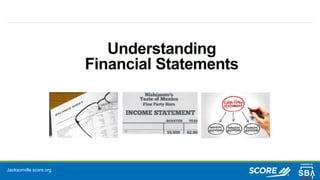
Understanding
Financial Statements
Jacksonville.score.org
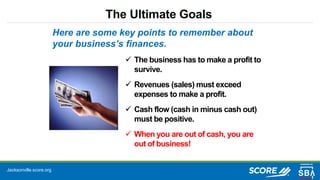
The Ultimate Goals
 The business has to make a profit to
survive.
 Revenues (sales) must exceed
expenses to make a profit.
 Cash flow (cash in minus cash out)
must be positive.
 When you are out of cash, you are
out of business!
Here are some key points to remember about
your business’s finances.
Jacksonville.score.org
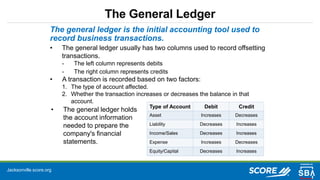
The General Ledger
The general ledger is the initial accounting tool used to
record business transactions.
• The general ledger usually has two columns used to record offsetting
transactions.
- The left column represents debits
- The right column represents credits
• A transaction is recorded based on two factors:
1. The type of account affected.
2. Whether the transaction increases or decreases the balance in that
account.
Type of Account Debit Credit
Asset Increases Decreases
Liability Decreases Increases
Income/Sales Decreases Increases
Expense Increases Decreases
Equity/Capital Decreases Increases
• The general ledger holds
the account information
needed to prepare the
company's financial
statements.
Jacksonville.score.org
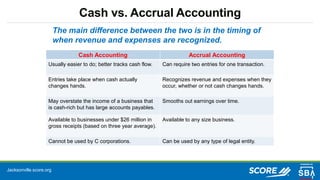
Cash vs. Accrual Accounting
The main difference between the two is in the timing of
when revenue and expenses are recognized.
Cash Accounting Accrual Accounting
Usually easier to do; better tracks cash flow. Can require two entries for one transaction.
Entries take place when cash actually
changes hands.
Recognizes revenue and expenses when they
occur, whether or not cash changes hands.
May overstate the income of a business that
is cash-rich but has large accounts payables.
Smooths out earnings over time.
Available to businesses under $26 million in
gross receipts (based on three year average).
Available to any size business.
Cannot be used by C corporations. Can be used by any type of legal entity.
Jacksonville.score.org
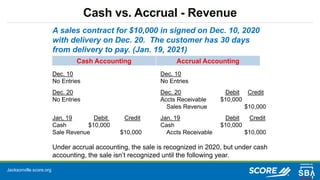
Cash vs. Accrual - Revenue
A sales contract for $10,000 in signed on Dec. 10, 2020
with delivery on Dec. 20. The customer has 30 days
from delivery to pay. (Jan. 19, 2021)
Dec. 10 Dec. 10
No Entries No Entries
Dec. 20 Dec. 20 Debit Credit
No Entries Accts Receivable $10,000
Sales Revenue $10,000
Jan, 19 Debit Credit Jan. 19 Debit Credit
Cash $10,000 Cash $10,000
Sale Revenue $10,000 Accts Receivable $10,000
Under accrual accounting, the sale is recognized in 2020, but under cash
accounting, the sale isn’t recognized until the following year.
Cash Accounting Accrual Accounting
Jacksonville.score.org
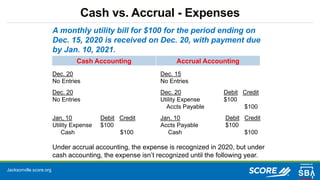
Cash vs. Accrual - Expenses
A monthly utility bill for $100 for the period ending on
Dec. 15, 2020 is received on Dec. 20, with payment due
by Jan. 10, 2021.
Dec. 20 Dec. 15
No Entries No Entries
Dec. 20 Dec. 20 Debit Credit
No Entries Utility Expense $100
Accts Payable $100
Jan, 10 Debit Credit Jan. 10 Debit Credit
Utility Expense $100 Accts Payable $100
Cash $100 Cash $100
Under accrual accounting, the expense is recognized in 2020, but under
cash accounting, the expense isn’t recognized until the following year.
Cash Accounting Accrual Accounting
Jacksonville.score.org
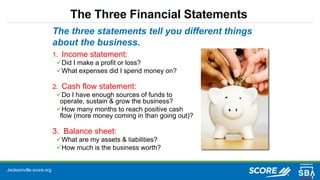
The Three Financial Statements
1. Income statement:
Did I make a profit or loss?
What expenses did I spend money on?
2. Cash flow statement:
Do I have enough sources of funds to
operate, sustain & grow the business?
How many months to reach positive cash
flow (more money coming in than going out)?
3. Balance sheet:
What are my assets & liabilities?
How much is the business worth?
The three statements tell you different things
about the business.
Jacksonville.score.org
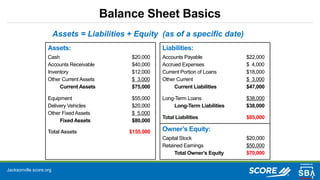
Balance Sheet Basics
Liabilities:
Accounts Payable $22,000
Accrued Expenses $ 4,000
Current Portion of Loans $18,000
Other Current $ 3,000
Current Liabilities $47,000
Long-Term Loans $38,000
Long-Term Liabilities $38,000
Total Liabilities $85,000
Owner’s Equity:
Capital Stock $20,000
Retained Earnings $50,000
Total Owner’s Equity $70,000
Assets = Liabilities + Equity (as of a specific date)
Assets:
Cash $20,000
Accounts Receivable $40,000
Inventory $12,000
Other Current Assets $ 3,000
Current Assets $75,000
Equipment $55,000
Delivery Vehicles $20,000
Other Fixed Assets $ 5,000
Fixed Assets $80,000
Total Assets $155,000
Jacksonville.score.org
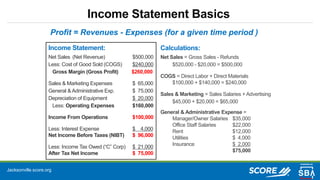
Income Statement Basics
Calculations:
Net Sales = Gross Sales - Refunds
$520,000 - $20,000 = $500,000
COGS = Direct Labor + Direct Materials
$100,000 + $140,000 = $240,000
Sales & Marketing = Sales Salaries + Advertising
$45,000 + $20,000 = $65,000
General & Administrative Expense =
Manager/Owner Salaries $35,000
Office Staff Salaries $22,000
Rent $12,000
Utilities $ 4,000
Insurance $ 2,000
$75,000
Profit = Revenues - Expenses (for a given time period )
Income Statement:
Net Sales (Net Revenue) $500,000
Less: Cost of Good Sold (COGS) $240,000
Gross Margin (Gross Profit) $260,000
Sales & Marketing Expenses $ 65,000
General & Administrative Exp. $ 75,000
Depreciation of Equipment $ 20,000
Less: Operating Expenses $160,000
Income From Operations $100,000
Less: Interest Expense $ 4,000
Net Income Before Taxes (NIBT) $ 96,000
Less: Income Tax Owed (“C” Corp) $ 21,000
After Tax Net Income $ 75,000
Jacksonville.score.org
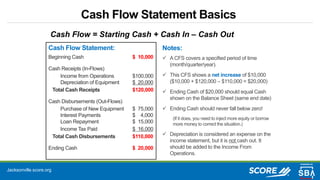
Cash Flow Statement Basics
Notes:
 A CFS covers a specified period of time
(month/quarter/year).
 This CFS shows a net increase of $10,000
($10,000 + $120,000 – $110,000 = $20,000)
 Ending Cash of $20,000 should equal Cash
shown on the Balance Sheet (same end date)
 Ending Cash should never fall below zero!
(If it does, you need to inject more equity or borrow
more money to correct the situation.)
 Depreciation is considered an expense on the
income statement, but it is not cash out. It
should be added to the Income From
Operations.
Cash Flow = Starting Cash + Cash In – Cash Out
Cash Flow Statement:
Beginning Cash $ 10,000
Cash Receipts (In-Flows)
Income from Operations $100,000
Depreciation of Equipment $ 20,000
Total Cash Receipts $120,000
Cash Disbursements (Out-Flows)
Purchase of New Equipment $ 75,000
Interest Payments $ 4,000
Loan Repayment $ 15,000
Income Tax Paid $ 16,000
Total Cash Disbursements $110,000
Ending Cash $ 20,000
Jacksonville.score.org
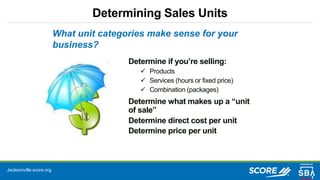
Determining Sales Units
What unit categories make sense for your
business?
Determine if you’re selling:
 Products
 Services (hours or fixed price)
 Combination (packages)
Determine what makes up a “unit
of sale”
Determine direct cost per unit
Determine price per unit
Jacksonville.score.org
Estimating Sales Volume
 How long will it take you to sell the
product or perform the service?
 New customers take longer to find
when getting started, so expect lower
sales in early months.
 You will become more efficient over
time with product or service.
How many items or services will sell in a
day/week/month?
Jacksonville.score.org
Estimating Dollars of Sales
• Is your product or service seasonal?
If yes, then you may sell 80% from Black Friday to
New Year’s day or during the summer months.
• Multiply by average selling price, not list
price.
Take into account discounts, credits, returns.
• Multiply by average 22 working days per
month.
60 units/day X $20.00 X 22 days = $26,400/month
Jacksonville.score.org
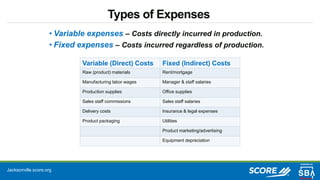
Types of Expenses
Variable (Direct) Costs Fixed (Indirect) Costs
Raw (product) materials Rent/mortgage
Manufacturing labor wages Manager & staff salaries
Production supplies Office supplies
Sales staff commissions Sales staff salaries
Delivery costs Insurance & legal expenses
Product packaging Utilities
Product marketing/advertising
Equipment depreciation
• Variable expenses – Costs directly incurred in production.
• Fixed expenses – Costs incurred regardless of production.
Jacksonville.score.org
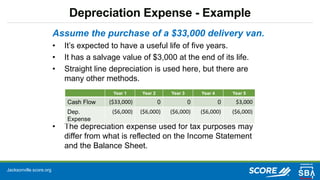
Depreciation Expense - Example
Assume the purchase of a $33,000 delivery van.
• It’s expected to have a useful life of five years.
• It has a salvage value of $3,000 at the end of its life.
• Straight line depreciation is used here, but there are
many other methods.
• The depreciation expense used for tax purposes may
differ from what is reflected on the Income Statement
and the Balance Sheet.
Year 1 Year 2 Year 3 Year 4 Year 5
Cash Flow ($33,000) 0 0 0 $3,000
Dep.
Expense
($6,000) ($6,000) ($6,000) ($6,000) ($6,000)
Jacksonville.score.org
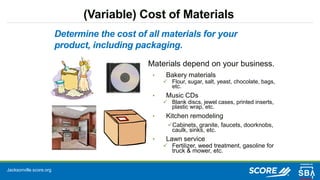
(Variable) Cost of Materials
Materials depend on your business.
• Bakery materials
 Flour, sugar, salt, yeast, chocolate, bags,
etc.
• Music CDs
 Blank discs, jewel cases, printed inserts,
plastic wrap, etc.
• Kitchen remodeling
Cabinets, granite, faucets, doorknobs,
caulk, sinks, etc.
• Lawn service
 Fertilizer, weed treatment, gasoline for
truck & mower, etc.
Determine the cost of all materials for your
product, including packaging.
Jacksonville.score.org
What is Gross Profit Margin (GPM)?
Direct Costs
 Materials & packaging in the product
 Labor to make the product
 Sales commissions
Why is it important?
Requires you to cost out what you’re
selling.
Helps determine adequacy of gross price
for what you’re selling.
Track the trend in GPM over time.
GPM = Net Sales dollars minus direct cost of
sales (COGS + sales commissions).
Jacksonville.score.org
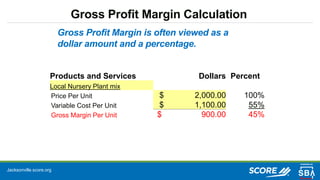
Gross Profit Margin Calculation
Gross Profit Margin is often viewed as a
dollar amount and a percentage.
Products and Services Dollars Percent
Local Nursery Plant mix
Price Per Unit $ 2,000.00 100%
Variable Cost Per Unit $ 1,100.00 55%
Gross Margin Per Unit $ 900.00 45%
Jacksonville.score.org
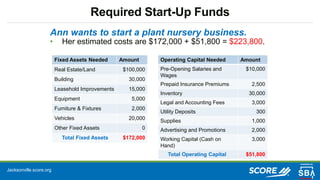
Required Start-Up Funds
Ann wants to start a plant nursery business.
• Her estimated costs are $172,000 + $51,800 = $223,800.
Fixed Assets Needed Amount
Real Estate/Land $100,000
Building 30,000
Leasehold Improvements 15,000
Equipment 5,000
Furniture & Fixtures 2,000
Vehicles 20,000
Other Fixed Assets 0
Total Fixed Assets $172,000
Operating Capital Needed Amount
Pre-Opening Salaries and
Wages
$10,000
Prepaid Insurance Premiums 2,500
Inventory 30,000
Legal and Accounting Fees 3,000
Utility Deposits 300
Supplies 1,000
Advertising and Promotions 2,000
Working Capital (Cash on
Hand)
3,000
Total Operating Capital $51,800
Jacksonville.score.org
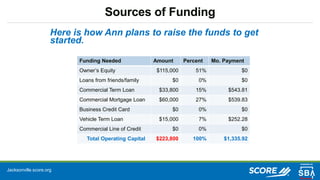
Sources of Funding
Here is how Ann plans to raise the funds to get
started.
Funding Needed Amount Percent Mo. Payment
Owner’s Equity $115,000 51% $0
Loans from friends/family $0 0% $0
Commercial Term Loan $33,800 15% $543.81
Commercial Mortgage Loan $60,000 27% $539.83
Business Credit Card $0 0% $0
Vehicle Term Loan $15,000 7% $252.28
Commercial Line of Credit $0 0% $0
Total Operating Capital $223,800 100% $1,335.92
Jacksonville.score.org
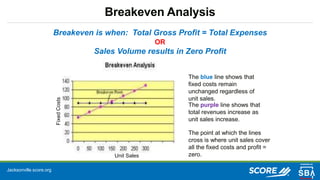
Breakeven Analysis
Breakeven is when: Total Gross Profit = Total Expenses
OR
Sales Volume results in Zero Profit
Fixed
Costs
Unit Sales
The blue line shows that
fixed costs remain
unchanged regardless of
unit sales.
The purple line shows that
total revenues increase as
unit sales increase.
The point at which the lines
cross is where unit sales cover
all the fixed costs and profit =
zero.
Jacksonville.score.org
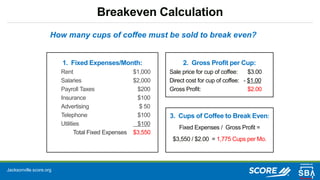
Breakeven Calculation
How many cups of coffee must be sold to break even?
1. Fixed Expenses/Month:
Rent $1,000
Salaries $2,000
Payroll Taxes $200
Insurance $100
Advertising $ 50
Telephone $100
Utilities $100
Total Fixed Expenses $3,550
2. Gross Profit per Cup:
Sale price for cup of coffee: $3.00
Direct cost for cup of coffee: - $1.00
Gross Profit: $2.00
3. Cups of Coffee to Break Even:
Fixed Expenses / Gross Profit =
$3,550 / $2.00 = 1,775 Cups per Mo.
Jacksonville.score.org
Funded in part through a cooperative
agreement with the U.S. Small Business
Administration.
All opinions, conclusions, and/or
recommendations expressed herein are
those of the author(s) and do not
necessarily reflect the
views of the SBA.
JWBC NFDO Quarterly Forum

JWBC NFDO Quarterly Forum

  • 1.
  • 3.
  • 5.
    Over 27 Yearsexperience in the Franchise Industry 39 years entrepreneur Featured in “Career Changers Manual” Samuel Greengard. Top 50 Advantage Business magazine Marshall Reddy President -- Franchise Network, Inc
  • 6.
    New Year NewYou Your Dream of Business Ownership
  • 7.
    AGENDA (60 MINUTES) •Why Business Ownership? • Options for Getting Into Business • Risks & Rewards of Business Ownership • Myths & Realities of Franchising • How to Identify the Best Business Option forYou • BuildingYour Personal Business Model
  • 8.
    WHO IS FRANNET? •30+ year old International Franchise Consulting firm • Over 100 locally-based consultants across North America • National partnerships with SCORE & SBDC. • We match people who want to be in business with a franchise that meets their needs. • Our services are always 100% free to you, the client
  • 9.
  • 10.
    • Risk: • Ajob is safer than a business • I’ll wait until the economy is better • Money: • A business costs a lot of money to start and run • Knowledge: • I don’t know where to start or find what I’m looking for • Skills: • Running a business takes specific talents and skills SOME OFTHE CONCERNS
  • 11.
  • 12.
    NOT OUR FIRSTRODEO … PAST: Dotcom bust, 9/11, Great Recession, SARS, H1N1…. PRESENT: COVID-19 FOCUS: • Create your own ladder • Recession-resistant industries • Reasonable overhead • Service-based businesses
  • 13.
    ARE YOU SURPRISED? •A recent survey conducted by a major franchise trade group, revealed some surprising results on franchise activity in the near term, amidst this challenging backdrop. • 54% think that “now is a good time” to start a business. • 59% expect to start a business within the next three months, and another 17% within four-to-six months
  • 14.
    HOW TO USETHIS TIME Hit the Brakes! • We get it • This isn’t for everyone Tap the Brakes • Proceed cautiously • Pull the trigger w/ clarity on COVID-19 • What IS clarity for you and is it realistic? Full Speed Ahead! • THIS is the time • Take advantage of opportunities (low interest rates, increased vacancies, lower costs, etc.) • Possible huge economic opportunity on the other side, I’ll be ready • Prepare now, take off when I want Searching for an opportunity is not the same as committing to a purchase.
  • 15.
    Risk Time Job (Then) Job(Now) Risk Increases Is working for someone safe? Short term yes, but …  Can you be sure your job is safe?  Can performance determine security?  Will you meet your long-term financial goals of security and retirement? RISK PERCEPTION: JOB
  • 16.
    Job Security Average Employment Tenure 2014: 4.6years 2016: 4.2 years 2019: 4.6 years 2020: 4.1 years Source: US Bureau of Labor Statistics
  • 17.
    Career Paths ofYesteryear
  • 18.
  • 19.
    Motivation to Owna Business Source: Guidant Financial Small Business Trends survey Dissatisfaction with corporate America has been #1 for last 3 years 75% of small business owners rate their happiness at 8/10 or higher.
  • 20.
    Small Business Source: SBA.Small Businesses are less than 500 employees.
  • 21.
    What is itfor YOU? Control Financial Security No More Layoffs Money Fulfillment Flexibility Independence SUCCESS WHY BUSINESS OWNERSHIP
  • 22.
    BUSINESS OWNERSHIP OPTIONS Starta Business From Scratch Buy an Existing Business Buy a Franchise
  • 23.
    START A BUSINESS ADVANTAGES TotalControl Make all decisions Room for creativity No predetermined rules Large upside Build a business from your passion Start a Business From Scratch DISADVANTAGES Must create systems Limited financial options Slow ramp-up High failure rate
  • 24.
    BUY AN EXISTINGBUSINESS ADVANTAGES Cash flow Goodwill Actual financial results Attractive to lenders Market established Customer base Employees Systems may be in place Owner financing Buy an Existing Business DISADVANTAGES Cash flow Bad will May be overpriced Poor training and support Hidden seller motives Employee defection Higher debt service
  • 25.
    BUY A FRANCHISE ADVANTAGES Namerecognition/ Licensed trademark Proven business system Training and support Lower failure rate Lower cost Financing options Disclosure Franchise family Buy a Franchise DISADVANTAGES Fewer industry options Structured operating system (in some franchises) Territory restrictions Can only sell their products Ongoing royalty payments
  • 26.
  • 27.
    Why Do PeopleChoose Franchising?
  • 28.
    Owners come fromall backgrounds *Based on FranNet placements Who Buys Franchises?
  • 29.
    Franchise Owners Inthe Past 5 Years • MoreWomen • Female owners: +22% • Younger • 20-29 years old: +100% • 30-39 years old: +53% • Veterans • Owners that are veterans: +3% Source: FranNet placement data
  • 31.
    Proven, systematic approachto starting and staying in business • Experience • Simplicity • Initial Training & Ongoing Support • Name Recognition • Sales, Marketing & Operational Systems • Culture of Teamwork HOW FRANCHISING WORKS
  • 32.
    • Many Unitsvs. Fewer Units • Well-established vs. Newer • Structured Systems vs. Flexible Systems • Expensive vs. Inexpensive • Remember: There is no automatic correlation between the between the cost of the franchise and the potential return. return. FRANCHISES ARE NOT ALLTHE SAME
  • 33.
    Am I willingto follow the franchisor’s system? Is it affordable? Is the risk level acceptable? Will I enjoy my business? FINDINGYOUR PERFECT FIT
  • 34.
    Separate the functionof the business, from the function of the business owner! FINDINGYOUR PERFECT FIT
  • 35.
    What is Rightfor YOU?
  • 36.
    Use Your TransferableBusiness Skills
  • 37.
    • Challenge, recognition, prestige •Build equity for retirement • Time for family and interests • Independence and control • Financial security WHAT IS IMPORTANTTOYOU?
  • 38.
    Government Disclosure: FDD •“Franchise Disclosure Document” • Mandatory Information • Franchisor Info • Time in business, experience • Bankruptcies, Litigation • Franchise Contract
  • 39.
    • Contact InfoFor: • Current franchisees • Past franchisees • Policies • Renewal,Termination &Transfer, Etc. • Financial • Earnings Claims • Investment • Franchise & other fees, capital • Royalties Government Disclosure: FDD
  • 40.
  • 41.
    MYTH #1: FRANCHISING IS ONLYFAST FOOD & RETAIL
  • 42.
    FRANCHISING FACT FACT: • Over3,600 different franchise companies • In more than 90 industries • With over 900,000 operating units Automotive Commercial & Residential Services Personal Services Business Services Retail Products & Services Other
  • 43.
    MYTH #2: FRANCHISES SUCCEED BECAUSEOFTHE QUALITY OF THE PRODUCT
  • 44.
    Can you makea hamburger? Is your hamburger better than McDonald’s? If it is not the product, then what is it? FRANCHISING FACT
  • 45.
    FACT: It isall about the Business System • Marketing • Sales • Operations • Accounting FRANCHISING FACT
  • 46.
    SUCCESSFUL FRANCHISES EMERGE INNEW INDUSTRIES WITH NO NEW COMPETITORS MYTH #3:
  • 47.
    FACT: It’s theSYSTEM! • McDonald’s started when there was a burger joint every corner. • More recent examples are in Consumer and Business Services. FRANCHISING FACT
  • 48.
  • 49.
    There is noautomatic correlation between the cost of the franchise and the potential return. Source: FRAN data 11% under $50K 27% are under $100K 55% are under $250K Many Investment Levels
  • 50.
    HOW MUCH DOI NEED? TOTAL INVESTMENT Your Money: 25-30% Financing: 70-75%
  • 51.
    FINANCING SOURCES Financing Sources: •Personal savings • Friends, relatives or partner • Home equity line of credit • Seller financing – resale • 401K, IRA, etc.
  • 52.
    HIGH RETURN REQUIRES AHIGH INVESTMENT MYTH #5:
  • 53.
    FACT: There isno automatic correlation between the cost of franchise and the potential FRANCHISING FACTS FACT: Service businesses require far less capital investments and frequently yield higher returns.
  • 54.
  • 55.
    FRANCHISING FACT Franchisors wantpeople who… • Will use their system • Will focus on being an owner • …with business and management skills • …with people and communication skills Proven Process • Franchisor trains the franchisee on how to use their system
  • 56.
    ADDITIONAL RESOURCES Professional Advisors: •Franchise Attorney • Accountant Suggested Reading: • More Than Just French Fries • E-Myth Revisited, by Michael Gerber • Street Smart Franchising, by Joe Matthews
  • 57.
    For Additional Information MarshallReddy Marshall@Whatthefranchise.com Whatthefranchise.com 904.249.1820
  • 59.
    STEVE GORANSON: ACTIONCOAC H • Steve Goranson,has owned and operated the North Florida office of ActionCOACH Business Coaching since 2004 • Established in 1993, ActionCOACH is the world’s largest coaching franchise with over 1000 offices in 70+ different countries. • They coach over 15,000 businesses each week across the Globe • ActionCOACH offers more than just coaching. It offers a change of lifestyle the opportunity to make more money and an improve work-life balance. Helping Business owners Work Smarter Not Harder! • ActionCOACH doesn’t offer the quick fix. It promises a change of lifestyle for those that use and embrace its systems and culture • Steve has lived in Jacksonville for over 30 years with his wife Shari and 4 kids. Over the years he has worked with small business owners in the areas of sales, advertising, marketing & marketing research. • Steve’s vision is to bring Success & Prosperity to Northeast Florida thru Business Re-Education. • He is committed to helping business owners make a better life for themselves and their families
  • 61.
    CRAIG LINSKY: SCORE JACKSONVILLE MENTOR &CLIENT EDUCATION COMMITTEE CHAIRMAN Craig Linsky is a SCORE mentor and Chairman of the Client Education Committee at SCORE in Jacksonville. Craig worked in the financial services industry for nearly thirty years. For the past ten years, he has designed and taught marketing and other business topics both domestically through SCORE and internationally through the Financial Services Volunteer Corp.
  • 62.
  • 63.
  • 64.
    Jacksonville.score.org What is SCORE? Anonprofit organization with the largest network of free business experts in the United States. • In association with the SBA, SCORE is dedicated to helping small businesses get started, grow and achieve their goals through education and mentorship. • Over 11,000 volunteers in over 250 chapters nationwide. • Dedicated to entrepreneur education, the formation, growth and success of small business. • Over 70 volunteers in the Northeast Florida chapter. Jacksonville Chapter
  • 65.
    Jacksonville.score.org Sign Up Witha Mentor Costs only $99 Sign up for a mentor Register for a workshop Find Templates & Webinars
  • 66.
    Jacksonville.score.org Upcoming Workshops Date StartTopic Aug 11 1:00 pm Reach Customers Online With Google Aug 11 6:00 pm Tackle Quickbook Basics Aug 12 6:00 pm Tax Bootcamp for SB Owners Aug 14 10:00 am Automate Your Marketing Aug 23 5:30 pm Cottage Law - How to Start a Home Based Food Business Aug 28 9:30 am You, Your Business Idea and How SCORE Can Help Aug 30 5:30 pm How to Manage Your Business with KPIs Aug 31 5:30 pm Internet Market Series – Pt 1 of 5, Creating a Connected Brand Sep 7 5:30 pm Internet Market Series – Pt 2 of 5, Websites That Convert Sep 8 5:30 pm Free Resources for Entrepreneurs at the St. John’s Library Sep 13 5:30 pm How Do I Develop a Product or Service to Sell? Sep 14 5:30 pm Internet Market Series – Pt 3 of 5, Create Six Months of Social Media in One Day
  • 67.
  • 68.
    Jacksonville.score.org The Ultimate Goals The business has to make a profit to survive.  Revenues (sales) must exceed expenses to make a profit.  Cash flow (cash in minus cash out) must be positive.  When you are out of cash, you are out of business! Here are some key points to remember about your business’s finances.
  • 69.
    Jacksonville.score.org The General Ledger Thegeneral ledger is the initial accounting tool used to record business transactions. • The general ledger usually has two columns used to record offsetting transactions. - The left column represents debits - The right column represents credits • A transaction is recorded based on two factors: 1. The type of account affected. 2. Whether the transaction increases or decreases the balance in that account. Type of Account Debit Credit Asset Increases Decreases Liability Decreases Increases Income/Sales Decreases Increases Expense Increases Decreases Equity/Capital Decreases Increases • The general ledger holds the account information needed to prepare the company's financial statements.
  • 70.
    Jacksonville.score.org Cash vs. AccrualAccounting The main difference between the two is in the timing of when revenue and expenses are recognized. Cash Accounting Accrual Accounting Usually easier to do; better tracks cash flow. Can require two entries for one transaction. Entries take place when cash actually changes hands. Recognizes revenue and expenses when they occur, whether or not cash changes hands. May overstate the income of a business that is cash-rich but has large accounts payables. Smooths out earnings over time. Available to businesses under $26 million in gross receipts (based on three year average). Available to any size business. Cannot be used by C corporations. Can be used by any type of legal entity.
  • 71.
    Jacksonville.score.org Cash vs. Accrual- Revenue A sales contract for $10,000 in signed on Dec. 10, 2020 with delivery on Dec. 20. The customer has 30 days from delivery to pay. (Jan. 19, 2021) Dec. 10 Dec. 10 No Entries No Entries Dec. 20 Dec. 20 Debit Credit No Entries Accts Receivable $10,000 Sales Revenue $10,000 Jan, 19 Debit Credit Jan. 19 Debit Credit Cash $10,000 Cash $10,000 Sale Revenue $10,000 Accts Receivable $10,000 Under accrual accounting, the sale is recognized in 2020, but under cash accounting, the sale isn’t recognized until the following year. Cash Accounting Accrual Accounting
  • 72.
    Jacksonville.score.org Cash vs. Accrual- Expenses A monthly utility bill for $100 for the period ending on Dec. 15, 2020 is received on Dec. 20, with payment due by Jan. 10, 2021. Dec. 20 Dec. 15 No Entries No Entries Dec. 20 Dec. 20 Debit Credit No Entries Utility Expense $100 Accts Payable $100 Jan, 10 Debit Credit Jan. 10 Debit Credit Utility Expense $100 Accts Payable $100 Cash $100 Cash $100 Under accrual accounting, the expense is recognized in 2020, but under cash accounting, the expense isn’t recognized until the following year. Cash Accounting Accrual Accounting
  • 73.
    Jacksonville.score.org The Three FinancialStatements 1. Income statement: Did I make a profit or loss? What expenses did I spend money on? 2. Cash flow statement: Do I have enough sources of funds to operate, sustain & grow the business? How many months to reach positive cash flow (more money coming in than going out)? 3. Balance sheet: What are my assets & liabilities? How much is the business worth? The three statements tell you different things about the business.
  • 74.
    Jacksonville.score.org Balance Sheet Basics Liabilities: AccountsPayable $22,000 Accrued Expenses $ 4,000 Current Portion of Loans $18,000 Other Current $ 3,000 Current Liabilities $47,000 Long-Term Loans $38,000 Long-Term Liabilities $38,000 Total Liabilities $85,000 Owner’s Equity: Capital Stock $20,000 Retained Earnings $50,000 Total Owner’s Equity $70,000 Assets = Liabilities + Equity (as of a specific date) Assets: Cash $20,000 Accounts Receivable $40,000 Inventory $12,000 Other Current Assets $ 3,000 Current Assets $75,000 Equipment $55,000 Delivery Vehicles $20,000 Other Fixed Assets $ 5,000 Fixed Assets $80,000 Total Assets $155,000
  • 75.
    Jacksonville.score.org Income Statement Basics Calculations: NetSales = Gross Sales - Refunds $520,000 - $20,000 = $500,000 COGS = Direct Labor + Direct Materials $100,000 + $140,000 = $240,000 Sales & Marketing = Sales Salaries + Advertising $45,000 + $20,000 = $65,000 General & Administrative Expense = Manager/Owner Salaries $35,000 Office Staff Salaries $22,000 Rent $12,000 Utilities $ 4,000 Insurance $ 2,000 $75,000 Profit = Revenues - Expenses (for a given time period ) Income Statement: Net Sales (Net Revenue) $500,000 Less: Cost of Good Sold (COGS) $240,000 Gross Margin (Gross Profit) $260,000 Sales & Marketing Expenses $ 65,000 General & Administrative Exp. $ 75,000 Depreciation of Equipment $ 20,000 Less: Operating Expenses $160,000 Income From Operations $100,000 Less: Interest Expense $ 4,000 Net Income Before Taxes (NIBT) $ 96,000 Less: Income Tax Owed (“C” Corp) $ 21,000 After Tax Net Income $ 75,000
  • 76.
    Jacksonville.score.org Cash Flow StatementBasics Notes:  A CFS covers a specified period of time (month/quarter/year).  This CFS shows a net increase of $10,000 ($10,000 + $120,000 – $110,000 = $20,000)  Ending Cash of $20,000 should equal Cash shown on the Balance Sheet (same end date)  Ending Cash should never fall below zero! (If it does, you need to inject more equity or borrow more money to correct the situation.)  Depreciation is considered an expense on the income statement, but it is not cash out. It should be added to the Income From Operations. Cash Flow = Starting Cash + Cash In – Cash Out Cash Flow Statement: Beginning Cash $ 10,000 Cash Receipts (In-Flows) Income from Operations $100,000 Depreciation of Equipment $ 20,000 Total Cash Receipts $120,000 Cash Disbursements (Out-Flows) Purchase of New Equipment $ 75,000 Interest Payments $ 4,000 Loan Repayment $ 15,000 Income Tax Paid $ 16,000 Total Cash Disbursements $110,000 Ending Cash $ 20,000
  • 77.
    Jacksonville.score.org Determining Sales Units Whatunit categories make sense for your business? Determine if you’re selling:  Products  Services (hours or fixed price)  Combination (packages) Determine what makes up a “unit of sale” Determine direct cost per unit Determine price per unit
  • 78.
    Jacksonville.score.org Estimating Sales Volume How long will it take you to sell the product or perform the service?  New customers take longer to find when getting started, so expect lower sales in early months.  You will become more efficient over time with product or service. How many items or services will sell in a day/week/month?
  • 79.
    Jacksonville.score.org Estimating Dollars ofSales • Is your product or service seasonal? If yes, then you may sell 80% from Black Friday to New Year’s day or during the summer months. • Multiply by average selling price, not list price. Take into account discounts, credits, returns. • Multiply by average 22 working days per month. 60 units/day X $20.00 X 22 days = $26,400/month
  • 80.
    Jacksonville.score.org Types of Expenses Variable(Direct) Costs Fixed (Indirect) Costs Raw (product) materials Rent/mortgage Manufacturing labor wages Manager & staff salaries Production supplies Office supplies Sales staff commissions Sales staff salaries Delivery costs Insurance & legal expenses Product packaging Utilities Product marketing/advertising Equipment depreciation • Variable expenses – Costs directly incurred in production. • Fixed expenses – Costs incurred regardless of production.
  • 81.
    Jacksonville.score.org Depreciation Expense -Example Assume the purchase of a $33,000 delivery van. • It’s expected to have a useful life of five years. • It has a salvage value of $3,000 at the end of its life. • Straight line depreciation is used here, but there are many other methods. • The depreciation expense used for tax purposes may differ from what is reflected on the Income Statement and the Balance Sheet. Year 1 Year 2 Year 3 Year 4 Year 5 Cash Flow ($33,000) 0 0 0 $3,000 Dep. Expense ($6,000) ($6,000) ($6,000) ($6,000) ($6,000)
  • 82.
    Jacksonville.score.org (Variable) Cost ofMaterials Materials depend on your business. • Bakery materials  Flour, sugar, salt, yeast, chocolate, bags, etc. • Music CDs  Blank discs, jewel cases, printed inserts, plastic wrap, etc. • Kitchen remodeling Cabinets, granite, faucets, doorknobs, caulk, sinks, etc. • Lawn service  Fertilizer, weed treatment, gasoline for truck & mower, etc. Determine the cost of all materials for your product, including packaging.
  • 83.
    Jacksonville.score.org What is GrossProfit Margin (GPM)? Direct Costs  Materials & packaging in the product  Labor to make the product  Sales commissions Why is it important? Requires you to cost out what you’re selling. Helps determine adequacy of gross price for what you’re selling. Track the trend in GPM over time. GPM = Net Sales dollars minus direct cost of sales (COGS + sales commissions).
  • 84.
    Jacksonville.score.org Gross Profit MarginCalculation Gross Profit Margin is often viewed as a dollar amount and a percentage. Products and Services Dollars Percent Local Nursery Plant mix Price Per Unit $ 2,000.00 100% Variable Cost Per Unit $ 1,100.00 55% Gross Margin Per Unit $ 900.00 45%
  • 85.
    Jacksonville.score.org Required Start-Up Funds Annwants to start a plant nursery business. • Her estimated costs are $172,000 + $51,800 = $223,800. Fixed Assets Needed Amount Real Estate/Land $100,000 Building 30,000 Leasehold Improvements 15,000 Equipment 5,000 Furniture & Fixtures 2,000 Vehicles 20,000 Other Fixed Assets 0 Total Fixed Assets $172,000 Operating Capital Needed Amount Pre-Opening Salaries and Wages $10,000 Prepaid Insurance Premiums 2,500 Inventory 30,000 Legal and Accounting Fees 3,000 Utility Deposits 300 Supplies 1,000 Advertising and Promotions 2,000 Working Capital (Cash on Hand) 3,000 Total Operating Capital $51,800
  • 86.
    Jacksonville.score.org Sources of Funding Hereis how Ann plans to raise the funds to get started. Funding Needed Amount Percent Mo. Payment Owner’s Equity $115,000 51% $0 Loans from friends/family $0 0% $0 Commercial Term Loan $33,800 15% $543.81 Commercial Mortgage Loan $60,000 27% $539.83 Business Credit Card $0 0% $0 Vehicle Term Loan $15,000 7% $252.28 Commercial Line of Credit $0 0% $0 Total Operating Capital $223,800 100% $1,335.92
  • 87.
    Jacksonville.score.org Breakeven Analysis Breakeven iswhen: Total Gross Profit = Total Expenses OR Sales Volume results in Zero Profit Fixed Costs Unit Sales The blue line shows that fixed costs remain unchanged regardless of unit sales. The purple line shows that total revenues increase as unit sales increase. The point at which the lines cross is where unit sales cover all the fixed costs and profit = zero.
  • 88.
    Jacksonville.score.org Breakeven Calculation How manycups of coffee must be sold to break even? 1. Fixed Expenses/Month: Rent $1,000 Salaries $2,000 Payroll Taxes $200 Insurance $100 Advertising $ 50 Telephone $100 Utilities $100 Total Fixed Expenses $3,550 2. Gross Profit per Cup: Sale price for cup of coffee: $3.00 Direct cost for cup of coffee: - $1.00 Gross Profit: $2.00 3. Cups of Coffee to Break Even: Fixed Expenses / Gross Profit = $3,550 / $2.00 = 1,775 Cups per Mo.
  • 89.
  • 90.
    Jacksonville.score.org Funded in partthrough a cooperative agreement with the U.S. Small Business Administration. All opinions, conclusions, and/or recommendations expressed herein are those of the author(s) and do not necessarily reflect the views of the SBA.