Questions To Keep In Mind
 What are my motivations for owning a business?
 Should I start or buy a business?
 What and where is the market for what I want to sell?
 How much will all this cost me?
 Should my company be domestic or global?
Motivations
 Deciding what your motivations are
will direct you toward what type of
business fits you best.
 Types:
1. Lifestyle Venture
2. Smaller Profit Venture
3. High Growth Venture
1. Lifestyle Venture
 Small company that provides its owner
independence, autonomy, and control.
 Is often run out of household
 Provides flexibility (hours, meeting
places, attire)
 Aligns your personal interests and
hobbies with your desire to make a
profit.
2. Smaller Profit Venture
 Small company not concentrated on
pushing the envelope and growing
inordinately large.
 Making millions of dollars not important.
 Content with making a decent living.
 Ex. Mom and Pop Stores
3. High Growth Ventures
 Goal is maximum profit and growth.
 Concentrated on pushing envelope and
growing as large as possible.
 Focus on innovation
Start or Buy?
 Start – cheapest, but very difficult
-requires most planning/research
 Buy – expensive – may be out or reach
-requires less planning and research
 Franchise (middle ground) – a business
run by an individual (the franchisee) to
whom a franchiser grants the right to
market a certain good or service.
The Market???
 Planning & Research essential
 Extensive market surveys (family,
friends, neighbors…)
 Magazines and Polls offer some
information on the market
-Businessweek, Harris Poll
What about the cost?
 Plan realistically, not optimistically

Don’t overestimate your profits

Don’t underestimate your costs
 Sources of Funds

Banks

Venture Capitalists – filthy rich, high risk investors
looking for a many-times-over yield

Angels – seem to have altruistic motives and less
stringent demands than venture capitalists
Domestic or Global?
 Drawbacks to Global – more research
and less accessible connections in
startup phase, more travel time
required, more considerations.
 Advantages to Global – more human
resources, more demand, more
financing, easier to start global than go
from domestic to global.
Entrepreneurship: Growth Pressures
Entrepreneurs often find that as their business grows, they feel
more pressure to use formal methods to lead their
organizations.
Although this formalization process may compromise some
entrepreneurs spirit, it often leads to more focus,
organization, and greater financial returns.
Basically, it’s a movement from a “seat-of-the-pants” operation
to a more structured, legitimate and recognizable business.
Entrepreneurship: Growth Pressures
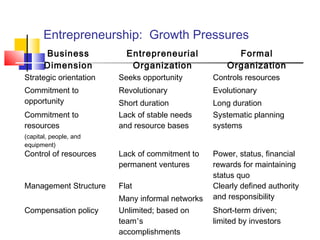
Entrepreneurial and Formal Organizations differ in
six business dimensions:

Strategic orientation

Commitment to opportunity

Commitment to resources

Control of resources

Management structure

Compensation policy
Entrepreneurship: Growth Pressures
Business
Dimension
Entrepreneurial
Organization
Formal
Organization
Strategic orientation Seeks opportunity Controls resources
Commitment to
opportunity
Revolutionary
Short duration
Evolutionary
Long duration
Commitment to
resources
(capital, people, and
equipment)
Lack of stable needs
and resource bases
Systematic planning
systems
Control of resources Lack of commitment to
permanent ventures
Power, status, financial
rewards for maintaining
status quo
Management Structure Flat
Many informal networks
Clearly defined authority
and responsibility
Compensation policy Unlimited; based on
team’s
accomplishments
Short-term driven;
limited by investors
Entrepreneurship: Growth Pressures
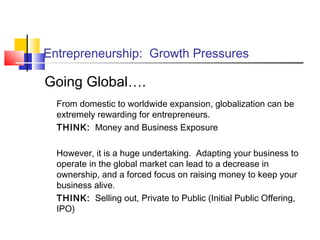
Going Global….
From domestic to worldwide expansion, globalization can be
extremely rewarding for entrepreneurs.
THINK: Money and Business Exposure
However, it is a huge undertaking. Adapting your business to
operate in the global market can lead to a decrease in
ownership, and a forced focus on raising money to keep your
business alive.
THINK: Selling out, Private to Public (Initial Public Offering,
IPO)
Entrepreneurship: Managing a Family Business
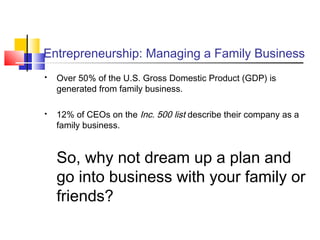
 Over 50% of the U.S. Gross Domestic Product (GDP) is
generated from family business.
 12% of CEOs on the Inc. 500 list describe their company as a
family business.
So, why not dream up a plan and
go into business with your family or
friends?
Entrepreneurship: Managing a Family Business
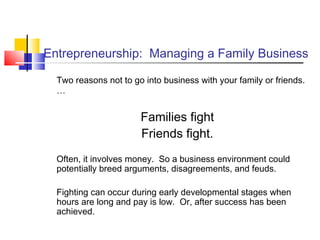
Two reasons not to go into business with your family or friends.
…
Families fight
Friends fight.
Often, it involves money. So a business environment could
potentially breed arguments, disagreements, and feuds.
Fighting can occur during early developmental stages when
hours are long and pay is low. Or, after success has been
achieved.
Entrepreneurship: Managing a Family Business
Six steps to help lead you to a successful Family Business:
 Clear job responsibilities
 Clear hiring criteria
 Clear plan for management transition
 Agreement on whether and when to sell business
 Commitment to resolving conflicts quickly
 Outside advisors are used to mediate conflicts.
Clarity is key…. but NO GUARANTEE.
Entrepreneurship: Managing a Family Business
Operational vs. Survival Issues….
Operational = Decisions about the economics of the business
and how to balance that with rational and family obligation
criteria.
THINK: Day-to-day grind.
Survival = Develop out of a lack of attention on the operational
issues within the business.
THINK: Festering problems; ultimately compromise livelihood.
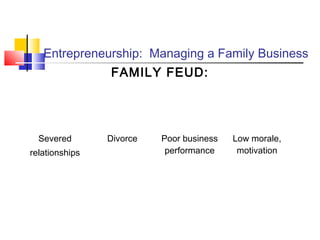
Entrepreneurship: Managing a Family Business
FAMILY FEUD:
Severed
relationships
Divorce Poor business
performance
Low morale,
motivation
Entrepreneurship: Corporate INTRA-preneurs
Intrapreneur = someone in an existing organization who
turns new ideas into profitable realities.
Not every employee has the ability to become a successful
intrapreneur. It takes well-developed strategic action, teamwork
and communication abilities.
Entrepreneurship: Corporate INTRA-preneurs
Organizations that redirect themselves through innovation have
the following characteristics:
 Commitment from senior management
 Flexible organization design
 Autonomy of the venture team
 Competent/Talented people with entrepreneurial
attitudes
 Incentives and rewards for risk taking
 Appropriately designed control system
Entrepreneurship: Corporate INTRA-preneurs
In order to for this type of forward thinking to reap long-term
benefits, top management must allow it to flourish in the day-to-
day operations of the business….
This is known as “skunkworks”
Skunkworks = Islands of intrapreneurial activity within an
organization.
REMEMBER: On the island, formal rules and policies of the
organization often DO NOT apply.
One More Time
 What is an entrepreneur?
 Characteristics of an entrepreneur
 Planning to be an entrepreneur
 Growth pressures, managing a family
business, and corporate
intrapreneurship

Entrep

  • 1.
    Questions To KeepIn Mind  What are my motivations for owning a business?  Should I start or buy a business?  What and where is the market for what I want to sell?  How much will all this cost me?  Should my company be domestic or global?
  • 2.
    Motivations  Deciding whatyour motivations are will direct you toward what type of business fits you best.  Types: 1. Lifestyle Venture 2. Smaller Profit Venture 3. High Growth Venture
  • 3.
    1. Lifestyle Venture Small company that provides its owner independence, autonomy, and control.  Is often run out of household  Provides flexibility (hours, meeting places, attire)  Aligns your personal interests and hobbies with your desire to make a profit.
  • 4.
    2. Smaller ProfitVenture  Small company not concentrated on pushing the envelope and growing inordinately large.  Making millions of dollars not important.  Content with making a decent living.  Ex. Mom and Pop Stores
  • 5.
    3. High GrowthVentures  Goal is maximum profit and growth.  Concentrated on pushing envelope and growing as large as possible.  Focus on innovation
  • 6.
    Start or Buy? Start – cheapest, but very difficult -requires most planning/research  Buy – expensive – may be out or reach -requires less planning and research  Franchise (middle ground) – a business run by an individual (the franchisee) to whom a franchiser grants the right to market a certain good or service.
  • 7.
    The Market???  Planning& Research essential  Extensive market surveys (family, friends, neighbors…)  Magazines and Polls offer some information on the market -Businessweek, Harris Poll
  • 8.
    What about thecost?  Plan realistically, not optimistically  Don’t overestimate your profits  Don’t underestimate your costs  Sources of Funds  Banks  Venture Capitalists – filthy rich, high risk investors looking for a many-times-over yield  Angels – seem to have altruistic motives and less stringent demands than venture capitalists
  • 9.
    Domestic or Global? Drawbacks to Global – more research and less accessible connections in startup phase, more travel time required, more considerations.  Advantages to Global – more human resources, more demand, more financing, easier to start global than go from domestic to global.
  • 10.
    Entrepreneurship: Growth Pressures Entrepreneursoften find that as their business grows, they feel more pressure to use formal methods to lead their organizations. Although this formalization process may compromise some entrepreneurs spirit, it often leads to more focus, organization, and greater financial returns. Basically, it’s a movement from a “seat-of-the-pants” operation to a more structured, legitimate and recognizable business.
  • 11.
    Entrepreneurship: Growth Pressures Entrepreneurialand Formal Organizations differ in six business dimensions:  Strategic orientation  Commitment to opportunity  Commitment to resources  Control of resources  Management structure  Compensation policy
  • 12.
    Entrepreneurship: Growth Pressures Business Dimension Entrepreneurial Organization Formal Organization Strategicorientation Seeks opportunity Controls resources Commitment to opportunity Revolutionary Short duration Evolutionary Long duration Commitment to resources (capital, people, and equipment) Lack of stable needs and resource bases Systematic planning systems Control of resources Lack of commitment to permanent ventures Power, status, financial rewards for maintaining status quo Management Structure Flat Many informal networks Clearly defined authority and responsibility Compensation policy Unlimited; based on team’s accomplishments Short-term driven; limited by investors
  • 13.
    Entrepreneurship: Growth Pressures GoingGlobal…. From domestic to worldwide expansion, globalization can be extremely rewarding for entrepreneurs. THINK: Money and Business Exposure However, it is a huge undertaking. Adapting your business to operate in the global market can lead to a decrease in ownership, and a forced focus on raising money to keep your business alive. THINK: Selling out, Private to Public (Initial Public Offering, IPO)
  • 14.
    Entrepreneurship: Managing aFamily Business  Over 50% of the U.S. Gross Domestic Product (GDP) is generated from family business.  12% of CEOs on the Inc. 500 list describe their company as a family business. So, why not dream up a plan and go into business with your family or friends?
  • 15.
    Entrepreneurship: Managing aFamily Business Two reasons not to go into business with your family or friends. … Families fight Friends fight. Often, it involves money. So a business environment could potentially breed arguments, disagreements, and feuds. Fighting can occur during early developmental stages when hours are long and pay is low. Or, after success has been achieved.
  • 16.
    Entrepreneurship: Managing aFamily Business Six steps to help lead you to a successful Family Business:  Clear job responsibilities  Clear hiring criteria  Clear plan for management transition  Agreement on whether and when to sell business  Commitment to resolving conflicts quickly  Outside advisors are used to mediate conflicts. Clarity is key…. but NO GUARANTEE.
  • 17.
    Entrepreneurship: Managing aFamily Business Operational vs. Survival Issues…. Operational = Decisions about the economics of the business and how to balance that with rational and family obligation criteria. THINK: Day-to-day grind. Survival = Develop out of a lack of attention on the operational issues within the business. THINK: Festering problems; ultimately compromise livelihood.
  • 18.
    Entrepreneurship: Managing aFamily Business FAMILY FEUD: Severed relationships Divorce Poor business performance Low morale, motivation
  • 19.
    Entrepreneurship: Corporate INTRA-preneurs Intrapreneur= someone in an existing organization who turns new ideas into profitable realities. Not every employee has the ability to become a successful intrapreneur. It takes well-developed strategic action, teamwork and communication abilities.
  • 20.
    Entrepreneurship: Corporate INTRA-preneurs Organizationsthat redirect themselves through innovation have the following characteristics:  Commitment from senior management  Flexible organization design  Autonomy of the venture team  Competent/Talented people with entrepreneurial attitudes  Incentives and rewards for risk taking  Appropriately designed control system
  • 21.
    Entrepreneurship: Corporate INTRA-preneurs Inorder to for this type of forward thinking to reap long-term benefits, top management must allow it to flourish in the day-to- day operations of the business…. This is known as “skunkworks” Skunkworks = Islands of intrapreneurial activity within an organization. REMEMBER: On the island, formal rules and policies of the organization often DO NOT apply.
  • 22.
    One More Time What is an entrepreneur?  Characteristics of an entrepreneur  Planning to be an entrepreneur  Growth pressures, managing a family business, and corporate intrapreneurship