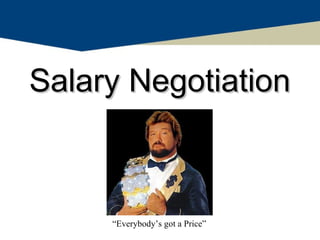
Salary Negotiation


     “Everybody’s got a Price”
“Money will not make you
         happy…..
But money can make a happy
      person happier.”
                      -Chad Pinion
AGENDA
•   Goal of Salary Negotiation
•   Preparation
•   Calculating Your Worth
•   “The Offer”
•   Counter Offers
•   Conclusion/Q&A
The Goal of Negotiation
• To reach an agreement that will maximize
  your potential earnings and provide for the
  employers needs
• To create a win-win situation with an
  employer with whom you can have a long
  term relationship
Are Salary Negotiations even
                 Possible
Yes, and no.
  It depends on the position, the manager, the organization, and your
  perceived value.
    – Most entry-level positions have set salaries that are subject to very little
       if any negotiation.
    – Mid-level positions typically have salary ranges (i.e., a job paying
       $30,000 a year may have a salary range between $27,000 and $33,000).
    – Employers will negotiate within the range, but will rarely exceed it
       unless you are an exceptional candidate.
    – Most state and federal government jobs have rigid, non-negotiable
       salary scales based on education and experience.
  In general, the higher-level management and executive positions offer the
   greatest opportunities for negotiation.
Preparation
Preparing for Salary Negotiation
• What you need to know before you begin
  salary negotiations
  – Know your market value – what are comparable salaries
    and positions
  – What do similar positions in the industry pay in your
    geographic region
  – How much do current employees earn.
  – Where do you fit in the organization- is this an entry
    level, practitioner, management or an executive position
Preparing for Salary Negotiation
• Factors that impact supply and demand –
  THE COMPETITION!
  – What is current in the industry - targeting local
    and national trends
  – Identity employers who compete for the best
    candidates and offer top salaries and superior
    benefits packages
Calculating Your
     Worth
Places to Search for Information
• Professional associations   • Online resources –
  – membership surveys          www.salary.com,
• Recruiters and executive      www.glassdoor.com,
  search firms                  www.indeed.com
• Monthly government labor    • Former and current
  reviews/ The Bureau of        employees
  Labor Statistics            • Your network – friends,
• Forbes, The Wall Street       colleagues, information
  Journal, Business Week,       interviews
  Fortune Magazine
Total Compensation Packages
Benefits can equal 20%-30% of your total compensation
package. What’s included:
  •   Bonuses                 •   Education rebates
  •   Signing bonus           •   Cost of living raises
  •   Flexible schedules      •   Parking
  •   Profit sharing          •   Company car
  •   Retirement package      •   Cell phone/Blackberry
  •   Insurance               •   Child care
  •   Stock options           •   Maternity leave
  •   Timely advancement      •   Relocation costs
  •   Vacation time           •   Health Care Insurance
“The Offer”
“The Offer”
Things to remember:
• Most companies make fair and realistic salary offers
• It is not in their best interest to make “low ball” offers
• They want to hire the best candidate for the job
• High employee turnover is an added expense to the
  bottom line for the employer
• Translation = the “Offer” should be good!
“The Offer”
• Anticipate objections to higher salary offers
• Be clear about your own value
• Be confident in your abilities, skills,
  professional experience and education
• Develop rebuttals to anticipate employers
  possible “excuses” for not wanting to raise
  salary levels
Discussing Salary History
• Try not to be the first one to give a salary
  range
• Discuss salary in future terms….
  – “If I was to stay in my current positions the value
    of my compensation package would be…”
  – “I would consider a salary range of…”
Negotiations
• Remember is not about winning, but about
  establishing mutual interests and goals
• Know where you can compromise
• Identity your possible competition
• Logically reiterate why you should be
  compensated at a greater level
Counter Offers
Counter Offers
Counter offers are offers from your current employers to
remain after you have announced intention to leave
• Investigate and determine      • They may feel desperate to
  your employer’s motivation       finish a project but may not
• Is it all about money?           be loyal to you and made
• Will the underlying issues       the offer
  that motivated you to move     • Do you really want to work
  be changing?                     for someone who only
• Know that your loyalty will      increased your salary
                                   because you were leaving?
  now be suspect and an
  attitude of negativity about   • Take this offer as a
  your choice to leave may         complement and move on
  be present
Thank You and Good Luck


   Charles (Chad) Pinion, GCDF
         (731) 446-1809
      cdpinion@yahoo.com

Salary negotiation

  • 1.
    Salary Negotiation “Everybody’s got a Price”
  • 2.
    “Money will notmake you happy….. But money can make a happy person happier.” -Chad Pinion
  • 3.
    AGENDA • Goal of Salary Negotiation • Preparation • Calculating Your Worth • “The Offer” • Counter Offers • Conclusion/Q&A
  • 4.
    The Goal ofNegotiation • To reach an agreement that will maximize your potential earnings and provide for the employers needs • To create a win-win situation with an employer with whom you can have a long term relationship
  • 5.
    Are Salary Negotiationseven Possible Yes, and no. It depends on the position, the manager, the organization, and your perceived value. – Most entry-level positions have set salaries that are subject to very little if any negotiation. – Mid-level positions typically have salary ranges (i.e., a job paying $30,000 a year may have a salary range between $27,000 and $33,000). – Employers will negotiate within the range, but will rarely exceed it unless you are an exceptional candidate. – Most state and federal government jobs have rigid, non-negotiable salary scales based on education and experience. In general, the higher-level management and executive positions offer the greatest opportunities for negotiation.
  • 6.
  • 7.
    Preparing for SalaryNegotiation • What you need to know before you begin salary negotiations – Know your market value – what are comparable salaries and positions – What do similar positions in the industry pay in your geographic region – How much do current employees earn. – Where do you fit in the organization- is this an entry level, practitioner, management or an executive position
  • 8.
    Preparing for SalaryNegotiation • Factors that impact supply and demand – THE COMPETITION! – What is current in the industry - targeting local and national trends – Identity employers who compete for the best candidates and offer top salaries and superior benefits packages
  • 9.
  • 10.
    Places to Searchfor Information • Professional associations • Online resources – – membership surveys www.salary.com, • Recruiters and executive www.glassdoor.com, search firms www.indeed.com • Monthly government labor • Former and current reviews/ The Bureau of employees Labor Statistics • Your network – friends, • Forbes, The Wall Street colleagues, information Journal, Business Week, interviews Fortune Magazine
  • 11.
    Total Compensation Packages Benefitscan equal 20%-30% of your total compensation package. What’s included: • Bonuses • Education rebates • Signing bonus • Cost of living raises • Flexible schedules • Parking • Profit sharing • Company car • Retirement package • Cell phone/Blackberry • Insurance • Child care • Stock options • Maternity leave • Timely advancement • Relocation costs • Vacation time • Health Care Insurance
  • 12.
  • 13.
    “The Offer” Things toremember: • Most companies make fair and realistic salary offers • It is not in their best interest to make “low ball” offers • They want to hire the best candidate for the job • High employee turnover is an added expense to the bottom line for the employer • Translation = the “Offer” should be good!
  • 14.
    “The Offer” • Anticipateobjections to higher salary offers • Be clear about your own value • Be confident in your abilities, skills, professional experience and education • Develop rebuttals to anticipate employers possible “excuses” for not wanting to raise salary levels
  • 15.
    Discussing Salary History •Try not to be the first one to give a salary range • Discuss salary in future terms…. – “If I was to stay in my current positions the value of my compensation package would be…” – “I would consider a salary range of…”
  • 16.
    Negotiations • Remember isnot about winning, but about establishing mutual interests and goals • Know where you can compromise • Identity your possible competition • Logically reiterate why you should be compensated at a greater level
  • 17.
  • 18.
    Counter Offers Counter offersare offers from your current employers to remain after you have announced intention to leave • Investigate and determine • They may feel desperate to your employer’s motivation finish a project but may not • Is it all about money? be loyal to you and made • Will the underlying issues the offer that motivated you to move • Do you really want to work be changing? for someone who only • Know that your loyalty will increased your salary because you were leaving? now be suspect and an attitude of negativity about • Take this offer as a your choice to leave may complement and move on be present
  • 19.
    Thank You andGood Luck Charles (Chad) Pinion, GCDF (731) 446-1809 cdpinion@yahoo.com