Core Java
Revisiting…
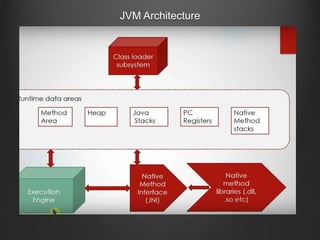
JVM Architecture
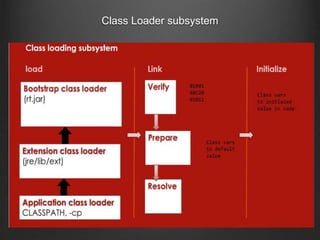
Class Loader subsystem
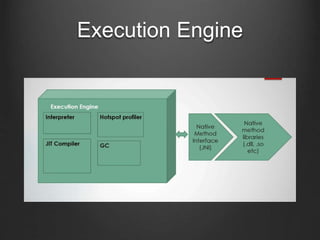
Execution Engine
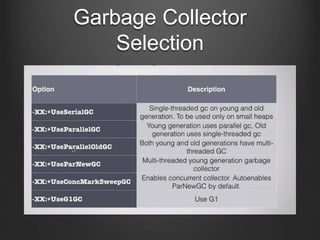
Garbage Collector
Selection
Serial Collector
The serial collector uses a single thread to perform all
garbage collection work.
Efficient because there is no communication overhead
between threads.
It is best-suited to single/multi processor machines with
data sets (up to approximately 100 MB)
The serial collector is selected by default on certain
hardware and operating system configurations,
or can be explicitly enabled with the option -
XX:+UseSerialGC.
Parallel Collector
The parallel collector (throughput collector) performs minor
collections in parallel, which can significantly reduce garbage
collection overhead.
It is intended for applications with medium-sized to large-sized
data sets that are run on multiprocessor or multithreaded
hardware.
The parallel collector is selected by default on certain hardware
and operating system configurations, or can be explicitly
enabled with the option -XX:+UseParallelGC.
This is the default GC in Java8
Concurrent Collectors
The mostly concurrent collector performs most of its work
concurrently (for example, while the application is still
running) to keep garbage collection pauses short.
• CMS : This collector is for applications that prefer shorter
garbage collection pauses and can afford to share processor
resources with the garbage collection.
• G1: This server-style collector is for multiprocessor machines
with large memories. It meets garbage collection pause time
goals with high probability while achieving high throughput.
Use the option -XX:+UseConcMarkSweepGC to enable
the CMS collector or -XX:+UseG1GC to enable the G1
collector.
Selecting GC
If the application has a small data set (up to approximately 100
MB), then select the serial collector with the option -
XX:+UseSerialGC.
If (a) peak application performance is the first priority and (b)
there are no pause time requirements or pauses of 1 second or
longer are acceptable, then let the VM select the collector, or
select the parallel collector with -XX:+UseParallelGC.
If response time is more important than overall throughput and
garbage collection pauses must be kept shorter than approximately
1 second, then select the concurrent collector with -
XX:+UseConcMarkSweepGC or -XX:+UseG1GC.
If the recommended collector does not achieve the desired
performance, first attempt to adjust the heap and generation sizes
to meet the desired goals.
Reference:
https://docs.oracle.com/javase/8/docs/technotes/guides/vm/gctun
ing/toc.html
Young Generation GC
Copy (enabled with -XX:+UseSerialGC) - the serial copy collector,
uses one thread to copy surviving objects from Eden to Survivor
spaces and between Survivor spaces until it decides they've been
there long enough, at which point it copies them into the old
generation.
PS Scavenge (enabled with -XX:+UseParallelGC) -the parallel
scavenge collector, like the Copy collector, but uses multiple
threads in parallel and has some knowledge of how the old
generation is collected (essentially written to work with the serial
and PS old gen collectors).
ParNew (enabled with -XX:+UseParNewGC) -the parallel copy
collector, like the Copy collector, but uses multiple threads in
parallel and has an internal 'callback' that allows an old generation
collector to operate on the objects it collects (really written to work
with the concurrent collector).
G1 Young Generation (enabled with -XX:+UseG1GC) -the
garbage first collector, uses the 'Garbage First' algorithm which
splits up the heap into lots of smaller spaces, but these are still
separated into Eden and Survivor spaces in the young generation
for G1.
Old generation GC
MarkSweepCompact (enabled with -XX:+UseSerialGC) -The serial mark-
sweep collector, the daddy of them all, uses a serial (one thread) full mark-
sweep garbage collection algorithm, with optional compaction.
PS MarkSweep (enabled with -XX:+UseParallelOldGC) -The parallel
scavenge mark-sweep collector, parallelised version (i.e. uses multiple
threads) of the MarkSweepCompact.
ConcurrentMarkSweep (enabled with -XX:+UseConcMarkSweepGC) -The
concurrent collector, a garbage collection algorithm that attempts to do
most of the garbage collection work in the background without stopping
application threads while it works (there are still phases where it has to stop
application threads, but these phases are attempted to be kept to a
minimum). Note if the concurrent collector fails to keep up with the garbage,
it fails over to the serial MarkSweepCompact collector for (just) the next
GC.
G1 Mixed Generation (enabled with -XX:+UseG1GC) -The garbage first
collector, uses the 'Garbage First' algorithm which splits up the heap into
lots of smaller spaces.
Reference : http://www.fasterj.com/articles/oraclecollectors1.shtml
Static method design
when to choose static methods
Static methods have following advantages
If a class is having multiple constructors then it is difficult to choose
which constructor to use unless we have good idea on API
documentation. Static method have names which is more readable.
 Builder design pattern recommends this approach
http.getInmemoryManager().withUsername().password().havin
gRole().build();
If the object states are limited it is good to use static methods and
ENUMs to create objects. Flyweight Design pattern follows this.
Boolean.valueOf() example of this
SOLID Principles
Single Responsibility Principle: Class should have only
one reason to change. design for one specific purpose
Open Close Principle: Open for extension and closed for
modification. (interface and inheritance ; encapsulation)
Liskov Substitution Principle: Derived class should be
substituted with their parent class (inheritance).
Interface Segregation Principle: Client should not
depend on interface members that are not required.(split
into multiple interface) (write adapters )
Dependency Inversion Principle: High level modules
should not depend on low-level classes. And abstract
classes shouldn’t refer concrete classes. (Bridge Design
Pattern)
Path and Paths
Path is an interface where as Paths is a class with some
static methods.
Path path=Paths.get( URI);
Path path=Paths.get( “”, “” , …..);
Stream<String> stream=Files.lines(path);
Files.lines(path);
Files.write(path, bytes);
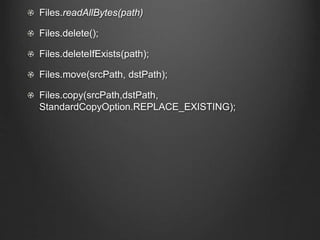
Files.readAllBytes(path)
Files.delete();
Files.deleteIfExists(path);
Files.move(srcPath, dstPath);
Files.copy(srcPath,dstPath,
StandardCopyOption.REPLACE_EXISTING);

Jvm Architecture

  • 1.
  • 2.
  • 3.
  • 5.
  • 6.
  • 7.
    Serial Collector The serialcollector uses a single thread to perform all garbage collection work. Efficient because there is no communication overhead between threads. It is best-suited to single/multi processor machines with data sets (up to approximately 100 MB) The serial collector is selected by default on certain hardware and operating system configurations, or can be explicitly enabled with the option - XX:+UseSerialGC.
  • 8.
    Parallel Collector The parallelcollector (throughput collector) performs minor collections in parallel, which can significantly reduce garbage collection overhead. It is intended for applications with medium-sized to large-sized data sets that are run on multiprocessor or multithreaded hardware. The parallel collector is selected by default on certain hardware and operating system configurations, or can be explicitly enabled with the option -XX:+UseParallelGC. This is the default GC in Java8
  • 9.
    Concurrent Collectors The mostlyconcurrent collector performs most of its work concurrently (for example, while the application is still running) to keep garbage collection pauses short. • CMS : This collector is for applications that prefer shorter garbage collection pauses and can afford to share processor resources with the garbage collection. • G1: This server-style collector is for multiprocessor machines with large memories. It meets garbage collection pause time goals with high probability while achieving high throughput. Use the option -XX:+UseConcMarkSweepGC to enable the CMS collector or -XX:+UseG1GC to enable the G1 collector.
  • 10.
    Selecting GC If theapplication has a small data set (up to approximately 100 MB), then select the serial collector with the option - XX:+UseSerialGC. If (a) peak application performance is the first priority and (b) there are no pause time requirements or pauses of 1 second or longer are acceptable, then let the VM select the collector, or select the parallel collector with -XX:+UseParallelGC. If response time is more important than overall throughput and garbage collection pauses must be kept shorter than approximately 1 second, then select the concurrent collector with - XX:+UseConcMarkSweepGC or -XX:+UseG1GC. If the recommended collector does not achieve the desired performance, first attempt to adjust the heap and generation sizes to meet the desired goals. Reference: https://docs.oracle.com/javase/8/docs/technotes/guides/vm/gctun ing/toc.html
  • 11.
    Young Generation GC Copy(enabled with -XX:+UseSerialGC) - the serial copy collector, uses one thread to copy surviving objects from Eden to Survivor spaces and between Survivor spaces until it decides they've been there long enough, at which point it copies them into the old generation. PS Scavenge (enabled with -XX:+UseParallelGC) -the parallel scavenge collector, like the Copy collector, but uses multiple threads in parallel and has some knowledge of how the old generation is collected (essentially written to work with the serial and PS old gen collectors). ParNew (enabled with -XX:+UseParNewGC) -the parallel copy collector, like the Copy collector, but uses multiple threads in parallel and has an internal 'callback' that allows an old generation collector to operate on the objects it collects (really written to work with the concurrent collector). G1 Young Generation (enabled with -XX:+UseG1GC) -the garbage first collector, uses the 'Garbage First' algorithm which splits up the heap into lots of smaller spaces, but these are still separated into Eden and Survivor spaces in the young generation for G1.
  • 12.
    Old generation GC MarkSweepCompact(enabled with -XX:+UseSerialGC) -The serial mark- sweep collector, the daddy of them all, uses a serial (one thread) full mark- sweep garbage collection algorithm, with optional compaction. PS MarkSweep (enabled with -XX:+UseParallelOldGC) -The parallel scavenge mark-sweep collector, parallelised version (i.e. uses multiple threads) of the MarkSweepCompact. ConcurrentMarkSweep (enabled with -XX:+UseConcMarkSweepGC) -The concurrent collector, a garbage collection algorithm that attempts to do most of the garbage collection work in the background without stopping application threads while it works (there are still phases where it has to stop application threads, but these phases are attempted to be kept to a minimum). Note if the concurrent collector fails to keep up with the garbage, it fails over to the serial MarkSweepCompact collector for (just) the next GC. G1 Mixed Generation (enabled with -XX:+UseG1GC) -The garbage first collector, uses the 'Garbage First' algorithm which splits up the heap into lots of smaller spaces. Reference : http://www.fasterj.com/articles/oraclecollectors1.shtml
  • 13.
    Static method design whento choose static methods Static methods have following advantages If a class is having multiple constructors then it is difficult to choose which constructor to use unless we have good idea on API documentation. Static method have names which is more readable.  Builder design pattern recommends this approach http.getInmemoryManager().withUsername().password().havin gRole().build(); If the object states are limited it is good to use static methods and ENUMs to create objects. Flyweight Design pattern follows this. Boolean.valueOf() example of this
  • 14.
    SOLID Principles Single ResponsibilityPrinciple: Class should have only one reason to change. design for one specific purpose Open Close Principle: Open for extension and closed for modification. (interface and inheritance ; encapsulation) Liskov Substitution Principle: Derived class should be substituted with their parent class (inheritance). Interface Segregation Principle: Client should not depend on interface members that are not required.(split into multiple interface) (write adapters ) Dependency Inversion Principle: High level modules should not depend on low-level classes. And abstract classes shouldn’t refer concrete classes. (Bridge Design Pattern)
  • 15.
    Path and Paths Pathis an interface where as Paths is a class with some static methods. Path path=Paths.get( URI); Path path=Paths.get( “”, “” , …..); Stream<String> stream=Files.lines(path); Files.lines(path); Files.write(path, bytes);
  • 16.