Garbage First andYou	

!
The new* Garbage Collector in the JVM
Kai Koenig	

@AgentK
Web/Mobile Developer since the late 1990s
Interested in: Java & JVM, CFML, Functional
Programming, Go, JS, Android, Raspberry Pi
!
And this is my view of the world…
Me
1.The JVM and Garbage Collection in 5 mins

2.Academic ideas behind G1

3.The G1 collector

4.Tuning G1 and practical implications

5. Further changes in Java 8	

Agenda
1. JVM and GC in 

5 minutes
Fundamentals
The most simplistic view of the JVM:	

!
“Java virtual machine (JVM) interprets
compiled Java binary code (called bytecode)
for a computer’s processor (or hardware
platform) so that it can perform a Java
program's instructions.”
1.1 JVM Architecture
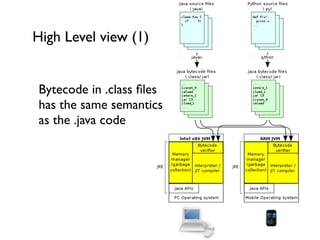
High Level view (1)
Bytecode in .class files
has the same semantics
as the .java code
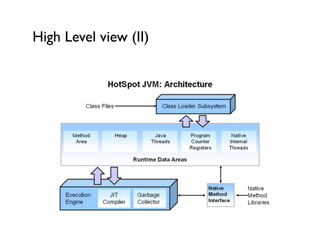
High Level view (II)
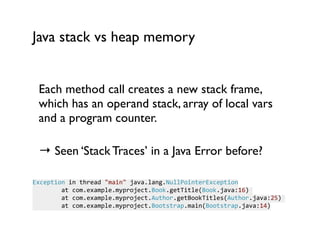
Java stack vs heap memory
Each method call creates a new stack frame,
which has an operand stack, array of local vars
and a program counter.	


→ Seen ‘Stack Traces’ in a Java Error before?	

!
Exception	
  in	
  thread	
  "main"	
  java.lang.NullPointerException	


  at	
  com.example.myproject.Book.getTitle(Book.java:16)	


  at	
  com.example.myproject.Author.getBookTitles(Author.java:25)	


  at	
  com.example.myproject.Bootstrap.main(Bootstrap.java:14)
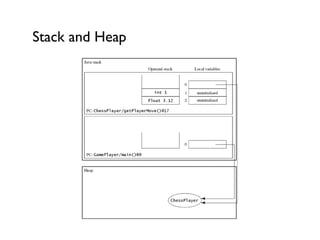
Stack and Heap
1.2 Garbage Collection
Heap management
The JVM has no way of knowing the lifespan of a
certain object in advance.	

Generational Memory Management is a solution
to overcome this issue and fragmentation:	


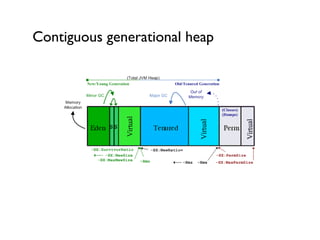
 -Young Generation	


 - Old Generation / Tenured Generation	


 - Sometimes: Permanent Generation
Contiguous generational heap
Garbage Collector selection criteria
Efficiency / Throughput	

Concurrency 	

Overhead	

JVM version you’re on	

!
YG Collectors: Parallel
Parallel MaC (since Java 1.4.2) distributes the
Marking and Copying phases over multiple
threads.	

The actual collection is still stop-the-world, but
for a much shorter period of time.	

YG default since Java 5 if machine has 2+ cores
or CPUs, otherwise: -XX:+UseParallelGC.	

!
OG Collectors: Concurrent
Up to Java 6/7 Concurrent Mark-and-Sweep is
the preferred OG collector if you want to
minimise stop-the-world collections.	

CMS via -XX:+UseConcMarkSweepGC
Well suited for larger heaps (but be aware of
fragmentation), there’s an ‘incremental’ mode for
systems with 1-2 CPU cores.	

Stop-the-world and concurrent collections
2. Academic ideas behind G1
“Garbage-First Garbage Collection”
Research paper originally published in 2004 by
David Detlefs, Christine Flood, Steve Heller and
Tony Printezis of Sun Research.	

!
The actual research project started in the late
1990s to overcome common issues in Garbage
Collection techniques known and used at the
time.
Core ideas
Four core elements:	


 - SATB concurrent marking algorithm	


 - Better way to achieve a real-time goal	


 - Get rid of a contiguous heap and use regions	


 - Compacting and predictable
Snapshot-at-the-beginning
SATB does a periodic analysis of global
reachability (liveness) and provide completeness.	

Results:	


 - Accurate counts of live data in each region


 - Completeness: garbage is eventually identified


 -Very low pause time	

!
‘Soft’ real-time goal and regions
Before G1, garbage collectors tried to achieve
hard real time goals by:	


 - making collection interruptible


 - working on the granularity of object levels.	

G1 works on a coarser granularity of regions:	


 - Chooses regions to collect that match goal


 - Collection of a region can be delayed	

!
3.The G1 Collector
3.1 Basics
G1 (Garbage First)
G1 is a ‘replacement’ for CMS in Java 7+	

Benefits:	


 - Consistently low-pause	


 - Adaptable	


 - Less fragmentation than CMS	


 - Less need for ongoing tuning	


 - Best collector for a really large heap
Fundamental ideas (I)
Minimum of 6 GB heap, if below - consider
staying with CMS	

Enable: -XX:+UseG1GC	

Provide minimal set of expectations and let G1
do the job:	


 - Heap size (min/max)


 - How much CPU time can the application use?


 - How much CPU time can G1 use?
Fundamental ideas (II)
‘Main’ setup parameter: 

-XX:MaxGCPauseMillis=<n>	

G1 is not an OG-only collector like CMS	

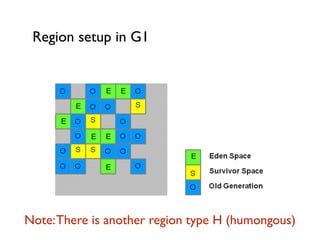
G1 splits the whole area of heap memory:	


 - ~2000 regions


 - Size between 1-32 MB each


 - usually automatically chosen by the JVM	

!
Region setup in G1
Note:There is another region type H (humongous)
3.2 G1YoungGen
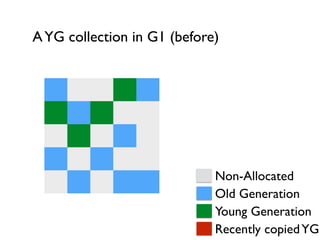
AYG collection in G1 (before)
Non-Allocated
Old Generation
Young Generation
Recently copiedYG
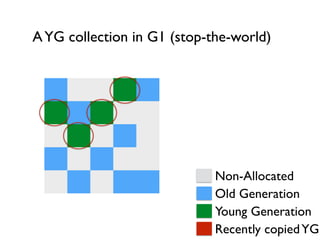
AYG collection in G1 (stop-the-world)
Non-Allocated
Old Generation
Young Generation
Recently copiedYG
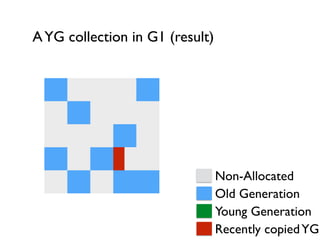
AYG collection in G1 (result)
Non-Allocated
Old Generation
Young Generation
Recently copiedYG
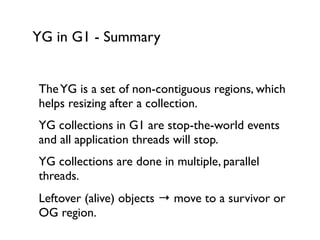
YG in G1 - Summary
TheYG is a set of non-contiguous regions, which
helps resizing after a collection.	

YG collections in G1 are stop-the-world events
and all application threads will stop.	

YG collections are done in multiple, parallel
threads.	

Leftover (alive) objects → move to a survivor or
OG region.
3.3 G1 OldGen
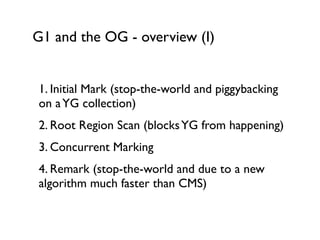
G1 and the OG - overview (I)
1. Initial Mark (stop-the-world and piggybacking
on aYG collection)	

2. Root Region Scan (blocksYG from happening)	

3. Concurrent Marking	

4. Remark (stop-the-world and due to a new
algorithm much faster than CMS)
G1 and the OG - overview (II)
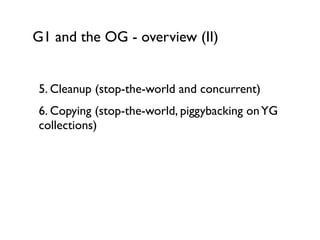
5. Cleanup (stop-the-world and concurrent)	

6. Copying (stop-the-world, piggybacking onYG
collections)	

!
!
!
!
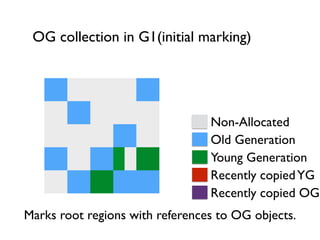
OG collection in G1(initial marking)
Marks root regions with references to OG objects.
Non-Allocated
Old Generation
Young Generation
Recently copiedYG
Recently copied OG
OG collection in G1(concurrent marking)
Marks empty regions and calculates object ‘liveness’.
X
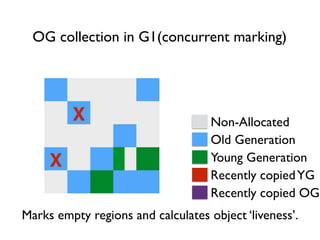
X
Non-Allocated
Old Generation
Young Generation
Recently copiedYG
Recently copied OG
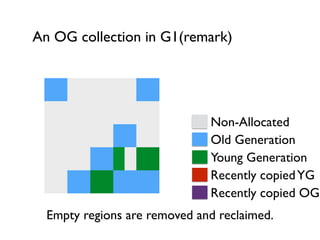
An OG collection in G1(remark)
Empty regions are removed and reclaimed.
Non-Allocated
Old Generation
Young Generation
Recently copiedYG
Recently copied OG
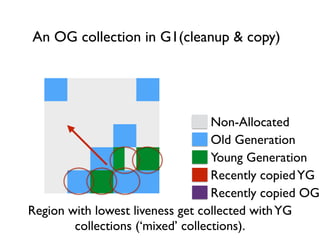
An OG collection in G1(cleanup & copy)
Region with lowest liveness get collected withYG
collections (‘mixed’ collections).
Non-Allocated
Old Generation
Young Generation
Recently copiedYG
Recently copied OG
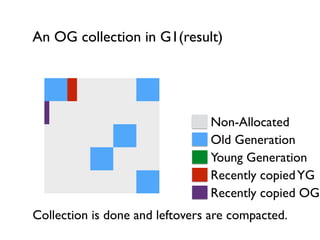
An OG collection in G1(result)
Collection is done and leftovers are compacted.
Non-Allocated
Old Generation
Young Generation
Recently copiedYG
Recently copied OG
OG in G1 - Summary
Concurrent Marking:	


 - Liveness info determines where to collect


 - No sweeping phase like in CMS	

Remark:	


 - SATB algorithm much faster than CMS


 - Completely empty regions are reclaimed	

Cleanup: optimised for ‘mixed’ collections
4.Tuning G1
Do not trust consultants, blog posts, mailing list
discussions etc. telling you what the ‘best’ JVM
settings would be.	

!
There is no such thing as global best settings.
JVM settings depend on the environment, the
application and the projected/actual usage.
JVM settings and logging
How do you find out what’s
happening in your JVM?	

-XX:+PrintGC
-XX:+PrintGCDetails
-XX:+PrintGCTimeStamps
or	

-XX:+PrintGCDateStamps
[GC 64781K->22983K(71360K), 0.0242084 secs]	

[GC 68487K->25003K(77888K), 0.0194041 secs]	

[Full GC 25003K->20302K(89600K), 0.1713420 secs]	

[GC 70670K->21755K(90048K), 0.0054093 secs]	

[GC 71913K->46558K(94912K), 0.0295257 secs]	

[Full GC 46558K->45267K(118336K), 0.2144038 secs]	

[GC 88214K->84651K(133056K), 0.0674443 secs]	

[Full GC 84651K->84633K(171648K), 0.1739369 secs]	

[GC 117977K->115114K(180736K), 0.0623399 secs]	

[GC 158613K->157136K(201152K), 0.0591171 secs]	

[Full GC 157136K->157098K(254784K), 0.1868453 secs]	

[GC 160678K->160455K(261184K), 0.0536678 secs]	

01/24 19:36:22 Debug [scheduler-1] - Next mail spool run in 15 seconds.	

[GC 202912K->200819K(268288K), 0.0625820 secs]	

[Full GC 200819K->200776K(332224K), 0.2121724 secs]	

[GC 213293K->212423K(339520K), 0.0426462 secs]	

[GC 259465K->256115K(340288K), 0.0645039 secs]	

[Full GC 256115K->255462K(418432K), 0.3226731 secs]	

[GC 281947K->279651K(421760K), 0.0530268 secs]	

[GC 331073K->323785K(422720K), 0.0695117 secs]	

[Full GC 323785K->323697K(459264K), 0.2139458 secs]	

[Full GC 364365K->361525K(459264K), 0.2180439 secs]	

[Full GC 400859K->400859K(459264K), 0.1702890 secs]	

[Full GC 400859K->43989K(274112K), 0.2642407 secs]	

[GC 95197K->93707K(273216K), 0.0338568 secs]	

[GC 146978K->140363K(276032K), 0.0664380 secs]	

[GC 193696K->189635K(277952K), 0.0630006 secs]	

[Full GC 189635K->189604K(425920K), 0.1913979 secs]	

[GC 219773K->205157K(426048K), 0.0442126 secs]
The two main tuning parameters for G1
-XX:MaxGCPauseMillis
Soft goal target for maximum GC pause time -
default 200ms
-XX:InitiatingHeapOccupancyPercent
Percentage of heap occupancy to start
concurrent GC cycle
Good practice
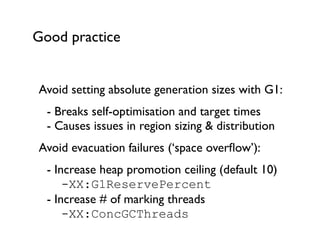
Avoid setting absolute generation sizes with G1:	


 - Breaks self-optimisation and target times


 - Causes issues in region sizing & distribution	

Avoid evacuation failures (‘space overflow’):	


 - Increase heap promotion ceiling (default 10)


 -XX:G1ReservePercent 


 - Increase # of marking threads


 -XX:ConcGCThreads
Real-world observations (I)
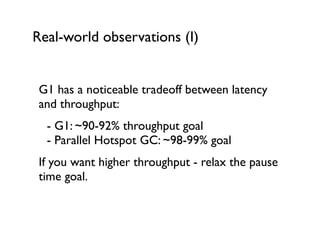
G1 has a noticeable tradeoff between latency
and throughput:	


 - G1: ~90-92% throughput goal


 - Parallel Hotspot GC: ~98-99% goal	

If you want higher throughput - relax the pause
time goal.
Real-world observations (II)
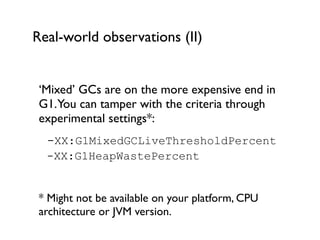
‘Mixed’ GCs are on the more expensive end in
G1.You can tamper with the criteria through
experimental settings*:	


 -XX:G1MixedGCLiveThresholdPercent	


 -XX:G1HeapWastePercent
!
* Might not be available on your platform, CPU
architecture or JVM version.
Real-world observations (III)
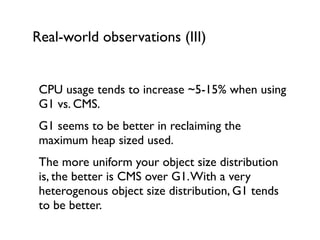
CPU usage tends to increase ~5-15% when using
G1 vs. CMS.	

G1 seems to be better in reclaiming the
maximum heap sized used.	

The more uniform your object size distribution
is, the better is CMS over G1.With a very
heterogenous object size distribution, G1 tends
to be better.
5. Changes in Java 8
Most of the previous is
valid for Java 7 and 8 -
but…
G1 string de-duplication
Java 8u_20 brings a new String de-duplication
optimisation.	

G1 collector can now identify strings that are
duplicated across the heap and repoint them to
the ‘same’ internal char[] representation: 	

-XX:+UseStringDeduplicationJVM
Java 8 and the PermGen
It’s gone and it’s been replaced by a Metaspace
(Oracle’s JRockit actually never had a PermGen).
Class metadata is now stored in native memory.	

!
A word of warning: Oracle tries to sell the
Metaspace as the new piece of awesomeness
that ‘just works’, but it still needs observation
and tuning!
Retired JVM GC combinations
Some rarely-used combinations of garbage
collectors have been deprecated:	

http://openjdk.java.net/jeps/173	

!
Important: iCMS has been deprecated!	

!
!
Additional Resources
Garbage Collection with Garbage First Research Paper:

http://citeseerx.ist.psu.edu/viewdoc/download?doi=10.1.1.63.6386&rep=rep1&type=pdf	

Understanding G1 logs: 

https://blogs.oracle.com/poonam/entry/understanding_g1_gc_logs	

“The JVM is your friend” - my more general GC talk at cf.Objective() 2014:

http://www.slideshare.net/AgentK/jvm-isyourfriend	

Java Performance:The Definitive Guide

http://www.amazon.com/Java-Performance-The-Definitive-Guide/dp/1449358454	

!
Photo credits
https://www.flickr.com/photos/aigle_dore/6973012997/

https://www.flickr.com/photos/65694112@N05/6147388744

https://www.flickr.com/photos/teclasorg/2852716491

https://www.flickr.com/photos/salendron/5390633053

https://www.flickr.com/photos/tim_ellis/2269499855

https://www.flickr.com/photos/apocalust/5729262611

https://www.flickr.com/photos/fkhuckel/16995618202

https://www.flickr.com/photos/poetprince/3389459474

https://www.flickr.com/photos/mario-mancuso/8331716569

https://www.flickr.com/photos/openindiana/16277077790/

Get in touch
Kai Koenig	

kai@ventego-creative.co.nz

www.ventego-creative.co.nz

www.bloginblack.de


Twitter: @AgentK

Garbage First and you

  • 1.
    Garbage First andYou ! Thenew* Garbage Collector in the JVM Kai Koenig @AgentK
  • 2.
    Web/Mobile Developer sincethe late 1990s Interested in: Java & JVM, CFML, Functional Programming, Go, JS, Android, Raspberry Pi ! And this is my view of the world… Me
  • 4.
    1.The JVM andGarbage Collection in 5 mins
 2.Academic ideas behind G1
 3.The G1 collector
 4.Tuning G1 and practical implications
 5. Further changes in Java 8 Agenda
  • 5.
    1. JVM andGC in 
 5 minutes
  • 6.
    Fundamentals The most simplisticview of the JVM: ! “Java virtual machine (JVM) interprets compiled Java binary code (called bytecode) for a computer’s processor (or hardware platform) so that it can perform a Java program's instructions.”
  • 7.
  • 8.
    High Level view(1) Bytecode in .class files has the same semantics as the .java code
  • 9.
  • 10.
    Java stack vsheap memory Each method call creates a new stack frame, which has an operand stack, array of local vars and a program counter. 
 → Seen ‘Stack Traces’ in a Java Error before? ! Exception  in  thread  "main"  java.lang.NullPointerException                  at  com.example.myproject.Book.getTitle(Book.java:16)                  at  com.example.myproject.Author.getBookTitles(Author.java:25)                  at  com.example.myproject.Bootstrap.main(Bootstrap.java:14)
  • 11.
  • 12.
  • 13.
    Heap management The JVMhas no way of knowing the lifespan of a certain object in advance. Generational Memory Management is a solution to overcome this issue and fragmentation: -Young Generation - Old Generation / Tenured Generation - Sometimes: Permanent Generation
  • 14.
  • 15.
    Garbage Collector selectioncriteria Efficiency / Throughput Concurrency Overhead JVM version you’re on !
  • 16.
    YG Collectors: Parallel ParallelMaC (since Java 1.4.2) distributes the Marking and Copying phases over multiple threads. The actual collection is still stop-the-world, but for a much shorter period of time. YG default since Java 5 if machine has 2+ cores or CPUs, otherwise: -XX:+UseParallelGC. !
  • 17.
    OG Collectors: Concurrent Upto Java 6/7 Concurrent Mark-and-Sweep is the preferred OG collector if you want to minimise stop-the-world collections. CMS via -XX:+UseConcMarkSweepGC Well suited for larger heaps (but be aware of fragmentation), there’s an ‘incremental’ mode for systems with 1-2 CPU cores. Stop-the-world and concurrent collections
  • 18.
  • 19.
    “Garbage-First Garbage Collection” Researchpaper originally published in 2004 by David Detlefs, Christine Flood, Steve Heller and Tony Printezis of Sun Research. ! The actual research project started in the late 1990s to overcome common issues in Garbage Collection techniques known and used at the time.
  • 20.
    Core ideas Four coreelements: - SATB concurrent marking algorithm - Better way to achieve a real-time goal - Get rid of a contiguous heap and use regions - Compacting and predictable
  • 21.
    Snapshot-at-the-beginning SATB does aperiodic analysis of global reachability (liveness) and provide completeness. Results: - Accurate counts of live data in each region
 - Completeness: garbage is eventually identified
 -Very low pause time !
  • 22.
    ‘Soft’ real-time goaland regions Before G1, garbage collectors tried to achieve hard real time goals by: - making collection interruptible
 - working on the granularity of object levels. G1 works on a coarser granularity of regions: - Chooses regions to collect that match goal
 - Collection of a region can be delayed !
  • 23.
  • 24.
  • 25.
    G1 (Garbage First) G1is a ‘replacement’ for CMS in Java 7+ Benefits: - Consistently low-pause - Adaptable - Less fragmentation than CMS - Less need for ongoing tuning - Best collector for a really large heap
  • 26.
    Fundamental ideas (I) Minimumof 6 GB heap, if below - consider staying with CMS Enable: -XX:+UseG1GC Provide minimal set of expectations and let G1 do the job: - Heap size (min/max)
 - How much CPU time can the application use?
 - How much CPU time can G1 use?
  • 27.
    Fundamental ideas (II) ‘Main’setup parameter: 
 -XX:MaxGCPauseMillis=<n> G1 is not an OG-only collector like CMS G1 splits the whole area of heap memory: - ~2000 regions
 - Size between 1-32 MB each
 - usually automatically chosen by the JVM !
  • 28.
    Region setup inG1 Note:There is another region type H (humongous)
  • 29.
  • 30.
    AYG collection inG1 (before) Non-Allocated Old Generation Young Generation Recently copiedYG
  • 31.
    AYG collection inG1 (stop-the-world) Non-Allocated Old Generation Young Generation Recently copiedYG
  • 32.
    AYG collection inG1 (result) Non-Allocated Old Generation Young Generation Recently copiedYG
  • 33.
    YG in G1- Summary TheYG is a set of non-contiguous regions, which helps resizing after a collection. YG collections in G1 are stop-the-world events and all application threads will stop. YG collections are done in multiple, parallel threads. Leftover (alive) objects → move to a survivor or OG region.
  • 34.
  • 35.
    G1 and theOG - overview (I) 1. Initial Mark (stop-the-world and piggybacking on aYG collection) 2. Root Region Scan (blocksYG from happening) 3. Concurrent Marking 4. Remark (stop-the-world and due to a new algorithm much faster than CMS)
  • 36.
    G1 and theOG - overview (II) 5. Cleanup (stop-the-world and concurrent) 6. Copying (stop-the-world, piggybacking onYG collections) ! ! ! !
  • 37.
    OG collection inG1(initial marking) Marks root regions with references to OG objects. Non-Allocated Old Generation Young Generation Recently copiedYG Recently copied OG
  • 38.
    OG collection inG1(concurrent marking) Marks empty regions and calculates object ‘liveness’. X X Non-Allocated Old Generation Young Generation Recently copiedYG Recently copied OG
  • 39.
    An OG collectionin G1(remark) Empty regions are removed and reclaimed. Non-Allocated Old Generation Young Generation Recently copiedYG Recently copied OG
  • 40.
    An OG collectionin G1(cleanup & copy) Region with lowest liveness get collected withYG collections (‘mixed’ collections). Non-Allocated Old Generation Young Generation Recently copiedYG Recently copied OG
  • 41.
    An OG collectionin G1(result) Collection is done and leftovers are compacted. Non-Allocated Old Generation Young Generation Recently copiedYG Recently copied OG
  • 42.
    OG in G1- Summary Concurrent Marking: - Liveness info determines where to collect
 - No sweeping phase like in CMS Remark: - SATB algorithm much faster than CMS
 - Completely empty regions are reclaimed Cleanup: optimised for ‘mixed’ collections
  • 43.
  • 44.
    Do not trustconsultants, blog posts, mailing list discussions etc. telling you what the ‘best’ JVM settings would be. ! There is no such thing as global best settings. JVM settings depend on the environment, the application and the projected/actual usage.
  • 45.
    JVM settings andlogging How do you find out what’s happening in your JVM? -XX:+PrintGC -XX:+PrintGCDetails -XX:+PrintGCTimeStamps or -XX:+PrintGCDateStamps [GC 64781K->22983K(71360K), 0.0242084 secs] [GC 68487K->25003K(77888K), 0.0194041 secs] [Full GC 25003K->20302K(89600K), 0.1713420 secs] [GC 70670K->21755K(90048K), 0.0054093 secs] [GC 71913K->46558K(94912K), 0.0295257 secs] [Full GC 46558K->45267K(118336K), 0.2144038 secs] [GC 88214K->84651K(133056K), 0.0674443 secs] [Full GC 84651K->84633K(171648K), 0.1739369 secs] [GC 117977K->115114K(180736K), 0.0623399 secs] [GC 158613K->157136K(201152K), 0.0591171 secs] [Full GC 157136K->157098K(254784K), 0.1868453 secs] [GC 160678K->160455K(261184K), 0.0536678 secs] 01/24 19:36:22 Debug [scheduler-1] - Next mail spool run in 15 seconds. [GC 202912K->200819K(268288K), 0.0625820 secs] [Full GC 200819K->200776K(332224K), 0.2121724 secs] [GC 213293K->212423K(339520K), 0.0426462 secs] [GC 259465K->256115K(340288K), 0.0645039 secs] [Full GC 256115K->255462K(418432K), 0.3226731 secs] [GC 281947K->279651K(421760K), 0.0530268 secs] [GC 331073K->323785K(422720K), 0.0695117 secs] [Full GC 323785K->323697K(459264K), 0.2139458 secs] [Full GC 364365K->361525K(459264K), 0.2180439 secs] [Full GC 400859K->400859K(459264K), 0.1702890 secs] [Full GC 400859K->43989K(274112K), 0.2642407 secs] [GC 95197K->93707K(273216K), 0.0338568 secs] [GC 146978K->140363K(276032K), 0.0664380 secs] [GC 193696K->189635K(277952K), 0.0630006 secs] [Full GC 189635K->189604K(425920K), 0.1913979 secs] [GC 219773K->205157K(426048K), 0.0442126 secs]
  • 46.
    The two maintuning parameters for G1 -XX:MaxGCPauseMillis Soft goal target for maximum GC pause time - default 200ms -XX:InitiatingHeapOccupancyPercent Percentage of heap occupancy to start concurrent GC cycle
  • 47.
    Good practice Avoid settingabsolute generation sizes with G1: - Breaks self-optimisation and target times
 - Causes issues in region sizing & distribution Avoid evacuation failures (‘space overflow’): - Increase heap promotion ceiling (default 10)
 -XX:G1ReservePercent 
 - Increase # of marking threads
 -XX:ConcGCThreads
  • 48.
    Real-world observations (I) G1has a noticeable tradeoff between latency and throughput: - G1: ~90-92% throughput goal
 - Parallel Hotspot GC: ~98-99% goal If you want higher throughput - relax the pause time goal.
  • 49.
    Real-world observations (II) ‘Mixed’GCs are on the more expensive end in G1.You can tamper with the criteria through experimental settings*: -XX:G1MixedGCLiveThresholdPercent 
 -XX:G1HeapWastePercent ! * Might not be available on your platform, CPU architecture or JVM version.
  • 50.
    Real-world observations (III) CPUusage tends to increase ~5-15% when using G1 vs. CMS. G1 seems to be better in reclaiming the maximum heap sized used. The more uniform your object size distribution is, the better is CMS over G1.With a very heterogenous object size distribution, G1 tends to be better.
  • 51.
  • 52.
    Most of theprevious is valid for Java 7 and 8 - but…
  • 53.
    G1 string de-duplication Java8u_20 brings a new String de-duplication optimisation. G1 collector can now identify strings that are duplicated across the heap and repoint them to the ‘same’ internal char[] representation: -XX:+UseStringDeduplicationJVM
  • 54.
    Java 8 andthe PermGen It’s gone and it’s been replaced by a Metaspace (Oracle’s JRockit actually never had a PermGen). Class metadata is now stored in native memory. ! A word of warning: Oracle tries to sell the Metaspace as the new piece of awesomeness that ‘just works’, but it still needs observation and tuning!
  • 55.
    Retired JVM GCcombinations Some rarely-used combinations of garbage collectors have been deprecated: http://openjdk.java.net/jeps/173 ! Important: iCMS has been deprecated! ! !
  • 56.
    Additional Resources Garbage Collectionwith Garbage First Research Paper:
 http://citeseerx.ist.psu.edu/viewdoc/download?doi=10.1.1.63.6386&rep=rep1&type=pdf Understanding G1 logs: 
 https://blogs.oracle.com/poonam/entry/understanding_g1_gc_logs “The JVM is your friend” - my more general GC talk at cf.Objective() 2014:
 http://www.slideshare.net/AgentK/jvm-isyourfriend Java Performance:The Definitive Guide
 http://www.amazon.com/Java-Performance-The-Definitive-Guide/dp/1449358454 !
  • 57.
  • 58.
    Get in touch KaiKoenig kai@ventego-creative.co.nz
 www.ventego-creative.co.nz
 www.bloginblack.de
 
 Twitter: @AgentK