Comment on Capital Punishment.
(Necessary or not ?)
Presented by Pavan Gautam
BBA LLB 5th semester
Contents:
• Fundamental questions
• Capital punishments in pre modern times
• Capital punishment in modern times
• Is capital punishment necessary ? (un view)
• Is capital punishment necessary ? (yes / no)
• Capital punishment scenario in India
• Case Laws
• Capital offences in India
• Abolitionist and Retentionist countries
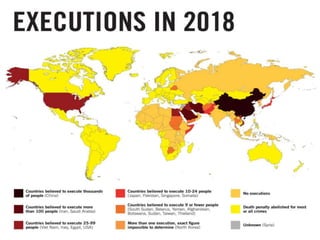
• Execution in 2018 Worldwide
• Execution in India since 1995
• My view on capital punishment in India
Fundamental questions to be
answered....
• What is capital punishment ?​
• Why is it given ?​
• History of capital punishment in human
civilization
What is capital punishment ?
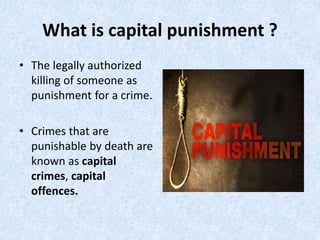
• The legally authorized
killing of someone as
punishment for a crime.
• Crimes that are
punishable by death are
known as capital
crimes, capital
offences.
Why is it given ?
• The capital punishment is reserved for the
most henious crimes in our country.
• It also serves to be an example for the ones
who are thinking of practicing the same crime
in future.​
History of capital punishment in
human civilization
• Execution of criminals has been used by nearly
all societies since the beginning of
civilizations on Earth.​
• No equal criteria for giving death penalty.​
• The use of formal execution extends to the
beginning of recorded history.
• Most historical records and various primitive
tribal practices indicate that the death penalty
was a part of their justice system.​
Some Capital Punishments in pre
modern Times
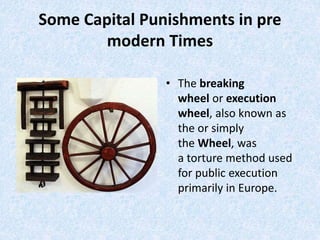
• The breaking
wheel or execution
wheel, also known as
the or simply
the Wheel, was
a torture method used
for public execution
primarily in Europe.
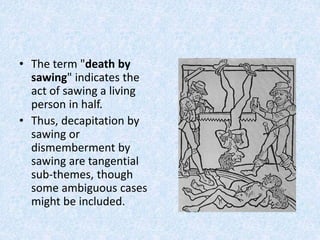
• The term "death by
sawing" indicates the
act of sawing a living
person in half.
• Thus, decapitation by
sawing or
dismemberment by
sawing are tangential
sub-themes, though
some ambiguous cases
might be included.
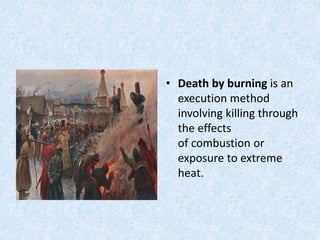
• Death by burning is an
execution method
involving killing through
the effects
of combustion or
exposure to extreme
heat.
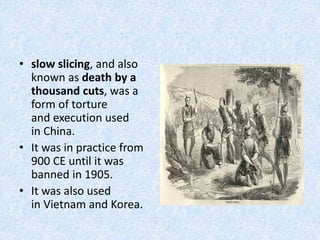
• slow slicing, and also
known as death by a
thousand cuts, was a
form of torture
and execution used
in China.
• It was in practice from
900 CE until it was
banned in 1905.
• It was also used
in Vietnam and Korea.
Some capital Punishment in modern
times
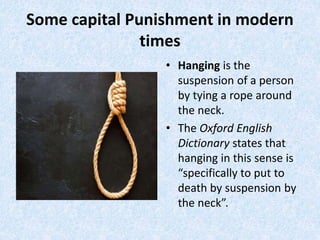
• Hanging is the
suspension of a person
by tying a rope around
the neck.
• The Oxford English
Dictionary states that
hanging in this sense is
“specifically to put to
death by suspension by
the neck”.
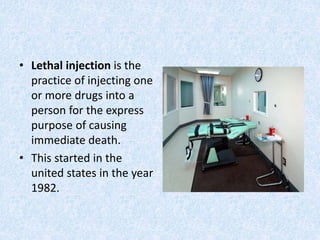
• Lethal injection is the
practice of injecting one
or more drugs into a
person for the express
purpose of causing
immediate death.
• This started in the
united states in the year
1982.
Is capital punishment necessary? (UN)
• Capital punishment is a matter of active controversy
in several countries and states, and positions can
vary within a single political ideology.​
• The United Nations General Assembly has adopted,
in 2007, 2008, 2010, 2012 and 2014, non-binding
resolutions calling for a global moratorium on executions,
with a view to eventually abolish it.​
• Hence, we can have a look at the efforts made by the UN
for abolishing the capital punishment.​
Is capital punishment necessary?
Yes. The reason are as follows:
1. Provides a deterrent against violent crime
• The goal of a law is to provide someone with
a deterrent against a crime they wish to
commit.
• By telling people they’ll die, if convicted, for
these serious crimes, the goal is to prevent
the crime from happening in the first place.
2. Allows for a deserved punishment
for horrific crimes
• There is a point in time when someone who
commits a horrific crime is beyond the point
where rehabilitation is possible.
• It provides a safety net for the rest of the
society.
3. Prevents prisons from becoming
over- populated
• Prisons become over populated due to the
fact that the prisoners would not get the
death penalty.
• This in turn increases the cost of taking care of
the basic necessities of the prisoners. For eg.
Food, maintenance of the jail ect.
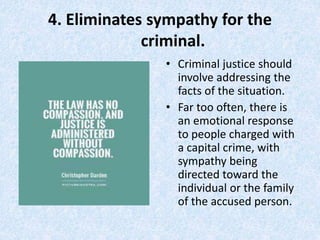
4. Eliminates sympathy for the
criminal.
• Criminal justice should
involve addressing the
facts of the situation.
• Far too often, there is
an emotional response
to people charged with
a capital crime, with
sympathy being
directed toward the
individual or the family
of the accused person.
5. Offers zero chance of escape
• When the death penalty is being
implemented, there is no chance for the
individual to escape the consequences of their
actions.
• It eliminates the possibility of an illegal
escape.
Is capital punishment Necessary?
No. Following are the reasons:
1. Does not deter crime like it should
• Data collected in some parts of India show
that the places where the executions have
taken place are the places where the crime
ratio have gone up.
• Therefore, one cannot say that by giving
death penalty it deters the society from
performing crime.
2. Does not provide a sense of justice
for the families of a victim.
• Although capital punishment may be the
“ultimate” form of justice, it does not provide
the sense of satisfaction for the families of a
victim that many people think it does.
3. It Cannot be undone
• Once a judge confirms a death punishment of
the accused person and once he is executed
he dies.
• If later the case re opens and it comes to the
knowledge of the judge that the person who
was executed was innocent, it cannot be
undone.
4. Eliminates the possibility of
rehabilitation.
• By giving death penalty to the criminal, it
eliminates all the possibilities of the
rehabilitation.
Capital punishments and scenario in
India
• Capital punishment is a legal penalty in India.
• It is given to the person who have performed crimes that
are henious in nature.
• There is a complete list of the offences where the death
punishment is applicable in India.
• However there is no clarity on the number of executions
that have taken place in India.
Case law
• Mithu vs. State of Punjab
• The Supreme Court in Mithu vs. State of
Punjab struck down Section 303 of the Indian
Penal Code, which provided for a mandatory
death sentence for offenders who committed
murder whilst serving a life sentence.
Bachan Singh vs. State of Punjab
(1980) (2 SCC 684)
• The Constitution Bench judgment of Supreme
Court of India in Bachan Singh vs. State of
Punjab made it very clear that Capital
punishment in India can be given only in rarest
of rare cases
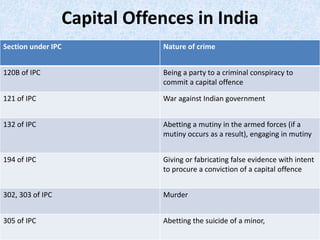
Capital Offences in India
Section under IPC Nature of crime
120B of IPC Being a party to a criminal conspiracy to
commit a capital offence
121 of IPC War against Indian government
132 of IPC Abetting a mutiny in the armed forces (if a
mutiny occurs as a result), engaging in mutiny
194 of IPC Giving or fabricating false evidence with intent
to procure a conviction of a capital offence
302, 303 of IPC Murder
305 of IPC Abetting the suicide of a minor,
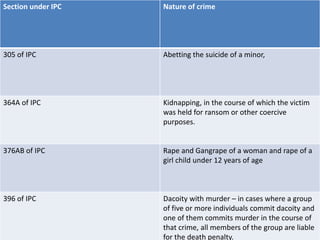
Section under IPC Nature of crime
305 of IPC Abetting the suicide of a minor,
364A of IPC Kidnapping, in the course of which the victim
was held for ransom or other coercive
purposes.
376AB of IPC Rape and Gangrape of a woman and rape of a
girl child under 12 years of age
396 of IPC Dacoity with murder – in cases where a group
of five or more individuals commit dacoity and
one of them commits murder in the course of
that crime, all members of the group are liable
for the death penalty.
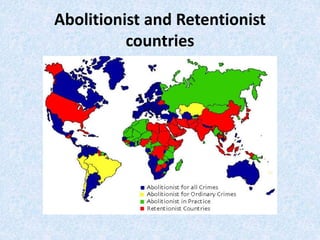
Abolitionist and Retentionist
countries
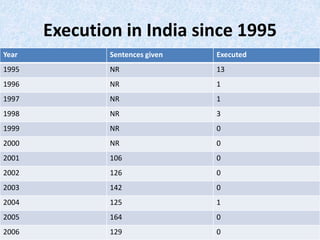
Execution in India since 1995
Year Sentences given Executed
1995 NR 13
1996 NR 1
1997 NR 1
1998 NR 3
1999 NR 0
2000 NR 0
2001 106 0
2002 126 0
2003 142 0
2004 125 1
2005 164 0
2006 129 0
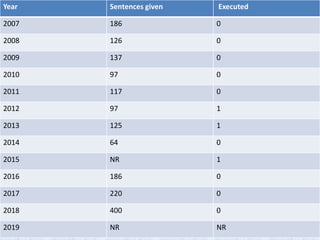
Year Sentences given Executed
2007 186 0
2008 126 0
2009 137 0
2010 97 0
2011 117 0
2012 97 1
2013 125 1
2014 64 0
2015 NR 1
2016 186 0
2017 220 0
2018 400 0
2019 NR NR
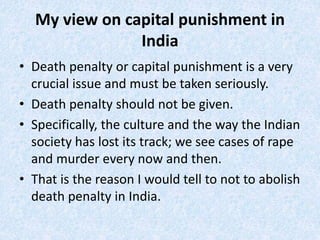
My view on capital punishment in
India
• Death penalty or capital punishment is a very
crucial issue and must be taken seriously.
• Death penalty should not be given.
• Specifically, the culture and the way the Indian
society has lost its track; we see cases of rape
and murder every now and then.
• That is the reason I would tell to not to abolish
death penalty in India.
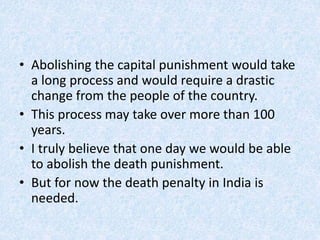
• Abolishing the capital punishment would take
a long process and would require a drastic
change from the people of the country.
• This process may take over more than 100
years.
• I truly believe that one day we would be able
to abolish the death punishment.
• But for now the death penalty in India is
needed.
Thankyou

Comment on capital punishment

  • 1.
    Comment on CapitalPunishment. (Necessary or not ?) Presented by Pavan Gautam BBA LLB 5th semester
  • 2.
    Contents: • Fundamental questions •Capital punishments in pre modern times • Capital punishment in modern times • Is capital punishment necessary ? (un view) • Is capital punishment necessary ? (yes / no) • Capital punishment scenario in India • Case Laws • Capital offences in India • Abolitionist and Retentionist countries • Execution in 2018 Worldwide • Execution in India since 1995 • My view on capital punishment in India
  • 3.
    Fundamental questions tobe answered.... • What is capital punishment ?​ • Why is it given ?​ • History of capital punishment in human civilization
  • 4.
    What is capitalpunishment ? • The legally authorized killing of someone as punishment for a crime. • Crimes that are punishable by death are known as capital crimes, capital offences.
  • 5.
    Why is itgiven ? • The capital punishment is reserved for the most henious crimes in our country. • It also serves to be an example for the ones who are thinking of practicing the same crime in future.​
  • 6.
    History of capitalpunishment in human civilization • Execution of criminals has been used by nearly all societies since the beginning of civilizations on Earth.​ • No equal criteria for giving death penalty.​ • The use of formal execution extends to the beginning of recorded history. • Most historical records and various primitive tribal practices indicate that the death penalty was a part of their justice system.​
  • 7.
    Some Capital Punishmentsin pre modern Times • The breaking wheel or execution wheel, also known as the or simply the Wheel, was a torture method used for public execution primarily in Europe.
  • 8.
    • The term"death by sawing" indicates the act of sawing a living person in half. • Thus, decapitation by sawing or dismemberment by sawing are tangential sub-themes, though some ambiguous cases might be included.
  • 9.
    • Death byburning is an execution method involving killing through the effects of combustion or exposure to extreme heat.
  • 10.
    • slow slicing,and also known as death by a thousand cuts, was a form of torture and execution used in China. • It was in practice from 900 CE until it was banned in 1905. • It was also used in Vietnam and Korea.
  • 11.
    Some capital Punishmentin modern times • Hanging is the suspension of a person by tying a rope around the neck. • The Oxford English Dictionary states that hanging in this sense is “specifically to put to death by suspension by the neck”.
  • 12.
    • Lethal injectionis the practice of injecting one or more drugs into a person for the express purpose of causing immediate death. • This started in the united states in the year 1982.
  • 13.
    Is capital punishmentnecessary? (UN) • Capital punishment is a matter of active controversy in several countries and states, and positions can vary within a single political ideology.​ • The United Nations General Assembly has adopted, in 2007, 2008, 2010, 2012 and 2014, non-binding resolutions calling for a global moratorium on executions, with a view to eventually abolish it.​ • Hence, we can have a look at the efforts made by the UN for abolishing the capital punishment.​
  • 14.
    Is capital punishmentnecessary? Yes. The reason are as follows: 1. Provides a deterrent against violent crime • The goal of a law is to provide someone with a deterrent against a crime they wish to commit. • By telling people they’ll die, if convicted, for these serious crimes, the goal is to prevent the crime from happening in the first place.
  • 15.
    2. Allows fora deserved punishment for horrific crimes • There is a point in time when someone who commits a horrific crime is beyond the point where rehabilitation is possible. • It provides a safety net for the rest of the society.
  • 16.
    3. Prevents prisonsfrom becoming over- populated • Prisons become over populated due to the fact that the prisoners would not get the death penalty. • This in turn increases the cost of taking care of the basic necessities of the prisoners. For eg. Food, maintenance of the jail ect.
  • 17.
    4. Eliminates sympathyfor the criminal. • Criminal justice should involve addressing the facts of the situation. • Far too often, there is an emotional response to people charged with a capital crime, with sympathy being directed toward the individual or the family of the accused person.
  • 18.
    5. Offers zerochance of escape • When the death penalty is being implemented, there is no chance for the individual to escape the consequences of their actions. • It eliminates the possibility of an illegal escape.
  • 19.
    Is capital punishmentNecessary? No. Following are the reasons: 1. Does not deter crime like it should • Data collected in some parts of India show that the places where the executions have taken place are the places where the crime ratio have gone up. • Therefore, one cannot say that by giving death penalty it deters the society from performing crime.
  • 20.
    2. Does notprovide a sense of justice for the families of a victim. • Although capital punishment may be the “ultimate” form of justice, it does not provide the sense of satisfaction for the families of a victim that many people think it does.
  • 21.
    3. It Cannotbe undone • Once a judge confirms a death punishment of the accused person and once he is executed he dies. • If later the case re opens and it comes to the knowledge of the judge that the person who was executed was innocent, it cannot be undone.
  • 22.
    4. Eliminates thepossibility of rehabilitation. • By giving death penalty to the criminal, it eliminates all the possibilities of the rehabilitation.
  • 23.
    Capital punishments andscenario in India • Capital punishment is a legal penalty in India. • It is given to the person who have performed crimes that are henious in nature. • There is a complete list of the offences where the death punishment is applicable in India. • However there is no clarity on the number of executions that have taken place in India.
  • 24.
    Case law • Mithuvs. State of Punjab • The Supreme Court in Mithu vs. State of Punjab struck down Section 303 of the Indian Penal Code, which provided for a mandatory death sentence for offenders who committed murder whilst serving a life sentence.
  • 25.
    Bachan Singh vs.State of Punjab (1980) (2 SCC 684) • The Constitution Bench judgment of Supreme Court of India in Bachan Singh vs. State of Punjab made it very clear that Capital punishment in India can be given only in rarest of rare cases
  • 26.
    Capital Offences inIndia Section under IPC Nature of crime 120B of IPC Being a party to a criminal conspiracy to commit a capital offence 121 of IPC War against Indian government 132 of IPC Abetting a mutiny in the armed forces (if a mutiny occurs as a result), engaging in mutiny 194 of IPC Giving or fabricating false evidence with intent to procure a conviction of a capital offence 302, 303 of IPC Murder 305 of IPC Abetting the suicide of a minor,
  • 27.
    Section under IPCNature of crime 305 of IPC Abetting the suicide of a minor, 364A of IPC Kidnapping, in the course of which the victim was held for ransom or other coercive purposes. 376AB of IPC Rape and Gangrape of a woman and rape of a girl child under 12 years of age 396 of IPC Dacoity with murder – in cases where a group of five or more individuals commit dacoity and one of them commits murder in the course of that crime, all members of the group are liable for the death penalty.
  • 28.
  • 30.
    Execution in Indiasince 1995 Year Sentences given Executed 1995 NR 13 1996 NR 1 1997 NR 1 1998 NR 3 1999 NR 0 2000 NR 0 2001 106 0 2002 126 0 2003 142 0 2004 125 1 2005 164 0 2006 129 0
  • 31.
    Year Sentences givenExecuted 2007 186 0 2008 126 0 2009 137 0 2010 97 0 2011 117 0 2012 97 1 2013 125 1 2014 64 0 2015 NR 1 2016 186 0 2017 220 0 2018 400 0 2019 NR NR
  • 32.
    My view oncapital punishment in India • Death penalty or capital punishment is a very crucial issue and must be taken seriously. • Death penalty should not be given. • Specifically, the culture and the way the Indian society has lost its track; we see cases of rape and murder every now and then. • That is the reason I would tell to not to abolish death penalty in India.
  • 33.
    • Abolishing thecapital punishment would take a long process and would require a drastic change from the people of the country. • This process may take over more than 100 years. • I truly believe that one day we would be able to abolish the death punishment. • But for now the death penalty in India is needed.
  • 34.