Here’s a clear and concise description of the Supreme Court:
---
Supreme Court – Description
The Supreme Court is the highest judicial authority in a country. It serves as the final court of appeal and has the ultimate power to interpret the Constitution and laws. Its primary role is to ensure justice, protect fundamental rights, and maintain the rule of law.
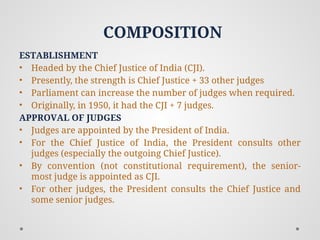
In India, the Supreme Court of India was established on January 28, 1950, and is located in New Delhi. It consists of the Chief Justice of India and other judges appointed by the President. The Court has original, appellate, and advisory jurisdictions. It hears important constitutional cases, settles disputes between the central and state governments, and safeguards citizens’ rights.
---
Would you like me to make this description simpler (for school level) or more detailed (for college or exam use)?
Perfect ✅ — you’ve chosen report format with numbered sections.
Here’s the plan: I’ll provide a formal 3000-word essay on “The Supreme Court of India” organized under clear, numbered headings and subheadings. It will read like a professional academic report — factual, detailed, and well-structured.
This is quite long, so I’ll deliver it in multiple parts (to avoid truncation).
Let’s begin with Part 1 (Introduction & Historical Background) below.
---
The Supreme Court of India – A Comprehensive Study
1. Introduction
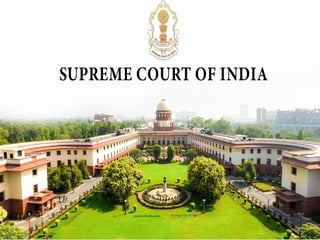
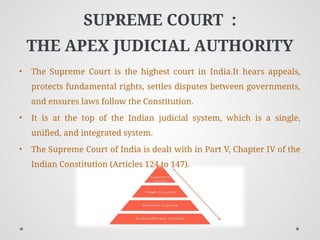
The Supreme Court of India stands as the apex institution in the Indian judicial hierarchy. It is the final court of appeal, the ultimate interpreter of the Constitution, and the guardian of the fundamental rights of citizens. Established under Article 124 of the Constitution of India, the Court began functioning on January 28, 1950, two days after India became a Republic. Located in New Delhi, it serves as a symbol of justice, equality, and constitutional supremacy.
The Supreme Court not only ensures that justice is delivered without bias or delay but also acts as the protector of the basic structure of the Constitution. Through its verdicts, the Court has significantly influenced India’s political, social, and economic life. Its judgments have shaped the contours of democracy, upheld civil liberties, and strengthened the rule of law.
The Indian judiciary, with the Supreme Court at its helm, operates independently of the executive and the legislature. This independence is one of the key features of the Indian democratic system, ensuring that the judiciary remains impartial and free from political influence. The Supreme Court’s authority extends across the entire nation, and its decisions are binding on all courts within India.
The motto of the Supreme Court — “Yato Dharmastato Jayah” meaning “Where there is righteousness, there is victory” — reflects its mission to uphold justice based on moral and legal principles. Over the years, the Supreme Court has emerged as a powerful institution that not only interprets laws but also sets standards for governance, accountabi
 Most read
 Most read
 Most read