Regular Expressions
IN GENERAL AND IN JAVASCRIPT
Theory Of Computation/Complexity
The Theory of Computation is a scientific discipline concerned with the study of general
properties of computation be it natural, man-made, or imaginary.
Most importantly, it aims to understand the nature of efficient computation.
In theoretical computer science and mathematics, the theory of computation is the branch that
deals with how efficiently problems can be solved on a model of computation, using an
algorithm
Languages
A language is theoretically a subset of all possible combinations of strings that can be created
from a given alphabet.
Example: English is a (natural) language.
The 26 letter alphabet is used to make combinations of strings.
The English language says that some subsets are English words and others are not.
isEnglish(“dog”)  yes // accepts dog
isEnglish(“xyz”)  no // does not accept xyz
isEnglish(“boat”)  yes // accepts boat
Computational Complexity
In computer science, the computational complexity, or simply complexity of an algorithm is the
amount of resources(states, time, space etc.) required for running it (a property unrelated to
“complexity” in a conventional sense).
The computational complexity of a problem is the minimum of the complexities of all possible
algorithms for this problem (including the unknown algorithms).
Chomsky’s Hierarchy
A finite-state machine (FSM) or finite-state
automaton (FSA, plural: automata), finite
automaton, or simply a state machine, is a
mathematical model of computation.
It is an abstract machine that can be in exactly one
of a finite number of states at any given time.
A FSA accepts Regular Expressions.
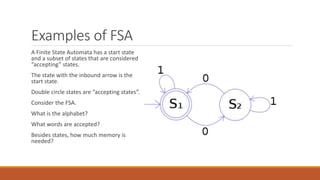
Examples of FSA
A Finite State Automata has a start state
and a subset of states that are considered
“accepting” states.
The state with the inbound arrow is the
start state.
Double circle states are “accepting states”.
Consider the FSA.
What is the alphabet?
What words are accepted?
Besides states, how much memory is
needed?
Write a regular expression for this FSA
This regular language will accept strings
from the alphabet = {0,1}
Meeting the condition that the string
has an even number of 0’s.
L = 1∗(01∗01∗)∗
Write a regular expression for this FSA
This regular language will accept strings
from the alphabet = {0,1}
L = (0|1)∗(00)+
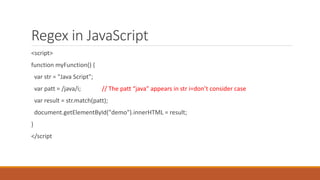
Regex in JavaScript
<script>
function myFunction() {
var str = "Java Script";
var patt = /java/i; // The patt “java” appears in str i=don’t consider case
var result = str.match(patt);
document.getElementById("demo").innerHTML = result;
}
</script
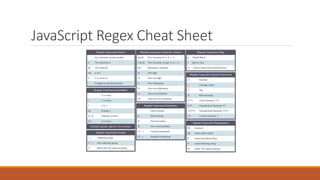
JavaScript Regex Cheat Sheet
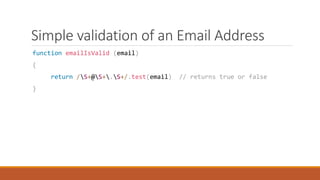
Simple validation of an Email Address
function emailIsValid (email)
{
return /S+@S+.S+/.test(email) // returns true or false
}
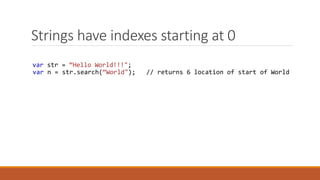
Strings have indexes starting at 0
var str = “Hello World!!!";
var n = str.search(“World"); // returns 6 location of start of World
Replace parts of strings
var str = “School is open today!";
var res = str.replace(“open", “closed");
alert(res) // School is closed today!
Modifiers
Modifier Description
i Perform case-insensitive matching
g Perform a global match (find all matches rather than stopping after the first
match)
m Perform multiline matching
Brackets
Expression Description
[abc] Find any of the characters between the brackets
[0-9] Find any of the digits between the brackets
(x|y) Find any of the alternatives separated with |
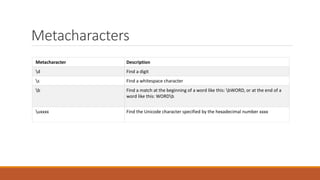
Metacharacters
Metacharacter Description
d Find a digit
s Find a whitespace character
b Find a match at the beginning of a word like this: bWORD, or at the end of a
word like this: WORDb
uxxxx Find the Unicode character specified by the hexadecimal number xxxx
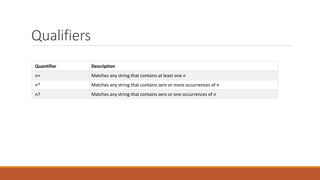
Qualifiers
Quantifier Description
n+ Matches any string that contains at least one n
n* Matches any string that contains zero or more occurrences of n
n? Matches any string that contains zero or one occurrences of n
Regex exec function
<!DOCTYPE html>
<html>
<body>
<h2>JavaScript Regular Expressions</h2>
<p id="demo"></p>
<script>
var obj = /life/.exec("The best things in life are free!");
document.getElementById("demo").innerHTML =
"Found " + obj[0] + " in position " + obj.index + " in the text: " + obj.input;
</script>
</body>
</html>
True or False (Accept or not?)
<script>
email = “student@college.edu” ;
accept = /S+(com|edu)/.test(email); // very week
</script>
<script>
email = “student@college.education” ;
accept = /S+(com|edu)/.test(email); // checks if com or edu is somewhere
</script>
Start with and Ends with Regex
<script>
email = “student@college.education” ;
accept = /^S+(com|edu)$/.test(email); // a little better
</script>
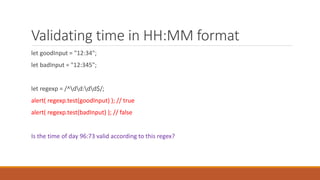
Validating time in HH:MM format
let goodInput = "12:34";
let badInput = "12:345";
let regexp = /^dd:dd$/;
alert( regexp.test(goodInput) ); // true
alert( regexp.test(badInput) ); // false
Is the time of day 96:73 valid according to this regex?
Validating time in HH:MM format(better)
let goodInput = "12:34";
let badInput = "12:345";
let regexp = ^[0-2][0-9]:[0-5][0-9]$
alert( regexp.test(goodInput) ); // true
alert( regexp.test(badInput) ); // false
Is the time of day 96:73 valid according to this regex?
Is this time of day 29:59 valid according to this regex?
Let’s make email validation a little better
<script>
email = “student@college.edu” ;
accept = /^(S)+@(S)+.(com|edu)$ /.test(email);
</script>
/ ^(S)+ @ (S)+ . (com|edu) / // spaced out for readability
Starts with 1 or more non-whitespace characters, then exactly 1 @ sign, then 1 or more non-
whitespace characters, then exactly 1 period, then end with either com or edu

JSregularExpressions.pptx

  • 1.
  • 2.
    Theory Of Computation/Complexity TheTheory of Computation is a scientific discipline concerned with the study of general properties of computation be it natural, man-made, or imaginary. Most importantly, it aims to understand the nature of efficient computation. In theoretical computer science and mathematics, the theory of computation is the branch that deals with how efficiently problems can be solved on a model of computation, using an algorithm
  • 3.
    Languages A language istheoretically a subset of all possible combinations of strings that can be created from a given alphabet. Example: English is a (natural) language. The 26 letter alphabet is used to make combinations of strings. The English language says that some subsets are English words and others are not. isEnglish(“dog”)  yes // accepts dog isEnglish(“xyz”)  no // does not accept xyz isEnglish(“boat”)  yes // accepts boat
  • 4.
    Computational Complexity In computerscience, the computational complexity, or simply complexity of an algorithm is the amount of resources(states, time, space etc.) required for running it (a property unrelated to “complexity” in a conventional sense). The computational complexity of a problem is the minimum of the complexities of all possible algorithms for this problem (including the unknown algorithms).
  • 5.
    Chomsky’s Hierarchy A finite-statemachine (FSM) or finite-state automaton (FSA, plural: automata), finite automaton, or simply a state machine, is a mathematical model of computation. It is an abstract machine that can be in exactly one of a finite number of states at any given time. A FSA accepts Regular Expressions.
  • 6.
    Examples of FSA AFinite State Automata has a start state and a subset of states that are considered “accepting” states. The state with the inbound arrow is the start state. Double circle states are “accepting states”. Consider the FSA. What is the alphabet? What words are accepted? Besides states, how much memory is needed?
  • 7.
    Write a regularexpression for this FSA This regular language will accept strings from the alphabet = {0,1} Meeting the condition that the string has an even number of 0’s. L = 1∗(01∗01∗)∗
  • 8.
    Write a regularexpression for this FSA This regular language will accept strings from the alphabet = {0,1} L = (0|1)∗(00)+
  • 9.
    Regex in JavaScript <script> functionmyFunction() { var str = "Java Script"; var patt = /java/i; // The patt “java” appears in str i=don’t consider case var result = str.match(patt); document.getElementById("demo").innerHTML = result; } </script
  • 10.
  • 11.
    Simple validation ofan Email Address function emailIsValid (email) { return /S+@S+.S+/.test(email) // returns true or false }
  • 12.
    Strings have indexesstarting at 0 var str = “Hello World!!!"; var n = str.search(“World"); // returns 6 location of start of World
  • 13.
    Replace parts ofstrings var str = “School is open today!"; var res = str.replace(“open", “closed"); alert(res) // School is closed today!
  • 14.
    Modifiers Modifier Description i Performcase-insensitive matching g Perform a global match (find all matches rather than stopping after the first match) m Perform multiline matching
  • 15.
    Brackets Expression Description [abc] Findany of the characters between the brackets [0-9] Find any of the digits between the brackets (x|y) Find any of the alternatives separated with |
  • 16.
    Metacharacters Metacharacter Description d Finda digit s Find a whitespace character b Find a match at the beginning of a word like this: bWORD, or at the end of a word like this: WORDb uxxxx Find the Unicode character specified by the hexadecimal number xxxx
  • 17.
    Qualifiers Quantifier Description n+ Matchesany string that contains at least one n n* Matches any string that contains zero or more occurrences of n n? Matches any string that contains zero or one occurrences of n
  • 18.
    Regex exec function <!DOCTYPEhtml> <html> <body> <h2>JavaScript Regular Expressions</h2> <p id="demo"></p> <script> var obj = /life/.exec("The best things in life are free!"); document.getElementById("demo").innerHTML = "Found " + obj[0] + " in position " + obj.index + " in the text: " + obj.input; </script> </body> </html>
  • 19.
    True or False(Accept or not?) <script> email = “student@college.edu” ; accept = /S+(com|edu)/.test(email); // very week </script> <script> email = “student@college.education” ; accept = /S+(com|edu)/.test(email); // checks if com or edu is somewhere </script>
  • 20.
    Start with andEnds with Regex <script> email = “student@college.education” ; accept = /^S+(com|edu)$/.test(email); // a little better </script>
  • 21.
    Validating time inHH:MM format let goodInput = "12:34"; let badInput = "12:345"; let regexp = /^dd:dd$/; alert( regexp.test(goodInput) ); // true alert( regexp.test(badInput) ); // false Is the time of day 96:73 valid according to this regex?
  • 22.
    Validating time inHH:MM format(better) let goodInput = "12:34"; let badInput = "12:345"; let regexp = ^[0-2][0-9]:[0-5][0-9]$ alert( regexp.test(goodInput) ); // true alert( regexp.test(badInput) ); // false Is the time of day 96:73 valid according to this regex? Is this time of day 29:59 valid according to this regex?
  • 23.
    Let’s make emailvalidation a little better <script> email = “student@college.edu” ; accept = /^(S)+@(S)+.(com|edu)$ /.test(email); </script> / ^(S)+ @ (S)+ . (com|edu) / // spaced out for readability Starts with 1 or more non-whitespace characters, then exactly 1 @ sign, then 1 or more non- whitespace characters, then exactly 1 period, then end with either com or edu