EDF 8289
Curriculum Development
Curriculum PPT
By Matt Marino
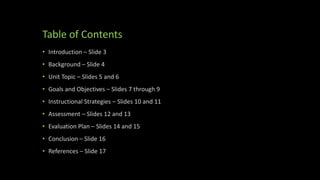
Table of Contents
• Introduction – Slide 3
• Background – Slide 4
• Unit Topic – Slides 5 and 6
• Goals and Objectives – Slides 7 through 9
• Instructional Strategies – Slides 10 and 11
• Assessment – Slides 12 and 13
• Evaluation Plan – Slides 14 and 15
• Conclusion – Slide 16
• References – Slide 17
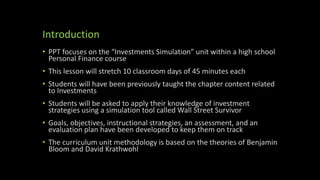
Introduction
• PPT focuses on the “Investments Simulation” unit within a high school
Personal Finance course
• This lesson will stretch 10 classroom days of 45 minutes each
• Students will have been previously taught the chapter content related
to Investments
• Students will be asked to apply their knowledge of investment
strategies using a simulation tool called Wall Street Survivor
• Goals, objectives, instructional strategies, an assessment, and an
evaluation plan have been developed to keep them on track
• The curriculum unit methodology is based on the theories of Benjamin
Bloom and David Krathwohl
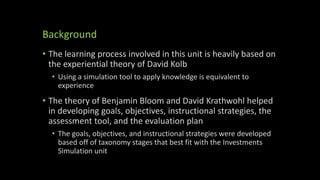
Background
• The learning process involved in this unit is heavily based on
the experiential theory of David Kolb
• Using a simulation tool to apply knowledge is equivalent to
experience
• The theory of Benjamin Bloom and David Krathwohl helped
in developing goals, objectives, instructional strategies, the
assessment tool, and the evaluation plan
• The goals, objectives, and instructional strategies were developed
based off of taxonomy stages that best fit with the Investments
Simulation unit
Unit Topic
Investments Simulation:
• Knowledge within a Personal Finance course is of great importance
• News outlets continue to report on the uncertain future of pensions and Social
Security benefits
• Due to this it is necessary to make sure students can apply investment
knowledge
• The “Investments Simulation” unit is within a high school Personal Finance
course and will stretch 10 classroom days of 45 minutes each
• Students will have been previously taught the chapter content related to
Investments
• Students will utilize Wall Street Survivor
• The simulation tool allows students to apply their knowledge
• Experiential learning is applied
Unit Topic: Using Wall Street Survivor
http://www.wallstreetsurvivor.com/
• Provides videos on
investment information
• Provides investment ideas
• Allows for a single course
setup or to compete against
any other class participating
• Starter Guide and Blog
• Free
• Social Media Friendly – can
earn badges and virtual
money and share with their
friends
• Realistic; while enforcing
concepts
• Great review tool due to the
information available
Goals and Objectives: Goals
Two Different Goals Based on Bloom’s and Krathwohl’s Theories:
• Bloom’s Cognitive Taxonomy of Educational Objectives Goal:
• Students will utilize investment simulation to synthesize investment
strategies in a meaningful and structured manner.
• Krathwohl’s Affective Taxonomy of Educational Objectives Goal:
• Students will organize investment strategies to value which strategy will
help them earn the most money within an investment simulation.
Goals and Objectives: Objectives
Objectives for 1st Goal
Objective 1: Apply investment and
savings knowledge to make money
within investment simulation.
[Application]
Objective 2: Interpret daily
results/earnings to adjust daily
investment strategy as needed.
[Comprehension]
Objectives for 2nd Goal
Objective 1: Participate in an
individual simulation, problem solving
activity. [Responding Stage]
Objective 2: Revise judgments and
behaviors within the simulation tool
based on previous results when using
simulation tool. [Characterization Stage]
Goals and Objectives: Supporting Theory
• Bloom used action words such as synthesize, interpret and apply.
• Krathwohl used terms like organize, participate, and revise.
• My objectives built off of the goals for the Investment Simulation Unit.
• While both theorists have similar styles, the action words they use can
be executed differently. For example, organize and synthesize are
similar action words, but can be interpreted differently.
• With each objective the “taxonomy stage” was referenced, that the
action word was associated with.
Instructional Strategies – Bloom
Instructional Strategy 1: During Day 1 of Investment
Simulation Unit apply investment strategy comprehension by
completing the following tasks: short sell a stock, hold a stock,
and purchase a less volatile investiture [bond, CD, etc.].
Instructional Strategy 2: During Day 4 of Investment
Simulation Unit interpret three previous days’ results and
adjust to one strategy you think will earn the most money.
Instructional Strategies – Krathwohl
Instructional Strategy 1: During Day 1 of Investment
Simulation Unit participate in simulation by viewing provided
video clips. Use problem solving skills to apply your perceived
best investment strategy.
Instructional Strategy 2: During Day 4 of Investment
Simulation Unit revise your strategy based on previous
experience to earn the most money.
Assessment
• One assessment tool will measure student
comprehension and application of their investment
knowledge
• This assessment tool will be a student presentation
on their process and experience
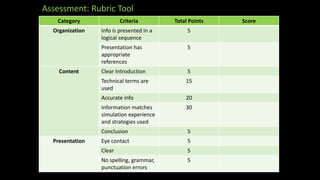
• This assessment tool will feature a rubric defining
necessary topic areas to discuss and scoring
Assessment: Rubric Tool
Category Criteria Total Points Score
Organization Info is presented in a
logical sequence
5
Presentation has
appropriate
references
5
Content Clear Introduction 5
Technical terms are
used
15
Accurate info 20
Information matches
simulation experience
and strategies used
30
Conclusion 5
Presentation Eye contact 5
Clear 5
No spelling, grammar,
punctuation errors
5
Evaluation Plan
• The presentation assessment tool will be used as part
of the evaluation plan
• In listening to student presentations applicable
strategies for investing must be mentioned and clearly
utilized properly
• The rubric will be used as a guide to see if the class as
a whole was able to apply investment knowledge
• A content review of investment strategies will be
conducted if necessary
Evaluation Plan: Continued
• The simulation practice and presentation
assessment allowed for achievement of all learning
goals, objectives, and instructional strategies.
• Assessments allowed them [students] to articulate
their investment knowledge and how they applied
it during the unit.
• The rubric may need to be more clearly defined in
the future.
Conclusion
•Students will meet expectations
within applying investment strategies
during the simulation process
•If not a review of content will be
appropriate
References
Bloom's Taxonomy of Educational Objectives. (n.d.). Retrieved August 31, 2016,
from http://teaching.uncc.edu/learning-resources/articles-books/best-practice/goals-
objectives/blooms-educational-objectives
Koffman, M. (1980). Using a Content/Behavior Matrix in the Instructional Planning Process.
Kolb, D. A. (2014). Experiential learning: Experience as the source of learning and
development. FT press.
Kolb, A. Y., & Kolb, D. A. (2012). Experiential learning theory. In Encyclopedia of the Sciences
of Learning (pp. 1215-1219). Springer US.
Krathwohl's affective domain taxonomy. (n.d.). Retrieved August 31, 2016,
from http://www.educ.ualberta.ca/staff/olenka.bilash/best of bilash/krathwol.html
Writing Instructional Goals and Objectives. (n.d.). Retrieved August 31, 2016,
from http://www.personal.psu.edu/bxb11/Objectives/GoalsAndObjectives_print.html
References are cited within Curriculum Unit Paper, but not used within this PPT

EDF 8289 Marino PPT.pptx

  • 1.
  • 2.
    Table of Contents •Introduction – Slide 3 • Background – Slide 4 • Unit Topic – Slides 5 and 6 • Goals and Objectives – Slides 7 through 9 • Instructional Strategies – Slides 10 and 11 • Assessment – Slides 12 and 13 • Evaluation Plan – Slides 14 and 15 • Conclusion – Slide 16 • References – Slide 17
  • 3.
    Introduction • PPT focuseson the “Investments Simulation” unit within a high school Personal Finance course • This lesson will stretch 10 classroom days of 45 minutes each • Students will have been previously taught the chapter content related to Investments • Students will be asked to apply their knowledge of investment strategies using a simulation tool called Wall Street Survivor • Goals, objectives, instructional strategies, an assessment, and an evaluation plan have been developed to keep them on track • The curriculum unit methodology is based on the theories of Benjamin Bloom and David Krathwohl
  • 4.
    Background • The learningprocess involved in this unit is heavily based on the experiential theory of David Kolb • Using a simulation tool to apply knowledge is equivalent to experience • The theory of Benjamin Bloom and David Krathwohl helped in developing goals, objectives, instructional strategies, the assessment tool, and the evaluation plan • The goals, objectives, and instructional strategies were developed based off of taxonomy stages that best fit with the Investments Simulation unit
  • 5.
    Unit Topic Investments Simulation: •Knowledge within a Personal Finance course is of great importance • News outlets continue to report on the uncertain future of pensions and Social Security benefits • Due to this it is necessary to make sure students can apply investment knowledge • The “Investments Simulation” unit is within a high school Personal Finance course and will stretch 10 classroom days of 45 minutes each • Students will have been previously taught the chapter content related to Investments • Students will utilize Wall Street Survivor • The simulation tool allows students to apply their knowledge • Experiential learning is applied
  • 6.
    Unit Topic: UsingWall Street Survivor http://www.wallstreetsurvivor.com/ • Provides videos on investment information • Provides investment ideas • Allows for a single course setup or to compete against any other class participating • Starter Guide and Blog • Free • Social Media Friendly – can earn badges and virtual money and share with their friends • Realistic; while enforcing concepts • Great review tool due to the information available
  • 7.
    Goals and Objectives:Goals Two Different Goals Based on Bloom’s and Krathwohl’s Theories: • Bloom’s Cognitive Taxonomy of Educational Objectives Goal: • Students will utilize investment simulation to synthesize investment strategies in a meaningful and structured manner. • Krathwohl’s Affective Taxonomy of Educational Objectives Goal: • Students will organize investment strategies to value which strategy will help them earn the most money within an investment simulation.
  • 8.
    Goals and Objectives:Objectives Objectives for 1st Goal Objective 1: Apply investment and savings knowledge to make money within investment simulation. [Application] Objective 2: Interpret daily results/earnings to adjust daily investment strategy as needed. [Comprehension] Objectives for 2nd Goal Objective 1: Participate in an individual simulation, problem solving activity. [Responding Stage] Objective 2: Revise judgments and behaviors within the simulation tool based on previous results when using simulation tool. [Characterization Stage]
  • 9.
    Goals and Objectives:Supporting Theory • Bloom used action words such as synthesize, interpret and apply. • Krathwohl used terms like organize, participate, and revise. • My objectives built off of the goals for the Investment Simulation Unit. • While both theorists have similar styles, the action words they use can be executed differently. For example, organize and synthesize are similar action words, but can be interpreted differently. • With each objective the “taxonomy stage” was referenced, that the action word was associated with.
  • 10.
    Instructional Strategies –Bloom Instructional Strategy 1: During Day 1 of Investment Simulation Unit apply investment strategy comprehension by completing the following tasks: short sell a stock, hold a stock, and purchase a less volatile investiture [bond, CD, etc.]. Instructional Strategy 2: During Day 4 of Investment Simulation Unit interpret three previous days’ results and adjust to one strategy you think will earn the most money.
  • 11.
    Instructional Strategies –Krathwohl Instructional Strategy 1: During Day 1 of Investment Simulation Unit participate in simulation by viewing provided video clips. Use problem solving skills to apply your perceived best investment strategy. Instructional Strategy 2: During Day 4 of Investment Simulation Unit revise your strategy based on previous experience to earn the most money.
  • 12.
    Assessment • One assessmenttool will measure student comprehension and application of their investment knowledge • This assessment tool will be a student presentation on their process and experience • This assessment tool will feature a rubric defining necessary topic areas to discuss and scoring
  • 13.
    Assessment: Rubric Tool CategoryCriteria Total Points Score Organization Info is presented in a logical sequence 5 Presentation has appropriate references 5 Content Clear Introduction 5 Technical terms are used 15 Accurate info 20 Information matches simulation experience and strategies used 30 Conclusion 5 Presentation Eye contact 5 Clear 5 No spelling, grammar, punctuation errors 5
  • 14.
    Evaluation Plan • Thepresentation assessment tool will be used as part of the evaluation plan • In listening to student presentations applicable strategies for investing must be mentioned and clearly utilized properly • The rubric will be used as a guide to see if the class as a whole was able to apply investment knowledge • A content review of investment strategies will be conducted if necessary
  • 15.
    Evaluation Plan: Continued •The simulation practice and presentation assessment allowed for achievement of all learning goals, objectives, and instructional strategies. • Assessments allowed them [students] to articulate their investment knowledge and how they applied it during the unit. • The rubric may need to be more clearly defined in the future.
  • 16.
    Conclusion •Students will meetexpectations within applying investment strategies during the simulation process •If not a review of content will be appropriate
  • 17.
    References Bloom's Taxonomy ofEducational Objectives. (n.d.). Retrieved August 31, 2016, from http://teaching.uncc.edu/learning-resources/articles-books/best-practice/goals- objectives/blooms-educational-objectives Koffman, M. (1980). Using a Content/Behavior Matrix in the Instructional Planning Process. Kolb, D. A. (2014). Experiential learning: Experience as the source of learning and development. FT press. Kolb, A. Y., & Kolb, D. A. (2012). Experiential learning theory. In Encyclopedia of the Sciences of Learning (pp. 1215-1219). Springer US. Krathwohl's affective domain taxonomy. (n.d.). Retrieved August 31, 2016, from http://www.educ.ualberta.ca/staff/olenka.bilash/best of bilash/krathwol.html Writing Instructional Goals and Objectives. (n.d.). Retrieved August 31, 2016, from http://www.personal.psu.edu/bxb11/Objectives/GoalsAndObjectives_print.html References are cited within Curriculum Unit Paper, but not used within this PPT