JOURNAL CLUB
Associations of Cord Blood Vitamin D
and Preeclampsia with offspring Blood
Pressure in Childhood and Adolescence
MODERATOR: DR ASWATHY RAJAN
PRESENTOR : SHANKAR H R
INTRODUCTION
• Journal: Journal of American Medical Association
• Authors: Mingyu Zhang, MHS; Erin D. Michos, MD et al
• Type of study :
• : Boston Medical Center, Boston, Massachusetts
• Period of study: December 1998 to June 2009
• Data analysis: from October 2019 to March 2020
• Published date: 5th October 2020
Introduction
 Pre-eclampsia is the leading cause of maternal & perinatal mortality
 Involved in 2-8% of pregnancy
 Simultaneous increased in preeclampsia and prevalence of childhood BP
 Elevated childhood BP- high risk of HTN and Cardiovascular diseases
 Maternal pre-eclampsia- one of earliest risk factor
Introduction- continued
 Vitamin-D deficiency- risk of cardiovascular diseases
 Meta-analysis from 10 studies- 3-6mmHg more SBP
 Meta-analysis of 27 RCT-showed Vit-D supplementation helps in reducing
preeclampsia
 Vit- D- plays role in fetal development
 Higher early life Vit D - may be protective against childhood high BP
Aim of the study
To assess the association betwn maternal preeclampsia and offsping SBP
across
- Early childhood( 3-5yrs)
- Middle childhood( 6-12yrs)
- Adolescene (13-18yrs)
To examinee whether this association differs by cord blood Vit-D level
Methodology
 Participants- ongoing prospective birth cohort from 1998 to
2002
 After 24 to 72hrs after delivery
 Follow-up period Feb 2002 to May 2018
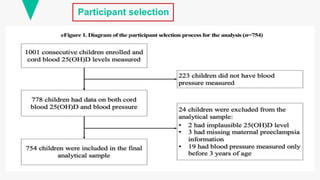
Inclusion criteria
 Mothers recruited 24 to 72hrs
after delivery
 Questionnaire
 with cord blood D3 level
Exclusion criteria
 Multiple gestation pregnancies
and neonates with major birth
defects
 Lacks datas on maternal
preeclampsia diagnosis, cord
blood D3 & child BP from 3 to
18 years of age
 child with one/less SBP reading
Preeclamsia
As per guidelines
After 20weeks of gestation
- New onset of SBP >140mmHg or
- Diastolic BP >90mmHg
+ Proteinuria
Cord blood Vitamin D levels
 Cord blood sample is collected at delivery
 HPLC method is used to calculate total Vitamin D3 level
 Cord blood D3 levels < 11ng/ml is taken as deficiency
> 11ng/ml meets needs of 97.5% of population
Childhood & Adolescence SBP
 Child SBP measured between 3-18yrs of age
 Used automatic sphygmomanometer- Masimo SET / Masimo Corp
 Appropriate sized cuff, Sitting position
 Right brachial artery
 Age, Sex and height specific SBP percentile based on AAP 2017
guidelines
Covariates
Using postpartum questionnaire & electronic medical records
- Maternal age at delivery,
Maternal race/ethnicity, educational level,
Smoking status during pregnancy
Prepregnancy BMI
Birth weight, gestational age and sex
Subsample of children's( n=586) Vitamin D3 level measured using
HPLC
Statistical analysis
Used linear mixed models
 to estimate the associations b/n maternal preeclampsia and
repeated measurements of child SBP percentile
 asssessed the maternal preeclampsia–child SBP
association varied by cord blood D3 level
Statistical analysis
 Fractional polynomial prediction plot
-associations b/n cord blood D3 and child SBP
percentile across all developmental stages
 Confounders defines as covariates a/w both exposure ( maternal
preeclampsia) and outcome ( child SBP) and not in the potential
casual pathway
 Adjusted the covariates like maternal age, race, education level,
smoking status, BMI, season of delivery
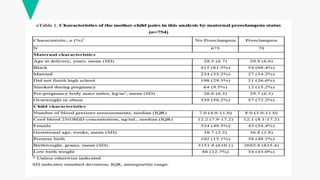
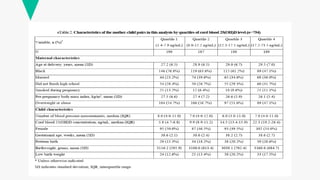
Participant selection
Results
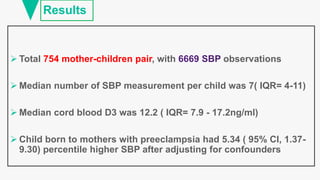
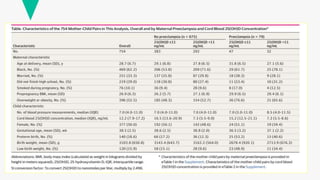
 Total 754 mother-children pair, with observations
 Median number of SBP measurement per child was 7( IQR= 4-11)
 Median cord blood D3 was 12.2 ( IQR= 7.9 - 17.2ng/ml)
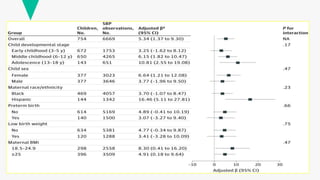
 Child born to mothers with preeclampsia had 5.34 ( 95% CI, 1.37-
9.30) percentile higher SBP after adjusting for confounders
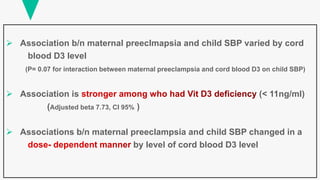
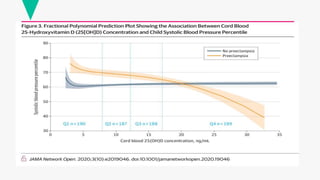
 Association b/n maternal preeclmapsia and child SBP varied by cord
blood D3 level
(P= 0.07 for interaction between maternal preeclampsia and cord blood D3 on child SBP)
 Association is (< 11ng/ml)
(Adjusted beta 7.73, CI 95% )
 Associations b/n maternal preeclampsia and child SBP changed in a
by level of cord blood D3 level
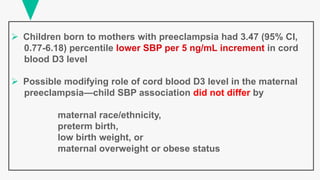
 Children born to mothers with preeclampsia had 3.47 (95% CI,
0.77-6.18) percentile lower SBP per 5 ng/mL increment in cord
blood D3 level
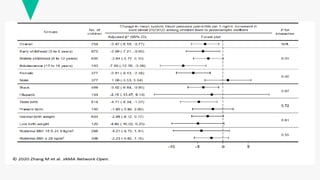
 Possible modifying role of cord blood D3 level in the maternal
preeclampsia—child SBP association did not differ by
maternal race/ethnicity,
preterm birth,
low birth weight, or
maternal overweight or obese status
Discussion
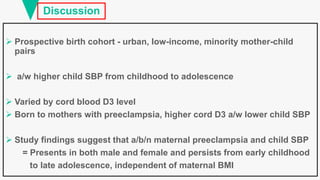
 Prospective birth cohort - urban, low-income, minority mother-child
pairs
 a/w higher child SBP from childhood to adolescence
 Varied by cord blood D3 level
 Born to mothers with preeclampsia, higher cord D3 a/w lower child SBP
 Study findings suggest that a/b/n maternal preeclampsia and child SBP
= Presents in both male and female and persists from early childhood
to late adolescence, independent of maternal BMI
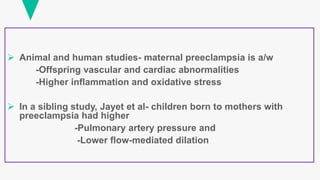
 Animal and human studies- maternal preeclampsia is a/w
-Offspring vascular and cardiac abnormalities
-Higher inflammation and oxidative stress
 In a sibling study, Jayet et al- children born to mothers with
preeclampsia had higher
-Pulmonary artery pressure and
-Lower flow-mediated dilation
 Vitamin D- a/w cardiovascular health and cardiovascular
physiology and pathology through multiple pathways-
- Regulations of
 Also involved in implantation, placentation & angiogenesis
& essential for maintaining a healthy pregnancy.
 Mechanisms on how vitamin D may modify the association
between preeclampsia and child BP, is unclear
 Further trials of vitamin D supplementation in pregnancies with
preeclampsia with long term follow-up of their children is needed
strengths of the study
 Association of maternal preeclampsia with offspring SBP from
early childhood to adolescence ( 3-18yrs)
 Possible modifying role of cord blood vitamin D
 Large sample size with median of 7 SBP observations per child
 Sample predominantly comprised underrepresented (62% Black,
19% Hispanic) mothers and preterm birth children
 Important segment of population
Limitations of the study
 Observational study- unmeasured confounding may exist like
Maternal nutrional factors
Lifestyles like sunlight exposure- difficult to measure
 Low cord D3 level may reflect poor maternal health
 No data on time of onset of preeclampsia - early/late onset
 No data on mother Vitamin D3 level
 Small proportion of children had only 1 SBP measured during followup
Conclusions
 Maternal preeclampsia to be a/w higher child BP from early
childhood to adolescence
 Adequate cord blood D3 level may modify this association
 Optimizing D3 levels in preeclamptic mother may help in
- Preventing high childhood BP and
- future cardiovascular disease risk.
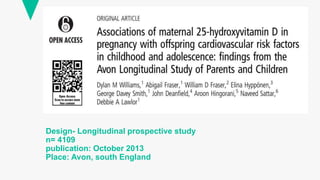
Design- Longitudinal prospective study
n= 4109
publication: October 2013
Place: Avon, south England
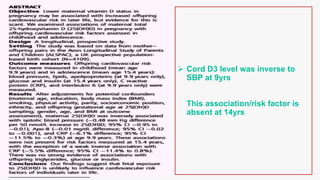
 Cord D3 level was inverse to
SBP at 9yrs
This association/risk factor is
absent at 14yrs
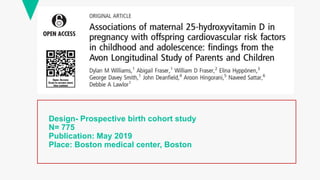
Design- Prospective birth cohort study
N= 775
Publication: May 2019
Place: Boston medical center, Boston
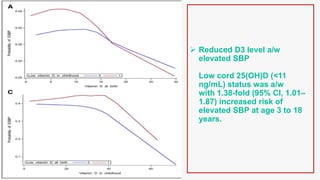
 Reduced D3 level a/w
elevated SBP
Low cord 25(OH)D (<11
ng/mL) status was a/w
with 1.38-fold (95% CI, 1.01–
1.87) increased risk of
elevated SBP at age 3 to 18
years.
Journal club october 2020

Journal club october 2020

  • 1.
    JOURNAL CLUB Associations ofCord Blood Vitamin D and Preeclampsia with offspring Blood Pressure in Childhood and Adolescence MODERATOR: DR ASWATHY RAJAN PRESENTOR : SHANKAR H R
  • 2.
    INTRODUCTION • Journal: Journalof American Medical Association • Authors: Mingyu Zhang, MHS; Erin D. Michos, MD et al • Type of study : • : Boston Medical Center, Boston, Massachusetts
  • 3.
    • Period ofstudy: December 1998 to June 2009 • Data analysis: from October 2019 to March 2020 • Published date: 5th October 2020
  • 4.
    Introduction  Pre-eclampsia isthe leading cause of maternal & perinatal mortality  Involved in 2-8% of pregnancy  Simultaneous increased in preeclampsia and prevalence of childhood BP  Elevated childhood BP- high risk of HTN and Cardiovascular diseases  Maternal pre-eclampsia- one of earliest risk factor
  • 5.
    Introduction- continued  Vitamin-Ddeficiency- risk of cardiovascular diseases  Meta-analysis from 10 studies- 3-6mmHg more SBP  Meta-analysis of 27 RCT-showed Vit-D supplementation helps in reducing preeclampsia  Vit- D- plays role in fetal development  Higher early life Vit D - may be protective against childhood high BP
  • 6.
    Aim of thestudy To assess the association betwn maternal preeclampsia and offsping SBP across - Early childhood( 3-5yrs) - Middle childhood( 6-12yrs) - Adolescene (13-18yrs) To examinee whether this association differs by cord blood Vit-D level
  • 7.
    Methodology  Participants- ongoingprospective birth cohort from 1998 to 2002  After 24 to 72hrs after delivery  Follow-up period Feb 2002 to May 2018
  • 8.
    Inclusion criteria  Mothersrecruited 24 to 72hrs after delivery  Questionnaire  with cord blood D3 level Exclusion criteria  Multiple gestation pregnancies and neonates with major birth defects  Lacks datas on maternal preeclampsia diagnosis, cord blood D3 & child BP from 3 to 18 years of age  child with one/less SBP reading
  • 9.
    Preeclamsia As per guidelines After20weeks of gestation - New onset of SBP >140mmHg or - Diastolic BP >90mmHg + Proteinuria
  • 10.
    Cord blood VitaminD levels  Cord blood sample is collected at delivery  HPLC method is used to calculate total Vitamin D3 level  Cord blood D3 levels < 11ng/ml is taken as deficiency > 11ng/ml meets needs of 97.5% of population
  • 11.
    Childhood & AdolescenceSBP  Child SBP measured between 3-18yrs of age  Used automatic sphygmomanometer- Masimo SET / Masimo Corp  Appropriate sized cuff, Sitting position  Right brachial artery  Age, Sex and height specific SBP percentile based on AAP 2017 guidelines
  • 12.
    Covariates Using postpartum questionnaire& electronic medical records - Maternal age at delivery, Maternal race/ethnicity, educational level, Smoking status during pregnancy Prepregnancy BMI Birth weight, gestational age and sex Subsample of children's( n=586) Vitamin D3 level measured using HPLC
  • 13.
    Statistical analysis Used linearmixed models  to estimate the associations b/n maternal preeclampsia and repeated measurements of child SBP percentile  asssessed the maternal preeclampsia–child SBP association varied by cord blood D3 level
  • 14.
    Statistical analysis  Fractionalpolynomial prediction plot -associations b/n cord blood D3 and child SBP percentile across all developmental stages  Confounders defines as covariates a/w both exposure ( maternal preeclampsia) and outcome ( child SBP) and not in the potential casual pathway  Adjusted the covariates like maternal age, race, education level, smoking status, BMI, season of delivery
  • 15.
  • 18.
    Results  Total 754mother-children pair, with observations  Median number of SBP measurement per child was 7( IQR= 4-11)  Median cord blood D3 was 12.2 ( IQR= 7.9 - 17.2ng/ml)  Child born to mothers with preeclampsia had 5.34 ( 95% CI, 1.37- 9.30) percentile higher SBP after adjusting for confounders
  • 19.
     Association b/nmaternal preeclmapsia and child SBP varied by cord blood D3 level (P= 0.07 for interaction between maternal preeclampsia and cord blood D3 on child SBP)  Association is (< 11ng/ml) (Adjusted beta 7.73, CI 95% )  Associations b/n maternal preeclampsia and child SBP changed in a by level of cord blood D3 level
  • 20.
     Children bornto mothers with preeclampsia had 3.47 (95% CI, 0.77-6.18) percentile lower SBP per 5 ng/mL increment in cord blood D3 level  Possible modifying role of cord blood D3 level in the maternal preeclampsia—child SBP association did not differ by maternal race/ethnicity, preterm birth, low birth weight, or maternal overweight or obese status
  • 25.
    Discussion  Prospective birthcohort - urban, low-income, minority mother-child pairs  a/w higher child SBP from childhood to adolescence  Varied by cord blood D3 level  Born to mothers with preeclampsia, higher cord D3 a/w lower child SBP  Study findings suggest that a/b/n maternal preeclampsia and child SBP = Presents in both male and female and persists from early childhood to late adolescence, independent of maternal BMI
  • 26.
     Animal andhuman studies- maternal preeclampsia is a/w -Offspring vascular and cardiac abnormalities -Higher inflammation and oxidative stress  In a sibling study, Jayet et al- children born to mothers with preeclampsia had higher -Pulmonary artery pressure and -Lower flow-mediated dilation
  • 27.
     Vitamin D-a/w cardiovascular health and cardiovascular physiology and pathology through multiple pathways- - Regulations of  Also involved in implantation, placentation & angiogenesis & essential for maintaining a healthy pregnancy.
  • 28.
     Mechanisms onhow vitamin D may modify the association between preeclampsia and child BP, is unclear  Further trials of vitamin D supplementation in pregnancies with preeclampsia with long term follow-up of their children is needed
  • 29.
    strengths of thestudy  Association of maternal preeclampsia with offspring SBP from early childhood to adolescence ( 3-18yrs)  Possible modifying role of cord blood vitamin D  Large sample size with median of 7 SBP observations per child  Sample predominantly comprised underrepresented (62% Black, 19% Hispanic) mothers and preterm birth children  Important segment of population
  • 30.
    Limitations of thestudy  Observational study- unmeasured confounding may exist like Maternal nutrional factors Lifestyles like sunlight exposure- difficult to measure  Low cord D3 level may reflect poor maternal health  No data on time of onset of preeclampsia - early/late onset  No data on mother Vitamin D3 level  Small proportion of children had only 1 SBP measured during followup
  • 31.
    Conclusions  Maternal preeclampsiato be a/w higher child BP from early childhood to adolescence  Adequate cord blood D3 level may modify this association  Optimizing D3 levels in preeclamptic mother may help in - Preventing high childhood BP and - future cardiovascular disease risk.
  • 32.
    Design- Longitudinal prospectivestudy n= 4109 publication: October 2013 Place: Avon, south England
  • 33.
     Cord D3level was inverse to SBP at 9yrs This association/risk factor is absent at 14yrs
  • 34.
    Design- Prospective birthcohort study N= 775 Publication: May 2019 Place: Boston medical center, Boston
  • 35.
     Reduced D3level a/w elevated SBP Low cord 25(OH)D (<11 ng/mL) status was a/w with 1.38-fold (95% CI, 1.01– 1.87) increased risk of elevated SBP at age 3 to 18 years.