International Medical Faculty
NAME :- MOHIT RULANIYA
TOPIC :- CONGENITAL HEART DISEASE
Epidemiology
• Prevalence:0.5-0.8% of live births (8/1000).Leading cause
ofdeath in children with CHD.
• Etiology:Unknown,multifactorial inheritance,genetic factors
implicated,high incidence in first degree relatives.
• 3% have a single gene defect,13% have associated
chromosomal abnormalities.
• 2-4% are associated with environmental or maternal
conditions & teratogenic influences.
• Gender differences:ASD,VSD,PDA & Pulmonic stenosis more
common in girls,left sided lesions in boys.
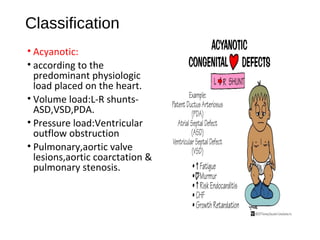
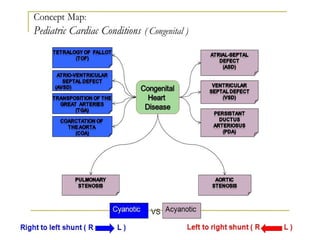
Classification
• Acyanotic:
• according to the
predominant physiologic
load placed on the heart.
• Volume load:L-R shunts-
ASD,VSD,PDA.
• Pressure load:Ventricular
outflow obstruction
• Pulmonary,aortic valve
lesions,aortic coarctation &
pulmonary stenosis.
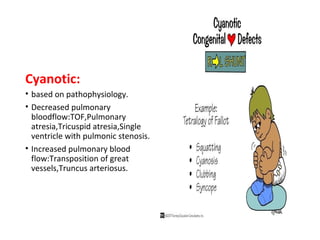
Cyanotic:
• based on pathophysiology.
• Decreased pulmonary
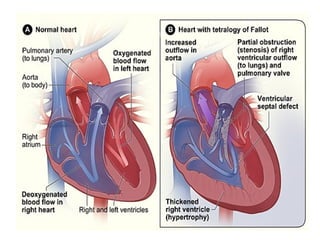
bloodflow:TOF,Pulmonary
atresia,Tricuspid atresia,Single
ventricle with pulmonic stenosis.
• Increased pulmonary blood
flow:Transposition of great
vessels,Truncus arteriosus.
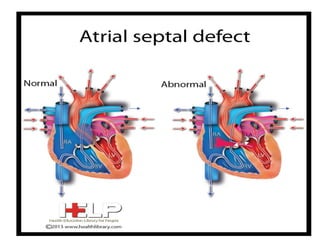
ATRIAL SEPTAL DEFECT.
•Sinus venosus defect:high in the septum.
•Ostium secundum defect:midseptum.
•Ostium primum defect:low in the septum.
•Pathophysiology:L-R shunt-increased flow across Rt
heart-RV & PA enlargement.
•Clinical features:asymptomatic,slow wt
gain,frequent LRTI.
•Diagnosis:Rt ventricular heave,systolic
murmur,fixed wide split S2.
Investigations:
• CXR:enlarged heart & PA,increased vascularity.
• ECG:Rt axis in secundum defect,hallmark of primum defect is
extreme Lt axis,RVH.
• ECHO:RVH,valve anatomy,flow direction.
• Treatment:closure during cardiac cathetrization,surgical closure.
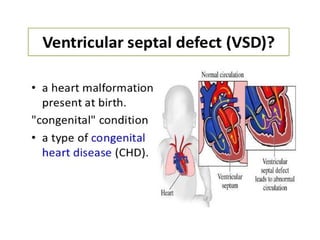
VENTRICULAR SEPTAL DEFECT.
•Most common CHD (26%),may be single or
multiple.
•Pathophysiology:Lt-Rt shunt as long as pulmonary
vascular resistance is lower than systemic
resistance,if reverse shunt reverses
•Large defects lead to pul.hypertension-
Eissenmenger syndrome.
•Clinical features: depend on
size,asymptomatic,growth failure,recurrent
LRTI,congestive heart failure,SOB,cyanosis
•Diagnosis:pansystolic murmur,loud p2.
Investigations
•CXR:cardiomegaly,enlarged LA&LV.
•ECG:extreme lt axis is charecteristic,biventricular
hypertrophy.
•ECHO:chamber size & pressures.
•Cardiac catheter:O2 content,PA pressure,size & no
of defects.
•Treatment:Endocarditis
prophylaxis,digoxin,diuretics.
•Surgical closure before pulmonary vascular changes
become irreversible.
PATENT DUCTUS ARTERIOSUS.
•Connection between PA & descending aorta
•10% of CHD.
•Pathophysiology:Lt-Rt shunt,reverses if pulmonary
resistance increases-RV enlargement.If PDA is large
Eissenmenger syndrome can develop.
•Clinical features:depend on size & direction of
flow,slow growth,LRTI,SOB,cyanosis.
•Diagnosis:bounding pulse,continous murmur,loud
S2.
Investigations
•CXR:cardiomegaly,increased pul vascularity.
•ECG:Lt or biventricular hypertrophy.
•ECHO:2D visualises PDA,doppler shows turbulance.
•Cardiac catheter:PA pressures & O2 sats.
•Treatment:Endocardial prophylaxis as long as
patent,Indomethacin.
•Surgical:ligation is curative.
TREATMENT
• Procedures using catheterization .
• Heart transplant
• OPen heart surgery
• Medications:Drugs known as angiotensin-converting enzyme (ACE)
inhibitors, angiotensin II receptor blockers (ARBs) and beta blockers
and medications that cause fluid loss (diuretics) can help ease stress
on the heart by lowering blood pressure, heart rate and the amount
of fluid in the chest.
Referance:-
• www.slideshare.com
• www.webmed.com
• www.Wikipedia.com

congenital heart defect in children

  • 1.
    International Medical Faculty NAME:- MOHIT RULANIYA TOPIC :- CONGENITAL HEART DISEASE
  • 3.
    Epidemiology • Prevalence:0.5-0.8% oflive births (8/1000).Leading cause ofdeath in children with CHD. • Etiology:Unknown,multifactorial inheritance,genetic factors implicated,high incidence in first degree relatives. • 3% have a single gene defect,13% have associated chromosomal abnormalities. • 2-4% are associated with environmental or maternal conditions & teratogenic influences. • Gender differences:ASD,VSD,PDA & Pulmonic stenosis more common in girls,left sided lesions in boys.
  • 6.
    Classification • Acyanotic: • accordingto the predominant physiologic load placed on the heart. • Volume load:L-R shunts- ASD,VSD,PDA. • Pressure load:Ventricular outflow obstruction • Pulmonary,aortic valve lesions,aortic coarctation & pulmonary stenosis.
  • 7.
    Cyanotic: • based onpathophysiology. • Decreased pulmonary bloodflow:TOF,Pulmonary atresia,Tricuspid atresia,Single ventricle with pulmonic stenosis. • Increased pulmonary blood flow:Transposition of great vessels,Truncus arteriosus.
  • 9.
    ATRIAL SEPTAL DEFECT. •Sinusvenosus defect:high in the septum. •Ostium secundum defect:midseptum. •Ostium primum defect:low in the septum. •Pathophysiology:L-R shunt-increased flow across Rt heart-RV & PA enlargement. •Clinical features:asymptomatic,slow wt gain,frequent LRTI. •Diagnosis:Rt ventricular heave,systolic murmur,fixed wide split S2.
  • 11.
    Investigations: • CXR:enlarged heart& PA,increased vascularity. • ECG:Rt axis in secundum defect,hallmark of primum defect is extreme Lt axis,RVH. • ECHO:RVH,valve anatomy,flow direction. • Treatment:closure during cardiac cathetrization,surgical closure.
  • 12.
    VENTRICULAR SEPTAL DEFECT. •Mostcommon CHD (26%),may be single or multiple. •Pathophysiology:Lt-Rt shunt as long as pulmonary vascular resistance is lower than systemic resistance,if reverse shunt reverses •Large defects lead to pul.hypertension- Eissenmenger syndrome. •Clinical features: depend on size,asymptomatic,growth failure,recurrent LRTI,congestive heart failure,SOB,cyanosis •Diagnosis:pansystolic murmur,loud p2.
  • 14.
    Investigations •CXR:cardiomegaly,enlarged LA&LV. •ECG:extreme ltaxis is charecteristic,biventricular hypertrophy. •ECHO:chamber size & pressures. •Cardiac catheter:O2 content,PA pressure,size & no of defects. •Treatment:Endocarditis prophylaxis,digoxin,diuretics. •Surgical closure before pulmonary vascular changes become irreversible.
  • 15.
    PATENT DUCTUS ARTERIOSUS. •Connectionbetween PA & descending aorta •10% of CHD. •Pathophysiology:Lt-Rt shunt,reverses if pulmonary resistance increases-RV enlargement.If PDA is large Eissenmenger syndrome can develop. •Clinical features:depend on size & direction of flow,slow growth,LRTI,SOB,cyanosis. •Diagnosis:bounding pulse,continous murmur,loud S2.
  • 16.
    Investigations •CXR:cardiomegaly,increased pul vascularity. •ECG:Ltor biventricular hypertrophy. •ECHO:2D visualises PDA,doppler shows turbulance. •Cardiac catheter:PA pressures & O2 sats. •Treatment:Endocardial prophylaxis as long as patent,Indomethacin. •Surgical:ligation is curative.
  • 17.
    TREATMENT • Procedures usingcatheterization . • Heart transplant • OPen heart surgery • Medications:Drugs known as angiotensin-converting enzyme (ACE) inhibitors, angiotensin II receptor blockers (ARBs) and beta blockers and medications that cause fluid loss (diuretics) can help ease stress on the heart by lowering blood pressure, heart rate and the amount of fluid in the chest.
  • 18.

Editor's Notes

  • #4 2-3 in 1000 newborn will be symptomatic within 1 year.