Cross-Site Ajax Challenges and Techniques for Building Rich Web 2.0 Mashups Joseph Smarr Plaxo, Inc. [email_address]
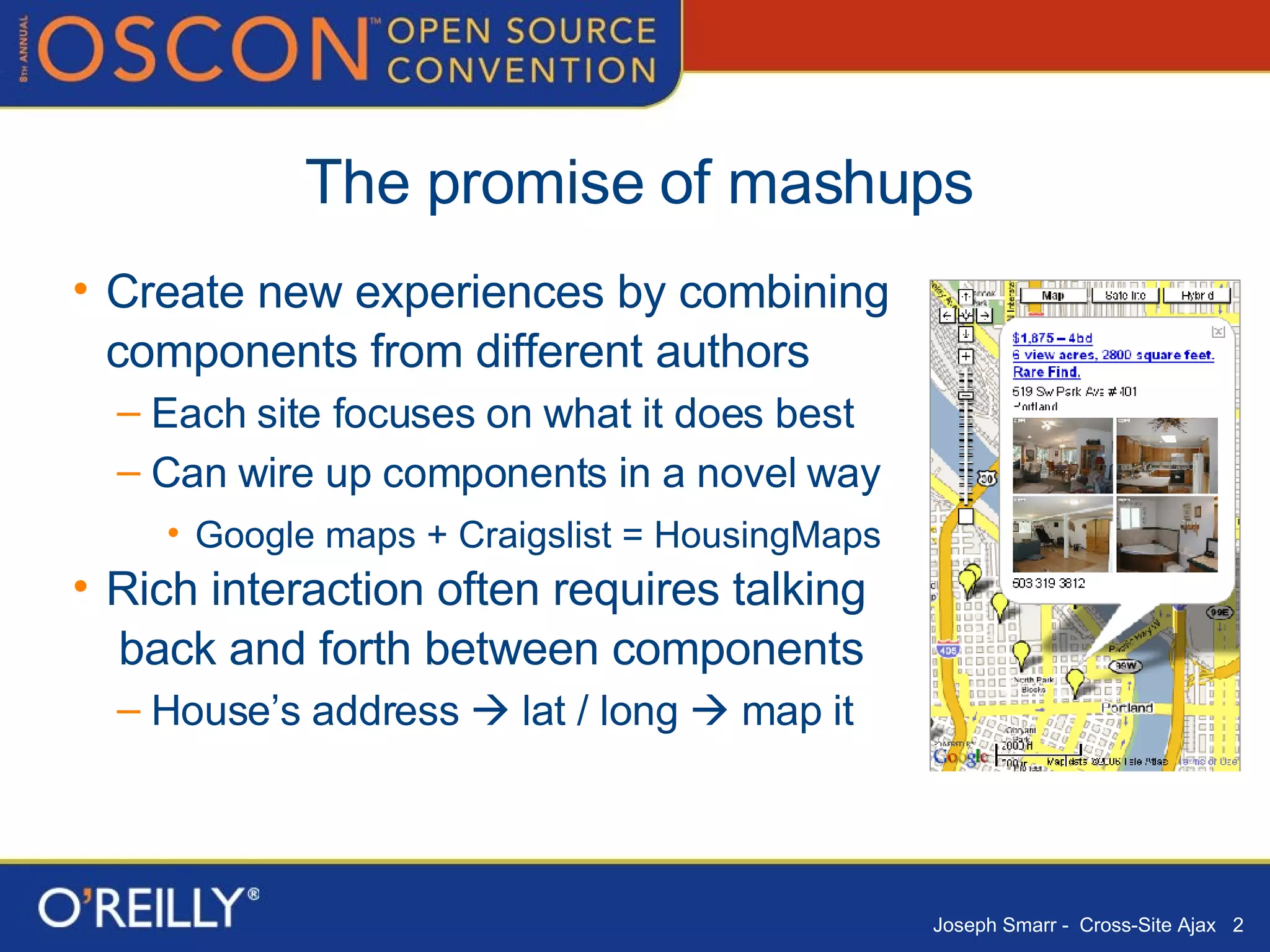
The promise of mashups Create new experiences by combining  components from different authors Each site focuses on what it does best Can wire up components in a novel way Google maps + Craigslist = HousingMaps Rich interaction often requires talking  back and forth between components House’s address    lat / long    map it
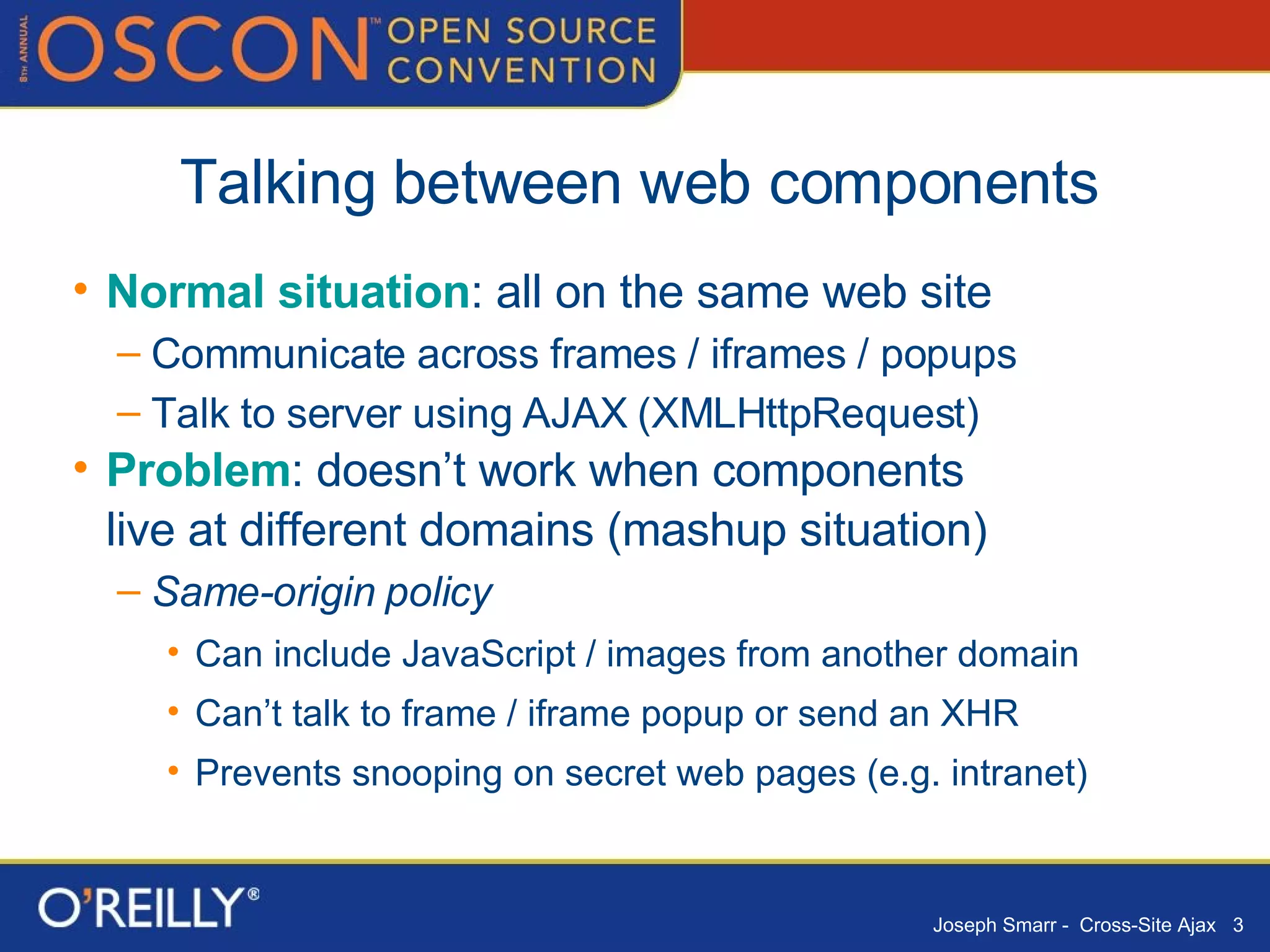
Talking between web components Normal situation : all on the same web site Communicate across frames / iframes / popups Talk to server using AJAX (XMLHttpRequest) Problem : doesn’t work when components  live at different domains (mashup situation) Same-origin   policy Can include JavaScript / images from another domain Can’t talk to frame / iframe popup or send an XHR Prevents snooping on secret web pages (e.g. intranet)
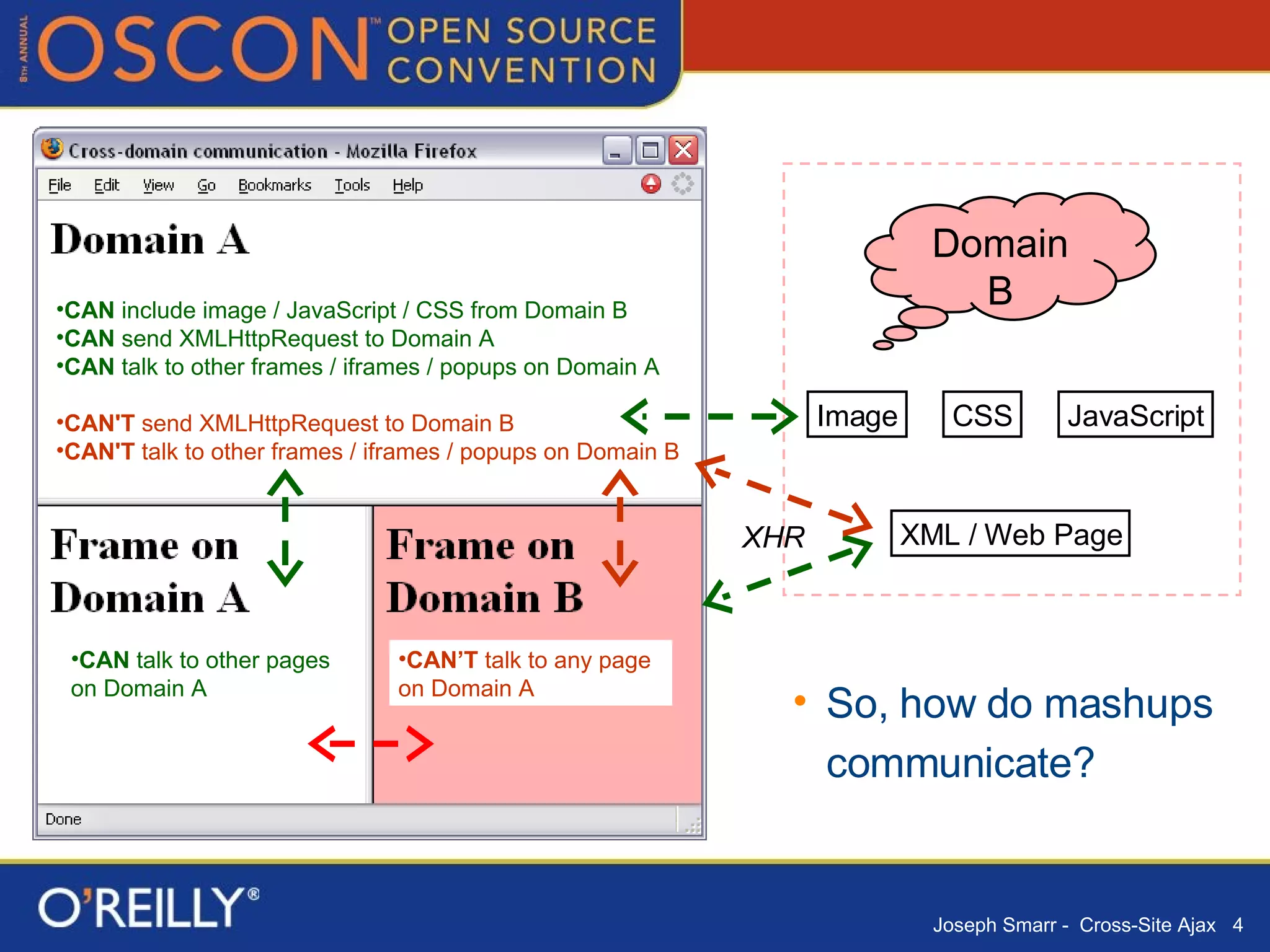
So, how do mashups communicate? CAN  include image / JavaScript / CSS from Domain B   CAN  send XMLHttpRequest to Domain A   CAN  talk to other frames / iframes / popups on Domain A  CAN'T  send XMLHttpRequest to Domain B  CAN'T  talk to other frames / iframes / popups on Domain B  CAN  talk to other pages  on Domain A   CAN’T  talk to any page on Domain A  Domain B XML / Web Page XHR Image CSS JavaScript
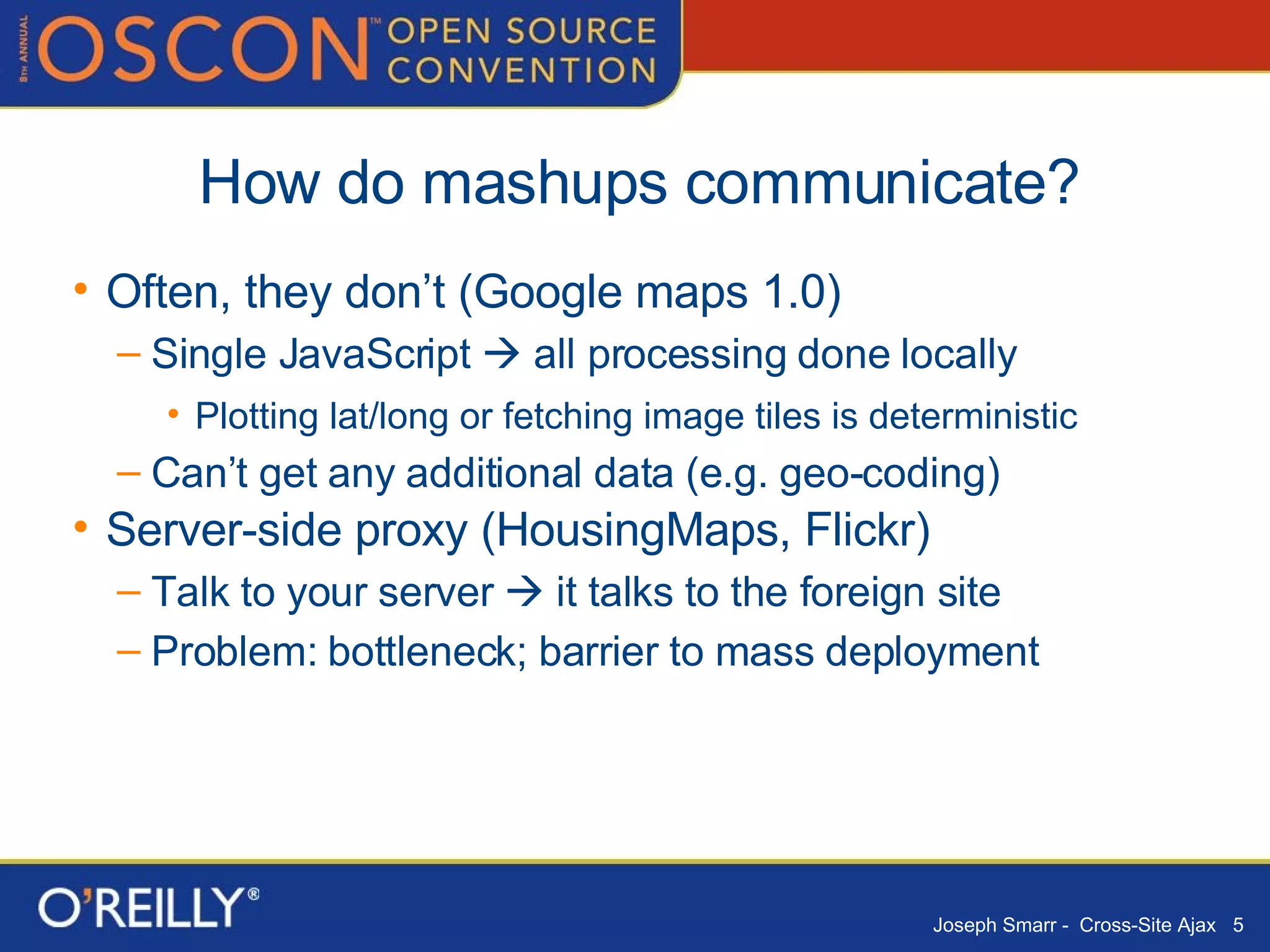
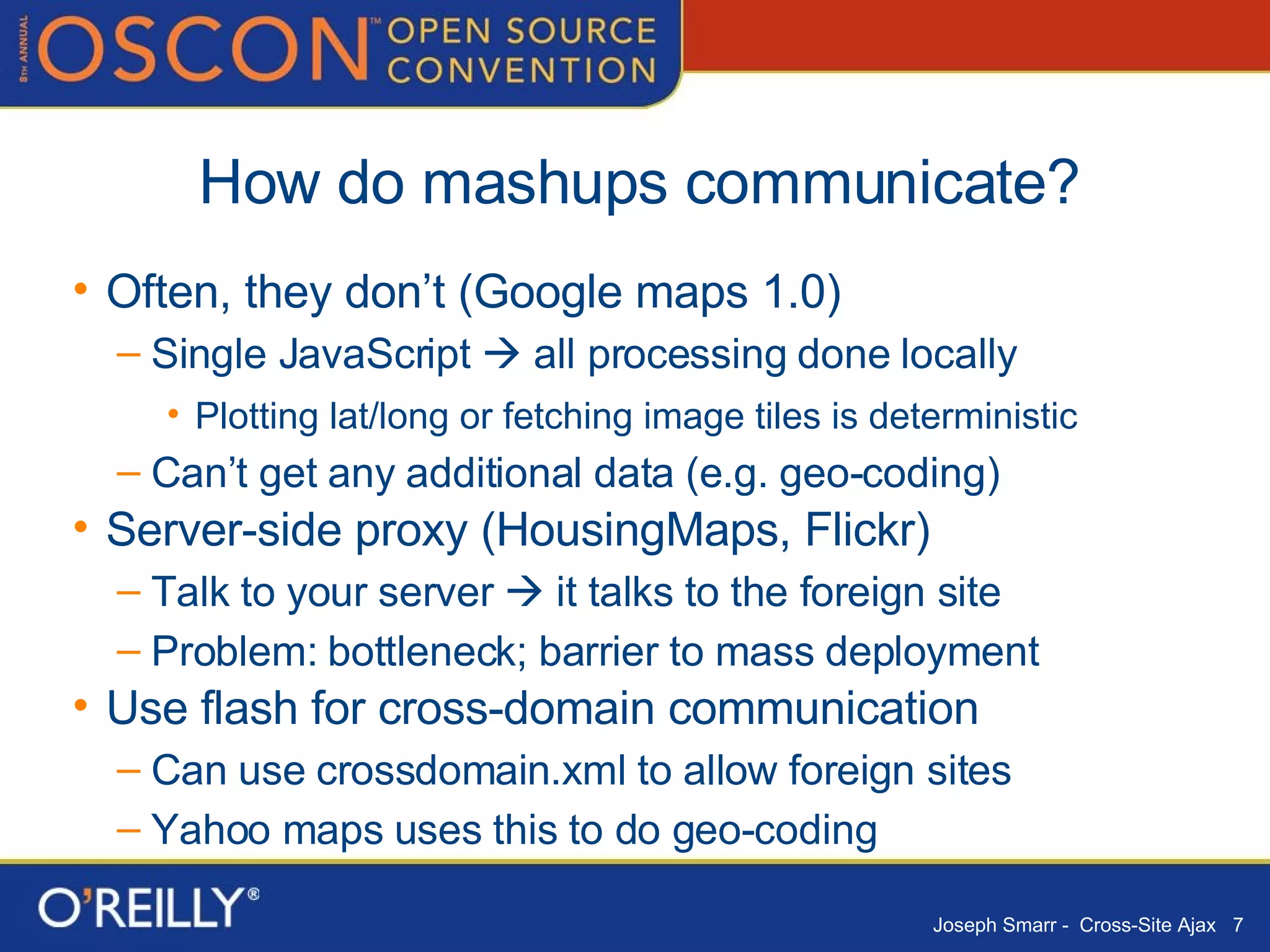
How do mashups communicate? Often, they don’t (Google maps 1.0) Single JavaScript    all processing done locally Plotting lat/long or fetching image tiles is deterministic Can’t get any additional data (e.g. geo-coding) Server-side proxy (HousingMaps, Flickr) Talk to your server    it talks to the foreign site Problem: bottleneck; barrier to mass deployment
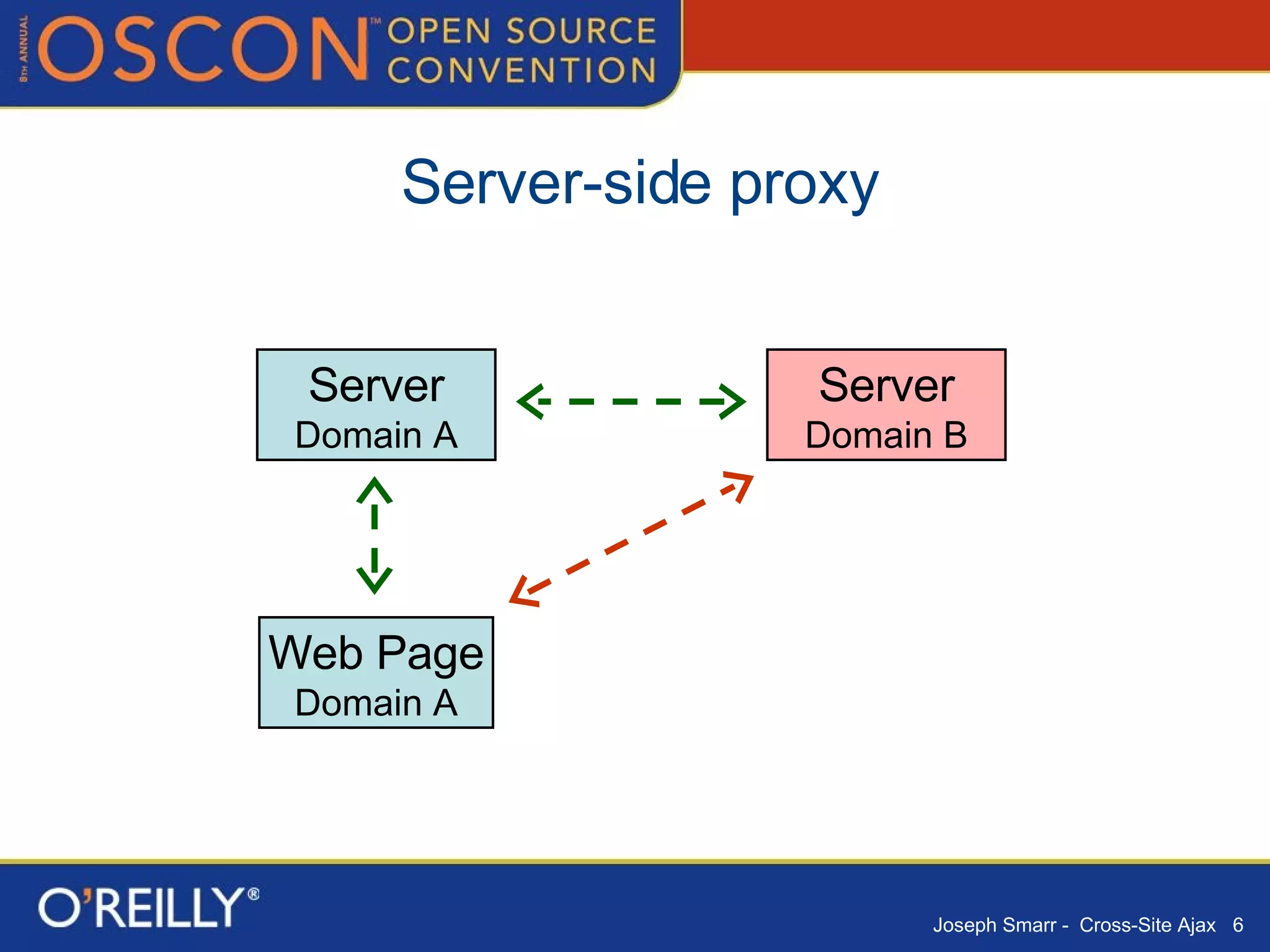
Server-side proxy Web Page Domain A Server Domain A Server Domain B
How do mashups communicate? Often, they don’t (Google maps 1.0) Single JavaScript    all processing done locally Plotting lat/long or fetching image tiles is deterministic Can’t get any additional data (e.g. geo-coding) Server-side proxy (HousingMaps, Flickr) Talk to your server    it talks to the foreign site Problem: bottleneck; barrier to mass deployment Use flash for cross-domain communication Can use crossdomain.xml to allow foreign sites Yahoo maps uses this to do geo-coding
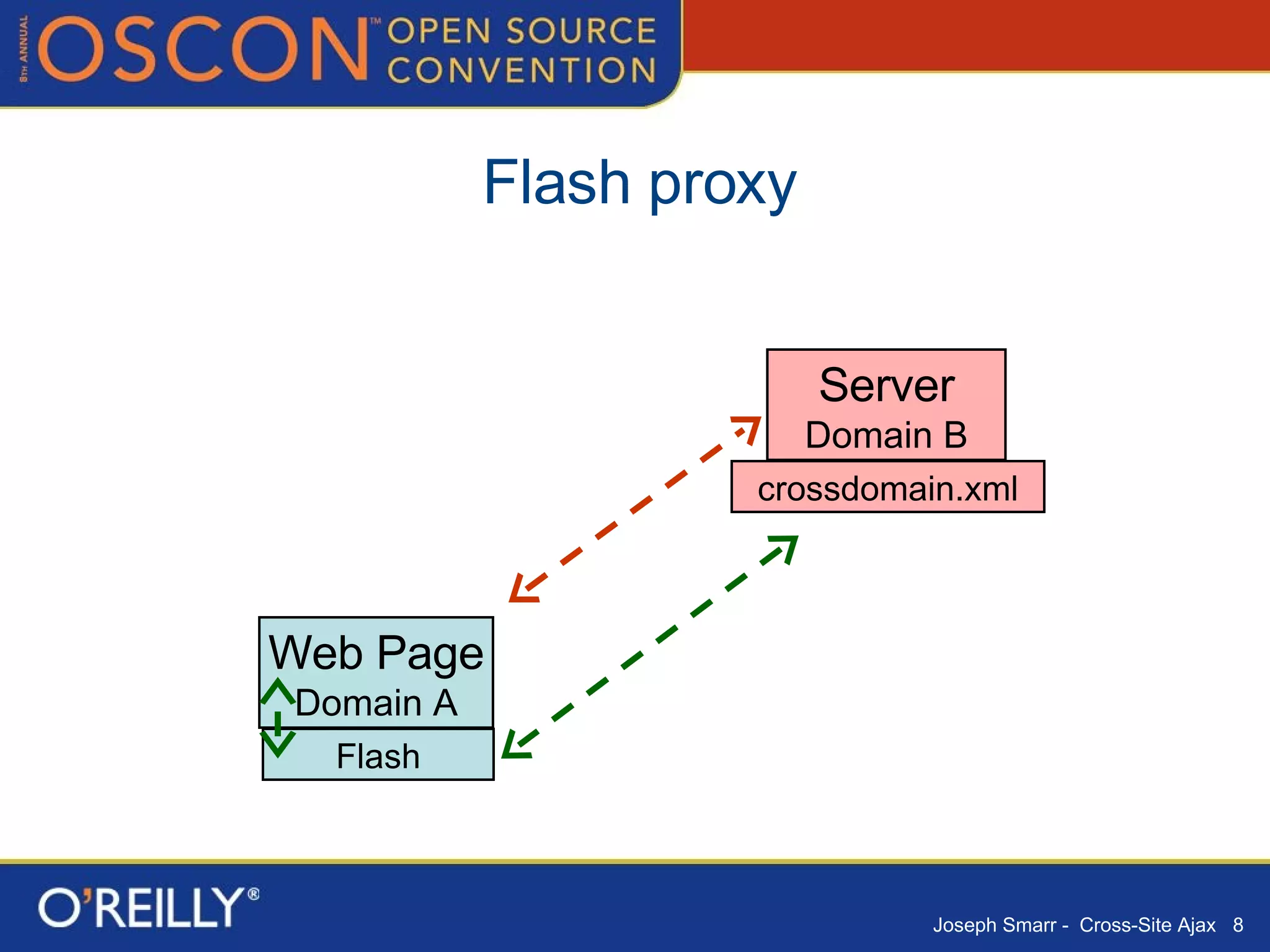
Flash proxy Web Page Domain A Server Domain B Flash crossdomain.xml
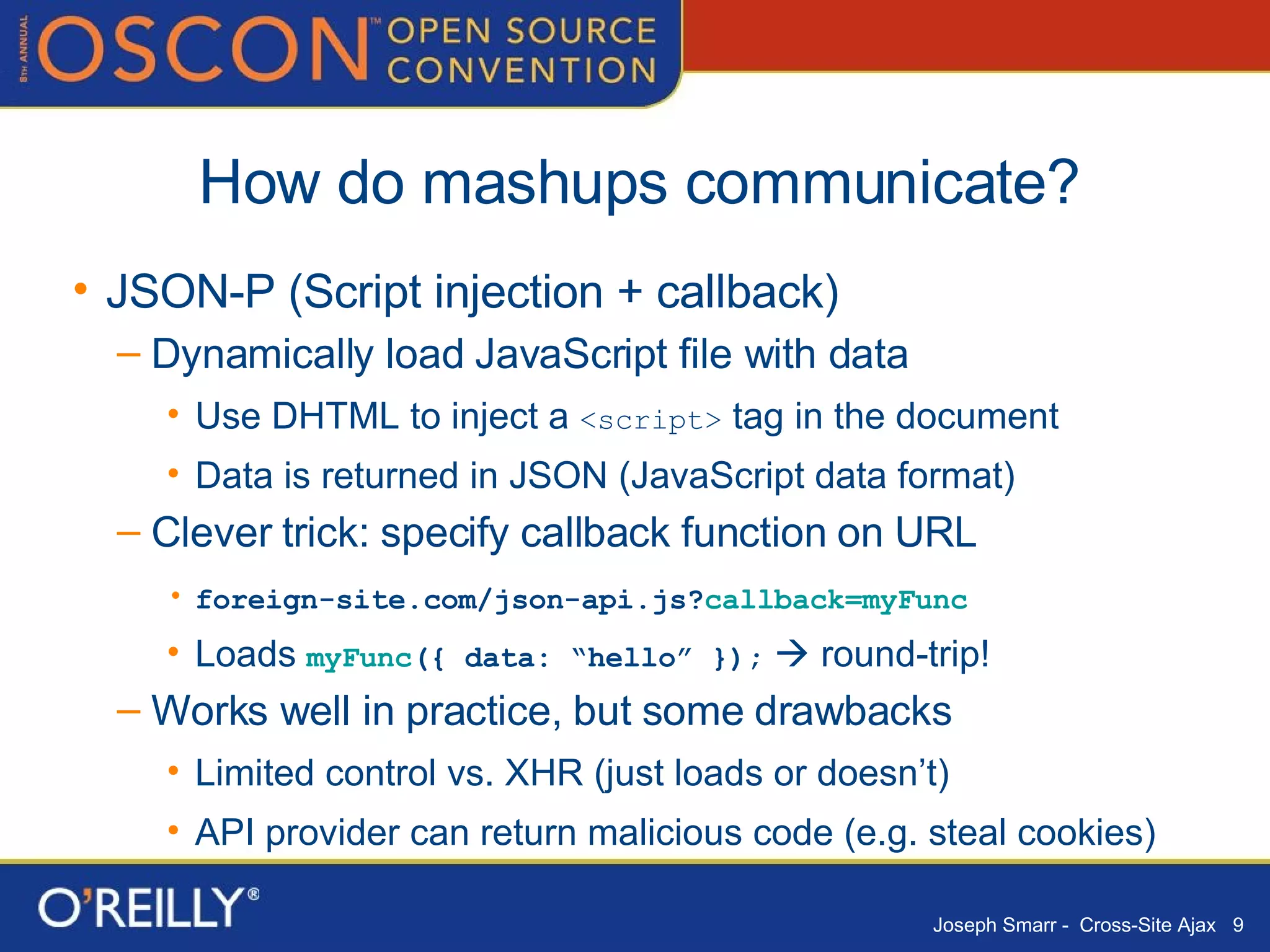
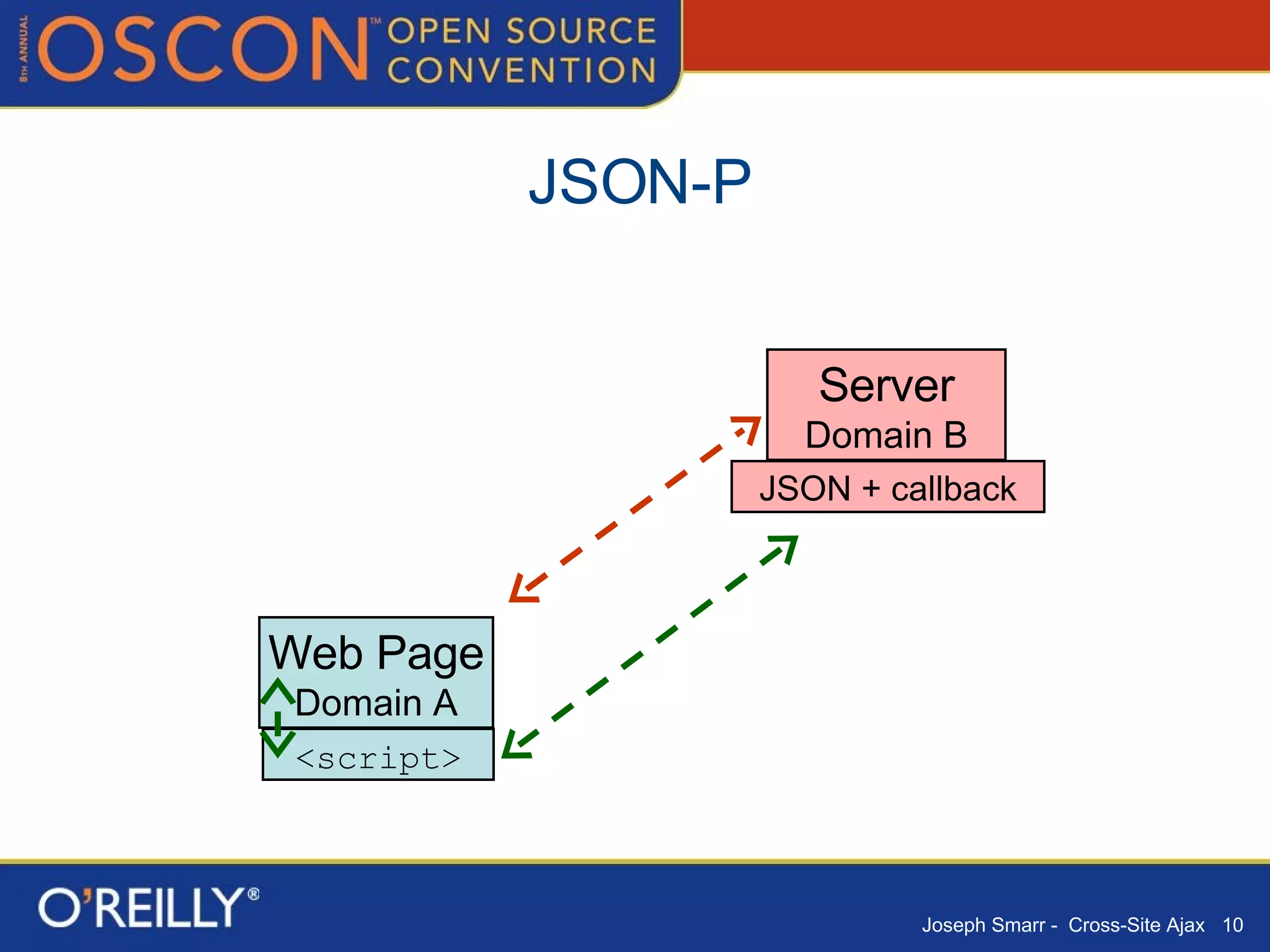
How do mashups communicate? JSON-P (Script injection + callback) Dynamically load JavaScript file with data Use DHTML to inject a  <script>  tag in the document Data is returned in JSON (JavaScript data format) Clever trick: specify callback function on URL foreign-site.com/json-api.js? callback=myFunc Loads  myFunc ({ data: “hello” });     round-trip! Works well in practice, but some drawbacks Limited control vs. XHR (just loads or doesn’t) API provider can return malicious code (e.g. steal cookies)
JSON-P Web Page Domain A Server Domain B <script> JSON + callback
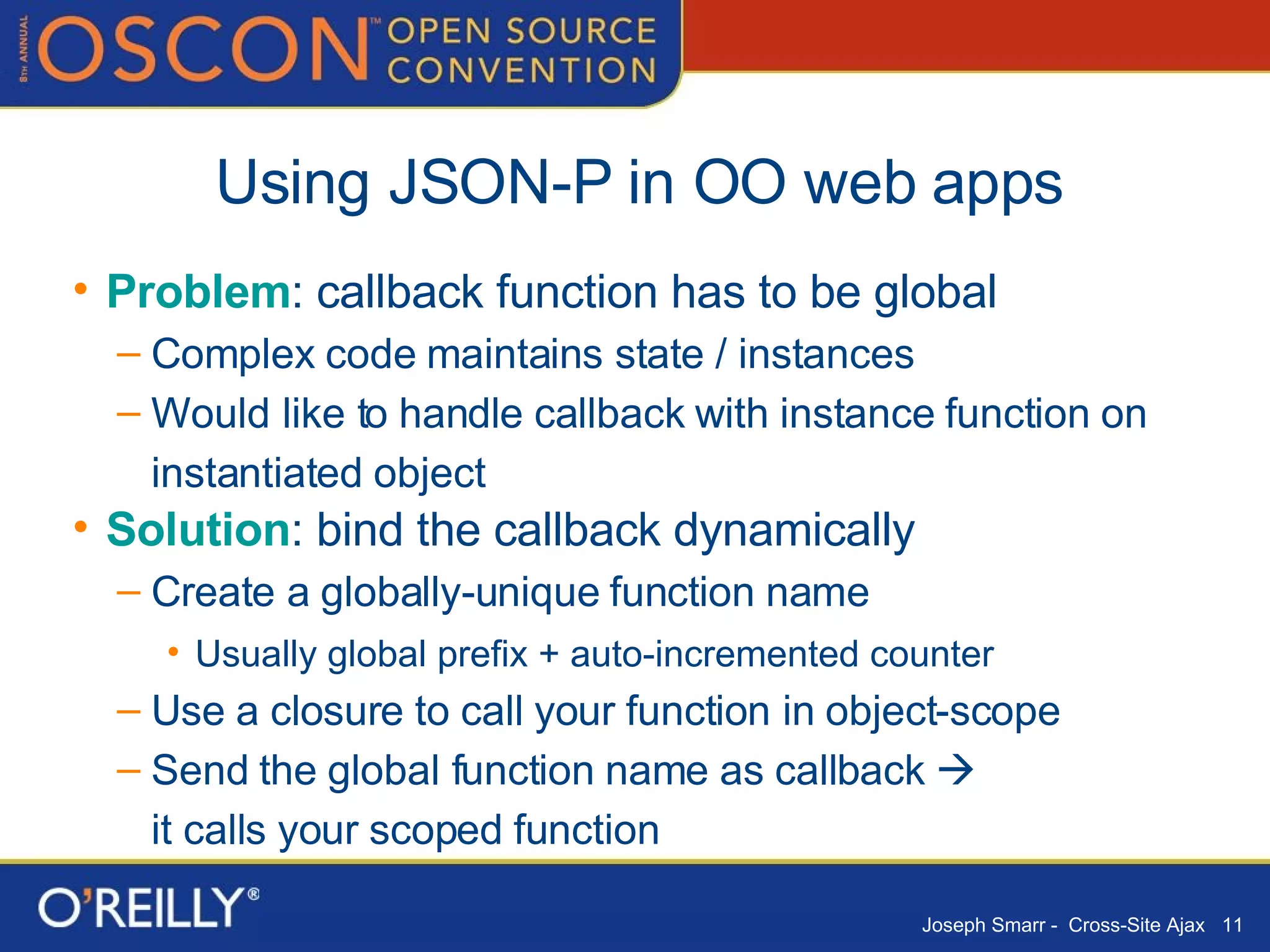
Using JSON-P in OO web apps Problem : callback function has to be global Complex code maintains state / instances Would like to handle callback with instance function on instantiated object Solution : bind the callback dynamically Create a globally-unique function name Usually global prefix + auto-incremented counter Use a closure to call your function in object-scope Send the global function name as callback     it calls your scoped function
Dynamically binding a global callback var cbName = 'cb' + JSON.callbackCounter++; var cbFunc = function(jsonData) { myFunc .call( myObj , jsonData); // call bound callback }; JSON.callbacks[cbName] = cbFunc; var globalCallbackName = ‘JSON.callbacks.’ + cbName // url: '/json-api.js?callback=' + globalCallbackName; Used by dojo (ScriptSrcIO), Google Maps 2.5, Plaxo, etc.
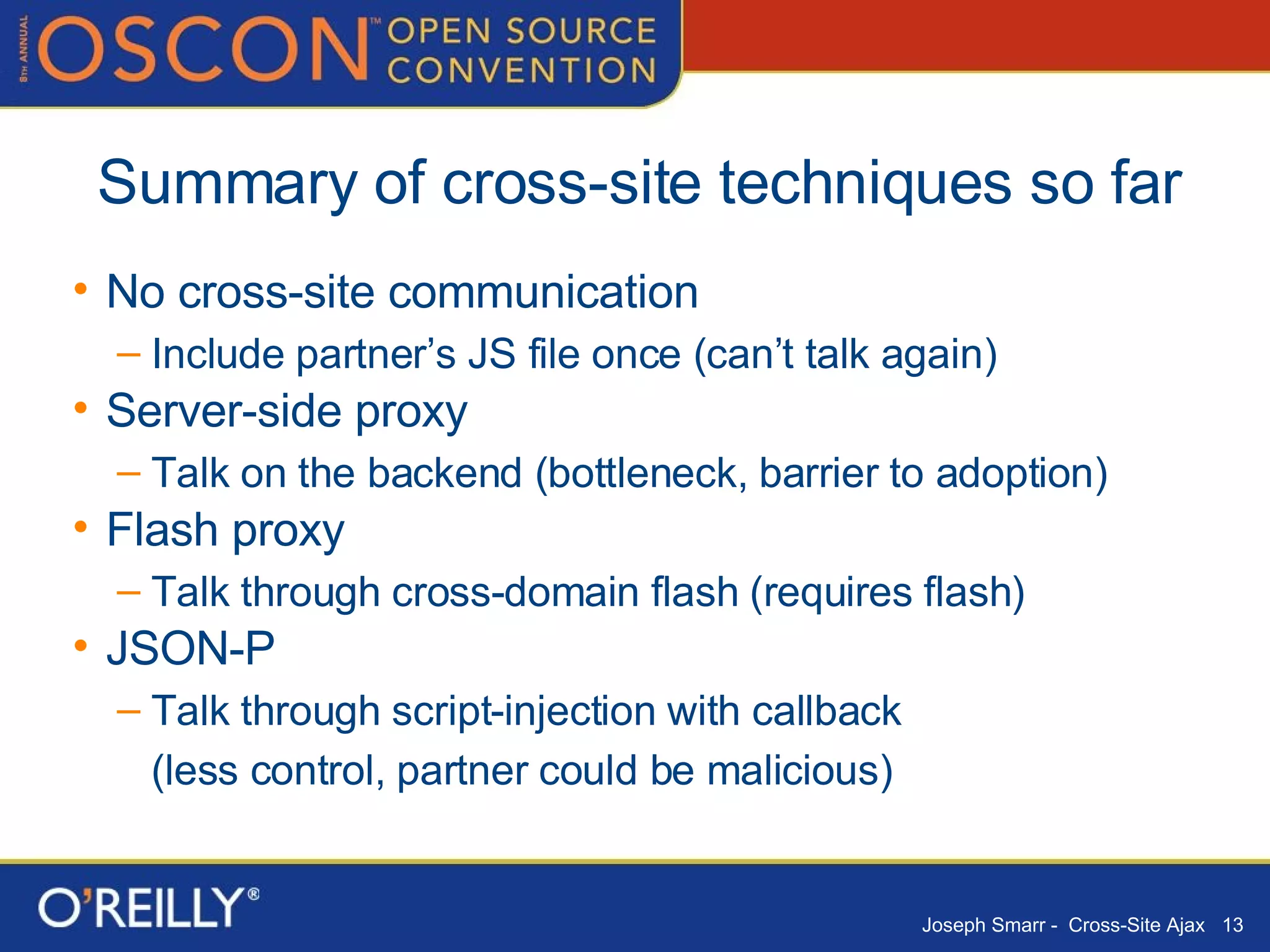
Summary of cross-site techniques so far No cross-site communication Include partner’s JS file once (can’t talk again) Server-side proxy Talk on the backend (bottleneck, barrier to adoption) Flash proxy Talk through cross-domain flash (requires flash) JSON-P Talk through script-injection with callback  (less control, partner could be malicious)
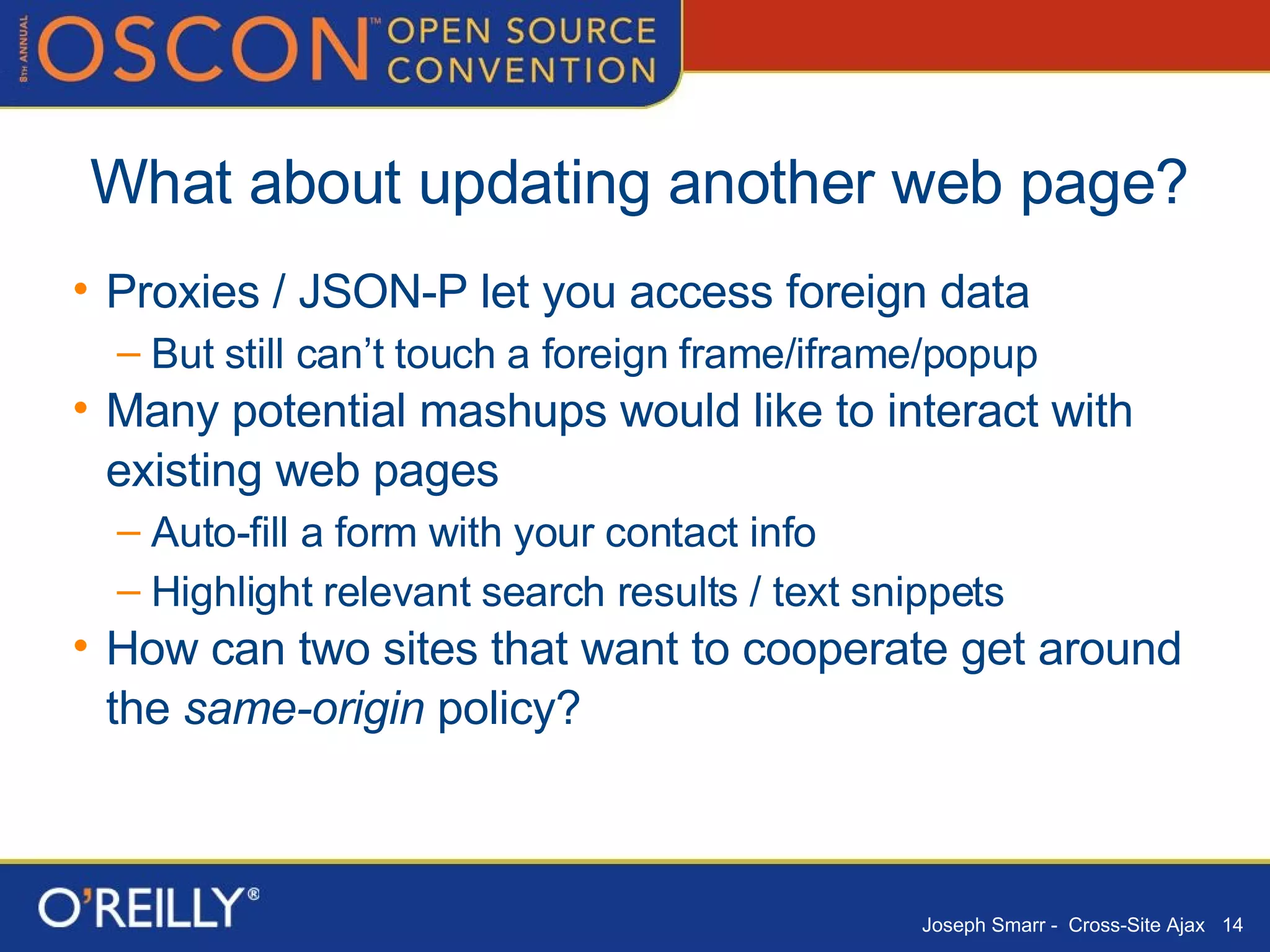
What about updating another web page? Proxies / JSON-P let you access foreign data But still can’t touch a foreign frame/iframe/popup Many potential mashups would like to interact with existing web pages Auto-fill a form with your contact info Highlight relevant search results / text snippets How can two sites that want to cooperate get around the  same-origin  policy?
 
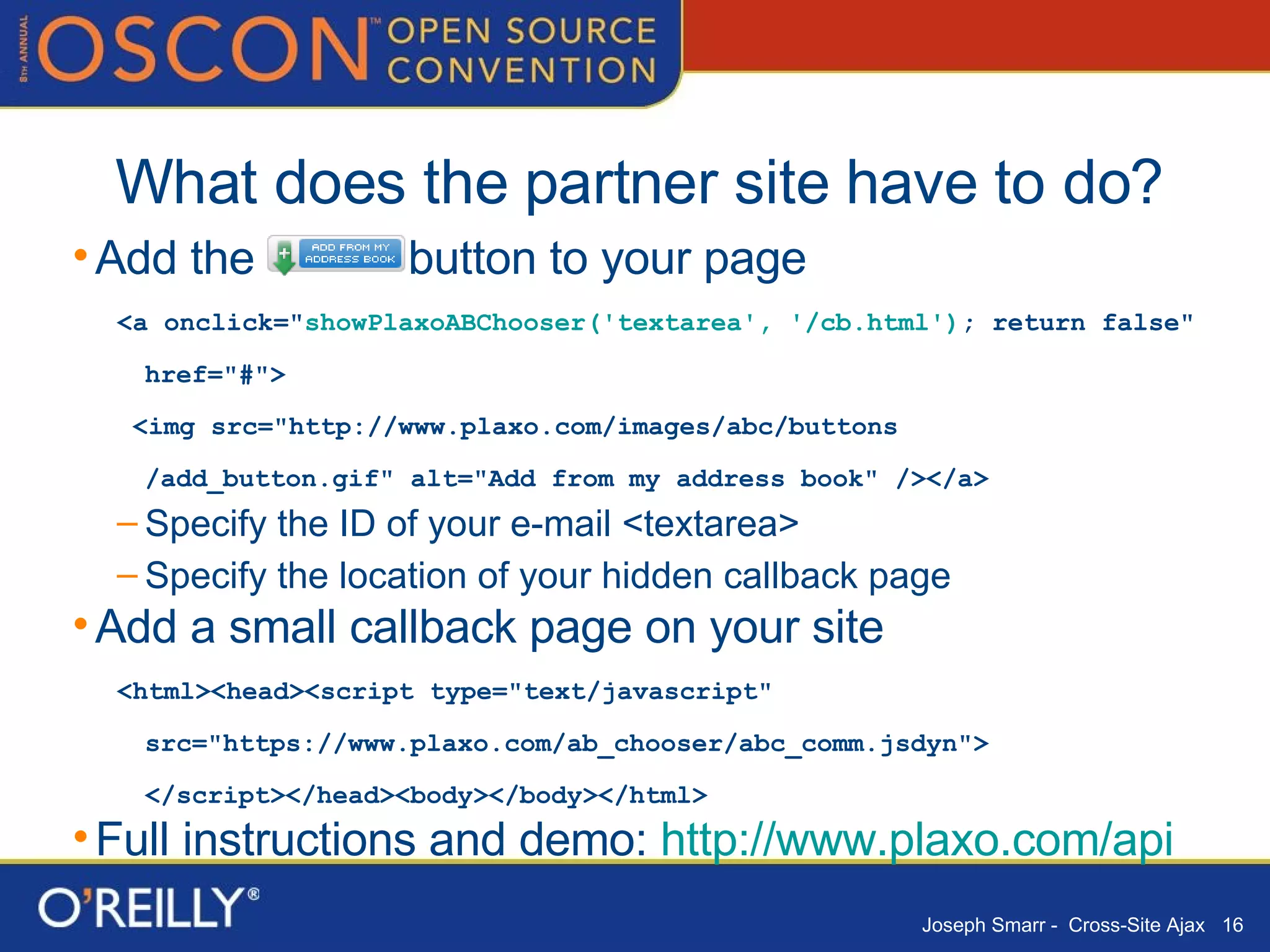
What does the partner site have to do? Add the  button to your page <a onclick=&quot; showPlaxoABChooser('textarea', '/cb.html') ; return false&quot; href=&quot;#&quot;> <img src=&quot;http://www.plaxo.com/images/abc/buttons /add_button.gif&quot; alt=&quot;Add from my address book&quot; /></a> Specify the ID of your e-mail <textarea> Specify the location of your hidden callback page Add a small callback page on your site <html><head><script type=&quot;text/javascript&quot; src=&quot;https://www.plaxo.com/ab_chooser/abc_comm.jsdyn&quot;> </script></head><body></body></html> Full instructions and demo:  http:// www.plaxo.com/api
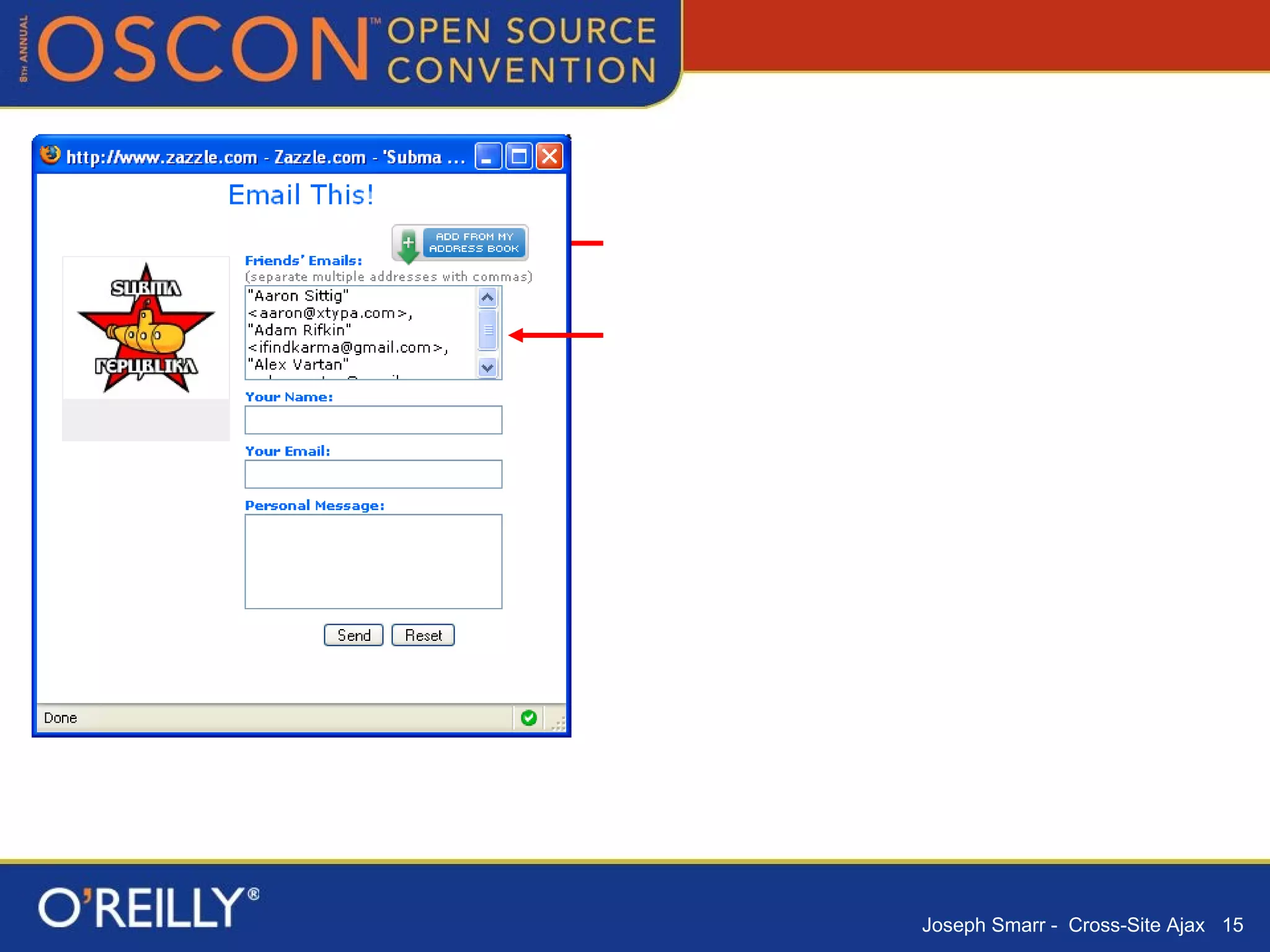
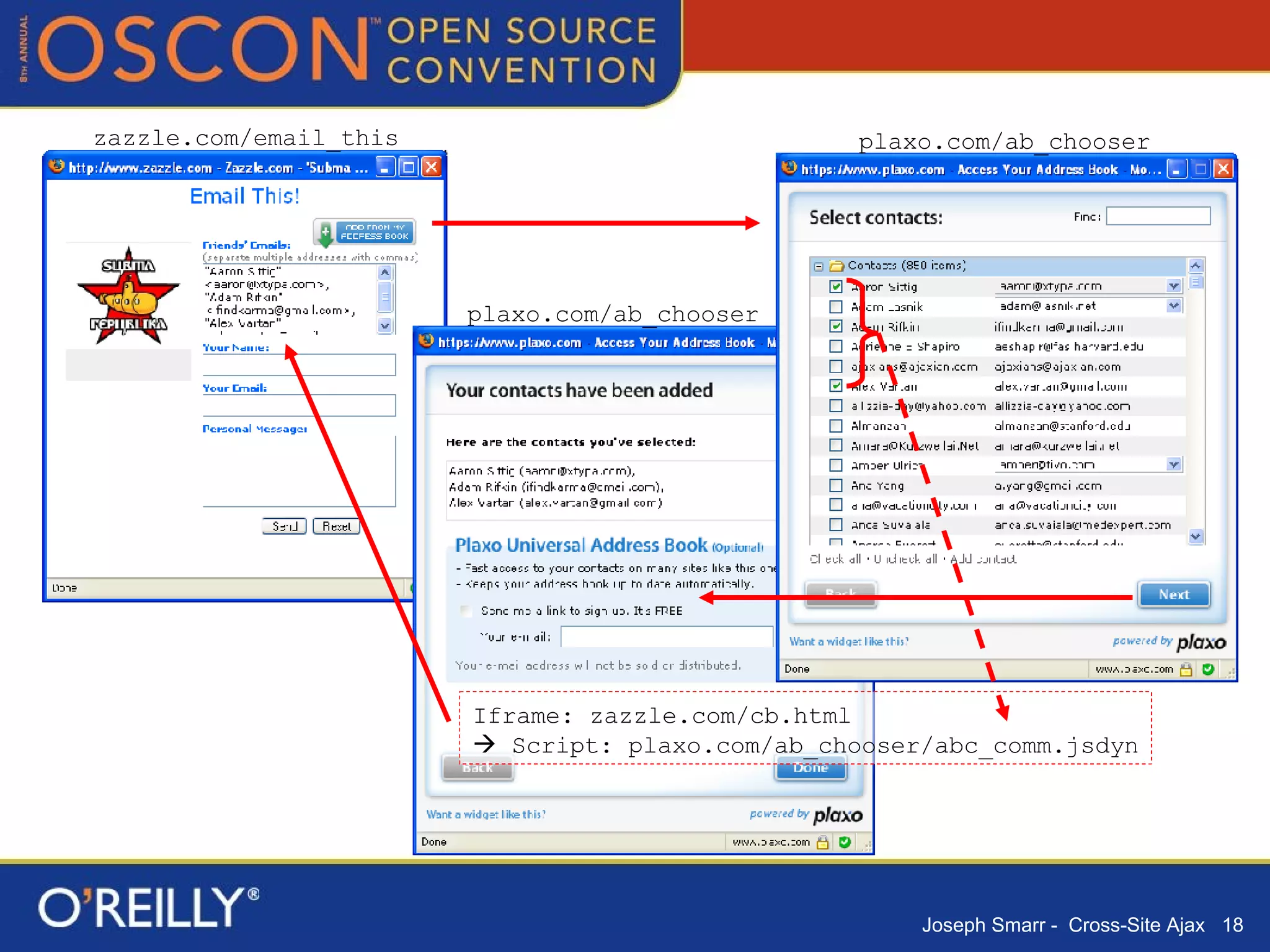
What does Plaxo have to do? Remember: Plaxo filled in a textarea on zazzle! Need to get around  same-origin  policy Without server-side proxy (JS/HTML only) JSON-P won’t solve this problem Widget popup is hosted by Plaxo and goes thru several steps Zazzle doesn’t know when to request the contact data Solution:  “The JavaScript Wormhole” Add hidden callback page on zazzle that includes Plaxo script Plaxo popup loads callback in an iframe when done Script is dynamically generated, and includes selected data IFrame is also on zazzle (and has the data), so it can tell parent.opener to fill in the textfield
zazzle.com/email_this plaxo.com/ab_chooser plaxo.com/ab_chooser Iframe: zazzle.com/cb.html    Script: plaxo.com/ab_chooser/abc_comm.jsdyn
Who’s using the Plaxo widget? See more at  http://www.plaxo.com/api/gallery Using the widget? Let us know!
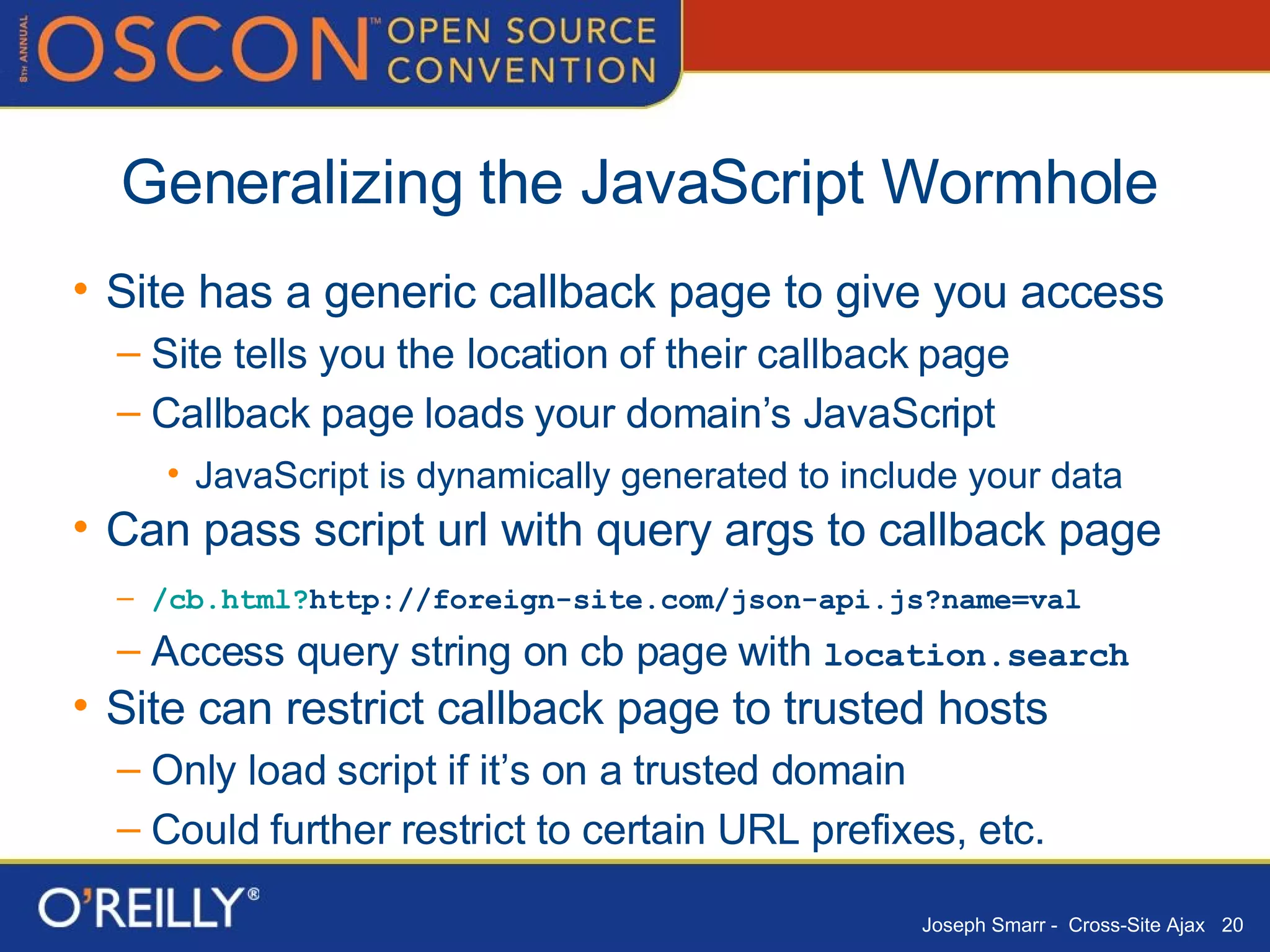
Generalizing the JavaScript Wormhole Site has a generic callback page to give you access Site tells you the location of their callback page Callback page loads your domain’s JavaScript JavaScript is dynamically generated to include your data Can pass script url with query args to callback page /cb.html? http://foreign-site.com/json-api.js?name=val Access query string on cb page with  location.search Site can restrict callback page to trusted hosts Only load script if it’s on a trusted domain Could further restrict to certain URL prefixes, etc.
<html><head><title>Generalized JavaScript Wormhole</title> <script type=&quot;text/javascript&quot;> var trustedDomains = [ &quot;http://www.plaxo.com/api/&quot;, &quot;http://www.google.com/&quot; ]; function isTrustedDomain(url) { for (var i = 0; i < trustedDomains.length; i++) if (url.indexOf(trustedDomains[i]) == 0)  return true; return false; } function doWormhole() { var url = location.search.substr(1); // chop off ? if (isTrustedDomain(url)) { var script = document.createElement('script'); script.type = &quot;text/javascript&quot;; script.src = url; document.getElementsByTagName(&quot;head&quot;)[0].appendChild(script); } else alert(&quot;ignoring untrusted url: &quot; + url); } </script></head><body onload=&quot;doWormhole()&quot;></body></html>
Where do we go from here? Ajax is a “hack” on top of an old platform The platform can evolve
Where do we go from here? Ajax is a “hack” on top of an old platform The platform is evolving
Where do we go from here? Ajax is a “hack” on top of an old platform The platform is evolving What platform do we want to build?
Should we open cross-domain XHR? After all, we can already include foreign JavaScript, image, and CSS files So why not XML too? (“just another resource file”) HTML looks like XML (esp. XHTML) Hard to make sure you  really  meant to serve that page as XML data (cf. js / img / css) Personal / private info more often in XML / HTML But increasingly a problem with JS too (JSON) Cookies / creds sent with XHR request Can’t easily distinguish direct vs. XHR access
Trust relationships between sites Random site accessing this file vs. trusted partner Flash does this with crossdomain.xml Web services do this with certs / IP whitelists JavaScript wormhole does it (sort of) Should a trust relationship exist for mashups? Want to minimize barriers to adoption / innovation When sharing user info, should have prior agreement? How formal / technical should this trust be?
Restricting access to unauthorized info Restrict XHR to same “internet zone” So public site can’t access intranet page Don’t send  any  cookies / credentials via XHR Practically restricts cross-site comm. to fully public info Could still send auth info on URL But now other site has it Give other site limited-access token? White-list authorized sites with cross-domain file Return special response headers for public pages Legacy problem for existing content
Proposals for better cross-site tools  ContextAgnosticXmlHttpRequest  (Chris Holland) Alternative to normal XmlHttpRequest for cross-site Don’t send/receive any cookie or HTTP auth info Server must specify X-Allow-Foreign-Hosts in response JSONRequest  (Douglas Crockford) New browser object for cross-site JSON (like XHR) Allows GET / POST / cancel of JSON request / response No cookies / auth info sent or received Requires special headers in request / response
In conclusion… Cross-site communication is tricky but important Key enabling technology for building rich mashups Raises legitimate security issues that can’t be ignored Today: Use server-side proxy or JSON-P Proxy introduces bottleneck, but provides full access JSON-P is more scalable, but limited to JSON APIs JavaScript Wormhole lets you touch foreign pages Keep the discussion of better tools / protocols going! This problem is here to stay Browser developers are listening!
For further reading… Cross-site limitations http://getahead.ltd.uk/ajax/cross-domain-xhr http:// msdn.microsoft.com/library/default.asp?url =/workshop/author/ om/xframe_scripting_security.asp FlashXMLHttpRequest http:// blog.monstuff.com/FlashXMLHttpRequest ContextAgnosticXMLHttpRequest http://chrisholland.blogspot.com/2005/03/contextagnosticxmlhttprequest-informal.html JSONRequest http:// json.org/JSONRequest.html

Joseph-Smarr-Plaxo-OSCON-2006

  • 1.
    Cross-Site Ajax Challengesand Techniques for Building Rich Web 2.0 Mashups Joseph Smarr Plaxo, Inc. [email_address]
  • 2.
    The promise ofmashups Create new experiences by combining components from different authors Each site focuses on what it does best Can wire up components in a novel way Google maps + Craigslist = HousingMaps Rich interaction often requires talking back and forth between components House’s address  lat / long  map it
  • 3.
    Talking between webcomponents Normal situation : all on the same web site Communicate across frames / iframes / popups Talk to server using AJAX (XMLHttpRequest) Problem : doesn’t work when components live at different domains (mashup situation) Same-origin policy Can include JavaScript / images from another domain Can’t talk to frame / iframe popup or send an XHR Prevents snooping on secret web pages (e.g. intranet)
  • 4.
    So, how domashups communicate? CAN include image / JavaScript / CSS from Domain B CAN send XMLHttpRequest to Domain A CAN talk to other frames / iframes / popups on Domain A CAN'T send XMLHttpRequest to Domain B CAN'T talk to other frames / iframes / popups on Domain B CAN talk to other pages on Domain A CAN’T talk to any page on Domain A Domain B XML / Web Page XHR Image CSS JavaScript
  • 5.
    How do mashupscommunicate? Often, they don’t (Google maps 1.0) Single JavaScript  all processing done locally Plotting lat/long or fetching image tiles is deterministic Can’t get any additional data (e.g. geo-coding) Server-side proxy (HousingMaps, Flickr) Talk to your server  it talks to the foreign site Problem: bottleneck; barrier to mass deployment
  • 6.
    Server-side proxy WebPage Domain A Server Domain A Server Domain B
  • 7.
    How do mashupscommunicate? Often, they don’t (Google maps 1.0) Single JavaScript  all processing done locally Plotting lat/long or fetching image tiles is deterministic Can’t get any additional data (e.g. geo-coding) Server-side proxy (HousingMaps, Flickr) Talk to your server  it talks to the foreign site Problem: bottleneck; barrier to mass deployment Use flash for cross-domain communication Can use crossdomain.xml to allow foreign sites Yahoo maps uses this to do geo-coding
  • 8.
    Flash proxy WebPage Domain A Server Domain B Flash crossdomain.xml
  • 9.
    How do mashupscommunicate? JSON-P (Script injection + callback) Dynamically load JavaScript file with data Use DHTML to inject a <script> tag in the document Data is returned in JSON (JavaScript data format) Clever trick: specify callback function on URL foreign-site.com/json-api.js? callback=myFunc Loads myFunc ({ data: “hello” });  round-trip! Works well in practice, but some drawbacks Limited control vs. XHR (just loads or doesn’t) API provider can return malicious code (e.g. steal cookies)
  • 10.
    JSON-P Web PageDomain A Server Domain B <script> JSON + callback
  • 11.
    Using JSON-P inOO web apps Problem : callback function has to be global Complex code maintains state / instances Would like to handle callback with instance function on instantiated object Solution : bind the callback dynamically Create a globally-unique function name Usually global prefix + auto-incremented counter Use a closure to call your function in object-scope Send the global function name as callback  it calls your scoped function
  • 12.
    Dynamically binding aglobal callback var cbName = 'cb' + JSON.callbackCounter++; var cbFunc = function(jsonData) { myFunc .call( myObj , jsonData); // call bound callback }; JSON.callbacks[cbName] = cbFunc; var globalCallbackName = ‘JSON.callbacks.’ + cbName // url: '/json-api.js?callback=' + globalCallbackName; Used by dojo (ScriptSrcIO), Google Maps 2.5, Plaxo, etc.
  • 13.
    Summary of cross-sitetechniques so far No cross-site communication Include partner’s JS file once (can’t talk again) Server-side proxy Talk on the backend (bottleneck, barrier to adoption) Flash proxy Talk through cross-domain flash (requires flash) JSON-P Talk through script-injection with callback (less control, partner could be malicious)
  • 14.
    What about updatinganother web page? Proxies / JSON-P let you access foreign data But still can’t touch a foreign frame/iframe/popup Many potential mashups would like to interact with existing web pages Auto-fill a form with your contact info Highlight relevant search results / text snippets How can two sites that want to cooperate get around the same-origin policy?
  • 15.
  • 16.
    What does thepartner site have to do? Add the button to your page <a onclick=&quot; showPlaxoABChooser('textarea', '/cb.html') ; return false&quot; href=&quot;#&quot;> <img src=&quot;http://www.plaxo.com/images/abc/buttons /add_button.gif&quot; alt=&quot;Add from my address book&quot; /></a> Specify the ID of your e-mail <textarea> Specify the location of your hidden callback page Add a small callback page on your site <html><head><script type=&quot;text/javascript&quot; src=&quot;https://www.plaxo.com/ab_chooser/abc_comm.jsdyn&quot;> </script></head><body></body></html> Full instructions and demo: http:// www.plaxo.com/api
  • 17.
    What does Plaxohave to do? Remember: Plaxo filled in a textarea on zazzle! Need to get around same-origin policy Without server-side proxy (JS/HTML only) JSON-P won’t solve this problem Widget popup is hosted by Plaxo and goes thru several steps Zazzle doesn’t know when to request the contact data Solution: “The JavaScript Wormhole” Add hidden callback page on zazzle that includes Plaxo script Plaxo popup loads callback in an iframe when done Script is dynamically generated, and includes selected data IFrame is also on zazzle (and has the data), so it can tell parent.opener to fill in the textfield
  • 18.
    zazzle.com/email_this plaxo.com/ab_chooser plaxo.com/ab_chooserIframe: zazzle.com/cb.html  Script: plaxo.com/ab_chooser/abc_comm.jsdyn
  • 19.
    Who’s using thePlaxo widget? See more at http://www.plaxo.com/api/gallery Using the widget? Let us know!
  • 20.
    Generalizing the JavaScriptWormhole Site has a generic callback page to give you access Site tells you the location of their callback page Callback page loads your domain’s JavaScript JavaScript is dynamically generated to include your data Can pass script url with query args to callback page /cb.html? http://foreign-site.com/json-api.js?name=val Access query string on cb page with location.search Site can restrict callback page to trusted hosts Only load script if it’s on a trusted domain Could further restrict to certain URL prefixes, etc.
  • 21.
    <html><head><title>Generalized JavaScript Wormhole</title><script type=&quot;text/javascript&quot;> var trustedDomains = [ &quot;http://www.plaxo.com/api/&quot;, &quot;http://www.google.com/&quot; ]; function isTrustedDomain(url) { for (var i = 0; i < trustedDomains.length; i++) if (url.indexOf(trustedDomains[i]) == 0) return true; return false; } function doWormhole() { var url = location.search.substr(1); // chop off ? if (isTrustedDomain(url)) { var script = document.createElement('script'); script.type = &quot;text/javascript&quot;; script.src = url; document.getElementsByTagName(&quot;head&quot;)[0].appendChild(script); } else alert(&quot;ignoring untrusted url: &quot; + url); } </script></head><body onload=&quot;doWormhole()&quot;></body></html>
  • 22.
    Where do wego from here? Ajax is a “hack” on top of an old platform The platform can evolve
  • 23.
    Where do wego from here? Ajax is a “hack” on top of an old platform The platform is evolving
  • 24.
    Where do wego from here? Ajax is a “hack” on top of an old platform The platform is evolving What platform do we want to build?
  • 25.
    Should we opencross-domain XHR? After all, we can already include foreign JavaScript, image, and CSS files So why not XML too? (“just another resource file”) HTML looks like XML (esp. XHTML) Hard to make sure you really meant to serve that page as XML data (cf. js / img / css) Personal / private info more often in XML / HTML But increasingly a problem with JS too (JSON) Cookies / creds sent with XHR request Can’t easily distinguish direct vs. XHR access
  • 26.
    Trust relationships betweensites Random site accessing this file vs. trusted partner Flash does this with crossdomain.xml Web services do this with certs / IP whitelists JavaScript wormhole does it (sort of) Should a trust relationship exist for mashups? Want to minimize barriers to adoption / innovation When sharing user info, should have prior agreement? How formal / technical should this trust be?
  • 27.
    Restricting access tounauthorized info Restrict XHR to same “internet zone” So public site can’t access intranet page Don’t send any cookies / credentials via XHR Practically restricts cross-site comm. to fully public info Could still send auth info on URL But now other site has it Give other site limited-access token? White-list authorized sites with cross-domain file Return special response headers for public pages Legacy problem for existing content
  • 28.
    Proposals for bettercross-site tools ContextAgnosticXmlHttpRequest (Chris Holland) Alternative to normal XmlHttpRequest for cross-site Don’t send/receive any cookie or HTTP auth info Server must specify X-Allow-Foreign-Hosts in response JSONRequest (Douglas Crockford) New browser object for cross-site JSON (like XHR) Allows GET / POST / cancel of JSON request / response No cookies / auth info sent or received Requires special headers in request / response
  • 29.
    In conclusion… Cross-sitecommunication is tricky but important Key enabling technology for building rich mashups Raises legitimate security issues that can’t be ignored Today: Use server-side proxy or JSON-P Proxy introduces bottleneck, but provides full access JSON-P is more scalable, but limited to JSON APIs JavaScript Wormhole lets you touch foreign pages Keep the discussion of better tools / protocols going! This problem is here to stay Browser developers are listening!
  • 30.
    For further reading…Cross-site limitations http://getahead.ltd.uk/ajax/cross-domain-xhr http:// msdn.microsoft.com/library/default.asp?url =/workshop/author/ om/xframe_scripting_security.asp FlashXMLHttpRequest http:// blog.monstuff.com/FlashXMLHttpRequest ContextAgnosticXMLHttpRequest http://chrisholland.blogspot.com/2005/03/contextagnosticxmlhttprequest-informal.html JSONRequest http:// json.org/JSONRequest.html