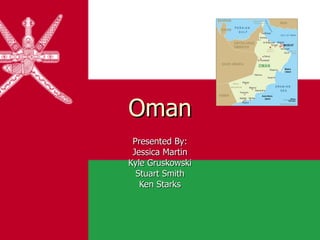
Oman Presented By: Jessica Martin Kyle Gruskowski Stuart Smith Ken Starks
Oman is the oldest independent state in the Arab world. It is one of the more traditional countries in the Gulf region but until 1970 it was one of the most isolated.
Timeline of Oman 1507  - Portuguese sack Muscat and capture the Omani coast; they are driven out in 1650.
1800s-1900s  - Omani empire expands to include Zanzibar and Mombasa on Africa's east coast and parts of the Indian subcontinent, reflecting Oman's strong maritime heritage.
1737  - Persians invade.
1749  - Persians are driven out. The Al Bu Said dynasty comes to power, and continues to rule to this day.
1913  - Control of the country splits. The interior is ruled by Ibadite imams and the coastal areas by the sultan. Under a British-brokered agreement in 1920 the sultan recognises the autonomy of the interior.
1959  - Sultan Said bin Taimur regains control of the interior. His rule is characterised by a fuedal and isolationist approach.
1964  - Oil reserves are discovered; extraction begins in 1967.
1965-75  - Rebellion in the southern region of Dhofar in which leftist forces are pitted against government troops. The uprising is finally put down with the help of soldiers from Jordan and Iran.

Post-Coup Timeline 1970  - The sultan is overthrown by his son in a bloodless coup. Sultan Qaboos bin Said begins a liberalization and modernization program.
1981  - Oman is a founding member of the six-nation Gulf Cooperation Council.
1997  - Sultan Qaboos decrees that women can stand for election to - and vote for - the Consultative Council. Two women are duly elected to the body.
1999  - Oman and neighboring United Arab Emirates (UAE) sign a border agreement defining most of their disputed common frontier.
Dhofar Rebellion 1964-1975
Sultan Said bin Taimur was ultraconservative and opposed to change of any kind
Its original aim was the overthrow of Said ibn Taimur, but, by 1967, under the name of the Popular Front for the Liberation of the Occupied Arabian Gulf--which in 1974 was changed to the Popular Front for the Liberation of Oman (PFLO)
British Propaganda - " The Hand of God Destroys Communism " PFLOAG Logo Popular Front for the Liberation of the Occupied Arabian Gulf Dhofar Sultan Said bin Taimur
Sultan Qaboos Bin Said Came to power in 1970 after overthrowing his father
 
Sultan Qaboos Bin Said Came to power in 1970 after overthrowing his father
Opened up the entire country of Oman
Created economic reforms and boosted spending on health, education and welfare
By reorganizing and modernizing the military he was able to defeat the Dhofar crisis and begin concentrating on other issues.
Neighborly Relations Northern tip 35 miles directly opposite with Iran.
Concerned with regional stability and security, given tensions in the region, the proximity of Iran and Iraq, and the potential threat of political Islam Not   Good!
Neighborly Relations Oman maintained its diplomatic relations with Iraq throughout the 1990-91 Gulf war
Since 1980 Oman and the U.S. have been parties to a military cooperation agreement
Oman also has long been an active participant in efforts to achieve Middle East peace. 
Jessica’s Sources http://news.bbc.co.uk/2/hi/middle_east/country_profiles/2448259.stm
http://encyclopedia.jrank.org/articles/pages/5492/Al-Bu-Sa-id-Qaboos-1940.html
http://www.onwar.com/aced/nation/oat/oman/foman1964.htm
http://www.state.gov/r/pa/ei/bgn/35834.htm
Omani Culture
Demographics Population 3,418,085 Birth Rate  (2009) 34.79/1000 population Death Rate  (2009) 3.65/1000 population Gender ratio  (2009) 1.22 male/female Life Expectancy 74.16 years
Demographics Cont. Nationality Omani Spoken Languages Arabic (official)
English
Baluchi
Urdu Ethnic Groups Arab
Baluchi
South Asian
African Literacy rate 81.4%, (male – 86.8%, female – 73.5%)
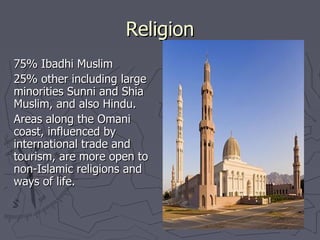
Religion 75% Ibadhi Muslim
25% other including large minorities Sunni and Shia Muslim, and also Hindu.
Areas along the Omani coast, influenced by international trade and tourism, are more open to non-Islamic religions and ways of life.
Women’s Inequality The government instigated an important change by introducing a law in 2008 stipulating that men and women's legal testimonies are now considered equal, although it is unclear to what extent this will apply to personal status law cases.
Oman's patriarchal culture, in combination with conservative religious norms, continues to have a profound impact on women.
Despite progress, women face discrimination in almost all areas of life, and men are traditionally and legally seen as heads of household.
Women remain underrepresented in the judiciary and government structures, and do not have full freedom to make decisions about their health and reproductive rights.
They are afforded unequal rights under the personal status law, which governs inheritance, marriage, divorce, and child custody

Oman

Editor's Notes

  • #7 Basically, Dhofar was the most overlooked and backwards place in Oman. This rebellion aimed to liberalize Oman and make it a “People’s Republic” against a really conservative ruler. The Sultan was overthrown by his son which was the beginning of the end to this rebellion.
  • #9 On 23 July 1970 Qaboos succeeded his father following a nearly bloodless palace coup. The action was coordinated by Sultan Sa’id’s British military advisors. The actual coup was lead by Burayk bin Hamud al-Ghafiri, the son of Sultan Sa’id’s governor of Dhofar, who led a group of the sultan’s bodyguards to the palace. After a brief struggle, Sultan Sa’id surrendered, signed an abdication document, received medical attention for a superficial gunshot wound, and then was flown to England to be exiled.
  • #24 National Holiday is the Sultan’s Birthday Although there isn’t a constitution, there is a royal decree with some explanations of laws, including succession, form of government. Borrows from Islamic and Common Law. Military and security officials can’t vote.
  • #28 Disposed of his father 53 Member in Council of Ministers
  • #30 Al-Zwaidi has been writing since 1986
  • #31 Arabic Network for Human Rights Information Black List is secret. Only three people have been discovered