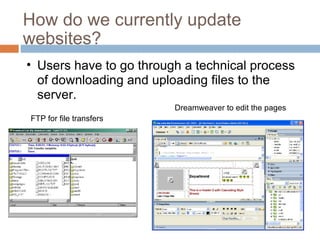
How do we currently update websites? Users have to go through a technical process of downloading and uploading files to the server. FTP for file transfers Dreamweaver to edit the pages
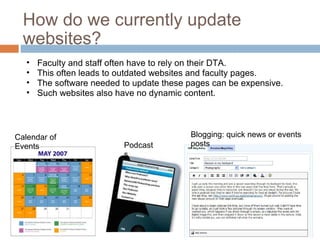
How do we currently update websites? Faculty and staff often have to rely on their DTA. This often leads to outdated websites and faculty pages. The software needed to update these pages can be expensive. Such websites also have no dynamic content. Calendar of Events Podcasts Blogging: quick news or events posts
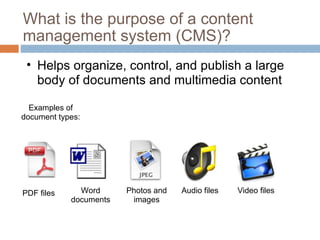
What is the purpose of a content management system (CMS)? Helps organize, control, and publish a large body of documents and multimedia content  PDF files Word documents Examples of document types: Photos and images Audio files Video files
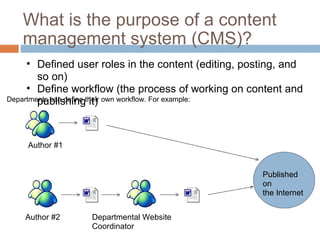
What is the purpose of a content management system (CMS)? Defined user roles in the content (editing, posting, and so on) Define workflow (the process of working on content and publishing it) Author #2 Author #1 Departmental Website Coordinator Published on  the Internet Departments can define their own workflow. For example:
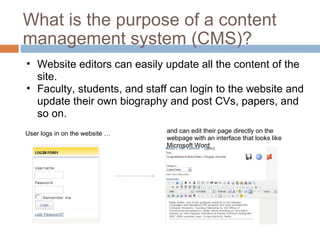
What is the purpose of a content management system (CMS)? Website editors can easily update all the content of the site. Faculty, students, and staff can login to the website and update their own biography and post CVs, papers, and so on. User logs in on the website … and can edit their page directly on the webpage with an interface that looks like Microsoft Word
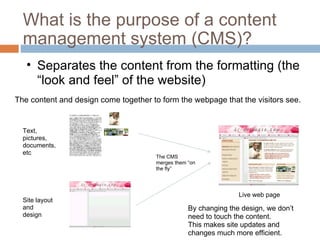
What is the purpose of a content management system (CMS)? Separates the content from the formatting (the “look and feel” of the website) The content and design come together to form the webpage that the visitors see. By changing the design, we don’t need to touch the content. This makes site updates and changes much more efficient. Text, pictures,  documents, etc Site layout and design Live web page The CMS merges them “on the fly”
Why Joomla? Joomla is  open source , meaning we can look at the code and modify as needed (as opposed to closed, proprietary systems) Joomla is  completely free  to download and use Joomla is written in PHP, a widely-used programming language, and relies on MySQL, a widely-used free database software. CDH has expertise in both. Joomla has a large development community The cost of exit is low
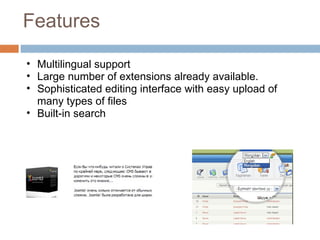
Features Multilingual support Large number of extensions already available. Sophisticated editing interface with easy upload of many types of files Built-in search
Brief Demo of Joomla portal websites and features
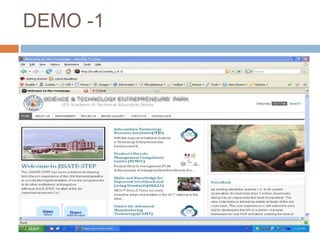
DEMO -1
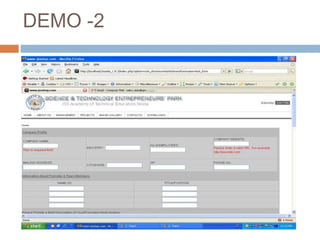
DEMO -2
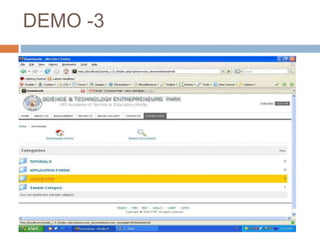
DEMO -3
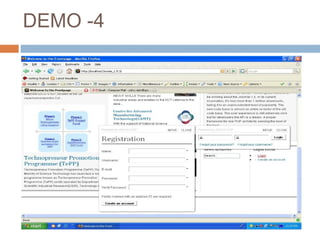
DEMO -4
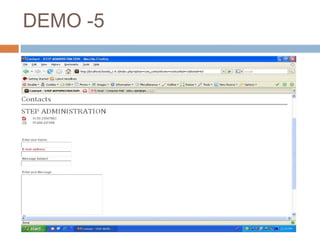
DEMO -5
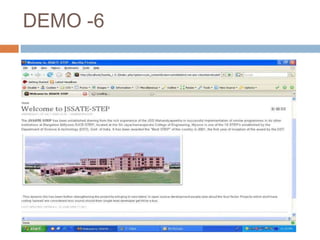
DEMO -6
Resources www.joomla.org www.mysql.com www.php.net www.extension.joomla.org www.siteground.com www.w3schools.com Apress Beginning Joomla From Novice to Professional Publishing Building Websites with Joomla1.5 Prentice Hall Practical PHP and MySQL

Joomla Services

  • 1.
  • 2.
    How do wecurrently update websites? Users have to go through a technical process of downloading and uploading files to the server. FTP for file transfers Dreamweaver to edit the pages
  • 3.
    How do wecurrently update websites? Faculty and staff often have to rely on their DTA. This often leads to outdated websites and faculty pages. The software needed to update these pages can be expensive. Such websites also have no dynamic content. Calendar of Events Podcasts Blogging: quick news or events posts
  • 4.
    What is thepurpose of a content management system (CMS)? Helps organize, control, and publish a large body of documents and multimedia content PDF files Word documents Examples of document types: Photos and images Audio files Video files
  • 5.
    What is thepurpose of a content management system (CMS)? Defined user roles in the content (editing, posting, and so on) Define workflow (the process of working on content and publishing it) Author #2 Author #1 Departmental Website Coordinator Published on the Internet Departments can define their own workflow. For example:
  • 6.
    What is thepurpose of a content management system (CMS)? Website editors can easily update all the content of the site. Faculty, students, and staff can login to the website and update their own biography and post CVs, papers, and so on. User logs in on the website … and can edit their page directly on the webpage with an interface that looks like Microsoft Word
  • 7.
    What is thepurpose of a content management system (CMS)? Separates the content from the formatting (the “look and feel” of the website) The content and design come together to form the webpage that the visitors see. By changing the design, we don’t need to touch the content. This makes site updates and changes much more efficient. Text, pictures, documents, etc Site layout and design Live web page The CMS merges them “on the fly”
  • 8.
    Why Joomla? Joomlais open source , meaning we can look at the code and modify as needed (as opposed to closed, proprietary systems) Joomla is completely free to download and use Joomla is written in PHP, a widely-used programming language, and relies on MySQL, a widely-used free database software. CDH has expertise in both. Joomla has a large development community The cost of exit is low
  • 9.
    Features Multilingual supportLarge number of extensions already available. Sophisticated editing interface with easy upload of many types of files Built-in search
  • 10.
    Brief Demo ofJoomla portal websites and features
  • 11.
  • 12.
  • 13.
  • 14.
  • 15.
  • 16.
  • 17.
    Resources www.joomla.org www.mysql.comwww.php.net www.extension.joomla.org www.siteground.com www.w3schools.com Apress Beginning Joomla From Novice to Professional Publishing Building Websites with Joomla1.5 Prentice Hall Practical PHP and MySQL