i
NASA DEP University Design Competition Report
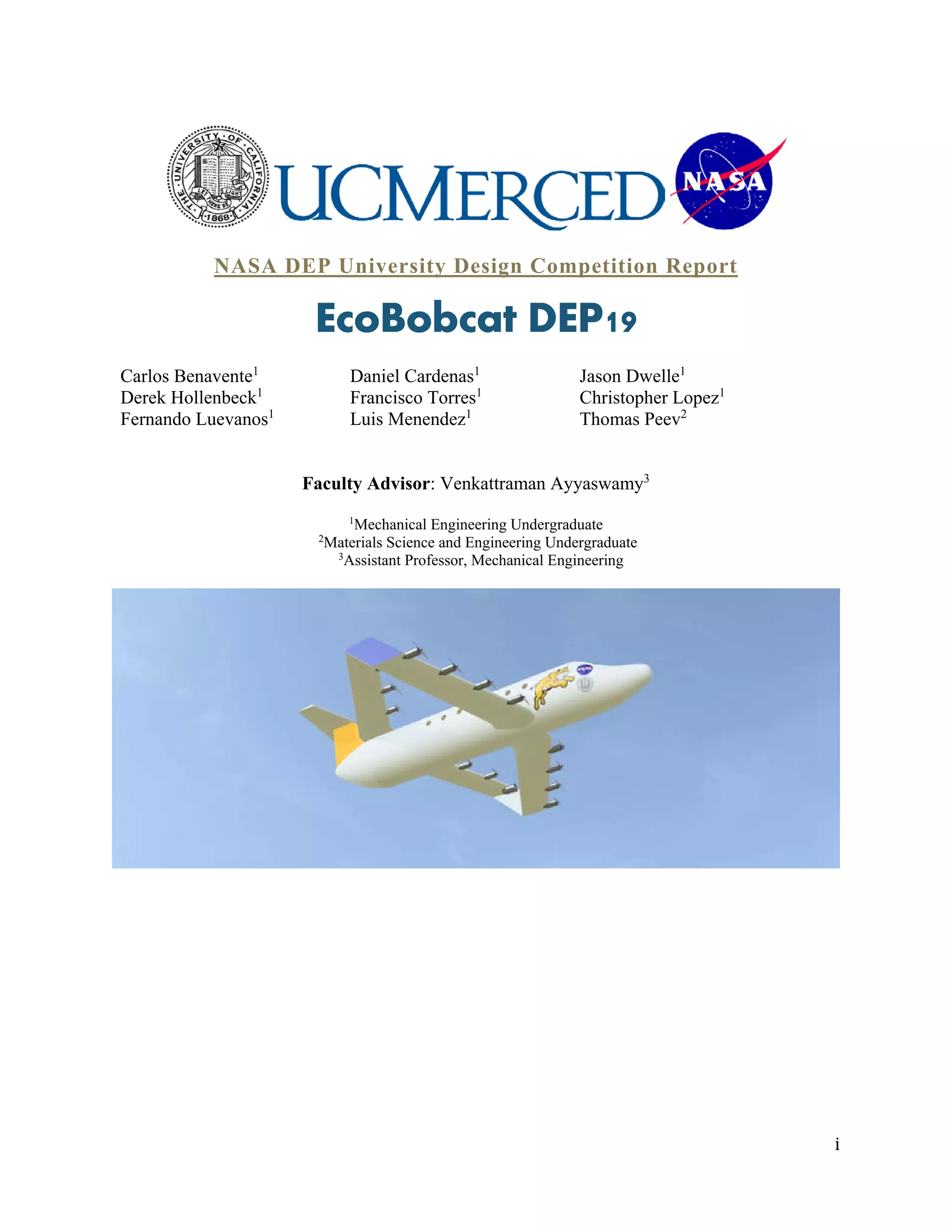
EcoBobcat DEP19
Carlos Benavente1
Derek Hollenbeck1
Fernando Luevanos1
Daniel Cardenas1
Francisco Torres1
Luis Menendez1
Jason Dwelle1
Christopher Lopez1
Thomas Peev2
Faculty Advisor: Venkattraman Ayyaswamy3
1
Mechanical Engineering Undergraduate
2
Materials Science and Engineering Undergraduate
3
Assistant Professor, Mechanical Engineering
ii
Abstract
In this report, we summarize the preliminary design of EcoBobcat DEP19, a 19 passenger + 2 crew
aircraft that uses distributed electric propulsion (DEP) to generate the thrust. The design process
begins with data collection of similar aircraft and a shortlist of three aircraft which are good
baselines for the mission requirements of the NASA competition. After a comparison of potential
materials including metallic and composites, we choose Epoxy Sheet Molding Compound (Carbon
fiber) as our primary material for the body of the aircraft. The material selection is followed by a
preliminary weight estimate and component-wise breakdown with 3200 kg for the aircraft body
(no engine, fuel and propellers), 2126 kg for payload, and 1775 kg for the propulsion system
(including turbo-electric generators, motors, propellers and fuel) thereby resulting in a total of
7101 kg or about 70 kN. We propose a novel looped-back wing concept where the regular wing is
looped back (with the use of a winglet-like structure) to be attached to the fuselage near the tail
region. Both components of the wing use a NACA 23018 airfoil at the root and a NACA 23012
airfoil at the tip. The wing span is chosen as 14.5 m with a root chord of 1.2 m and a tip chord of
0.6 m resulting in a mean aerodynamic chord of 0.9 m. The total wing planform area of the looped-
back wing is 26.1 m2
. The DEP concept is implemented using 14 propellers attached to the wings
(4 on each side of the forward wing and 3 on each side of the looped-back wing). The size of the
propellers is 1.27 m (50 in) and all propellers operate at 1000 rpm resulting in relatively low tip
speeds and noise. The propellers are driven by superconducting motors which in turn are driven
by turbo-electric generators mounted near the wingtips. The generators are sized using a standard
system-level analysis and are designed to operate using an air mass flow rate of 2 kg/s. The
maximum power rating of each engine is obtained as 0.7 MW. The mass of the entire propulsion
system is 820 kg with room for 955 kg for fuel. The aircraft performance parameters are obtained
including a range greater than 3500 km, endurance greater than 8 hours, take-off length of 2600
ft, landing length of 2800 ft, climb rate of 513 m/min. The aircraft therefore meets all requirements
of the competition. Structural analyses are also presented for load factors of 2.5 and -1 and the
wing structure was able to withstand the loads produced. The information iss used to obtain the V-
n diagram of the EcoBobcat DEP19. We believe the EcoBobcat DEP19 is a good representation
of an aircraft that can be expected to be flown in future given the significant advantages of using
DEP.
iii
Table of Contents
Introduction................................................................................................................................................................1
Design Strategy .........................................................................................................................................................1
Preliminary Design..................................................................................................................................................2
Preliminary Empty Weight .................................................................................................................................4
Propulsion System Design....................................................................................................................................7
Propeller Design .......................................................................................................................................................7
Performance Analysis ......................................................................................................................................... 13
Overall Design........................................................................................................................................................ 18
Environmental Analysis: Emissions and Noise........................................................................................ 19
Safety and Risk Assessment ............................................................................................................................. 23
1
Introduction
With the rapid increase in the number of airplanes that currently decorate the sky, there is a
growing concern on the harmful effects they have on our environment. Of all the concerns, the
harmful effects of NOx emissions [1, 2] are one of the most significant and there are several efforts
underway to reduce emissions using more efficient engines, alternate fuels [3] and better air traffic
management [4]. In this regard, electric aircraft present an attractive zero-emission option while
the aircraft is in operation. While the energy production itself will still produce emissions if the
source is non-renewable (such as producing electricity by burning coal), this can be controlled and
being able to operate electric aircraft will certainly go a long way in decreasing the effects of
harmful emissions. Apart from the obvious green effect of electric aircraft, there are less obvious
advantages that such technology can lead to. Specifically, electric aircraft technology can lead to
paradigm shifts in the way airplanes are designed and one such alternative design strategy is the
concept of Distribution Electric Propulsion (DEP) [5, 6]. As an example, NASA researchers have
proposed a DEP concept referred to as Leading Edge Asynchronous Propellers Technology
(LEAPTech) [6] that has been an active area of research over the past few years. The DEP concept
provides the freedom to locate a large number propellers (that are driven by small motors) at
strategic locations on the wing to lead to other performance enhancements. For example, the
LEAPTech aircraft uses propellers that blow the wing during take-off and landing thereby
increasing the dynamic pressure over the wings and lowering the stall speed. While other high-lift
and flow control strategies can lead to a similar enhancement in take-off and landing performance,
the DEP concept leads to other multi-disciplinary advantages resulting in a synergy between
aerodynamics and propulsion. In spite of the attractive features of DEP, it is still a futuristic
concept and requires careful analysis before commercial passenger aircraft using this technology
are flown. Even the LEAPTech aircraft that NASA researchers have been studying is a four-seater
aircraft. In this regard, the primary goal of the current design competition is to explore the benefits
of using DEP on a typical commercial aircraft by proposing a complete on-paper design. Apart
from the design, we also present performance analysis to demonstrate the feasibility of a
commercial DEP aircraft.
Design Strategy
The overall design of the proposed aircraft (named EcoBobcat DEP19 to account for its eco-
friendly nature as well as emphasize the connection with the mascot of the University of California
Merced) was broken into three main categories: preliminary, critical, and overall design. This was
done to showcase the design process and final design selections based off the competition design
and mission requirements. As part of the NASA ARMD challenge, several design constraints are
required to be satisfied by the proposed design and are briefly summarized below. The mission
requirements included a 19 passenger seating capacity with 31-inch seat pitch, cruise speed of 250
mph, service ceiling of 28,000 ft, takeoff & landing field length of 3000 ft at maximum takeoff
weight at standard atmospheric conditions, Also included was the ability to fly in all weather
(including icing conditions) with a structural design criteria of +2.5/-1.0 g loading and safety factor
of 1.5. There is also a requirement to maintain a fuel reserve requirement as per the Federal
Aviation Regulations (FAR) under Instrument Flight Regulation (IFR) conditions. This fuel
requirement says that we must carry enough reserve such that
1. Complete the flight to the first airport of intended landing;
2. Fly from that airport to the alternate airport;
2
3. Fly after that for 45 minutes at normal cruising speed
It will be shown that our aircraft can satisfies all of these requirements.
Preliminary Design
In the preliminary design we looked at the main design requirements and goals to evaluate
conceptual design platforms based on figures of merit (FOM). The essential parameters need of
the aircraft were determined first then were compared with already available aircraft. The first
step in our aircraft design process [7] was the data collection step which allows the choice of a
starting point for the design. For example, even though every aircraft in the Boeing or Airbus series
has its own unique features, the similarities in them cannot be discounted. The criteria used to
determine the conceptual design were based on flight parameters, cost of the system, and
uniqueness of the platform.
• Mission Requirements – The main parameters looked at were number of passengers,
cruise speed, range, and service ceiling. All aircraft looked at meet initial design
requirements
• Cost – The average aircraft cost was used to determine the most economical choice.
• Uniqueness – As a design challenge we wanted to include a uniqueness factor for selection
as we wanted to contribute an innovative solution to the design problem. In fact, we
present a novel wing concept which we believe is a strength of our design.
A list of aircraft was gathered and compiled into Table 1 and carefully chosen based on the criteria
mentioned above. While most parameters were determined from Jane’s All the World Aircraft [8],
some parameters were not available and are not included in the table. Once the preliminary list of
similar aircraft was compiled, we short-listed three aircraft from this table to design the EcoBobcat
DEP19. The three short-listed aircraft included the BAE Jetstream 31, Dornier Do 228 and
Beechcraft 1900. The design team then performed a figure-of-merit analysis for the short-listed
aircraft based on three quantities including mission requirements (60% weightage), cost (20%
weightage) and uniqueness (20% weightage). The team assigned points for each figure-of-merit
quantity to determine an overall score for each of the three aircraft. Based on Table 1 and the
findings of Table 2, the team found that the best platform to work from is the Beechcraft 1900. In
other words, the conceptual design will be based off the Beechcraft 1900’s bottom wing, T-tail
configurations with the tricycle landing gear. However, as will be clear in subsequent sections, we
used a novel wing design wherein the regular wings are connected back to the fuselage (at a
location near the tail) through an auxiliary wing. We refer to this concept as a loop-back wing.
Table 1: Summary of preliminary data collection of various aircraft with comparable mission
requirements
Beechcraft
1900
L-
410
Do 228 EMB
110
SC.7
Skyvan
An-
28
B.A
Jetstre
am
Gulfstrea
m IV
Dassault
Falcon
7X
Passengers/
Crew
19/2 19/ 19/2 18/2 19/2 18/2 19/2 19/2 19/3
Length (m) 17.62 14.4 16.56 15.1 12.21 12.98 14.37 27.2 23.38
Wingspan
(m)
17.64 19.5 16.97 15.33 19.78 22.00 15.85 23.7 26.21
Height (m) 4.72 5.83 4.86 4.92 4.6 4.6 5.32 7.67 7.93
3
Empty
weight (kg)
4732 3985 3739 3393 3331 3900 4360 19700 15465
Max.
weight (kg)
7764 6400 6400 5900 5670 6100 6950 32200 31750
Max Speed
(km/h)
413 325 355 488 935 953
Cruise
Speed
(km/h)
518 (at
20000 ft)
365 352 341 317 335 426 850 900
Range (km) 2700 1380 1111 1964 1117 510 1260 8060 11000
Service
Ceiling (m)
7620 6320 8500 6550 6858 6000 7620 13700 15500
Rate of
climb (m/s)
13.28 7.4 7.5 8.3 8.33 12.0 10.6
Wing
loading
(kg/m2
)
136.6 146 276 435
Power/mass
(kW/kg)
0.250 0.201
Material Selection
Determination of the material used for the aircraft body crucial for all other performance
parameters. The properties of the material determine the ceiling service altitude, the maximum
speed, and the weight of the aircraft. Materials used in the aerospace industry include aluminum
alloys, titanium alloys, as well as other composite materials. Other materials previously used
include steel alloys and wood. Based on a literature survey, the materials considered as candidates
included Al 2024-T3, Al 3003-H14, Al 5052-H32, Al 6061-T6, Al 7075, and Ti6Al4V (Grade 5).
Table 3 below summarizes the properties of these materials. We are interested in materials with
high stiffness, high strength, high toughness, and low density. These figures of merit were used to
determine materials with comparable or superior material properties. Using a well-established
materials database (CES Edupack) [9], 169 potential materials were ranked based on their density,
strength as well as CO2 footprint. The four short-listed materials were determined to be
Epoxy/aramid fiber UD composite, Epoxy SMC (carbon fiber), Al 518.0 F, and Al 2297-T87. It
should be noted that the first two selections are composite materials, while the Al alloys are
metallic. It is worth mentioning that aircraft are traditionally not manufactured using a single
material, but comprises of a selection of different materials, each specialized for their application.
Also, current aircraft (including Boeing 787) are not exclusively built out of composites, and the
high cost is not the only reason for that. It is also difficult to recycle composite materials compared
to aluminum alloys. Replacing aluminum parts in planes with carbon fiber parts can reduce the
overall weight of the plane by up to 20%. For example, the Boeing 787 is modeled closely after
the Boeing 747, but the Boeing 787 is significantly lighter (by about 20%) since it includes
advanced composites in its construction. Due to the weight reduction, the Boeing 787 Dreamliner
model is said to be more fuel efficient than other aircraft of similar size. Carbon fiber is more
expensive than aluminum due to the molding process required (also included in our cost analysis
by doubling the values obtained for aluminum), but this may also be beneficial in the long run. By
using carbon fiber, aircraft can be molded in fewer pieces. As an example, the wings can be molded
with the fuselage thus making it more aerodynamic. This could be advantageous because of the
use of fewer parts such as fasteners and adhesives. Another benefit of the carbon fiber is that the
material is more durable and would require less maintenance. Aluminum airplanes often need to
4
be maintained to avoid corrosion, but carbon fiber planes would require very little maintenance.
While carbon fiber is a great material, there was one major problem with it. When struck by
lightning, carbon fiber is completely shredded. In order to avoid such problem, small strands of
metal are woven into the material to decrease the damage caused by lightning. Based on all these
considerations, the team finalized that the structural support and parts of the plane skin should be
made out of Epoxy SMC (carbon fiber), which is lightweight, strong, and has a low carbon
footprint during its production.
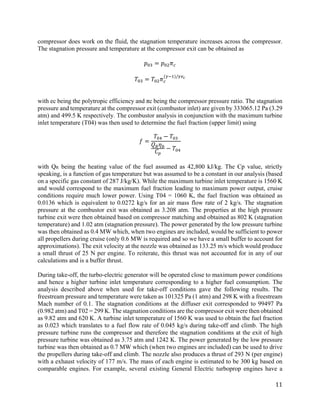
Figure 1: Images of BAE Jetstream, Dornier Do 228 and Beechcraft 1900 - our baseline aircraft
Table 2: Summary of figure-of-merit analysis used to determine the short-list of baseline aircraft
BAE Jetstream 31 Dornier Do 228 Beechcraft 1900
Mission (60%) 5 4 7
Cost (20%) 10 5 7
Uniqueness (20%) 5 5 5
Total 6 4.4 6.6
Preliminary Empty Weight
In order to estimate the preliminary empty weight [10] of the EcoBobcat DEP19, we go back to
our survey of comparable aircraft. Among the three short-listed aircraft empty weights, the Dornier
Do 228 has the minimum empty weight and the Beechcraft has the maximum empty weight. We
start-off with an empty weight of 4300 kg which is between the values of Do 228 and Beechcraft
and incidentally agrees with the empty weight of the Jetstream 31. However, we anticipate a 20%
savings (based on data from weight savings of Boeing 787) since the proposed aircraft will be
manufactured using lightweight composite technology. This results in an empty weight of 3440
kg. However, it should be noted that this includes the engine weight and might be different for the
EcoBobcat DEP19. Specifically, as discussed in detail in a subsequent section, the proposed
aircraft will utilize two turbo-electric generators that will drive the DEP propellers distributed on
the wing. The propeller weight will be added to the empty weight discussed above. The dry engine
weight of the Beechcraft 1900 is about 240 kg (corresponding to two Pratt and Whitney Canada
PT6 turboprop engines). Therefore the empty weight of the engine-less EcoBobcat DEP19 is
estimated at 3200 kg. Assuming that the propulsion system will account for about 25% of the
overall gross maximum take-off weight, and including payload at 21 people (19 passengers + 2
crew) with each person weighing 225 lb (NASA recommendation), the estimated total maximum
take-off weight of the aircraft is obtained as 7101 kg corresponding to about 70 kN. The payload
accounts for 2126.25 kg. Our estimations allow 1775.75 kg for the propulsion system and fuel
which should be verified and updated while designing the turbo-electric generators, propellers and
the motors that drive the propellers.
5
Table 3: Summary of properties of materials that are commonly used in existing aircraft - All data from
EduPack 2015
Aerodynamic Design
Once the material selection was completed, the team next focused on finalizing the aerodynamic
design which includes airfoil selection, wing and tail design. While it could be argued that the
extensive analysis on improving aerodynamic designs over the past several decades limits our
ability to make significant improvements in existing efficiencies, the team performed some
aerodynamic analyses to try to come up with a novel and yet efficient aerodynamic design which
is discussed below. Also, use of the DEP concept is anticipated to lead to significant improvements
in the aerodynamic characteristics as a result of the blowing effect it provides to the wings [6].
This will be accounted for in our design.
Airfoil Selection
For the airfoil selection of the design process we focused on the airfoils typically used by aircraft
of similar size and flight parameters. We considered the root and tip airfoils used by BAE Jetstream
31, Beechcraft 1900, and Gulfstream IV. The final airfoil was selected based on several parameters
including maximum lift coefficient, lift to drag ratio, and the pitching moment coefficient at cruise
and take-off. The team finalized the use of a NACA 23018 as the root airfoil and a NACA 23012
as the tip airfoil. The reasoning for using two different airfoils is to generate higher amounts of lift
at the root of the wing to reduce the structural stress from the high lift at the wing tips. The NACA
airfoils are all similar but have some key differences. In particular, the four-digit number at the
end of the NACA airfoils defines the shape of the airfoil. The first two digits characterize the
camber and the last two digits define the thickness of the airfoil as a percentage of the chord length.
The aerodynamic characteristics of the chosen airfoils and their dependence on the angle of attack
were obtained using the well-established XFLR5 software [11]. XFLR5 uses a panel method to
solve for flow past the given airfoil to obtain the performance coefficients (lift coefficient, drag
coefficient and moment coefficient) as a function of angle of attack. While XFLR5 can perform
both inviscid and viscous analysis, we included viscosity in all our analyses to capture airfoil stall
and hence obtain the maximum lift coefficient.
Figure 2 shows the variation of lift coefficient (Cl), drag coefficient (Cd) and lift-to-drag ratio as
a function of angle of attack. The lift coefficient reaches a maximum of about 1.8 beyond which
the airfoil stalls leading to a decrease in lift coefficient. The stall angle was determined to be about
160
. The maximum lift-to-drag ratio was obtained as 150 at an angle of attack of about 80
.
However, the lift-to-drag ratio (L/D) for the entire aircraft is likely to be significantly lower. For
example, an existing comparable aircraft (Beechcraft) has a cruise L/D of about 13.
6
Wing Design
The analysis performed above is only for the two-dimensional airfoil and is used to obtain the
finite wing aerodynamic characteristics as discussed below. As briefly mentioned earlier, the
EcoBobcat DEP19 has a traditional wing which is looped back through a winglet structure to be
connected to the fuselage near the tail region of the aircraft. We anticipate this design to have the
advantages of both forward swept wing and backward swept wing. We began with an initial
wingspan chosen as 14.5 m which translates to a total span of 29 m with the two wings. The two
wings allow us to distribute a larger number of propellers without significant interaction between
any two adjacent propellers. The mean aerodynamic chord was initially chosen as 0.9 m resulting
in a total gross wing area of 26.1 m2
. The density at cruise conditions of 28,000 ft (taken to be
same as the service ceiling specified in the competition mission requirements) was obtained from
the International Standard Atmosphere as 0.4931 kg/m3
. The freestream temperature at cruise
altitude was obtained as 233 K corresponding to a speed of sound of 306 m/s. A cruise speed of
275 mph (greater than the 250 mph prescribed in the competition requirements) was targeted
initially. This translates to a cruise speed of 123 m/s and a cruise Mach number of 0.4 which would
still classify this as a low speed aircraft. Since the preliminary estimate of the gross weight is
already known as 70 kN, we then estimate the cruise CL of the EcoBobcat DEP19 using
𝐶𝐶𝐿𝐿 =
2𝑊𝑊
𝜌𝜌𝜌𝜌𝑉𝑉2
with the specified cruise density and velocity. The cruise CL is hence obtained as 0.72 which might
seem to be on the higher side but is enabled by the blowing effect produced by the propellers
distributed on the wing. To reiterate, the propellers induce an axial velocity on the wing which
increases the relative velocity as seen by the wing thereby increasing the lift coefficient. For
example, LEAPTech (the four-seater NASA aircraft with DEP) has a cruise CL of 0.77 in
comparison with 0.3 for the Cirrus SR22 (an aircraft comparable to LEAPTech.
Once the cruise CL is estimated, the cruise drag can be estimated to determine the thrust required
at cruise to overcome this drag. A typical drag polar comprises of parasitic drag and the induced
drag (drag due to lift) components and is represented as
𝐶𝐶𝐷𝐷 = 𝐶𝐶𝐷𝐷,0 + 𝐾𝐾𝐶𝐶𝐿𝐿
2
We estimate the parasitic drag coefficient to be 0.03 and using an aspect ratio of 16.11 (using the
span and mean aerodynamic chord discussed earlier), and Ostwald’s efficiency factor = 0.80 gives
K = 0.025 and a corresponding CD of 0.043. The cruise L/D is 16.78 which is higher than
comparable aircraft and is enabled primarily by the use of DEP. The total estimated drag at cruise
is therefore 4152 N and should be overcome by the thrust produced by the propulsion system that
is designed next. While the propulsion system should produce about 4.2 kN during cruise, our
design targets a maximum thrust of at least 20 kN to account for other missions such as take-off
and climb (within reasonable time to service ceiling) as well as to exceed design requirements in
spite of the approximations involved. Finally, the tail design was chosen as a well-established T-
tail configuration with dimensions similar to the three baseline aircraft we chose earlier
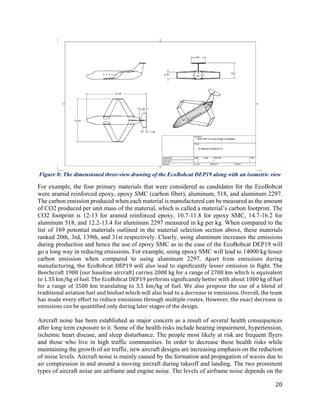
(dimensions specified in the 3-view drawing presented in Figure 8.
7
Figure 2: Aerodynamic characteristics of the NACA 23018 and NACA 23012 at take-off and cruise
conditions. The NACA 23018 and NACA 23012 are used as the root and tip airfoils in EcoBobcat DEP19.
Propulsion System Design
The EcoBobcat DEP19 will utilize the DEP concept not only to enhance the aerodynamic
characteristics but also to produce thrust. The DEP system on the proposed aircraft includes a
turbo-electric generator that will produce turbine power through traditional combustion. This
turbine power will be transmitted to the propellers that are distributed along the wing. The
transmission will be performed electrically (rather than mechanically) using superconducting
motors [12, 13] and power lines. The rapid growth in superconducting electrical machines allows
us to achieve this electrical transmission with a negligible weight penalty. The design
specifications of each of these components is described in detail below.
Propeller Design
In an aircraft propelled by DEP, a large number of relatively small propellers (as opposed to two
larger propellers) are distributed along the wing to produce thrust apart from aerodynamic
enhancement of the wing. The design of each propeller includes choice of diameter, number of
blades, pitch, and material. For the DEP concept, one must also specify the exact locations of these
propellers on the wing (seen clearly in the artist’s rendition). We propose to utilize propellers with
a diameter of 50 in. which translates to 1.27 m. Our design is also based on distributing a total of
14 propellers in total. The front wing will have 8 propellers (4 on each side) and the loop-back will
have 6 propellers (3 on each side). The relatively small number of propellers on each side provides
us with the maximum freedom in terms of their locations. Each propeller is then required to
8
produce a thrust of 0.3 kN or 300 N (during cruise) and 1.5 kN during take-off and climb. The
momentum theory (actuator disk theory) was then used to determine the power requirements for
driving each propeller. It should be mentioned that a similar analysis was used to perform
preliminary design of propellers of the LEAPTech [6]. The momentum theory in spite of involving
approximations is an extremely useful technique for preliminary design of propellers.
The momentum theory expresses the velocity far downstream of the propeller (Ve) in terms of the
freestream velocity (V0) and thrust loading Tc as
𝑉𝑉𝑒𝑒 = 𝑉𝑉0�1 + 𝑇𝑇𝑐𝑐
where Tc is a non-dimensional thrust defined as
𝑇𝑇𝑐𝑐 =
2𝑇𝑇
𝜌𝜌𝑉𝑉0
2
𝐴𝐴𝑝𝑝
With Ap being the propeller area. The velocity at the propeller disk location (Vd) is the average of
Ve and V0 and therefore in terms of Tc is given by
𝑉𝑉𝑑𝑑 =
𝑉𝑉0(1 + �1 + 𝑇𝑇𝑐𝑐)
2
The total power required to drive the propeller is then obtained as
𝑃𝑃 =
1
4
𝑇𝑇𝑐𝑐 𝜌𝜌𝑉𝑉0
2
𝐴𝐴𝑝𝑝 𝑉𝑉0(1 + �1 + 𝑇𝑇𝑐𝑐)
Utilizing these equations for the propellers of the EcoBobcat DEP19, the value of Tc is given by
0.0635. The power requirement is then given by 37.47 kW for one propeller and adds to about
524.6 kW for all 14 propellers. Assuming an efficiency of 0.8 for the propeller, the turbo-electric
generator should produce a power of about 670 kW. The design of the turbo-electric generator
will be discussed in a subsequent section.
Also, the proposed propeller design uses a two-blade configuration. Ideally, the propeller diameter
should be as large as possible since it can provide momentum to a larger volume of air thereby
resulting in higher thrust. However, the tip speed of the propeller which is proportional to the
radius as well as the angular speed should not be too high. Specifically, a common rule of thumb
is to ensure that the tip Mach number does not exceed 0.85 or so. The more compressible the flow
is near the propeller tip, the more noise it generates making it more uncomfortable for the pilot
and passengers. The advance ratio J given by
𝐽𝐽 =
𝑉𝑉
𝑛𝑛𝑛𝑛
where V is the freestream velocity, n is the revolutions per second and D is the propeller diameter
plays a major role in determining the efficiency of the propeller. A propeller diameter of 50 inches
(1.27 m) and an angular speed of 16.67 revolutions per second (corresponding to 1000 rpm)
9
ensures that J is about 0.9245 for a cruise speed of 123 m/s. The tip speed of the propeller is only
133 m/s (corresponding to a Mach number of about 0.5) thereby preventing supersonic flow near
the tip. The noise levels are also anticipated to be sufficiently low to ensure passenger comfort in
the cabin. Both fixed-pitch and constant-speed (variable pitch) propellers were considered as
options. While constant-speed propellers have the ability to control the blade pitch to ensure
maximum efficiency at various operating conditions, they come with the disadvantage of weighing
more than fixed-pitch propellers. We decided to choose a fixed-pitch propeller with the blade angle
of about 20 degrees which would ensure peak efficiency for the propeller for an advance ratio of
about 0.9245. To summarize, the proposed two-blade propeller of Eco-Bobcat DEP19 has a
diameter (d) of 50 inches with a pitch of about 20 degrees and will be made of carbon fiber
composites which in conjunction with the turbo-electric generator should produce sufficient
thrust to meet the desired aircraft requirements. The advance ratio values encountered will
ensure that the propeller efficiencies can be assumed to be about 80% at cruise and about 60%
during take-off based on curves from McCormick [14] as shown in Figure 3. While a more careful
optimization procedure should likely be adopted at later stages of the design, we conclude that this
is a good representative propeller for the Eco-Bobcat DEP19. The mass of each propeller is
estimated as 5 kg totaling 70 kg for all propellers.
Figure 3: Variation of efficiency as a function of advance ratio for various blade angles. Figure
reproduced from McCormick
Turbo-electric Generator
The power requirement quantified above will be met using two turbo-electric generators mounted
near the tip region of the wings (see exact location in the artist’s rendition). This section will
therefore present the sizing and analysis of the turbo-electric generators. The current design
proposes the use of generators that are very similar to traditional gas turbine engines. The turbo-
electric generator will take in a certain mass of air (depending on the inlet area) which will then
be slowed down in a diffuser before being compressed to higher pressures. The high pressure air
enters the combustion chamber where fuel is added and the exothermic combustion process
increases the temperature. The high pressure, high temperature exhaust then drives a high-pressure
turbine that is matched with the compressor. In other words, the compressor is driven using the
power generated by the high pressure turbine. The gas then enters the low pressure turbine which
produces power to drive all propellers of the DEP system before being exhausted through the
nozzle. It should be mentioned that the nozzle will also produce a small amount of thrust but the
10
generator is designed in such a way that most of the energy is used to drive the propellers. This is
achieved by choosing the power split ratio (ratio of propeller power to total power available when
the gas exits the high pressure turbine) to be 0.96. A standard black-box analysis [15] of the engine
is performed by assuming state-of-the-art efficiencies and parameters for the diffuser, compressor,
combustion chamber, turbine and nozzle with the design discussed below.
The inlet are of the engine was chosen as 0.5 m which was suitable for an air mass flow rate of 2
kg/s. The ratio of specific heat was taken as 1.4 and the specific gas constant as 287 J/kg/K. The
engine diffuser slows down the air adiabatically (isentropic flow is not possible due to friction and
mild flow separation losses). While the shaping of the diffuser is beyond the scope of this system-
level analysis, we assume a stagnation pressure loss of 0.8. The flow then enters the compressor
with a pressure ratio of 10 and a polytropic efficiency of 0.90 (a good estimate for compressor
flow). The compressor exit leads to the burner/combustion chamber and a burning efficiency of
0.99 along with a stagnation pressure loss (across the combustion chamber) of 0.975 was assumed.
The flow exiting the combustor enters the high pressure turbine that runs the compressor with
polytropic efficiency of 0.85 and a mechanical efficiency (for the shaft connecting the compressor
to the high pressure turbine) of 0.99. Also, it is assumed that the turbine inlet temperature will be
a maximum of 1560 K which is well below the temperature that can be handled by state-of-the-art
materials. The exit of the high pressure turbine leads to the low pressure turbine with polytropic
efficiency of 0.88. The low pressure turbine will produce the power that will drive all propellors
and should therefore be able to generate about 1.3 MW during take-off. To reiterate 96% of the
power available in the flow at the point of exiting the high pressure turbine will be extracted in the
low pressure turbine and the remaining will be extracted through the nozzle. The remainder will
be exhausted through the nozzle (efficiency of 0.95) and will produce a small thrust but is not
accounted for in our design and will remain excess thrust (a buffer for possible errors due to
approximations performed during the design). If more power is extracted by low pressure turbine,
the nozzle will start producing a drag. The fuel will be a 50% blend of standard aviation fuel and
biodiesel. Such a blend has been shown to lead to significant decrease in emissions.
We now present a summary of our calculations for the turbo-electric generator performance at
cruise and take-off. At cruise, the freestream temperature and pressure (from International
Standard Atmosphere) are given by pa = 32932.4 Pa and Ta = 233 K respectively. The flow is
assumed to be slowed down isentropically to determine the inlet conditions. The stagnation
pressure and stagnation temperature at the exit of diffuser (entrance to compressor) are obtained
as
𝑝𝑝02 = 𝑝𝑝𝑎𝑎 �1 +
𝛾𝛾 − 1
2
𝑀𝑀𝑎𝑎
2
� 𝜋𝜋𝑑𝑑
𝑇𝑇02 = 𝑇𝑇𝑎𝑎 �1 +
𝛾𝛾 − 1
2
𝑀𝑀𝑎𝑎
2
�
where πd is the stagnation pressure loss across the diffuser and Ma is the freestream Mach number.
We obtain p02 = 33306.51 Pa along with T02 = 240.5 K. It should be noted that the stagnation
temperature remains the same at the inlet and exit of diffuser since flow across the diffusor is
adiabatic but not isentropic. The stagnation pressure increases across the compressor and since the
11
compressor does work on the fluid, the stagnation temperature increases across the compressor.
The stagnation pressure and temperature at the compressor exit can be obtained as
𝑝𝑝03 = 𝑝𝑝02 𝜋𝜋𝑐𝑐
𝑇𝑇03 = 𝑇𝑇02 𝜋𝜋𝑐𝑐
(𝛾𝛾−1)/𝛾𝛾𝑒𝑒𝑐𝑐
with ec being the polytropic efficiency and πc being the compressor pressure ratio. The stagnation
pressure and temperature at the compressor exit (combustor inlet) are given by 333065.12 Pa (3.29
atm) and 499.5 K respectively. The combustor analysis in conjunction with the maximum turbine
inlet temperature (T04) was then used to determine the fuel fraction (upper limit) using
𝑓𝑓 =
𝑇𝑇04 − 𝑇𝑇03
𝑄𝑄𝑅𝑅 𝜂𝜂𝑏𝑏
𝐶𝐶𝑝𝑝
− 𝑇𝑇04
with QR being the heating value of the fuel assumed as 42,800 kJ/kg. The Cp value, strictly
speaking, is a function of gas temperature but was assumed to be a constant in our analysis (based
on a specific gas constant of 287 J/kg/K). While the maximum turbine inlet temperature is 1560 K
and would correspond to the maximum fuel fraction leading to maximum power output, cruise
conditions require much lower power. Using T04 = 1060 K, the fuel fraction was obtained as
0.0136 which is equivalent to 0.0272 kg/s for an air mass flow rate of 2 kg/s. The stagnation
pressure at the combustor exit was obtained as 3.208 atm. The properties at the high pressure
turbine exit were then obtained based on compressor matching and obtained as 802 K (stagnation
temperature) and 1.02 atm (stagnation pressure). The power generated by the low pressure turbine
was then obtained as 0.4 MW which, when two engines are included, would be sufficient to power
all propellers during cruise (only 0.6 MW is required and so we have a small buffer to account for
approximations). The exit velocity at the nozzle was obtained as 133.25 m/s which would produce
a small thrust of 25 N per engine. To reiterate, this thrust was not accounted for in any of our
calculations and is a buffer thrust.
During take-off, the turbo-electric generator will be operated close to maximum power conditions
and hence a higher turbine inlet temperature corresponding to a higher fuel consumption. The
analysis described above when used for take-off conditions gave the following results. The
freestream pressure and temperature were taken as 101325 Pa (1 atm) and 298 K with a freestream
Mach number of 0.1. The stagnation conditions at the diffuser exit corresponded to 99497 Pa
(0.982 atm) and T02 = 299 K. The stagnation conditions are the compressor exit were then obtained
as 9.82 atm and 620 K. A turbine inlet temperature of 1560 K was used to obtain the fuel fraction
as 0.023 which translates to a fuel flow rate of 0.045 kg/s during take-off and climb. The high
pressure turbine runs the compressor and therefore the stagnation conditions at the exit of high
pressure turbine was obtained as 3.75 atm and 1242 K. The power generated by the low pressure
turbine was then obtained as 0.7 MW which (when two engines are included) can be used to drive
the propellers during take-off and climb. The nozzle also produces a thrust of 293 N (per engine)
with a exhaust velocity of 177 m/s. The mass of each engine is estimated to be 300 kg based on
comparable engines. For example, several existing General Electric turboprop engines have a
12
maximum power (in kW) to mass ratio (in kg) between 3.5 and 4.5. We utilize a conservative value
of 2.6 to estimate the mass of each engine as 270 kg.
The power generated by the low pressure turbine will be transmitted through superconducting
power lines that will drive superconducting motors which in turn will drive the propellers.
Superconducting motors are essentially new types of alternating current (AC) motors that employ
high temperature superconductor (HTS) windings instead of traditional copper coils. Since HTS
wires can carry significantly larger currents than copper wire, these windings are capable of
generating much stronger magnetic fields in a given volume. The choice of superconducting
motors also stems from the fact that they, unlike traditional copper wires, allow power transmission
at much higher efficiencies with very limited loss. An HTS synchronous motor [16] has
considerably reduced losses, yielding significant annual savings in electricity consumption.
Elimination of iron teeth in the stator results in a lightweight motor that boasts quiet and smooth
operation. The compact design of HTS motors will facilitate placement in transportation
applications where space and/or weight is at a premium (such as in aircraft). Superconducting
motors can withstand large transients or oscillatory torques without losing synchronous speed. The
HTS machines do not require rapid field forcing during fast load changes or transients as is often
the case with conventional machines. The smaller size of superconducting motors will also enable
them to be manufactured and shipped directly to the customer without costly disassembly and
subsequent onsite re-assembly and testing. These advantages will reduce delivery lead times and
reduce overhead costs. These attractive traits make superconducting motors particularly suitable
for the EcoBobcat DEP19 that utilizes DEP. Specifically, the power generated in the turbo-electric
generator can be transmitted to various propellers (that could potentially be at distances as large
as 5 m from the turbo-electric generator) without losses. The mass of the superconducting motor
was estimated based on a reasonable estimate of about 15 kW/kg thereby translating to a mass of
200 kg. In summary, the total mass of the propulsion system (excluding fuel) is estimated to
be 820 kg which allows the remaining mass (based on an initial allocation of 1775 kg) of 955
kg for fuel.
Fuselage and Landing Gear Design
For the fuselage, our design team decided to stick to a simple conventional shape. The cabin was
modeled closely after the design of comparable aircraft that also seated 19 passengers and are
considered to have a comfortable layout. The fuselage cross section was chosen to be circular with
a width of 8 ft. The width was chosen based on a 6 ft cabin height and a 2 ft space (under the cabin)
for cargo. The seat layout was chosen as three seats in a row and an additional set in the last row
near the restroom. The seat pitch was chosen as 31 inch as prescribed in the competition
requirements. It should be noted that the cabin internal dimensions are slightly larger than the
Beechcraft 1900. As part of our preliminary design, we also made some initial choices for the
landing gear system. It is a major, but often neglected, component of any aircraft, given that it is
required for takeoff, landing and any movement on ground. Multiple factors are taken into account
when designing landing gears including the aircraft’s weight, center of gravity, take-off angle, and
desired level of ground mobility. The major factors that should be considered include the type of
landing gear, the distance of the front/back wheel(s) from the center of gravity, the expected load
on the gear, and the desired allowable turn angle while the aircraft is on the ground. Since there
was no specific requirement from the competition, we made some preliminary choices for the
landing gear system. The first choice that the team made was regarding the landing gear type. After
13
looking at multiple airplanes that have a similar scope as our aircraft, the tricycle landing gear was
chosen. The position of the landing gear is governed by several factors including the take-off angle
as the plane leaves the ground and the center of gravity. While taking off, the angle made by the
aircraft with the horizontal should ensure that the rear of the aircraft does not strike the runway. In
addition, the front and rear landing gears need to be located in such a way that the front gear holds
only a small fraction (between 5 to 20 %) of the total aircraft weight. Based on an assumed center
of gravity location, we obtained the location of the front gear to be 0.1667 m and the rear gears to
be 3.02 m from the nose of the aircraft. Taking into account that the average aircraft takes off at
an angle of 10 degrees and by assuming a 15 degree buffer, we obtained a gear height of 1.378 m.
After adding a 30 cm for the ground clearance of the rear of the fuselage, we obtained a gear height
of 1.7 m. We also made some preliminary calculations for the gap between the rear landing gears.
The separation between the landing gears affects the turn angle and assuming a 25 degree turn
angle gives a separation of 1.58 m.
Performance Analysis
We now present a detailed discussion on the performance of the EcoBobcat DEP19 and
demonstrate how it satisfies the design requirements outlined in the NASA competition. Below,
we discuss our approach to determine the performance characteristics summarized above. While
we had the option to use the RDS software that ships with the design book of Raymer [7], we
chose to implement the equations in an in-house MATLAB since we had complete control on the
in-house MATLAB script. Our MATLAB script begins by taking in the motor power, targeted
cruise velocity and the range. The script then performs the take-off and landing analysis based on
the approach described by Raymer [7]. The stall velocity is computed as
𝑉𝑉𝑠𝑠𝑠𝑠𝑠𝑠𝑠𝑠𝑠𝑠 = �
2𝑊𝑊
𝜌𝜌𝜌𝜌𝐶𝐶𝐿𝐿𝐿𝐿𝐿𝐿𝐿𝐿
where S is the wing planform area, 𝜌𝜌 is the air density taken as 1.226 kg/m3
corresponding to
standard atmospheric conditions at sea-level, W is the weight of the airplane, and 𝐶𝐶𝐿𝐿𝐿𝐿𝐿𝐿𝐿𝐿 is the
maximum lift coefficient of our aircraft. While the maximum lift coefficient of our airfoil is around
1.6 (XFLR5 analysis presented earlier), high-lift devices are typically used during take-off to
increase this further. We propose to use trailing-edge flaps for our aircraft and this allows us to
achieve a 𝐶𝐶𝐿𝐿𝐿𝐿𝐿𝐿𝐿𝐿 of about 2.5. Also, the DEP concept helps achieve even higher 𝐶𝐶𝐿𝐿𝐿𝐿𝐿𝐿𝐿𝐿 values.
Therefore, we assume a value of 3.0 for our analysis. The take-off velocity was then determined
as
𝑉𝑉𝑡𝑡𝑡𝑡 = 1.1𝑉𝑉𝑠𝑠𝑠𝑠𝑠𝑠𝑠𝑠𝑠𝑠
The stall velocity for the Eco-Bobcat is 38.11 m/s and the take-off velocity is 41.92 m/s. For
reference, the Beechcraft 1900 has a stall speed of 43 m/s Next, the take-off thrust, lift and drag
coefficient at take-off were calculated as
𝑇𝑇𝑡𝑡𝑡𝑡 =
𝑃𝑃𝑝𝑝 𝜂𝜂𝑡𝑡𝑡𝑡
𝑉𝑉𝑡𝑡𝑡𝑡
14
𝐶𝐶𝐿𝐿,𝑡𝑡𝑡𝑡 =
2𝑊𝑊
𝜌𝜌𝜌𝜌𝑉𝑉𝑡𝑡𝑡𝑡
2
𝐶𝐶𝐷𝐷,𝑡𝑡𝑡𝑡 = 𝐶𝐶𝐷𝐷𝐷𝐷 + 𝐾𝐾𝐶𝐶𝐿𝐿,𝑡𝑡𝑡𝑡
2
𝐾𝐾 =
1
𝜋𝜋𝜋𝜋𝜋𝜋𝜋𝜋
where 𝑃𝑃𝑝𝑝is the power produced by the superconducting motors and 𝜂𝜂𝑡𝑡𝑡𝑡 is the efficiency of the
propeller during takeoff assumed to be 0.60 which is a reasonable value based on our analysis
presented earlier when sizing the propeller. Also, the superconducting motor is assumed to be
transmitting 1.4 MW during take-off. The lift coefficient equation assumes that the weight of the
aircraft is balanced by the lift. In the above equations, AR is the aspect ratio and e is the Oswald
efficiency factor. The aspect ratio for the Eco-Bobcat DEP19 is 16.11, a little higher than for
similar aircraft but the advances in material science certainly allow current aircraft to be designed
with high values of AR. As suggested by Raymer [7], the take-off analysis is broken into three
sections: ground roll, transition to climb, and climb. The ground roll analysis is essentially a force
balance which is then used to obtain an expression for the acceleration of the airplane. Integrating
this from the initial velocity of zero to the final velocity that is equal to the take-off velocity gives
an expression for the ground roll distance as
𝑆𝑆𝐺𝐺 = �
1
2𝑔𝑔𝐾𝐾𝐴𝐴
� 𝑙𝑙𝑙𝑙 �
𝐾𝐾𝑇𝑇 + 𝐾𝐾𝐴𝐴 𝑉𝑉𝑡𝑡𝑡𝑡𝑡𝑡𝑡𝑡𝑡𝑡𝑡𝑡𝑡𝑡
2
𝐾𝐾𝑇𝑇
�
𝐾𝐾𝑇𝑇 = �
𝑇𝑇
𝑊𝑊
� − 𝜇𝜇
𝐾𝐾𝐴𝐴 =
𝜌𝜌
2(𝑊𝑊/𝑆𝑆)
(𝜇𝜇𝐶𝐶𝐿𝐿 − 𝐶𝐶𝐷𝐷𝐷𝐷 − 𝐾𝐾𝐶𝐶𝐿𝐿
2)
where 𝐾𝐾𝑇𝑇 contains the thrust terms, 𝐾𝐾𝐴𝐴 contains the aerodynamic terms and 𝜇𝜇 is the friction
coefficient. Typical friction coefficient values for standard runways can be found in Raymer and
for our analysis, we used 0.03. During transition from take-off to climb, we assume that the
aircraft’s path approximately follows a circular arc. The aircraft also accelerates from take-off
velocity to climb speed (1.2Vstall) during this transition. In order to simplify the analysis (without
requiring to numerically integrate along the flight path), an average velocity of 1.15 Vstall was
assumed for this phase. The radius of the circular transition path was obtained as
𝑅𝑅 =
1.3225𝑉𝑉𝑠𝑠𝑠𝑠𝑠𝑠𝑠𝑠𝑠𝑠
2
𝑔𝑔(𝑛𝑛 − 1)
where g is the acceleration due to gravity and n = L/W is the load factor typically about 1.2 just
after take-off. For our analysis, we computed the load factor using a take-off lift coefficient of 2.48
and an average climb speed of 43.83 m/s (1.15 Vstall). This resulted in a load factor of 1.09. The
climb angle was then determined as
𝑠𝑠𝑠𝑠𝑠𝑠(𝛾𝛾𝑐𝑐𝑐𝑐𝑐𝑐 𝑐𝑐𝑐𝑐) =
𝑇𝑇 − 𝐷𝐷
𝑊𝑊
𝑆𝑆𝑇𝑇𝑇𝑇 = 𝑅𝑅𝑠𝑠𝑠𝑠𝑠𝑠(𝛾𝛾𝑐𝑐𝑐𝑐𝑐𝑐 𝑐𝑐𝑐𝑐)
15
The final phase of the take-off analysis is the distance travelled to clear an obstacle of 50 ft. If the
altitude gained during transition
ℎ𝑇𝑇𝑇𝑇 = 𝑅𝑅(1 − cos(𝛾𝛾𝑐𝑐𝑐𝑐𝑐𝑐 𝑐𝑐𝑐𝑐))
is greater than 50 ft, then the distance travelled before clearing 50 ft, SC is taken to be zero. If not,
𝑆𝑆𝐶𝐶 =
ℎ𝑜𝑜𝑜𝑜𝑜𝑜𝑜𝑜𝑜𝑜𝑜𝑜𝑜𝑜𝑜𝑜 − ℎ𝑇𝑇𝑇𝑇
tan(𝛾𝛾𝑐𝑐𝑐𝑐𝑐𝑐 𝑐𝑐𝑐𝑐)
Therefore, the total take-off distance is
𝑇𝑇𝑇𝑇𝑇𝑇𝑇𝑇𝑇𝑇𝑇𝑇𝑇𝑇 𝑑𝑑𝑑𝑑𝑑𝑑𝑑𝑑𝑑𝑑𝑑𝑑𝑑𝑑𝑑𝑑 = 𝑆𝑆𝐺𝐺 + 𝑆𝑆𝑇𝑇𝑇𝑇 + 𝑆𝑆𝐶𝐶
The maximum rate of climb at sea-level was then obtained as
𝑅𝑅𝑅𝑅 = 𝑉𝑉𝑎𝑎𝑎𝑎𝑎𝑎𝑎𝑎𝑎𝑎𝑎𝑎𝑎𝑎 𝑐𝑐𝑐𝑐𝑐𝑐 𝑐𝑐𝑐𝑐 𝑠𝑠𝑠𝑠𝑠𝑠(𝛾𝛾𝑐𝑐𝑐𝑐𝑐𝑐 𝑐𝑐𝑐𝑐)
This gives us a maximum rate of climb of 512 m/min. The above analysis gave us a take-off
distance of 2600 ft which meets the NASA competition requirements for take-off distance (< 3000
ft). For comparison, the Beechcraft 1900 has a take-off distance of 3740 ft which would not meet
the competition requirements. The landing analysis is very similar to the take-off analysis and is
broken into approach and flare distance, free roll, and ground roll. The approach analysis begins
with our aircraft clearing an obstacle height of 50 ft. The approach velocity of the aircraft is taken
as 1.3𝑉𝑉𝑠𝑠𝑠𝑠𝑠𝑠𝑠𝑠𝑠𝑠 with the approach angle and approach distance calculated as
𝑠𝑠𝑠𝑠𝑠𝑠(𝛾𝛾𝑎𝑎) =
𝑇𝑇𝑎𝑎 − 𝐷𝐷𝑎𝑎
𝑊𝑊
Where the subscript ‘a’ is used to denote approach. The drag at approach is computed based on
the approach velocity and the coefficient of drag corresponding to a flare velocity of 1.23𝑉𝑉𝑠𝑠𝑠𝑠𝑠𝑠𝑠𝑠𝑠𝑠
(the average of approach and touchdown velocities). The touchdown velocity is taken as 1.15𝑉𝑉𝑠𝑠𝑠𝑠𝑠𝑠𝑠𝑠𝑠𝑠
which is a standard assumption as recommended by Raymer. To compute the approach thrust, we
assume that the generator is operating at 1/8th
of its peak power rating and a propeller efficiency
corresponding to that of take-off (60%). Therefore, we compute our approach angle as about 1
degree. The radius of the flare circular arc is similar to the arc of the path during transition to climb
and is therefore not described in detail. Once the flare height is computed, the approach distance
is obtained as
𝑆𝑆𝑎𝑎 =
ℎ𝑜𝑜𝑜𝑜𝑜𝑜𝑜𝑜𝑜𝑜𝑜𝑜𝑜𝑜𝑜𝑜 − ℎ𝑓𝑓
𝑡𝑡𝑡𝑡𝑡𝑡(𝛾𝛾𝑎𝑎)
where hf is the flare height and the obstacle height is used as 50 ft (similar to the take-off analysis).
The flare analysis is similar to the transition analysis of the takeoff. The airplane transitions from
descent at a stable approach angle, brings up the nose of the plane down, and slows down until the
airplane touches down with a vertical velocity of zero. A main difference between the flare stage
and transition stage is that the airplane is running at idle thrust (at flare stage), which is assumed
to be an eighth of the maximum thrust. The equation to compute flare distance is same as the
equation used to compute transition distance in the take-off analysis. We then added a free roll
distance that aircraft travels before applying brakes. The free roll distance was computed as the
product of a time delay (to apply brakes) and the touchdown velocity mathematically given by
16
𝑆𝑆𝐹𝐹𝐹𝐹 = 𝑡𝑡𝑑𝑑𝑑𝑑𝑑𝑑𝑑𝑑𝑑𝑑 𝑉𝑉𝑇𝑇𝑇𝑇
For our computations, we assumed a time delay of 3 s. The ground roll of the landing analysis is
similar to the take-off analysis except that the bounds of the integration range from 𝑉𝑉𝑇𝑇𝑇𝑇 to zero
with the final expression given by
𝑆𝑆𝐵𝐵 = �
1
2𝑔𝑔𝐾𝐾𝐴𝐴
� 𝑙𝑙𝑙𝑙 �
𝐾𝐾𝑇𝑇
𝐾𝐾𝑇𝑇 + 𝐾𝐾𝐴𝐴 𝑉𝑉2
𝑇𝑇𝑇𝑇
�
It should be mentioned that while computing KT, the contribution of applying brakes is included
using a higher coefficient of friction value of 0.5. The total landing distance is the sum of the
approach, flare, free roll, and ground roll distances.
𝐿𝐿𝐿𝐿𝐿𝐿𝐿𝐿𝐿𝐿𝐿𝐿𝐿𝐿 𝑑𝑑𝑑𝑑𝑑𝑑𝑑𝑑𝑑𝑑𝑑𝑑𝑑𝑑𝑑𝑑 = 𝑆𝑆𝑎𝑎 + 𝑆𝑆𝑓𝑓 + 𝑆𝑆𝐹𝐹𝐹𝐹 + 𝑆𝑆𝐵𝐵
From our landing analysis, we obtained a total landing distance of 2830 ft.
Apart from the take-off and landing field lengths, another important performance parameter is the
range and endurance of the aircraft. The higher L/D of our aircraft is anticipated to lead to
significant benefits in the range achievable and will be one of the crucial parameters where our
aircraft will significantly outperform existing comparable aircraft. We estimate range using the
Breguet equation
𝑅𝑅 = 𝜂𝜂0
𝑄𝑄𝑅𝑅
𝑔𝑔
𝐿𝐿
𝐷𝐷
𝑙𝑙𝑙𝑙 �
𝑊𝑊𝑖𝑖
𝑊𝑊𝑓𝑓
�
Where η0 is the overall efficiency, QR is the fuel heating value, g is acceleration due to gravity,
Wi is initial weight and Wf is final final weight (after subtracting fuel weight). The range obtained
for the EcoBobcat DEP19 was 4269 km which is significantly higher than comparable aircraft and
is enabled almost completely due to the DEP concept and its propulsive and aerodynamic
enhancements. This range would correspond to an endurance of about 10 hours when computed
as range divided by cruise speed. While the exact range and endurance are likely to be lower than
these numbers, we still anticipate the range to be at least 3500 km (if the above range is over-
estimated by 20%) with a corresponding endurance of 8 hours. Even these numbers significantly
outperform comparable aircraft.
The structural analysis of the design focused on the strength of the wings and the V-n diagram.
The wings were analyzed using FEA software simulating the wings using two I-beams. Since the
wing design was unique in that it connects to the tail portion of the aircraft a solid member of
neglected weight connected both of the swept wings together as shown in Figure 4. Two sets of
analysis were performed – one for a load factor of 2.5 and another for a load factor of -1 as
prescribed in the competition. The stress levels obtained were significantly lower than the
maximum stresses for carbon fiber composites and we concluded that our design would be able to
withstand the structural loads encountered. The average factor of safety was more than 8 for both
cases. The V-n diagram obtained for the aircraft is shown in Figure 5. It should be mentioned that
17
the aircraft can possibly withstand higher load factors without failure but 2.5 is a reasonable upper
limit to ensure comfort of passengers.
Figure 4: Finite Element Analysis (FEA) of the idealized wing structure at a load factor of -1. The
analysis performed for a load factor of 2.5 is not shown. The contours shown are that of stress in MPa
and are well within the failure limits
Figure 5: The V-n diagram of the EcoBobcat DEP19 showing the limits of safe flight conditions
18
Overall Design
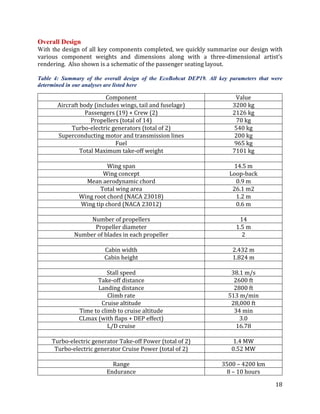
With the design of all key components completed, we quickly summarize our design with
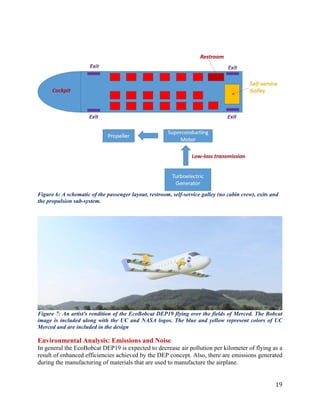
various component weights and dimensions along with a three-dimensional artist’s
rendering. Also shown is a schematic of the passenger seating layout.
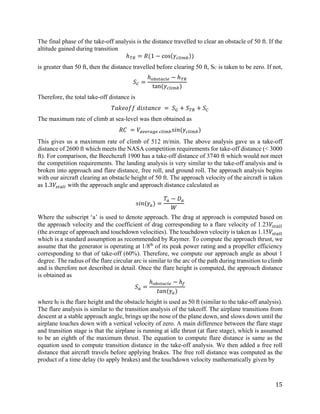
Table 4: Summary of the overall design of the EcoBobcat DEP19. All key parameters that were
determined in our analyses are listed here
Component Value
Aircraft body (includes wings, tail and fuselage) 3200 kg
Passengers (19) + Crew (2) 2126 kg
Propellers (total of 14) 70 kg
Turbo-electric generators (total of 2) 540 kg
Superconducting motor and transmission lines 200 kg
Fuel 965 kg
Total Maximum take-off weight 7101 kg
Wing span 14.5 m
Wing concept Loop-back
Mean aerodynamic chord 0.9 m
Total wing area 26.1 m2
Wing root chord (NACA 23018) 1.2 m
Wing tip chord (NACA 23012) 0.6 m
Number of propellers 14
Propeller diameter 1.5 m
Number of blades in each propeller 2
Cabin width 2.432 m
Cabin height 1.824 m
Stall speed 38.1 m/s
Take-off distance 2600 ft
Landing distance 2800 ft
Climb rate 513 m/min
Cruise altitude 28,000 ft
Time to climb to cruise altitude 34 min
CLmax (with flaps + DEP effect) 3.0
L/D cruise 16.78
Turbo-electric generator Take-off Power (total of 2) 1.4 MW
Turbo-electric generator Cruise Power (total of 2) 0.52 MW
Range 3500 – 4200 km
Endurance 8 – 10 hours
19
Figure 6: A schematic of the passenger layout, restroom, self-service galley (no cabin crew), exits and
the propulsion sub-system.
Figure 7: An artist's rendition of the EcoBobcat DEP19 flying over the fields of Merced. The Bobcat
image is included along with the UC and NASA logos. The blue and yellow represent colors of UC
Merced and are included in the design
Environmental Analysis: Emissions and Noise
In general the EcoBobcat DEP19 is expected to decrease air pollution per kilometer of flying as a
result of enhanced efficiencies achieved by the DEP concept. Also, there are emissions generated
during the manufacturing of materials that are used to manufacture the airplane.
20
Figure 8: The dimensioned three-view drawing of the EcoBobcat DEP19 along with an isometric view
For example, the four primary materials that were considered as candidates for the EcoBobcat
were aramid reinforced epoxy, epoxy SMC (carbon fiber), aluminum, 518, and aluminum 2297.
The carbon emission produced when each material is manufactured can be measured as the amount
of CO2 produced per unit mass of the material, which is called a material’s carbon footprint. The
CO2 footprint is 12-13 for aramid reinforced epoxy, 10.7-11.8 for epoxy SMC, 14.7-16.2 for
aluminum 518, and 12.2-13.4 for aluminum 2297 measured in kg per kg. When compared to the
list of 169 potential materials outlined in the material selection section above, these materials
ranked 20th, 3rd, 139th, and 31st respectively. Clearly, using aluminum increases the emissions
during production and hence the use of epoxy SMC as in the case of the EcoBobcat DEP19 will
go a long way in reducing emissions. For example, using epoxy SMC will lead to 14000 kg lesser
carbon emission when compared to using aluminum 2297. Apart from emissions during
manufacturing, the EcoBobcat DEP19 will also lead to significantly lesser emission in flight. The
Beechcraft 1900 (our baseline aircraft) carries 2000 kg for a range of 2700 km which is equivalent
to 1.35 km/kg of fuel. The EcoBobcat DEP19 performs significantly better with about 1000 kg of fuel
for a range of 3500 km translating to 3.5 km/kg of fuel. We also propose the use of a blend of
traditional aviation fuel and biofuel which will also lead to a decrease in emissions. Overall, the team
has made every effort to reduce emissions through multiple routes. However, the exact decrease in
emissions can be quantified only during later stages of the design.
Aircraft noise has been established as major concern as a result of several health consequences
after long term exposure to it. Some of the health risks include hearing impairment, hypertension,
ischemic heart disease, and sleep disturbance. The people most likely at risk are frequent flyers
and those who live in high traffic communities. In order to decrease these health risks while
maintaining the growth of air traffic, new aircraft designs are increasing emphasis on the reduction
of noise levels. Aircraft noise is mainly caused by the formation and propagation of waves due to
air compression in and around a moving aircraft during takeoff and landing. The two prominent
types of aircraft noise are airframe and engine noise. The levels of airframe noise depends on the
21
aerodynamics of the plane’s fuselage, wings, control surfaces and undercarriage. The levels of
engine noise depends on the sounds generated by the propellers and moving parts of the engine
(turbo-electric generator in the case of EcoBobcat DEP19).
The use of a DEP concept plays a significant role in decreasing noise of the propulsion system
since the burden of producing thrust is divided among many propellers. If an aircraft uses two
turboprop engines (and hence two propellers), their size is inherently larger than a similar aircraft
that uses 14 propellers. A larger propeller dimension leads to higher tip speeds in the compressible
regime thereby leading to significantly more noise. While not very intuitive, two large propellers
will be much more noisy than 14 of the small propellers that our DEP aircraft will use. Also, the
fact that we use superconducting motors with fewer moving parts in comparison to traditional
motors will lead to noise reduction. Once again just as in the case of emissions, we have been very
cautious in order to maximize the noise reduction.
In order to further reduce airframe noise the current design could be modified to implement wing
morphing technology. Wing morphing adds considerable aerodynamic advantages to the aircraft
since it would replace slats and flaps and will be able to dynamically change the shape of the wing
based on the flight. To reduce undercarriage airframe noise the landing gear could have its small
components such as the hydraulic lines be placed in dead zones of the airflow by being placed
behind or enclosed by bigger components. Another method of reducing airframe noise would be
to implement vertical take-off and landing.
Cost Analysis
Cost analysis for the EcoBobcat DEP19 was done using the Development and Procurement Costs
of Aircraft (DAPCA) guidelines outlined in Raymer’s book [7]. Analysis was separated into 2
major phases, Manufacturing and Operations. Within the manufacturing phase, cost is broken
down into two groups. These two groups are known as RDT&E and Fly-away. RDT&E costs
includes research, development, testing, and evaluation. Fly-away cost includes both material and
labor. Using the DAPCA equations listed in Raymer’s book, the required hours to complete:
engineering, tooling, manufacturing, and quality control were estimated and multiplied by the
standard hourly rate. Development support, flight-test, and material costs can also be directly
estimated using DAPCA equations which are empirically calibrated and commonly used. For the
purpose of cost analysis, it was assumed that 695 units will be manufactured since the units cost
for Beechcraft 1900 was available based on 695 units manufactured. An increase in production
quantity would result in a decrease in manufacturing cost. This decrease in cost is a result of the
“learning curve” effect. That is, as production increases, the better the manufacturing work force
gets at producing each component, resulting in a decrease in hours needed for each phase.
According to Raymer, as production quantity is doubled the cost of labor per plane goes down by
about 20%. It is also important to recognize that the values calculated using these equations have
results in 1986 dollars and must be inflated to today’s dollars using the consumer price index (CPI).
The DAPCA equations depend primarily on the aircraft empty weight, maximum velocity,
production quantity, number of flight test aircraft, number of engines, engine maximum thrust,
engine maximum Mach number, and Turbine inlet temperature. We initially obtain the total
number of engineering hours that include the airframe design and analysis, test engineering,
configuration control, and system engineering. Engineering hours are primarily expended during
the RDT&E stage but there is some engineering aspect even during the production stage.
22
Tooling hours embrace all of the preparation for production: design and fabrication of the tools
and fixtures, preparation of molds and dies, programming for numerically-controlled
manufacturing, and development and fabrication of production test apparatus. Tooling hours also
cover the ongoing tooling support during production. Manufacturing labor is the direct labor to
fabricate the aircraft, including forming, machining, fastening, subassembly fabrication, final
assembly, routing (hydraulics, electrics, and pneumatics), and purchased part installation (engines,
avionics, subsystems, etc). The equation below includes the manufacturing hours performed by
airframe subcontractors, if any. Quality Control is actually a part of manufacturing, but is estimated
separately. It includes receiving inspection, production inspection, and final inspection. Quality
Control inspects tools and fixtures as well as aircraft subassemblies and completed aircraft. The
RDT&E phase includes development support and flight-test costs. Development-support costs are
the nonrecurring costs of manufacturing support of RDT&E, including fabrication of mockups,
iron-bird subsystem simulators, structural test articles, and various other test items used during
RDT&E. In DAPCA these costs are estimated directly, although some other models separately
estimate the labor and material costs for development support. Flight-test costs cover all costs
incurred to demonstrate airworthiness for civil certification or Mil-Spec compliance except for the
costs of the flight test aircraft themselves. Costs for the flight-test aircraft are included in the total
production-run cost estimation. Flight-test costs include planning, instrumentation, flight
operations, data reduction, and engineering and manufacturing support of flight testing.
Manufacturing materials-the raw materials and purchased hardware and equipment from which
the aircraft is built-include the structural raw materials, such as aluminum, steel, or graphite
composite, plus the electrical, hydraulic, and pneumatic systems, the environmental control
system, fasteners, clamps, and similar standard parts.
All costs were estimated using a total production quantity of 695. The number of flight test aircraft
was taken as 1. The total number of engineering hours for the EcoBobcat DEP19 were then
obtained as 1.28 million hours. Similarly, the number of tooling hours, manufacturing hours and
quality control hours were obtained as 1.07 million hours, 6.67 million hours and 1.77 million
hours. To obtain the corresponding costs, Raymer recommends hourly rates that include salaries,
benefits, overhead and administrative costs. These rates are $59.10 for engineering, $60.70 for
tooling, $55.40 for quality control, and $50.10 for manufacturing. Therefore the total costs were
determined as
Similarly, the development support cost, flight test cost, manufacturing materials cost, engine
production cost and avionics cost were estimated as $13.61 million, $2.69 million, $1.27 million,
$1.02 million and
Therefore, the unit cost is obtained as $3.7 million for the entire process and $3.25 million if only
manufacturing costs are included. While this amount is in 1986 dollars, using an inflation
calculator shows that this would be equivalent to $8.066 million for total unit cost and $7.085
million for manufacturing costs. This would be slightly more expensive than the Beechcraft 1900’s
cost of $4.995 million in 2001 dollars ($6.74 million in 2016 dollars). However the EcoBobcat
DEP19 significantly outperforms the Beechcraft 1900 (in several performance parameters
including range, endurance etc.) thereby making it an attractive aircraft for customers.
23
The second phase of cost analysis comes in the form of operating costs. Included in operation cost
is fuel, oil, air crew, maintenance and insurance. Like with the manufacturing cost, DAPCA
equations were once again used to estimate cost for both maintenance and crew salaries. For both,
the costs are estimated in per block hour amounts. This means the costs are estimated per hour,
beginning when the “blocks” are removed from the tires before takeoff, to when they are once
again place behind the tires after landing. Using block hours allows the estimated cost to include
flight time, ground/air holding time, or any other delays. Two-man Aircrew cost per block hour
can be calculated using the following equation (from Raymer)
Two-man Crew = 35 �𝑉𝑉𝑐𝑐
𝑊𝑊𝑜𝑜
105�
0.3
+ 84
In this equation Vc is the cruise velocity in knots, and W0 is the takeoff gross weight in lb. When
using this equation we get $148 per block hour. While crew salaries can vary significantly, Raymer
indicates that the above rate will provide a reasonable estimation (particularly for initial trade
studies and student design competitions). Using 2080 hours per year, we get total crew salary of
$0.3 million per year in 1986 dollars. This is equivalent to $0.65 million per year in 2016.
Maintenance expenses must be split into two parts, material and labor. In order to estimate the
labor cost, approximations were once again used from Raymer. The labor cost approximations for
maintenance man hours per flight hours is between 0.25 and 1 (for light aircraft). We used 0.5 for
our analysis and assumed 2080 flight hours per year. According to Raymer, the same hourly rates
used for manufacturing can be applied due to lack of more rigorous data. Therefore, we obtain
$52,104 per year in 1986 dollars or $0.11 million in 2016 dollars. Material maintenance cost per
hour was calculated using the following empirical equation provided by Raymer
𝑚𝑚𝑚𝑚𝑚𝑚𝑚𝑚𝑚𝑚𝑚𝑚𝑚𝑚𝑚𝑚 𝑐𝑐𝑐𝑐𝑐𝑐𝑐𝑐
𝐹𝐹𝐹𝐹
= 3.3 �
𝐶𝐶𝑎𝑎
106
� + 7.04 + �58 �
𝐶𝐶𝑒𝑒
106
� − 13 � 𝑁𝑁𝑒𝑒
In this equation, Ca is the cost of the plane minus the engine, while Ce is the cost of the engine. The
final estimated costs are calculated in dollars per flight hours. Once the amount is inflated using
the CPI, the total material maintenance cost is estimated to be $237 per flight hour and translates
to $1.07 million per year for 2080 flight hours per year. As for fuel costs, it can be estimated as
$1 per gallon of aviation fuel which in conjunction with a fuel density of 3.024 kg/gallon implies
$0.33 per kg. With EcoBobcat DEP19’s fuel consumption of about 100 kg/hr, the fuel cost is
$33/hour or $68,640 per year. With a 1% insurance cost, the final total estimated annual
operations cost is $1.92 million.
Safety and Risk Assessment
Among the various safety aspects, we first considered crashworthiness that refers to those design
characteristics that protect the passengers from injury or death at the event of a crash. The
fundamental principles of crashworthiness is often described using the acronym CREEP –
Container, Restraint, Energy Management, Environment and Post-crash factors (including fuel
system, fire and egress). EcoBobcat DEP19 uses a strong, enclosed fuselage structure to contain
the passengers and uses restraints that have good attachment strength and are suitably placed. The
restraints of EcoBobcat DEP19 will ensure that they transfer inertial loads from the occupants out
through the body’s strong skeletal structure rather than through soft tissue or vital organs. The
fuselage will utilize state-of-the-art energy absorbing technologies to effectively control the
24
deceleration and forces that passengers encounter. Such technologies will be incorporated into the
fuselage structure, landing gear and restraints. The cabin interior of EcoBobcat will be carefully
designed to minimize passenger injury by limiting the size of passenger flail envelope as well as
eliminating, relocating potential striking hazards. The final aspect of the CREEP acronym deals
with post-crash hazards that include fire prevention/containment as well as properly functioning
emergency egress.
Over the last decade, fire containment within the cabin of an aircraft has jumped considerably in
its level of importance. This is due to the increase in reliability and desire of electronic devices for
passengers on aircraft. In order to combat this growing concern, the EcoBobcat DEP19 will carry
an Emergency Fire Containment System (EFCS). The EFCS uses an automatic suppression system
with an aqueous solution to cool off and suppress fires. Once the internal temperature of the bag
gets above the set temperature, the solution is released to extinguish the item on fire within the
bag. According to the Fire containment concepts website, the EFCS.
• Contains and extinguishes PED and Lithium Battery fires.
• The EFCS effectively contains 98% all of the resultant smoke.
• The EFCS enables the ability to relocate a possible fire threat away from passengers, crew
and flight sensitive areas.
In addition to the EFCS, the EcoBobcat DEP19 will also carry standard fire extinguishers in case
of any fire emergency. The EcoBobcat DEP19 will also include an emergency egress system for
evacuation in case of an incident. The emergency exit will be located both in the front and rear and
will include an inflatable slide.
One other important safety concern that is worth discussing particularly in the context of
EcoBobcat DEP19 is propeller blade separation that occurs most often in propeller systems. With
the 14 propellers in our DEP-based aircraft, propeller separation becomes even more important to
consider. However, separation is most probable in propellers that have a variable pitch as opposed
to a fixed pitch system. Also, separation can happen during flight or on the ground. It is caused by
the combination of centrifugal forces due to having a high RPM and one or more of the following:
material fatigue, cracks, corrosion, damage, operation beyond design limitations, improper
servicing or maintenance procedures. When this incident occurs, it will cause propeller imbalance
which will lead to severe vibrations, decreased performance, decreased handling and increased
drag. Potential problems that can also arise, include the loss of control of the aircraft, damage to
the engine or any part of the aircraft, and injury to passengers if the blade penetrations the fuselage.
Since the EcoBobcat DEP19 has propellers that operate at low rpm and also have a fixed pitched,
the chances of propeller blade separation is lower than if it had higher RPM and/or variable pitch
propellers. Proper operation should be performed as it will lower the risks of problems when the
airplane is operating within design limits. Proper maintenance along with non-destructive testing
should be conducted to detect fatigue, cracks corrosion or damage on the propellers, and to repair
or replace any damaged components. Also, with a DEP system, the propeller imbalance, the
vibrations, and the decreased handling that are caused by blade separation aren't as severe as in an
airplane with fewer propellers. Specifically, even if one or two propellers on one side of the plane
experience blade separation, the imbalance would be small as that side would still have 5/6
25
propellers operating which would only be one/two less than the other side. Also, the propellers on
the other side can be turned off suitably to ensure that the same number of propellers are in
operation on both sides. A slightly more important potential issue for the proposed aircraft is fan
burst in the turbo-electric generator which can be prevented by proper design, choice of materials
and maintenance.
Summary and Recommendations
To conclude our design study, we presented the preliminary design of EcoBobcat DEP19 which is
a 19 passenger + 2 crew aircraft that uses distributed electric propulsion (DEP) to generate the
thrust. The design process began with data collection of similar aircraft and a shortlist of three
aircraft which were good baselines for the mission requirements of the NASA competition. After
a comparison of potential materials including metallic and composites, we chose Epoxy Sheet
Molding Compound (Carbon fiber) as our primary material for the body of the aircraft. The
material selection was followed by a preliminary weight estimate and component-wise breakdown
with 3200 kg for the aircraft body (no engine, fuel and propellers), 2126 kg for payload, and 1775
kg for the propulsion system (including turbo-electric generators, motors, propellers and fuel)
thereby resulting in a total of 7101 kg or about 70 kN. We proposed the use of a novel looped-
back wing concept where the regular wing is looped back (with the use of a winglet-like structure)
to be attached to the fuselage near the tail region. Both components of the wing use a NACA 23018
airfoil at the root and a NACA 23012 airfoil at the tip. The wing span was chosen as 14.5 m with
a root chord of 1.2 m and a tip chord of 0.6 m a mean aerodynamic chord of 0.9 m. The total wing
planform area of the looped-back wing is 26.1 m2
. The DEP concept was implemented using 14
propellers attached to the wings (4 on each side of the forward wing and 3 on each side of the
looped-back wing). The size of the propellers was chosen as 1.27 m (50 in) and all propellers
operated at 1000 rpm resulting in relatively low tip speeds and noise. The propellers are driven by
superconducting motors which in turn are driven by turbo-electric generators mounted near the
wingtips. The generators were sized using a standard system-level analysis and were designed to
operate using an air mass flow rate of 2 kg/s. The maximum power rating of each engine was
obtained as 0.7 MW. The mass of the entire propulsion system was obtained as 820 kg with room
for 955 kg for fuel. The aircraft performance parameters were obtained including a range greater
than 3500 km, endurance greater than 8 hours, take-off length of 2600 ft, landing length of 2800
ft, climb rate of 513 m/min. The aircraft met all requirements of the competition and surpassed the
performance of comparable existing aircraft. Structural analyses were also presented for load
factors of 2.5 and -1 and the wing structure was able to withstand the loads produced. The
information was used to obtain the V-n diagram of the EcoBobcat DEP19. While our design team
performed a comprehensive preliminary analysis of the aircraft, future efforts should focus on
validating the design through careful tests – both computational and experimental. More in-depth
studies will likely to more accurate estimates for all of the parameters. The team also plans to keep
an eye for any technology enhancements including in superconducting motors, as well as materials
that could lead to additional weight reductions and performance enhancements. In summary, the
EcoBobcat DEP19 is a good representation of an aircraft that can be expected to be flown in future
given the significant advantages of using DEP.
26
References
[1] U. Schumann, "The impact of nitrogen oxides emissions from aircraft upon the atmosphere
at flight altitudes - results from the AERONOX project," Atmospheric Environment, pp.
1723 - 1733, 1997.
[2] I. Kohler, R. Sausen and R. Reinberger, "Contributions of aircraft emissions to the
atmospheric NOx content," Atmospheric Environment, vol. 31, no. 12, pp. 1801 - 18, 1997.
[3] D. Daggett, O. Hadaller, R. Hendricks and R. Walther, "Alternative fuels and their potential
impact on aviation," National Aeronautics and Space Administration NASA/TM 214365,
2006.
[4] A. Stevanovic, J. Stevanovic, K. Zhang and S. Batterman, "Optimizing traffic control to
reduce fuel consumption and vehicular emission: Integrated approach with VISSIM,
CMEM, and VISGAOST," Transportation Research Record: Journal of the transportation
research board, vol. 2128, pp. 105 - 113, 2009.
[5] A. S. Gohardani, G. Doulgeris and R. Singh, "Challenges of future aircraft propulsion: A
review of distributed propulsion technology and its potential application for the all electric
commercial aircraft," Progress in Aerospace Sciences, vol. 47, no. 5, pp. 369 - 91, 2011.
[6] A. M. Stoll, J. Bevirt, M. D. Moore, W. J. Fredericks and N. K. Borer, "Drag reduction
through distributed electric propulsion," in 14th AIAA Aviation Technology, Integration and
Operations Conference, 2014.
[7] D. P. Raymer, Aircraft Design: A Conceptual Approach, AIAA, 2012.
[8] P. Jackson, Jane's All the World's Aircraft (2004 - 2005), 2004.
[9] C. Edupack, Materials Database, Cambridge: Granta Design Limited, 2012.
[10] D. J. Roskam, Airplane Design: Part I: Prelininary Sizing of Airplanes, vol. 2, Lawrence,
Kansas: Design, Analysis and Research Corporation.
[11] X. Software, "www.xflr5.com," [Online].
[12] P. J. Masson and C. A. Luongo, "High power density superconducting motor for all-electric
aircraft propulsion," Applied Superconductivity, vol. 15, no. 2, pp. 2226 - 2229, 2005.
[13] J. L. Felder, H. D. Kim and G. V. Brown, "Turbo-electric distributed propulsion engine cycle
analysis for hybrid-wing-body aircraft," in 47th AIAA Aerospace Sciences Meeting, Orlando,
FL, 2009.
[14] B. W. McCormick, Aerodynamics, Aeronautics and Flight Mechanics, New York: Wiley,
1979.
[15] S. Farokhi, Aircraft Propulsion, 2014.
[16] http://www.azom.com/article.aspx?ArticleID=949. [Online].
27
Mailing Address for Certificates
Venkattraman Ayyaswamy
University of California Merced
5200 N. Lake Rd
Merced CA 95343
U N I V E R S I T Y O F C A L I F O R N I A
S C H O O L O F E N G I N E E R I N G U N I V E R S I T Y O F C A L I F O R N I A , M E R C E D
VENKATTRAMAN AYYASWAMY 5 2 0 0 N . L A K E R O A D
ASSISTANT PROFESSOR M E R C E D , C A L I F O R N I A 9 5 3 4 4
E M A I L : v a y y a s w a m y @ u c m e r c e d . e d u P H O N E : ( 2 0 9 ) 2 2 8 - 4 4 1 1
P H O N E : ( 2 0 9 ) 2 2 8 2 3 5 9 F A X : ( 2 0 9 ) 2 2 8 - 4 0 4 7
BERKELEY • DAVIS • IRVINE • LOS ANGELES • MERCED • RIVERSIDE • SAN DIEGO • SAN FRANCISCO SANTA BARBARA • SANTACRUZ
May 23rd
2016
To whom it may concern,
I am writing this letter in my capacity as faculty mentor of the team from University of California Merced
who are submitting an entry to the NASA University Design Competition. I would like to affirm that
the students are submitting their original work to the competition. They have come with a design –
EcoBobcat E19 that satisfies all requirements of the competition.
Please do not hesitate to get in touch with me either by email (vayyaswamy@ucmerced.edu) or by phone
(209) 228 2359 if you have any questions.
Regards,
Venkattraman Ayyaswamy
Venkattrama
n Ayyaswamy
Digitally signed by Venkattraman
Ayyaswamy
DN: cn=Venkattraman Ayyaswamy,
o=University of California, Merced,
ou=School of Engineering,
email=vayyaswamy@ucmerced.edu,
c=US
Date: 2016.05.20 23:57:02 -07'00'
U N I V E R S I T Y O F C A L I F O R N I A
S C H O O L O F E N G I N E E R I N G U N I V E R S I T Y O F C A L I F O R N I A , M E R C E D
VENKATTRAMAN AYYASWAMY 5 2 0 0 N . L A K E R O A D
ASSISTANT PROFESSOR M E R C E D , C A L I F O R N I A 9 5 3 4 4
E M A I L : v a y y a s w a m y @ u c m e r c e d . e d u P H O N E : ( 2 0 9 ) 2 2 8 - 4 4 1 1
P H O N E : ( 2 0 9 ) 2 2 8 2 3 5 9 F A X : ( 2 0 9 ) 2 2 8 - 4 0 4 7
BERKELEY • DAVIS • IRVINE • LOS ANGELES • MERCED • RIVERSIDE • SAN DIEGO • SAN FRANCISCO SANTA BARBARA • SANTACRUZ
May 23rd
2016
Disclosure Statement
The entire team would like to confirm that none of us received any funding from NASA during the course
of this effort. This includes both the faculty mentor (Venkattraman Ayyaswamy) as well as the students
(Carlos Benavente, Derek Hollenbeck, Fernando Luevanos, Francisco Torres, Daniel Cardenas, Luis
Menendez , Jason Dwelle, Christopher Lopez, and Thomas Peev).

UCMerced_Benavente

  • 1.
    i NASA DEP UniversityDesign Competition Report EcoBobcat DEP19 Carlos Benavente1 Derek Hollenbeck1 Fernando Luevanos1 Daniel Cardenas1 Francisco Torres1 Luis Menendez1 Jason Dwelle1 Christopher Lopez1 Thomas Peev2 Faculty Advisor: Venkattraman Ayyaswamy3 1 Mechanical Engineering Undergraduate 2 Materials Science and Engineering Undergraduate 3 Assistant Professor, Mechanical Engineering
  • 2.
    ii Abstract In this report,we summarize the preliminary design of EcoBobcat DEP19, a 19 passenger + 2 crew aircraft that uses distributed electric propulsion (DEP) to generate the thrust. The design process begins with data collection of similar aircraft and a shortlist of three aircraft which are good baselines for the mission requirements of the NASA competition. After a comparison of potential materials including metallic and composites, we choose Epoxy Sheet Molding Compound (Carbon fiber) as our primary material for the body of the aircraft. The material selection is followed by a preliminary weight estimate and component-wise breakdown with 3200 kg for the aircraft body (no engine, fuel and propellers), 2126 kg for payload, and 1775 kg for the propulsion system (including turbo-electric generators, motors, propellers and fuel) thereby resulting in a total of 7101 kg or about 70 kN. We propose a novel looped-back wing concept where the regular wing is looped back (with the use of a winglet-like structure) to be attached to the fuselage near the tail region. Both components of the wing use a NACA 23018 airfoil at the root and a NACA 23012 airfoil at the tip. The wing span is chosen as 14.5 m with a root chord of 1.2 m and a tip chord of 0.6 m resulting in a mean aerodynamic chord of 0.9 m. The total wing planform area of the looped- back wing is 26.1 m2 . The DEP concept is implemented using 14 propellers attached to the wings (4 on each side of the forward wing and 3 on each side of the looped-back wing). The size of the propellers is 1.27 m (50 in) and all propellers operate at 1000 rpm resulting in relatively low tip speeds and noise. The propellers are driven by superconducting motors which in turn are driven by turbo-electric generators mounted near the wingtips. The generators are sized using a standard system-level analysis and are designed to operate using an air mass flow rate of 2 kg/s. The maximum power rating of each engine is obtained as 0.7 MW. The mass of the entire propulsion system is 820 kg with room for 955 kg for fuel. The aircraft performance parameters are obtained including a range greater than 3500 km, endurance greater than 8 hours, take-off length of 2600 ft, landing length of 2800 ft, climb rate of 513 m/min. The aircraft therefore meets all requirements of the competition. Structural analyses are also presented for load factors of 2.5 and -1 and the wing structure was able to withstand the loads produced. The information iss used to obtain the V- n diagram of the EcoBobcat DEP19. We believe the EcoBobcat DEP19 is a good representation of an aircraft that can be expected to be flown in future given the significant advantages of using DEP.
  • 3.
    iii Table of Contents Introduction................................................................................................................................................................1 DesignStrategy .........................................................................................................................................................1 Preliminary Design..................................................................................................................................................2 Preliminary Empty Weight .................................................................................................................................4 Propulsion System Design....................................................................................................................................7 Propeller Design .......................................................................................................................................................7 Performance Analysis ......................................................................................................................................... 13 Overall Design........................................................................................................................................................ 18 Environmental Analysis: Emissions and Noise........................................................................................ 19 Safety and Risk Assessment ............................................................................................................................. 23
  • 4.
    1 Introduction With the rapidincrease in the number of airplanes that currently decorate the sky, there is a growing concern on the harmful effects they have on our environment. Of all the concerns, the harmful effects of NOx emissions [1, 2] are one of the most significant and there are several efforts underway to reduce emissions using more efficient engines, alternate fuels [3] and better air traffic management [4]. In this regard, electric aircraft present an attractive zero-emission option while the aircraft is in operation. While the energy production itself will still produce emissions if the source is non-renewable (such as producing electricity by burning coal), this can be controlled and being able to operate electric aircraft will certainly go a long way in decreasing the effects of harmful emissions. Apart from the obvious green effect of electric aircraft, there are less obvious advantages that such technology can lead to. Specifically, electric aircraft technology can lead to paradigm shifts in the way airplanes are designed and one such alternative design strategy is the concept of Distribution Electric Propulsion (DEP) [5, 6]. As an example, NASA researchers have proposed a DEP concept referred to as Leading Edge Asynchronous Propellers Technology (LEAPTech) [6] that has been an active area of research over the past few years. The DEP concept provides the freedom to locate a large number propellers (that are driven by small motors) at strategic locations on the wing to lead to other performance enhancements. For example, the LEAPTech aircraft uses propellers that blow the wing during take-off and landing thereby increasing the dynamic pressure over the wings and lowering the stall speed. While other high-lift and flow control strategies can lead to a similar enhancement in take-off and landing performance, the DEP concept leads to other multi-disciplinary advantages resulting in a synergy between aerodynamics and propulsion. In spite of the attractive features of DEP, it is still a futuristic concept and requires careful analysis before commercial passenger aircraft using this technology are flown. Even the LEAPTech aircraft that NASA researchers have been studying is a four-seater aircraft. In this regard, the primary goal of the current design competition is to explore the benefits of using DEP on a typical commercial aircraft by proposing a complete on-paper design. Apart from the design, we also present performance analysis to demonstrate the feasibility of a commercial DEP aircraft. Design Strategy The overall design of the proposed aircraft (named EcoBobcat DEP19 to account for its eco- friendly nature as well as emphasize the connection with the mascot of the University of California Merced) was broken into three main categories: preliminary, critical, and overall design. This was done to showcase the design process and final design selections based off the competition design and mission requirements. As part of the NASA ARMD challenge, several design constraints are required to be satisfied by the proposed design and are briefly summarized below. The mission requirements included a 19 passenger seating capacity with 31-inch seat pitch, cruise speed of 250 mph, service ceiling of 28,000 ft, takeoff & landing field length of 3000 ft at maximum takeoff weight at standard atmospheric conditions, Also included was the ability to fly in all weather (including icing conditions) with a structural design criteria of +2.5/-1.0 g loading and safety factor of 1.5. There is also a requirement to maintain a fuel reserve requirement as per the Federal Aviation Regulations (FAR) under Instrument Flight Regulation (IFR) conditions. This fuel requirement says that we must carry enough reserve such that 1. Complete the flight to the first airport of intended landing; 2. Fly from that airport to the alternate airport;
  • 5.
    2 3. Fly afterthat for 45 minutes at normal cruising speed It will be shown that our aircraft can satisfies all of these requirements. Preliminary Design In the preliminary design we looked at the main design requirements and goals to evaluate conceptual design platforms based on figures of merit (FOM). The essential parameters need of the aircraft were determined first then were compared with already available aircraft. The first step in our aircraft design process [7] was the data collection step which allows the choice of a starting point for the design. For example, even though every aircraft in the Boeing or Airbus series has its own unique features, the similarities in them cannot be discounted. The criteria used to determine the conceptual design were based on flight parameters, cost of the system, and uniqueness of the platform. • Mission Requirements – The main parameters looked at were number of passengers, cruise speed, range, and service ceiling. All aircraft looked at meet initial design requirements • Cost – The average aircraft cost was used to determine the most economical choice. • Uniqueness – As a design challenge we wanted to include a uniqueness factor for selection as we wanted to contribute an innovative solution to the design problem. In fact, we present a novel wing concept which we believe is a strength of our design. A list of aircraft was gathered and compiled into Table 1 and carefully chosen based on the criteria mentioned above. While most parameters were determined from Jane’s All the World Aircraft [8], some parameters were not available and are not included in the table. Once the preliminary list of similar aircraft was compiled, we short-listed three aircraft from this table to design the EcoBobcat DEP19. The three short-listed aircraft included the BAE Jetstream 31, Dornier Do 228 and Beechcraft 1900. The design team then performed a figure-of-merit analysis for the short-listed aircraft based on three quantities including mission requirements (60% weightage), cost (20% weightage) and uniqueness (20% weightage). The team assigned points for each figure-of-merit quantity to determine an overall score for each of the three aircraft. Based on Table 1 and the findings of Table 2, the team found that the best platform to work from is the Beechcraft 1900. In other words, the conceptual design will be based off the Beechcraft 1900’s bottom wing, T-tail configurations with the tricycle landing gear. However, as will be clear in subsequent sections, we used a novel wing design wherein the regular wings are connected back to the fuselage (at a location near the tail) through an auxiliary wing. We refer to this concept as a loop-back wing. Table 1: Summary of preliminary data collection of various aircraft with comparable mission requirements Beechcraft 1900 L- 410 Do 228 EMB 110 SC.7 Skyvan An- 28 B.A Jetstre am Gulfstrea m IV Dassault Falcon 7X Passengers/ Crew 19/2 19/ 19/2 18/2 19/2 18/2 19/2 19/2 19/3 Length (m) 17.62 14.4 16.56 15.1 12.21 12.98 14.37 27.2 23.38 Wingspan (m) 17.64 19.5 16.97 15.33 19.78 22.00 15.85 23.7 26.21 Height (m) 4.72 5.83 4.86 4.92 4.6 4.6 5.32 7.67 7.93
  • 6.
    3 Empty weight (kg) 4732 39853739 3393 3331 3900 4360 19700 15465 Max. weight (kg) 7764 6400 6400 5900 5670 6100 6950 32200 31750 Max Speed (km/h) 413 325 355 488 935 953 Cruise Speed (km/h) 518 (at 20000 ft) 365 352 341 317 335 426 850 900 Range (km) 2700 1380 1111 1964 1117 510 1260 8060 11000 Service Ceiling (m) 7620 6320 8500 6550 6858 6000 7620 13700 15500 Rate of climb (m/s) 13.28 7.4 7.5 8.3 8.33 12.0 10.6 Wing loading (kg/m2 ) 136.6 146 276 435 Power/mass (kW/kg) 0.250 0.201 Material Selection Determination of the material used for the aircraft body crucial for all other performance parameters. The properties of the material determine the ceiling service altitude, the maximum speed, and the weight of the aircraft. Materials used in the aerospace industry include aluminum alloys, titanium alloys, as well as other composite materials. Other materials previously used include steel alloys and wood. Based on a literature survey, the materials considered as candidates included Al 2024-T3, Al 3003-H14, Al 5052-H32, Al 6061-T6, Al 7075, and Ti6Al4V (Grade 5). Table 3 below summarizes the properties of these materials. We are interested in materials with high stiffness, high strength, high toughness, and low density. These figures of merit were used to determine materials with comparable or superior material properties. Using a well-established materials database (CES Edupack) [9], 169 potential materials were ranked based on their density, strength as well as CO2 footprint. The four short-listed materials were determined to be Epoxy/aramid fiber UD composite, Epoxy SMC (carbon fiber), Al 518.0 F, and Al 2297-T87. It should be noted that the first two selections are composite materials, while the Al alloys are metallic. It is worth mentioning that aircraft are traditionally not manufactured using a single material, but comprises of a selection of different materials, each specialized for their application. Also, current aircraft (including Boeing 787) are not exclusively built out of composites, and the high cost is not the only reason for that. It is also difficult to recycle composite materials compared to aluminum alloys. Replacing aluminum parts in planes with carbon fiber parts can reduce the overall weight of the plane by up to 20%. For example, the Boeing 787 is modeled closely after the Boeing 747, but the Boeing 787 is significantly lighter (by about 20%) since it includes advanced composites in its construction. Due to the weight reduction, the Boeing 787 Dreamliner model is said to be more fuel efficient than other aircraft of similar size. Carbon fiber is more expensive than aluminum due to the molding process required (also included in our cost analysis by doubling the values obtained for aluminum), but this may also be beneficial in the long run. By using carbon fiber, aircraft can be molded in fewer pieces. As an example, the wings can be molded with the fuselage thus making it more aerodynamic. This could be advantageous because of the use of fewer parts such as fasteners and adhesives. Another benefit of the carbon fiber is that the material is more durable and would require less maintenance. Aluminum airplanes often need to
  • 7.
    4 be maintained toavoid corrosion, but carbon fiber planes would require very little maintenance. While carbon fiber is a great material, there was one major problem with it. When struck by lightning, carbon fiber is completely shredded. In order to avoid such problem, small strands of metal are woven into the material to decrease the damage caused by lightning. Based on all these considerations, the team finalized that the structural support and parts of the plane skin should be made out of Epoxy SMC (carbon fiber), which is lightweight, strong, and has a low carbon footprint during its production. Figure 1: Images of BAE Jetstream, Dornier Do 228 and Beechcraft 1900 - our baseline aircraft Table 2: Summary of figure-of-merit analysis used to determine the short-list of baseline aircraft BAE Jetstream 31 Dornier Do 228 Beechcraft 1900 Mission (60%) 5 4 7 Cost (20%) 10 5 7 Uniqueness (20%) 5 5 5 Total 6 4.4 6.6 Preliminary Empty Weight In order to estimate the preliminary empty weight [10] of the EcoBobcat DEP19, we go back to our survey of comparable aircraft. Among the three short-listed aircraft empty weights, the Dornier Do 228 has the minimum empty weight and the Beechcraft has the maximum empty weight. We start-off with an empty weight of 4300 kg which is between the values of Do 228 and Beechcraft and incidentally agrees with the empty weight of the Jetstream 31. However, we anticipate a 20% savings (based on data from weight savings of Boeing 787) since the proposed aircraft will be manufactured using lightweight composite technology. This results in an empty weight of 3440 kg. However, it should be noted that this includes the engine weight and might be different for the EcoBobcat DEP19. Specifically, as discussed in detail in a subsequent section, the proposed aircraft will utilize two turbo-electric generators that will drive the DEP propellers distributed on the wing. The propeller weight will be added to the empty weight discussed above. The dry engine weight of the Beechcraft 1900 is about 240 kg (corresponding to two Pratt and Whitney Canada PT6 turboprop engines). Therefore the empty weight of the engine-less EcoBobcat DEP19 is estimated at 3200 kg. Assuming that the propulsion system will account for about 25% of the overall gross maximum take-off weight, and including payload at 21 people (19 passengers + 2 crew) with each person weighing 225 lb (NASA recommendation), the estimated total maximum take-off weight of the aircraft is obtained as 7101 kg corresponding to about 70 kN. The payload accounts for 2126.25 kg. Our estimations allow 1775.75 kg for the propulsion system and fuel which should be verified and updated while designing the turbo-electric generators, propellers and the motors that drive the propellers.
  • 8.
    5 Table 3: Summaryof properties of materials that are commonly used in existing aircraft - All data from EduPack 2015 Aerodynamic Design Once the material selection was completed, the team next focused on finalizing the aerodynamic design which includes airfoil selection, wing and tail design. While it could be argued that the extensive analysis on improving aerodynamic designs over the past several decades limits our ability to make significant improvements in existing efficiencies, the team performed some aerodynamic analyses to try to come up with a novel and yet efficient aerodynamic design which is discussed below. Also, use of the DEP concept is anticipated to lead to significant improvements in the aerodynamic characteristics as a result of the blowing effect it provides to the wings [6]. This will be accounted for in our design. Airfoil Selection For the airfoil selection of the design process we focused on the airfoils typically used by aircraft of similar size and flight parameters. We considered the root and tip airfoils used by BAE Jetstream 31, Beechcraft 1900, and Gulfstream IV. The final airfoil was selected based on several parameters including maximum lift coefficient, lift to drag ratio, and the pitching moment coefficient at cruise and take-off. The team finalized the use of a NACA 23018 as the root airfoil and a NACA 23012 as the tip airfoil. The reasoning for using two different airfoils is to generate higher amounts of lift at the root of the wing to reduce the structural stress from the high lift at the wing tips. The NACA airfoils are all similar but have some key differences. In particular, the four-digit number at the end of the NACA airfoils defines the shape of the airfoil. The first two digits characterize the camber and the last two digits define the thickness of the airfoil as a percentage of the chord length. The aerodynamic characteristics of the chosen airfoils and their dependence on the angle of attack were obtained using the well-established XFLR5 software [11]. XFLR5 uses a panel method to solve for flow past the given airfoil to obtain the performance coefficients (lift coefficient, drag coefficient and moment coefficient) as a function of angle of attack. While XFLR5 can perform both inviscid and viscous analysis, we included viscosity in all our analyses to capture airfoil stall and hence obtain the maximum lift coefficient. Figure 2 shows the variation of lift coefficient (Cl), drag coefficient (Cd) and lift-to-drag ratio as a function of angle of attack. The lift coefficient reaches a maximum of about 1.8 beyond which the airfoil stalls leading to a decrease in lift coefficient. The stall angle was determined to be about 160 . The maximum lift-to-drag ratio was obtained as 150 at an angle of attack of about 80 . However, the lift-to-drag ratio (L/D) for the entire aircraft is likely to be significantly lower. For example, an existing comparable aircraft (Beechcraft) has a cruise L/D of about 13.
  • 9.
    6 Wing Design The analysisperformed above is only for the two-dimensional airfoil and is used to obtain the finite wing aerodynamic characteristics as discussed below. As briefly mentioned earlier, the EcoBobcat DEP19 has a traditional wing which is looped back through a winglet structure to be connected to the fuselage near the tail region of the aircraft. We anticipate this design to have the advantages of both forward swept wing and backward swept wing. We began with an initial wingspan chosen as 14.5 m which translates to a total span of 29 m with the two wings. The two wings allow us to distribute a larger number of propellers without significant interaction between any two adjacent propellers. The mean aerodynamic chord was initially chosen as 0.9 m resulting in a total gross wing area of 26.1 m2 . The density at cruise conditions of 28,000 ft (taken to be same as the service ceiling specified in the competition mission requirements) was obtained from the International Standard Atmosphere as 0.4931 kg/m3 . The freestream temperature at cruise altitude was obtained as 233 K corresponding to a speed of sound of 306 m/s. A cruise speed of 275 mph (greater than the 250 mph prescribed in the competition requirements) was targeted initially. This translates to a cruise speed of 123 m/s and a cruise Mach number of 0.4 which would still classify this as a low speed aircraft. Since the preliminary estimate of the gross weight is already known as 70 kN, we then estimate the cruise CL of the EcoBobcat DEP19 using 𝐶𝐶𝐿𝐿 = 2𝑊𝑊 𝜌𝜌𝜌𝜌𝑉𝑉2 with the specified cruise density and velocity. The cruise CL is hence obtained as 0.72 which might seem to be on the higher side but is enabled by the blowing effect produced by the propellers distributed on the wing. To reiterate, the propellers induce an axial velocity on the wing which increases the relative velocity as seen by the wing thereby increasing the lift coefficient. For example, LEAPTech (the four-seater NASA aircraft with DEP) has a cruise CL of 0.77 in comparison with 0.3 for the Cirrus SR22 (an aircraft comparable to LEAPTech. Once the cruise CL is estimated, the cruise drag can be estimated to determine the thrust required at cruise to overcome this drag. A typical drag polar comprises of parasitic drag and the induced drag (drag due to lift) components and is represented as 𝐶𝐶𝐷𝐷 = 𝐶𝐶𝐷𝐷,0 + 𝐾𝐾𝐶𝐶𝐿𝐿 2 We estimate the parasitic drag coefficient to be 0.03 and using an aspect ratio of 16.11 (using the span and mean aerodynamic chord discussed earlier), and Ostwald’s efficiency factor = 0.80 gives K = 0.025 and a corresponding CD of 0.043. The cruise L/D is 16.78 which is higher than comparable aircraft and is enabled primarily by the use of DEP. The total estimated drag at cruise is therefore 4152 N and should be overcome by the thrust produced by the propulsion system that is designed next. While the propulsion system should produce about 4.2 kN during cruise, our design targets a maximum thrust of at least 20 kN to account for other missions such as take-off and climb (within reasonable time to service ceiling) as well as to exceed design requirements in spite of the approximations involved. Finally, the tail design was chosen as a well-established T- tail configuration with dimensions similar to the three baseline aircraft we chose earlier (dimensions specified in the 3-view drawing presented in Figure 8.
  • 10.
    7 Figure 2: Aerodynamiccharacteristics of the NACA 23018 and NACA 23012 at take-off and cruise conditions. The NACA 23018 and NACA 23012 are used as the root and tip airfoils in EcoBobcat DEP19. Propulsion System Design The EcoBobcat DEP19 will utilize the DEP concept not only to enhance the aerodynamic characteristics but also to produce thrust. The DEP system on the proposed aircraft includes a turbo-electric generator that will produce turbine power through traditional combustion. This turbine power will be transmitted to the propellers that are distributed along the wing. The transmission will be performed electrically (rather than mechanically) using superconducting motors [12, 13] and power lines. The rapid growth in superconducting electrical machines allows us to achieve this electrical transmission with a negligible weight penalty. The design specifications of each of these components is described in detail below. Propeller Design In an aircraft propelled by DEP, a large number of relatively small propellers (as opposed to two larger propellers) are distributed along the wing to produce thrust apart from aerodynamic enhancement of the wing. The design of each propeller includes choice of diameter, number of blades, pitch, and material. For the DEP concept, one must also specify the exact locations of these propellers on the wing (seen clearly in the artist’s rendition). We propose to utilize propellers with a diameter of 50 in. which translates to 1.27 m. Our design is also based on distributing a total of 14 propellers in total. The front wing will have 8 propellers (4 on each side) and the loop-back will have 6 propellers (3 on each side). The relatively small number of propellers on each side provides us with the maximum freedom in terms of their locations. Each propeller is then required to
  • 11.
    8 produce a thrustof 0.3 kN or 300 N (during cruise) and 1.5 kN during take-off and climb. The momentum theory (actuator disk theory) was then used to determine the power requirements for driving each propeller. It should be mentioned that a similar analysis was used to perform preliminary design of propellers of the LEAPTech [6]. The momentum theory in spite of involving approximations is an extremely useful technique for preliminary design of propellers. The momentum theory expresses the velocity far downstream of the propeller (Ve) in terms of the freestream velocity (V0) and thrust loading Tc as 𝑉𝑉𝑒𝑒 = 𝑉𝑉0�1 + 𝑇𝑇𝑐𝑐 where Tc is a non-dimensional thrust defined as 𝑇𝑇𝑐𝑐 = 2𝑇𝑇 𝜌𝜌𝑉𝑉0 2 𝐴𝐴𝑝𝑝 With Ap being the propeller area. The velocity at the propeller disk location (Vd) is the average of Ve and V0 and therefore in terms of Tc is given by 𝑉𝑉𝑑𝑑 = 𝑉𝑉0(1 + �1 + 𝑇𝑇𝑐𝑐) 2 The total power required to drive the propeller is then obtained as 𝑃𝑃 = 1 4 𝑇𝑇𝑐𝑐 𝜌𝜌𝑉𝑉0 2 𝐴𝐴𝑝𝑝 𝑉𝑉0(1 + �1 + 𝑇𝑇𝑐𝑐) Utilizing these equations for the propellers of the EcoBobcat DEP19, the value of Tc is given by 0.0635. The power requirement is then given by 37.47 kW for one propeller and adds to about 524.6 kW for all 14 propellers. Assuming an efficiency of 0.8 for the propeller, the turbo-electric generator should produce a power of about 670 kW. The design of the turbo-electric generator will be discussed in a subsequent section. Also, the proposed propeller design uses a two-blade configuration. Ideally, the propeller diameter should be as large as possible since it can provide momentum to a larger volume of air thereby resulting in higher thrust. However, the tip speed of the propeller which is proportional to the radius as well as the angular speed should not be too high. Specifically, a common rule of thumb is to ensure that the tip Mach number does not exceed 0.85 or so. The more compressible the flow is near the propeller tip, the more noise it generates making it more uncomfortable for the pilot and passengers. The advance ratio J given by 𝐽𝐽 = 𝑉𝑉 𝑛𝑛𝑛𝑛 where V is the freestream velocity, n is the revolutions per second and D is the propeller diameter plays a major role in determining the efficiency of the propeller. A propeller diameter of 50 inches (1.27 m) and an angular speed of 16.67 revolutions per second (corresponding to 1000 rpm)
  • 12.
    9 ensures that Jis about 0.9245 for a cruise speed of 123 m/s. The tip speed of the propeller is only 133 m/s (corresponding to a Mach number of about 0.5) thereby preventing supersonic flow near the tip. The noise levels are also anticipated to be sufficiently low to ensure passenger comfort in the cabin. Both fixed-pitch and constant-speed (variable pitch) propellers were considered as options. While constant-speed propellers have the ability to control the blade pitch to ensure maximum efficiency at various operating conditions, they come with the disadvantage of weighing more than fixed-pitch propellers. We decided to choose a fixed-pitch propeller with the blade angle of about 20 degrees which would ensure peak efficiency for the propeller for an advance ratio of about 0.9245. To summarize, the proposed two-blade propeller of Eco-Bobcat DEP19 has a diameter (d) of 50 inches with a pitch of about 20 degrees and will be made of carbon fiber composites which in conjunction with the turbo-electric generator should produce sufficient thrust to meet the desired aircraft requirements. The advance ratio values encountered will ensure that the propeller efficiencies can be assumed to be about 80% at cruise and about 60% during take-off based on curves from McCormick [14] as shown in Figure 3. While a more careful optimization procedure should likely be adopted at later stages of the design, we conclude that this is a good representative propeller for the Eco-Bobcat DEP19. The mass of each propeller is estimated as 5 kg totaling 70 kg for all propellers. Figure 3: Variation of efficiency as a function of advance ratio for various blade angles. Figure reproduced from McCormick Turbo-electric Generator The power requirement quantified above will be met using two turbo-electric generators mounted near the tip region of the wings (see exact location in the artist’s rendition). This section will therefore present the sizing and analysis of the turbo-electric generators. The current design proposes the use of generators that are very similar to traditional gas turbine engines. The turbo- electric generator will take in a certain mass of air (depending on the inlet area) which will then be slowed down in a diffuser before being compressed to higher pressures. The high pressure air enters the combustion chamber where fuel is added and the exothermic combustion process increases the temperature. The high pressure, high temperature exhaust then drives a high-pressure turbine that is matched with the compressor. In other words, the compressor is driven using the power generated by the high pressure turbine. The gas then enters the low pressure turbine which produces power to drive all propellers of the DEP system before being exhausted through the nozzle. It should be mentioned that the nozzle will also produce a small amount of thrust but the
  • 13.
    10 generator is designedin such a way that most of the energy is used to drive the propellers. This is achieved by choosing the power split ratio (ratio of propeller power to total power available when the gas exits the high pressure turbine) to be 0.96. A standard black-box analysis [15] of the engine is performed by assuming state-of-the-art efficiencies and parameters for the diffuser, compressor, combustion chamber, turbine and nozzle with the design discussed below. The inlet are of the engine was chosen as 0.5 m which was suitable for an air mass flow rate of 2 kg/s. The ratio of specific heat was taken as 1.4 and the specific gas constant as 287 J/kg/K. The engine diffuser slows down the air adiabatically (isentropic flow is not possible due to friction and mild flow separation losses). While the shaping of the diffuser is beyond the scope of this system- level analysis, we assume a stagnation pressure loss of 0.8. The flow then enters the compressor with a pressure ratio of 10 and a polytropic efficiency of 0.90 (a good estimate for compressor flow). The compressor exit leads to the burner/combustion chamber and a burning efficiency of 0.99 along with a stagnation pressure loss (across the combustion chamber) of 0.975 was assumed. The flow exiting the combustor enters the high pressure turbine that runs the compressor with polytropic efficiency of 0.85 and a mechanical efficiency (for the shaft connecting the compressor to the high pressure turbine) of 0.99. Also, it is assumed that the turbine inlet temperature will be a maximum of 1560 K which is well below the temperature that can be handled by state-of-the-art materials. The exit of the high pressure turbine leads to the low pressure turbine with polytropic efficiency of 0.88. The low pressure turbine will produce the power that will drive all propellors and should therefore be able to generate about 1.3 MW during take-off. To reiterate 96% of the power available in the flow at the point of exiting the high pressure turbine will be extracted in the low pressure turbine and the remaining will be extracted through the nozzle. The remainder will be exhausted through the nozzle (efficiency of 0.95) and will produce a small thrust but is not accounted for in our design and will remain excess thrust (a buffer for possible errors due to approximations performed during the design). If more power is extracted by low pressure turbine, the nozzle will start producing a drag. The fuel will be a 50% blend of standard aviation fuel and biodiesel. Such a blend has been shown to lead to significant decrease in emissions. We now present a summary of our calculations for the turbo-electric generator performance at cruise and take-off. At cruise, the freestream temperature and pressure (from International Standard Atmosphere) are given by pa = 32932.4 Pa and Ta = 233 K respectively. The flow is assumed to be slowed down isentropically to determine the inlet conditions. The stagnation pressure and stagnation temperature at the exit of diffuser (entrance to compressor) are obtained as 𝑝𝑝02 = 𝑝𝑝𝑎𝑎 �1 + 𝛾𝛾 − 1 2 𝑀𝑀𝑎𝑎 2 � 𝜋𝜋𝑑𝑑 𝑇𝑇02 = 𝑇𝑇𝑎𝑎 �1 + 𝛾𝛾 − 1 2 𝑀𝑀𝑎𝑎 2 � where πd is the stagnation pressure loss across the diffuser and Ma is the freestream Mach number. We obtain p02 = 33306.51 Pa along with T02 = 240.5 K. It should be noted that the stagnation temperature remains the same at the inlet and exit of diffuser since flow across the diffusor is adiabatic but not isentropic. The stagnation pressure increases across the compressor and since the
  • 14.
    11 compressor does workon the fluid, the stagnation temperature increases across the compressor. The stagnation pressure and temperature at the compressor exit can be obtained as 𝑝𝑝03 = 𝑝𝑝02 𝜋𝜋𝑐𝑐 𝑇𝑇03 = 𝑇𝑇02 𝜋𝜋𝑐𝑐 (𝛾𝛾−1)/𝛾𝛾𝑒𝑒𝑐𝑐 with ec being the polytropic efficiency and πc being the compressor pressure ratio. The stagnation pressure and temperature at the compressor exit (combustor inlet) are given by 333065.12 Pa (3.29 atm) and 499.5 K respectively. The combustor analysis in conjunction with the maximum turbine inlet temperature (T04) was then used to determine the fuel fraction (upper limit) using 𝑓𝑓 = 𝑇𝑇04 − 𝑇𝑇03 𝑄𝑄𝑅𝑅 𝜂𝜂𝑏𝑏 𝐶𝐶𝑝𝑝 − 𝑇𝑇04 with QR being the heating value of the fuel assumed as 42,800 kJ/kg. The Cp value, strictly speaking, is a function of gas temperature but was assumed to be a constant in our analysis (based on a specific gas constant of 287 J/kg/K). While the maximum turbine inlet temperature is 1560 K and would correspond to the maximum fuel fraction leading to maximum power output, cruise conditions require much lower power. Using T04 = 1060 K, the fuel fraction was obtained as 0.0136 which is equivalent to 0.0272 kg/s for an air mass flow rate of 2 kg/s. The stagnation pressure at the combustor exit was obtained as 3.208 atm. The properties at the high pressure turbine exit were then obtained based on compressor matching and obtained as 802 K (stagnation temperature) and 1.02 atm (stagnation pressure). The power generated by the low pressure turbine was then obtained as 0.4 MW which, when two engines are included, would be sufficient to power all propellers during cruise (only 0.6 MW is required and so we have a small buffer to account for approximations). The exit velocity at the nozzle was obtained as 133.25 m/s which would produce a small thrust of 25 N per engine. To reiterate, this thrust was not accounted for in any of our calculations and is a buffer thrust. During take-off, the turbo-electric generator will be operated close to maximum power conditions and hence a higher turbine inlet temperature corresponding to a higher fuel consumption. The analysis described above when used for take-off conditions gave the following results. The freestream pressure and temperature were taken as 101325 Pa (1 atm) and 298 K with a freestream Mach number of 0.1. The stagnation conditions at the diffuser exit corresponded to 99497 Pa (0.982 atm) and T02 = 299 K. The stagnation conditions are the compressor exit were then obtained as 9.82 atm and 620 K. A turbine inlet temperature of 1560 K was used to obtain the fuel fraction as 0.023 which translates to a fuel flow rate of 0.045 kg/s during take-off and climb. The high pressure turbine runs the compressor and therefore the stagnation conditions at the exit of high pressure turbine was obtained as 3.75 atm and 1242 K. The power generated by the low pressure turbine was then obtained as 0.7 MW which (when two engines are included) can be used to drive the propellers during take-off and climb. The nozzle also produces a thrust of 293 N (per engine) with a exhaust velocity of 177 m/s. The mass of each engine is estimated to be 300 kg based on comparable engines. For example, several existing General Electric turboprop engines have a
  • 15.
    12 maximum power (inkW) to mass ratio (in kg) between 3.5 and 4.5. We utilize a conservative value of 2.6 to estimate the mass of each engine as 270 kg. The power generated by the low pressure turbine will be transmitted through superconducting power lines that will drive superconducting motors which in turn will drive the propellers. Superconducting motors are essentially new types of alternating current (AC) motors that employ high temperature superconductor (HTS) windings instead of traditional copper coils. Since HTS wires can carry significantly larger currents than copper wire, these windings are capable of generating much stronger magnetic fields in a given volume. The choice of superconducting motors also stems from the fact that they, unlike traditional copper wires, allow power transmission at much higher efficiencies with very limited loss. An HTS synchronous motor [16] has considerably reduced losses, yielding significant annual savings in electricity consumption. Elimination of iron teeth in the stator results in a lightweight motor that boasts quiet and smooth operation. The compact design of HTS motors will facilitate placement in transportation applications where space and/or weight is at a premium (such as in aircraft). Superconducting motors can withstand large transients or oscillatory torques without losing synchronous speed. The HTS machines do not require rapid field forcing during fast load changes or transients as is often the case with conventional machines. The smaller size of superconducting motors will also enable them to be manufactured and shipped directly to the customer without costly disassembly and subsequent onsite re-assembly and testing. These advantages will reduce delivery lead times and reduce overhead costs. These attractive traits make superconducting motors particularly suitable for the EcoBobcat DEP19 that utilizes DEP. Specifically, the power generated in the turbo-electric generator can be transmitted to various propellers (that could potentially be at distances as large as 5 m from the turbo-electric generator) without losses. The mass of the superconducting motor was estimated based on a reasonable estimate of about 15 kW/kg thereby translating to a mass of 200 kg. In summary, the total mass of the propulsion system (excluding fuel) is estimated to be 820 kg which allows the remaining mass (based on an initial allocation of 1775 kg) of 955 kg for fuel. Fuselage and Landing Gear Design For the fuselage, our design team decided to stick to a simple conventional shape. The cabin was modeled closely after the design of comparable aircraft that also seated 19 passengers and are considered to have a comfortable layout. The fuselage cross section was chosen to be circular with a width of 8 ft. The width was chosen based on a 6 ft cabin height and a 2 ft space (under the cabin) for cargo. The seat layout was chosen as three seats in a row and an additional set in the last row near the restroom. The seat pitch was chosen as 31 inch as prescribed in the competition requirements. It should be noted that the cabin internal dimensions are slightly larger than the Beechcraft 1900. As part of our preliminary design, we also made some initial choices for the landing gear system. It is a major, but often neglected, component of any aircraft, given that it is required for takeoff, landing and any movement on ground. Multiple factors are taken into account when designing landing gears including the aircraft’s weight, center of gravity, take-off angle, and desired level of ground mobility. The major factors that should be considered include the type of landing gear, the distance of the front/back wheel(s) from the center of gravity, the expected load on the gear, and the desired allowable turn angle while the aircraft is on the ground. Since there was no specific requirement from the competition, we made some preliminary choices for the landing gear system. The first choice that the team made was regarding the landing gear type. After
  • 16.
    13 looking at multipleairplanes that have a similar scope as our aircraft, the tricycle landing gear was chosen. The position of the landing gear is governed by several factors including the take-off angle as the plane leaves the ground and the center of gravity. While taking off, the angle made by the aircraft with the horizontal should ensure that the rear of the aircraft does not strike the runway. In addition, the front and rear landing gears need to be located in such a way that the front gear holds only a small fraction (between 5 to 20 %) of the total aircraft weight. Based on an assumed center of gravity location, we obtained the location of the front gear to be 0.1667 m and the rear gears to be 3.02 m from the nose of the aircraft. Taking into account that the average aircraft takes off at an angle of 10 degrees and by assuming a 15 degree buffer, we obtained a gear height of 1.378 m. After adding a 30 cm for the ground clearance of the rear of the fuselage, we obtained a gear height of 1.7 m. We also made some preliminary calculations for the gap between the rear landing gears. The separation between the landing gears affects the turn angle and assuming a 25 degree turn angle gives a separation of 1.58 m. Performance Analysis We now present a detailed discussion on the performance of the EcoBobcat DEP19 and demonstrate how it satisfies the design requirements outlined in the NASA competition. Below, we discuss our approach to determine the performance characteristics summarized above. While we had the option to use the RDS software that ships with the design book of Raymer [7], we chose to implement the equations in an in-house MATLAB since we had complete control on the in-house MATLAB script. Our MATLAB script begins by taking in the motor power, targeted cruise velocity and the range. The script then performs the take-off and landing analysis based on the approach described by Raymer [7]. The stall velocity is computed as 𝑉𝑉𝑠𝑠𝑠𝑠𝑠𝑠𝑠𝑠𝑠𝑠 = � 2𝑊𝑊 𝜌𝜌𝜌𝜌𝐶𝐶𝐿𝐿𝐿𝐿𝐿𝐿𝐿𝐿 where S is the wing planform area, 𝜌𝜌 is the air density taken as 1.226 kg/m3 corresponding to standard atmospheric conditions at sea-level, W is the weight of the airplane, and 𝐶𝐶𝐿𝐿𝐿𝐿𝐿𝐿𝐿𝐿 is the maximum lift coefficient of our aircraft. While the maximum lift coefficient of our airfoil is around 1.6 (XFLR5 analysis presented earlier), high-lift devices are typically used during take-off to increase this further. We propose to use trailing-edge flaps for our aircraft and this allows us to achieve a 𝐶𝐶𝐿𝐿𝐿𝐿𝐿𝐿𝐿𝐿 of about 2.5. Also, the DEP concept helps achieve even higher 𝐶𝐶𝐿𝐿𝐿𝐿𝐿𝐿𝐿𝐿 values. Therefore, we assume a value of 3.0 for our analysis. The take-off velocity was then determined as 𝑉𝑉𝑡𝑡𝑡𝑡 = 1.1𝑉𝑉𝑠𝑠𝑠𝑠𝑠𝑠𝑠𝑠𝑠𝑠 The stall velocity for the Eco-Bobcat is 38.11 m/s and the take-off velocity is 41.92 m/s. For reference, the Beechcraft 1900 has a stall speed of 43 m/s Next, the take-off thrust, lift and drag coefficient at take-off were calculated as 𝑇𝑇𝑡𝑡𝑡𝑡 = 𝑃𝑃𝑝𝑝 𝜂𝜂𝑡𝑡𝑡𝑡 𝑉𝑉𝑡𝑡𝑡𝑡
  • 17.
    14 𝐶𝐶𝐿𝐿,𝑡𝑡𝑡𝑡 = 2𝑊𝑊 𝜌𝜌𝜌𝜌𝑉𝑉𝑡𝑡𝑡𝑡 2 𝐶𝐶𝐷𝐷,𝑡𝑡𝑡𝑡 =𝐶𝐶𝐷𝐷𝐷𝐷 + 𝐾𝐾𝐶𝐶𝐿𝐿,𝑡𝑡𝑡𝑡 2 𝐾𝐾 = 1 𝜋𝜋𝜋𝜋𝜋𝜋𝜋𝜋 where 𝑃𝑃𝑝𝑝is the power produced by the superconducting motors and 𝜂𝜂𝑡𝑡𝑡𝑡 is the efficiency of the propeller during takeoff assumed to be 0.60 which is a reasonable value based on our analysis presented earlier when sizing the propeller. Also, the superconducting motor is assumed to be transmitting 1.4 MW during take-off. The lift coefficient equation assumes that the weight of the aircraft is balanced by the lift. In the above equations, AR is the aspect ratio and e is the Oswald efficiency factor. The aspect ratio for the Eco-Bobcat DEP19 is 16.11, a little higher than for similar aircraft but the advances in material science certainly allow current aircraft to be designed with high values of AR. As suggested by Raymer [7], the take-off analysis is broken into three sections: ground roll, transition to climb, and climb. The ground roll analysis is essentially a force balance which is then used to obtain an expression for the acceleration of the airplane. Integrating this from the initial velocity of zero to the final velocity that is equal to the take-off velocity gives an expression for the ground roll distance as 𝑆𝑆𝐺𝐺 = � 1 2𝑔𝑔𝐾𝐾𝐴𝐴 � 𝑙𝑙𝑙𝑙 � 𝐾𝐾𝑇𝑇 + 𝐾𝐾𝐴𝐴 𝑉𝑉𝑡𝑡𝑡𝑡𝑡𝑡𝑡𝑡𝑡𝑡𝑡𝑡𝑡𝑡 2 𝐾𝐾𝑇𝑇 � 𝐾𝐾𝑇𝑇 = � 𝑇𝑇 𝑊𝑊 � − 𝜇𝜇 𝐾𝐾𝐴𝐴 = 𝜌𝜌 2(𝑊𝑊/𝑆𝑆) (𝜇𝜇𝐶𝐶𝐿𝐿 − 𝐶𝐶𝐷𝐷𝐷𝐷 − 𝐾𝐾𝐶𝐶𝐿𝐿 2) where 𝐾𝐾𝑇𝑇 contains the thrust terms, 𝐾𝐾𝐴𝐴 contains the aerodynamic terms and 𝜇𝜇 is the friction coefficient. Typical friction coefficient values for standard runways can be found in Raymer and for our analysis, we used 0.03. During transition from take-off to climb, we assume that the aircraft’s path approximately follows a circular arc. The aircraft also accelerates from take-off velocity to climb speed (1.2Vstall) during this transition. In order to simplify the analysis (without requiring to numerically integrate along the flight path), an average velocity of 1.15 Vstall was assumed for this phase. The radius of the circular transition path was obtained as 𝑅𝑅 = 1.3225𝑉𝑉𝑠𝑠𝑠𝑠𝑠𝑠𝑠𝑠𝑠𝑠 2 𝑔𝑔(𝑛𝑛 − 1) where g is the acceleration due to gravity and n = L/W is the load factor typically about 1.2 just after take-off. For our analysis, we computed the load factor using a take-off lift coefficient of 2.48 and an average climb speed of 43.83 m/s (1.15 Vstall). This resulted in a load factor of 1.09. The climb angle was then determined as 𝑠𝑠𝑠𝑠𝑠𝑠(𝛾𝛾𝑐𝑐𝑐𝑐𝑐𝑐 𝑐𝑐𝑐𝑐) = 𝑇𝑇 − 𝐷𝐷 𝑊𝑊 𝑆𝑆𝑇𝑇𝑇𝑇 = 𝑅𝑅𝑠𝑠𝑠𝑠𝑠𝑠(𝛾𝛾𝑐𝑐𝑐𝑐𝑐𝑐 𝑐𝑐𝑐𝑐)
  • 18.
    15 The final phaseof the take-off analysis is the distance travelled to clear an obstacle of 50 ft. If the altitude gained during transition ℎ𝑇𝑇𝑇𝑇 = 𝑅𝑅(1 − cos(𝛾𝛾𝑐𝑐𝑐𝑐𝑐𝑐 𝑐𝑐𝑐𝑐)) is greater than 50 ft, then the distance travelled before clearing 50 ft, SC is taken to be zero. If not, 𝑆𝑆𝐶𝐶 = ℎ𝑜𝑜𝑜𝑜𝑜𝑜𝑜𝑜𝑜𝑜𝑜𝑜𝑜𝑜𝑜𝑜 − ℎ𝑇𝑇𝑇𝑇 tan(𝛾𝛾𝑐𝑐𝑐𝑐𝑐𝑐 𝑐𝑐𝑐𝑐) Therefore, the total take-off distance is 𝑇𝑇𝑇𝑇𝑇𝑇𝑇𝑇𝑇𝑇𝑇𝑇𝑇𝑇 𝑑𝑑𝑑𝑑𝑑𝑑𝑑𝑑𝑑𝑑𝑑𝑑𝑑𝑑𝑑𝑑 = 𝑆𝑆𝐺𝐺 + 𝑆𝑆𝑇𝑇𝑇𝑇 + 𝑆𝑆𝐶𝐶 The maximum rate of climb at sea-level was then obtained as 𝑅𝑅𝑅𝑅 = 𝑉𝑉𝑎𝑎𝑎𝑎𝑎𝑎𝑎𝑎𝑎𝑎𝑎𝑎𝑎𝑎 𝑐𝑐𝑐𝑐𝑐𝑐 𝑐𝑐𝑐𝑐 𝑠𝑠𝑠𝑠𝑠𝑠(𝛾𝛾𝑐𝑐𝑐𝑐𝑐𝑐 𝑐𝑐𝑐𝑐) This gives us a maximum rate of climb of 512 m/min. The above analysis gave us a take-off distance of 2600 ft which meets the NASA competition requirements for take-off distance (< 3000 ft). For comparison, the Beechcraft 1900 has a take-off distance of 3740 ft which would not meet the competition requirements. The landing analysis is very similar to the take-off analysis and is broken into approach and flare distance, free roll, and ground roll. The approach analysis begins with our aircraft clearing an obstacle height of 50 ft. The approach velocity of the aircraft is taken as 1.3𝑉𝑉𝑠𝑠𝑠𝑠𝑠𝑠𝑠𝑠𝑠𝑠 with the approach angle and approach distance calculated as 𝑠𝑠𝑠𝑠𝑠𝑠(𝛾𝛾𝑎𝑎) = 𝑇𝑇𝑎𝑎 − 𝐷𝐷𝑎𝑎 𝑊𝑊 Where the subscript ‘a’ is used to denote approach. The drag at approach is computed based on the approach velocity and the coefficient of drag corresponding to a flare velocity of 1.23𝑉𝑉𝑠𝑠𝑠𝑠𝑠𝑠𝑠𝑠𝑠𝑠 (the average of approach and touchdown velocities). The touchdown velocity is taken as 1.15𝑉𝑉𝑠𝑠𝑠𝑠𝑠𝑠𝑠𝑠𝑠𝑠 which is a standard assumption as recommended by Raymer. To compute the approach thrust, we assume that the generator is operating at 1/8th of its peak power rating and a propeller efficiency corresponding to that of take-off (60%). Therefore, we compute our approach angle as about 1 degree. The radius of the flare circular arc is similar to the arc of the path during transition to climb and is therefore not described in detail. Once the flare height is computed, the approach distance is obtained as 𝑆𝑆𝑎𝑎 = ℎ𝑜𝑜𝑜𝑜𝑜𝑜𝑜𝑜𝑜𝑜𝑜𝑜𝑜𝑜𝑜𝑜 − ℎ𝑓𝑓 𝑡𝑡𝑡𝑡𝑡𝑡(𝛾𝛾𝑎𝑎) where hf is the flare height and the obstacle height is used as 50 ft (similar to the take-off analysis). The flare analysis is similar to the transition analysis of the takeoff. The airplane transitions from descent at a stable approach angle, brings up the nose of the plane down, and slows down until the airplane touches down with a vertical velocity of zero. A main difference between the flare stage and transition stage is that the airplane is running at idle thrust (at flare stage), which is assumed to be an eighth of the maximum thrust. The equation to compute flare distance is same as the equation used to compute transition distance in the take-off analysis. We then added a free roll distance that aircraft travels before applying brakes. The free roll distance was computed as the product of a time delay (to apply brakes) and the touchdown velocity mathematically given by
  • 19.
    16 𝑆𝑆𝐹𝐹𝐹𝐹 = 𝑡𝑡𝑑𝑑𝑑𝑑𝑑𝑑𝑑𝑑𝑑𝑑𝑉𝑉𝑇𝑇𝑇𝑇 For our computations, we assumed a time delay of 3 s. The ground roll of the landing analysis is similar to the take-off analysis except that the bounds of the integration range from 𝑉𝑉𝑇𝑇𝑇𝑇 to zero with the final expression given by 𝑆𝑆𝐵𝐵 = � 1 2𝑔𝑔𝐾𝐾𝐴𝐴 � 𝑙𝑙𝑙𝑙 � 𝐾𝐾𝑇𝑇 𝐾𝐾𝑇𝑇 + 𝐾𝐾𝐴𝐴 𝑉𝑉2 𝑇𝑇𝑇𝑇 � It should be mentioned that while computing KT, the contribution of applying brakes is included using a higher coefficient of friction value of 0.5. The total landing distance is the sum of the approach, flare, free roll, and ground roll distances. 𝐿𝐿𝐿𝐿𝐿𝐿𝐿𝐿𝐿𝐿𝐿𝐿𝐿𝐿 𝑑𝑑𝑑𝑑𝑑𝑑𝑑𝑑𝑑𝑑𝑑𝑑𝑑𝑑𝑑𝑑 = 𝑆𝑆𝑎𝑎 + 𝑆𝑆𝑓𝑓 + 𝑆𝑆𝐹𝐹𝐹𝐹 + 𝑆𝑆𝐵𝐵 From our landing analysis, we obtained a total landing distance of 2830 ft. Apart from the take-off and landing field lengths, another important performance parameter is the range and endurance of the aircraft. The higher L/D of our aircraft is anticipated to lead to significant benefits in the range achievable and will be one of the crucial parameters where our aircraft will significantly outperform existing comparable aircraft. We estimate range using the Breguet equation 𝑅𝑅 = 𝜂𝜂0 𝑄𝑄𝑅𝑅 𝑔𝑔 𝐿𝐿 𝐷𝐷 𝑙𝑙𝑙𝑙 � 𝑊𝑊𝑖𝑖 𝑊𝑊𝑓𝑓 � Where η0 is the overall efficiency, QR is the fuel heating value, g is acceleration due to gravity, Wi is initial weight and Wf is final final weight (after subtracting fuel weight). The range obtained for the EcoBobcat DEP19 was 4269 km which is significantly higher than comparable aircraft and is enabled almost completely due to the DEP concept and its propulsive and aerodynamic enhancements. This range would correspond to an endurance of about 10 hours when computed as range divided by cruise speed. While the exact range and endurance are likely to be lower than these numbers, we still anticipate the range to be at least 3500 km (if the above range is over- estimated by 20%) with a corresponding endurance of 8 hours. Even these numbers significantly outperform comparable aircraft. The structural analysis of the design focused on the strength of the wings and the V-n diagram. The wings were analyzed using FEA software simulating the wings using two I-beams. Since the wing design was unique in that it connects to the tail portion of the aircraft a solid member of neglected weight connected both of the swept wings together as shown in Figure 4. Two sets of analysis were performed – one for a load factor of 2.5 and another for a load factor of -1 as prescribed in the competition. The stress levels obtained were significantly lower than the maximum stresses for carbon fiber composites and we concluded that our design would be able to withstand the structural loads encountered. The average factor of safety was more than 8 for both cases. The V-n diagram obtained for the aircraft is shown in Figure 5. It should be mentioned that
  • 20.
    17 the aircraft canpossibly withstand higher load factors without failure but 2.5 is a reasonable upper limit to ensure comfort of passengers. Figure 4: Finite Element Analysis (FEA) of the idealized wing structure at a load factor of -1. The analysis performed for a load factor of 2.5 is not shown. The contours shown are that of stress in MPa and are well within the failure limits Figure 5: The V-n diagram of the EcoBobcat DEP19 showing the limits of safe flight conditions
  • 21.
    18 Overall Design With thedesign of all key components completed, we quickly summarize our design with various component weights and dimensions along with a three-dimensional artist’s rendering. Also shown is a schematic of the passenger seating layout. Table 4: Summary of the overall design of the EcoBobcat DEP19. All key parameters that were determined in our analyses are listed here Component Value Aircraft body (includes wings, tail and fuselage) 3200 kg Passengers (19) + Crew (2) 2126 kg Propellers (total of 14) 70 kg Turbo-electric generators (total of 2) 540 kg Superconducting motor and transmission lines 200 kg Fuel 965 kg Total Maximum take-off weight 7101 kg Wing span 14.5 m Wing concept Loop-back Mean aerodynamic chord 0.9 m Total wing area 26.1 m2 Wing root chord (NACA 23018) 1.2 m Wing tip chord (NACA 23012) 0.6 m Number of propellers 14 Propeller diameter 1.5 m Number of blades in each propeller 2 Cabin width 2.432 m Cabin height 1.824 m Stall speed 38.1 m/s Take-off distance 2600 ft Landing distance 2800 ft Climb rate 513 m/min Cruise altitude 28,000 ft Time to climb to cruise altitude 34 min CLmax (with flaps + DEP effect) 3.0 L/D cruise 16.78 Turbo-electric generator Take-off Power (total of 2) 1.4 MW Turbo-electric generator Cruise Power (total of 2) 0.52 MW Range 3500 – 4200 km Endurance 8 – 10 hours
  • 22.
    19 Figure 6: Aschematic of the passenger layout, restroom, self-service galley (no cabin crew), exits and the propulsion sub-system. Figure 7: An artist's rendition of the EcoBobcat DEP19 flying over the fields of Merced. The Bobcat image is included along with the UC and NASA logos. The blue and yellow represent colors of UC Merced and are included in the design Environmental Analysis: Emissions and Noise In general the EcoBobcat DEP19 is expected to decrease air pollution per kilometer of flying as a result of enhanced efficiencies achieved by the DEP concept. Also, there are emissions generated during the manufacturing of materials that are used to manufacture the airplane.
  • 23.
    20 Figure 8: Thedimensioned three-view drawing of the EcoBobcat DEP19 along with an isometric view For example, the four primary materials that were considered as candidates for the EcoBobcat were aramid reinforced epoxy, epoxy SMC (carbon fiber), aluminum, 518, and aluminum 2297. The carbon emission produced when each material is manufactured can be measured as the amount of CO2 produced per unit mass of the material, which is called a material’s carbon footprint. The CO2 footprint is 12-13 for aramid reinforced epoxy, 10.7-11.8 for epoxy SMC, 14.7-16.2 for aluminum 518, and 12.2-13.4 for aluminum 2297 measured in kg per kg. When compared to the list of 169 potential materials outlined in the material selection section above, these materials ranked 20th, 3rd, 139th, and 31st respectively. Clearly, using aluminum increases the emissions during production and hence the use of epoxy SMC as in the case of the EcoBobcat DEP19 will go a long way in reducing emissions. For example, using epoxy SMC will lead to 14000 kg lesser carbon emission when compared to using aluminum 2297. Apart from emissions during manufacturing, the EcoBobcat DEP19 will also lead to significantly lesser emission in flight. The Beechcraft 1900 (our baseline aircraft) carries 2000 kg for a range of 2700 km which is equivalent to 1.35 km/kg of fuel. The EcoBobcat DEP19 performs significantly better with about 1000 kg of fuel for a range of 3500 km translating to 3.5 km/kg of fuel. We also propose the use of a blend of traditional aviation fuel and biofuel which will also lead to a decrease in emissions. Overall, the team has made every effort to reduce emissions through multiple routes. However, the exact decrease in emissions can be quantified only during later stages of the design. Aircraft noise has been established as major concern as a result of several health consequences after long term exposure to it. Some of the health risks include hearing impairment, hypertension, ischemic heart disease, and sleep disturbance. The people most likely at risk are frequent flyers and those who live in high traffic communities. In order to decrease these health risks while maintaining the growth of air traffic, new aircraft designs are increasing emphasis on the reduction of noise levels. Aircraft noise is mainly caused by the formation and propagation of waves due to air compression in and around a moving aircraft during takeoff and landing. The two prominent types of aircraft noise are airframe and engine noise. The levels of airframe noise depends on the
  • 24.
    21 aerodynamics of theplane’s fuselage, wings, control surfaces and undercarriage. The levels of engine noise depends on the sounds generated by the propellers and moving parts of the engine (turbo-electric generator in the case of EcoBobcat DEP19). The use of a DEP concept plays a significant role in decreasing noise of the propulsion system since the burden of producing thrust is divided among many propellers. If an aircraft uses two turboprop engines (and hence two propellers), their size is inherently larger than a similar aircraft that uses 14 propellers. A larger propeller dimension leads to higher tip speeds in the compressible regime thereby leading to significantly more noise. While not very intuitive, two large propellers will be much more noisy than 14 of the small propellers that our DEP aircraft will use. Also, the fact that we use superconducting motors with fewer moving parts in comparison to traditional motors will lead to noise reduction. Once again just as in the case of emissions, we have been very cautious in order to maximize the noise reduction. In order to further reduce airframe noise the current design could be modified to implement wing morphing technology. Wing morphing adds considerable aerodynamic advantages to the aircraft since it would replace slats and flaps and will be able to dynamically change the shape of the wing based on the flight. To reduce undercarriage airframe noise the landing gear could have its small components such as the hydraulic lines be placed in dead zones of the airflow by being placed behind or enclosed by bigger components. Another method of reducing airframe noise would be to implement vertical take-off and landing. Cost Analysis Cost analysis for the EcoBobcat DEP19 was done using the Development and Procurement Costs of Aircraft (DAPCA) guidelines outlined in Raymer’s book [7]. Analysis was separated into 2 major phases, Manufacturing and Operations. Within the manufacturing phase, cost is broken down into two groups. These two groups are known as RDT&E and Fly-away. RDT&E costs includes research, development, testing, and evaluation. Fly-away cost includes both material and labor. Using the DAPCA equations listed in Raymer’s book, the required hours to complete: engineering, tooling, manufacturing, and quality control were estimated and multiplied by the standard hourly rate. Development support, flight-test, and material costs can also be directly estimated using DAPCA equations which are empirically calibrated and commonly used. For the purpose of cost analysis, it was assumed that 695 units will be manufactured since the units cost for Beechcraft 1900 was available based on 695 units manufactured. An increase in production quantity would result in a decrease in manufacturing cost. This decrease in cost is a result of the “learning curve” effect. That is, as production increases, the better the manufacturing work force gets at producing each component, resulting in a decrease in hours needed for each phase. According to Raymer, as production quantity is doubled the cost of labor per plane goes down by about 20%. It is also important to recognize that the values calculated using these equations have results in 1986 dollars and must be inflated to today’s dollars using the consumer price index (CPI). The DAPCA equations depend primarily on the aircraft empty weight, maximum velocity, production quantity, number of flight test aircraft, number of engines, engine maximum thrust, engine maximum Mach number, and Turbine inlet temperature. We initially obtain the total number of engineering hours that include the airframe design and analysis, test engineering, configuration control, and system engineering. Engineering hours are primarily expended during the RDT&E stage but there is some engineering aspect even during the production stage.
  • 25.
    22 Tooling hours embraceall of the preparation for production: design and fabrication of the tools and fixtures, preparation of molds and dies, programming for numerically-controlled manufacturing, and development and fabrication of production test apparatus. Tooling hours also cover the ongoing tooling support during production. Manufacturing labor is the direct labor to fabricate the aircraft, including forming, machining, fastening, subassembly fabrication, final assembly, routing (hydraulics, electrics, and pneumatics), and purchased part installation (engines, avionics, subsystems, etc). The equation below includes the manufacturing hours performed by airframe subcontractors, if any. Quality Control is actually a part of manufacturing, but is estimated separately. It includes receiving inspection, production inspection, and final inspection. Quality Control inspects tools and fixtures as well as aircraft subassemblies and completed aircraft. The RDT&E phase includes development support and flight-test costs. Development-support costs are the nonrecurring costs of manufacturing support of RDT&E, including fabrication of mockups, iron-bird subsystem simulators, structural test articles, and various other test items used during RDT&E. In DAPCA these costs are estimated directly, although some other models separately estimate the labor and material costs for development support. Flight-test costs cover all costs incurred to demonstrate airworthiness for civil certification or Mil-Spec compliance except for the costs of the flight test aircraft themselves. Costs for the flight-test aircraft are included in the total production-run cost estimation. Flight-test costs include planning, instrumentation, flight operations, data reduction, and engineering and manufacturing support of flight testing. Manufacturing materials-the raw materials and purchased hardware and equipment from which the aircraft is built-include the structural raw materials, such as aluminum, steel, or graphite composite, plus the electrical, hydraulic, and pneumatic systems, the environmental control system, fasteners, clamps, and similar standard parts. All costs were estimated using a total production quantity of 695. The number of flight test aircraft was taken as 1. The total number of engineering hours for the EcoBobcat DEP19 were then obtained as 1.28 million hours. Similarly, the number of tooling hours, manufacturing hours and quality control hours were obtained as 1.07 million hours, 6.67 million hours and 1.77 million hours. To obtain the corresponding costs, Raymer recommends hourly rates that include salaries, benefits, overhead and administrative costs. These rates are $59.10 for engineering, $60.70 for tooling, $55.40 for quality control, and $50.10 for manufacturing. Therefore the total costs were determined as Similarly, the development support cost, flight test cost, manufacturing materials cost, engine production cost and avionics cost were estimated as $13.61 million, $2.69 million, $1.27 million, $1.02 million and Therefore, the unit cost is obtained as $3.7 million for the entire process and $3.25 million if only manufacturing costs are included. While this amount is in 1986 dollars, using an inflation calculator shows that this would be equivalent to $8.066 million for total unit cost and $7.085 million for manufacturing costs. This would be slightly more expensive than the Beechcraft 1900’s cost of $4.995 million in 2001 dollars ($6.74 million in 2016 dollars). However the EcoBobcat DEP19 significantly outperforms the Beechcraft 1900 (in several performance parameters including range, endurance etc.) thereby making it an attractive aircraft for customers.
  • 26.
    23 The second phaseof cost analysis comes in the form of operating costs. Included in operation cost is fuel, oil, air crew, maintenance and insurance. Like with the manufacturing cost, DAPCA equations were once again used to estimate cost for both maintenance and crew salaries. For both, the costs are estimated in per block hour amounts. This means the costs are estimated per hour, beginning when the “blocks” are removed from the tires before takeoff, to when they are once again place behind the tires after landing. Using block hours allows the estimated cost to include flight time, ground/air holding time, or any other delays. Two-man Aircrew cost per block hour can be calculated using the following equation (from Raymer) Two-man Crew = 35 �𝑉𝑉𝑐𝑐 𝑊𝑊𝑜𝑜 105� 0.3 + 84 In this equation Vc is the cruise velocity in knots, and W0 is the takeoff gross weight in lb. When using this equation we get $148 per block hour. While crew salaries can vary significantly, Raymer indicates that the above rate will provide a reasonable estimation (particularly for initial trade studies and student design competitions). Using 2080 hours per year, we get total crew salary of $0.3 million per year in 1986 dollars. This is equivalent to $0.65 million per year in 2016. Maintenance expenses must be split into two parts, material and labor. In order to estimate the labor cost, approximations were once again used from Raymer. The labor cost approximations for maintenance man hours per flight hours is between 0.25 and 1 (for light aircraft). We used 0.5 for our analysis and assumed 2080 flight hours per year. According to Raymer, the same hourly rates used for manufacturing can be applied due to lack of more rigorous data. Therefore, we obtain $52,104 per year in 1986 dollars or $0.11 million in 2016 dollars. Material maintenance cost per hour was calculated using the following empirical equation provided by Raymer 𝑚𝑚𝑚𝑚𝑚𝑚𝑚𝑚𝑚𝑚𝑚𝑚𝑚𝑚𝑚𝑚 𝑐𝑐𝑐𝑐𝑐𝑐𝑐𝑐 𝐹𝐹𝐹𝐹 = 3.3 � 𝐶𝐶𝑎𝑎 106 � + 7.04 + �58 � 𝐶𝐶𝑒𝑒 106 � − 13 � 𝑁𝑁𝑒𝑒 In this equation, Ca is the cost of the plane minus the engine, while Ce is the cost of the engine. The final estimated costs are calculated in dollars per flight hours. Once the amount is inflated using the CPI, the total material maintenance cost is estimated to be $237 per flight hour and translates to $1.07 million per year for 2080 flight hours per year. As for fuel costs, it can be estimated as $1 per gallon of aviation fuel which in conjunction with a fuel density of 3.024 kg/gallon implies $0.33 per kg. With EcoBobcat DEP19’s fuel consumption of about 100 kg/hr, the fuel cost is $33/hour or $68,640 per year. With a 1% insurance cost, the final total estimated annual operations cost is $1.92 million. Safety and Risk Assessment Among the various safety aspects, we first considered crashworthiness that refers to those design characteristics that protect the passengers from injury or death at the event of a crash. The fundamental principles of crashworthiness is often described using the acronym CREEP – Container, Restraint, Energy Management, Environment and Post-crash factors (including fuel system, fire and egress). EcoBobcat DEP19 uses a strong, enclosed fuselage structure to contain the passengers and uses restraints that have good attachment strength and are suitably placed. The restraints of EcoBobcat DEP19 will ensure that they transfer inertial loads from the occupants out through the body’s strong skeletal structure rather than through soft tissue or vital organs. The fuselage will utilize state-of-the-art energy absorbing technologies to effectively control the
  • 27.
    24 deceleration and forcesthat passengers encounter. Such technologies will be incorporated into the fuselage structure, landing gear and restraints. The cabin interior of EcoBobcat will be carefully designed to minimize passenger injury by limiting the size of passenger flail envelope as well as eliminating, relocating potential striking hazards. The final aspect of the CREEP acronym deals with post-crash hazards that include fire prevention/containment as well as properly functioning emergency egress. Over the last decade, fire containment within the cabin of an aircraft has jumped considerably in its level of importance. This is due to the increase in reliability and desire of electronic devices for passengers on aircraft. In order to combat this growing concern, the EcoBobcat DEP19 will carry an Emergency Fire Containment System (EFCS). The EFCS uses an automatic suppression system with an aqueous solution to cool off and suppress fires. Once the internal temperature of the bag gets above the set temperature, the solution is released to extinguish the item on fire within the bag. According to the Fire containment concepts website, the EFCS. • Contains and extinguishes PED and Lithium Battery fires. • The EFCS effectively contains 98% all of the resultant smoke. • The EFCS enables the ability to relocate a possible fire threat away from passengers, crew and flight sensitive areas. In addition to the EFCS, the EcoBobcat DEP19 will also carry standard fire extinguishers in case of any fire emergency. The EcoBobcat DEP19 will also include an emergency egress system for evacuation in case of an incident. The emergency exit will be located both in the front and rear and will include an inflatable slide. One other important safety concern that is worth discussing particularly in the context of EcoBobcat DEP19 is propeller blade separation that occurs most often in propeller systems. With the 14 propellers in our DEP-based aircraft, propeller separation becomes even more important to consider. However, separation is most probable in propellers that have a variable pitch as opposed to a fixed pitch system. Also, separation can happen during flight or on the ground. It is caused by the combination of centrifugal forces due to having a high RPM and one or more of the following: material fatigue, cracks, corrosion, damage, operation beyond design limitations, improper servicing or maintenance procedures. When this incident occurs, it will cause propeller imbalance which will lead to severe vibrations, decreased performance, decreased handling and increased drag. Potential problems that can also arise, include the loss of control of the aircraft, damage to the engine or any part of the aircraft, and injury to passengers if the blade penetrations the fuselage. Since the EcoBobcat DEP19 has propellers that operate at low rpm and also have a fixed pitched, the chances of propeller blade separation is lower than if it had higher RPM and/or variable pitch propellers. Proper operation should be performed as it will lower the risks of problems when the airplane is operating within design limits. Proper maintenance along with non-destructive testing should be conducted to detect fatigue, cracks corrosion or damage on the propellers, and to repair or replace any damaged components. Also, with a DEP system, the propeller imbalance, the vibrations, and the decreased handling that are caused by blade separation aren't as severe as in an airplane with fewer propellers. Specifically, even if one or two propellers on one side of the plane experience blade separation, the imbalance would be small as that side would still have 5/6
  • 28.
    25 propellers operating whichwould only be one/two less than the other side. Also, the propellers on the other side can be turned off suitably to ensure that the same number of propellers are in operation on both sides. A slightly more important potential issue for the proposed aircraft is fan burst in the turbo-electric generator which can be prevented by proper design, choice of materials and maintenance. Summary and Recommendations To conclude our design study, we presented the preliminary design of EcoBobcat DEP19 which is a 19 passenger + 2 crew aircraft that uses distributed electric propulsion (DEP) to generate the thrust. The design process began with data collection of similar aircraft and a shortlist of three aircraft which were good baselines for the mission requirements of the NASA competition. After a comparison of potential materials including metallic and composites, we chose Epoxy Sheet Molding Compound (Carbon fiber) as our primary material for the body of the aircraft. The material selection was followed by a preliminary weight estimate and component-wise breakdown with 3200 kg for the aircraft body (no engine, fuel and propellers), 2126 kg for payload, and 1775 kg for the propulsion system (including turbo-electric generators, motors, propellers and fuel) thereby resulting in a total of 7101 kg or about 70 kN. We proposed the use of a novel looped- back wing concept where the regular wing is looped back (with the use of a winglet-like structure) to be attached to the fuselage near the tail region. Both components of the wing use a NACA 23018 airfoil at the root and a NACA 23012 airfoil at the tip. The wing span was chosen as 14.5 m with a root chord of 1.2 m and a tip chord of 0.6 m a mean aerodynamic chord of 0.9 m. The total wing planform area of the looped-back wing is 26.1 m2 . The DEP concept was implemented using 14 propellers attached to the wings (4 on each side of the forward wing and 3 on each side of the looped-back wing). The size of the propellers was chosen as 1.27 m (50 in) and all propellers operated at 1000 rpm resulting in relatively low tip speeds and noise. The propellers are driven by superconducting motors which in turn are driven by turbo-electric generators mounted near the wingtips. The generators were sized using a standard system-level analysis and were designed to operate using an air mass flow rate of 2 kg/s. The maximum power rating of each engine was obtained as 0.7 MW. The mass of the entire propulsion system was obtained as 820 kg with room for 955 kg for fuel. The aircraft performance parameters were obtained including a range greater than 3500 km, endurance greater than 8 hours, take-off length of 2600 ft, landing length of 2800 ft, climb rate of 513 m/min. The aircraft met all requirements of the competition and surpassed the performance of comparable existing aircraft. Structural analyses were also presented for load factors of 2.5 and -1 and the wing structure was able to withstand the loads produced. The information was used to obtain the V-n diagram of the EcoBobcat DEP19. While our design team performed a comprehensive preliminary analysis of the aircraft, future efforts should focus on validating the design through careful tests – both computational and experimental. More in-depth studies will likely to more accurate estimates for all of the parameters. The team also plans to keep an eye for any technology enhancements including in superconducting motors, as well as materials that could lead to additional weight reductions and performance enhancements. In summary, the EcoBobcat DEP19 is a good representation of an aircraft that can be expected to be flown in future given the significant advantages of using DEP.
  • 29.
    26 References [1] U. Schumann,"The impact of nitrogen oxides emissions from aircraft upon the atmosphere at flight altitudes - results from the AERONOX project," Atmospheric Environment, pp. 1723 - 1733, 1997. [2] I. Kohler, R. Sausen and R. Reinberger, "Contributions of aircraft emissions to the atmospheric NOx content," Atmospheric Environment, vol. 31, no. 12, pp. 1801 - 18, 1997. [3] D. Daggett, O. Hadaller, R. Hendricks and R. Walther, "Alternative fuels and their potential impact on aviation," National Aeronautics and Space Administration NASA/TM 214365, 2006. [4] A. Stevanovic, J. Stevanovic, K. Zhang and S. Batterman, "Optimizing traffic control to reduce fuel consumption and vehicular emission: Integrated approach with VISSIM, CMEM, and VISGAOST," Transportation Research Record: Journal of the transportation research board, vol. 2128, pp. 105 - 113, 2009. [5] A. S. Gohardani, G. Doulgeris and R. Singh, "Challenges of future aircraft propulsion: A review of distributed propulsion technology and its potential application for the all electric commercial aircraft," Progress in Aerospace Sciences, vol. 47, no. 5, pp. 369 - 91, 2011. [6] A. M. Stoll, J. Bevirt, M. D. Moore, W. J. Fredericks and N. K. Borer, "Drag reduction through distributed electric propulsion," in 14th AIAA Aviation Technology, Integration and Operations Conference, 2014. [7] D. P. Raymer, Aircraft Design: A Conceptual Approach, AIAA, 2012. [8] P. Jackson, Jane's All the World's Aircraft (2004 - 2005), 2004. [9] C. Edupack, Materials Database, Cambridge: Granta Design Limited, 2012. [10] D. J. Roskam, Airplane Design: Part I: Prelininary Sizing of Airplanes, vol. 2, Lawrence, Kansas: Design, Analysis and Research Corporation. [11] X. Software, "www.xflr5.com," [Online]. [12] P. J. Masson and C. A. Luongo, "High power density superconducting motor for all-electric aircraft propulsion," Applied Superconductivity, vol. 15, no. 2, pp. 2226 - 2229, 2005. [13] J. L. Felder, H. D. Kim and G. V. Brown, "Turbo-electric distributed propulsion engine cycle analysis for hybrid-wing-body aircraft," in 47th AIAA Aerospace Sciences Meeting, Orlando, FL, 2009. [14] B. W. McCormick, Aerodynamics, Aeronautics and Flight Mechanics, New York: Wiley, 1979. [15] S. Farokhi, Aircraft Propulsion, 2014. [16] http://www.azom.com/article.aspx?ArticleID=949. [Online].
  • 30.
    27 Mailing Address forCertificates Venkattraman Ayyaswamy University of California Merced 5200 N. Lake Rd Merced CA 95343
  • 31.
    U N IV E R S I T Y O F C A L I F O R N I A S C H O O L O F E N G I N E E R I N G U N I V E R S I T Y O F C A L I F O R N I A , M E R C E D VENKATTRAMAN AYYASWAMY 5 2 0 0 N . L A K E R O A D ASSISTANT PROFESSOR M E R C E D , C A L I F O R N I A 9 5 3 4 4 E M A I L : v a y y a s w a m y @ u c m e r c e d . e d u P H O N E : ( 2 0 9 ) 2 2 8 - 4 4 1 1 P H O N E : ( 2 0 9 ) 2 2 8 2 3 5 9 F A X : ( 2 0 9 ) 2 2 8 - 4 0 4 7 BERKELEY • DAVIS • IRVINE • LOS ANGELES • MERCED • RIVERSIDE • SAN DIEGO • SAN FRANCISCO SANTA BARBARA • SANTACRUZ May 23rd 2016 To whom it may concern, I am writing this letter in my capacity as faculty mentor of the team from University of California Merced who are submitting an entry to the NASA University Design Competition. I would like to affirm that the students are submitting their original work to the competition. They have come with a design – EcoBobcat E19 that satisfies all requirements of the competition. Please do not hesitate to get in touch with me either by email (vayyaswamy@ucmerced.edu) or by phone (209) 228 2359 if you have any questions. Regards, Venkattraman Ayyaswamy Venkattrama n Ayyaswamy Digitally signed by Venkattraman Ayyaswamy DN: cn=Venkattraman Ayyaswamy, o=University of California, Merced, ou=School of Engineering, email=vayyaswamy@ucmerced.edu, c=US Date: 2016.05.20 23:57:02 -07'00'
  • 32.
    U N IV E R S I T Y O F C A L I F O R N I A S C H O O L O F E N G I N E E R I N G U N I V E R S I T Y O F C A L I F O R N I A , M E R C E D VENKATTRAMAN AYYASWAMY 5 2 0 0 N . L A K E R O A D ASSISTANT PROFESSOR M E R C E D , C A L I F O R N I A 9 5 3 4 4 E M A I L : v a y y a s w a m y @ u c m e r c e d . e d u P H O N E : ( 2 0 9 ) 2 2 8 - 4 4 1 1 P H O N E : ( 2 0 9 ) 2 2 8 2 3 5 9 F A X : ( 2 0 9 ) 2 2 8 - 4 0 4 7 BERKELEY • DAVIS • IRVINE • LOS ANGELES • MERCED • RIVERSIDE • SAN DIEGO • SAN FRANCISCO SANTA BARBARA • SANTACRUZ May 23rd 2016 Disclosure Statement The entire team would like to confirm that none of us received any funding from NASA during the course of this effort. This includes both the faculty mentor (Venkattraman Ayyaswamy) as well as the students (Carlos Benavente, Derek Hollenbeck, Fernando Luevanos, Francisco Torres, Daniel Cardenas, Luis Menendez , Jason Dwelle, Christopher Lopez, and Thomas Peev).