Cloud Computing
KHELENDER SASAN
Agenda covered
 Introduction
 What
 Model & Deployments cases
 Applications & Use cases
 Generic
 Domain Specific
 Case Studies
 Technology & Architecture
 Evolution of related technologies
 Components of a cloud framework
 Development, Challenges and
Future
 Numbers
 Tools & Frameworks
 Programming paradigm changes
Introduction
WHAT, MODELS, DEPLOYMENTS, BENEFITS, EXAMPLES
NIST Definition of Cloud Computing
"cloud computing is a model for enabling
ubiquitous, convenient, on-demand network
access to a shared pool of configurable
computing resources (e.g., networks, servers,
storage, applications and services) that can be
rapidly provisioned and released with minimal
management effort or service provider
interaction."
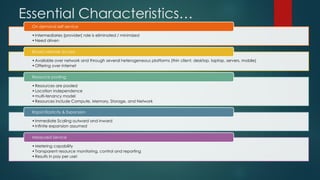
Essential Characteristics…
•Intermediaries (provider) role is eliminated / minimized
•Need driven
On demand self service
•Available over network and through several heterogeneous platforms (thin client, desktop, laptop, servers, mobile)
•Offering over internet
Broad network access
•Resources are pooled
•Location independence
•multi-tenancy model
•Resources include Compute, Memory, Storage, and Network
Resource pooling
•Immediate Scaling outward and inward
•Infinite expansion assumed
Rapid Elasticity & Expansion
•Metering capability
•Transparent resource monitoring, control and reporting
•Results in pay per use!
Measured Service
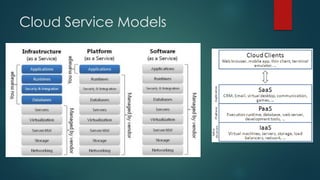
Cloud Service Models
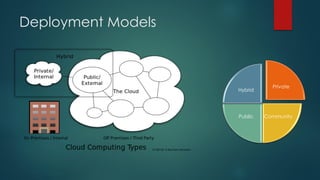
Deployment Models
Private
CommunityPublic
Hybrid
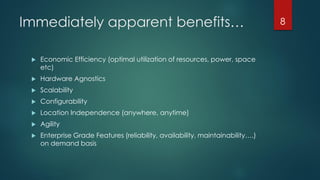
Immediately apparent benefits…
 Economic Efficiency (optimal utilization of resources, power, space
etc)
 Hardware Agnostics
 Scalability
 Configurability
 Location Independence (anywhere, anytime)
 Agility
 Enterprise Grade Features (reliability, availability, maintainability….)
on demand basis
8
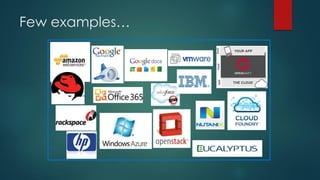
Few examples…
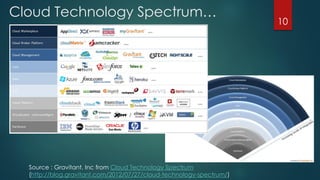
Cloud Technology Spectrum…
10
Source : Gravitant, Inc from Cloud Technology Spectrum
(http://blog.gravitant.com/2012/07/27/cloud-technology-spectrum/)
Applications &
Usage scenarios
WHERE THEY GET USED ?
Usage scenarios
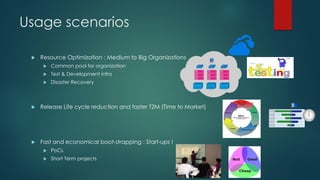
 Resource Optimization : Medium to Big Organizations
 Common pool for organization
 Test & Development infra
 Disaster Recovery
 Release Life cycle reduction and faster T2M (Time to Market)
 Fast and economical boot-strapping : Start-ups !
 PoCs
 Short Term projects
Usage scenarios
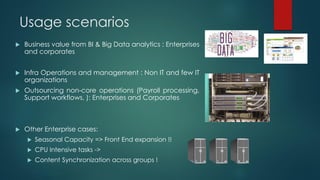
 Business value from BI & Big Data analytics : Enterprises
and corporates
 Infra Operations and management : Non IT and few IT
organizations
 Outsourcing non-core operations (Payroll processing,
Support workflows, ): Enterprises and Corporates
 Other Enterprise cases:
 Seasonal Capacity => Front End expansion !!
 CPU Intensive tasks ->
 Content Synchronization across groups !
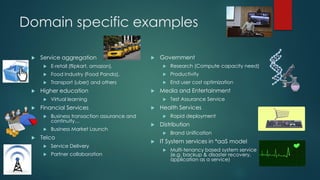
Domain specific examples
 Service aggregation
 E-retail (flipkart, amazon),
 Food Industry (Food Panda),
 Transport (uber) and others
 Higher education
 Virtual learning
 Financial Services
 Business transaction assurance and
continuity…
 Business Market Launch
 Telco
 Service Delivery
 Partner collaboration
 Government
 Research (Compute capacity need)
 Productivity
 End user cost optimization
 Media and Entertainment
 Test Assurance Service
 Health Services
 Rapid deployment
 Distribution
 Brand Unification
 IT System services in *aaS model
 Multi-tenancy based system service
(e.g. backup & disaster recovery,
application as a service)
Enabling
Technologies…
BIT OF HISTORY AND CURRENT STATE…
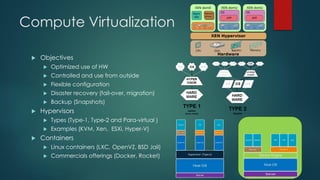
Compute Virtualization
 Objectives
 Optimized use of HW
 Controlled and use from outside
 Flexible configuration
 Disaster recovery (fail-over, migration)
 Backup (Snapshots)
 Hypervisors
 Types (Type-1, Type-2 and Para-virtual )
 Examples (KVM, Xen, ESXi, Hyper-V)
 Containers
 Linux containers (LXC, OpenVZ, BSD Jail)
 Commercials offerings (Docker, Rocket)
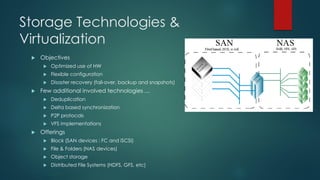
Storage Technologies &
Virtualization
 Objectives
 Optimized use of HW
 Flexible configuration
 Disaster recovery (fail-over, backup and snapshots)
 Few additional involved technologies …
 Deduplication
 Delta based synchronization
 P2P protocols
 VFS implementations
 Offerings
 Block (SAN devices : FC and iSCSI)
 File & Folders (NAS devices)
 Object storage
 Distributed File Systems (HDFS, GFS, etc)
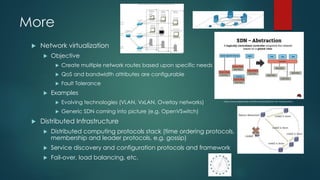
More
 Network virtualization
 Objective
 Create multiple network routes based upon specific needs
 QoS and bandwidth attributes are configurable
 Fault Tolerance
 Examples
 Evolving technologies (VLAN, VxLAN, Overlay networks)
 Generic SDN coming into picture (e.g. OpenVSwitch)
 Distributed Infrastructure
 Distributed computing protocols stack (time ordering protocols,
membership and leader protocols, e.g. gossip)
 Service discovery and configuration protocols and framework
 Fail-over, load balancing, etc.
http://www.slideshare.net/ThomasGraf5/sdn-nfv-introduction
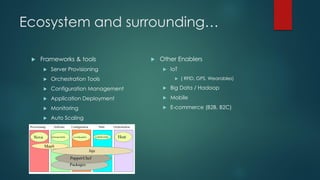
Ecosystem and surrounding…
 Frameworks & tools
 Server Provisioning
 Orchestration Tools
 Configuration Management
 Application Deployment
 Monitoring
 Auto Scaling
 Other Enablers
 IoT
 ( RFID, GPS, Wearables)
 Big Data / Hadoop
 Mobile
 E-commerce (B2B, B2C)
Cloud Architecture
ESSENTIAL COMPONENTS
TYPICAL CONFIGURATION
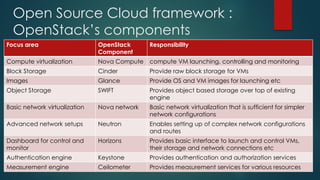
Open Source Cloud framework :
OpenStack’s components
Focus area OpenStack
Component
Responsibility
Compute virtualization Nova Compute compute VM launching, controlling and monitoring
Block Storage Cinder Provide raw block storage for VMs
Images Glance Provide OS and VM images for launching etc
Object Storage SWIFT Provides object based storage over top of existing
engine
Basic network virtualization Nova network Basic network virtualization that is sufficient for simpler
network configurations
Advanced network setups Neutron Enables setting up of complex network configurations
and routes
Dashboard for control and
monitor
Horizons Provides basic interface to launch and control VMs,
their storage and network connections etc
Authentication engine Keystone Provides authentication and authorization services
Measurement engine Ceilometer Provides measurement services for various resources
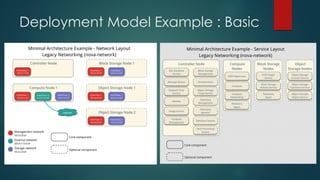
Deployment Model Example : Basic
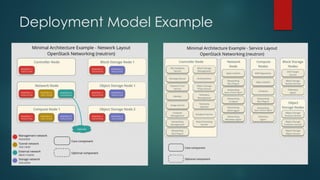
Deployment Model Example
A Different perspective
CHALLENGES AND CHANGES EXPECTED
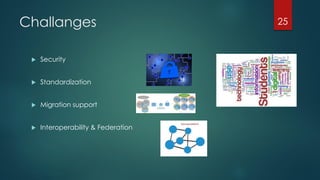
Challanges
 Security
 Standardization
 Migration support
 Interoperability & Federation
25
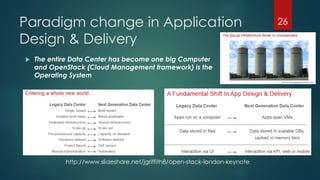
Paradigm change in Application
Design & Delivery
 The entire Data Center has become one big Computer
and OpenStack (Cloud Management framework) is the
Operating System
26
http://www.slideshare.net/jgriffith8/open-stack-london-keynote
Cloud Market
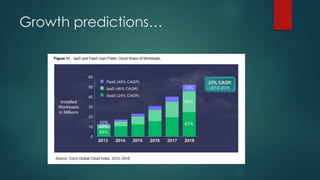
A BRIEF LOOK ON GROWTH NUMBERS…
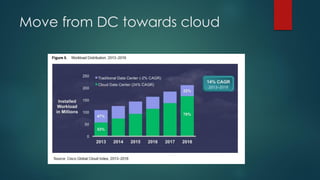
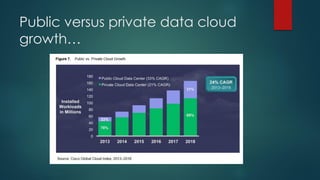
Move from DC towards cloud
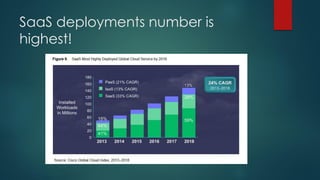
SaaS deployments number is
highest!
Growth predictions…
Public versus private data cloud
growth…
Thanks!
Q&A

Cloud computingintroduction

  • 1.
  • 2.
    Agenda covered  Introduction What  Model & Deployments cases  Applications & Use cases  Generic  Domain Specific  Case Studies  Technology & Architecture  Evolution of related technologies  Components of a cloud framework  Development, Challenges and Future  Numbers  Tools & Frameworks  Programming paradigm changes
  • 3.
  • 4.
    NIST Definition ofCloud Computing "cloud computing is a model for enabling ubiquitous, convenient, on-demand network access to a shared pool of configurable computing resources (e.g., networks, servers, storage, applications and services) that can be rapidly provisioned and released with minimal management effort or service provider interaction."
  • 5.
    Essential Characteristics… •Intermediaries (provider)role is eliminated / minimized •Need driven On demand self service •Available over network and through several heterogeneous platforms (thin client, desktop, laptop, servers, mobile) •Offering over internet Broad network access •Resources are pooled •Location independence •multi-tenancy model •Resources include Compute, Memory, Storage, and Network Resource pooling •Immediate Scaling outward and inward •Infinite expansion assumed Rapid Elasticity & Expansion •Metering capability •Transparent resource monitoring, control and reporting •Results in pay per use! Measured Service
  • 6.
  • 7.
  • 8.
    Immediately apparent benefits… Economic Efficiency (optimal utilization of resources, power, space etc)  Hardware Agnostics  Scalability  Configurability  Location Independence (anywhere, anytime)  Agility  Enterprise Grade Features (reliability, availability, maintainability….) on demand basis 8
  • 9.
  • 10.
    Cloud Technology Spectrum… 10 Source: Gravitant, Inc from Cloud Technology Spectrum (http://blog.gravitant.com/2012/07/27/cloud-technology-spectrum/)
  • 11.
  • 12.
    Usage scenarios  ResourceOptimization : Medium to Big Organizations  Common pool for organization  Test & Development infra  Disaster Recovery  Release Life cycle reduction and faster T2M (Time to Market)  Fast and economical boot-strapping : Start-ups !  PoCs  Short Term projects
  • 13.
    Usage scenarios  Businessvalue from BI & Big Data analytics : Enterprises and corporates  Infra Operations and management : Non IT and few IT organizations  Outsourcing non-core operations (Payroll processing, Support workflows, ): Enterprises and Corporates  Other Enterprise cases:  Seasonal Capacity => Front End expansion !!  CPU Intensive tasks ->  Content Synchronization across groups !
  • 14.
    Domain specific examples Service aggregation  E-retail (flipkart, amazon),  Food Industry (Food Panda),  Transport (uber) and others  Higher education  Virtual learning  Financial Services  Business transaction assurance and continuity…  Business Market Launch  Telco  Service Delivery  Partner collaboration  Government  Research (Compute capacity need)  Productivity  End user cost optimization  Media and Entertainment  Test Assurance Service  Health Services  Rapid deployment  Distribution  Brand Unification  IT System services in *aaS model  Multi-tenancy based system service (e.g. backup & disaster recovery, application as a service)
  • 15.
  • 16.
    Compute Virtualization  Objectives Optimized use of HW  Controlled and use from outside  Flexible configuration  Disaster recovery (fail-over, migration)  Backup (Snapshots)  Hypervisors  Types (Type-1, Type-2 and Para-virtual )  Examples (KVM, Xen, ESXi, Hyper-V)  Containers  Linux containers (LXC, OpenVZ, BSD Jail)  Commercials offerings (Docker, Rocket)
  • 17.
    Storage Technologies & Virtualization Objectives  Optimized use of HW  Flexible configuration  Disaster recovery (fail-over, backup and snapshots)  Few additional involved technologies …  Deduplication  Delta based synchronization  P2P protocols  VFS implementations  Offerings  Block (SAN devices : FC and iSCSI)  File & Folders (NAS devices)  Object storage  Distributed File Systems (HDFS, GFS, etc)
  • 18.
    More  Network virtualization Objective  Create multiple network routes based upon specific needs  QoS and bandwidth attributes are configurable  Fault Tolerance  Examples  Evolving technologies (VLAN, VxLAN, Overlay networks)  Generic SDN coming into picture (e.g. OpenVSwitch)  Distributed Infrastructure  Distributed computing protocols stack (time ordering protocols, membership and leader protocols, e.g. gossip)  Service discovery and configuration protocols and framework  Fail-over, load balancing, etc. http://www.slideshare.net/ThomasGraf5/sdn-nfv-introduction
  • 19.
    Ecosystem and surrounding… Frameworks & tools  Server Provisioning  Orchestration Tools  Configuration Management  Application Deployment  Monitoring  Auto Scaling  Other Enablers  IoT  ( RFID, GPS, Wearables)  Big Data / Hadoop  Mobile  E-commerce (B2B, B2C)
  • 20.
  • 21.
    Open Source Cloudframework : OpenStack’s components Focus area OpenStack Component Responsibility Compute virtualization Nova Compute compute VM launching, controlling and monitoring Block Storage Cinder Provide raw block storage for VMs Images Glance Provide OS and VM images for launching etc Object Storage SWIFT Provides object based storage over top of existing engine Basic network virtualization Nova network Basic network virtualization that is sufficient for simpler network configurations Advanced network setups Neutron Enables setting up of complex network configurations and routes Dashboard for control and monitor Horizons Provides basic interface to launch and control VMs, their storage and network connections etc Authentication engine Keystone Provides authentication and authorization services Measurement engine Ceilometer Provides measurement services for various resources
  • 22.
  • 23.
  • 24.
  • 25.
    Challanges  Security  Standardization Migration support  Interoperability & Federation 25
  • 26.
    Paradigm change inApplication Design & Delivery  The entire Data Center has become one big Computer and OpenStack (Cloud Management framework) is the Operating System 26 http://www.slideshare.net/jgriffith8/open-stack-london-keynote
  • 27.
    Cloud Market A BRIEFLOOK ON GROWTH NUMBERS…
  • 28.
    Move from DCtowards cloud
  • 29.
  • 30.
  • 31.
    Public versus privatedata cloud growth…
  • 32.