Starting Your Job Search:
Figure Out What You Like to Do
Then
“What do you
want to be when
you grow up?”
“What exactly do you
want your day-to-day
job experience to
be like?”
Now
If you could choose your ideal job
(within reason, of course), what would
you actually be doing and under what
conditions would you be doing it?
Consider:
Big or small company?
By yourself or in a team?
In an office or on the road?
At a desk or outside?
Financial motivation
or emotional motivation?
Animals? People? Kids?
To help you answer that question,
do the following 4-step exercise.
1. Develop a list
of activities
Write down as many activities as
you can think of (job-related and
otherwise) that you have done
over the years. It doesn’t matter
whether you enjoyed the activity.
If you have had limited professional
work experience, don’t worry.
Write down leisure activities or
specific tasks that you performed
on your own or in an organization.
Examples:
✔ Recruited and hired new waiters and waitresses
✔ Conducted training programs
✔ Greeted and seated guests
✔ Developed and wrote training manuals
✔ Sold raffle tickets door to door
✔ Managed Little League baseball team
✔ Served food in homeless shelter
✔ Collected stamps
✔ Worked as a stage manager for an amateur theater group
✔ Did volunteer work in a hospital
✔ Headed PTA fundraising drive
Write down as many of these tasks
as possible. The more activities the
better this exercise works.
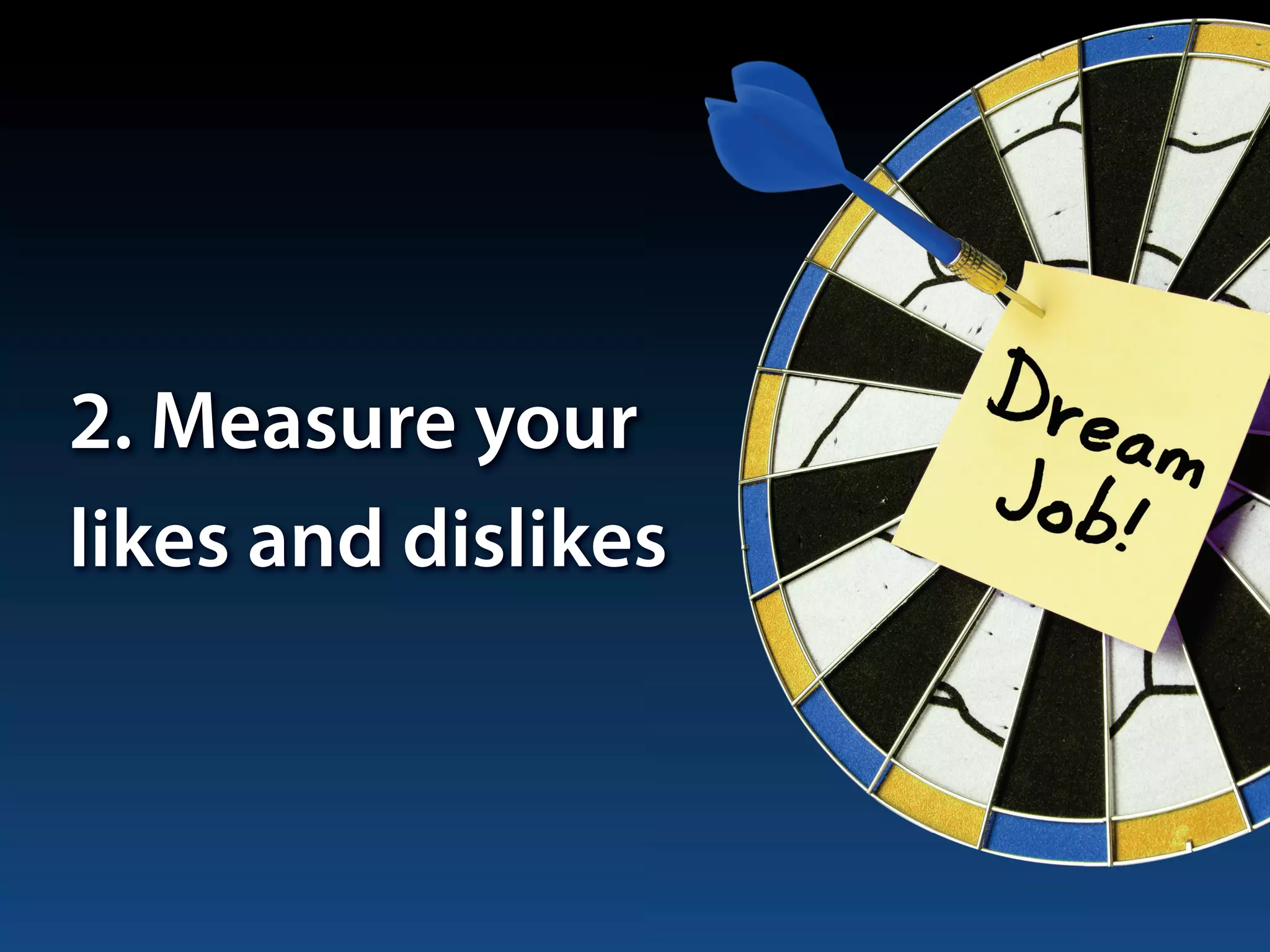
2. Measure your
likes and dislikes
Assign a satisfaction/dissatisfaction
rating to each item on the list.
Don’t overthink.
Use a scale of –10 to +10.
Enjoyable tasks get a 9 or 10.
Unenjoyable tasks get a -9 or -10.
3. Analyze your list
Isolate tasks that come out on
opposite ends of the spectrum
(7 or above & -7 and below)
Think about each item and ask
yourself, “What about this activity
did I enjoy or find awful?”
4. Look for patterns
Read over and analyze your
answers to the preceding questions.
See if you can uncover certain
patterns and common threads.
If you find that a common
thread among the activities that
brought you satisfaction is people,
it’s a safe bet that you’re an extrovert.
If one of the common threads
is helping other people, your
tendencies are service-oriented.
But don’t
stop there.
Narrow the “people” pattern down.
Do you like working with people as
part of a team, managing people,
training people?
Do the activities that you find
satisfying (or unsatisfying)
call for problem-solving skills or
creativity? Is there a competitive
aspect to those activities, or are
they cooperative?
The important thing about this
exercise is not to judge yourself.
Don’t think in terms of whether you
SHOULD OR SHOULDN’T FIND
an activity satisfying.
If you list enough activities — 25 is
not an excessive amount to work
with — you should be able to find
some patterns.
DON’T RUSH THIS EXERCISE.
The more insights you gain from
this stage of job targeting, the easier
it will be for you to complete the other
stages of the job searching process.
Jump-start your job hunt with
these For Dummies books:
Darts © Getty Images/iStockphoto
Online job finder button © iStockphoto
Application for employment © Getty Images/iStockphoto
Content from Job Hunting for Dummies by Max Messmer.
Learn more: http://bit.ly/JobHuntingFD

Starting Your Job Search

  • 1.
    Starting Your JobSearch: Figure Out What You Like to Do
  • 2.
    Then “What do you wantto be when you grow up?” “What exactly do you want your day-to-day job experience to be like?” Now
  • 3.
    If you couldchoose your ideal job (within reason, of course), what would you actually be doing and under what conditions would you be doing it?
  • 4.
    Consider: Big or smallcompany? By yourself or in a team? In an office or on the road? At a desk or outside? Financial motivation or emotional motivation? Animals? People? Kids?
  • 5.
    To help youanswer that question, do the following 4-step exercise.
  • 6.
    1. Develop alist of activities
  • 7.
    Write down asmany activities as you can think of (job-related and otherwise) that you have done over the years. It doesn’t matter whether you enjoyed the activity.
  • 8.
    If you havehad limited professional work experience, don’t worry. Write down leisure activities or specific tasks that you performed on your own or in an organization.
  • 9.
    Examples: ✔ Recruited andhired new waiters and waitresses ✔ Conducted training programs ✔ Greeted and seated guests ✔ Developed and wrote training manuals ✔ Sold raffle tickets door to door ✔ Managed Little League baseball team ✔ Served food in homeless shelter ✔ Collected stamps ✔ Worked as a stage manager for an amateur theater group ✔ Did volunteer work in a hospital ✔ Headed PTA fundraising drive
  • 10.
    Write down asmany of these tasks as possible. The more activities the better this exercise works.
  • 11.
  • 12.
    Assign a satisfaction/dissatisfaction ratingto each item on the list. Don’t overthink.
  • 13.
    Use a scaleof –10 to +10. Enjoyable tasks get a 9 or 10. Unenjoyable tasks get a -9 or -10.
  • 14.
  • 15.
    Isolate tasks thatcome out on opposite ends of the spectrum (7 or above & -7 and below)
  • 16.
    Think about eachitem and ask yourself, “What about this activity did I enjoy or find awful?”
  • 17.
    4. Look forpatterns
  • 18.
    Read over andanalyze your answers to the preceding questions. See if you can uncover certain patterns and common threads.
  • 19.
    If you findthat a common thread among the activities that brought you satisfaction is people, it’s a safe bet that you’re an extrovert.
  • 20.
    If one ofthe common threads is helping other people, your tendencies are service-oriented.
  • 21.
  • 22.
    Narrow the “people”pattern down. Do you like working with people as part of a team, managing people, training people?
  • 23.
    Do the activitiesthat you find satisfying (or unsatisfying) call for problem-solving skills or creativity? Is there a competitive aspect to those activities, or are they cooperative?
  • 24.
    The important thingabout this exercise is not to judge yourself. Don’t think in terms of whether you SHOULD OR SHOULDN’T FIND an activity satisfying.
  • 25.
    If you listenough activities — 25 is not an excessive amount to work with — you should be able to find some patterns.
  • 26.
    DON’T RUSH THISEXERCISE. The more insights you gain from this stage of job targeting, the easier it will be for you to complete the other stages of the job searching process.
  • 27.
    Jump-start your jobhunt with these For Dummies books: Darts © Getty Images/iStockphoto Online job finder button © iStockphoto Application for employment © Getty Images/iStockphoto Content from Job Hunting for Dummies by Max Messmer. Learn more: http://bit.ly/JobHuntingFD