















All you wanted to know about
job satisfaction
by Toronto Training and HR
September 2015
CONTENTS
3-4 Introduction
5-6 Definition
7-8 Causes of job dissatisfaction
9-10 Intrinsic and extrinsic job quality factors
11-14 A survey for the scale of job satisfaction
15-16 Work unit absenteeism and job satisfaction
17-18 Forces driving labour market transformations and job satisfaction
19-20 Dimensions of job satisfaction in call centres
21-24 Numbers and job satisfaction
25-26 Participatory decision making and job satisfaction
27-28 Trust and job satisfaction
29-30 Organizational citizenship behaviour and job satisfaction
31-32 Employee voluntary partnership and job satisfaction
33-34 Transformational leadership and job satisfaction
35-37 Career development and job satisfaction
38-39 Employee-management relationships and job satisfaction
40-41 Reward and job satisfaction
42-44 Work environment and job satisfaction
45-48 Areas to consider when arranging fun activities
49-50 Conclusion, summary and questions
Page 2
Page 3
Introduction
Page 4
Introduction to Toronto Training
and HR
Toronto Training and HR is a specialist training and
human resources consultancy headed by Timothy Holden
10 years in banking
15 years in training and human resources
Freelance practitioner since 2006
The core services provided by Toronto Training and HR
are:
Training event design
Training event delivery
HR support with an emphasis on reducing
costs, saving time plus improving employee
engagement and morale
Services for job seekers
Page 5
Definition
Definition • Job satisfaction
Page 6
Page 7
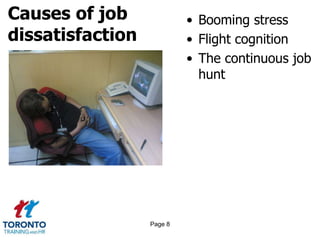
Causes of job
dissatisfaction
Causes of job
dissatisfaction
• Booming stress
• Flight cognition
• The continuous job
hunt
Page 8
Page 9
Intrinsic and extrinsic job
quality factors
Intrinsic and
extrinsic job
quality factors
• Intrinsic rewards
• Extrinsic rewards
• Individual control
variables
• Country specific
contextual variables
Page 10
Page 11
A survey for the scale of
job satisfaction
A survey for the
scale of job
satisfaction
1 of 3
• Work is complex/simple
• Work is creative/routine
• Work is satisfying/
not satisfied
• Work is respected/
not respected
• Sense of
accomplishment/not
fulfilling
• Supervisor is
professional/not
professional
Page 12
A survey for the
scale of job
satisfaction
2 of 3
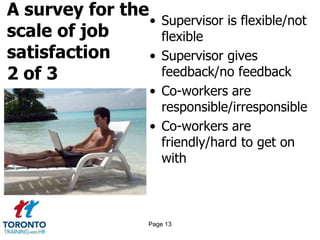
• Supervisor is flexible/not
flexible
• Supervisor gives
feedback/no feedback
• Co-workers are
responsible/irresponsible
• Co-workers are
friendly/hard to get on
with
Page 13
A survey for the
scale of job
satisfaction
3 of 3
• Promotions are
fair/unfair
• Promotions are
frequent/infrequent
• Promotions are on
ability/arbitrary
• Good future
advancement/poor
future advancement
• Pay is good/underpaid
Page 14
Page 15
Work unit absenteeism
and job satisfaction
Work unit
absenteeism
and job
satisfaction
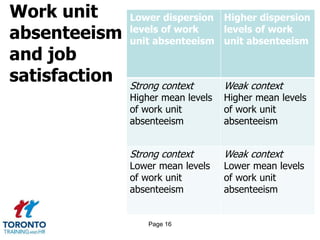
Lower dispersion
levels of work
unit absenteeism
Higher dispersion
levels of work
unit absenteeism
Strong context
Higher mean levels
of work unit
absenteeism
Weak context
Higher mean levels
of work unit
absenteeism
Strong context
Lower mean levels
of work unit
absenteeism
Weak context
Lower mean levels
of work unit
absenteeism
Page 16
Page 17
Forces driving labour
market transformations
linked to job satisfaction
Forces driving
labour market
transformations
linked to job
satisfaction
• Globalization and
offshoring
• Mergers, acquisitions
and restructuring
• Transition from
industrialization to a
knowledge-based and
service economy
• De-unionization
Page 18
Page 19
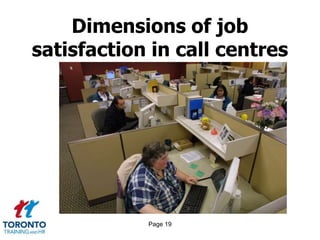
Dimensions of job
satisfaction in call centres
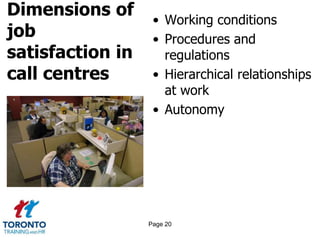
Dimensions of
job
satisfaction in
call centres
• Working conditions
• Procedures and
regulations
• Hierarchical relationships
at work
• Autonomy
Page 20
Page 21
Numbers and job
satisfaction
Numbers and
job
satisfaction
1 of 3
Percentage of people who…
• Like their jobs
• Like the type of work they
are doing better than any
their aspect of their job
• Like their co-workers
better than any other
aspect of their job
• Like their pay better than
any other aspect of their
job
• Say they are paid fairly
Page 22
Numbers and
job
satisfaction
2 of 3
True or false…
• White-collar workers are
more satisfied with their
jobs than blue-collar
workers are with their
jobs
• Younger workers and
more satisfied with their
jobs than older workers
are satisfied with their
jobs
Page 23
Numbers and
job
satisfaction
3 of 3
True or false (cont.)…
• Managers and
professionals are less
satisfied than
non-managers and
non-professionals
• Employees working with
friendly co-workers are
more satisfied than
employees working
alone
Page 24
Page 25
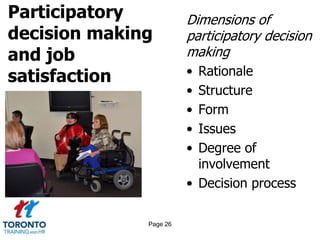
Participatory decision
making and job
satisfaction
Participatory
decision making
and job
satisfaction
Dimensions of
participatory decision
making
• Rationale
• Structure
• Form
• Issues
• Degree of
involvement
• Decision process
Page 26
Page 27
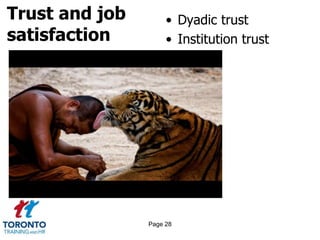
Trust and job satisfaction
Trust and job
satisfaction
• Dyadic trust
• Institution trust
Page 28
Page 29
Organizational citizenship
behaviour and
job satisfaction
Organizational
citizenship
behaviour and
job satisfaction
• Definition
• The Big Five dimensions
Page 30
Page 31
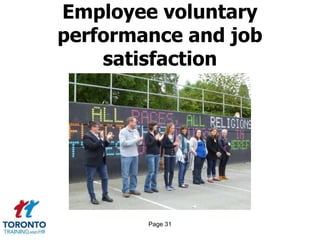
Employee voluntary
performance and job
satisfaction
Employee
voluntary
performance
and job
satisfaction
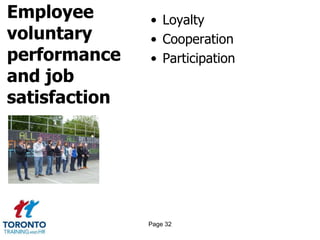
• Loyalty
• Cooperation
• Participation
Page 32
Page 33
Transformational
leadership and job
satisfaction
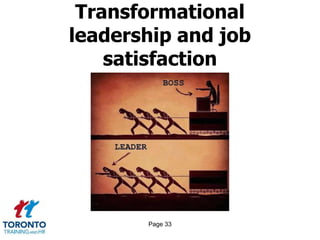
Transformational
leadership and
job satisfaction
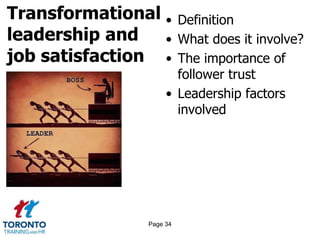
• Definition
• What does it involve?
• The importance of
follower trust
• Leadership factors
involved
Page 34
Page 35
Career development and
job satisfaction
Career
development and
job satisfaction
1 of 2
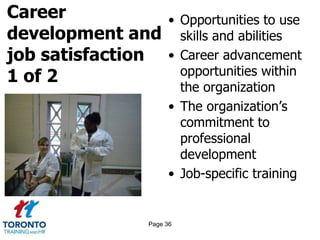
• Opportunities to use
skills and abilities
• Career advancement
opportunities within
the organization
• The organization’s
commitment to
professional
development
• Job-specific training
Page 36
Career
development and
job satisfaction
2 of 2
• Career development
opportunities
• Paid training and
tuition reimbursement
programs
• Networking
Page 37
Page 38
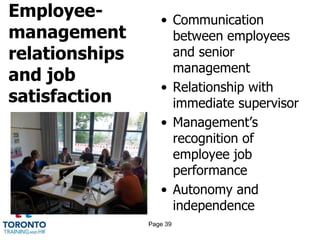
Employee-management
relationships and
job satisfaction
Employee-
management
relationships
and job
satisfaction
• Communication
between employees
and senior
management
• Relationship with
immediate supervisor
• Management’s
recognition of
employee job
performance
• Autonomy and
independence
Page 39
Page 40
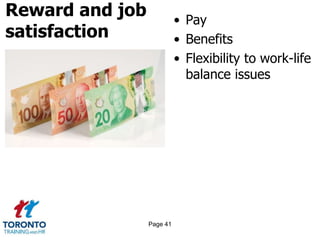
Reward and job
satisfaction
Reward and job
satisfaction
• Pay
• Benefits
• Flexibility to work-life
balance issues
Page 41
Page 42
Work environment and job
satisfaction
Work
environment
and job
satisfaction
1 of 2
• Job security
• Organization’s financial
stability
• The work itself
• Feeling safe in the work
environment
• Overall corporate culture
• Relationships with
co-workers
• Meaningfulness of job
Page 43
Work
environment
and job
satisfaction
2 of 2
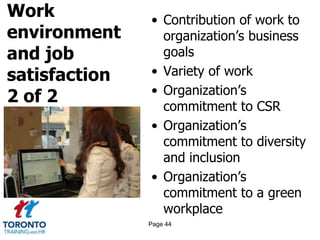
• Contribution of work to
organization’s business
goals
• Variety of work
• Organization’s
commitment to CSR
• Organization’s
commitment to diversity
and inclusion
• Organization’s
commitment to a green
workplace
Page 44
Page 45
Areas to consider when
arranging fun activities
Areas to consider
when arranging
fun activities
1 of 3
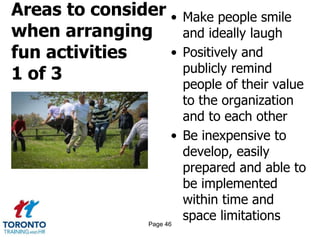
• Make people smile
and ideally laugh
• Positively and
publicly remind
people of their value
to the organization
and to each other
• Be inexpensive to
develop, easily
prepared and able to
be implemented
within time and
space limitationsPage 46
Areas to consider
when arranging
fun activities
2 of 3
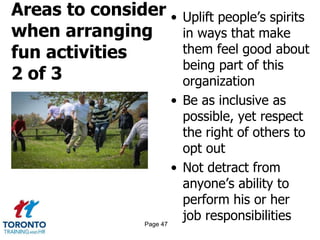
• Uplift people’s spirits
in ways that make
them feel good about
being part of this
organization
• Be as inclusive as
possible, yet respect
the right of others to
opt out
• Not detract from
anyone’s ability to
perform his or her
job responsibilitiesPage 47
Areas to consider
when arranging
fun activities
3 of 3
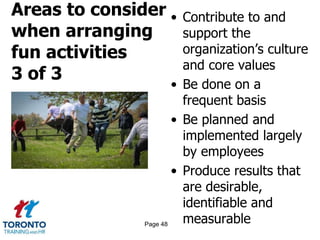
• Contribute to and
support the
organization’s culture
and core values
• Be done on a
frequent basis
• Be planned and
implemented largely
by employees
• Produce results that
are desirable,
identifiable and
measurablePage 48
Page 49
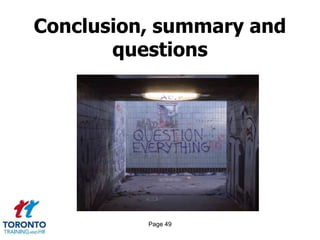
Conclusion, summary and
questions
Page 50
Conclusion, summary and
questions
Conclusion
Summary
Videos
Questions

Job satisfaction September 2015

  • 1.
    All you wantedto know about job satisfaction by Toronto Training and HR September 2015
  • 2.
    CONTENTS 3-4 Introduction 5-6 Definition 7-8Causes of job dissatisfaction 9-10 Intrinsic and extrinsic job quality factors 11-14 A survey for the scale of job satisfaction 15-16 Work unit absenteeism and job satisfaction 17-18 Forces driving labour market transformations and job satisfaction 19-20 Dimensions of job satisfaction in call centres 21-24 Numbers and job satisfaction 25-26 Participatory decision making and job satisfaction 27-28 Trust and job satisfaction 29-30 Organizational citizenship behaviour and job satisfaction 31-32 Employee voluntary partnership and job satisfaction 33-34 Transformational leadership and job satisfaction 35-37 Career development and job satisfaction 38-39 Employee-management relationships and job satisfaction 40-41 Reward and job satisfaction 42-44 Work environment and job satisfaction 45-48 Areas to consider when arranging fun activities 49-50 Conclusion, summary and questions Page 2
  • 3.
  • 4.
    Page 4 Introduction toToronto Training and HR Toronto Training and HR is a specialist training and human resources consultancy headed by Timothy Holden 10 years in banking 15 years in training and human resources Freelance practitioner since 2006 The core services provided by Toronto Training and HR are: Training event design Training event delivery HR support with an emphasis on reducing costs, saving time plus improving employee engagement and morale Services for job seekers
  • 5.
  • 6.
    Definition • Jobsatisfaction Page 6
  • 7.
    Page 7 Causes ofjob dissatisfaction
  • 8.
    Causes of job dissatisfaction •Booming stress • Flight cognition • The continuous job hunt Page 8
  • 9.
    Page 9 Intrinsic andextrinsic job quality factors
  • 10.
    Intrinsic and extrinsic job qualityfactors • Intrinsic rewards • Extrinsic rewards • Individual control variables • Country specific contextual variables Page 10
  • 11.
    Page 11 A surveyfor the scale of job satisfaction
  • 12.
    A survey forthe scale of job satisfaction 1 of 3 • Work is complex/simple • Work is creative/routine • Work is satisfying/ not satisfied • Work is respected/ not respected • Sense of accomplishment/not fulfilling • Supervisor is professional/not professional Page 12
  • 13.
    A survey forthe scale of job satisfaction 2 of 3 • Supervisor is flexible/not flexible • Supervisor gives feedback/no feedback • Co-workers are responsible/irresponsible • Co-workers are friendly/hard to get on with Page 13
  • 14.
    A survey forthe scale of job satisfaction 3 of 3 • Promotions are fair/unfair • Promotions are frequent/infrequent • Promotions are on ability/arbitrary • Good future advancement/poor future advancement • Pay is good/underpaid Page 14
  • 15.
    Page 15 Work unitabsenteeism and job satisfaction
  • 16.
    Work unit absenteeism and job satisfaction Lowerdispersion levels of work unit absenteeism Higher dispersion levels of work unit absenteeism Strong context Higher mean levels of work unit absenteeism Weak context Higher mean levels of work unit absenteeism Strong context Lower mean levels of work unit absenteeism Weak context Lower mean levels of work unit absenteeism Page 16
  • 17.
    Page 17 Forces drivinglabour market transformations linked to job satisfaction
  • 18.
    Forces driving labour market transformations linkedto job satisfaction • Globalization and offshoring • Mergers, acquisitions and restructuring • Transition from industrialization to a knowledge-based and service economy • De-unionization Page 18
  • 19.
    Page 19 Dimensions ofjob satisfaction in call centres
  • 20.
    Dimensions of job satisfaction in callcentres • Working conditions • Procedures and regulations • Hierarchical relationships at work • Autonomy Page 20
  • 21.
    Page 21 Numbers andjob satisfaction
  • 22.
    Numbers and job satisfaction 1 of3 Percentage of people who… • Like their jobs • Like the type of work they are doing better than any their aspect of their job • Like their co-workers better than any other aspect of their job • Like their pay better than any other aspect of their job • Say they are paid fairly Page 22
  • 23.
    Numbers and job satisfaction 2 of3 True or false… • White-collar workers are more satisfied with their jobs than blue-collar workers are with their jobs • Younger workers and more satisfied with their jobs than older workers are satisfied with their jobs Page 23
  • 24.
    Numbers and job satisfaction 3 of3 True or false (cont.)… • Managers and professionals are less satisfied than non-managers and non-professionals • Employees working with friendly co-workers are more satisfied than employees working alone Page 24
  • 25.
  • 26.
    Participatory decision making and job satisfaction Dimensionsof participatory decision making • Rationale • Structure • Form • Issues • Degree of involvement • Decision process Page 26
  • 27.
    Page 27 Trust andjob satisfaction
  • 28.
    Trust and job satisfaction •Dyadic trust • Institution trust Page 28
  • 29.
  • 30.
    Organizational citizenship behaviour and job satisfaction •Definition • The Big Five dimensions Page 30
  • 31.
  • 32.
  • 33.
  • 34.
    Transformational leadership and job satisfaction •Definition • What does it involve? • The importance of follower trust • Leadership factors involved Page 34
  • 35.
    Page 35 Career developmentand job satisfaction
  • 36.
    Career development and job satisfaction 1of 2 • Opportunities to use skills and abilities • Career advancement opportunities within the organization • The organization’s commitment to professional development • Job-specific training Page 36
  • 37.
    Career development and job satisfaction 2of 2 • Career development opportunities • Paid training and tuition reimbursement programs • Networking Page 37
  • 38.
  • 39.
    Employee- management relationships and job satisfaction • Communication betweenemployees and senior management • Relationship with immediate supervisor • Management’s recognition of employee job performance • Autonomy and independence Page 39
  • 40.
    Page 40 Reward andjob satisfaction
  • 41.
    Reward and job satisfaction •Pay • Benefits • Flexibility to work-life balance issues Page 41
  • 42.
    Page 42 Work environmentand job satisfaction
  • 43.
    Work environment and job satisfaction 1 of2 • Job security • Organization’s financial stability • The work itself • Feeling safe in the work environment • Overall corporate culture • Relationships with co-workers • Meaningfulness of job Page 43
  • 44.
    Work environment and job satisfaction 2 of2 • Contribution of work to organization’s business goals • Variety of work • Organization’s commitment to CSR • Organization’s commitment to diversity and inclusion • Organization’s commitment to a green workplace Page 44
  • 45.
    Page 45 Areas toconsider when arranging fun activities
  • 46.
    Areas to consider whenarranging fun activities 1 of 3 • Make people smile and ideally laugh • Positively and publicly remind people of their value to the organization and to each other • Be inexpensive to develop, easily prepared and able to be implemented within time and space limitationsPage 46
  • 47.
    Areas to consider whenarranging fun activities 2 of 3 • Uplift people’s spirits in ways that make them feel good about being part of this organization • Be as inclusive as possible, yet respect the right of others to opt out • Not detract from anyone’s ability to perform his or her job responsibilitiesPage 47
  • 48.
    Areas to consider whenarranging fun activities 3 of 3 • Contribute to and support the organization’s culture and core values • Be done on a frequent basis • Be planned and implemented largely by employees • Produce results that are desirable, identifiable and measurablePage 48
  • 49.
  • 50.
    Page 50 Conclusion, summaryand questions Conclusion Summary Videos Questions