How to find and secure the ideal job
by Toronto Training and HR
September 2015
CONTENTS
3-4 Introduction
5-6 Making a choice
7-8 What are employers looking for?
9-10 Stages of the job search
11-12 Preparedness
13-14 Self-branding
15-16 The elevator pitch
17-18 Why do they want me to…?
19-20 Positive body language
21-22 Resumes
23-24 Turning an internship into a full-time job offer
25-28 Rules to bear in mind when negotiating a job offer
29-31 Effective interviews
32-34 Create the right state for an interview
35-36 Telephone and Skype interviews
37-38 Group applicant interviews
39-45 Strategies for responding to specific interview questions
46-47 The CAR technique for competency-based interview questions
48-49 Interviews; the four Bes
50-51 Conclusion, summary and questions
Page 2
Page 3
Introduction
Page 4
Introduction to Toronto Training
and HR
Toronto Training and HR is a specialist training and
human resources consultancy headed by Timothy Holden
10 years in banking
15 years in training and human resources
Freelance practitioner since 2006
The core services provided by Toronto Training and HR
are:
Training event design
Training event delivery
HR support with an emphasis on reducing
costs, saving time plus improving employee
engagement and morale
Services for job seekers
Page 5
Making a choice
Making a
choice
• Love it
• Leverage it
• Lose it
• Leave it
Page 6
Page 7
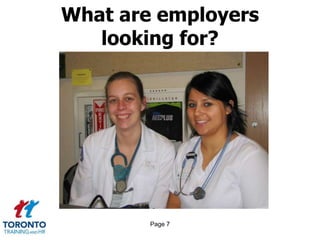
What are employers
looking for?
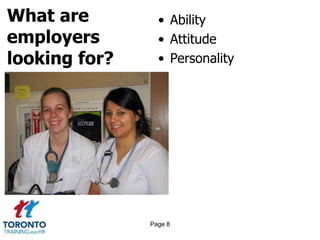
What are
employers
looking for?
• Ability
• Attitude
• Personality
Page 8
Page 9
Stages of the job search
Stages of the
job search
• Preparatory stage
• Active-extensive stage
• Active-intensive stage
Page 10
Page 11
Preparedness
Preparedness • What is preparedness?
• Elements of
preparedness
• Routine career renewal
• Coping strategies
Page 12
Page 13
Self-branding
Self-branding • What is a brand?
• What is self-branding?
• Components of
developing a self-brand
• Questions to ask
• SWOT
Page 14
Page 15
The elevator pitch
The elevator
pitch
• Who are you?
• What do you do?
• What are you
looking for?
• Why are you the
perfect candidate
for this position?
Page 16
Page 17
Why do they want me
to…?
Why do they
want me to…?
• Take notes during
the interview
• Want me to give a
presentation
• Want me to take part
in group activities
with other candidates
• Want me to do a test
Page 18
Page 19
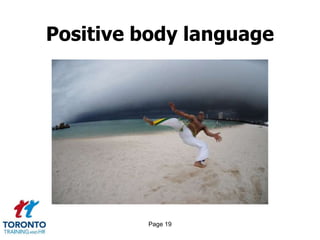
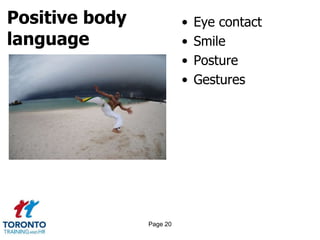
Positive body language
Positive body
language
• Eye contact
• Smile
• Posture
• Gestures
Page 20
Page 21
Resumes
Resumes • First impression
• Layout and
appearance
• Format and
organization
• Job objective
• Qualifications
• Content relevance
Page 22
Page 23
Turning an internship into
a full-time job offer
Turning an
internship
into a
full-time
job offer
• Show off your social
intelligence
• Speak up, but know
your audience
• Don’t assume you’re
invisible to the
people at the top
• Send isn’t always
your friend
• Don’t join the wolf
pack
Page 24
Page 25
Rules to bear in mind
when negotiating a job
offer
Rules to bear in
mind when
negotiating a job
offer 1 of 3
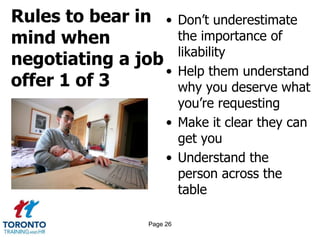
• Don’t underestimate
the importance of
likability
• Help them understand
why you deserve what
you’re requesting
• Make it clear they can
get you
• Understand the
person across the
table
Page 26
Rules to bear in
mind when
negotiating a job
offer 2 of 3
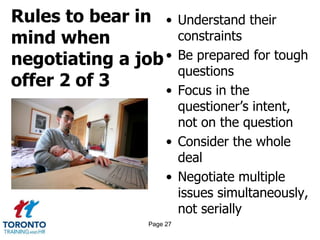
• Understand their
constraints
• Be prepared for tough
questions
• Focus in the
questioner’s intent,
not on the question
• Consider the whole
deal
• Negotiate multiple
issues simultaneously,
not serially
Page 27
Rules to bear in
mind when
negotiating a job
offer 3 of 3
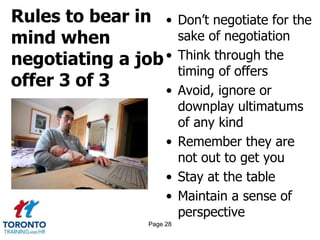
• Don’t negotiate for the
sake of negotiation
• Think through the
timing of offers
• Avoid, ignore or
downplay ultimatums
of any kind
• Remember they are
not out to get you
• Stay at the table
• Maintain a sense of
perspective
Page 28
Page 29
Effective interviews
Effective
interviews
1 of 2
• Before
• During
• After
• Follow-up
Page 30
Effective
interviews
2 of 2
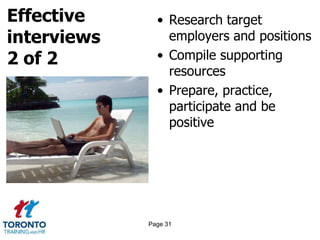
• Research target
employers and positions
• Compile supporting
resources
• Prepare, practice,
participate and be
positive
Page 31
Page 32
Create the right state for
an interview
Create the
right state for
an interview
1 of 2
• Choose the right
language
• Physical preparation
• Have the right focus
Page 33
Create the
right state for
an interview
2 of 2
• Physiology
• Focus
• Language
Page 34
Page 35
Telephone and Skype
interviews
Telephone
and Skype
interviews
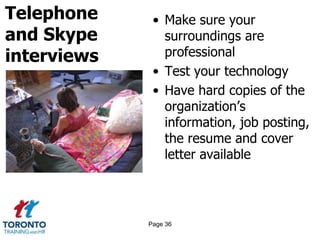
• Make sure your
surroundings are
professional
• Test your technology
• Have hard copies of the
organization’s
information, job posting,
the resume and cover
letter available
Page 36
Page 37
Group applicant interviews
Group
applicant
interviews
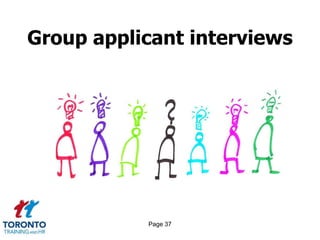
• Focus on why you are the
best fit for the
organization, not how you
are better than everyone
else in the room
• Listen to the answers
from other applicants,
and think about how you
can build on what they
have said
• Show eagerness when
answering questions
Page 38
Page 39
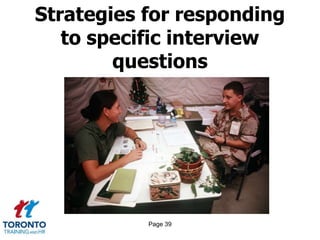
Strategies for responding
to specific interview
questions
Strategies for
responding to
specific
interview
questions
1 of 6
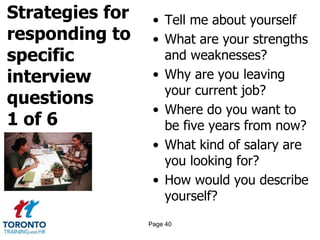
• Tell me about yourself
• What are your strengths
and weaknesses?
• Why are you leaving
your current job?
• Where do you want to
be five years from now?
• What kind of salary are
you looking for?
• How would you describe
yourself?
Page 40
Strategies for
responding to
specific
interview
questions
2 of 6
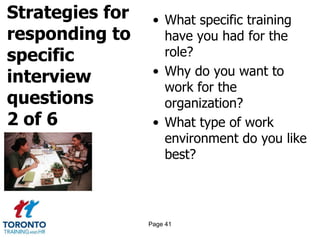
• What specific training
have you had for the
role?
• Why do you want to
work for the
organization?
• What type of work
environment do you like
best?
Page 41
Strategies for
responding to
specific
interview
questions
3 of 6
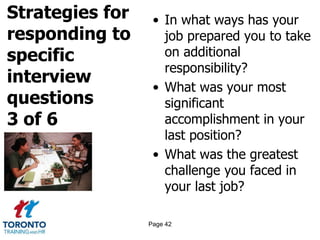
• In what ways has your
job prepared you to take
on additional
responsibility?
• What was your most
significant
accomplishment in your
last position?
• What was the greatest
challenge you faced in
your last job?
Page 42
Strategies for
responding to
specific
interview
questions
4 of 6
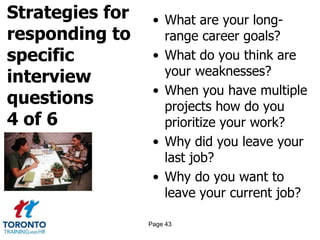
• What are your long-
range career goals?
• What do you think are
your weaknesses?
• When you have multiple
projects how do you
prioritize your work?
• Why did you leave your
last job?
• Why do you want to
leave your current job?
Page 43
Strategies for
responding to
specific
interview
questions
5 of 6
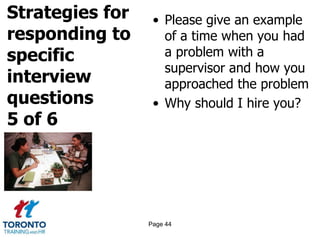
• Please give an example
of a time when you had
a problem with a
supervisor and how you
approached the problem
• Why should I hire you?
Page 44
Strategies for
responding to
specific
interview
questions
6 of 6
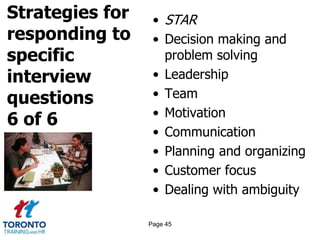
• STAR
• Decision making and
problem solving
• Leadership
• Team
• Motivation
• Communication
• Planning and organizing
• Customer focus
• Dealing with ambiguity
Page 45
Page 46
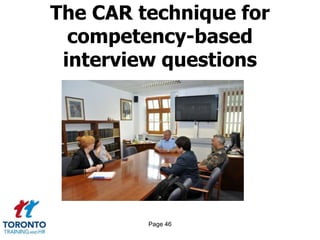
The CAR technique for
competency-based
interview questions
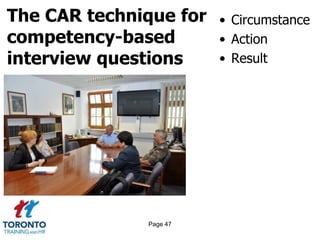
The CAR technique for
competency-based
interview questions
• Circumstance
• Action
• Result
Page 47
Page 48
Interviews; the four Bes
Interviews;
the four Bes
• Be positive
• Be a good listener
• Be honest
• Be consistent
Page 49
Page 50
Conclusion, summary and
questions
Page 51
Conclusion, summary and
questions
Conclusion
Summary
Videos
Questions

Job seekers September 2015

  • 1.
    How to findand secure the ideal job by Toronto Training and HR September 2015
  • 2.
    CONTENTS 3-4 Introduction 5-6 Makinga choice 7-8 What are employers looking for? 9-10 Stages of the job search 11-12 Preparedness 13-14 Self-branding 15-16 The elevator pitch 17-18 Why do they want me to…? 19-20 Positive body language 21-22 Resumes 23-24 Turning an internship into a full-time job offer 25-28 Rules to bear in mind when negotiating a job offer 29-31 Effective interviews 32-34 Create the right state for an interview 35-36 Telephone and Skype interviews 37-38 Group applicant interviews 39-45 Strategies for responding to specific interview questions 46-47 The CAR technique for competency-based interview questions 48-49 Interviews; the four Bes 50-51 Conclusion, summary and questions Page 2
  • 3.
  • 4.
    Page 4 Introduction toToronto Training and HR Toronto Training and HR is a specialist training and human resources consultancy headed by Timothy Holden 10 years in banking 15 years in training and human resources Freelance practitioner since 2006 The core services provided by Toronto Training and HR are: Training event design Training event delivery HR support with an emphasis on reducing costs, saving time plus improving employee engagement and morale Services for job seekers
  • 5.
  • 6.
    Making a choice • Loveit • Leverage it • Lose it • Leave it Page 6
  • 7.
    Page 7 What areemployers looking for?
  • 8.
    What are employers looking for? •Ability • Attitude • Personality Page 8
  • 9.
    Page 9 Stages ofthe job search
  • 10.
    Stages of the jobsearch • Preparatory stage • Active-extensive stage • Active-intensive stage Page 10
  • 11.
  • 12.
    Preparedness • Whatis preparedness? • Elements of preparedness • Routine career renewal • Coping strategies Page 12
  • 13.
  • 14.
    Self-branding • Whatis a brand? • What is self-branding? • Components of developing a self-brand • Questions to ask • SWOT Page 14
  • 15.
  • 16.
    The elevator pitch • Whoare you? • What do you do? • What are you looking for? • Why are you the perfect candidate for this position? Page 16
  • 17.
    Page 17 Why dothey want me to…?
  • 18.
    Why do they wantme to…? • Take notes during the interview • Want me to give a presentation • Want me to take part in group activities with other candidates • Want me to do a test Page 18
  • 19.
  • 20.
    Positive body language • Eyecontact • Smile • Posture • Gestures Page 20
  • 21.
  • 22.
    Resumes • Firstimpression • Layout and appearance • Format and organization • Job objective • Qualifications • Content relevance Page 22
  • 23.
    Page 23 Turning aninternship into a full-time job offer
  • 24.
    Turning an internship into a full-time joboffer • Show off your social intelligence • Speak up, but know your audience • Don’t assume you’re invisible to the people at the top • Send isn’t always your friend • Don’t join the wolf pack Page 24
  • 25.
    Page 25 Rules tobear in mind when negotiating a job offer
  • 26.
    Rules to bearin mind when negotiating a job offer 1 of 3 • Don’t underestimate the importance of likability • Help them understand why you deserve what you’re requesting • Make it clear they can get you • Understand the person across the table Page 26
  • 27.
    Rules to bearin mind when negotiating a job offer 2 of 3 • Understand their constraints • Be prepared for tough questions • Focus in the questioner’s intent, not on the question • Consider the whole deal • Negotiate multiple issues simultaneously, not serially Page 27
  • 28.
    Rules to bearin mind when negotiating a job offer 3 of 3 • Don’t negotiate for the sake of negotiation • Think through the timing of offers • Avoid, ignore or downplay ultimatums of any kind • Remember they are not out to get you • Stay at the table • Maintain a sense of perspective Page 28
  • 29.
  • 30.
    Effective interviews 1 of 2 •Before • During • After • Follow-up Page 30
  • 31.
    Effective interviews 2 of 2 •Research target employers and positions • Compile supporting resources • Prepare, practice, participate and be positive Page 31
  • 32.
    Page 32 Create theright state for an interview
  • 33.
    Create the right statefor an interview 1 of 2 • Choose the right language • Physical preparation • Have the right focus Page 33
  • 34.
    Create the right statefor an interview 2 of 2 • Physiology • Focus • Language Page 34
  • 35.
    Page 35 Telephone andSkype interviews
  • 36.
    Telephone and Skype interviews • Makesure your surroundings are professional • Test your technology • Have hard copies of the organization’s information, job posting, the resume and cover letter available Page 36
  • 37.
  • 38.
    Group applicant interviews • Focus onwhy you are the best fit for the organization, not how you are better than everyone else in the room • Listen to the answers from other applicants, and think about how you can build on what they have said • Show eagerness when answering questions Page 38
  • 39.
    Page 39 Strategies forresponding to specific interview questions
  • 40.
    Strategies for responding to specific interview questions 1of 6 • Tell me about yourself • What are your strengths and weaknesses? • Why are you leaving your current job? • Where do you want to be five years from now? • What kind of salary are you looking for? • How would you describe yourself? Page 40
  • 41.
    Strategies for responding to specific interview questions 2of 6 • What specific training have you had for the role? • Why do you want to work for the organization? • What type of work environment do you like best? Page 41
  • 42.
    Strategies for responding to specific interview questions 3of 6 • In what ways has your job prepared you to take on additional responsibility? • What was your most significant accomplishment in your last position? • What was the greatest challenge you faced in your last job? Page 42
  • 43.
    Strategies for responding to specific interview questions 4of 6 • What are your long- range career goals? • What do you think are your weaknesses? • When you have multiple projects how do you prioritize your work? • Why did you leave your last job? • Why do you want to leave your current job? Page 43
  • 44.
    Strategies for responding to specific interview questions 5of 6 • Please give an example of a time when you had a problem with a supervisor and how you approached the problem • Why should I hire you? Page 44
  • 45.
    Strategies for responding to specific interview questions 6of 6 • STAR • Decision making and problem solving • Leadership • Team • Motivation • Communication • Planning and organizing • Customer focus • Dealing with ambiguity Page 45
  • 46.
    Page 46 The CARtechnique for competency-based interview questions
  • 47.
    The CAR techniquefor competency-based interview questions • Circumstance • Action • Result Page 47
  • 48.
  • 49.
    Interviews; the four Bes •Be positive • Be a good listener • Be honest • Be consistent Page 49
  • 50.
  • 51.
    Page 51 Conclusion, summaryand questions Conclusion Summary Videos Questions