BRIJESH YADAV
    S.Y.B.M.S (B)
     17088(217)
PRODUCTIVITY & QUALITY
         MANAGEMENT
Topic-    methods to
   Improve productivity
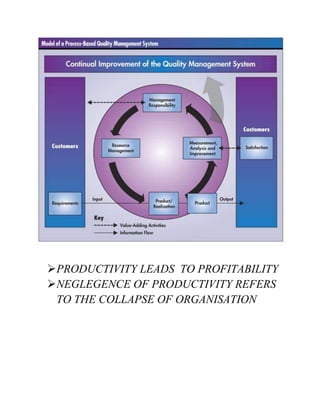
PRODUCTIVITY LEADS TO PROFITABILITY
NEGLEGENCE OF PRODUCTIVITY REFERS
 TO THE COLLAPSE OF ORGANISATION
STEPS RELATING TO PRODUCTIVITY IMPROVEMENT

Step-1

List your organization's short-term and long-term goals and a reasonable timeframe
for meeting those objectives. Select a qualitative and quantitative methodology for
measuring progress. Invite input from personnel involved with these activities.
Assign in-house committees to determine what resources are currently available
and what is still needed to accomplish specified goals.

Step 2

Review employee performance to measure whether workers are meeting industry
standards. Provide additional training and education as needed or assign workers
more responsibility and a leadership role.

Step 3
Streamline, consolidate, update, outsource or eliminate tasks to save your company
more time or money. Replace outmoded technology. If necessary, bring in an
outside consultant who can evaluate your operations objectively.

Step 4
Communicate openly to foster a positive workplace environment and address
simmering rumors and anxiety that inhibit productivity. Rectify morale issues so
that workers who are negative, paranoid or resistant to any form of change do not
prevent their coworkers from achieving their own potential or trusting the policy
decisions set forth by management.
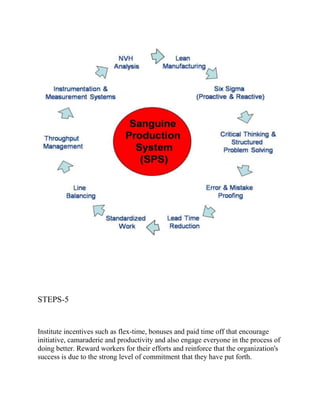
STEPS-5


Institute incentives such as flex-time, bonuses and paid time off that encourage
initiative, camaraderie and productivity and also engage everyone in the process of
doing better. Reward workers for their efforts and reinforce that the organization's
success is due to the strong level of commitment that they have put forth.
2.Communications

Clear communications improves productivity. Provide clear instructions to the
employee on how to perform assigned work, including a comprehensive job
description. The instructions reduce the time required to understand how to
accomplish assigned work.

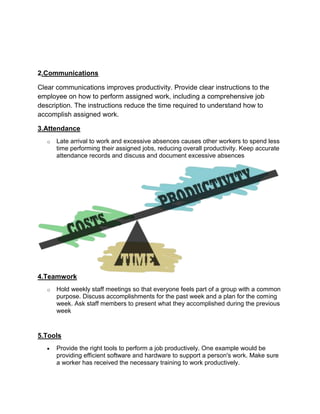
3.Attendance
   o   Late arrival to work and excessive absences causes other workers to spend less
       time performing their assigned jobs, reducing overall productivity. Keep accurate
       attendance records and discuss and document excessive absences


4.Teamwork
   o   Hold weekly staff meetings so that everyone feels part of a group with a common
       purpose. Discuss accomplishments for the past week and a plan for the coming
       week. Ask staff members to present what they accomplished during the previous
       week


5.Tools
       Provide the right tools to perform a job productively. One example would be
       providing efficient software and hardware to support a person's work. Make sure
       a worker has received the necessary training to work productively.
Factors of Productivity in the Workplace
                                                      X

  By Frank Girard, eHow Contributor


  Print this article


                                                                                 Improve employee
  productivity by focusing on improving important factors.

  Productivity is measured by comparing the output from work to the input. As the U.S.
  faces increased competition from workers in other countries, interest is increasing in how
  to make our workforce more productive. Several key factors affect productivity in the
  workforce.
  Other Peoples contribution


           p           productivity comes from satisfaction of employees


                   ? Productivity refers to the proper utlisation of resources

2. Job Satisfaction
      o   Employees who are satisfied with their work tend to be more productive.
          Recognize your employees by commending them for a job well done. They can
          be recognized financially when bonuses are distributed, but there are important
A few factors that can help to improve the
employee productivity at the workplace are:
# 1. Accountability

Every employee needs to be well aware that he is accountable for his actions and decisions, and
he can neither pass the buck or pass the blame to someone else.

       This will help him work more meticulously ,
       Take cautious rather than reckless decisions, and not take advantage of his place, position or
       relationship with his superiors.

# 2. Follow up

Employers often set targets and feel their job is done.

       No, every target or milestone set needs to be followed up as well, to see if the progress is
       sufficient and if not, whether any interim measures can be taken before it is too late to salvage a
       situation.
       It also keeps the employee on track, ensuring there is consistent effort throughout the lifetime
       of the project

3. Manage micromanagement the work force but avoid

It is well known that a large pool of employees does need to be managed, provided direction and
given assistance. But with this they must also be trusted, given freedom to operate in their style
and adopt measures which they think are the best to deliver results.

       This freedom to act as they deem fit helps to keep them encouraged, motivated and happy in
       the belief that they are trusted.
       Micro management is a human tendency but one that is detrimental to achievement, since it
       makes mere puppets out of employees, who are expected to toe the boss’ line and not think for
       themselves.
       Employees need to think for themselves, analyze the consequences of every decision or action
       to be able to give their best to their jobs. And the employers must make it possible for their
       workers to do so.

#4. Encourage, motivate, reward and recognize

The employer must ensure that on his part he always has words of encouragement for his staff.
Encouraging them helps them move forward and do even better, and makes the worker feel
happy. Innovative ways of motivating them spurs them even more. For example, holidays or
conferences paid for by the company have been found to motivate employees immensely.

       Rewarding the hard work put in by employees makes them continue to work in the same
       fashion, and if the employee feels that his work is not appreciated in words or in material terms,
       he may gradually stop doing so, since he may feel that others working less are given the same
       too, so he need not work more.
       Rewards, and other ways of keeping employees happy makes them feel that their effort is being
       recognized and that they are needed by the company.
       Without these, they may soon start looking for greener pastures and new jobs.

5. Reach out to employees by seeking them out

Every employee loves to feel he has the ears of the management who will recognize him and
listen to what he says. Display of inter personal skills in which the boss appears humane and one
of them, rather than a larger than life, distant figure, helps to have employees warm up to him
and feel happy working for him.

       A bit of effort to reach out helps them all do better.
       If this extends beyond the work place it may prove to be even more encouraging to increase
       employee productivity.

# 6. Demand realistic targets

Employers need to set realistic goals that are within the limits of achievement. While an
aggressive employer may want his people to outstretch themselves to achieve farfetched goals, it
may also burn them out.

Related: Rewarding poor performers – are you guilty?

# 7. Team work

Team work always helps in increasing workplace productivity since there is more input in the
form of more ideas and minds at work. Working alone is not always the happiest situation either,
especially in the field. Successful team building and working together is bound to bring out the
best out of the employees who may also then compete with each other ensuring the business is
the winner.

# 8. Ensure that people enjoy their work

The best performing employee is the happy employee, and the employer has to find ways of
making his people happy. Besides working conditions and the work culture implemented, he has
to devise ways of making the work seem challenging and interesting rather than mundane and
boring
# 9. Break the monotony and rotate

While employers assign tasks according to an employee’s core competence, even the task they
are best at, can make an employee bored and his work seem monotonous.

       This monotony can be broken with rotation and giving people new tasks and exposure to other
       divisions.
       This adds their learning and helps them get a holistic view of the business.

# 10. Courses and improvement options

Employees are delighted when they can enhance their skills and get additional learning
opportunities sponsored by the employer. This helps them learn, feel indebted for the money
being spent on them, which also adds to their resume, and are obliged to perform better by
applying all the knowledge gained in these course

# 11. Spend less time on meetings and more on action

The current trend to have more meetings and discussion rather than spending more time working
to achieve results, leads to precious productive time loss.

       Meetings for reviews and sharing of ideas can be limited and kept short.
       Employees should have more time to show results.

# 12. Tools and equipment to raise productivity

Finally, the workplace must have the best machinery, devices and equipment that yield error free
results in the minimum possible time. Efficient electronic equipment with no connectivity issues
and breakdowns will help to save precious time. They should take the place of paper work, and
yield fast results. Some of these include:

       Smart phones
       Laptops
       Tablet computers
       Latest applications and software that offers quick connectivity and access
       Digital recorders-these help to record thoughts and new ideas when they strike, when no paper
       is available and the fear is of forgetting
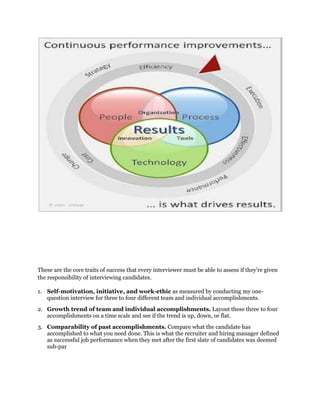
These are the core traits of success that every interviewer must be able to assess if they’re given
the responsibility of interviewing candidates.

1. Self-motivation, initiative, and work-ethic as measured by conducting my one-
   question interview for three to four different team and individual accomplishments.
2. Growth trend of team and individual accomplishments. Layout these three to four
   accomplishments on a time scale and see if the trend is up, down, or flat.
3. Comparability of past accomplishments. Compare what the candidate has
   accomplished to what you need done. This is what the recruiter and hiring manager defined
   as successful job performance when they met after the first slate of candidates was deemed
   sub-par
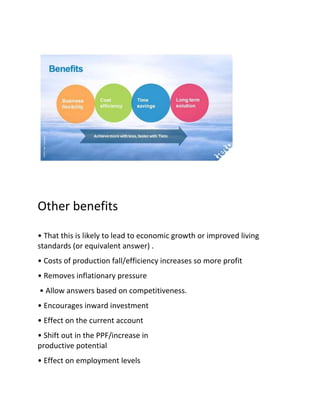
Benefits of productivity improvement
1)Increasing productivity increases a company’s profitability by producing

more goods and services with the same level of inputs or producing the

same level of goods and services with fewer inputs. This increased

profitability also results in higher wages for workers through increased

salaries and performance related bonuses.


2)Each company that increases productivity adds to the productivity of

company. The higher output of goods and services, together with reducing

levels of inputs, increases the wealth of the country and drives economic

growth. Thus the increased (and increasing) standard of living in Singapore

will be more sustainable as a result.


3)Furthermore, the increased productivity of company as a whole will make

the country more competitive both regionally and globally. This not only

protects current jobs, but will attract more foreign companies and MNCs

which will create additional jobs and greater opportunities for workers at

all levels.


Productivity affects everybody in the economy and increasing

productivity is everyone’s responsibility.
Other benefits

• That this is likely to lead to economic growth or improved living
standards (or equivalent answer) .
• Costs of production fall/efficiency increases so more profit
• Removes inflationary pressure
• Allow answers based on competitiveness.
• Encourages inward investment
• Effect on the current account
• Shift out in the PPF/increase in
productive potential
• Effect on employment levels
Propuctivity assignment

Propuctivity assignment

  • 1.
    BRIJESH YADAV S.Y.B.M.S (B) 17088(217) PRODUCTIVITY & QUALITY MANAGEMENT Topic- methods to Improve productivity
  • 3.
    PRODUCTIVITY LEADS TOPROFITABILITY NEGLEGENCE OF PRODUCTIVITY REFERS TO THE COLLAPSE OF ORGANISATION
  • 4.
    STEPS RELATING TOPRODUCTIVITY IMPROVEMENT Step-1 List your organization's short-term and long-term goals and a reasonable timeframe for meeting those objectives. Select a qualitative and quantitative methodology for measuring progress. Invite input from personnel involved with these activities. Assign in-house committees to determine what resources are currently available and what is still needed to accomplish specified goals. Step 2 Review employee performance to measure whether workers are meeting industry standards. Provide additional training and education as needed or assign workers more responsibility and a leadership role. Step 3 Streamline, consolidate, update, outsource or eliminate tasks to save your company more time or money. Replace outmoded technology. If necessary, bring in an outside consultant who can evaluate your operations objectively. Step 4 Communicate openly to foster a positive workplace environment and address simmering rumors and anxiety that inhibit productivity. Rectify morale issues so that workers who are negative, paranoid or resistant to any form of change do not prevent their coworkers from achieving their own potential or trusting the policy decisions set forth by management.
  • 5.
    STEPS-5 Institute incentives suchas flex-time, bonuses and paid time off that encourage initiative, camaraderie and productivity and also engage everyone in the process of doing better. Reward workers for their efforts and reinforce that the organization's success is due to the strong level of commitment that they have put forth.
  • 6.
    2.Communications Clear communications improvesproductivity. Provide clear instructions to the employee on how to perform assigned work, including a comprehensive job description. The instructions reduce the time required to understand how to accomplish assigned work. 3.Attendance o Late arrival to work and excessive absences causes other workers to spend less time performing their assigned jobs, reducing overall productivity. Keep accurate attendance records and discuss and document excessive absences 4.Teamwork o Hold weekly staff meetings so that everyone feels part of a group with a common purpose. Discuss accomplishments for the past week and a plan for the coming week. Ask staff members to present what they accomplished during the previous week 5.Tools Provide the right tools to perform a job productively. One example would be providing efficient software and hardware to support a person's work. Make sure a worker has received the necessary training to work productively.
  • 9.
    Factors of Productivityin the Workplace X By Frank Girard, eHow Contributor Print this article Improve employee productivity by focusing on improving important factors. Productivity is measured by comparing the output from work to the input. As the U.S. faces increased competition from workers in other countries, interest is increasing in how to make our workforce more productive. Several key factors affect productivity in the workforce. Other Peoples contribution p productivity comes from satisfaction of employees ? Productivity refers to the proper utlisation of resources 2. Job Satisfaction o Employees who are satisfied with their work tend to be more productive. Recognize your employees by commending them for a job well done. They can be recognized financially when bonuses are distributed, but there are important
  • 10.
    A few factorsthat can help to improve the employee productivity at the workplace are: # 1. Accountability Every employee needs to be well aware that he is accountable for his actions and decisions, and he can neither pass the buck or pass the blame to someone else. This will help him work more meticulously , Take cautious rather than reckless decisions, and not take advantage of his place, position or relationship with his superiors. # 2. Follow up Employers often set targets and feel their job is done. No, every target or milestone set needs to be followed up as well, to see if the progress is sufficient and if not, whether any interim measures can be taken before it is too late to salvage a situation. It also keeps the employee on track, ensuring there is consistent effort throughout the lifetime of the project 3. Manage micromanagement the work force but avoid It is well known that a large pool of employees does need to be managed, provided direction and given assistance. But with this they must also be trusted, given freedom to operate in their style and adopt measures which they think are the best to deliver results. This freedom to act as they deem fit helps to keep them encouraged, motivated and happy in the belief that they are trusted. Micro management is a human tendency but one that is detrimental to achievement, since it makes mere puppets out of employees, who are expected to toe the boss’ line and not think for themselves. Employees need to think for themselves, analyze the consequences of every decision or action to be able to give their best to their jobs. And the employers must make it possible for their workers to do so. #4. Encourage, motivate, reward and recognize The employer must ensure that on his part he always has words of encouragement for his staff. Encouraging them helps them move forward and do even better, and makes the worker feel
  • 11.
    happy. Innovative waysof motivating them spurs them even more. For example, holidays or conferences paid for by the company have been found to motivate employees immensely. Rewarding the hard work put in by employees makes them continue to work in the same fashion, and if the employee feels that his work is not appreciated in words or in material terms, he may gradually stop doing so, since he may feel that others working less are given the same too, so he need not work more. Rewards, and other ways of keeping employees happy makes them feel that their effort is being recognized and that they are needed by the company. Without these, they may soon start looking for greener pastures and new jobs. 5. Reach out to employees by seeking them out Every employee loves to feel he has the ears of the management who will recognize him and listen to what he says. Display of inter personal skills in which the boss appears humane and one of them, rather than a larger than life, distant figure, helps to have employees warm up to him and feel happy working for him. A bit of effort to reach out helps them all do better. If this extends beyond the work place it may prove to be even more encouraging to increase employee productivity. # 6. Demand realistic targets Employers need to set realistic goals that are within the limits of achievement. While an aggressive employer may want his people to outstretch themselves to achieve farfetched goals, it may also burn them out. Related: Rewarding poor performers – are you guilty? # 7. Team work Team work always helps in increasing workplace productivity since there is more input in the form of more ideas and minds at work. Working alone is not always the happiest situation either, especially in the field. Successful team building and working together is bound to bring out the best out of the employees who may also then compete with each other ensuring the business is the winner. # 8. Ensure that people enjoy their work The best performing employee is the happy employee, and the employer has to find ways of making his people happy. Besides working conditions and the work culture implemented, he has to devise ways of making the work seem challenging and interesting rather than mundane and boring
  • 12.
    # 9. Breakthe monotony and rotate While employers assign tasks according to an employee’s core competence, even the task they are best at, can make an employee bored and his work seem monotonous. This monotony can be broken with rotation and giving people new tasks and exposure to other divisions. This adds their learning and helps them get a holistic view of the business. # 10. Courses and improvement options Employees are delighted when they can enhance their skills and get additional learning opportunities sponsored by the employer. This helps them learn, feel indebted for the money being spent on them, which also adds to their resume, and are obliged to perform better by applying all the knowledge gained in these course # 11. Spend less time on meetings and more on action The current trend to have more meetings and discussion rather than spending more time working to achieve results, leads to precious productive time loss. Meetings for reviews and sharing of ideas can be limited and kept short. Employees should have more time to show results. # 12. Tools and equipment to raise productivity Finally, the workplace must have the best machinery, devices and equipment that yield error free results in the minimum possible time. Efficient electronic equipment with no connectivity issues and breakdowns will help to save precious time. They should take the place of paper work, and yield fast results. Some of these include: Smart phones Laptops Tablet computers Latest applications and software that offers quick connectivity and access Digital recorders-these help to record thoughts and new ideas when they strike, when no paper is available and the fear is of forgetting
  • 13.
    These are thecore traits of success that every interviewer must be able to assess if they’re given the responsibility of interviewing candidates. 1. Self-motivation, initiative, and work-ethic as measured by conducting my one- question interview for three to four different team and individual accomplishments. 2. Growth trend of team and individual accomplishments. Layout these three to four accomplishments on a time scale and see if the trend is up, down, or flat. 3. Comparability of past accomplishments. Compare what the candidate has accomplished to what you need done. This is what the recruiter and hiring manager defined as successful job performance when they met after the first slate of candidates was deemed sub-par
  • 14.
    Benefits of productivityimprovement 1)Increasing productivity increases a company’s profitability by producing more goods and services with the same level of inputs or producing the same level of goods and services with fewer inputs. This increased profitability also results in higher wages for workers through increased salaries and performance related bonuses. 2)Each company that increases productivity adds to the productivity of company. The higher output of goods and services, together with reducing levels of inputs, increases the wealth of the country and drives economic growth. Thus the increased (and increasing) standard of living in Singapore will be more sustainable as a result. 3)Furthermore, the increased productivity of company as a whole will make the country more competitive both regionally and globally. This not only protects current jobs, but will attract more foreign companies and MNCs which will create additional jobs and greater opportunities for workers at all levels. Productivity affects everybody in the economy and increasing productivity is everyone’s responsibility.
  • 15.
    Other benefits • Thatthis is likely to lead to economic growth or improved living standards (or equivalent answer) . • Costs of production fall/efficiency increases so more profit • Removes inflationary pressure • Allow answers based on competitiveness. • Encourages inward investment • Effect on the current account • Shift out in the PPF/increase in productive potential • Effect on employment levels