Journal of Lung, Pulmonary & Respiratory Research
Socio-demographic Patterns of Tuberculosis Patients,
Experience of a Tertiary Care Medical College Hospital of
Bangladesh
Submit Manuscript | http://medcraveonline.com
Introduction
Tuberculosis (TB) is one of the leading causes of mortality
and morbidity among infectious diseases worldwide and has an
enormous economic impact on many countries [1]. Bangladesh is
one of the highest TB burden countries accounting for one fifth
of the global incidence of TB [2]. The disease is more prevalent in
the productive age group of 15-54 yrs which causes an economic
burden on the individual’s household when they fall sick. The
number of TB patients is increasing at a horrifying speed for
several reasons. One is the lack of awareness of the disease, which
makes patients neglect their symptoms till it is too late. For many
they fear that they will surely die of TB and are therefore unable
to accept the fact. Another very important reason for hiding the
truth is the social stigma attached to TB. Women are thrown out
of families, people lose their jobs and childrens are thrown out
of school because of the irrational belief that TB is fatal and will
kill all those who live in proximity to a TB patient. Once removed
from the family, these people have a seriously diminished quality
of life and die on the streets due to complications of the disease
and starvation [3]. Extra pulmonary TB occurs outside the
lungs; in lymph nodes and in any organ system even brain and
reproductive organs. The bacteria may spread through lymphatic
or haematogenous dissemination. The TB bacteria may remain
dormant for years at a particular site before causing the disease
and may have a wide variety of clinical manifestations leading to
difficulty and delay in its diagnosis [4].
Methods
An observational study was conducted over a period of one
year from September 2015 to August 2016 in the Outpatient
Department of Jahurul Islam Medical College Hospital and
Department of Pathology, Jahurul Islam Medical College,
Kishoregonj, Bangladesh. A total of 112 patients, who came to
outpatient department were interviewed. The inclusion criteria
of the study were pulmonary and extra pulmonary tuberculosis
cases diagnosed on the basis of sputum smear, culture, chest-
radiograph, cytological and histopathological examination
receiving antitubercular drugs therapy. Patients unwilling to
participate in the study were excluded from the study. Informed
consent was taken for the study. Patient’s informed consent form
including information regarding the study were provided to the
patientsfortheirunderstandingaboutthestudyandparticipation.
Patient informed consent was written in Bengali language.
Primary data from each patient was included in Tuberculosis
Patient Profile form such as age, gender, educational level, annual
income in taka, occupational status and selected social habits like
smoking, alcohol.
Results
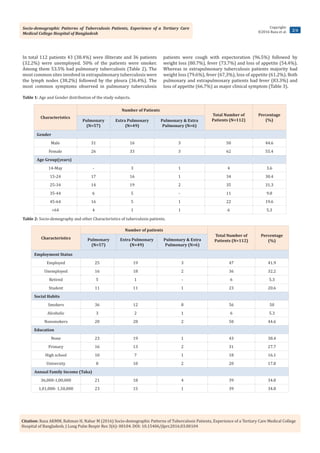
Out of 112 patients studied, 50(44.6%) were male and 62
(55.4%) were female. The majority of patients 69 (61.7%) were
in the age group of 15-34 years (Table 1). Annual family income
of 78 (69.6%) patients ranged between 36,000- 1,50,000 taka.
Volume 3 Issue 6 - 2016
1
Assistant Professor of Pathology, Jahurul Islam Medical
College, Bangladesh
2
Assistant Professor of Biochemistry, Jahurul Islam Medical
College, Bangladesh
3
Jahurul Islam Medical College, Bangladesh
*Corresponding author: AKM Maruf Raza, Assistant
Professor Department of Pathology, Jahurul Islam
Medical College, Bajitpur, Kishoregonj, Bangladesh, Tel:
+8801711306123; Email:
Received: November 17, 2016 | Published: December 14,
2016
Research Article
J Lung Pulm Respir Res 2016, 3(6): 00104
Abstract
Pulmonary tuberculosis is an air born infectious disease caused by Mycobacterium
tuberculosis and is a major cause of morbidity and mortality particularly in developing
countries. There are 33 million cases of tuberculosis worldwide, 3 million annual
death and 8 million persons developed active tuberculosis every year. If tuberculosis is
detected early and fully treated, people with the disease quickly become non-infectious
and are eventually cured. However multi-drug resistance tuberculosis, HIV associated
tuberculosis and weak health system are the major challenges. An observational study
was conducted over a period of one year from September 2015 to August 2016 in
the Outpatient Department of Jahurul Islam Medical College Hospital and Department
of Pathology, Jahurul Islam Medical College, Kishoregonj, Bangladesh. Most of the
patients were in the age group of 15-34 years (61.7%). 69.6% of the patients belonged
to lower income group. 50.9% patients had pulmonary tuberculosis, 43.7% patients
had extra pulmonary tuberculosis and 5.4% had both pulmonary and extra pulmonary
tuberculosis. The most common symptoms observed in pulmonary tuberculosis
patients were cough with expectoration (96.5%) followed by weight loss (80.7%),
fever (73.7%) and loss of appetite (54.4%) whereas in extrapulmonary tuberculosis
patients majority had weight loss(79.6%), fever (67,3%), loss of appetite (61.2%).
Keywords: Tuberculosis; Pulmonary tuberculosis; Extra pulmonary tuberculosis
Socio-demographic Patterns of Tuberculosis Patients, Experience of a Tertiary Care
Medical College Hospital of Bangladesh
2/4
Copyright:
©2016 Raza et al.
Citation: Raza AKMM, Rahman H, Nahar M (2016) Socio-demographic Patterns of Tuberculosis Patients, Experience of a Tertiary Care Medical College
Hospital of Bangladesh. J Lung Pulm Respir Res 3(6): 00104. DOI: 10.15406/jlprr.2016.03.00104
In total 112 patients 43 (38.4%) were illiterate and 36 patients
(32.2%) were unemployed. 50% of the patients were smoker.
Among them 53.5% had pulmonary tuberculosis (Table 2). The
most common sites involved in extrapulmonary tuberculosis were
the lymph nodes (38.2%) followed by the pleura (36.4%). The
most common symptoms observed in pulmonary tuberculosis
patients were cough with expectoration (96.5%) followed by
weight loss (80.7%), fever (73.7%) and loss of appetite (54.4%).
Whereas in extrapulmonary tuberculosis patients majority had
weight loss (79.6%), fever (67,3%), loss of appetite (61.2%). Both
pulmonary and extrapulmonary patients had fever (83.3%) and
loss of appetite (66.7%) as major clinical symptom (Table 3).
Table 1: Age and Gender distribution of the study subjects.
Characteristics
Number of Patients
Total Number of
Patients (N=112)
Percentage
(%)Pulmonary
(N=57)
Extra Pulmonary
(N=49)
Pulmonary & Extra
Pulmonary (N=6)
Gender
Male 31 16 3 50 44.6
Female 26 33 3 62 55.4
Age Group(years)
14-May - 3 1 4 3.6
15-24 17 16 1 34 30.4
25-34 14 19 2 35 31.3
35-44 6 5 - 11 9.8
45-64 16 5 1 22 19.6
>64 4 1 1 6 5.3
Table 2: Socio-demography and other Characteristics of tuberculosis patients.
Characteristics
Number of patients
Total Number of
Patients (N=112)
Percentage
(%)Pulmonary
(N=57)
Extra Pulmonary
(N=49)
Pulmonary & Extra
Pulmonary (N=6)
Employment Status
Employed 25 19 3 47 41.9
Unemployed 16 18 2 36 32.2
Retired 5 1 - 6 5.3
Student 11 11 1 23 20.6
Social Habits
Smokers 36 12 8 56 50
Alcoholic 3 2 1 6 5.3
Nonsmokers 20 28 2 50 44.6
Education
None 23 19 1 43 38.4
Primary 16 13 2 31 27.7
High school 10 7 1 18 16.1
University 8 10 2 20 17.8
Annual Family Income (Taka)
36,000-1,00,000 21 18 4 39 34.8
1,01,000- 1,50,000 23 15 1 39 34.8
Socio-demographic Patterns of Tuberculosis Patients, Experience of a Tertiary Care
Medical College Hospital of Bangladesh
3/4
Copyright:
©2016 Raza et al.
Citation: Raza AKMM, Rahman H, Nahar M (2016) Socio-demographic Patterns of Tuberculosis Patients, Experience of a Tertiary Care Medical College
Hospital of Bangladesh. J Lung Pulm Respir Res 3(6): 00104. DOI: 10.15406/jlprr.2016.03.00104
Table 3: Clinical presentation of patients with pulmonary and extra pulmonary tuberculosis.
Characteristics
Pulmonary (%)
(N=57)
Extra Pulmonary
(%) (N=49)
Pulmonary+Extra
Pulmonary (%) (N= 6)
Cough with Expectoration 55 [ 96.5%] 20 [ 40.8%] 03 [50%]
Loss of Appetite 31 [ 54.4%] 30 [ 61.2%] 04 [66.67%]
Fever 42 [73.7%] 33 [ 67.3%] 05 [83.33%]
Sweating 19 [ 33.3%] 06 [ 12.2%] 01 [16.67%]
Chills 27 [ 47.4%] 22 [44.9%] 03 [50%]
Fatigue 25 [ 43.9%] 11 [22.4%] 04 [66.67%]
Weight Loss 24 [42.1%] 15 [ 30.6%] 02 [33.33%]
Chest Pain 04 [7.0%] 13 [ 26.5%] -
Abdominal Pain 19 [33.3%] 11 [ 22.4%] 03 [50%]
Breathlessness 13 [22.8% ] 19 [ 38.8%] 04 [66.67%]
Swelling - 16 [ 32.7%] -
Body Ache 13 [22.8%] 18 [ 36.7%] 01 [16.67%]
Discussion
Pulmonary tuberculosis is an air born infectious disease
caused by Mycobacterium tuberculosis and is a major cause of
morbidity and mortality particularly in developing countries.
In this study a total of 112 diagnosed TB patients undergoing
treatment were studied. Of these 50 (44.6%) were males and 62
(55.4%) were females, which suggests that the number of female
patients are more compared to male patients which is similar to
a study conducted by Gamil Qasem Othman et al. [5]. This could
be because women often face some obstacles such as high female
illiteracy, ill health with lower immune status, massive house hold
work load and economic dependency that allow them limited
access to health care. Of the 112 tuberculosis patients evaluated,
69 (61.7%) patients were within the age group of 15–34 years.
This shows that TB mainly infects the productive age group
constituting to a strong economic burden and affect their working
potentiality. A large number of study populations were illiterate
43(38.4%). As level of education is an important factor in with
knowledge about disease, educational status of the community is
one of the key factor for the success or failure of the treatment
in tuberculosis. In the present study, 41.9% were employed. The
educational level and employment status of this study was found
consistent with the studies from Brazil conducted by Ricardo
Steffen et al. [6] .Only 10 (8.9%) of the patients had annual
family income more than 2 lacs taka which shows tuberculosis
affects middle class and lower class economic population group.
Unemployment, lower Educational Level, unhealthy living
environment and overcrowding living condition may be the
reason for TB in lower socio economic class people. This study
show 56 (50%) of the patients are smoker suggesting smoking
is one of the main risk factor for TB. Furthermore, behavioral
factors especially cigarette smoking and alcohol use have negative
effect on TB treatment. Cigarette smoking is known to damage the
lungs and suppress the individual adaptive immune responses
affecting patient’s response to TB treatment. In our study 50.9%
patients had pulmonary tuberculosis, 43.7% patients had extra
pulmonary tuberculosis and 5.4% were both pulmonary and
extrapulmonary tuberculosis. Pulmonary tuberculosis were more
common than extra pulmonary tuberculosis. This study also show
pulmonary tuberculosis is more common in men (54.4%) than in
women (45.6%). The same result was also observed in a study
by Noertjojo K et al. [7]. Recent studies have suggested that the
sites of extra-pulmonary tuberculosis may vary according to
geographic location and population. It is well known that lymph
node and pleural involvement in TB is a direct extension of the
disease from lung parenchyma [8]. In this study the most common
sites involved in extrapulmonary tuberculosis were the lymph
nodes (38.2%) followed by the pleura (36.4%) which is consistent
with the study from Nepal conducted by Chandrashekhar T
Sreeramareddy et al. [9]. The signs and symptoms of pulmonary
TB are typical and known (cough and sputum) whereas extra
pulmonary TB is difficult to identify not only by the patients but
also by the clinicians themselves [10]. In this study 96.5% of
patients of pulmonary TB and 40.8% patients of extrapulmonary
TB has cough with expectoration which was also observed in
similar study conducted by Gamil Qasem Othman et al. [5].
Conclusion
Our study conclude that majority of the tuberculosis patients
are within the economically productive age group ranged
between 15-34 years. Females are the majority of the patients
with extra pulmonary tuberculosis while pulmonary tuberculosis
predominantly occurred in men. The most common sites of
involvement was the lymph nodes followed by pleura, spine and
genitourinary tract. Based on this results TB control programme
might usefully target young and female populations for early
diagnosis to decrease tuberculosis morbidity and mortality.
Socio-demographic Patterns of Tuberculosis Patients, Experience of a Tertiary Care
Medical College Hospital of Bangladesh
4/4
Copyright:
©2016 Raza et al.
Citation: Raza AKMM, Rahman H, Nahar M (2016) Socio-demographic Patterns of Tuberculosis Patients, Experience of a Tertiary Care Medical College
Hospital of Bangladesh. J Lung Pulm Respir Res 3(6): 00104. DOI: 10.15406/jlprr.2016.03.00104
References
1.	 Anunnatsiri S, Chetchotisakd P, Wanke C (2005) Factors associated
with treatment outcomesin pulmonary tuberculosis in northeastern
Thailand. Southeast Asian J Trop Med Public Health 36(2): 324-330.
2.	 http://www.who.int/tb/publications/ global_report/ gtbr14_
executive_summary.Pdf
3.	 Shelly Batra (2008) Improving the health care delivery through
global collaboration. Operation ASHA- fighting Tuberculosis in India.
4.	 Gonzalez OY, Adams G, Teeter, LD, Bui TT, Musser JM, et al. (2003)
Extra-pulmonary manifestations in a large metropolitan area with
a low incidence of tuberculosis. Int J Tuberc Lung Dis 7(12): 1178-
1185.
5.	 Gamil Qasem Othman, Mohamed Izham M Ibrahim, Yahia Ahmed
Raja A (2011) Comparison of the Clinical and Socio-Demographical
factors in Pulmonary and Extra Pulmonary Tuberculosis patients in
Yemen. Journal of Clinical and Diagnostic Research 5(2): 191-195.
6.	 Steffen R, Menzies D, Oxlade O, Pinto M, de Castro AZ, et al. (2010)
Patients’ Costs and Cost-Effectiveness of Tuberculosis Treatment in
DOTS and Non-DOTS Facilities in Rio de Janeiro, Brazil. PLoS One
5(11): e14014.
7.	 Noertjojo K, Tam CM, Chan SL, Chan-Yeung MMW (2002) Extra-
pulmonary and pulmonary tuberculosis in Hong Kong. International
Journal of Tuberculosis lung Disease 6(10): 879-886.
8.	 Khazaei S, Roshanaei G, Saatchi M, Rezaeian S, Zahiri A, et al. (2014)
The epidemiological aspects of tuberculosis in Hamadan Province
during 2005-11. Int J Health Policy Manag 2(2): 75-80.
9.	 Chandrashekhar T Sreeramareddy, Kishore V Panduru,
Sharat C Verma, Hari S Joshi, Michael N Bates (2008) Comparison of
pulmonary and extrapulmonary tuberculosis in Nepal- a hospital-
based retrospective study. BMC Infectious Diseases 8: 1-8.
10.	 Muniyandi M, Ramachandran R, Balasubramanian R, Narayanan PR
(2006) Socio-economic dimensions of tuberculosis control: review
of studies over two decades from Tuberculosis Research Center. J
Commun Dis 38(3): 204-215.

Jlprr 03-00104

  • 1.
    Journal of Lung,Pulmonary & Respiratory Research Socio-demographic Patterns of Tuberculosis Patients, Experience of a Tertiary Care Medical College Hospital of Bangladesh Submit Manuscript | http://medcraveonline.com Introduction Tuberculosis (TB) is one of the leading causes of mortality and morbidity among infectious diseases worldwide and has an enormous economic impact on many countries [1]. Bangladesh is one of the highest TB burden countries accounting for one fifth of the global incidence of TB [2]. The disease is more prevalent in the productive age group of 15-54 yrs which causes an economic burden on the individual’s household when they fall sick. The number of TB patients is increasing at a horrifying speed for several reasons. One is the lack of awareness of the disease, which makes patients neglect their symptoms till it is too late. For many they fear that they will surely die of TB and are therefore unable to accept the fact. Another very important reason for hiding the truth is the social stigma attached to TB. Women are thrown out of families, people lose their jobs and childrens are thrown out of school because of the irrational belief that TB is fatal and will kill all those who live in proximity to a TB patient. Once removed from the family, these people have a seriously diminished quality of life and die on the streets due to complications of the disease and starvation [3]. Extra pulmonary TB occurs outside the lungs; in lymph nodes and in any organ system even brain and reproductive organs. The bacteria may spread through lymphatic or haematogenous dissemination. The TB bacteria may remain dormant for years at a particular site before causing the disease and may have a wide variety of clinical manifestations leading to difficulty and delay in its diagnosis [4]. Methods An observational study was conducted over a period of one year from September 2015 to August 2016 in the Outpatient Department of Jahurul Islam Medical College Hospital and Department of Pathology, Jahurul Islam Medical College, Kishoregonj, Bangladesh. A total of 112 patients, who came to outpatient department were interviewed. The inclusion criteria of the study were pulmonary and extra pulmonary tuberculosis cases diagnosed on the basis of sputum smear, culture, chest- radiograph, cytological and histopathological examination receiving antitubercular drugs therapy. Patients unwilling to participate in the study were excluded from the study. Informed consent was taken for the study. Patient’s informed consent form including information regarding the study were provided to the patientsfortheirunderstandingaboutthestudyandparticipation. Patient informed consent was written in Bengali language. Primary data from each patient was included in Tuberculosis Patient Profile form such as age, gender, educational level, annual income in taka, occupational status and selected social habits like smoking, alcohol. Results Out of 112 patients studied, 50(44.6%) were male and 62 (55.4%) were female. The majority of patients 69 (61.7%) were in the age group of 15-34 years (Table 1). Annual family income of 78 (69.6%) patients ranged between 36,000- 1,50,000 taka. Volume 3 Issue 6 - 2016 1 Assistant Professor of Pathology, Jahurul Islam Medical College, Bangladesh 2 Assistant Professor of Biochemistry, Jahurul Islam Medical College, Bangladesh 3 Jahurul Islam Medical College, Bangladesh *Corresponding author: AKM Maruf Raza, Assistant Professor Department of Pathology, Jahurul Islam Medical College, Bajitpur, Kishoregonj, Bangladesh, Tel: +8801711306123; Email: Received: November 17, 2016 | Published: December 14, 2016 Research Article J Lung Pulm Respir Res 2016, 3(6): 00104 Abstract Pulmonary tuberculosis is an air born infectious disease caused by Mycobacterium tuberculosis and is a major cause of morbidity and mortality particularly in developing countries. There are 33 million cases of tuberculosis worldwide, 3 million annual death and 8 million persons developed active tuberculosis every year. If tuberculosis is detected early and fully treated, people with the disease quickly become non-infectious and are eventually cured. However multi-drug resistance tuberculosis, HIV associated tuberculosis and weak health system are the major challenges. An observational study was conducted over a period of one year from September 2015 to August 2016 in the Outpatient Department of Jahurul Islam Medical College Hospital and Department of Pathology, Jahurul Islam Medical College, Kishoregonj, Bangladesh. Most of the patients were in the age group of 15-34 years (61.7%). 69.6% of the patients belonged to lower income group. 50.9% patients had pulmonary tuberculosis, 43.7% patients had extra pulmonary tuberculosis and 5.4% had both pulmonary and extra pulmonary tuberculosis. The most common symptoms observed in pulmonary tuberculosis patients were cough with expectoration (96.5%) followed by weight loss (80.7%), fever (73.7%) and loss of appetite (54.4%) whereas in extrapulmonary tuberculosis patients majority had weight loss(79.6%), fever (67,3%), loss of appetite (61.2%). Keywords: Tuberculosis; Pulmonary tuberculosis; Extra pulmonary tuberculosis
  • 2.
    Socio-demographic Patterns ofTuberculosis Patients, Experience of a Tertiary Care Medical College Hospital of Bangladesh 2/4 Copyright: ©2016 Raza et al. Citation: Raza AKMM, Rahman H, Nahar M (2016) Socio-demographic Patterns of Tuberculosis Patients, Experience of a Tertiary Care Medical College Hospital of Bangladesh. J Lung Pulm Respir Res 3(6): 00104. DOI: 10.15406/jlprr.2016.03.00104 In total 112 patients 43 (38.4%) were illiterate and 36 patients (32.2%) were unemployed. 50% of the patients were smoker. Among them 53.5% had pulmonary tuberculosis (Table 2). The most common sites involved in extrapulmonary tuberculosis were the lymph nodes (38.2%) followed by the pleura (36.4%). The most common symptoms observed in pulmonary tuberculosis patients were cough with expectoration (96.5%) followed by weight loss (80.7%), fever (73.7%) and loss of appetite (54.4%). Whereas in extrapulmonary tuberculosis patients majority had weight loss (79.6%), fever (67,3%), loss of appetite (61.2%). Both pulmonary and extrapulmonary patients had fever (83.3%) and loss of appetite (66.7%) as major clinical symptom (Table 3). Table 1: Age and Gender distribution of the study subjects. Characteristics Number of Patients Total Number of Patients (N=112) Percentage (%)Pulmonary (N=57) Extra Pulmonary (N=49) Pulmonary & Extra Pulmonary (N=6) Gender Male 31 16 3 50 44.6 Female 26 33 3 62 55.4 Age Group(years) 14-May - 3 1 4 3.6 15-24 17 16 1 34 30.4 25-34 14 19 2 35 31.3 35-44 6 5 - 11 9.8 45-64 16 5 1 22 19.6 >64 4 1 1 6 5.3 Table 2: Socio-demography and other Characteristics of tuberculosis patients. Characteristics Number of patients Total Number of Patients (N=112) Percentage (%)Pulmonary (N=57) Extra Pulmonary (N=49) Pulmonary & Extra Pulmonary (N=6) Employment Status Employed 25 19 3 47 41.9 Unemployed 16 18 2 36 32.2 Retired 5 1 - 6 5.3 Student 11 11 1 23 20.6 Social Habits Smokers 36 12 8 56 50 Alcoholic 3 2 1 6 5.3 Nonsmokers 20 28 2 50 44.6 Education None 23 19 1 43 38.4 Primary 16 13 2 31 27.7 High school 10 7 1 18 16.1 University 8 10 2 20 17.8 Annual Family Income (Taka) 36,000-1,00,000 21 18 4 39 34.8 1,01,000- 1,50,000 23 15 1 39 34.8
  • 3.
    Socio-demographic Patterns ofTuberculosis Patients, Experience of a Tertiary Care Medical College Hospital of Bangladesh 3/4 Copyright: ©2016 Raza et al. Citation: Raza AKMM, Rahman H, Nahar M (2016) Socio-demographic Patterns of Tuberculosis Patients, Experience of a Tertiary Care Medical College Hospital of Bangladesh. J Lung Pulm Respir Res 3(6): 00104. DOI: 10.15406/jlprr.2016.03.00104 Table 3: Clinical presentation of patients with pulmonary and extra pulmonary tuberculosis. Characteristics Pulmonary (%) (N=57) Extra Pulmonary (%) (N=49) Pulmonary+Extra Pulmonary (%) (N= 6) Cough with Expectoration 55 [ 96.5%] 20 [ 40.8%] 03 [50%] Loss of Appetite 31 [ 54.4%] 30 [ 61.2%] 04 [66.67%] Fever 42 [73.7%] 33 [ 67.3%] 05 [83.33%] Sweating 19 [ 33.3%] 06 [ 12.2%] 01 [16.67%] Chills 27 [ 47.4%] 22 [44.9%] 03 [50%] Fatigue 25 [ 43.9%] 11 [22.4%] 04 [66.67%] Weight Loss 24 [42.1%] 15 [ 30.6%] 02 [33.33%] Chest Pain 04 [7.0%] 13 [ 26.5%] - Abdominal Pain 19 [33.3%] 11 [ 22.4%] 03 [50%] Breathlessness 13 [22.8% ] 19 [ 38.8%] 04 [66.67%] Swelling - 16 [ 32.7%] - Body Ache 13 [22.8%] 18 [ 36.7%] 01 [16.67%] Discussion Pulmonary tuberculosis is an air born infectious disease caused by Mycobacterium tuberculosis and is a major cause of morbidity and mortality particularly in developing countries. In this study a total of 112 diagnosed TB patients undergoing treatment were studied. Of these 50 (44.6%) were males and 62 (55.4%) were females, which suggests that the number of female patients are more compared to male patients which is similar to a study conducted by Gamil Qasem Othman et al. [5]. This could be because women often face some obstacles such as high female illiteracy, ill health with lower immune status, massive house hold work load and economic dependency that allow them limited access to health care. Of the 112 tuberculosis patients evaluated, 69 (61.7%) patients were within the age group of 15–34 years. This shows that TB mainly infects the productive age group constituting to a strong economic burden and affect their working potentiality. A large number of study populations were illiterate 43(38.4%). As level of education is an important factor in with knowledge about disease, educational status of the community is one of the key factor for the success or failure of the treatment in tuberculosis. In the present study, 41.9% were employed. The educational level and employment status of this study was found consistent with the studies from Brazil conducted by Ricardo Steffen et al. [6] .Only 10 (8.9%) of the patients had annual family income more than 2 lacs taka which shows tuberculosis affects middle class and lower class economic population group. Unemployment, lower Educational Level, unhealthy living environment and overcrowding living condition may be the reason for TB in lower socio economic class people. This study show 56 (50%) of the patients are smoker suggesting smoking is one of the main risk factor for TB. Furthermore, behavioral factors especially cigarette smoking and alcohol use have negative effect on TB treatment. Cigarette smoking is known to damage the lungs and suppress the individual adaptive immune responses affecting patient’s response to TB treatment. In our study 50.9% patients had pulmonary tuberculosis, 43.7% patients had extra pulmonary tuberculosis and 5.4% were both pulmonary and extrapulmonary tuberculosis. Pulmonary tuberculosis were more common than extra pulmonary tuberculosis. This study also show pulmonary tuberculosis is more common in men (54.4%) than in women (45.6%). The same result was also observed in a study by Noertjojo K et al. [7]. Recent studies have suggested that the sites of extra-pulmonary tuberculosis may vary according to geographic location and population. It is well known that lymph node and pleural involvement in TB is a direct extension of the disease from lung parenchyma [8]. In this study the most common sites involved in extrapulmonary tuberculosis were the lymph nodes (38.2%) followed by the pleura (36.4%) which is consistent with the study from Nepal conducted by Chandrashekhar T Sreeramareddy et al. [9]. The signs and symptoms of pulmonary TB are typical and known (cough and sputum) whereas extra pulmonary TB is difficult to identify not only by the patients but also by the clinicians themselves [10]. In this study 96.5% of patients of pulmonary TB and 40.8% patients of extrapulmonary TB has cough with expectoration which was also observed in similar study conducted by Gamil Qasem Othman et al. [5]. Conclusion Our study conclude that majority of the tuberculosis patients are within the economically productive age group ranged between 15-34 years. Females are the majority of the patients with extra pulmonary tuberculosis while pulmonary tuberculosis predominantly occurred in men. The most common sites of involvement was the lymph nodes followed by pleura, spine and genitourinary tract. Based on this results TB control programme might usefully target young and female populations for early diagnosis to decrease tuberculosis morbidity and mortality.
  • 4.
    Socio-demographic Patterns ofTuberculosis Patients, Experience of a Tertiary Care Medical College Hospital of Bangladesh 4/4 Copyright: ©2016 Raza et al. Citation: Raza AKMM, Rahman H, Nahar M (2016) Socio-demographic Patterns of Tuberculosis Patients, Experience of a Tertiary Care Medical College Hospital of Bangladesh. J Lung Pulm Respir Res 3(6): 00104. DOI: 10.15406/jlprr.2016.03.00104 References 1. Anunnatsiri S, Chetchotisakd P, Wanke C (2005) Factors associated with treatment outcomesin pulmonary tuberculosis in northeastern Thailand. Southeast Asian J Trop Med Public Health 36(2): 324-330. 2. http://www.who.int/tb/publications/ global_report/ gtbr14_ executive_summary.Pdf 3. Shelly Batra (2008) Improving the health care delivery through global collaboration. Operation ASHA- fighting Tuberculosis in India. 4. Gonzalez OY, Adams G, Teeter, LD, Bui TT, Musser JM, et al. (2003) Extra-pulmonary manifestations in a large metropolitan area with a low incidence of tuberculosis. Int J Tuberc Lung Dis 7(12): 1178- 1185. 5. Gamil Qasem Othman, Mohamed Izham M Ibrahim, Yahia Ahmed Raja A (2011) Comparison of the Clinical and Socio-Demographical factors in Pulmonary and Extra Pulmonary Tuberculosis patients in Yemen. Journal of Clinical and Diagnostic Research 5(2): 191-195. 6. Steffen R, Menzies D, Oxlade O, Pinto M, de Castro AZ, et al. (2010) Patients’ Costs and Cost-Effectiveness of Tuberculosis Treatment in DOTS and Non-DOTS Facilities in Rio de Janeiro, Brazil. PLoS One 5(11): e14014. 7. Noertjojo K, Tam CM, Chan SL, Chan-Yeung MMW (2002) Extra- pulmonary and pulmonary tuberculosis in Hong Kong. International Journal of Tuberculosis lung Disease 6(10): 879-886. 8. Khazaei S, Roshanaei G, Saatchi M, Rezaeian S, Zahiri A, et al. (2014) The epidemiological aspects of tuberculosis in Hamadan Province during 2005-11. Int J Health Policy Manag 2(2): 75-80. 9. Chandrashekhar T Sreeramareddy, Kishore V Panduru, Sharat C Verma, Hari S Joshi, Michael N Bates (2008) Comparison of pulmonary and extrapulmonary tuberculosis in Nepal- a hospital- based retrospective study. BMC Infectious Diseases 8: 1-8. 10. Muniyandi M, Ramachandran R, Balasubramanian R, Narayanan PR (2006) Socio-economic dimensions of tuberculosis control: review of studies over two decades from Tuberculosis Research Center. J Commun Dis 38(3): 204-215.