



Group Members
Mohammad Shahriar Reza 011 132 065
Samrin Ahmed Riya 011 142 021
• What is Compiler
• Introduction to JUST IN TIME COMPILERS
• Basis for JIT
• Relies on JIT
• Time space trade off (JIT)
• Functioning of JIT
• Classification of JUST IN TIME COMPILERS
• Conclusion
• References
CONTENTS
COMPILER
• A program that changes source code (high-level
language) to object code which that can be executed by
a machine.
• Compiler:
o Checks syntax of program
o Checks at a time all the program
• Primary reason for compiling source code is to create an
executable program
• Examples of compiler based language:
• C, C++, JAVA
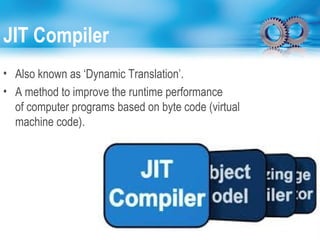
JIT Compiler
• Also known as ‘Dynamic Translation’.
• A method to improve the runtime performance
of computer programs based on byte code (virtual
machine code).
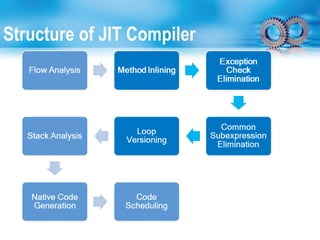
Structure of JIT Compiler
Basis for JIT
• Stores the program as byte code.
• Runs the code segment preoperatively compiled to physical
machine code in order to run faster.
• Represents a hybrid approach translation occurring continuously,
as with interpreters.
• Handles late-bound data types and the ability to enforce security
guarantees.
• Converts code at runtime prior to executing it natively.
Relies on JIT
• Microsoft's .NET Framework.
• Most implementations of Java.
Reason: For high-speed code execution.
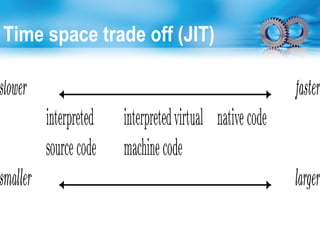
Time space trade off (JIT)
Functioning of JIT
Dynamic Compilation:
• Can do non-conservative optimizations in dynamic
• Separates optimization from product delivery cycle
• – Update JVM, run the same application, realize
improved performance!
• – Can be "tuned" to the target platform.
Functioning of JIT (Contd..)
• Knows about
– loaded classes, methods the program has executed
• Makes optimization decisions based on code paths executed
– Code generation depends on what is observed:
-loaded classes, code paths executed,
branches taken
• May re-optimize if assumption was wrong, or alternative code
paths taken.
– Instruction path length may change between
invocations of methods as a result of de-optimization
/ re-compilation
Functioning of JIT (Contd..)
JVM: Makes Bytecodes Fast
• JVMs eventually JIT bytecodes
– To make them fast
– compiled when needed
- Maybe immediately before execution or
when we decide it’s important
– Some JITs are high quality optimizing compilers
Functioning of JIT (Contd..)
 JVM: Makes Bytecodes Fast
• JIT'ing requires Profiling
– Because you don't want to JIT everything
• Profiling allows focused code-gen
• Profiling allows better code-gen
– Inline what’s hot
– Loop unrolling, range-check elimination, etc
– Branch prediction, spill-code-gen, scheduling
Functioning of JIT (Contd..)
Dynamic Compilation (JIT)
• Is dynamic compilation overhead essential?
– The longer your application runs, the less the
overhead
• Trading off compilation time, not application time
– Steal some cycles very early in execution
– Done automagically and transparently to application
• Most of “perceived” overhead is compiler waiting for more data
– ...thus running semi-optimal code for time being
Overhead
Functioning of JIT (Contd..)
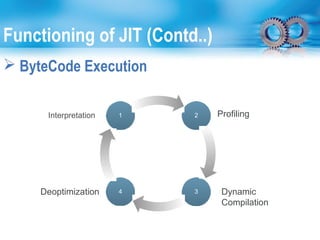
 ByteCode Execution
1 2
34
Interpretation Profiling
Dynamic
Compilation
Deoptimization
Classification features of JUST IN TIME
COMPILERS
• JIT systems can be classified according to three properties:
1. Invocation
-Explicitly invoked the user must take some action to cause
compilation at runtime. An implicitly invoked JIT compiler is transparent
to the user.
2. Executability
-Performs optimization on the fly on one of the source languages
namely ‘JITsystemmonoexecutable’ or ‘polyexecutable’.
3. Concurrency
-operates to execute the program concurrently; in a
separate thread or process, even on a different processor.
Conclusion
• A traditional compiler that compiles all the code to
machine language before the program is first run.
• An access to dynamic runtime information.
• Actually a feature of the runtime interpreter.
• Ideally the efficiency of running object code will
overcome the inefficiency of recompiling the program
every time it runs.
References
•  http://www.theserverside.com/definition/just-in-time-
compiler-JIT
• https://www.slideshare.net/ZeroTurnaround/vladimir-
ivanovjvmjitcompilationoverview-24613146
• http://stackoverflow.com/questions/95635/what-does-a-just-
in-time-jit-compiler-do
• https://en.wikipedia.org/wiki/Just-in-time_compilation
Questions
JIT Compiler

JIT Compiler

  • 2.
    Group Members Mohammad ShahriarReza 011 132 065 Samrin Ahmed Riya 011 142 021
  • 3.
    • What isCompiler • Introduction to JUST IN TIME COMPILERS • Basis for JIT • Relies on JIT • Time space trade off (JIT) • Functioning of JIT • Classification of JUST IN TIME COMPILERS • Conclusion • References CONTENTS
  • 4.
  • 5.
    • A programthat changes source code (high-level language) to object code which that can be executed by a machine. • Compiler: o Checks syntax of program o Checks at a time all the program • Primary reason for compiling source code is to create an executable program • Examples of compiler based language: • C, C++, JAVA
  • 6.
    JIT Compiler • Alsoknown as ‘Dynamic Translation’. • A method to improve the runtime performance of computer programs based on byte code (virtual machine code).
  • 7.
  • 8.
    Basis for JIT •Stores the program as byte code. • Runs the code segment preoperatively compiled to physical machine code in order to run faster. • Represents a hybrid approach translation occurring continuously, as with interpreters. • Handles late-bound data types and the ability to enforce security guarantees. • Converts code at runtime prior to executing it natively.
  • 9.
    Relies on JIT •Microsoft's .NET Framework. • Most implementations of Java. Reason: For high-speed code execution.
  • 10.
  • 11.
    Functioning of JIT DynamicCompilation: • Can do non-conservative optimizations in dynamic • Separates optimization from product delivery cycle • – Update JVM, run the same application, realize improved performance! • – Can be "tuned" to the target platform.
  • 12.
    Functioning of JIT(Contd..) • Knows about – loaded classes, methods the program has executed • Makes optimization decisions based on code paths executed – Code generation depends on what is observed: -loaded classes, code paths executed, branches taken • May re-optimize if assumption was wrong, or alternative code paths taken. – Instruction path length may change between invocations of methods as a result of de-optimization / re-compilation
  • 13.
    Functioning of JIT(Contd..) JVM: Makes Bytecodes Fast • JVMs eventually JIT bytecodes – To make them fast – compiled when needed - Maybe immediately before execution or when we decide it’s important – Some JITs are high quality optimizing compilers
  • 14.
    Functioning of JIT(Contd..)  JVM: Makes Bytecodes Fast • JIT'ing requires Profiling – Because you don't want to JIT everything • Profiling allows focused code-gen • Profiling allows better code-gen – Inline what’s hot – Loop unrolling, range-check elimination, etc – Branch prediction, spill-code-gen, scheduling
  • 15.
    Functioning of JIT(Contd..) Dynamic Compilation (JIT) • Is dynamic compilation overhead essential? – The longer your application runs, the less the overhead • Trading off compilation time, not application time – Steal some cycles very early in execution – Done automagically and transparently to application • Most of “perceived” overhead is compiler waiting for more data – ...thus running semi-optimal code for time being Overhead
  • 16.
    Functioning of JIT(Contd..)  ByteCode Execution 1 2 34 Interpretation Profiling Dynamic Compilation Deoptimization
  • 17.
    Classification features ofJUST IN TIME COMPILERS • JIT systems can be classified according to three properties: 1. Invocation -Explicitly invoked the user must take some action to cause compilation at runtime. An implicitly invoked JIT compiler is transparent to the user. 2. Executability -Performs optimization on the fly on one of the source languages namely ‘JITsystemmonoexecutable’ or ‘polyexecutable’. 3. Concurrency -operates to execute the program concurrently; in a separate thread or process, even on a different processor.
  • 18.
    Conclusion • A traditionalcompiler that compiles all the code to machine language before the program is first run. • An access to dynamic runtime information. • Actually a feature of the runtime interpreter. • Ideally the efficiency of running object code will overcome the inefficiency of recompiling the program every time it runs.
  • 19.
    References •  http://www.theserverside.com/definition/just-in-time- compiler-JIT • https://www.slideshare.net/ZeroTurnaround/vladimir- ivanovjvmjitcompilationoverview-24613146 •http://stackoverflow.com/questions/95635/what-does-a-just- in-time-jit-compiler-do • https://en.wikipedia.org/wiki/Just-in-time_compilation
  • 20.