Roads and Bridges

Construction Methods & resources


       by:
                               1
  Jihad Daniel
Types of Roads
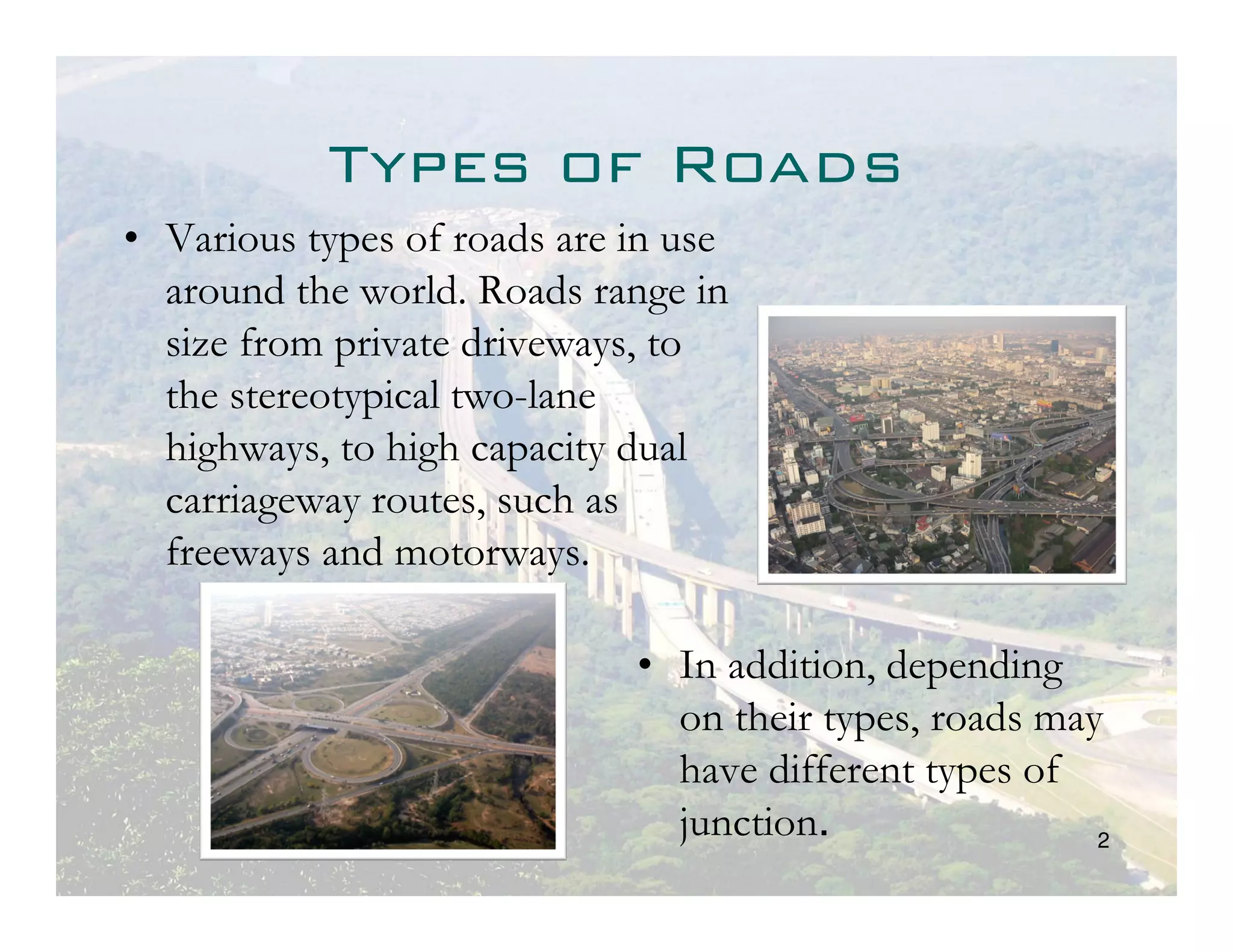
• Various types of roads are in use
  around the world. Roads range in
  size from private driveways, to
  the stereotypical two-lane
  highways, to high capacity dual
  carriageway routes, such as
  freeways and motorways.

                             • In addition, depending
                               on their types, roads may
                               have different types of
                               junction.                2
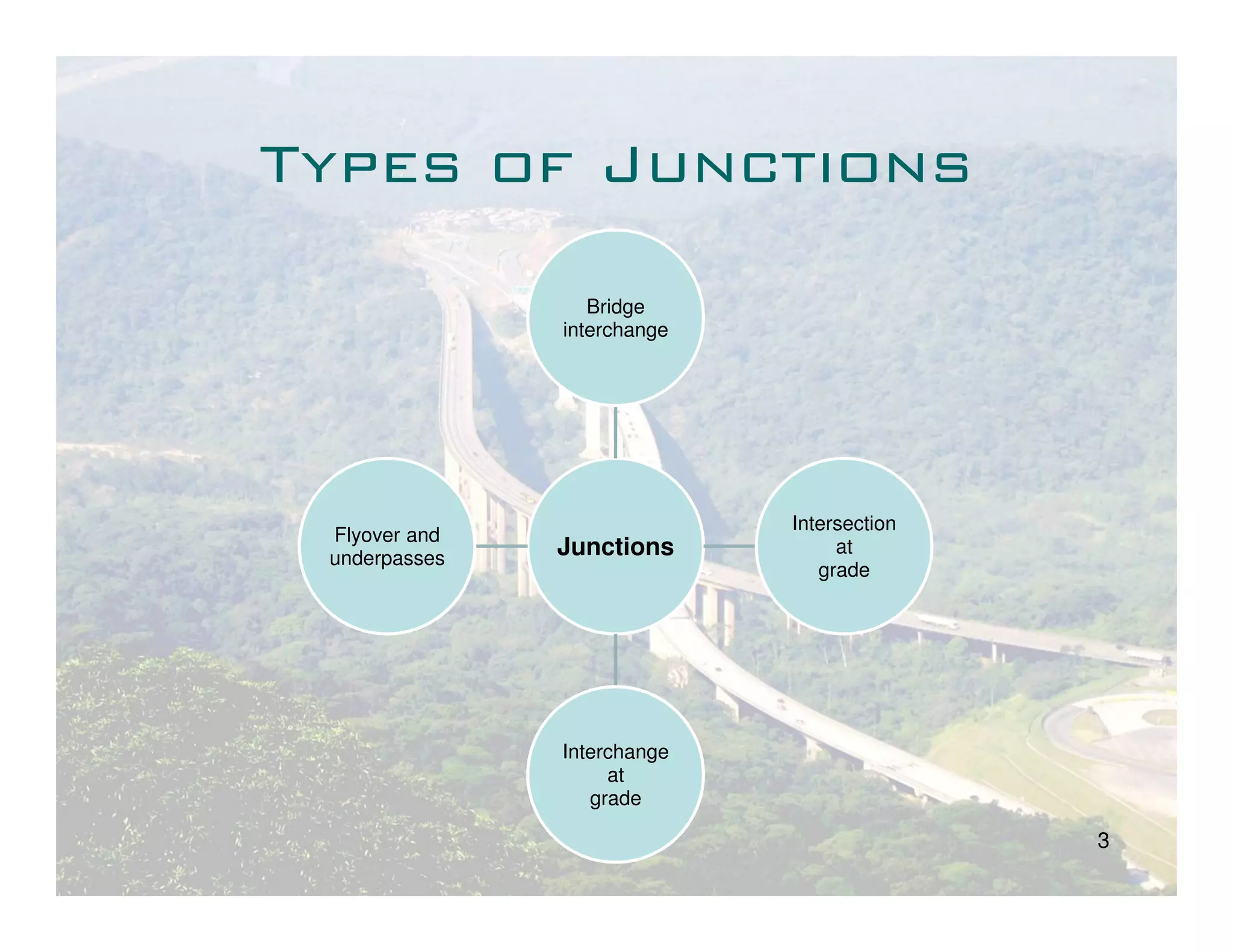
Types of Junctions
                  Bridge
               interchange


                             Intersection
 Flyover and
 underpasses   Junctions          at
                                grade


               Interchange
                    at
                  grade

                                            3
Types of Junctions
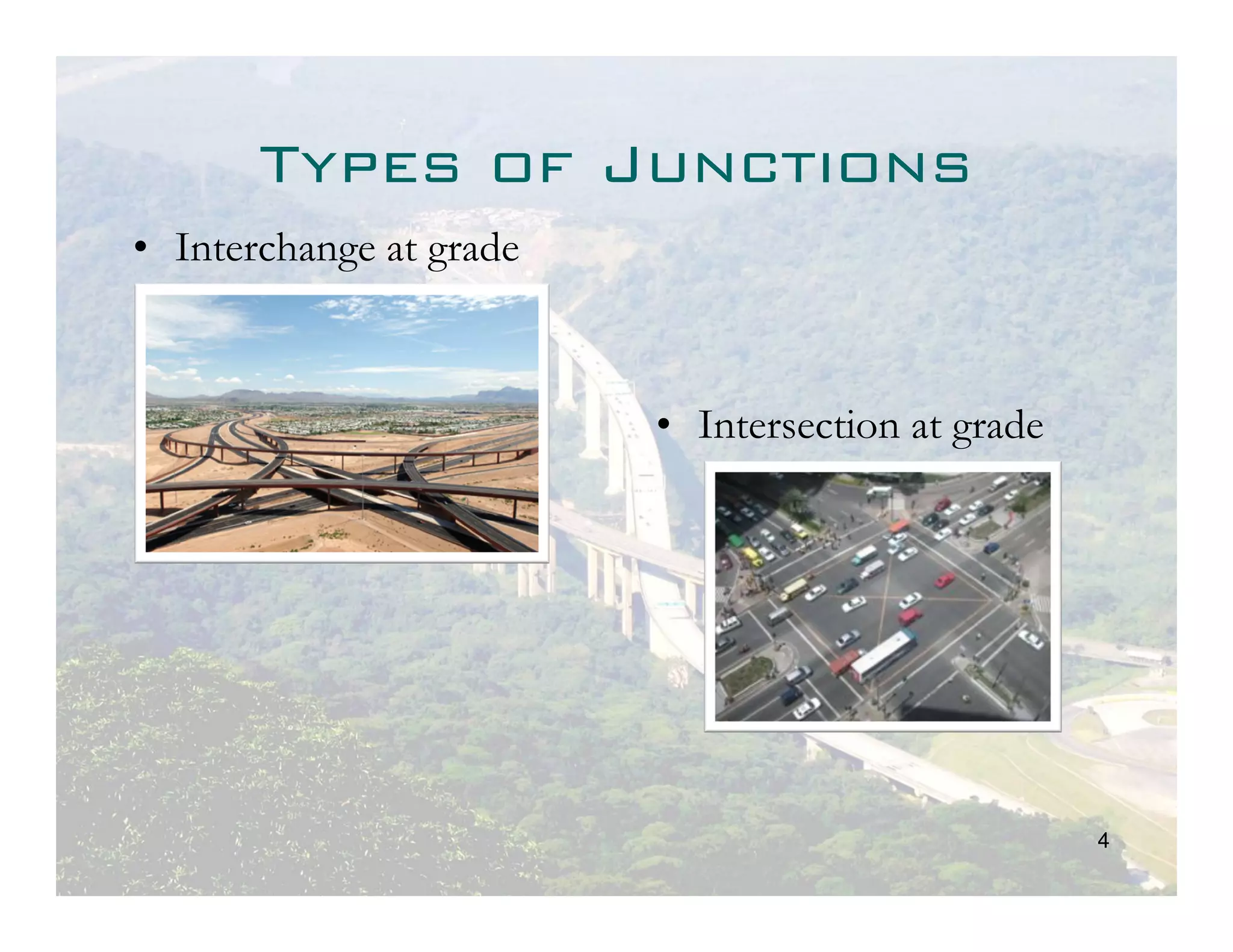
• Interchange at grade


                         • Intersection at grade


                                                   4
Types of Junctions
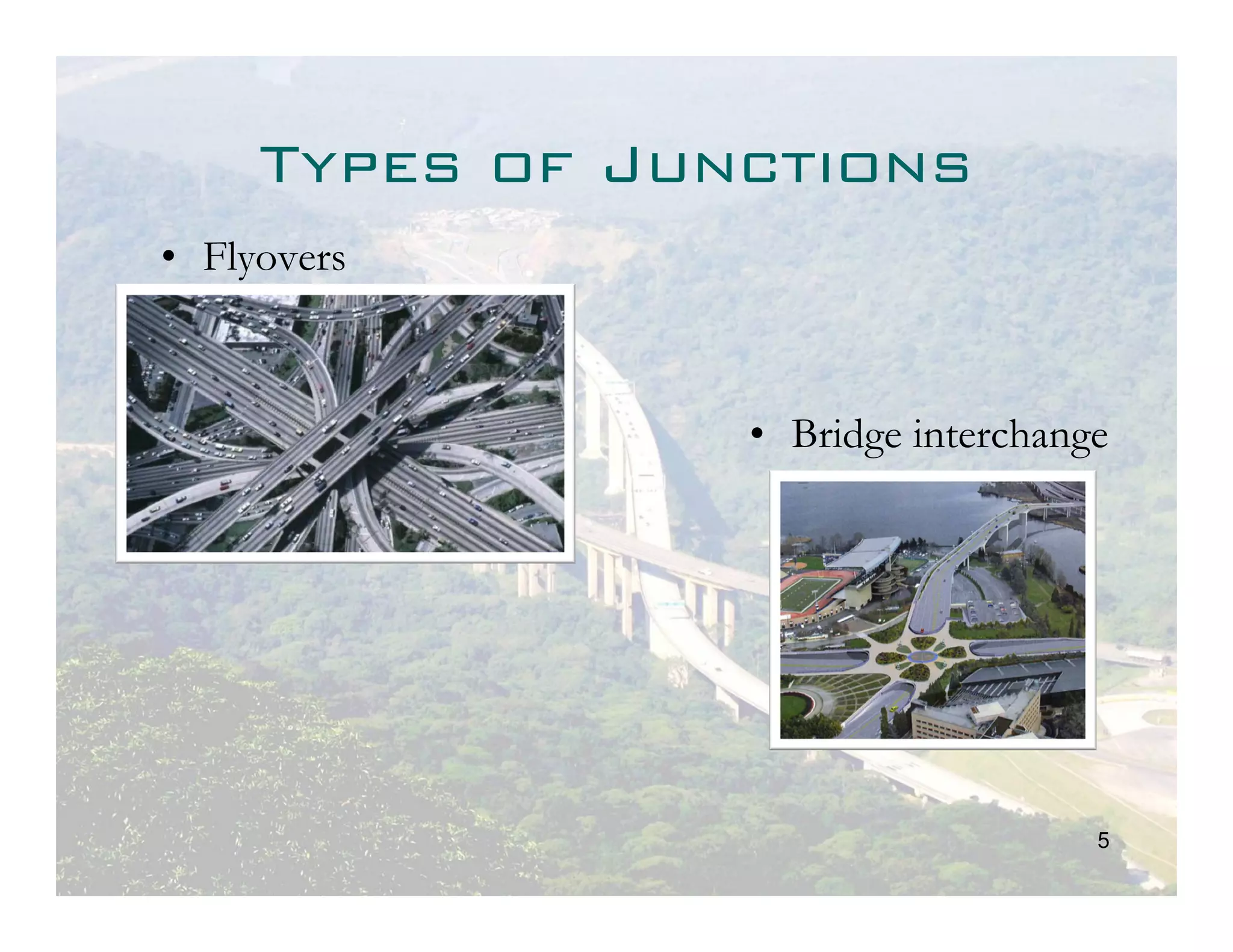
• Flyovers


                 • Bridge interchange


                                    5
Road Structure
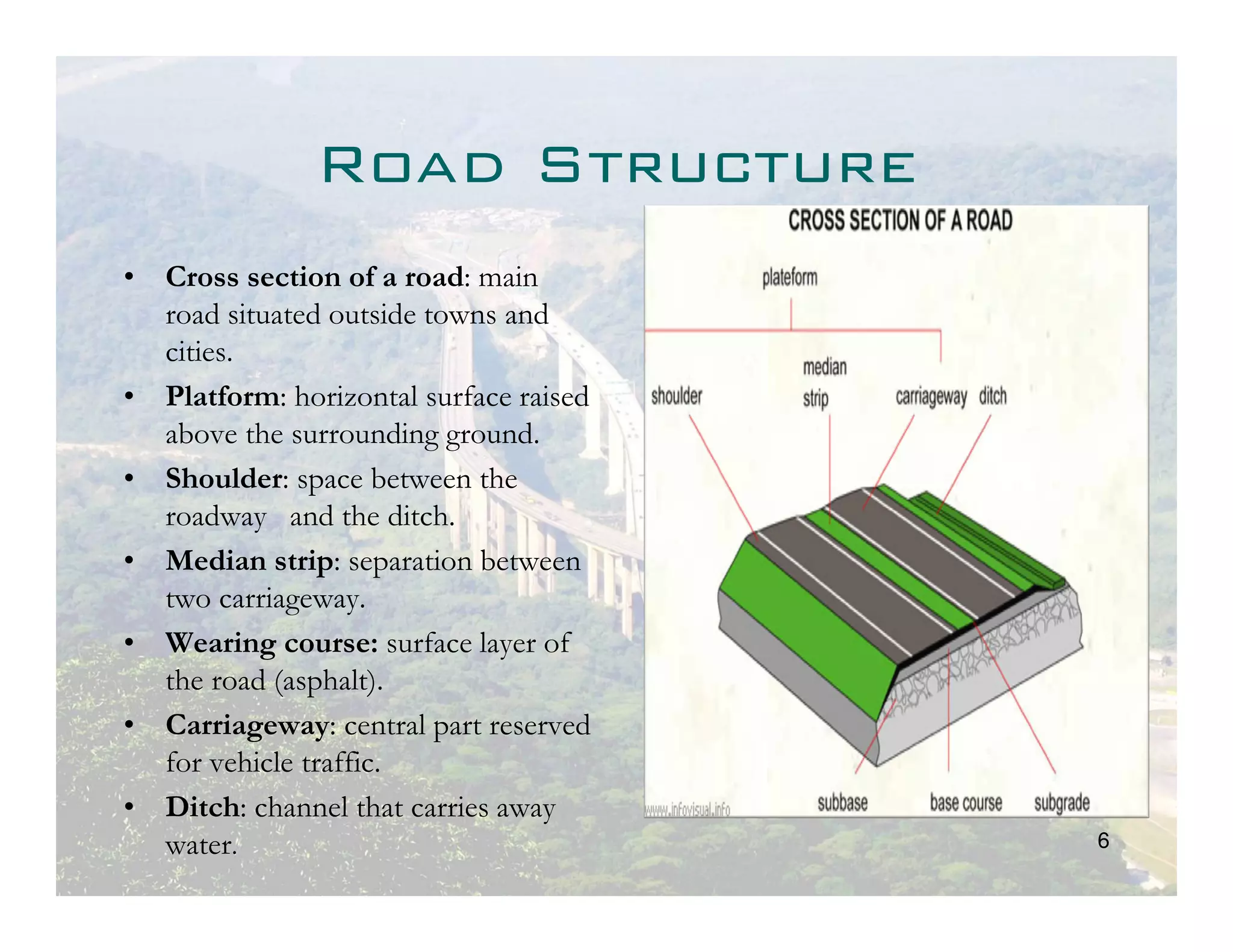
• Cross section of a road: main
  road situated outside towns and
  cities.
• Platform: horizontal surface raised
  above the surrounding ground.
• Shoulder: space between the
  roadway and the ditch.
• Median strip: separation between
  two carriageway.
• Wearing course: surface layer of
  the road (asphalt).
• Carriageway: central part reserved
  for vehicle traffic.
• Ditch: channel that carries away
  water.                                6
Road Structure
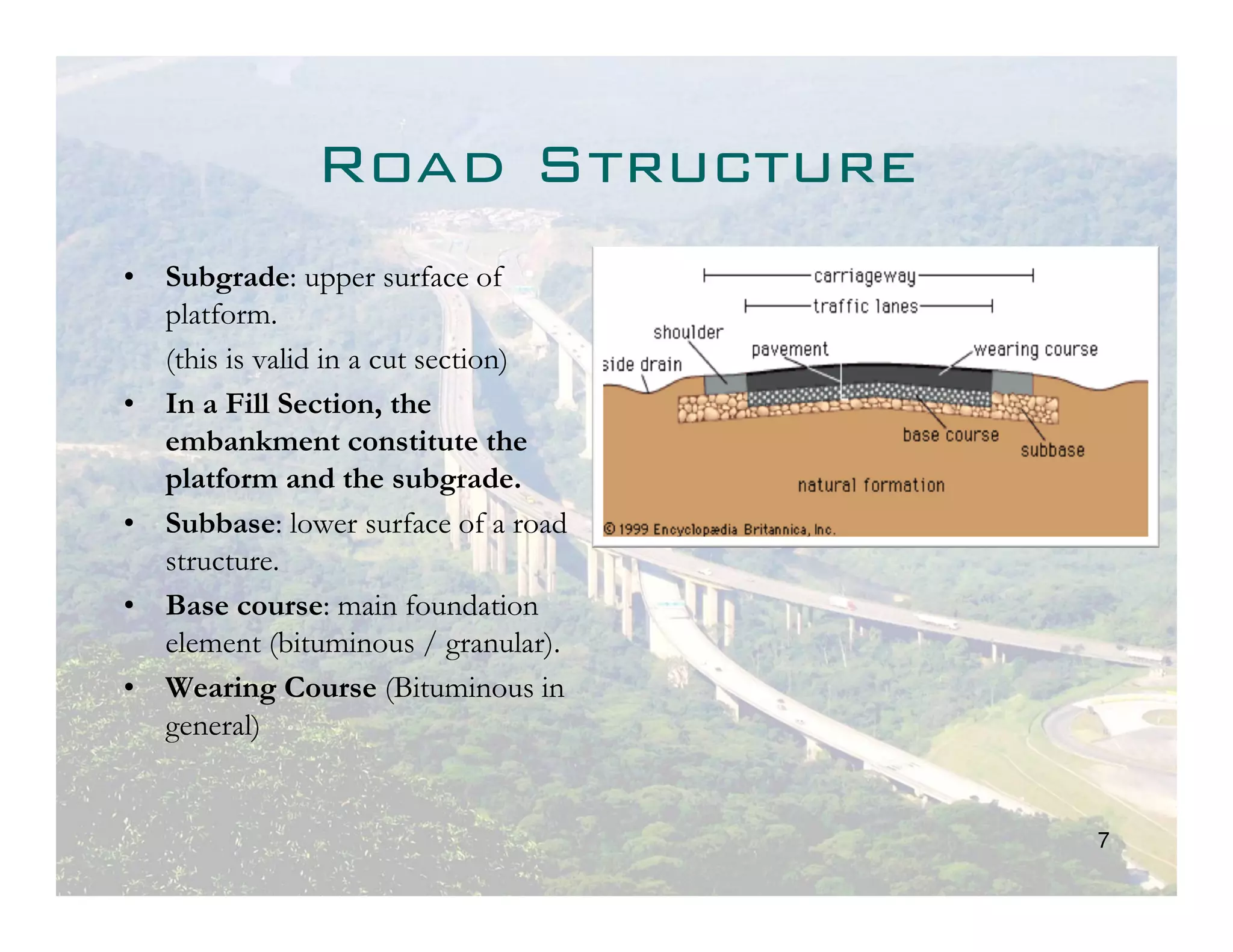
• Subgrade: upper surface of
  platform.
  (this is valid in a cut section)
• In a Fill Section, the
  embankment constitute the
  platform and the subgrade.
• Subbase: lower surface of a road
  structure.
• Base course: main foundation
  element (bituminous / granular).
• Wearing Course (Bituminous in
  general)


                                     7
Road Profile
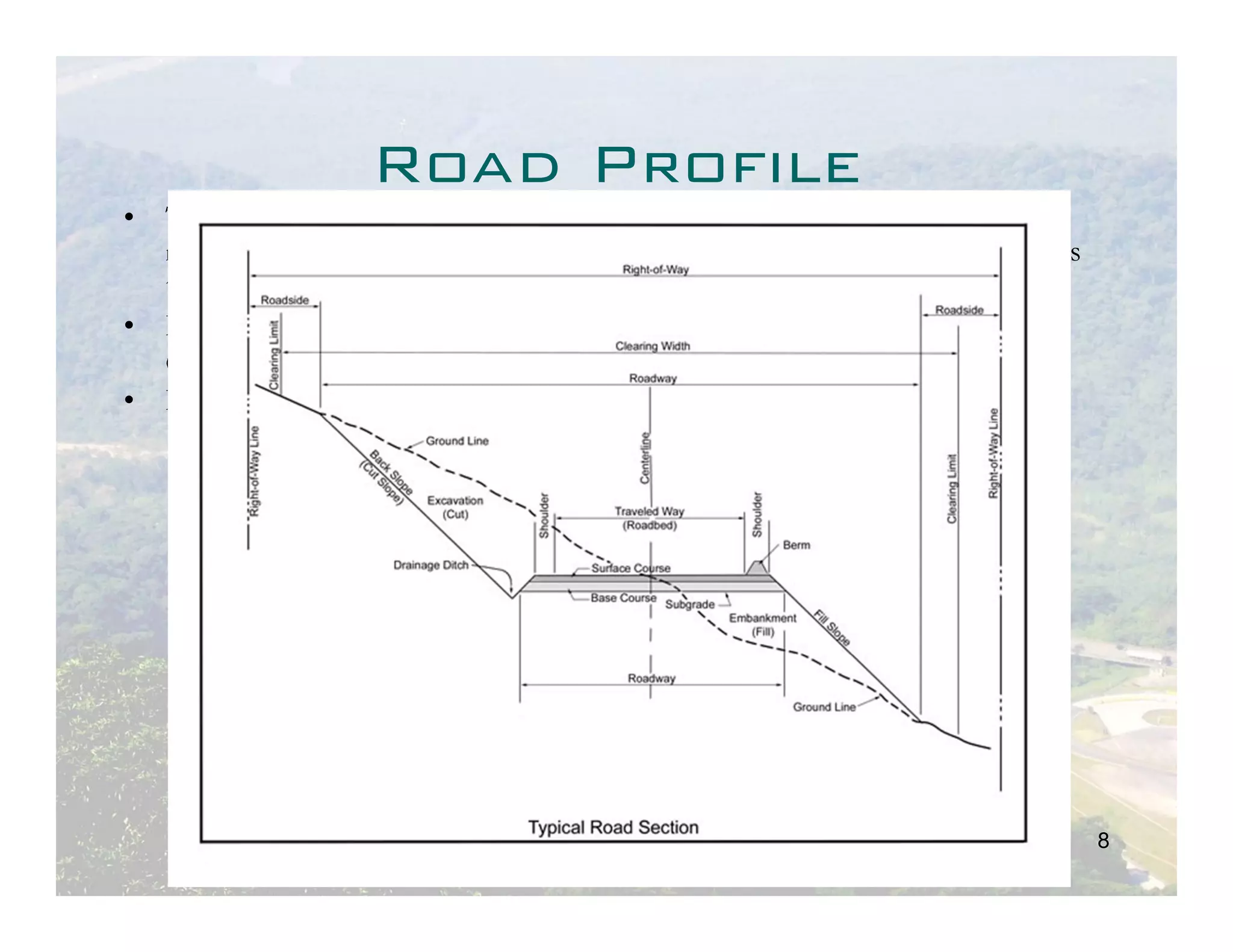
• The right of way ground formation maybe, as the road profile requires,
  natural ground, cut or fill. In case of fill, ground formation is filled in layers
  to comply with the profile. The work is called embankment.
• Embankment is made in layers with thickness varying from 20 to 40 cm
  depending on the material used.
• In case of cut this could be open cut or tunnel.


                                                                                       8
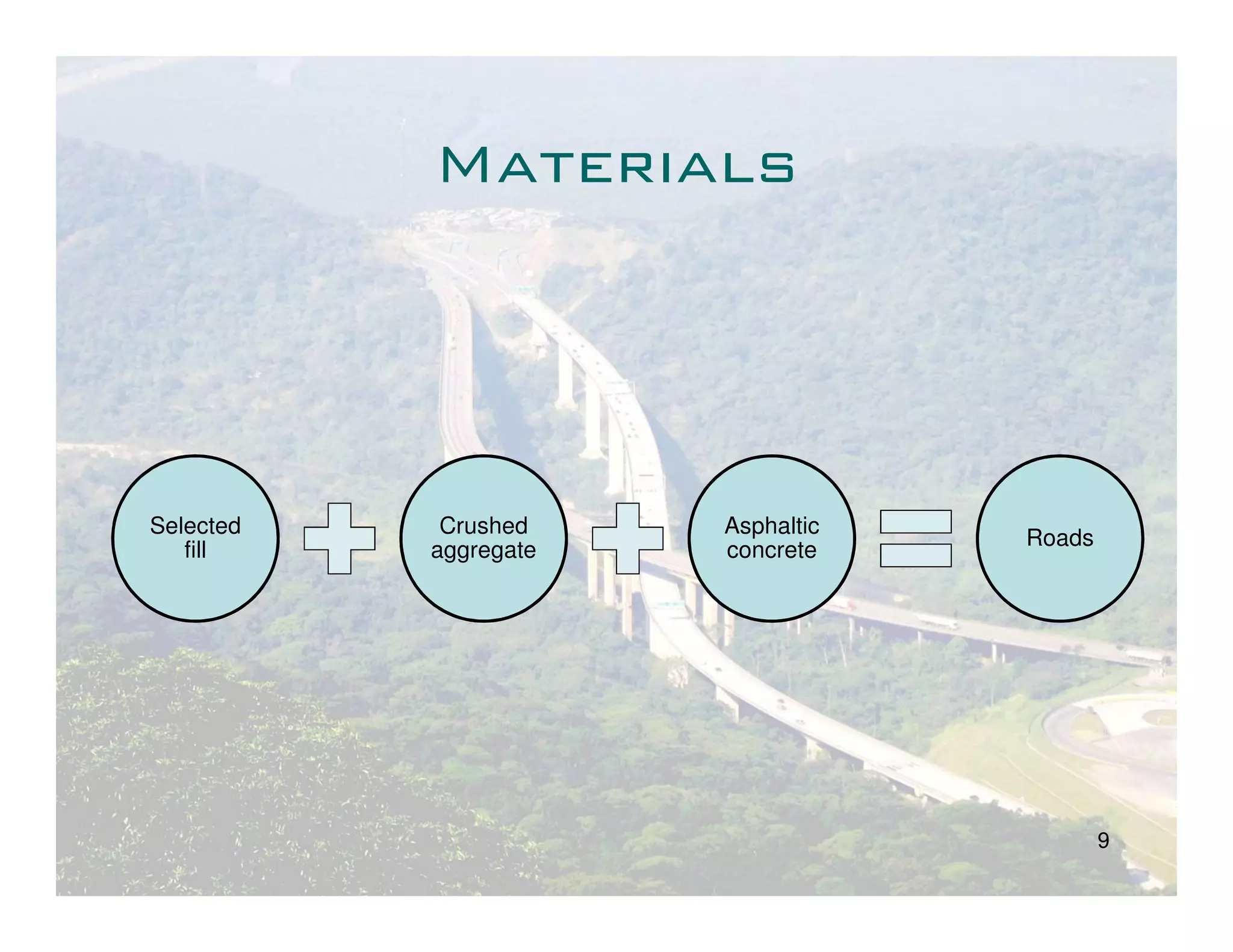
Materials


Selected    Crushed    Asphaltic
                                   Roads
   fill    aggregate   concrete


                                           9
Road Furniture and
     Incidental Works
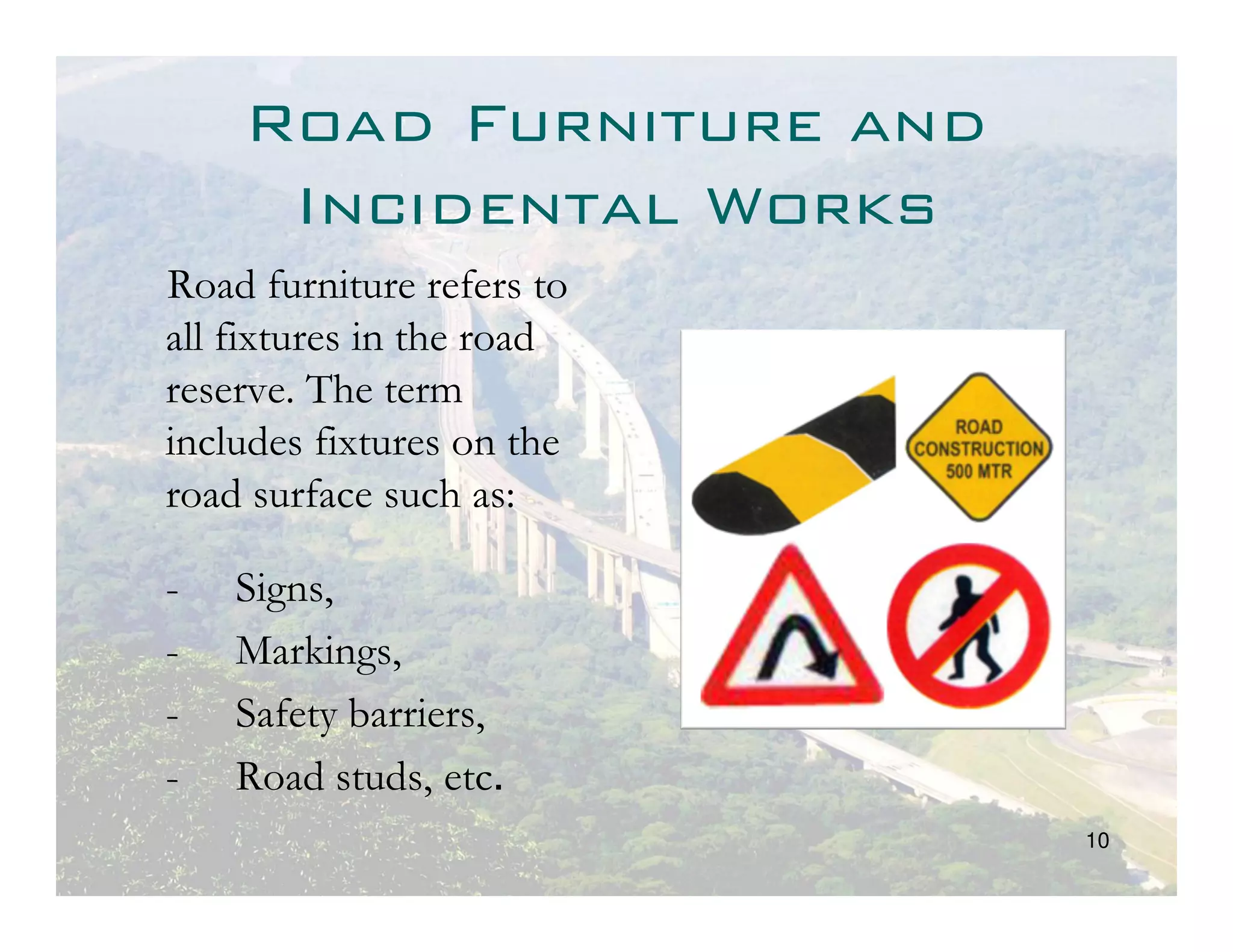
Road furniture refers to
all fixtures in the road
reserve. The term
includes fixtures on the
road surface such as:

-   Signs,
-   Markings,
-   Safety barriers,
-   Road studs, etc.
                           10
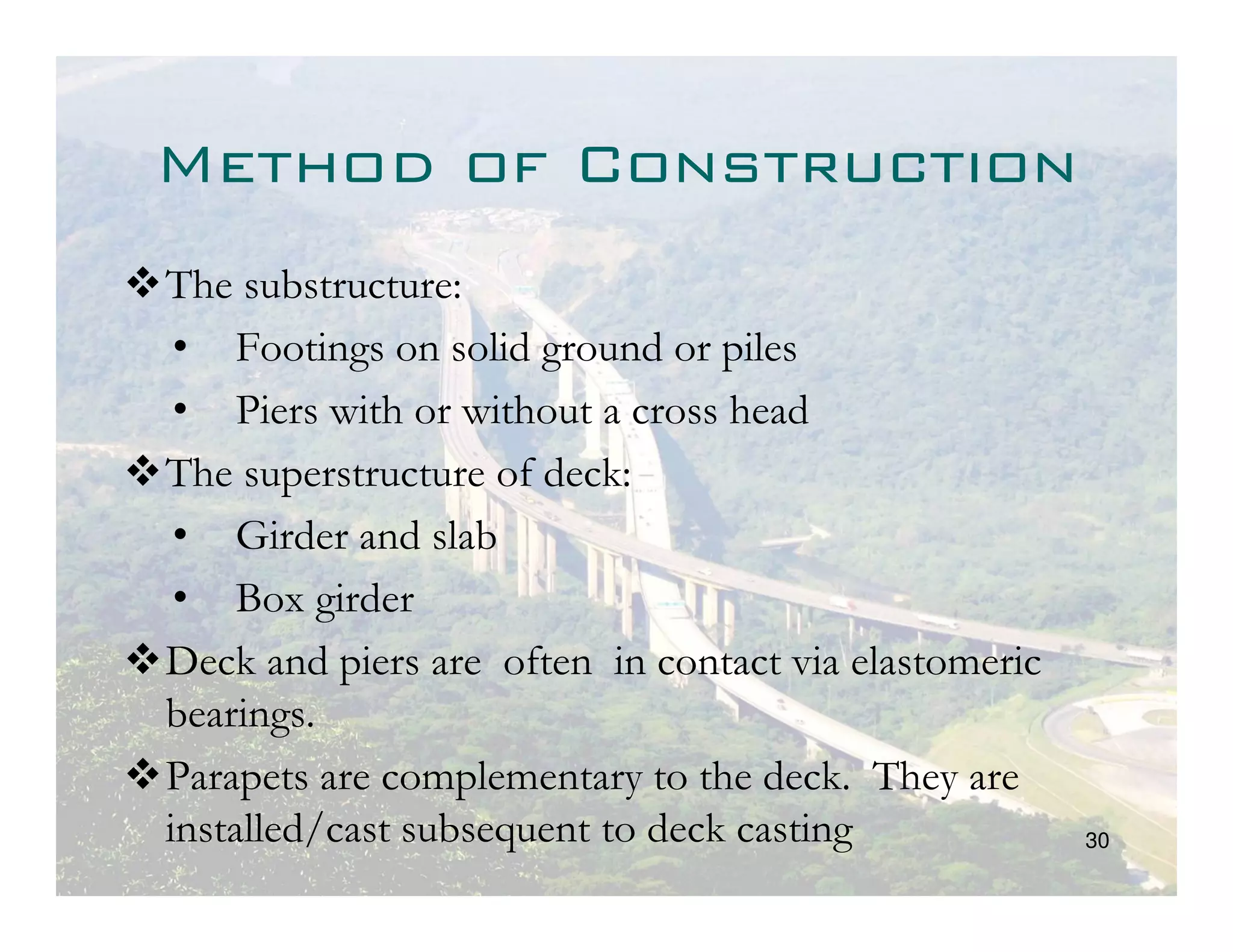
Method of Construction
The system is based on a monthly output of
major work items using the minimum
equipment considered necessary to carry out the
work during a month of 25 working days, each
day being 8 working hours.


                                              11
Road works planning
        criteria
• Planning road works, as a first step, depends on the
  extent of earthmoving quantities.

• Generally, the most driving is the fill making the
  embankment, especially for the case of high
  embankments.

• The basic equipment is as follows:
                                                       12
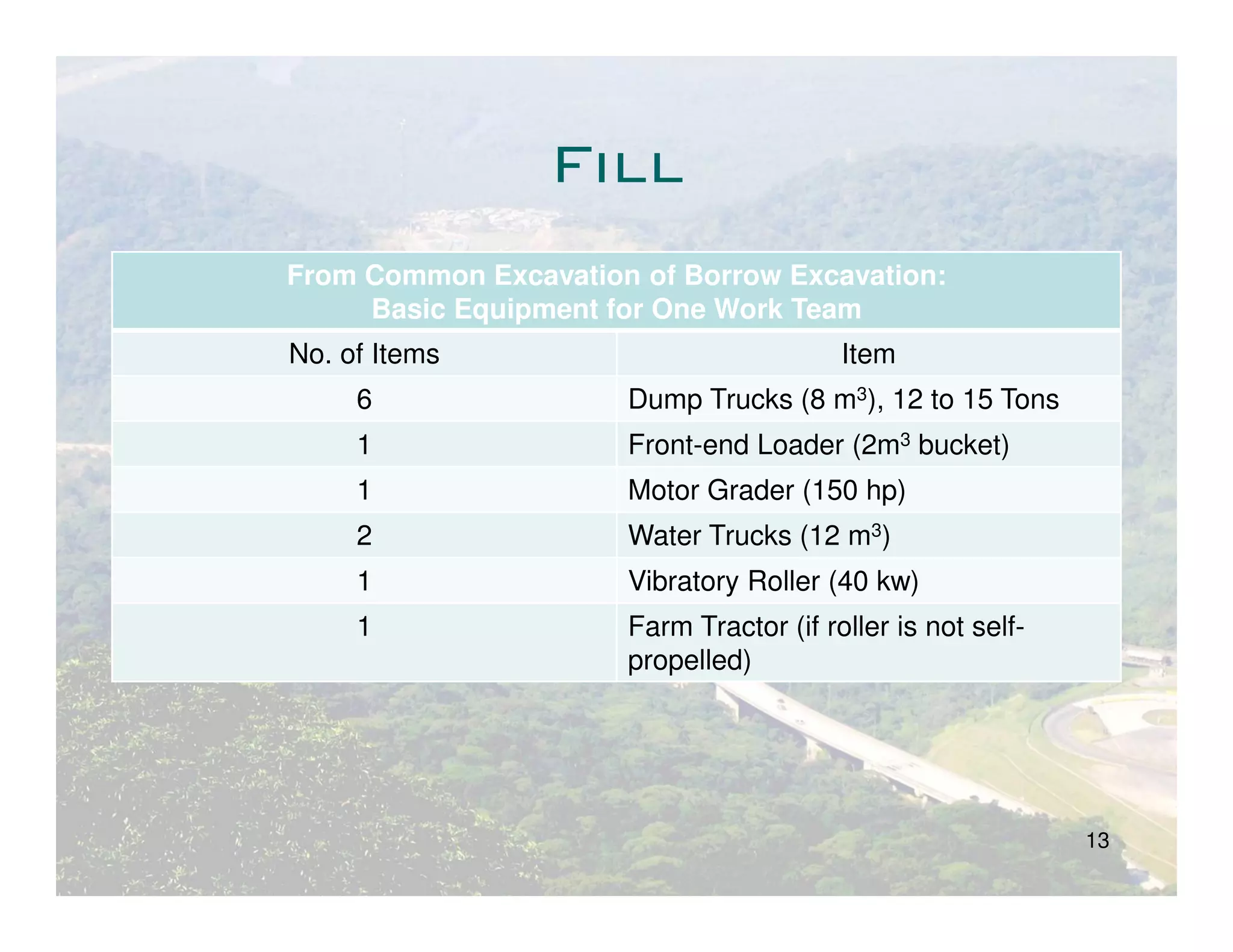
Fill
From Common Excavation of Borrow Excavation:
     Basic Equipment for One Work Team
No. of Items                             Item
     6                Dump Trucks (8 m3), 12 to 15 Tons
     1                Front-end Loader (2m3 bucket)
     1                Motor Grader (150 hp)
     2                Water Trucks (12 m3)
     1                Vibratory Roller (40 kw)
     1                Farm Tractor (if roller is not self-
                      propelled)


                                                             13
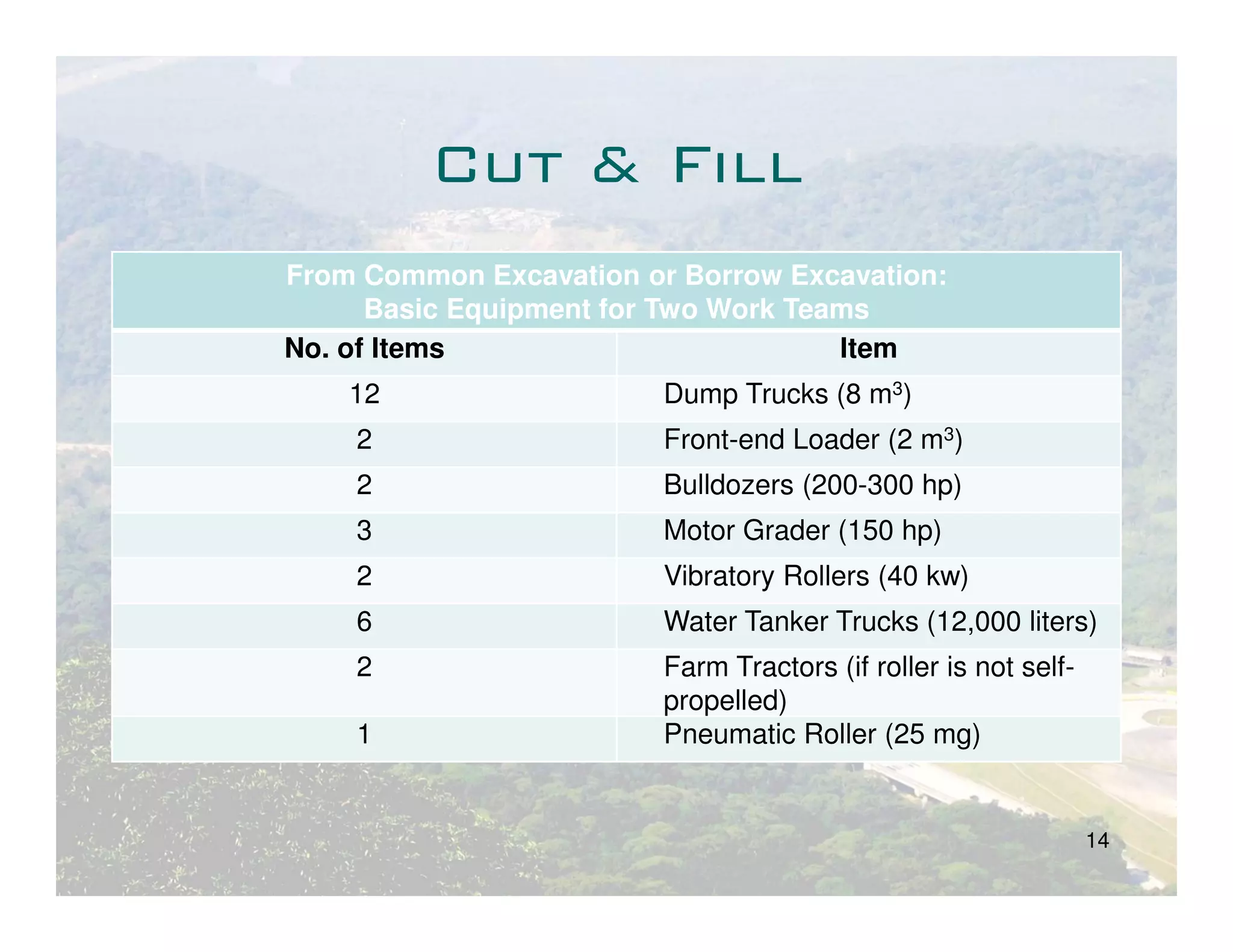
Cut & Fill
From Common Excavation or Borrow Excavation:
      Basic Equipment for Two Work Teams
No. of Items                          Item
    12                   Dump Trucks (8 m3)
    2                    Front-end Loader (2 m3)
    2                    Bulldozers (200-300 hp)
    3                    Motor Grader (150 hp)
    2                    Vibratory Rollers (40 kw)
    6                    Water Tanker Trucks (12,000 liters)
    2                    Farm Tractors (if roller is not self-
                         propelled)
    1                    Pneumatic Roller (25 mg)


                                                                 14
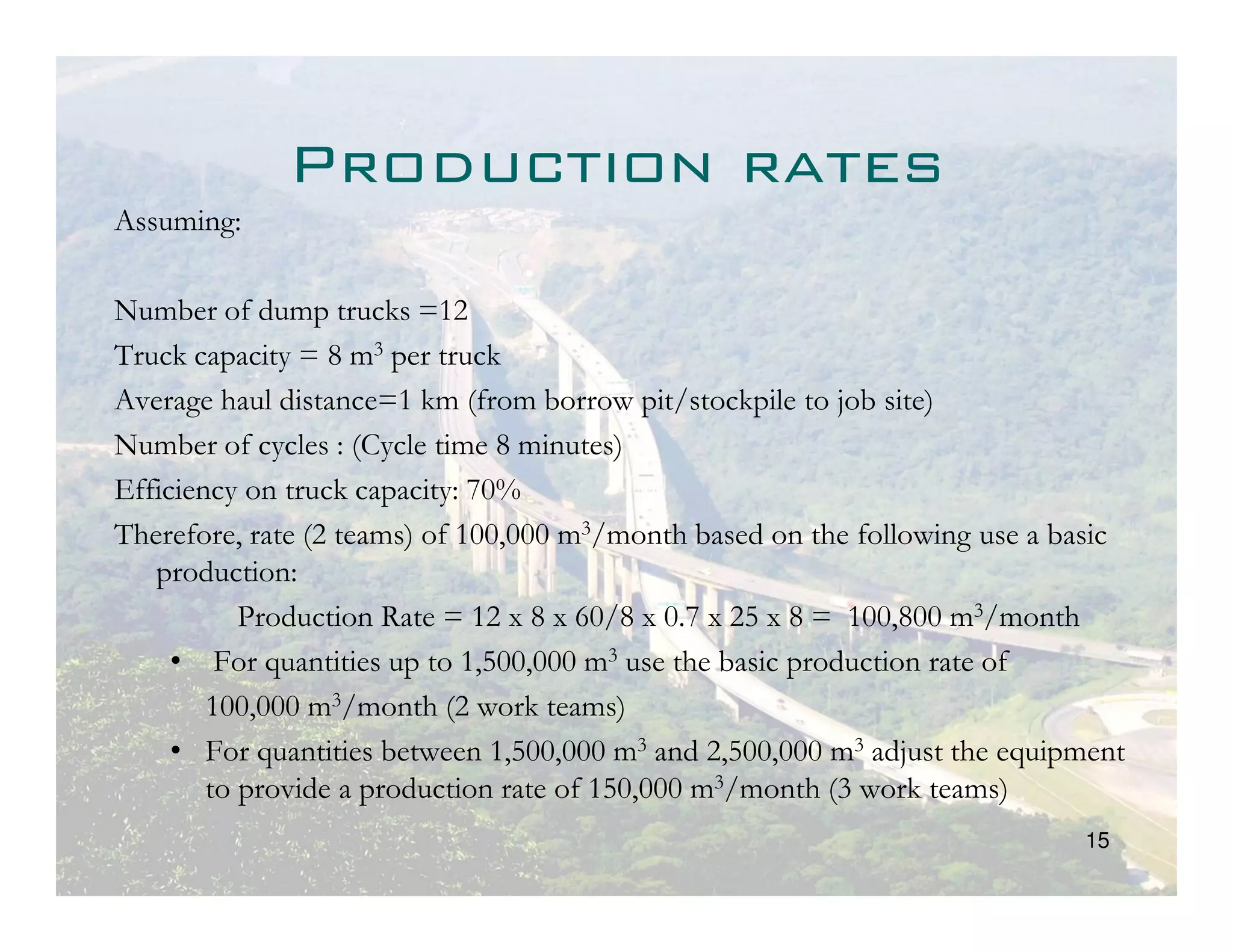
Production rates
Assuming:

Number of dump trucks =12
Truck capacity = 8 m3 per truck
Average haul distance=1 km (from borrow pit/stockpile to job site)
Number of cycles : (Cycle time 8 minutes)
Efficiency on truck capacity: 70%
Therefore, rate (2 teams) of 100,000 m3/month based on the following use a basic
   production:
           Production Rate = 12 x 8 x 60/8 x 0.7 x 25 x 8 = 100,800 m3/month
     • For quantities up to 1,500,000 m3 use the basic production rate of
        100,000 m3/month (2 work teams)
     • For quantities between 1,500,000 m3 and 2,500,000 m3 adjust the equipment
        to provide a production rate of 150,000 m3/month (3 work teams)
                                                                            15
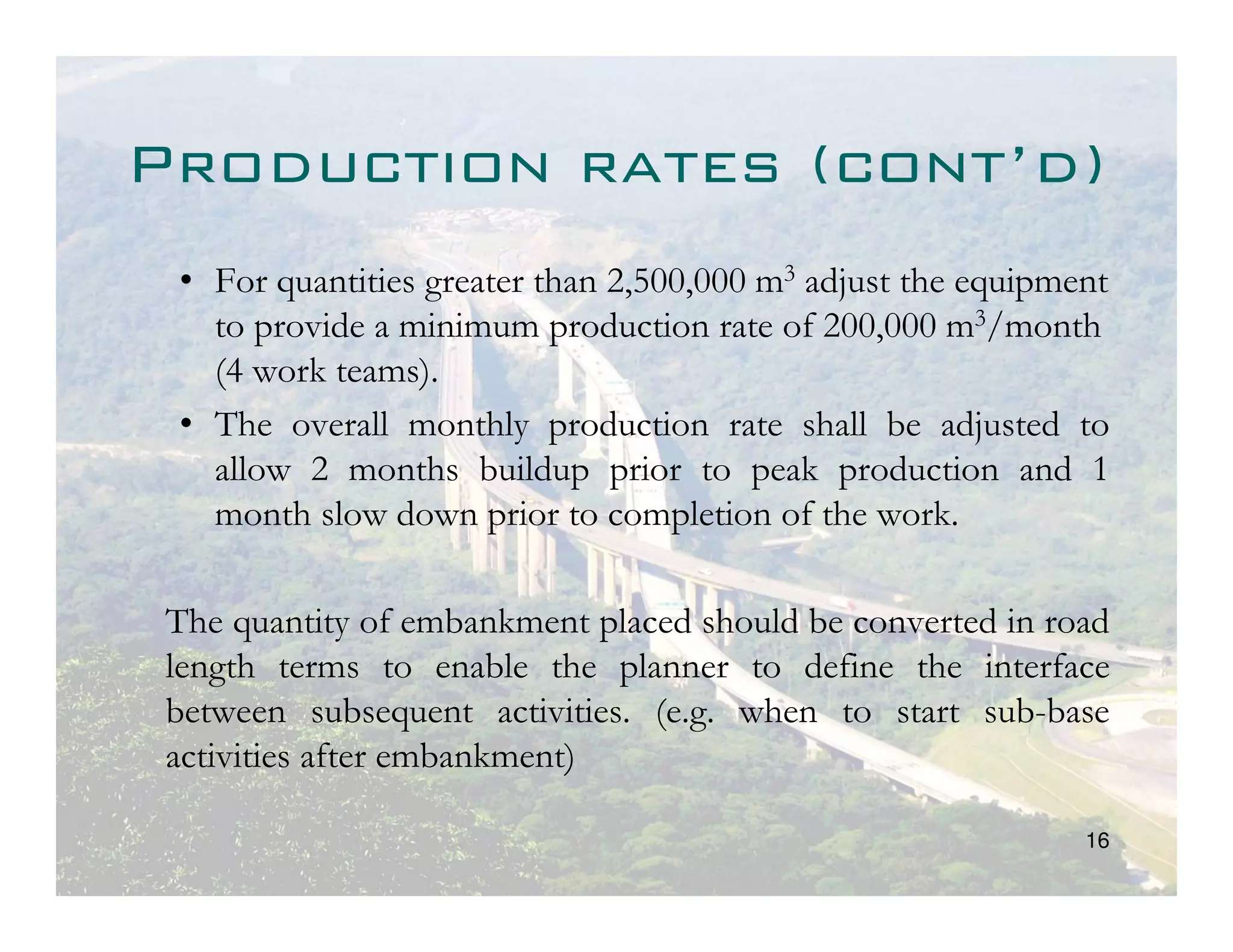
Production rates (cont’d)
 • For quantities greater than 2,500,000 m3 adjust the equipment
   to provide a minimum production rate of 200,000 m3/month
   (4 work teams).
 • The overall monthly production rate shall be adjusted to
   allow 2 months buildup prior to peak production and 1
   month slow down prior to completion of the work.

 The quantity of embankment placed should be converted in road
 length terms to enable the planner to define the interface
 between subsequent activities. (e.g. when to start sub-base
 activities after embankment)

                                                              16
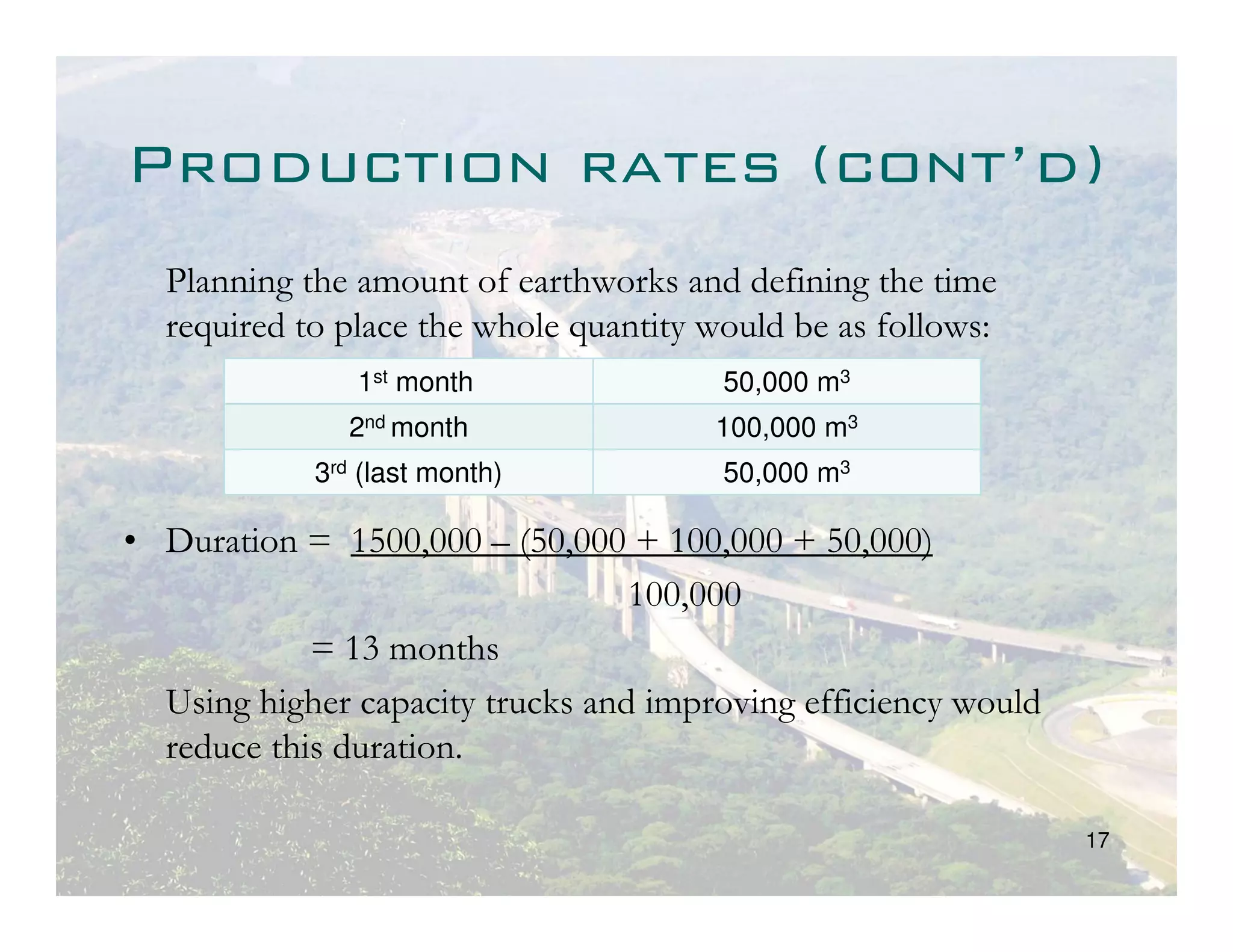
Production rates (cont’d)
  Planning the amount of earthworks and defining the time
  required to place the whole quantity would be as follows:
               1st month                50,000 m3
               2nd month               100,000 m3
            3rd (last month)            50,000 m3

• Duration = 1500,000 – (50,000 + 100,000 + 50,000)
                                  100,000
            = 13 months
  Using higher capacity trucks and improving efficiency would
  reduce this duration.

                                                                17
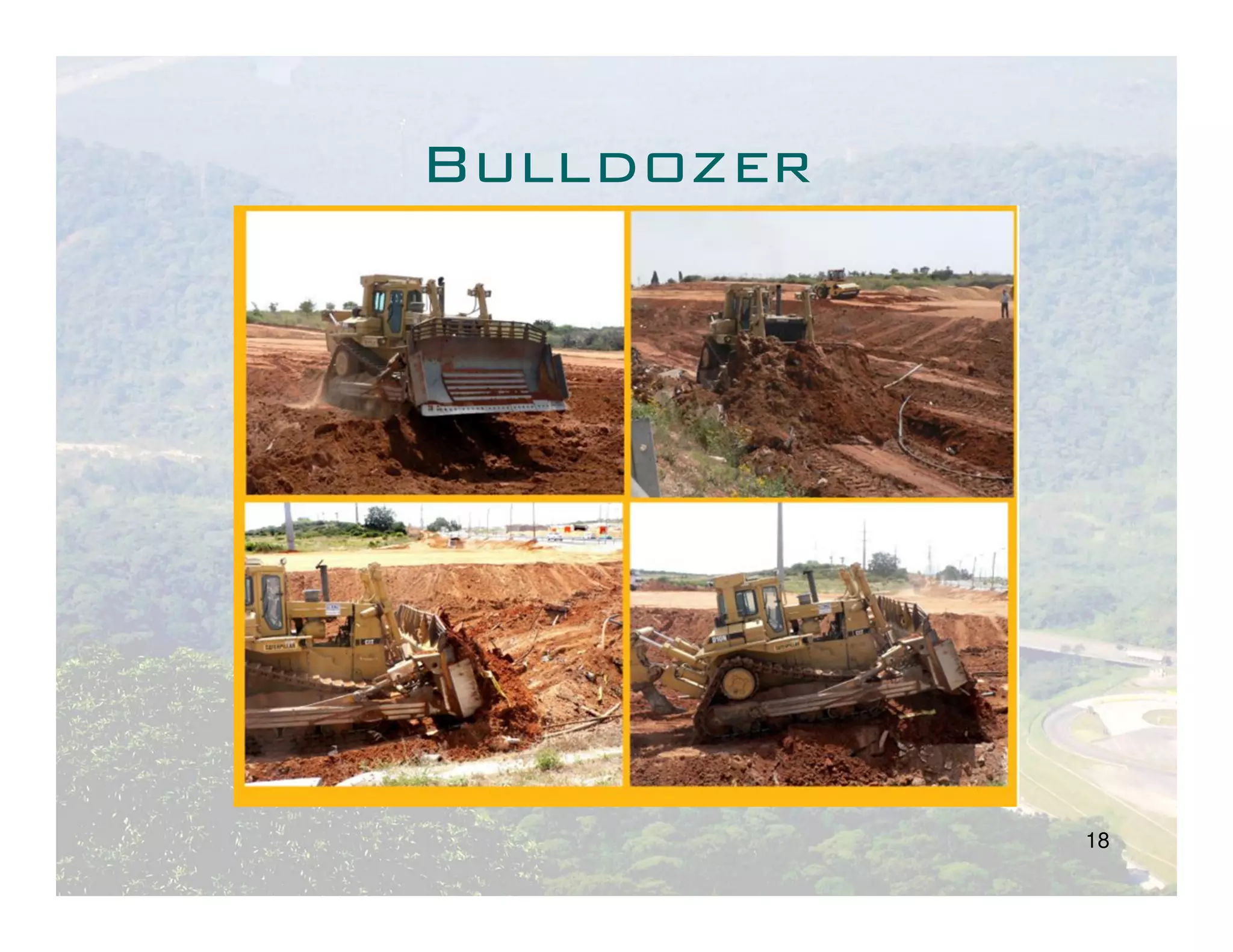
Bulldozer


            18
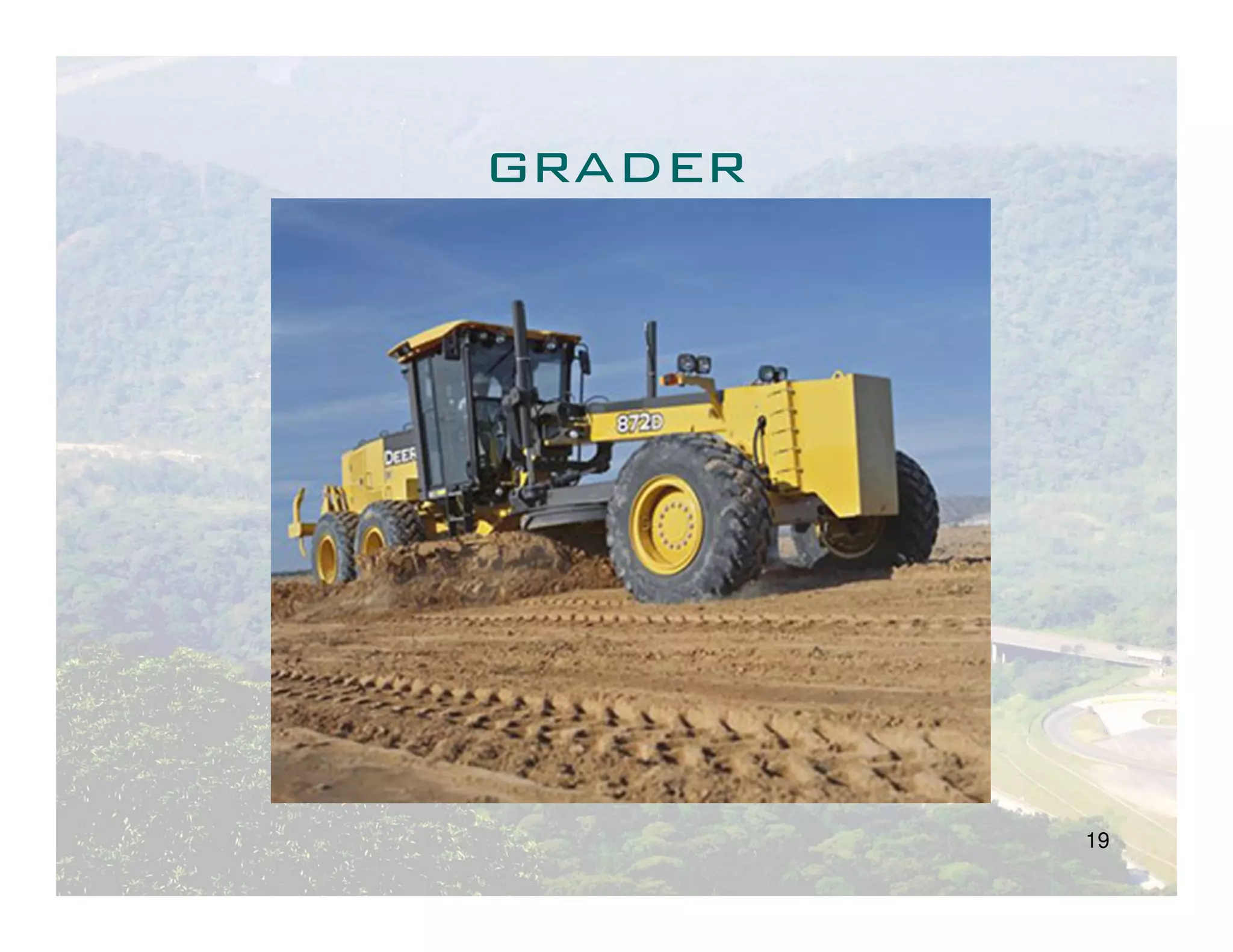
grader


         19
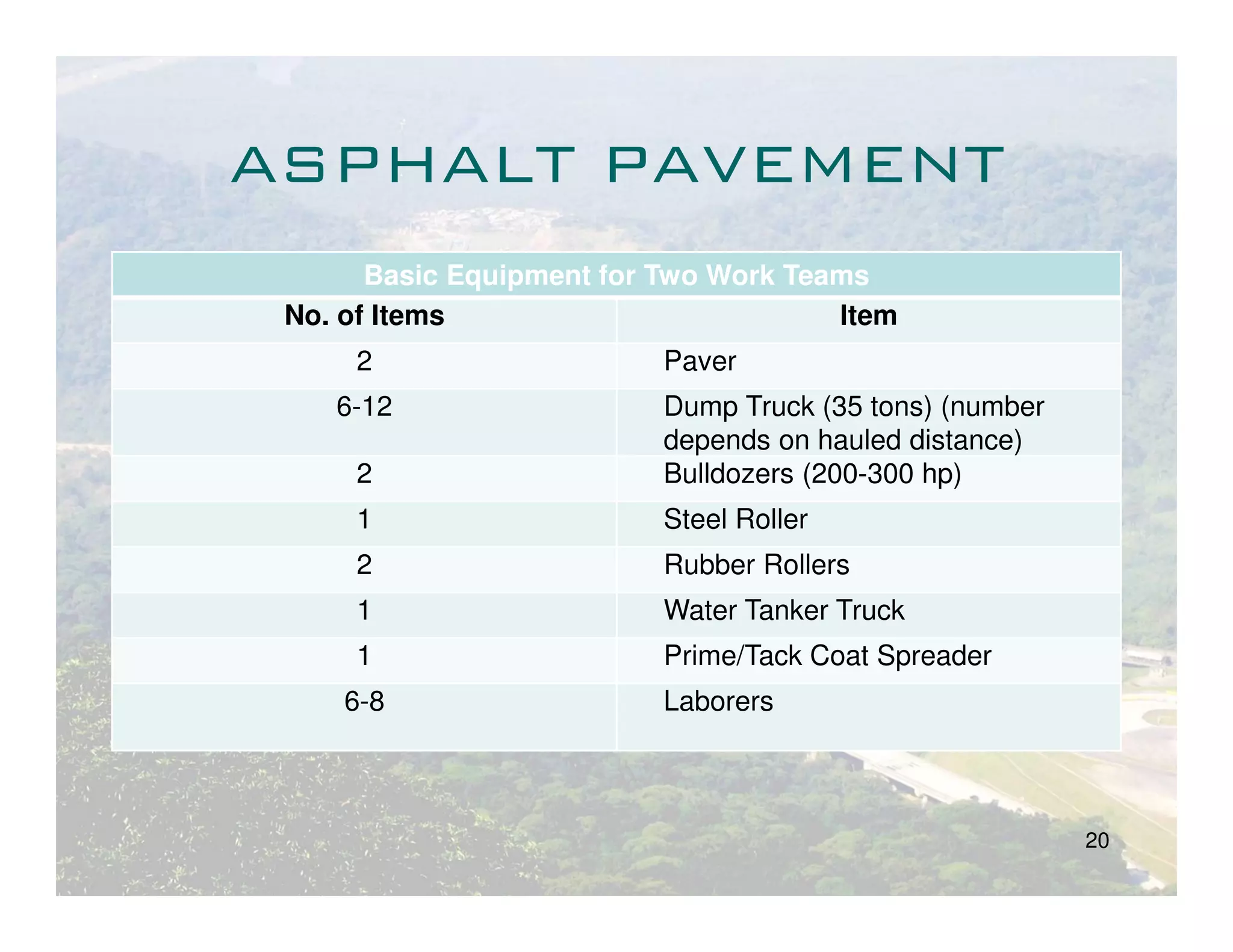
ASPHALT PAVEMENT
       Basic Equipment for Two Work Teams
 No. of Items                          Item
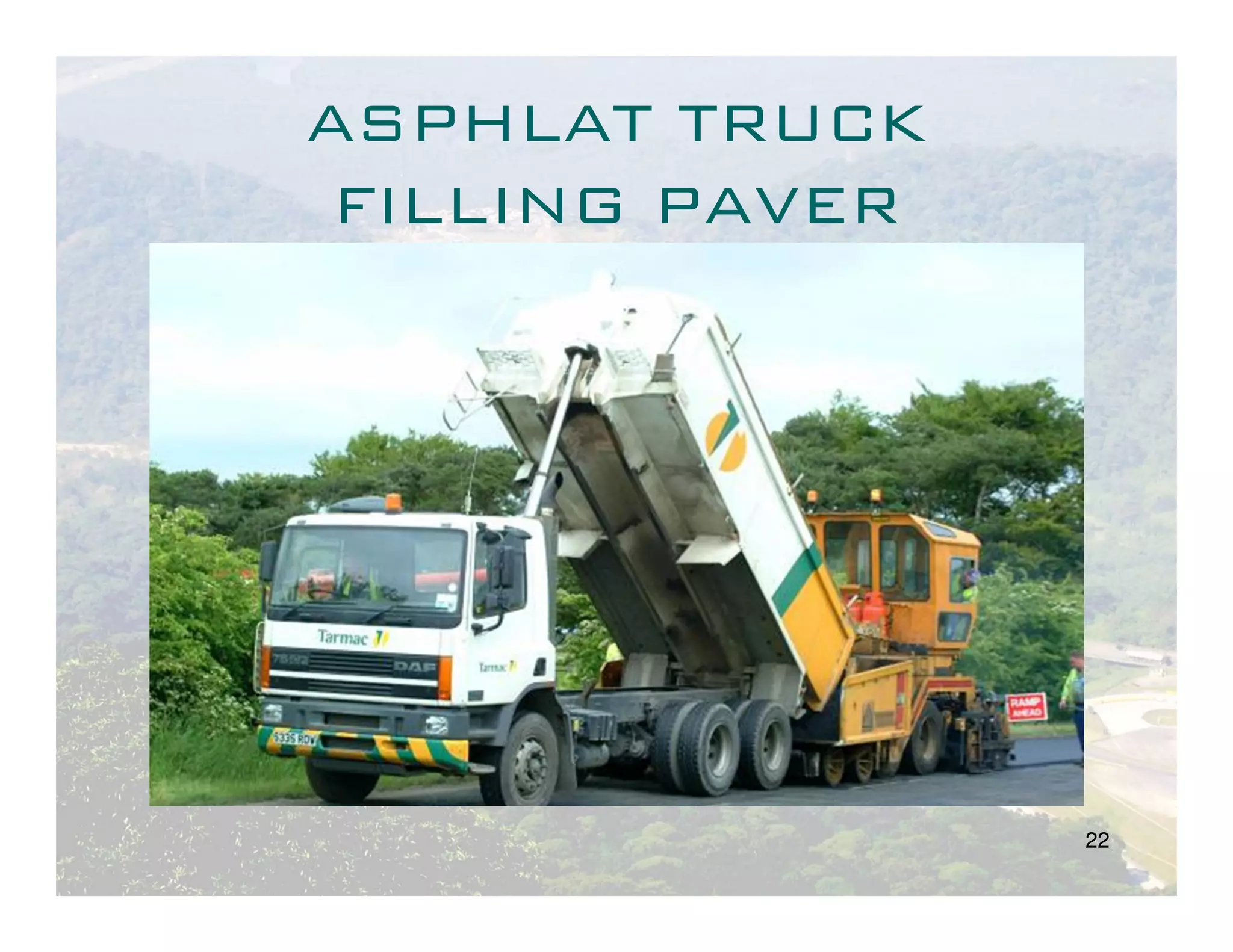
     2                    Paver
    6-12                  Dump Truck (35 tons) (number
                          depends on hauled distance)
     2                    Bulldozers (200-300 hp)
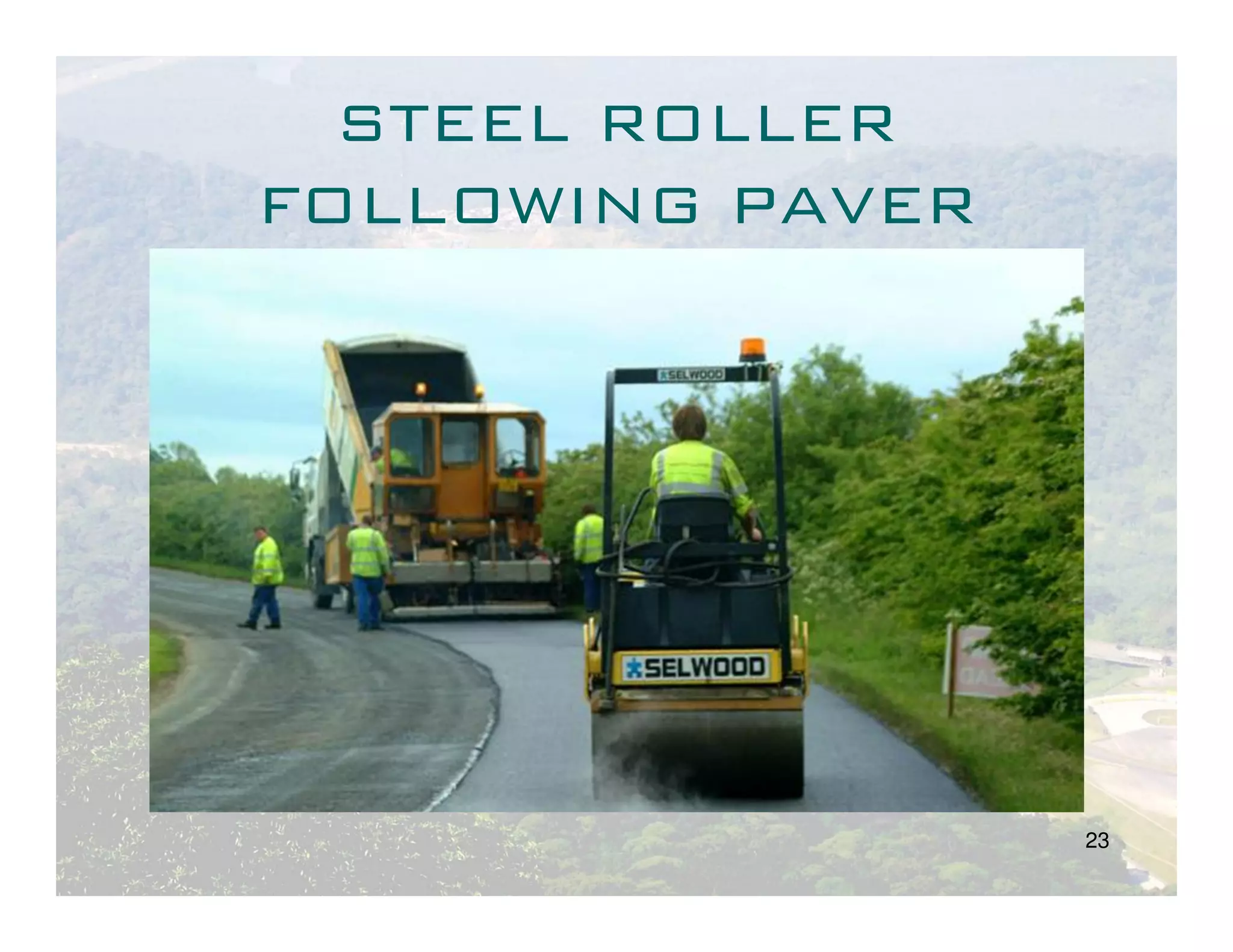
     1                    Steel Roller
     2                    Rubber Rollers
     1                    Water Tanker Truck
     1                    Prime/Tack Coat Spreader
     6-8                  Laborers


                                                         20
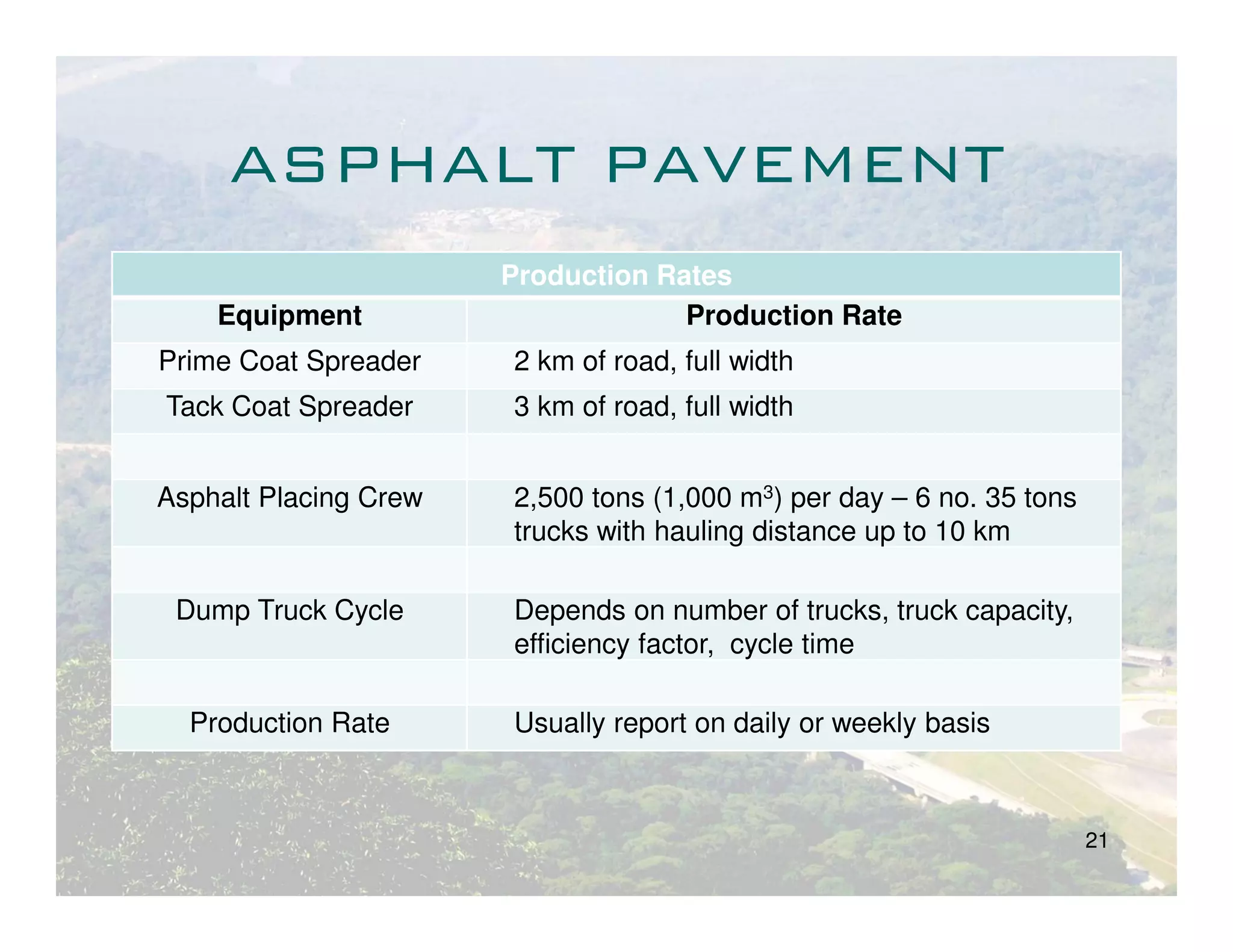
ASPHALT PAVEMENT
                       Production Rates
    Equipment                       Production Rate
Prime Coat Spreader    2 km of road, full width
Tack Coat Spreader     3 km of road, full width


Asphalt Placing Crew   2,500 tons (1,000 m3) per day – 6 no. 35 tons
                       trucks with hauling distance up to 10 km

 Dump Truck Cycle      Depends on number of trucks, truck capacity,
                       efficiency factor, cycle time

  Production Rate      Usually report on daily or weekly basis


                                                                       21
ASPHLAT TRUCK
 FILLING PAVER


                 22
STEEL ROLLER
FOLLOWING PAVER


                  23
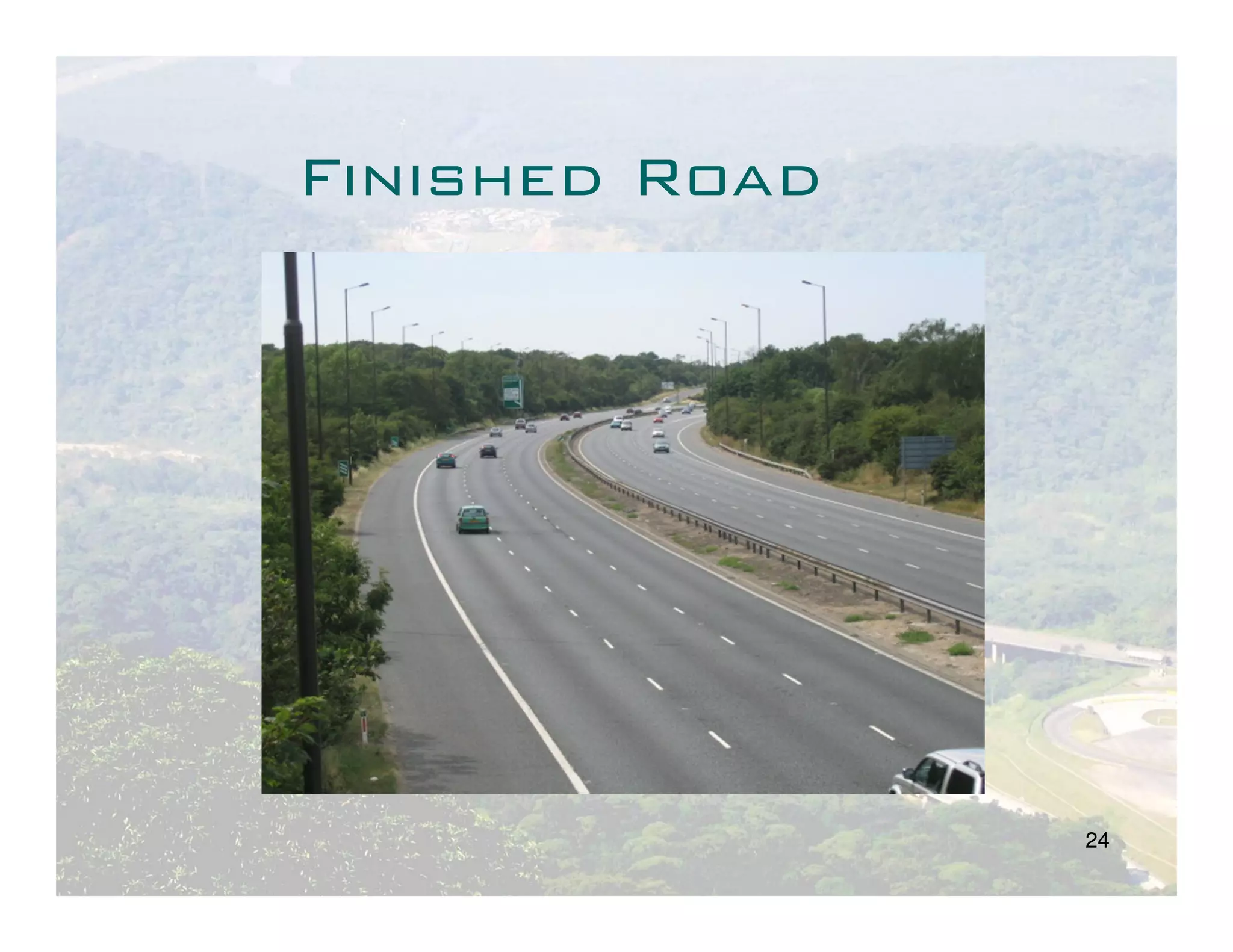
Finished Road


                24
Finished Road


                25
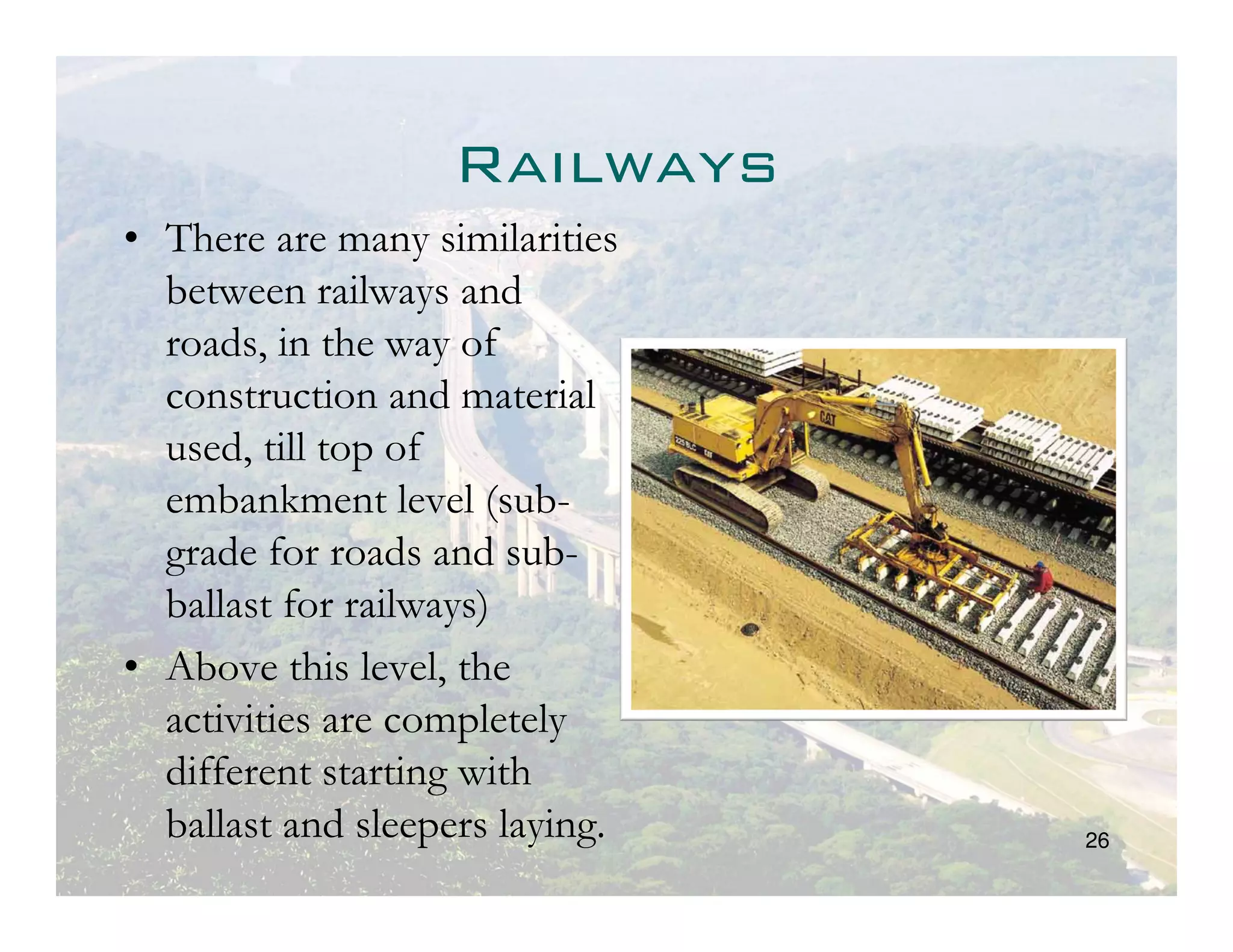
Railways
• There are many similarities
  between railways and
  roads, in the way of
  construction and material
  used, till top of
  embankment level (sub-
  grade for roads and sub-
  ballast for railways)
• Above this level, the
  activities are completely
  different starting with
  ballast and sleepers laying.   26
Bridges
• Bridges can be of different nature and types. They can
  be made of steel, concrete and other materials such as
  stones, timber, etc.
• They can be skew, straight, curved, flat or arched. The
  presentation will be limited to straight concrete
  structured bridges.
• The spans vary between long, medium and short spans.
               Long           50- 350 or more meters
              Medium              30-45 meters
               Short              12-25 meters

                                                        27
Bridges
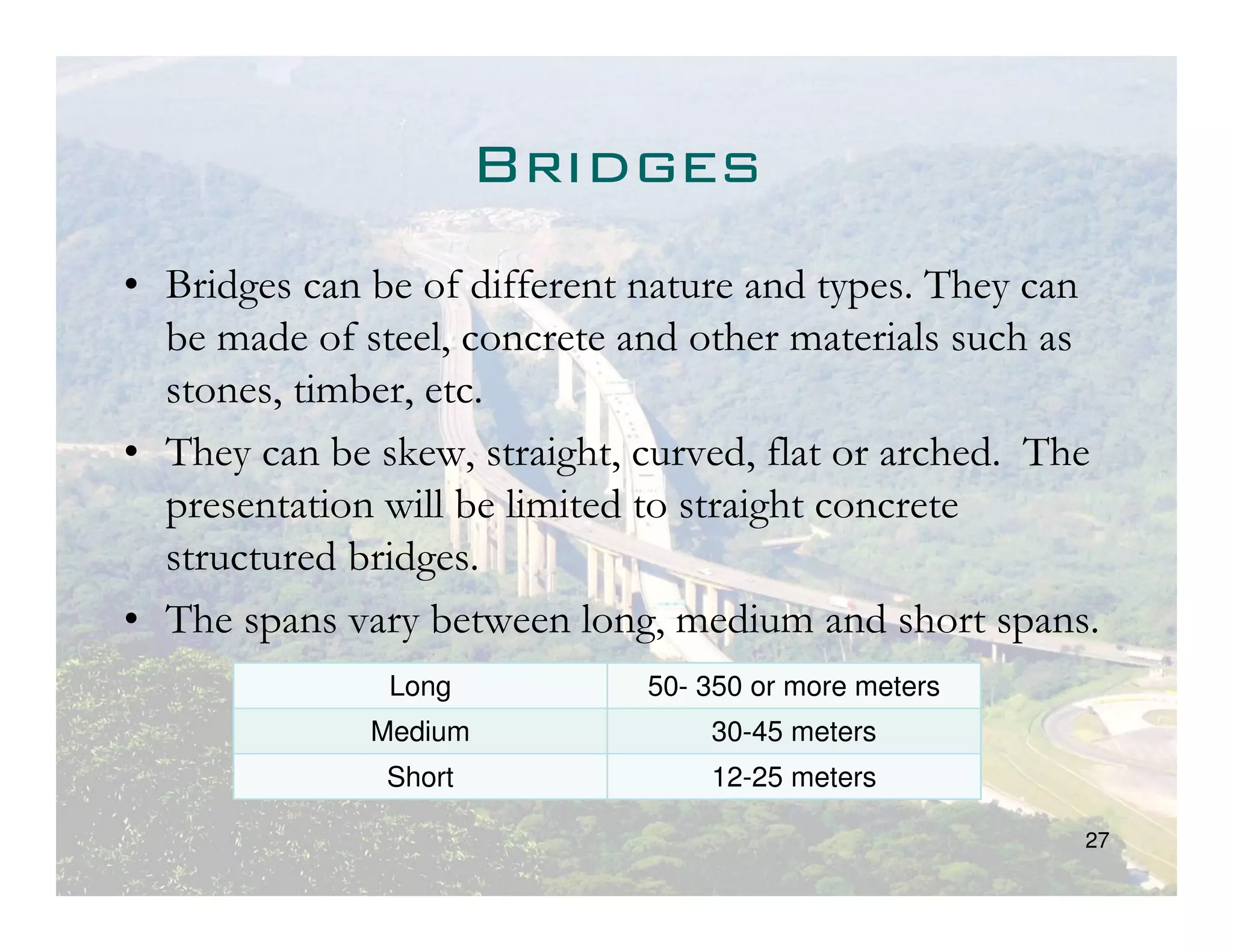
The deck structure and
method of construction
are dependent on the
span length, pier height
and accessibility.
 • Long span bridges are
   cable stayed.
 • Medium span bridges
   are box girder type.

                           28
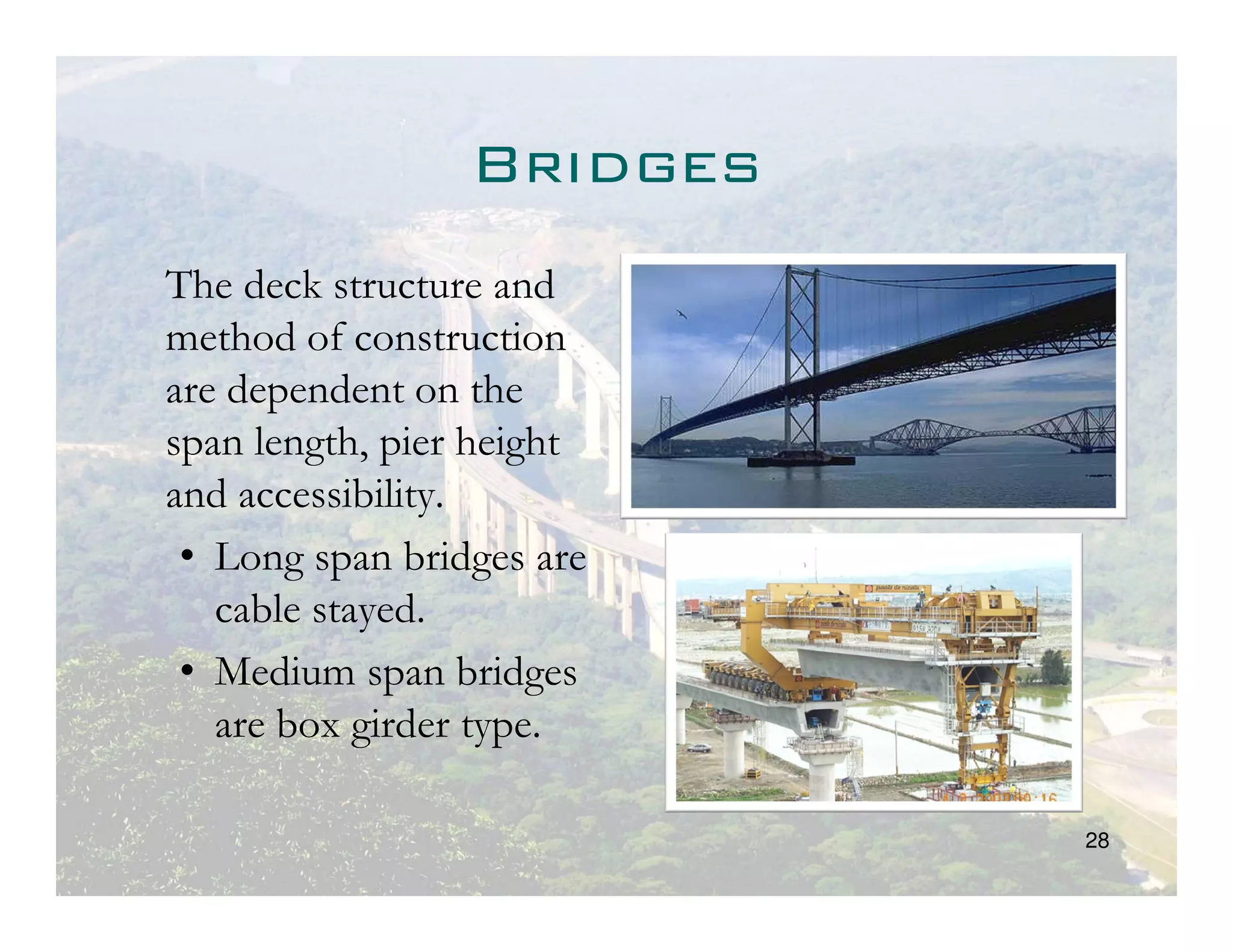
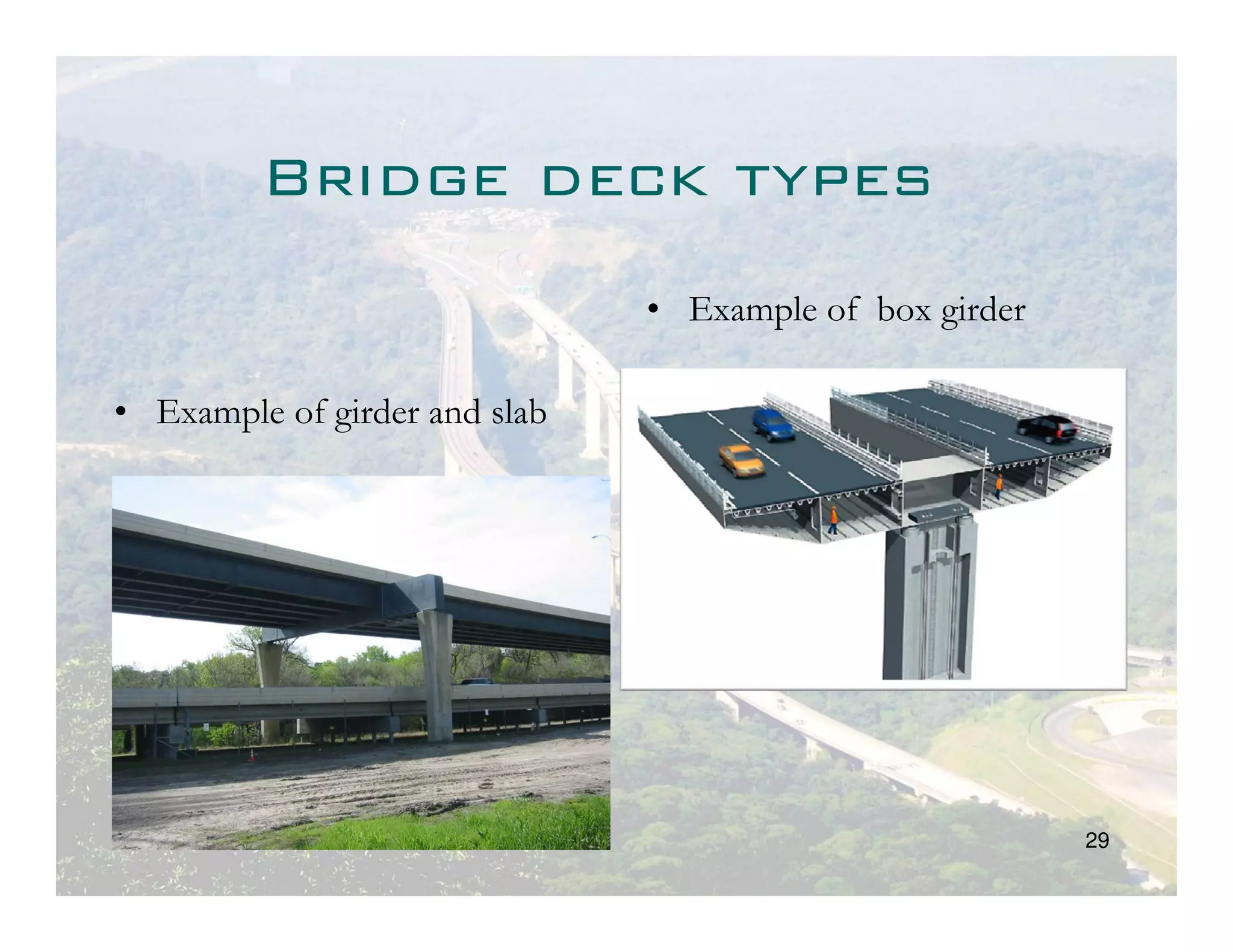
Bridge deck types
                               • Example of box girder

• Example of girder and slab


                                                         29
Method of Construction
The substructure:
 • Footings on solid ground or piles
 • Piers with or without a cross head
The superstructure of deck:
 • Girder and slab
 • Box girder
Deck and piers are often in contact via elastomeric
bearings.
Parapets are complementary to the deck. They are
installed/cast subsequent to deck casting             30
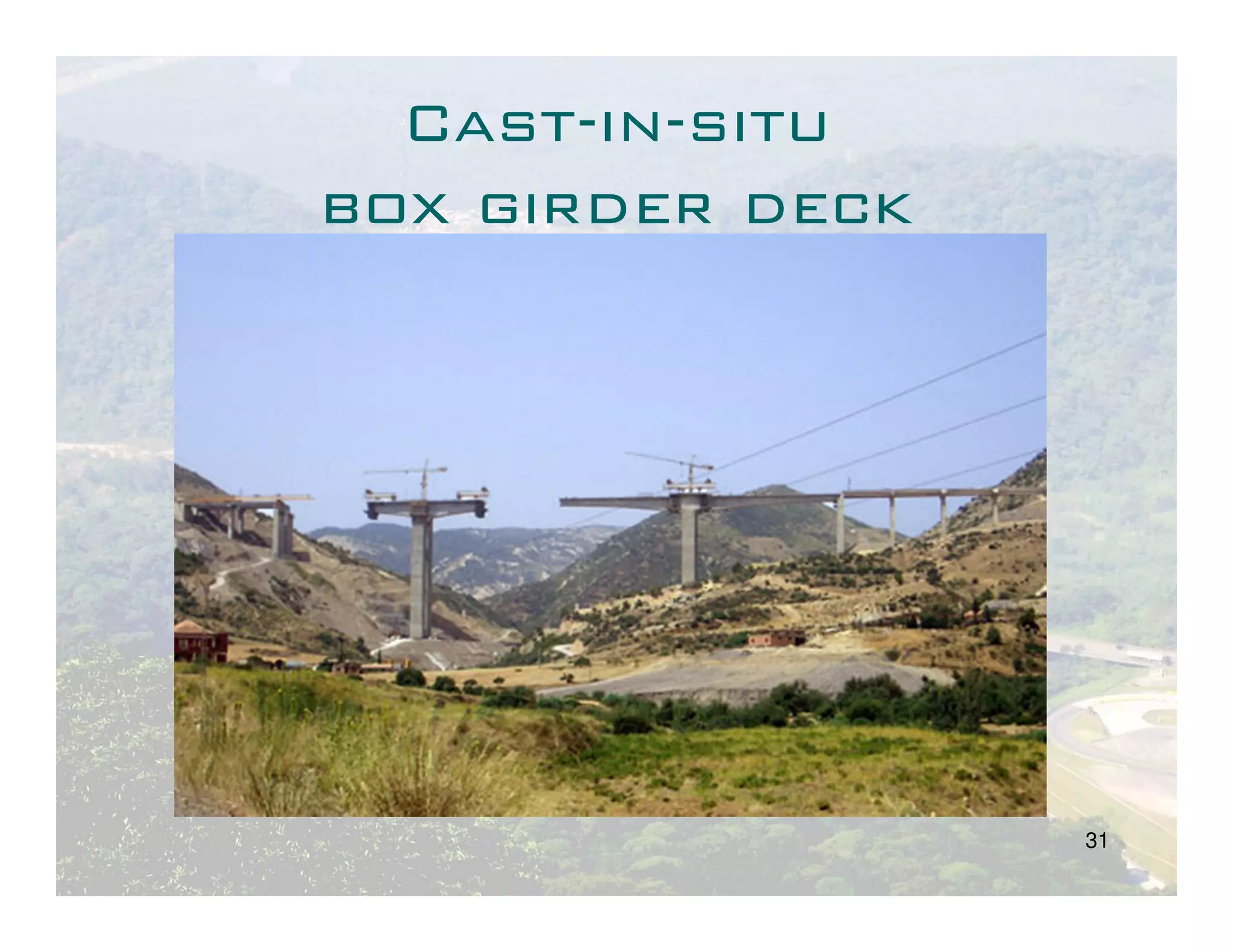
Cast-in-situ
box girder deck


                  31
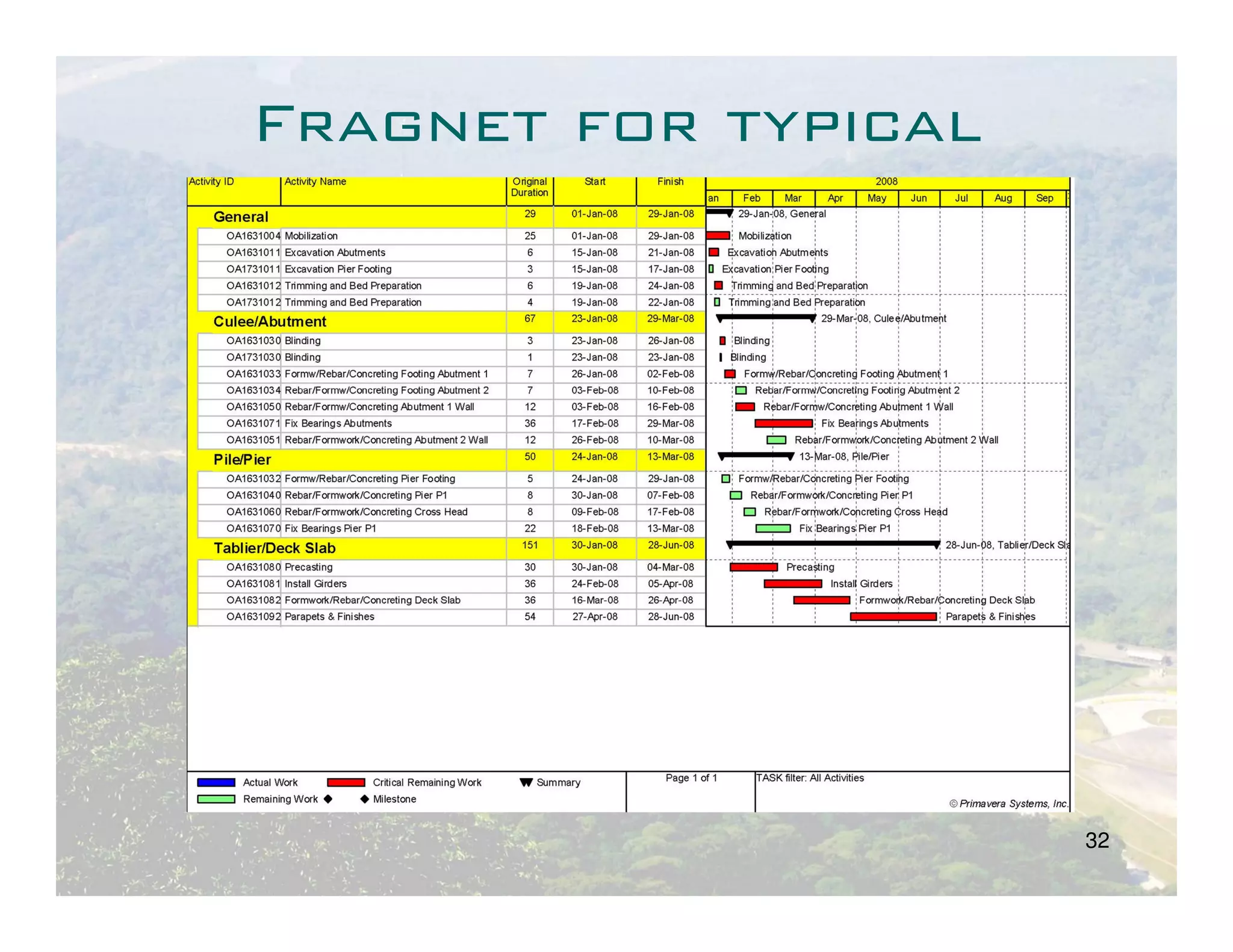
Fragnet for typical
bridge construction


                      32
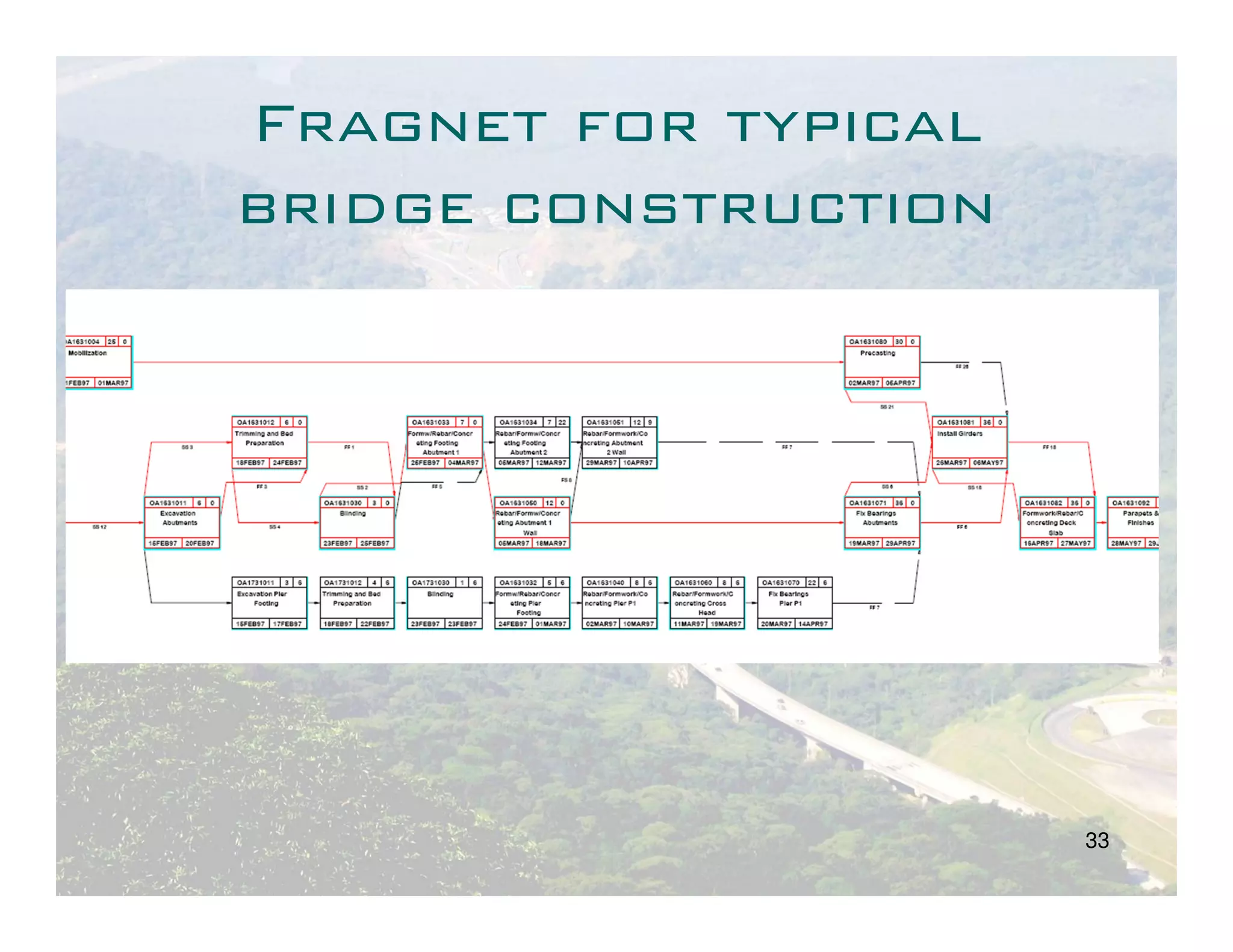
Fragnet for typical
bridge construction


                      33

J.S. Daniel paper for roads and bridges construction methods & resources

  • 1.
    Roads and Bridges ConstructionMethods & resources by: 1 Jihad Daniel
  • 2.
    Types of Roads •Various types of roads are in use around the world. Roads range in size from private driveways, to the stereotypical two-lane highways, to high capacity dual carriageway routes, such as freeways and motorways. • In addition, depending on their types, roads may have different types of junction. 2
  • 3.
    Types of Junctions Bridge interchange Intersection Flyover and underpasses Junctions at grade Interchange at grade 3
  • 4.
    Types of Junctions •Interchange at grade • Intersection at grade 4
  • 5.
    Types of Junctions •Flyovers • Bridge interchange 5
  • 6.
    Road Structure • Crosssection of a road: main road situated outside towns and cities. • Platform: horizontal surface raised above the surrounding ground. • Shoulder: space between the roadway and the ditch. • Median strip: separation between two carriageway. • Wearing course: surface layer of the road (asphalt). • Carriageway: central part reserved for vehicle traffic. • Ditch: channel that carries away water. 6
  • 7.
    Road Structure • Subgrade:upper surface of platform. (this is valid in a cut section) • In a Fill Section, the embankment constitute the platform and the subgrade. • Subbase: lower surface of a road structure. • Base course: main foundation element (bituminous / granular). • Wearing Course (Bituminous in general) 7
  • 8.
    Road Profile • Theright of way ground formation maybe, as the road profile requires, natural ground, cut or fill. In case of fill, ground formation is filled in layers to comply with the profile. The work is called embankment. • Embankment is made in layers with thickness varying from 20 to 40 cm depending on the material used. • In case of cut this could be open cut or tunnel. 8
  • 9.
    Materials Selected Crushed Asphaltic Roads fill aggregate concrete 9
  • 10.
    Road Furniture and Incidental Works Road furniture refers to all fixtures in the road reserve. The term includes fixtures on the road surface such as: - Signs, - Markings, - Safety barriers, - Road studs, etc. 10
  • 11.
    Method of Construction Thesystem is based on a monthly output of major work items using the minimum equipment considered necessary to carry out the work during a month of 25 working days, each day being 8 working hours. 11
  • 12.
    Road works planning criteria • Planning road works, as a first step, depends on the extent of earthmoving quantities. • Generally, the most driving is the fill making the embankment, especially for the case of high embankments. • The basic equipment is as follows: 12
  • 13.
    Fill From Common Excavationof Borrow Excavation: Basic Equipment for One Work Team No. of Items Item 6 Dump Trucks (8 m3), 12 to 15 Tons 1 Front-end Loader (2m3 bucket) 1 Motor Grader (150 hp) 2 Water Trucks (12 m3) 1 Vibratory Roller (40 kw) 1 Farm Tractor (if roller is not self- propelled) 13
  • 14.
    Cut & Fill FromCommon Excavation or Borrow Excavation: Basic Equipment for Two Work Teams No. of Items Item 12 Dump Trucks (8 m3) 2 Front-end Loader (2 m3) 2 Bulldozers (200-300 hp) 3 Motor Grader (150 hp) 2 Vibratory Rollers (40 kw) 6 Water Tanker Trucks (12,000 liters) 2 Farm Tractors (if roller is not self- propelled) 1 Pneumatic Roller (25 mg) 14
  • 15.
    Production rates Assuming: Number ofdump trucks =12 Truck capacity = 8 m3 per truck Average haul distance=1 km (from borrow pit/stockpile to job site) Number of cycles : (Cycle time 8 minutes) Efficiency on truck capacity: 70% Therefore, rate (2 teams) of 100,000 m3/month based on the following use a basic production: Production Rate = 12 x 8 x 60/8 x 0.7 x 25 x 8 = 100,800 m3/month • For quantities up to 1,500,000 m3 use the basic production rate of 100,000 m3/month (2 work teams) • For quantities between 1,500,000 m3 and 2,500,000 m3 adjust the equipment to provide a production rate of 150,000 m3/month (3 work teams) 15
  • 16.
    Production rates (cont’d) • For quantities greater than 2,500,000 m3 adjust the equipment to provide a minimum production rate of 200,000 m3/month (4 work teams). • The overall monthly production rate shall be adjusted to allow 2 months buildup prior to peak production and 1 month slow down prior to completion of the work. The quantity of embankment placed should be converted in road length terms to enable the planner to define the interface between subsequent activities. (e.g. when to start sub-base activities after embankment) 16
  • 17.
    Production rates (cont’d) Planning the amount of earthworks and defining the time required to place the whole quantity would be as follows: 1st month 50,000 m3 2nd month 100,000 m3 3rd (last month) 50,000 m3 • Duration = 1500,000 – (50,000 + 100,000 + 50,000) 100,000 = 13 months Using higher capacity trucks and improving efficiency would reduce this duration. 17
  • 18.
  • 19.
  • 20.
    ASPHALT PAVEMENT Basic Equipment for Two Work Teams No. of Items Item 2 Paver 6-12 Dump Truck (35 tons) (number depends on hauled distance) 2 Bulldozers (200-300 hp) 1 Steel Roller 2 Rubber Rollers 1 Water Tanker Truck 1 Prime/Tack Coat Spreader 6-8 Laborers 20
  • 21.
    ASPHALT PAVEMENT Production Rates Equipment Production Rate Prime Coat Spreader 2 km of road, full width Tack Coat Spreader 3 km of road, full width Asphalt Placing Crew 2,500 tons (1,000 m3) per day – 6 no. 35 tons trucks with hauling distance up to 10 km Dump Truck Cycle Depends on number of trucks, truck capacity, efficiency factor, cycle time Production Rate Usually report on daily or weekly basis 21
  • 22.
  • 23.
  • 24.
  • 25.
  • 26.
    Railways • There aremany similarities between railways and roads, in the way of construction and material used, till top of embankment level (sub- grade for roads and sub- ballast for railways) • Above this level, the activities are completely different starting with ballast and sleepers laying. 26
  • 27.
    Bridges • Bridges canbe of different nature and types. They can be made of steel, concrete and other materials such as stones, timber, etc. • They can be skew, straight, curved, flat or arched. The presentation will be limited to straight concrete structured bridges. • The spans vary between long, medium and short spans. Long 50- 350 or more meters Medium 30-45 meters Short 12-25 meters 27
  • 28.
    Bridges The deck structureand method of construction are dependent on the span length, pier height and accessibility. • Long span bridges are cable stayed. • Medium span bridges are box girder type. 28
  • 29.
    Bridge deck types • Example of box girder • Example of girder and slab 29
  • 30.
    Method of Construction Thesubstructure: • Footings on solid ground or piles • Piers with or without a cross head The superstructure of deck: • Girder and slab • Box girder Deck and piers are often in contact via elastomeric bearings. Parapets are complementary to the deck. They are installed/cast subsequent to deck casting 30
  • 31.
  • 32.
  • 33.