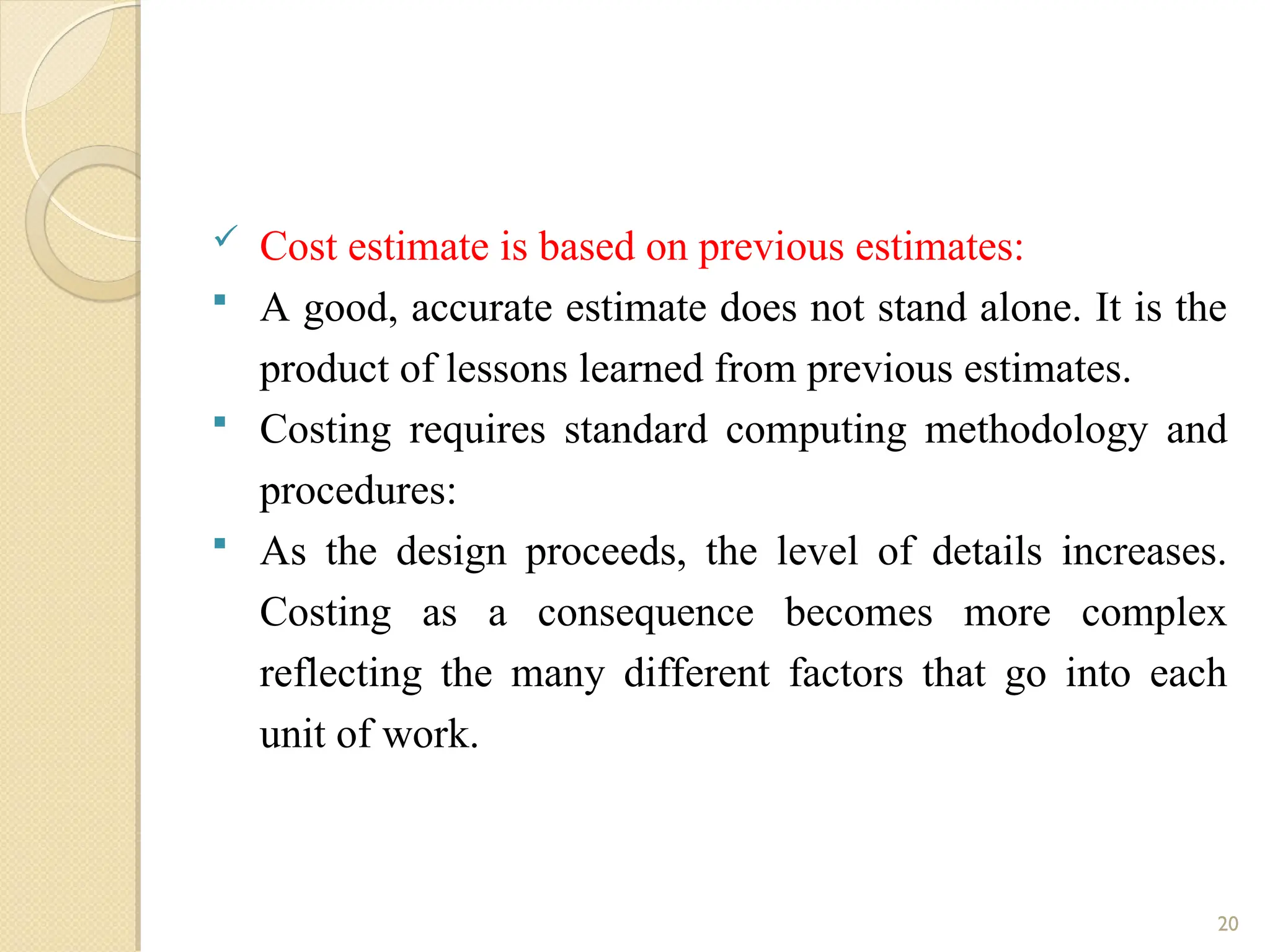
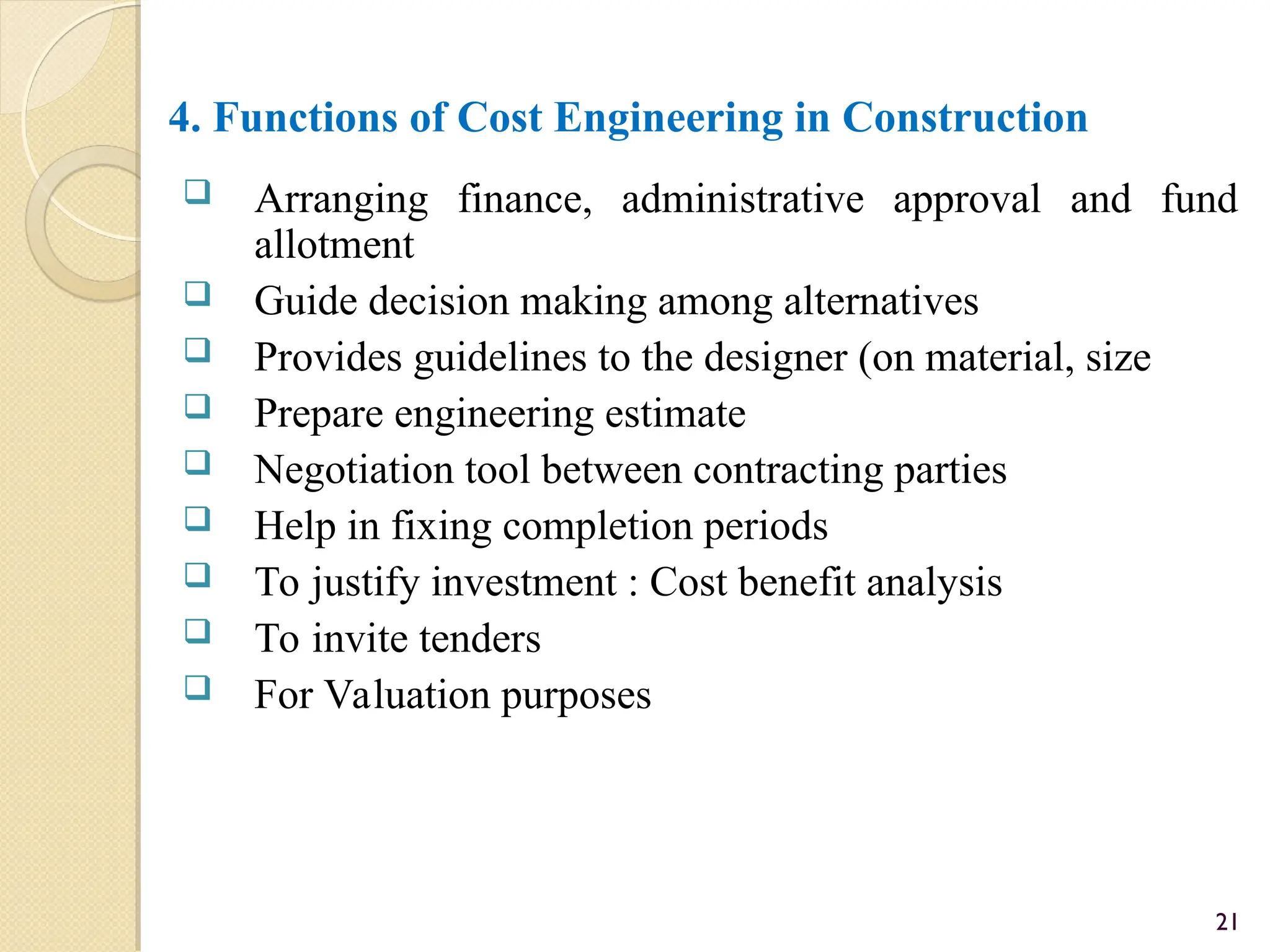
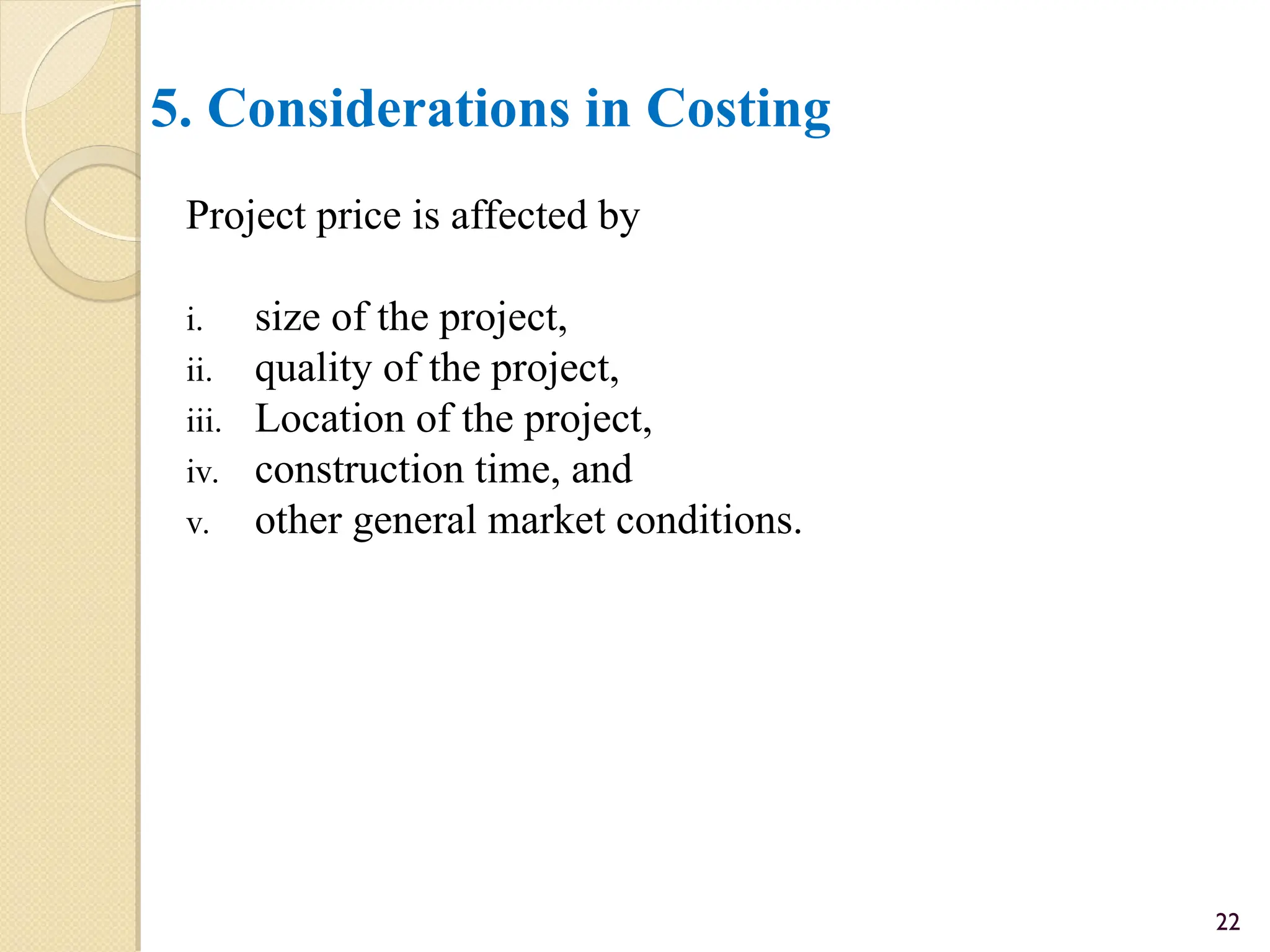
Construction Management Chair
COTM 5202
COST ENGINEERING
Chapter 1
Fundamental Principles of Cost
Engineering
Minweyelt E.
OCT 2018
Outline
Outline
1. Fundamental Principles of Cost Engineering
 Introduction
 Definitions and Terminology for Cost Engineers
 Cost Engineering Traits
 Functions of Cost Engineering in Construction
 Considerations in Costing
2
1.
1. Introduction
1. 1 Cost Engineering
 Cost engineering is concerned with problems of cost
estimation, cost control, and business planning and
management science, including problems of project
management, planning, scheduling, and profitability
analysis of engineering projects and processes.
 It needs understanding of
 Construction Technology
 Quantity surveying including understanding of contract
documents and forms of contract
 Management Theory and technique: pre contract
planning, tendering policy and the organization of
resources
 Construction economics
3
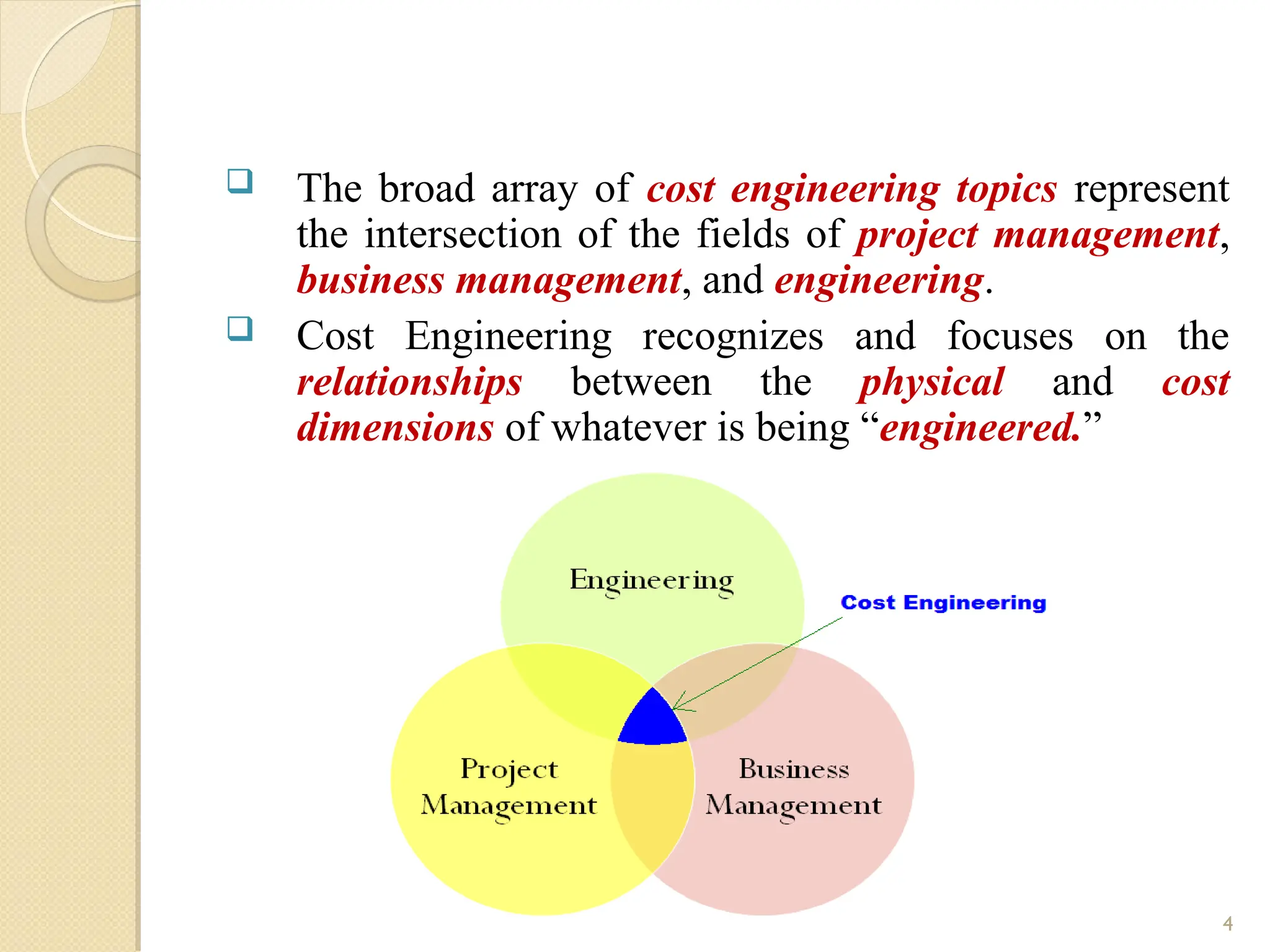
 The broad array of cost engineering topics represent
the intersection of the fields of project management,
business management, and engineering.
 Cost Engineering recognizes and focuses on the
relationships between the physical and cost
dimensions of whatever is being “engineered.”
4
1.2 Cost Engineers
 Cost Engineer: is a qualified professional dedicated to
TCM over the life cycle of a project, facility or
manufacturing operation.
 Cost Engineers are responsible for carefully managing
and maintaining the integrity of all project capitalizable,
and related non-capitalizable, cost data.
 A Cost Engineer determines how much money,
resources, and time a project will require prior to its
launch.
 Cost Engineers may have different titles such as: cost
estimator, quantity surveyor, parametric analyst, strategic
planner, planner/scheduler, value engineer, cost/schedule
engineer, claims consultant, project manager, or project
control lead.
5
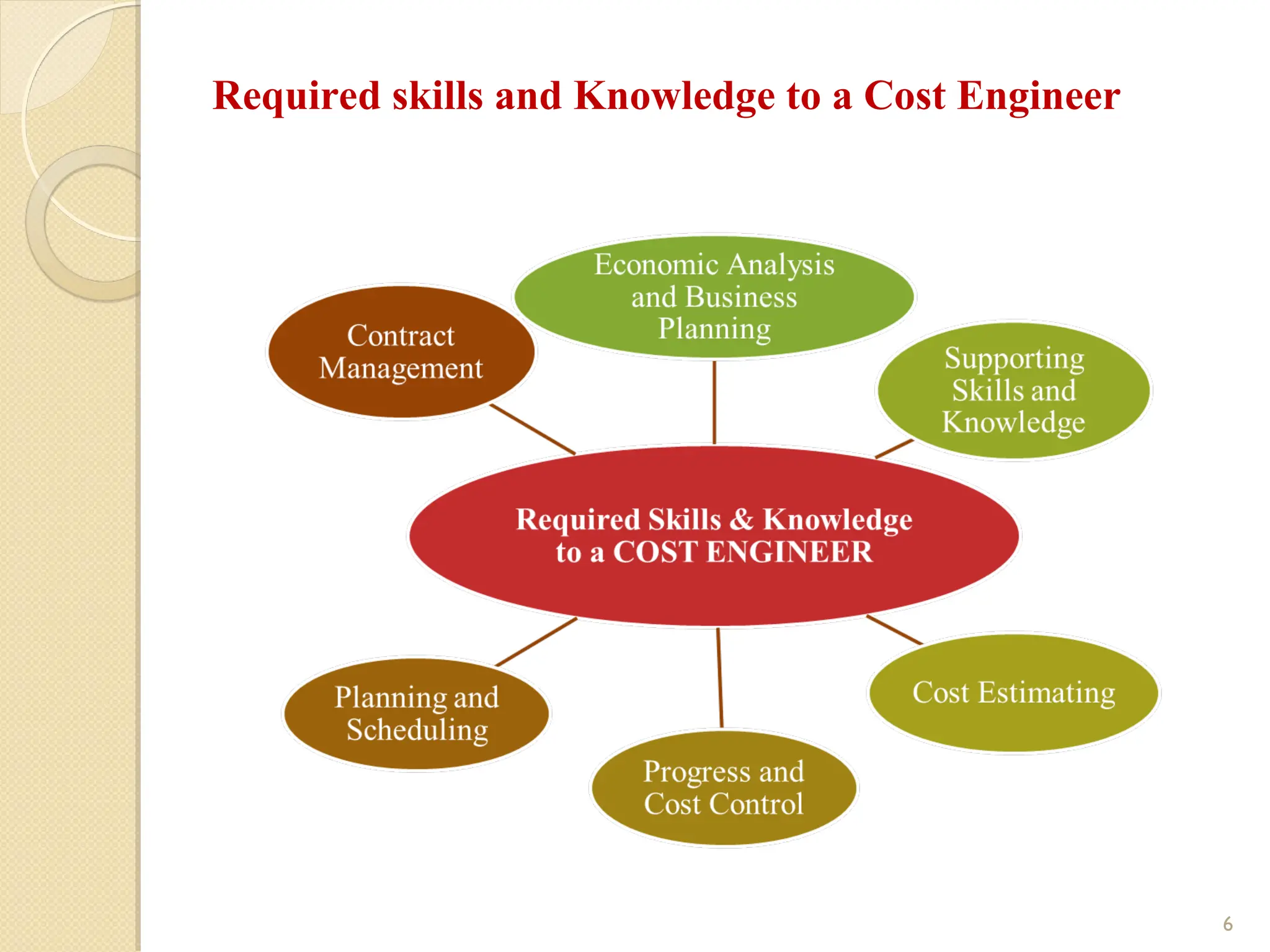
Required skills and Knowledge to a Cost Engineer
6
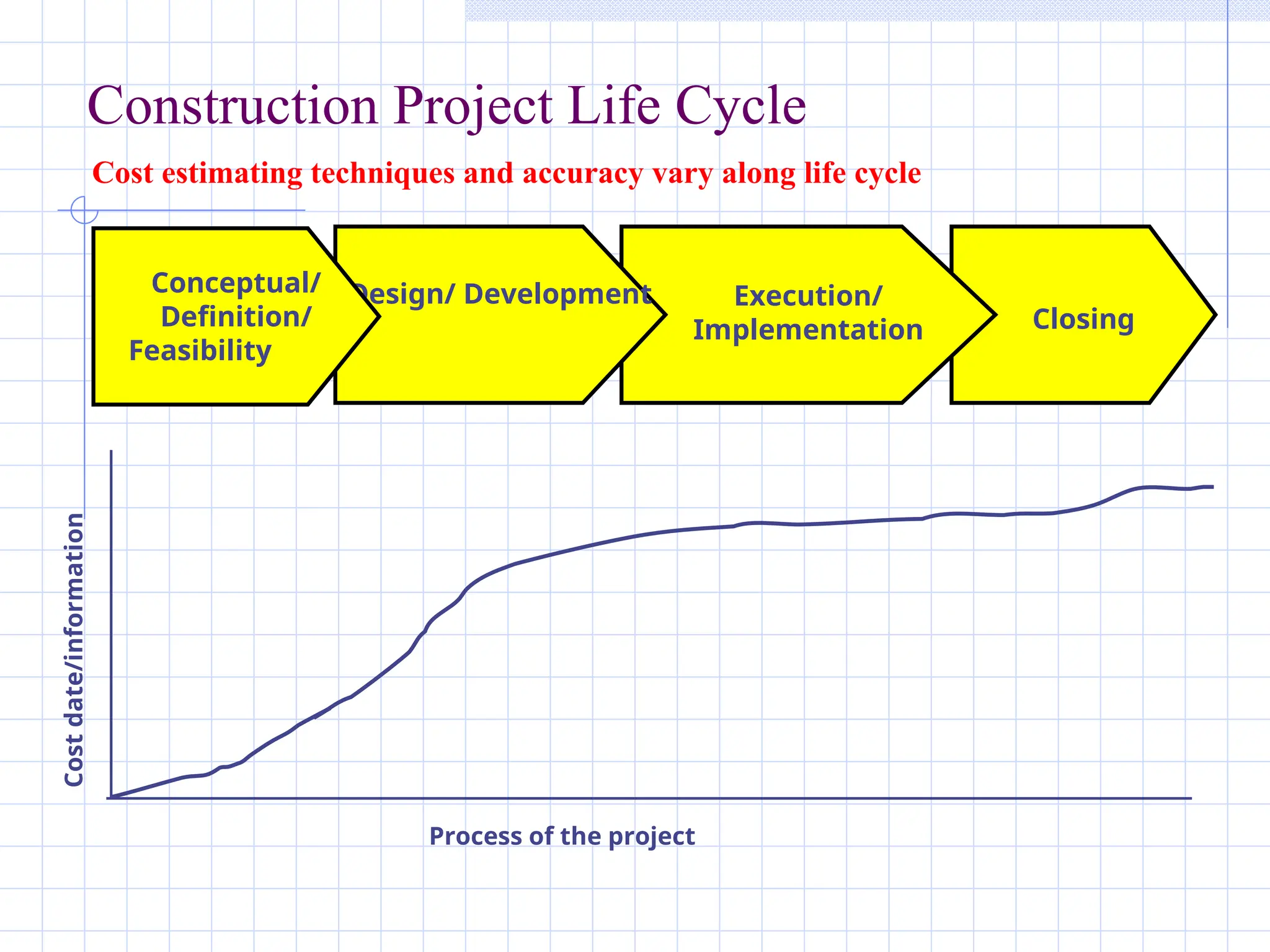
Construction Project Life Cycle
Closing
Execution/
Implementation
Design/ Development
Conceptual/
Definition/
Feasibility
Cost estimating techniques and accuracy vary along life cycle
Cost
date/information
Process of the project
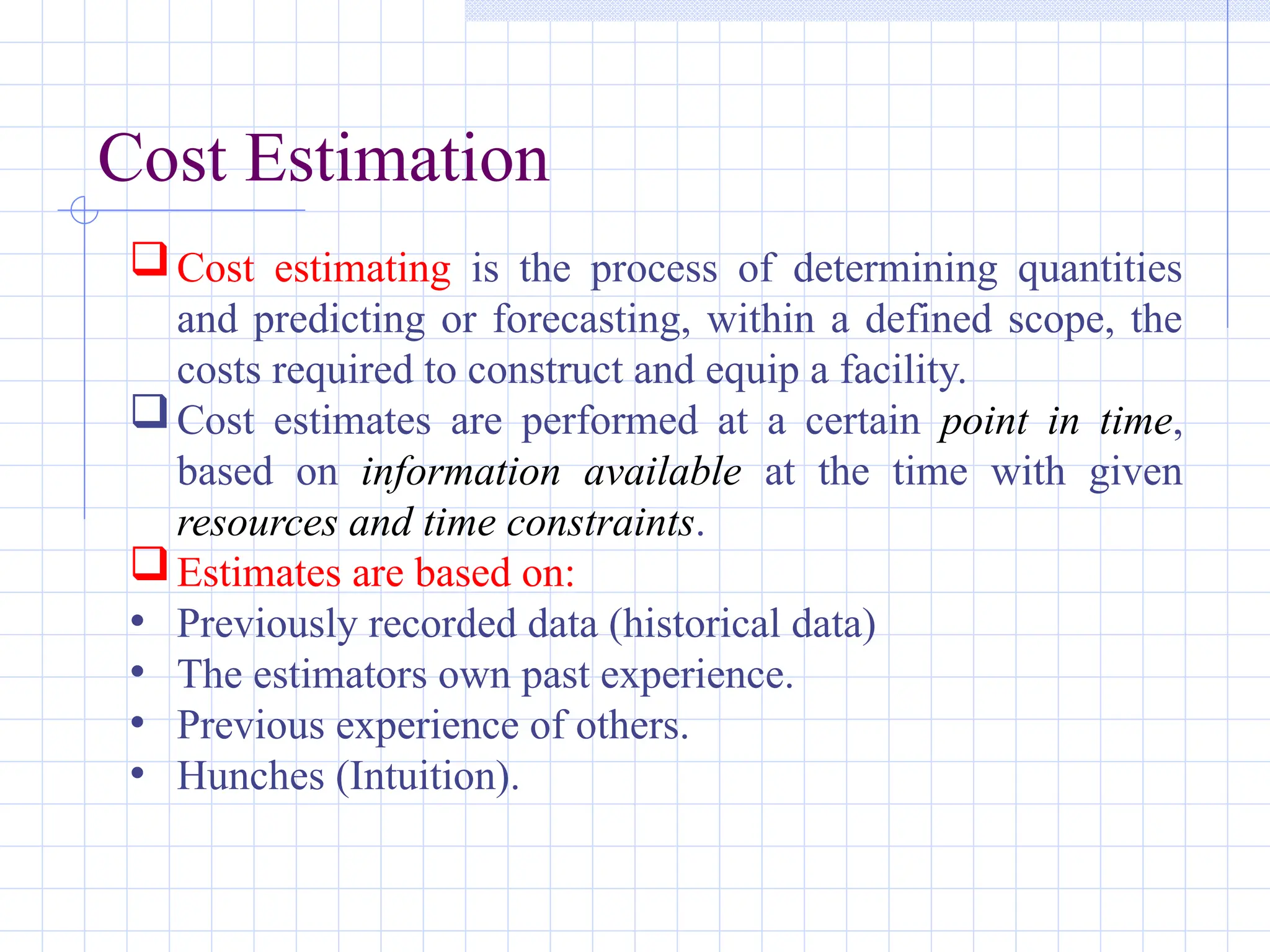
Cost Estimation
Cost estimating is the process of determining quantities
and predicting or forecasting, within a defined scope, the
costs required to construct and equip a facility.
Cost estimates are performed at a certain point in time,
based on information available at the time with given
resources and time constraints.
Estimates are based on:
• Previously recorded data (historical data)
• The estimators own past experience.
• Previous experience of others.
• Hunches (Intuition).
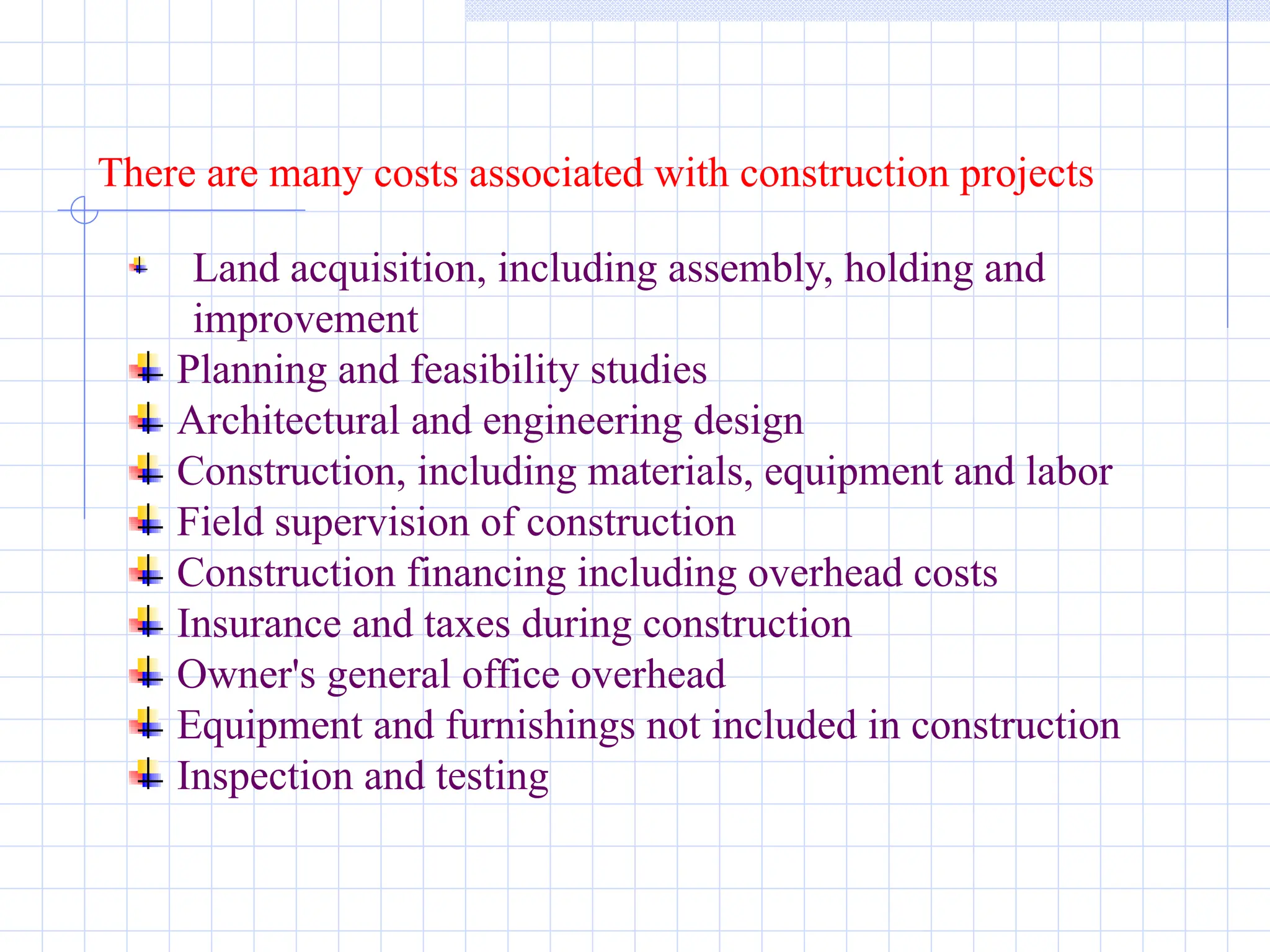
There are many costs associated with construction projects
Land acquisition, including assembly, holding and
improvement
Planning and feasibility studies
Architectural and engineering design
Construction, including materials, equipment and labor
Field supervision of construction
Construction financing including overhead costs
Insurance and taxes during construction
Owner's general office overhead
Equipment and furnishings not included in construction
Inspection and testing
Subsequent Operation and Maintenance Costs
and rent, if applicable
perating staff
abor and material for maintenance and repairs
eriodic renovations
nsurance and taxes
inancing costs
tilities
wner's other expenses
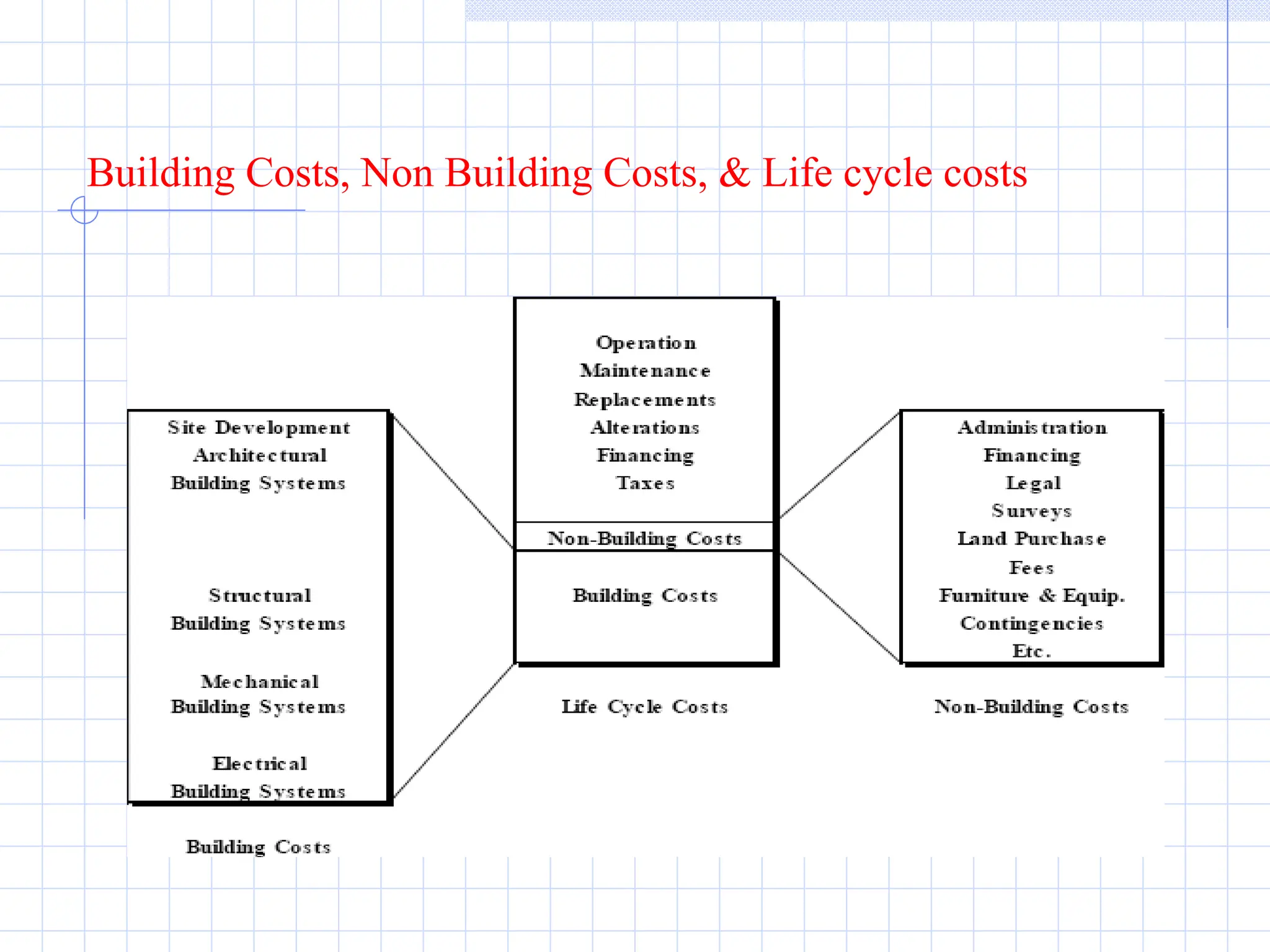
Building Costs, Non Building Costs, & Life cycle costs
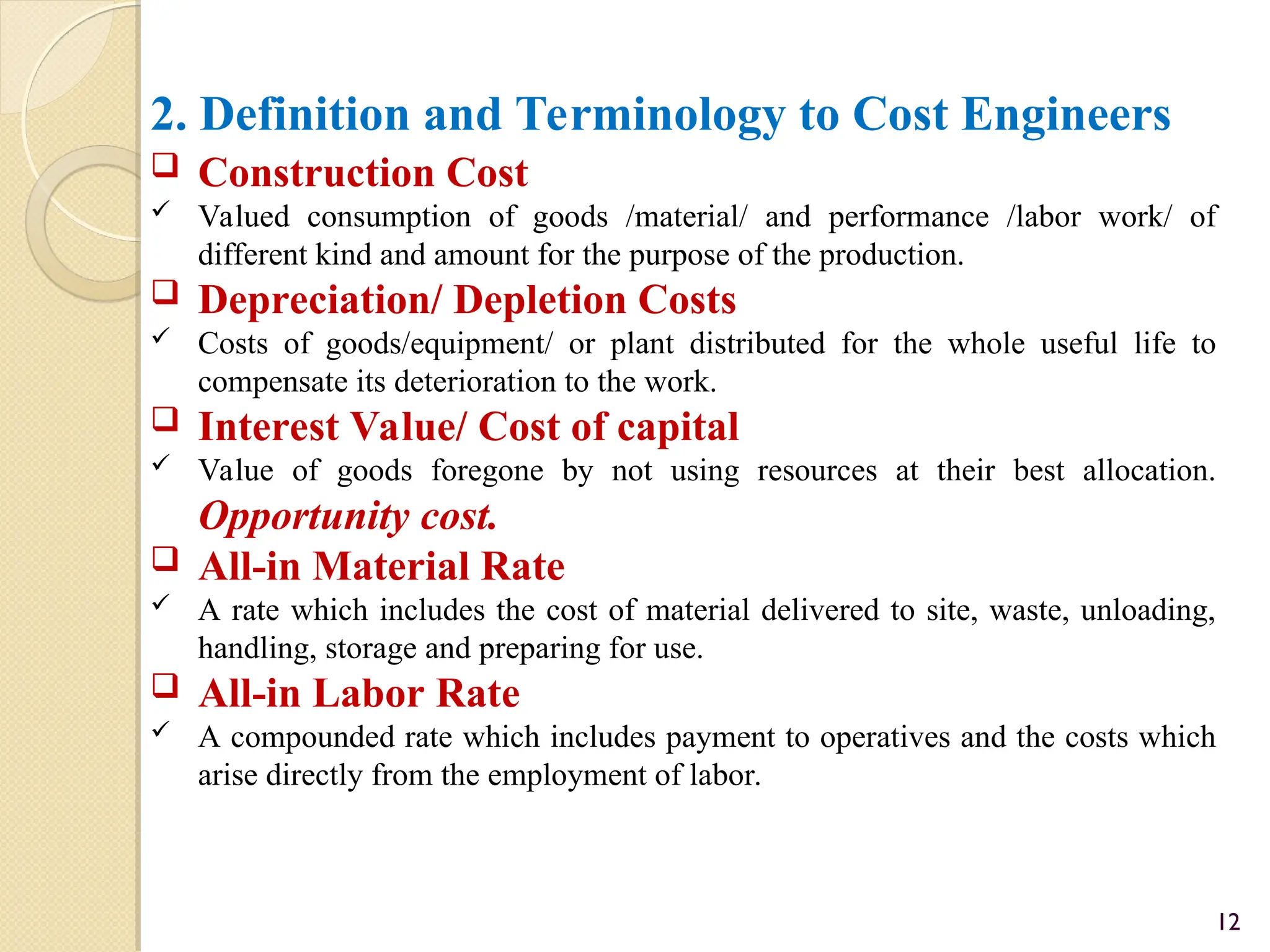
2. Definition and Terminology to Cost Engineers
 Construction Cost
 Valued consumption of goods /material/ and performance /labor work/ of
different kind and amount for the purpose of the production.
 Depreciation/ Depletion Costs
 Costs of goods/equipment/ or plant distributed for the whole useful life to
compensate its deterioration to the work.
 Interest Value/ Cost of capital
 Value of goods foregone by not using resources at their best allocation.
Opportunity cost.
 All-in Material Rate
 A rate which includes the cost of material delivered to site, waste, unloading,
handling, storage and preparing for use.
 All-in Labor Rate
 A compounded rate which includes payment to operatives and the costs which
arise directly from the employment of labor.
12
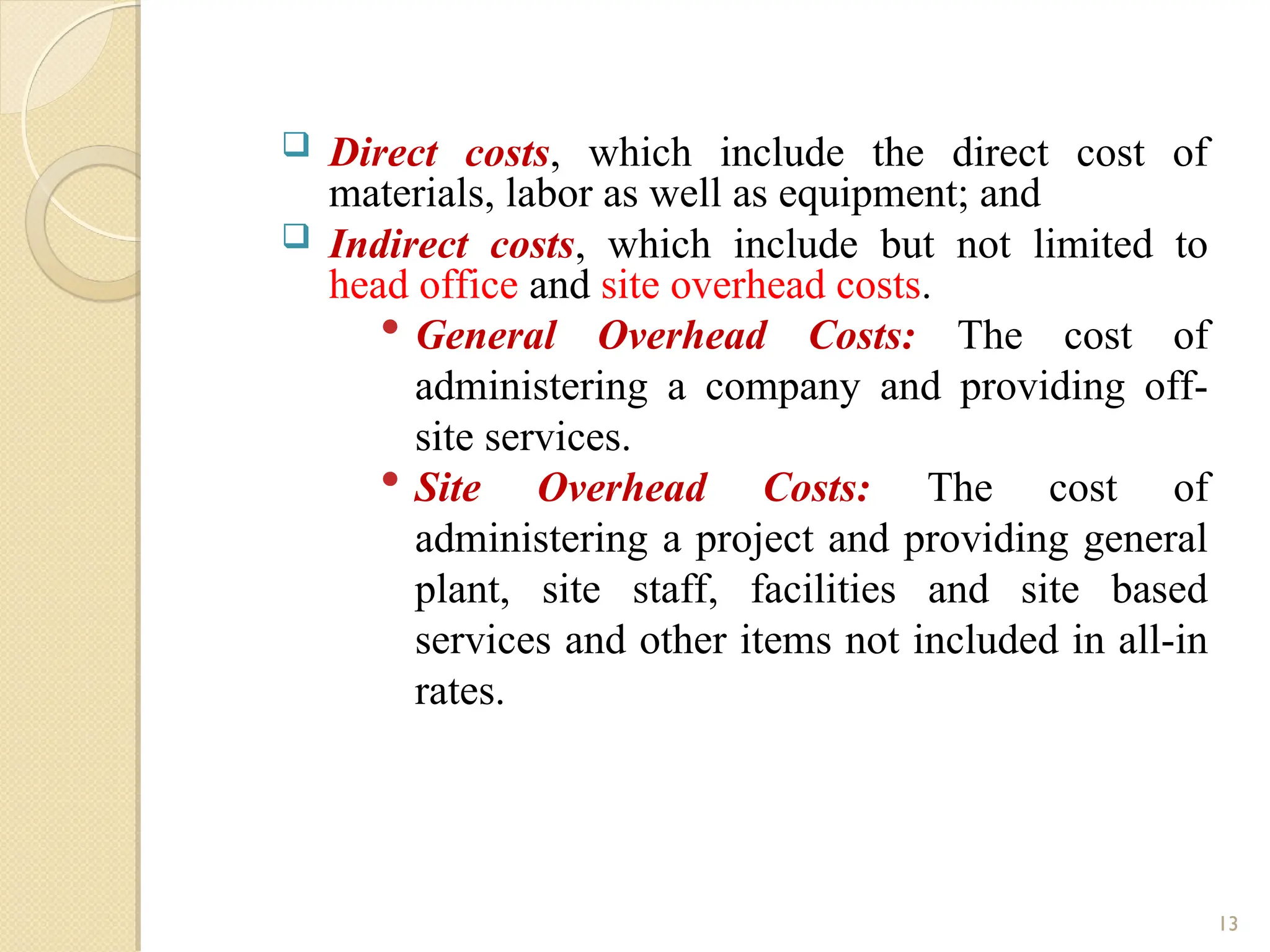
 Direct costs, which include the direct cost of
materials, labor as well as equipment; and
 Indirect costs, which include but not limited to
head office and site overhead costs.
 General Overhead Costs: The cost of
administering a company and providing off-
site services.
 Site Overhead Costs: The cost of
administering a project and providing general
plant, site staff, facilities and site based
services and other items not included in all-in
rates.
13
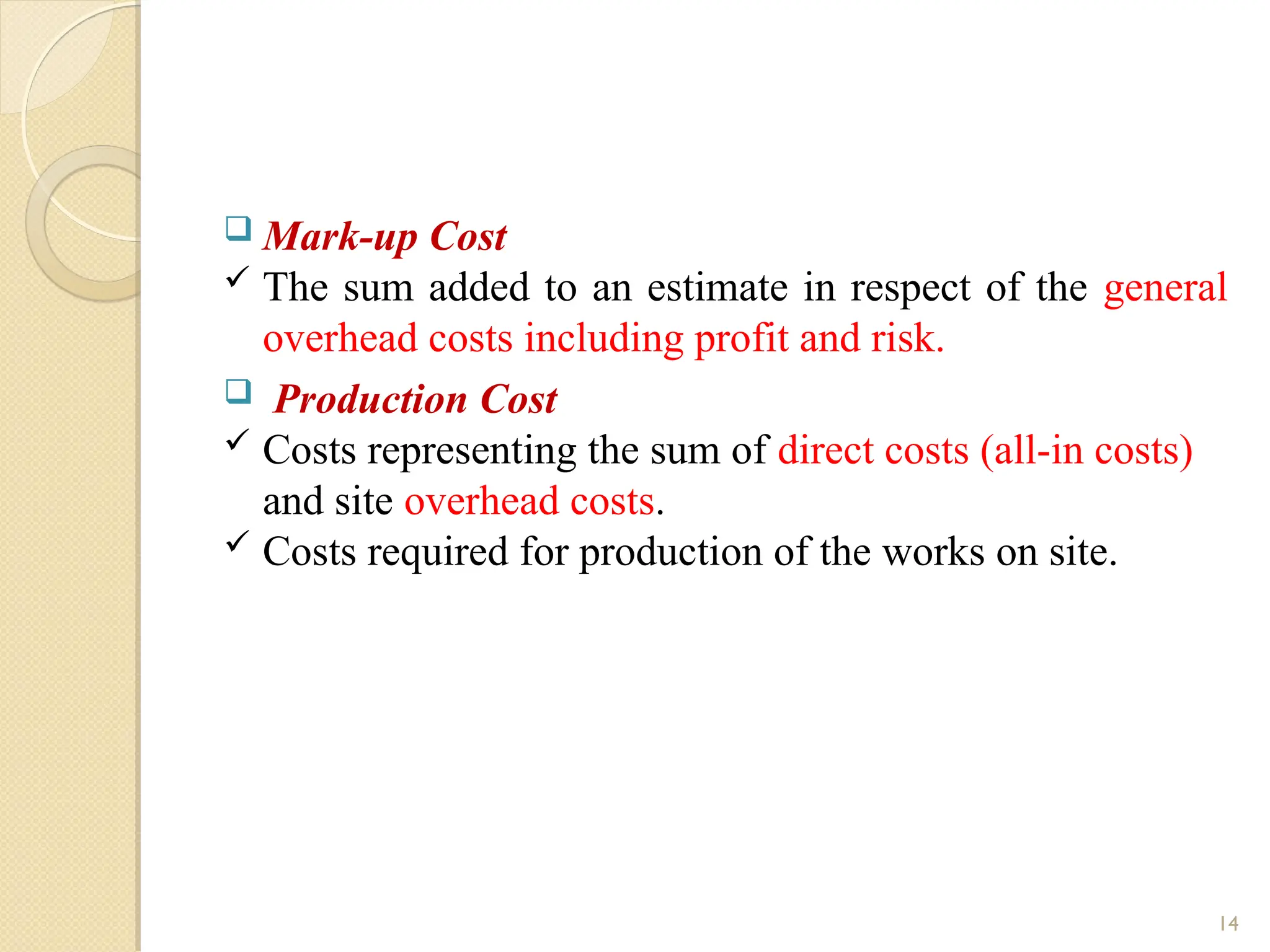
 Mark-up Cost
 The sum added to an estimate in respect of the general
overhead costs including profit and risk.
 Production Cost
 Costs representing the sum of direct costs (all-in costs)
and site overhead costs.
 Costs required for production of the works on site.
14
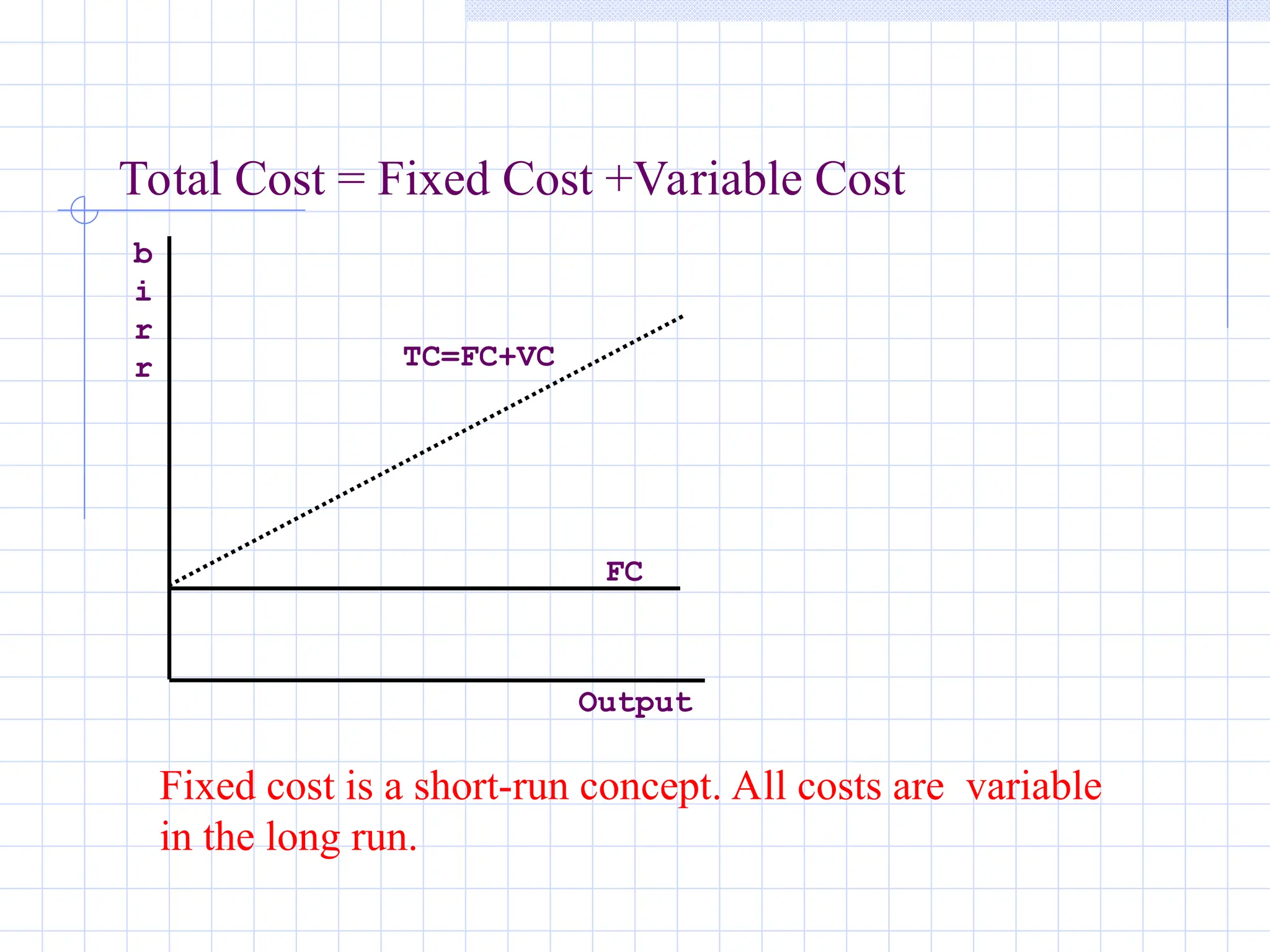
Total Cost = Fixed Cost +Variable Cost
b
i
r
r
FC
Output
TC=FC+VC
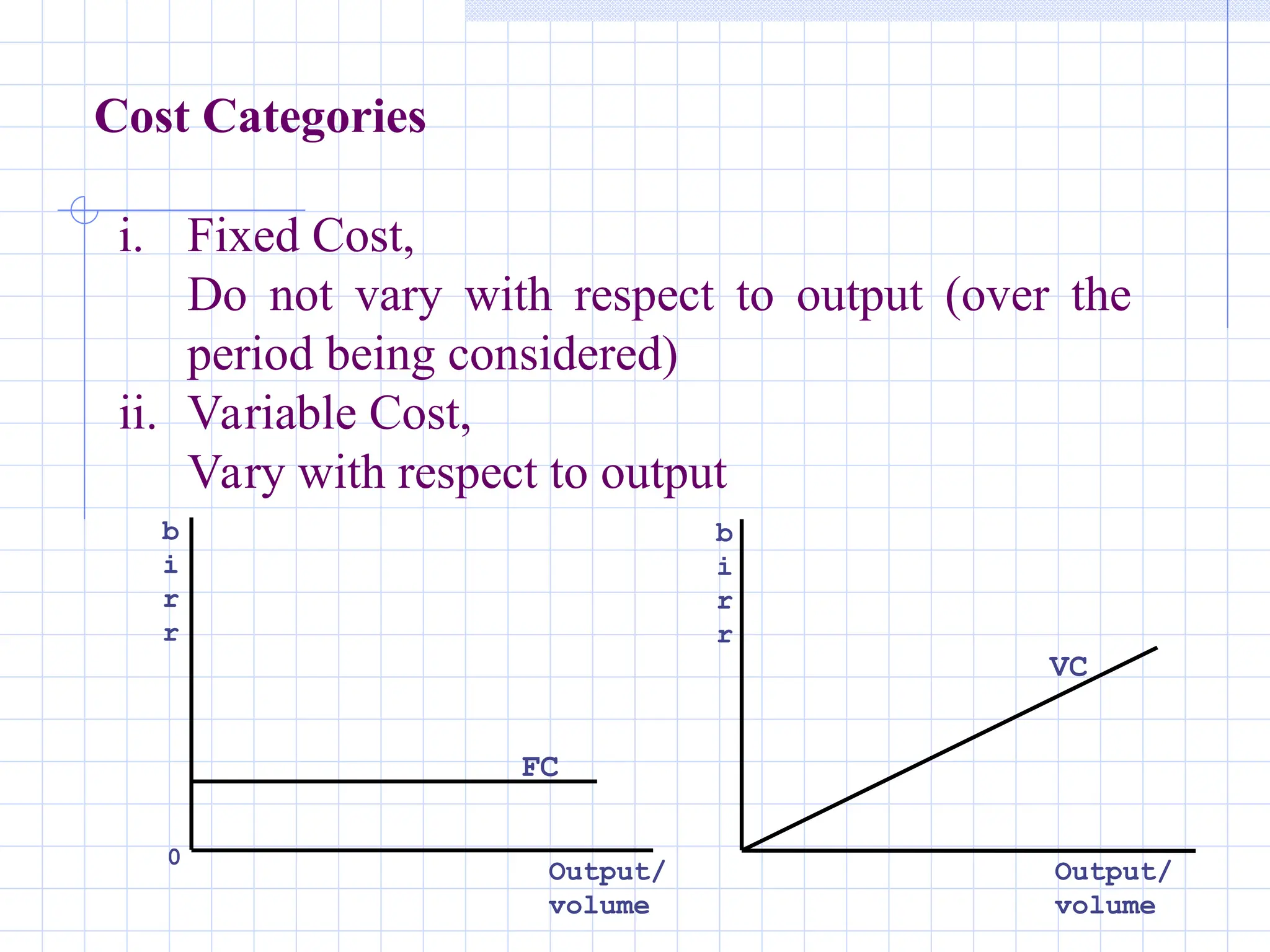
Fixed cost is a short-run concept. All costs are variable
in the long run.
Cost Categories
i. Fixed Cost,
Do not vary with respect to output (over the
period being considered)
ii. Variable Cost,
Vary with respect to output
b
i
r
r
FC
0
Output/
volume
b
i
r
r
VC
Output/
volume
3. Cost Engineering Traits
 Cost Engineering shares common traits of the following:
 Conflicting Issues of quality, size, performance and cost
 As projects develop, there is continual competition among
issues of quality, size, performance and cost.
 Owners want to have the biggest facility with the best
finishes and systems that will perform over time with least
possible amount of money. With these criteria, it is likely
that conflicts are bound to arise.
17
 Cost Engineering combines both science and art:
 Cost estimates are a product of information supplied by the
designer, the owner and the suppliers.
 Experienced Cost Engineers use much judgment in
interpreting and configuring this information.
 Cost Engineering does not offer guarantees of costs: Used
properly, however, can be important tool in bringing a
project under or at budget.
 The costs developed during design and even at the bidding
stage are almost never the final and complete costs of the
project.
18
 Costing can only be as accurate as the information upon which
it is based:
 Cost accuracy depends on many factors. Document
completeness, data base accuracy, the skill and judgment of the
Cost Engineer.
 Cost estimate accuracy increases as the design becomes more
precisely defined:
 A normal feature of the design process is that earlier stages of
design are less precise than later stages.
 Cost information provided at schematic and preliminary design
will by nature be less accurate than the ones provided at design
developments.
19
 Cost estimate is based on previous estimates:
 A good, accurate estimate does not stand alone. It is the
product of lessons learned from previous estimates.
 Costing requires standard computing methodology and
procedures:
 As the design proceeds, the level of details increases.
Costing as a consequence becomes more complex
reflecting the many different factors that go into each
unit of work.
20
4. Functions of Cost Engineering in Construction
 Arranging finance, administrative approval and fund
allotment
 Guide decision making among alternatives
 Provides guidelines to the designer (on material, size
 Prepare engineering estimate
 Negotiation tool between contracting parties
 Help in fixing completion periods
 To justify investment : Cost benefit analysis
 To invite tenders
 For Valuation purposes
21
5. Considerations in Costing
Project price is affected by
i. size of the project,
ii. quality of the project,
iii. Location of the project,
iv. construction time, and
v. other general market conditions.
22
THANK YOU!
23

1.Introduction for Cost Engineering cost

  • 1.
    Construction Management Chair ConstructionManagement Chair COTM 5202 COST ENGINEERING Chapter 1 Fundamental Principles of Cost Engineering Minweyelt E. OCT 2018
  • 2.
    Outline Outline 1. Fundamental Principlesof Cost Engineering  Introduction  Definitions and Terminology for Cost Engineers  Cost Engineering Traits  Functions of Cost Engineering in Construction  Considerations in Costing 2
  • 3.
    1. 1. Introduction 1. 1Cost Engineering  Cost engineering is concerned with problems of cost estimation, cost control, and business planning and management science, including problems of project management, planning, scheduling, and profitability analysis of engineering projects and processes.  It needs understanding of  Construction Technology  Quantity surveying including understanding of contract documents and forms of contract  Management Theory and technique: pre contract planning, tendering policy and the organization of resources  Construction economics 3
  • 4.
     The broadarray of cost engineering topics represent the intersection of the fields of project management, business management, and engineering.  Cost Engineering recognizes and focuses on the relationships between the physical and cost dimensions of whatever is being “engineered.” 4
  • 5.
    1.2 Cost Engineers Cost Engineer: is a qualified professional dedicated to TCM over the life cycle of a project, facility or manufacturing operation.  Cost Engineers are responsible for carefully managing and maintaining the integrity of all project capitalizable, and related non-capitalizable, cost data.  A Cost Engineer determines how much money, resources, and time a project will require prior to its launch.  Cost Engineers may have different titles such as: cost estimator, quantity surveyor, parametric analyst, strategic planner, planner/scheduler, value engineer, cost/schedule engineer, claims consultant, project manager, or project control lead. 5
  • 6.
    Required skills andKnowledge to a Cost Engineer 6
  • 7.
    Construction Project LifeCycle Closing Execution/ Implementation Design/ Development Conceptual/ Definition/ Feasibility Cost estimating techniques and accuracy vary along life cycle Cost date/information Process of the project
  • 8.
    Cost Estimation Cost estimatingis the process of determining quantities and predicting or forecasting, within a defined scope, the costs required to construct and equip a facility. Cost estimates are performed at a certain point in time, based on information available at the time with given resources and time constraints. Estimates are based on: • Previously recorded data (historical data) • The estimators own past experience. • Previous experience of others. • Hunches (Intuition).
  • 9.
    There are manycosts associated with construction projects Land acquisition, including assembly, holding and improvement Planning and feasibility studies Architectural and engineering design Construction, including materials, equipment and labor Field supervision of construction Construction financing including overhead costs Insurance and taxes during construction Owner's general office overhead Equipment and furnishings not included in construction Inspection and testing
  • 10.
    Subsequent Operation andMaintenance Costs and rent, if applicable perating staff abor and material for maintenance and repairs eriodic renovations nsurance and taxes inancing costs tilities wner's other expenses
  • 11.
    Building Costs, NonBuilding Costs, & Life cycle costs
  • 12.
    2. Definition andTerminology to Cost Engineers  Construction Cost  Valued consumption of goods /material/ and performance /labor work/ of different kind and amount for the purpose of the production.  Depreciation/ Depletion Costs  Costs of goods/equipment/ or plant distributed for the whole useful life to compensate its deterioration to the work.  Interest Value/ Cost of capital  Value of goods foregone by not using resources at their best allocation. Opportunity cost.  All-in Material Rate  A rate which includes the cost of material delivered to site, waste, unloading, handling, storage and preparing for use.  All-in Labor Rate  A compounded rate which includes payment to operatives and the costs which arise directly from the employment of labor. 12
  • 13.
     Direct costs,which include the direct cost of materials, labor as well as equipment; and  Indirect costs, which include but not limited to head office and site overhead costs.  General Overhead Costs: The cost of administering a company and providing off- site services.  Site Overhead Costs: The cost of administering a project and providing general plant, site staff, facilities and site based services and other items not included in all-in rates. 13
  • 14.
     Mark-up Cost The sum added to an estimate in respect of the general overhead costs including profit and risk.  Production Cost  Costs representing the sum of direct costs (all-in costs) and site overhead costs.  Costs required for production of the works on site. 14
  • 15.
    Total Cost =Fixed Cost +Variable Cost b i r r FC Output TC=FC+VC Fixed cost is a short-run concept. All costs are variable in the long run.
  • 16.
    Cost Categories i. FixedCost, Do not vary with respect to output (over the period being considered) ii. Variable Cost, Vary with respect to output b i r r FC 0 Output/ volume b i r r VC Output/ volume
  • 17.
    3. Cost EngineeringTraits  Cost Engineering shares common traits of the following:  Conflicting Issues of quality, size, performance and cost  As projects develop, there is continual competition among issues of quality, size, performance and cost.  Owners want to have the biggest facility with the best finishes and systems that will perform over time with least possible amount of money. With these criteria, it is likely that conflicts are bound to arise. 17
  • 18.
     Cost Engineeringcombines both science and art:  Cost estimates are a product of information supplied by the designer, the owner and the suppliers.  Experienced Cost Engineers use much judgment in interpreting and configuring this information.  Cost Engineering does not offer guarantees of costs: Used properly, however, can be important tool in bringing a project under or at budget.  The costs developed during design and even at the bidding stage are almost never the final and complete costs of the project. 18
  • 19.
     Costing canonly be as accurate as the information upon which it is based:  Cost accuracy depends on many factors. Document completeness, data base accuracy, the skill and judgment of the Cost Engineer.  Cost estimate accuracy increases as the design becomes more precisely defined:  A normal feature of the design process is that earlier stages of design are less precise than later stages.  Cost information provided at schematic and preliminary design will by nature be less accurate than the ones provided at design developments. 19
  • 20.
     Cost estimateis based on previous estimates:  A good, accurate estimate does not stand alone. It is the product of lessons learned from previous estimates.  Costing requires standard computing methodology and procedures:  As the design proceeds, the level of details increases. Costing as a consequence becomes more complex reflecting the many different factors that go into each unit of work. 20
  • 21.
    4. Functions ofCost Engineering in Construction  Arranging finance, administrative approval and fund allotment  Guide decision making among alternatives  Provides guidelines to the designer (on material, size  Prepare engineering estimate  Negotiation tool between contracting parties  Help in fixing completion periods  To justify investment : Cost benefit analysis  To invite tenders  For Valuation purposes 21
  • 22.
    5. Considerations inCosting Project price is affected by i. size of the project, ii. quality of the project, iii. Location of the project, iv. construction time, and v. other general market conditions. 22
  • 23.