S. Mari Selvi @ Dhivya
 A Jigsaw listening is an information gap
exercise
 Learners hear or read different parts of a text,
then exchange information with others in
order to complete a task.
 It encourages learners to develop speaking and
listening skills with in the context of a
curriculum topic and support the development
of academic language.
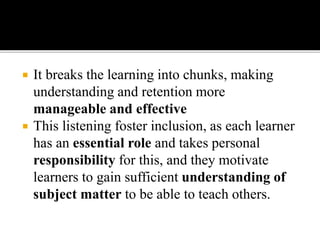
 It breaks the learning into chunks, making
understanding and retention more
manageable and effective
 This listening foster inclusion, as each learner
has an essential role and takes personal
responsibility for this, and they motivate
learners to gain sufficient understanding of
subject matter to be able to teach others.
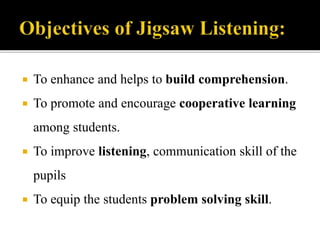
 To enhance and helps to build comprehension.
 To promote and encourage cooperative learning
among students.
 To improve listening, communication skill of the
pupils
 To equip the students problem solving skill.
 There are some of the materials for jigsaw
listening
 Poems
 Novels
 Short stories
 Play divided up by stanza, chapter order of events
or scenes
 The teacher divides the class into groups
 Each group listen to a different part of story on
the audio cassette.
 A mystery story is most suitable for jigsaw
listening.
 In the next stage learners send one or two
members from their group to other groups
 They will be asked several questions and will
have to respond and give information
 The various groups thus collect the missing
sequences of the story
 Now, in their original groups, they speculate
on the last part or the ending of the story.
 Each group reposts to the class their version of
the story – what their point of view or conjecture
is.
 Other groups are free to react, questions and
comment, and finally teacher plays the final part
which teacher plays the final part which resolves
the mystery.
 Effective way to learn
 Encourages empathy, and engagement.
 Jigsaw listening is a well-established method for
encouraging group sharing and learning of
specific content.
 It helps students to learn cooperation as a group
members share responsibility for each other’s learning
by using critical thinking and social skills to complete
an assignment.
 There is a corollary benefit as well-students working as
a team, with each team member contributing to the
overall success of the group, learn a vital real-life
lesson.
 When kids learn something well enough that they can
teach it to others, they have truly mastered the material.
 The jigsaw strategy allows them to hone their
cooperative/competitive skills in an area far removed
from the athletic field.

Jigsaw listening english

  • 1.
    S. Mari Selvi@ Dhivya
  • 2.
     A Jigsawlistening is an information gap exercise  Learners hear or read different parts of a text, then exchange information with others in order to complete a task.  It encourages learners to develop speaking and listening skills with in the context of a curriculum topic and support the development of academic language.
  • 3.
     It breaksthe learning into chunks, making understanding and retention more manageable and effective  This listening foster inclusion, as each learner has an essential role and takes personal responsibility for this, and they motivate learners to gain sufficient understanding of subject matter to be able to teach others.
  • 4.
     To enhanceand helps to build comprehension.  To promote and encourage cooperative learning among students.  To improve listening, communication skill of the pupils  To equip the students problem solving skill.
  • 5.
     There aresome of the materials for jigsaw listening  Poems  Novels  Short stories  Play divided up by stanza, chapter order of events or scenes
  • 6.
     The teacherdivides the class into groups  Each group listen to a different part of story on the audio cassette.  A mystery story is most suitable for jigsaw listening.  In the next stage learners send one or two members from their group to other groups
  • 7.
     They willbe asked several questions and will have to respond and give information  The various groups thus collect the missing sequences of the story  Now, in their original groups, they speculate on the last part or the ending of the story.
  • 8.
     Each groupreposts to the class their version of the story – what their point of view or conjecture is.  Other groups are free to react, questions and comment, and finally teacher plays the final part which teacher plays the final part which resolves the mystery.
  • 9.
     Effective wayto learn  Encourages empathy, and engagement.  Jigsaw listening is a well-established method for encouraging group sharing and learning of specific content.
  • 10.
     It helpsstudents to learn cooperation as a group members share responsibility for each other’s learning by using critical thinking and social skills to complete an assignment.  There is a corollary benefit as well-students working as a team, with each team member contributing to the overall success of the group, learn a vital real-life lesson.
  • 11.
     When kidslearn something well enough that they can teach it to others, they have truly mastered the material.  The jigsaw strategy allows them to hone their cooperative/competitive skills in an area far removed from the athletic field.