2013
Empowering Hispanic Parents
Stephanie Dodson
EDU 647: Projects in Curriculum &
Instruction
Dr. Karin Lukacs
November 25, 2013
Dodson 1
Table of Contents
I: Needs Statement…………………………………………………..2
II: Project Goals, Objectives, & Indicators……………………………………5
III: Project Design………………………………………………7
IV: Project Results………………………………………………….15
V: Implications…………………………………………………….20
VI: Personal Reflection…………………………………………………….33
References……………………………………………………………34
Appendix I: Parent Survey………………………………………36
Appendix II: Program
Invitation………………………………………………….37
Dodson 2
I: Needs Statement
Immigrant parents experience communication barriers that impair their ability to
serve as partners in their children’s education (Guo, 2010; Guo, 2012; McCormick &
Ozuna, 2012). Green Leaf High School (GLHS), located in a small urban school district
in Northern Virginia, has a student population that is approximately 46% Hispanic
(National Center for Education Statistics, 2013). An organization is needed to support
Hispanic families by facilitating communication between Spanish-speaking parents and
the school. The goal of this project is to empower Hispanic parents to serve as equal,
involved partners in their child’s education.
Extensive literature supports the need for a strong partnership between a child’s
family and school. Reschly and Christenson (2012) discuss the importance of the
school-family partnership in the article "Moving from Context Matters to Engaged
Partnerships with Families." The authors define this partnership as a mesosystem, in
which school and family comprise a system that affects a student's educational
outcomes. The system is characterized by the principle of circular causality, which
"refers to the effect changes in one part of a system may have in other areas (p. 64).”
For example, “a change to family childcare arrangements after school may positively or
negatively change a student’s preparation and homework completion, which in turn may
affect grades and test performance in school (p. 64).” The mesosystem framework
illustrates the need for a strong partnership between schools and families. The two
systems must communicate effectively in order to function as part of the larger system
that determines a child's educational outcomes (p. 64).
Dodson 3
Effective two-way communication is an essential component of the school-family
partnership. In the case of immigrant parents, communication barriers may hinder this
partnership, and these barriers must be overcome in order for the two parties to work
together effectively (Guo, 2010; Guo, 2012; McCormick & Ozuna, 2012). Linguistic
barriers are a factor in cases where parents and school personnel do not share a
common language (Guo, 2010; Guo, 2012). At GLHS, for example, many parents speak
only Spanish. This makes it difficult for these families to communicate with English-
speaking teachers, administrators, and staff.
Language barriers are not the only roadblock for the school-family system.
Cultural differences also hinder communication. Immigrant parents may be unfamiliar
with the host country’s school system and thus lack the agency to advocate on behalf of
their child’s education (Guo, 2012, p. 123). Teachers, in turn, may lack the experience
and awareness necessary to communicate with parents from different cultures (p.122).
Teachers may misinterpret a student’s behavior, such as refusal to make eye contact,
because they are unfamiliar with that student’s culture (p. 125). According to Guo
(2012), some teachers fear diversity in the aftermath of the September 11th
terrorist
attacks. She argues that “the current curriculum and teaching practice… characterized
by Eurocentric perspectives, standards, and values, do not reflect the knowledge and
experiences of our culturally and religiously diverse student and parent population (p.
122).” Furthermore, she argues that “barriers such as class and race” hinder
communication (p. 122). These include “educators’ cultural biases, and their generally
low expectations of immigrant parents (pp. 122-123).”
Dodson 4
Guo (2012) describes how immigrant parents are frequently viewed by schools
in terms of their “deficits,” rather than their strengths. This “difference as deficit” mindset
focuses on “parents’ inability to speak English and their difficulties in communicating
with schools, rather than on the strengths of these individuals (p. 122).” For example,
Guo cites “the unique way that immigrant parents engage in their children’s education,”
which “is often ignored by teachers and school administrators (p. 122 ).”
Guo presents an alternative model for the home/school relationship that
emphasizes immigrant parents’ strengths rather than their weaknesses. She argues that
schools should recognize the knowledge these parents possess, including “that drawn
from [parents’] own educational backgrounds, their professional and personal
experiences of interacting with schools in their countries of origin… their current
understanding of the host country’s education system, their own struggles as immigrant
parents, and their future aspirations for their children (p. 124).” Guo describes how
schools should view this knowledge as an asset rather than a deficit:
Knowledge is power; knowledge is socially constructed, culturally mediated, and
historically situated… Mobilizing [immigrant parents’] knowledge systematically in
the classroom by teachers and administrators would promote insightful
connections between curricular goals and immigrant students’ experiences… (p.
123).
By focusing on knowledge rather than deficits, argues Guo, schools will be able to
develop stronger partnerships with parents from different cultures.
The literature indicates a clear need for an organization that facilitates
communication between Green Leaf High School and its Spanish-speaking parents.
Dodson 5
Overcoming linguistic and cultural barriers will enable schools and families to function
as partners in supporting their children’s education.
II: Project Goals, Objectives, & Indicators
 Project Goal: To empower Spanish-speaking families to serve as equal,
involved partners in their child's education.
Green Leaf High School has a growing population of Spanish-speaking students
and families. The goal of this project is to develop and strengthen the home-school
connection with these families and to overcome communication barriers that may
prevent Spanish-speaking parents from becoming partners in their child’s education.
Spanish-speaking parents will gain the agency to serve as equal partners in the
educational process.
 Objective: Parents will engage in constructive dialogue with teachers,
administrators, and staff members about issues affecting their child's
education.
Indicators that will be used to measure this objective include the following:
1) Parent attendance: Attendance at meetings by parents and staff is crucial to
the program’s success. Therefore, we will look for a measurable increase in
attendance from one meeting to the next. We will strive for 100% attendance
among Spanish-speaking families.
2) Staff attendance: All staff members will attend at least one meeting during
the school year.
Dodson 6
3) Parent participation during meetings: Program meetings are an
opportunity for parents to engage in dialogue with staff members. Parent
participation during meetings is an indication of the program’s success. We
may use the following indicator questions to determine whether a meeting
was successful:
 Did parents and staff engage in active, constructive discussions?
 Did every parent ask a question during the meeting?
 Did parents receive satisfactory answers to their questions?
 Were there enough interpreters present to facilitate communication?
 Did the meeting lead to more frequent two-way communication
between parents and the school?
 Did the meeting strengthen the home-school connection?
Dodson 7
III: Project Design
Vision
The overall vision for this project is to start an organization that will meet on a
regular basis and provide programs for Spanish-speaking parents. Parents will meet at
the school to participate in training sessions, panel discussions, Q&A sessions, and
other program events. All sessions will serve to further the goal of empowering Spanish-
speaking parents to serve as equal and engaged partners in their child's education.
Facilitating Two-Way Communication
Two-way communication is an essential component of the school-family
partnership. This project aims to overcome cultural and socioeconomic barriers by
inviting Spanish-speaking parents to interact with school personnel and learn how to
utilize school facilities, resources, and services. English-speaking school personnel will
also be invited to attend events and interact with parents. These interactions will
strengthen the school-family relationship and facilitate ongoing two-way communication.
Communication barriers between Hispanic families and U.S. high schools exist
on multiple levels: linguistic, cultural, and socioeconomic. Many parents speak only
Spanish, while school personnel may speak only English. Culturally speaking, Hispanic
families may be unfamiliar with the U.S. educational system and its norms, procedures,
and expectations. Finally, parents from lower socioeconomic backgrounds may lack the
skills necessary to advocate for their child’s education (Guo, 2012, p. 123).
To overcome communication barriers, parents will have the opportunity to attend
sessions in which they learn how the school is organized, how to communicate with
Dodson 8
their child’s teachers, and how to utilize school resources and services. Through panel
discussions, on-site parent-teacher conferences, and Q&A sessions, parents will have
the opportunity to interact with a wide range of school personnel, including teachers,
administrators, guidance counselors, librarian, and school nurse. Parents will acquire
the knowledge, skills, and confidence necessary to communicate with the school;
advocate for their child; and serve as an equal partner in their child’s education.
English-speaking school personnel will, likewise, have the opportunity to interact with
Spanish-speaking parents.
Recruiting Interpreters
Volunteer interpreters will be recruited to compensate for the language barrier
during program meetings. The interpreters will facilitate communication between
Spanish-speaking parents and English-speaking school personnel. Interpreters will be
recruited among bilingual parents and school personnel. Parents and staff will be
provided with contact information for interpreters who are available to assist with future
communications, including conferences, e-mails, and phone calls.
Planning Stage
I began planning this project in September of 2013. My initial proposal of a guest
speaker program was rejected by my principal due to security concerns. On September
19, I met with the principal to discuss a new idea: to start an organization to support
communication between the school and Spanish-speaking parents. My principal
Dodson 9
enthusiastically embraced this idea and directed me to collaborate with the ESL
teachers, who were planning a similar program for their department.
Throughout October, I attempted to plan the project in collaboration with ESL
teachers. However, these colleagues were busy with other priorities. On October 28, I
approached the principal and requested permission to host a small-scale event for just
my students and their parents. He approved the request, and we agreed that this event
would serve as a model for future, school-wide programs geared toward Spanish-
speaking families. We scheduled the initial meeting for the evening of Thursday,
November 14.
The principal asked me to include a help session for online student registration.
This year, Green Leaf High School is trying to get all families to complete the
registration process so that we have up-to-date contact information for each student's
family. As of October 28, there were still 150 students whose parents had not completed
online registration.
Next, I needed to recruit staff members, and possibly parents, to help with the
program. The principal agreed to participate in a Q&A session with parents. I
approached the school nurse, Ms. Morris, with the idea of doing an informational
session for Spanish-speaking parents. She enthusiastically agreed. Ms. Morris, who
does not speak Spanish, was very excited at the prospect of being able to share
information on health services with the Spanish-speaking community.
My next step was to e-mail ten bilingual staff members from Green Leaf High
School and Middle School to request their services as interpreters and facilitators for the
November 14th
program. Four colleagues agreed to help: Ms. Smith, ESL Teacher; Ms.
Dodson 10
Flores, Instructional Assistant; Ms. Gonzalez, Math Teacher; and Ms. Weaver,
Language Arts Teacher, who is also the parent of a current student. I assigned Ms.
Smith to serve as interpreter for Ms. Morris during the nurse's program. Ms. Smith and
Ms. Morris met prior to the initial meeting to review information and Spanish vocabulary
related to Ms. Morris's presentation.
On November 2, I sent home a parent survey to assess interest and availability
regarding school programs for Spanish-speaking families. Survey results will be
discussed in a later section. On November 6, I sent home parent invitations to the
November 14th
meeting. Invitations were given to seventy-four students with one or
more Spanish-speaking parents, and to other students who expressed interest in
attending the program. During parent-teacher conferences, which were held on
November 5, I also distributed invitations and told parents about the program. Two of
these parents told me they planned to attend the program.
On November 13, the day before the first meeting, I made phone calls to twenty-
three Spanish-speaking households, inviting parents to attend the program. Twelve
parents told me they would try to make it, including the two I had spoken with at
conferences, while one father told me would be unable to attend because he had to
work on Thursday evenings. I left voice-mail messages for twelve households and left a
message with one household member. Three households appeared to hang up on me,
while the remaining phone numbers did not have functioning voice-mail systems.
Dodson 11
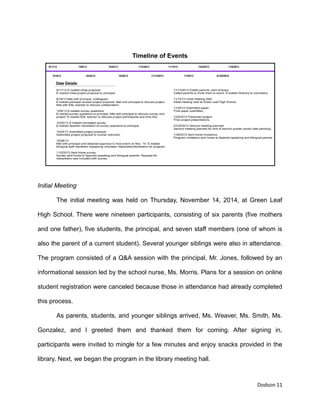
Timeline of Events
Initial Meeting
The initial meeting was held on Thursday, November 14, 2014, at Green Leaf
High School. There were nineteen participants, consisting of six parents (five mothers
and one father), five students, the principal, and seven staff members (one of whom is
also the parent of a current student). Several younger siblings were also in attendance.
The program consisted of a Q&A session with the principal, Mr. Jones, followed by an
informational session led by the school nurse, Ms. Morris. Plans for a session on online
student registration were canceled because those in attendance had already completed
this process.
As parents, students, and younger siblings arrived, Ms. Weaver, Ms. Smith, Ms.
Gonzalez, and I greeted them and thanked them for coming. After signing in,
participants were invited to mingle for a few minutes and enjoy snacks provided in the
library. Next, we began the program in the library meeting hall.
Dodson 12
Principal's Forum
We began with a session led by the principal, Mr. Jones. I interpreted the
program to Spanish and Ms. Smith (ESL teacher) was also on hand to help facilitate
communication. To begin, I thanked parents and students for coming and introduced Mr.
Jones. Mr. Jones began by sharing a PowerPoint presentation with information he
wanted to share with parents. He discussed AP (Advanced Placement) courses, which
allow students to receive college credit, and emphasized that all students are
encouraged to take these classes. He outlined the school's strengths and weaknesses
on state exams, and discussed how the school is striving to raise math scores.
Dodson 13
Next, parents were invited to ask Mr. Jones questions. Questions asked
[paraphrased] included the following:
 “My son is struggling in all his subjects and I really want to help him. What can I do?”
 “When can my child stay after school for tutoring?”
 “What is the schedule for math tutoring?”
 “Does my son need to sign up ahead of time for Saturday math tutoring, or can he just
show up?”
 “Is there a way to find out if my son is really staying after school with teachers, or
whether he is just hanging out somewhere with friends?”
In addition, a student raised her hand and asked whether she should drop a history
course that she was currently failing.
Mr. Jones provided information and feedback in response to each question. Ms.
Smith, who frequently serves as an interpreter for parent meetings, also helped answer
questions and direct parents to appropriate resources. In response to their questions,
parents received information on after-school tutoring sessions, Saturday Math School
(assistance with math offered every other Saturday), and how to communicate with
teachers by phone or e-mail. Parents in need of an interpreter for communicating with
teachers were directed to contact Ms. Dodson or Ms. Smith. Mr. Jones made plans with
one mother to meet and develop an individual study plan for her son.
Before asking her question, one mother thanked the school for organizing this
program. She told us that she had previously attended a school program for Spanish-
speaking parents while living in another city, and that she thought it was important to
have a similar program here.
Dodson 14
Nurse's Program
Next, participants went to my (Ms. Dodson's) classroom for the nurse's program.
Ms. Smith (ESL Teacher) served as interpreter for this segment. Ms. Morris shared
information on a free clinic offered at the local community center, as well as a local
program offering vaccinations. She explained her role as the school nurse and
discussed what she can and cannot do in this capacity. She explained the form parents
should complete to give permission for their child to take medication at school, and
explained the procedure for taking medication at school (she keeps the medication in
her office, and students can come to the clinic to use it). She also discussed the
importance of informing the school about any allergies a child may have, so that the
school is prepared to take action in case of an allergic reaction that occurs at school.
Ms. Morris distributed literature in Spanish, including information on the free clinic
and copies of the medication and allergy forms. She answered questions on how to fill
out the forms. One parent completed an allergy form for a condition that had not been
previously disclosed to the school.
At the conclusion of the nurse's program, I thanked parents for coming and
invited everyone to take a tour of the clinic and have their blood pressure checked by
Ms. Morris. Following the clinic tour, several parents stayed longer for one-on-one
conversations with teachers, the nurse, and the principal. I brought one parent to see
the principal and obtain a schedule for Saturday Math School, a twice-monthly program
for students struggling in math.
Dodson 15
IV: Project Results
Parent Survey
Prior to the initial meeting, a Spanish-language survey (see Appendix) was
deployed to assess parent interest and availability regarding school programs for
Spanish-speaking parents. The survey was sent home with students who reported
having one or more Spanish-speaking parent(s). Additional copies were distributed
during parent-teacher conferences and to former students known to have Spanish-
speaking parents. Twenty-six completed surveys were collected out of approximately
one hundred copies distributed.
Spoken & Preferred Languages
Parents were asked to identify language(s) spoken at home and their preferred
language(s) for communicating with the school. They were instructed to check all
applicable boxes: “Spanish,” “English,” and “Other” (those who selected “Other” were
asked to identify language spoken).
Dodson 16
Fourteen out of twenty-six respondents (54%) reported speaking only Spanish at
home. Eight respondents (31%) reported speaking both Spanish and English, while
three respondents (12%) reported speaking only English at home. One respondent
reported “Spanglish” as the language spoken at home.
Sixteen respondents (62%) identified Spanish as their preferred language for
communicating with the school. Seven respondents (27%) selected English, while three
respondents (12%) selected both Spanish and English as preferred languages for
communication.
Program Interest
Parents were asked to check all applicable boxes for school programs they
would be interested in attending. Choices included “Q&A session with principal,” “How
to use PowerSchool [online parent portal],” “Communication with teachers,” “College
and scholarship applications,” “How to help your child be successful in school,” “English
Dodson 17
as a Second Language classes,” and “Other.” Respondents who selected “Other” were
asked to specify program type(s).
The greatest number of responses (13) was recorded for “How to help your
children be successful in school.” The second most popular selection (12 responses)
was “College and scholarship applications.” The fewest number of responses (3) was
recorded for “Q&A session with principal.” Zero respondents marked “Other.”
Availability to Attend Programs
Parents were asked to check all applicable boxes indicating when they would be
available to attend programs at the school. Respondents could select from the following
choices:
Dodson 18
Day Afternoon Evening
Monday  
Tuesday  
Wednesday  
Thursday  
Friday  
Twenty-one out of twenty-six respondents marked at least one selection. Five
respondents left this section blank.
Dodson 19
For day(s) available, Monday was the most popular selection, with thirteen
responses. Thursday was the least popular selection, with eight responses. For time of
day, evening was the most popular selection, with twelve responses. Seven
respondents selected afternoon, while two respondents selected both afternoon and
evening.
Interest in Serving as Interpreter
The last survey question asked parents to check “yes” or “no” regarding their
interest in serving as a volunteer interpreter for school programs. Out of twenty-six
respondents, three selected “yes.” One of these parents included a personal note
inviting me to contact her if she could be of assistance. Twenty-two respondents marked
“no,” and one did not mark a selection.
Dodson 20
V: Implications
Analysis of Survey Data
Green Leaf High School has a student population of 790. Since 46% of students
are Hispanic, this means that there are approximately 363 Hispanic households. We will
use this total for further analysis.
Spoken & Preferred Language(s)
Fifty-four percent of respondents reported Spanish as their only language spoken
at home. We can use this percentage to predict the total number of households where
Spanish is the only language spoken. We will calculate the predicted number by solving
for “X” using the following ratio:
54 (percentage) = X (households)
100 (total) 363 (total households)
We can solve for X as follows: X = 54 x 363 ÷ 100.
This calculation yields a result of X= 196 households. Thus, we can predict that
Green Leaf High School has 196 households where Spanish is the only language
spoken.
Language(s) Spoken
at Home
Number of
Households
(Out of 26)
% of Total Predicted Number of
Households
(Out of 363)
Spanish 14 54% 196
Spanish & English 8 31% 113
English 3 12% 44
Other: “Spanglish” 1 4% 15
Dodson 21
We can repeat this calculation to predict that there are 113 households where both
Spanish & English are spoken, 44 households where only English is spoken at home,
and 15 households that may identify their home language as “Spanglish.”
Regarding the forty-four households where only English is spoken at home, we
can infer that these households boast at least one bilingual parent. The bilingual parent
is sufficiently proficient in Spanish to be able to complete the survey, but he/she speaks
only English at home with their family. This figure indicates that there are at least forty-
four bilingual parents school-wide who are proficient in both Spanish and English. I will
attempt to recruit these parents to serve as volunteer interpreters for future programs.
Preferred Language
for Communicating
With School
Number of
Households
(Out of 26)
% of Total Predicted Number of
Households
(Out of 363)
Spanish 16 62% 225
Spanish & English 7 27% 98
English 3 12% 44
I repeated these calculations for respondents' preferred language for
communicating with the school. We can predict that out of 363 Spanish-speaking
households, 225 prefer using Spanish to communicate with the school; 98 prefer
Spanish or English; and 44 prefer to use English.
Especially important is the number of respondents (225) who prefer to use
Spanish to communicate with the school. This figure represents 28% of the entire
student population. It is extremely important that these parents have access to
interpreters and Spanish translations of printed communications from the school.
Likewise, English-speaking teachers need access to interpreters and translators in
order to communicate effectively with this population.
Dodson 22
Program Interest
Respondents were instructed to check all applicable boxes for programs they
would be interested in attending. The following response numbers were recorded:
Program Type Number of responses
Q&A session with principal 3
How to use PowerSchool [online parent portal] 6
Communication with teachers 10
College and scholarship applications 12
How to help your child(ren) be successful in school 13
English as a Second Language classes 9
“Q&A with the principal” received the fewest number of responses (3). Despite
this low number, six parents attended the principal’s Q&A session during the November
14th
program. Based on program interest alone, we can use this data to extrapolate
predictions for attendance at future sessions.
Let’s begin with “How to use PowerSchool,” which received 6 survey responses.
This is twice the number of responses (3) for “Q&A session with principal.” We can
extrapolate, therefore, that there is twice as much interest in the PowerSchool program
as in the Principal’s program. We will use this ratio to calculate predicted attendance at
the PowerSchool program.
Y (predicted attendance at P.S. program) = 2 x 6 parents (attendance at principal’s program)
Y = 12 parents
By solving for Y, we can predict that 12 parents will attend the PowerSchool program.
We will repeat this procedure to calculate predicted attendance for the remaining
programs types. Answers will be rounded to the nearest whole number.
Dodson 23
Q (predicted attendance at “Communication with teachers”) = 3.3 X 6
Q = 19.8
Z (predicted attendance at “College & scholarship applications) = 4 X 6
Z = 24
P (predicted attendance at “How to help your children…”) = 4.3 X 6
P = 25.8
F (predicted attendance at “ESL classes”) = 3 X 6
F = 18
Program Type Number of survey
responses
Predicted Meeting
Attendance (in
number of parents)
How to use PowerSchool
[online parent portal] 6 12
Communication with teachers 10 20
College and scholarship
applications 12 24
How to help your child(ren) be
successful in school 13 26
English as a Second Language
classes 9 18
Based on these calculations, we can predict that if the same population of
parents is invited future meetings, we can expect that 12 parents will attend the
“PowerSchool” session, 20 parents will attend “Communication with teachers,” 24 will
attend “College and scholarship applications,” 26 will attend “How to help your child be
successful in school,” and 18 will attend “ESL classes.”
However, we must consider the fact that future meetings will be expanded to
include all Spanish-speaking households in the school, not just those of my students. As
a base population for the initial program, we will use the seventy-four students with one
Dodson 24
or more Spanish-speaking parents who received program invitations. We will refer back
to our earlier figures for school-wide population:
Language(s) Spoken
at Home
Number of
Households
(Out of 26)
% of Total Predicted Number of
Households
(Out of 363)
Spanish 14 54% 196
Spanish & English 8 31% 113
English 3 12% 44
Other: “Spanglish” 1 4% 15
For these calculations, we will assume that every household is potentially interested in
attending every program. (We will not consider the effect of specialized programs such
as English as a Second Language Classes, which would only be relevant to non-
English-speaking families). Thus, we will use our total population of 363 Spanish-
speaking households to predict meeting attendance.
We will calculate predicted school-wide attendance per program type using the
following ratio:
Predicted attendance = Predicted school-wide attendance (S)
74 households 363 households
We can calculate predicted school-wide attendance by solving for S. Let’s began with
“How to use PowerSchool.”
12 parents = S
74 363
S = 12 X 363 / 74
S = 58.9 parents
Dodson 25
By solving for S, we can predict that fifty-nine parents will attend the PowerSchool
session. I repeated these calculations for the remaining program types. Answers are
rounded to the nearest whole number.
Program Type
Predicted Attendance (out of
74 households) Measured in
Number of Parents
Predicted School-wide
Attendance (out of 363
households) Measured in
Number of Parents
How to use PowerSchool
[online parent portal] 12 59
Communication with teachers 20 98
College and scholarship
applications 24 118
How to help your child(ren) be
successful in school 26 128
English as a Second Language
classes 18 88
Availability to Attend Programs
Now, we will turn our attention to the effect of day of the week on program
attendance. As mentioned, respondents were instructed to select all applicable choices
for days available. The responses numbers are below:
Day
Number of
Responses
Monday 13
Tuesday 10
Wednesday 11
Thursday 8
Friday 10
The initial meeting was held on a Thursday, which was the least popular day
according to the survey. Based on the survey responses, it is logical to predict that
changing the program day will result in a greater turnout of parents. We can calculate
Dodson 26
the predicted increase in attendance as a percentage. Let’s start with Monday, the most
popular day, with 13 responses.
Percent increase (P) = (End Value – Starting Value) / Starting Value
P = (13 [Monday Responses] – 8 [Thursday responses]) / 8 [Thursday responses]
P = .63 = 63%
By solving for P, we can predict that moving the program from Thursday to Monday will result in
a 63% increase in meeting attendance.
Day Predicted % Increase in Meeting Attendance
Monday 63%
Tuesday 25%
Wednesday 38%
Friday 25%
By repeating this process for the remaining days of the week, we can predict that
moving the meeting day from Thursday to Monday will result in the greatest percentage
increase (63%) in meeting attendance.
Regarding time of day, our data shows that the majority of responses were
recorded for “evening” as a preferred meeting time. This result indicates that we can
maximize attendance by continuing to hold meetings in the evening versus afternoon.
Based on the survey data, I predict that Monday evening is the meeting time that will
yield the highest level of parent attendance.
Dodson 27
Interest in Serving as Interpreter
We will use two methods to predict interest in serving as interpreter among the
Hispanic parent population. First, we will predict the number of parents who may be
interested based on the percentage of affirmative survey responses. Second, we will
examine the percentage of parents who may be identified as bilingual based on their
stated languages spoken at home.
Three out of twenty-six (12%) respondents indicated that they would be
interested in serving as a volunteer interpreter for future programs. We can use this
percentage to calculate predicted interest among the general Hispanic population.
12 = N (interested parents)
100 363 (total Hispanic parents)
N = 43.56
By rounding our answer to the nearest whole number, we can predict that there are 44
parents school-wide who may be interested in serving as interpreters. Strikingly, this is
the same predicted number of Spanish-speaking parents who report speaking only
English at home:
Language(s) Spoken
at Home
Number of
Households
(Out of 26)
% of Total Predicted Number of
Households
(Out of 363)
Spanish 14 54% 196
Spanish & English 8 31% 113
English 3 12% 44
Other: “Spanglish” 1 4% 15
Survey results indicate that the interest level (12%) in serving as an interpreter is
identical to the percentage of Spanish-speaking parents (12%) who report speaking
Dodson 28
only English at home. To me, this result indicates that there is strong interest among
bilingual parents in serving as an interpreter for school programs.
Conclusions
To evaluate the success of the first program, we can return to our list of goals,
objectives, and indicators. Our overall goal is to empower Spanish-speaking families to
serve as equal, involved partners in their child's education. Our objective is for parents
to engage in constructive dialogue with teachers, administrators, and staff members
about issues affecting their child's education. Our indicators for this objective are parent
attendance and parent participation during meetings.
First, let’s address the parent attendance indicator. Since I was unsure if anyone
would attend, I was pleased that six parents attended the first meeting. In the “Analysis”
section, I discussed strategies that I will implement to increase parent attendance at
future meetings. First, we will choose meeting topics that are of interest to parents.
Survey results predict the highest turnout for programs related to “How to help your
child be successful in school” and “College and scholarship applications.” I will include
these sessions at future meetings, and I will continue using surveys to assess parent
interest in different program types. Next, we will schedule meetings for days and times
when parents report being able to attend. The next meeting will be moved to Monday
evening, since the highest attendance is predicted for this day and time.
Next, let’s address the staff attendance indicator. Once again, I was very pleased
with the number of staff who attended the first meeting. I will invite staff members to the
next meeting and try to have every staff members attend at least one meeting before
Dodson 29
the end of the school year. This way, every staff member will have the opportunity to
interact with Spanish-speaking parents, and the parents will have opportunities to
interact with a wide range of staff members.
Our third indicator is parent participation during meetings. We can use several
questions to determine whether this indicator was met.
 Did parents and staff engage in active, constructive discussions?
Parents and staff engaged in active, constructive discussions during this meeting.
Both parties had the opportunity to share information with one another, and parents had
the opportunity to ask questions and receive answers from the principal and staff.
 Did every parent ask a question during the meeting?
Every parent in attendance asked at least one question.
 Did parents receive satisfactory answers to their questions?
My perception was that parents received satisfactory answers. However, I plan to
contact the parents who attended and ask for their feedback.
 Were there enough interpreters present to facilitate communication?
There were five interpreters (all staff volunteers) present at the initial meeting. They
were able to manage the workload of facilitating communicating between parents and
staff. Our data analysis predicts that there are forty-four bilingual parents school-wide
who may be interested in serving as interpreters. This is a sufficient number to start a
network of interpreters to facilitate communication at program meetings.
Dodson 30
 Did the meeting lead to more frequent two-way communication between parents and
the school?
 Did the meeting strengthen the home-school connection?
I will address these two questions together. Evidence suggests that this meeting
strengthened the home-school connection and will lead to more frequent two-way
communication between parents and the school.
Ms. Morris, the nurse, commented to me that “the whole meeting was worth it just to
get that allergy form.” She was referring to the parent disclosure of a child’s allergy that
was previously unknown to the school. During the meeting, the parent was able to
provide the nurse with valuable, life-saving information regarding the child’s condition. In
addition, the nurse and the parent now know how to contact one another. This session
paved the way for future two-way communication related to the child’s health.
One parent made plans to meet with the principal and develop a plan to help her
son, who is struggling academically. This meeting is likely to lead to further
communication between this parent, the principal, and her son’s teachers.
One father inquired about math tutoring and received a copy of the schedule for
Saturday Math School. As a result of the meeting, he knows about the math sessions
and how his son can attend. My perception is that the father will begin taking advantage
of these tutoring opportunities for his son, and that this is likely to lead to further
communication with his son’s teachers.
Parents were told how to contact Ms. Morris and Ms. Dodson when they need an
interpreter. Now that they know there are interpreters available, and how to access
them, I believe that parents will be likelier to initiate contact with their child’s teachers.
Dodson 31
Several parents thanked me for organizing the meeting. Based on this feedback,
I believe that parents had a positive experience that will make them likelier to attend
school functions in the future.
Next Steps
The principal has given approval for a second meeting to be held in January, at
the end of the second grading quarter. The second meeting will be expanded to include
all Spanish-speaking families in the school. The principal has also discussed hosting a
program of similar format for English-speaking families.
I am hopeful that this project will grow into a cohesive group that meets regularly,
perhaps once a month. Prior to the next meeting, I will enlist other bilingual teachers to
help make phone calls inviting parents to attend. We will strive to call every Spanish-
speaking parent in the school to let them know about the meeting. I am also hopeful that
word of mouth among Spanish-speaking parents will encourage more families to attend.
My plan is for as many school personnel as possible to be involved in this
program. I plan to invite school personnel including teachers, administrators, guidance
counselors, nurse, librarian, and others to attend meetings and interact with Spanish-
speaking parents. Staff members will be invited to participate in Q&A sessions, panel
discussions, and training sessions for Spanish-speaking families. I will send an
introductory e-mail to staff explaining the project purpose and letting them know that
there will be interpreters on hand to facilitate communication. For the next meeting, I
Dodson 32
plan to ask guidance counselors to give presentations on college and scholarship
applications.
Interpreters are critical to the program's success. For a larger scale program, we
will need many interpreters. I plan recruit as many volunteer interpreters as possible to
facilitate communication during meetings. I will contact bilingual parents and staff
members to enlist their services. We will hold a session for interpreters prior to the next
meeting. During this session, we will discuss the program's goals and the role volunteer
interpreters will play during meetings.
Plans for the initial meeting included a help session for online student
registration. However, this segment was cancelled because everyone in attendance had
already completed the registration process. Our administration wants every parent to
complete the online registration to ensure that we have up-to-date contact information
for every household. It is difficult to contact parents who haven’t completed registration
because we may not have their current phone numbers on file. (This may explain the
experience of people “hanging up on me” when I called to invite them to the meeting).
Prior to the next meeting, I will attempt to make contact with as many of these families
as possible and encourage them to attend. We will help all attendees who haven’t done
so complete the online registration process. Getting everyone registered will improve
home-school communication because teachers will have the right contact information
for parents.
Future meetings will be held in the library or in specific locations (such as the
guidance office or computer lab) pertinent to the meeting topic. Volunteer interpreters
will facilitate communication, enabling parents and personnel to engage in Q&A
Dodson 33
sessions, information and training sessions, panel discussions, and on-site
parent/teacher conferences.
VI: Personal Reflection
On the evening of the initial meeting, I was nervous because I did not know
whether any parents would attend. In the end, there were six parent attendees (seven
counting the staff member who is also a parent). I was thrilled that so many attended,
and I am hopeful that there will be an even greater turnout at future meetings. The
meeting proved to be a rewarding experience that opened doors for future
communication between the school and Spanish-speaking parents.
I believe that as a result of this program, parents who attended the meeting will
feel more confident communicating with the school in the future. The result will be a
stronger relationship and ongoing two-way communication between Spanish-speaking
parents and the school.
Future research is necessary to explore the long-term implications of this
program. Specifically, I would like to investigate the effects of the parent program on
academic performance among children of Spanish-speaking parents. I predict that
these students will show higher levels of academic achievement as a result of the
program and its strengthening of the home-school connection. I predict that they will
show increased participation in tutoring sessions and AP sessions. Furthermore, I would
like to investigate whether these students graduate at a higher rate.
Dodson 34
References
Bennett-Conroy, W. (2012). Engaging parents of eighth grade students in parent-
teacher bidirectional communication. School Community Journal, 22(2), 87-110.
Retrieved from http://files.eric.ed.gov/fulltext/EJ1001614.pdf.
DeFur, S. (2012). Parents as collaborators: Building partnerships with school- and
community-based providers. TEACHING Exceptional Children, 44(3), 58-67.
Guo, Y. (2012). Diversity in public education: Acknowledging immigrant parent
knowledge. Canadian Journal of Education, 35(2), 120-140. Retrieved from
http://files.eric.ed.gov/fulltext/EJ975278.pdf.
Guo, Y. (2010). Meetings without dialogue: A study of ESL parent–teacher interactions
at secondary school parents’ nights. School Community Journal, 20(1), 121-140.
Retrieved from http://files.eric.ed.gov/fulltext/EJ891835.pdf.
McCormick, J. & Ozuna, S. (2012). Community partnerships: Working across institutions
to support parent advocacy and education. Online Yearbook of Urban Learning,
Teaching, and Research, 26-32. Retrieved from
http://files.eric.ed.gov/fulltext/EJ980018.pdf.
Dodson 35
National Center for Education Statistics. (2013). [Name of School Redacted]
[Data set]. Retrieved from http://nces.ed.gov/.
Reschly, A. & Christenson, S. (2012). Moving from “context matters” to engaged
partnerships with families. Journal of Educational & Psychological Consultation,
22(1-2), 62-78.
Dodson 36
Encuesta para las familias hispanohablantes
¿Cuál(es) idioma(s) habla usted en casa?
(Escriba un ✓ a todos los que le aplican).
 Español
 Inglés
 Otro: _________________
¿Qué idioma prefiere usar para comunicarse con el colegio?
 Español
 Inglés
 Otro: _________________
¿Le interesa asistir a programas que tratan de...?
(Escriba un ✓ a todos los que le aplican).
 Sesión de pregunta y respuesta con el director.
 Como usar el sistema de PowerSchool.
 La comunicación con los maestros.
 Las solicitudes de entrada a la universidad y para las becas.
 Como ayudar a su hijo(a) a tener éxito en los estudios.
 Las clases de inglés como segundo idioma.
¿Cuándo está disponible para asistir a un programa del colegio?
(Escriba un ✓ a todos los que le aplican).
Día Por la tarde Por la noche
Lunes  
Martes  
Miércoles  
Jueves  
Viernes  
¿Le interesa ofrecerse como intérprete voluntario para los programas?
 Sí
 No
Si le interesa ofrecerse como intérprete, por favor, llame a Stephanie Dodson: (123) 456-7891,
ext. 23456. ¡Muchas gracias!
Dodson 37

dodson_home_school_communication

  • 1.
    2013 Empowering Hispanic Parents StephanieDodson EDU 647: Projects in Curriculum & Instruction Dr. Karin Lukacs November 25, 2013
  • 2.
    Dodson 1 Table ofContents I: Needs Statement…………………………………………………..2 II: Project Goals, Objectives, & Indicators……………………………………5 III: Project Design………………………………………………7 IV: Project Results………………………………………………….15 V: Implications…………………………………………………….20 VI: Personal Reflection…………………………………………………….33 References……………………………………………………………34 Appendix I: Parent Survey………………………………………36 Appendix II: Program Invitation………………………………………………….37
  • 3.
    Dodson 2 I: NeedsStatement Immigrant parents experience communication barriers that impair their ability to serve as partners in their children’s education (Guo, 2010; Guo, 2012; McCormick & Ozuna, 2012). Green Leaf High School (GLHS), located in a small urban school district in Northern Virginia, has a student population that is approximately 46% Hispanic (National Center for Education Statistics, 2013). An organization is needed to support Hispanic families by facilitating communication between Spanish-speaking parents and the school. The goal of this project is to empower Hispanic parents to serve as equal, involved partners in their child’s education. Extensive literature supports the need for a strong partnership between a child’s family and school. Reschly and Christenson (2012) discuss the importance of the school-family partnership in the article "Moving from Context Matters to Engaged Partnerships with Families." The authors define this partnership as a mesosystem, in which school and family comprise a system that affects a student's educational outcomes. The system is characterized by the principle of circular causality, which "refers to the effect changes in one part of a system may have in other areas (p. 64).” For example, “a change to family childcare arrangements after school may positively or negatively change a student’s preparation and homework completion, which in turn may affect grades and test performance in school (p. 64).” The mesosystem framework illustrates the need for a strong partnership between schools and families. The two systems must communicate effectively in order to function as part of the larger system that determines a child's educational outcomes (p. 64).
  • 4.
    Dodson 3 Effective two-waycommunication is an essential component of the school-family partnership. In the case of immigrant parents, communication barriers may hinder this partnership, and these barriers must be overcome in order for the two parties to work together effectively (Guo, 2010; Guo, 2012; McCormick & Ozuna, 2012). Linguistic barriers are a factor in cases where parents and school personnel do not share a common language (Guo, 2010; Guo, 2012). At GLHS, for example, many parents speak only Spanish. This makes it difficult for these families to communicate with English- speaking teachers, administrators, and staff. Language barriers are not the only roadblock for the school-family system. Cultural differences also hinder communication. Immigrant parents may be unfamiliar with the host country’s school system and thus lack the agency to advocate on behalf of their child’s education (Guo, 2012, p. 123). Teachers, in turn, may lack the experience and awareness necessary to communicate with parents from different cultures (p.122). Teachers may misinterpret a student’s behavior, such as refusal to make eye contact, because they are unfamiliar with that student’s culture (p. 125). According to Guo (2012), some teachers fear diversity in the aftermath of the September 11th terrorist attacks. She argues that “the current curriculum and teaching practice… characterized by Eurocentric perspectives, standards, and values, do not reflect the knowledge and experiences of our culturally and religiously diverse student and parent population (p. 122).” Furthermore, she argues that “barriers such as class and race” hinder communication (p. 122). These include “educators’ cultural biases, and their generally low expectations of immigrant parents (pp. 122-123).”
  • 5.
    Dodson 4 Guo (2012)describes how immigrant parents are frequently viewed by schools in terms of their “deficits,” rather than their strengths. This “difference as deficit” mindset focuses on “parents’ inability to speak English and their difficulties in communicating with schools, rather than on the strengths of these individuals (p. 122).” For example, Guo cites “the unique way that immigrant parents engage in their children’s education,” which “is often ignored by teachers and school administrators (p. 122 ).” Guo presents an alternative model for the home/school relationship that emphasizes immigrant parents’ strengths rather than their weaknesses. She argues that schools should recognize the knowledge these parents possess, including “that drawn from [parents’] own educational backgrounds, their professional and personal experiences of interacting with schools in their countries of origin… their current understanding of the host country’s education system, their own struggles as immigrant parents, and their future aspirations for their children (p. 124).” Guo describes how schools should view this knowledge as an asset rather than a deficit: Knowledge is power; knowledge is socially constructed, culturally mediated, and historically situated… Mobilizing [immigrant parents’] knowledge systematically in the classroom by teachers and administrators would promote insightful connections between curricular goals and immigrant students’ experiences… (p. 123). By focusing on knowledge rather than deficits, argues Guo, schools will be able to develop stronger partnerships with parents from different cultures. The literature indicates a clear need for an organization that facilitates communication between Green Leaf High School and its Spanish-speaking parents.
  • 6.
    Dodson 5 Overcoming linguisticand cultural barriers will enable schools and families to function as partners in supporting their children’s education. II: Project Goals, Objectives, & Indicators  Project Goal: To empower Spanish-speaking families to serve as equal, involved partners in their child's education. Green Leaf High School has a growing population of Spanish-speaking students and families. The goal of this project is to develop and strengthen the home-school connection with these families and to overcome communication barriers that may prevent Spanish-speaking parents from becoming partners in their child’s education. Spanish-speaking parents will gain the agency to serve as equal partners in the educational process.  Objective: Parents will engage in constructive dialogue with teachers, administrators, and staff members about issues affecting their child's education. Indicators that will be used to measure this objective include the following: 1) Parent attendance: Attendance at meetings by parents and staff is crucial to the program’s success. Therefore, we will look for a measurable increase in attendance from one meeting to the next. We will strive for 100% attendance among Spanish-speaking families. 2) Staff attendance: All staff members will attend at least one meeting during the school year.
  • 7.
    Dodson 6 3) Parentparticipation during meetings: Program meetings are an opportunity for parents to engage in dialogue with staff members. Parent participation during meetings is an indication of the program’s success. We may use the following indicator questions to determine whether a meeting was successful:  Did parents and staff engage in active, constructive discussions?  Did every parent ask a question during the meeting?  Did parents receive satisfactory answers to their questions?  Were there enough interpreters present to facilitate communication?  Did the meeting lead to more frequent two-way communication between parents and the school?  Did the meeting strengthen the home-school connection?
  • 8.
    Dodson 7 III: ProjectDesign Vision The overall vision for this project is to start an organization that will meet on a regular basis and provide programs for Spanish-speaking parents. Parents will meet at the school to participate in training sessions, panel discussions, Q&A sessions, and other program events. All sessions will serve to further the goal of empowering Spanish- speaking parents to serve as equal and engaged partners in their child's education. Facilitating Two-Way Communication Two-way communication is an essential component of the school-family partnership. This project aims to overcome cultural and socioeconomic barriers by inviting Spanish-speaking parents to interact with school personnel and learn how to utilize school facilities, resources, and services. English-speaking school personnel will also be invited to attend events and interact with parents. These interactions will strengthen the school-family relationship and facilitate ongoing two-way communication. Communication barriers between Hispanic families and U.S. high schools exist on multiple levels: linguistic, cultural, and socioeconomic. Many parents speak only Spanish, while school personnel may speak only English. Culturally speaking, Hispanic families may be unfamiliar with the U.S. educational system and its norms, procedures, and expectations. Finally, parents from lower socioeconomic backgrounds may lack the skills necessary to advocate for their child’s education (Guo, 2012, p. 123). To overcome communication barriers, parents will have the opportunity to attend sessions in which they learn how the school is organized, how to communicate with
  • 9.
    Dodson 8 their child’steachers, and how to utilize school resources and services. Through panel discussions, on-site parent-teacher conferences, and Q&A sessions, parents will have the opportunity to interact with a wide range of school personnel, including teachers, administrators, guidance counselors, librarian, and school nurse. Parents will acquire the knowledge, skills, and confidence necessary to communicate with the school; advocate for their child; and serve as an equal partner in their child’s education. English-speaking school personnel will, likewise, have the opportunity to interact with Spanish-speaking parents. Recruiting Interpreters Volunteer interpreters will be recruited to compensate for the language barrier during program meetings. The interpreters will facilitate communication between Spanish-speaking parents and English-speaking school personnel. Interpreters will be recruited among bilingual parents and school personnel. Parents and staff will be provided with contact information for interpreters who are available to assist with future communications, including conferences, e-mails, and phone calls. Planning Stage I began planning this project in September of 2013. My initial proposal of a guest speaker program was rejected by my principal due to security concerns. On September 19, I met with the principal to discuss a new idea: to start an organization to support communication between the school and Spanish-speaking parents. My principal
  • 10.
    Dodson 9 enthusiastically embracedthis idea and directed me to collaborate with the ESL teachers, who were planning a similar program for their department. Throughout October, I attempted to plan the project in collaboration with ESL teachers. However, these colleagues were busy with other priorities. On October 28, I approached the principal and requested permission to host a small-scale event for just my students and their parents. He approved the request, and we agreed that this event would serve as a model for future, school-wide programs geared toward Spanish- speaking families. We scheduled the initial meeting for the evening of Thursday, November 14. The principal asked me to include a help session for online student registration. This year, Green Leaf High School is trying to get all families to complete the registration process so that we have up-to-date contact information for each student's family. As of October 28, there were still 150 students whose parents had not completed online registration. Next, I needed to recruit staff members, and possibly parents, to help with the program. The principal agreed to participate in a Q&A session with parents. I approached the school nurse, Ms. Morris, with the idea of doing an informational session for Spanish-speaking parents. She enthusiastically agreed. Ms. Morris, who does not speak Spanish, was very excited at the prospect of being able to share information on health services with the Spanish-speaking community. My next step was to e-mail ten bilingual staff members from Green Leaf High School and Middle School to request their services as interpreters and facilitators for the November 14th program. Four colleagues agreed to help: Ms. Smith, ESL Teacher; Ms.
  • 11.
    Dodson 10 Flores, InstructionalAssistant; Ms. Gonzalez, Math Teacher; and Ms. Weaver, Language Arts Teacher, who is also the parent of a current student. I assigned Ms. Smith to serve as interpreter for Ms. Morris during the nurse's program. Ms. Smith and Ms. Morris met prior to the initial meeting to review information and Spanish vocabulary related to Ms. Morris's presentation. On November 2, I sent home a parent survey to assess interest and availability regarding school programs for Spanish-speaking families. Survey results will be discussed in a later section. On November 6, I sent home parent invitations to the November 14th meeting. Invitations were given to seventy-four students with one or more Spanish-speaking parents, and to other students who expressed interest in attending the program. During parent-teacher conferences, which were held on November 5, I also distributed invitations and told parents about the program. Two of these parents told me they planned to attend the program. On November 13, the day before the first meeting, I made phone calls to twenty- three Spanish-speaking households, inviting parents to attend the program. Twelve parents told me they would try to make it, including the two I had spoken with at conferences, while one father told me would be unable to attend because he had to work on Thursday evenings. I left voice-mail messages for twelve households and left a message with one household member. Three households appeared to hang up on me, while the remaining phone numbers did not have functioning voice-mail systems.
  • 12.
    Dodson 11 Timeline ofEvents Initial Meeting The initial meeting was held on Thursday, November 14, 2014, at Green Leaf High School. There were nineteen participants, consisting of six parents (five mothers and one father), five students, the principal, and seven staff members (one of whom is also the parent of a current student). Several younger siblings were also in attendance. The program consisted of a Q&A session with the principal, Mr. Jones, followed by an informational session led by the school nurse, Ms. Morris. Plans for a session on online student registration were canceled because those in attendance had already completed this process. As parents, students, and younger siblings arrived, Ms. Weaver, Ms. Smith, Ms. Gonzalez, and I greeted them and thanked them for coming. After signing in, participants were invited to mingle for a few minutes and enjoy snacks provided in the library. Next, we began the program in the library meeting hall.
  • 13.
    Dodson 12 Principal's Forum Webegan with a session led by the principal, Mr. Jones. I interpreted the program to Spanish and Ms. Smith (ESL teacher) was also on hand to help facilitate communication. To begin, I thanked parents and students for coming and introduced Mr. Jones. Mr. Jones began by sharing a PowerPoint presentation with information he wanted to share with parents. He discussed AP (Advanced Placement) courses, which allow students to receive college credit, and emphasized that all students are encouraged to take these classes. He outlined the school's strengths and weaknesses on state exams, and discussed how the school is striving to raise math scores.
  • 14.
    Dodson 13 Next, parentswere invited to ask Mr. Jones questions. Questions asked [paraphrased] included the following:  “My son is struggling in all his subjects and I really want to help him. What can I do?”  “When can my child stay after school for tutoring?”  “What is the schedule for math tutoring?”  “Does my son need to sign up ahead of time for Saturday math tutoring, or can he just show up?”  “Is there a way to find out if my son is really staying after school with teachers, or whether he is just hanging out somewhere with friends?” In addition, a student raised her hand and asked whether she should drop a history course that she was currently failing. Mr. Jones provided information and feedback in response to each question. Ms. Smith, who frequently serves as an interpreter for parent meetings, also helped answer questions and direct parents to appropriate resources. In response to their questions, parents received information on after-school tutoring sessions, Saturday Math School (assistance with math offered every other Saturday), and how to communicate with teachers by phone or e-mail. Parents in need of an interpreter for communicating with teachers were directed to contact Ms. Dodson or Ms. Smith. Mr. Jones made plans with one mother to meet and develop an individual study plan for her son. Before asking her question, one mother thanked the school for organizing this program. She told us that she had previously attended a school program for Spanish- speaking parents while living in another city, and that she thought it was important to have a similar program here.
  • 15.
    Dodson 14 Nurse's Program Next,participants went to my (Ms. Dodson's) classroom for the nurse's program. Ms. Smith (ESL Teacher) served as interpreter for this segment. Ms. Morris shared information on a free clinic offered at the local community center, as well as a local program offering vaccinations. She explained her role as the school nurse and discussed what she can and cannot do in this capacity. She explained the form parents should complete to give permission for their child to take medication at school, and explained the procedure for taking medication at school (she keeps the medication in her office, and students can come to the clinic to use it). She also discussed the importance of informing the school about any allergies a child may have, so that the school is prepared to take action in case of an allergic reaction that occurs at school. Ms. Morris distributed literature in Spanish, including information on the free clinic and copies of the medication and allergy forms. She answered questions on how to fill out the forms. One parent completed an allergy form for a condition that had not been previously disclosed to the school. At the conclusion of the nurse's program, I thanked parents for coming and invited everyone to take a tour of the clinic and have their blood pressure checked by Ms. Morris. Following the clinic tour, several parents stayed longer for one-on-one conversations with teachers, the nurse, and the principal. I brought one parent to see the principal and obtain a schedule for Saturday Math School, a twice-monthly program for students struggling in math.
  • 16.
    Dodson 15 IV: ProjectResults Parent Survey Prior to the initial meeting, a Spanish-language survey (see Appendix) was deployed to assess parent interest and availability regarding school programs for Spanish-speaking parents. The survey was sent home with students who reported having one or more Spanish-speaking parent(s). Additional copies were distributed during parent-teacher conferences and to former students known to have Spanish- speaking parents. Twenty-six completed surveys were collected out of approximately one hundred copies distributed. Spoken & Preferred Languages Parents were asked to identify language(s) spoken at home and their preferred language(s) for communicating with the school. They were instructed to check all applicable boxes: “Spanish,” “English,” and “Other” (those who selected “Other” were asked to identify language spoken).
  • 17.
    Dodson 16 Fourteen outof twenty-six respondents (54%) reported speaking only Spanish at home. Eight respondents (31%) reported speaking both Spanish and English, while three respondents (12%) reported speaking only English at home. One respondent reported “Spanglish” as the language spoken at home. Sixteen respondents (62%) identified Spanish as their preferred language for communicating with the school. Seven respondents (27%) selected English, while three respondents (12%) selected both Spanish and English as preferred languages for communication. Program Interest Parents were asked to check all applicable boxes for school programs they would be interested in attending. Choices included “Q&A session with principal,” “How to use PowerSchool [online parent portal],” “Communication with teachers,” “College and scholarship applications,” “How to help your child be successful in school,” “English
  • 18.
    Dodson 17 as aSecond Language classes,” and “Other.” Respondents who selected “Other” were asked to specify program type(s). The greatest number of responses (13) was recorded for “How to help your children be successful in school.” The second most popular selection (12 responses) was “College and scholarship applications.” The fewest number of responses (3) was recorded for “Q&A session with principal.” Zero respondents marked “Other.” Availability to Attend Programs Parents were asked to check all applicable boxes indicating when they would be available to attend programs at the school. Respondents could select from the following choices:
  • 19.
    Dodson 18 Day AfternoonEvening Monday   Tuesday   Wednesday   Thursday   Friday   Twenty-one out of twenty-six respondents marked at least one selection. Five respondents left this section blank.
  • 20.
    Dodson 19 For day(s)available, Monday was the most popular selection, with thirteen responses. Thursday was the least popular selection, with eight responses. For time of day, evening was the most popular selection, with twelve responses. Seven respondents selected afternoon, while two respondents selected both afternoon and evening. Interest in Serving as Interpreter The last survey question asked parents to check “yes” or “no” regarding their interest in serving as a volunteer interpreter for school programs. Out of twenty-six respondents, three selected “yes.” One of these parents included a personal note inviting me to contact her if she could be of assistance. Twenty-two respondents marked “no,” and one did not mark a selection.
  • 21.
    Dodson 20 V: Implications Analysisof Survey Data Green Leaf High School has a student population of 790. Since 46% of students are Hispanic, this means that there are approximately 363 Hispanic households. We will use this total for further analysis. Spoken & Preferred Language(s) Fifty-four percent of respondents reported Spanish as their only language spoken at home. We can use this percentage to predict the total number of households where Spanish is the only language spoken. We will calculate the predicted number by solving for “X” using the following ratio: 54 (percentage) = X (households) 100 (total) 363 (total households) We can solve for X as follows: X = 54 x 363 ÷ 100. This calculation yields a result of X= 196 households. Thus, we can predict that Green Leaf High School has 196 households where Spanish is the only language spoken. Language(s) Spoken at Home Number of Households (Out of 26) % of Total Predicted Number of Households (Out of 363) Spanish 14 54% 196 Spanish & English 8 31% 113 English 3 12% 44 Other: “Spanglish” 1 4% 15
  • 22.
    Dodson 21 We canrepeat this calculation to predict that there are 113 households where both Spanish & English are spoken, 44 households where only English is spoken at home, and 15 households that may identify their home language as “Spanglish.” Regarding the forty-four households where only English is spoken at home, we can infer that these households boast at least one bilingual parent. The bilingual parent is sufficiently proficient in Spanish to be able to complete the survey, but he/she speaks only English at home with their family. This figure indicates that there are at least forty- four bilingual parents school-wide who are proficient in both Spanish and English. I will attempt to recruit these parents to serve as volunteer interpreters for future programs. Preferred Language for Communicating With School Number of Households (Out of 26) % of Total Predicted Number of Households (Out of 363) Spanish 16 62% 225 Spanish & English 7 27% 98 English 3 12% 44 I repeated these calculations for respondents' preferred language for communicating with the school. We can predict that out of 363 Spanish-speaking households, 225 prefer using Spanish to communicate with the school; 98 prefer Spanish or English; and 44 prefer to use English. Especially important is the number of respondents (225) who prefer to use Spanish to communicate with the school. This figure represents 28% of the entire student population. It is extremely important that these parents have access to interpreters and Spanish translations of printed communications from the school. Likewise, English-speaking teachers need access to interpreters and translators in order to communicate effectively with this population.
  • 23.
    Dodson 22 Program Interest Respondentswere instructed to check all applicable boxes for programs they would be interested in attending. The following response numbers were recorded: Program Type Number of responses Q&A session with principal 3 How to use PowerSchool [online parent portal] 6 Communication with teachers 10 College and scholarship applications 12 How to help your child(ren) be successful in school 13 English as a Second Language classes 9 “Q&A with the principal” received the fewest number of responses (3). Despite this low number, six parents attended the principal’s Q&A session during the November 14th program. Based on program interest alone, we can use this data to extrapolate predictions for attendance at future sessions. Let’s begin with “How to use PowerSchool,” which received 6 survey responses. This is twice the number of responses (3) for “Q&A session with principal.” We can extrapolate, therefore, that there is twice as much interest in the PowerSchool program as in the Principal’s program. We will use this ratio to calculate predicted attendance at the PowerSchool program. Y (predicted attendance at P.S. program) = 2 x 6 parents (attendance at principal’s program) Y = 12 parents By solving for Y, we can predict that 12 parents will attend the PowerSchool program. We will repeat this procedure to calculate predicted attendance for the remaining programs types. Answers will be rounded to the nearest whole number.
  • 24.
    Dodson 23 Q (predictedattendance at “Communication with teachers”) = 3.3 X 6 Q = 19.8 Z (predicted attendance at “College & scholarship applications) = 4 X 6 Z = 24 P (predicted attendance at “How to help your children…”) = 4.3 X 6 P = 25.8 F (predicted attendance at “ESL classes”) = 3 X 6 F = 18 Program Type Number of survey responses Predicted Meeting Attendance (in number of parents) How to use PowerSchool [online parent portal] 6 12 Communication with teachers 10 20 College and scholarship applications 12 24 How to help your child(ren) be successful in school 13 26 English as a Second Language classes 9 18 Based on these calculations, we can predict that if the same population of parents is invited future meetings, we can expect that 12 parents will attend the “PowerSchool” session, 20 parents will attend “Communication with teachers,” 24 will attend “College and scholarship applications,” 26 will attend “How to help your child be successful in school,” and 18 will attend “ESL classes.” However, we must consider the fact that future meetings will be expanded to include all Spanish-speaking households in the school, not just those of my students. As a base population for the initial program, we will use the seventy-four students with one
  • 25.
    Dodson 24 or moreSpanish-speaking parents who received program invitations. We will refer back to our earlier figures for school-wide population: Language(s) Spoken at Home Number of Households (Out of 26) % of Total Predicted Number of Households (Out of 363) Spanish 14 54% 196 Spanish & English 8 31% 113 English 3 12% 44 Other: “Spanglish” 1 4% 15 For these calculations, we will assume that every household is potentially interested in attending every program. (We will not consider the effect of specialized programs such as English as a Second Language Classes, which would only be relevant to non- English-speaking families). Thus, we will use our total population of 363 Spanish- speaking households to predict meeting attendance. We will calculate predicted school-wide attendance per program type using the following ratio: Predicted attendance = Predicted school-wide attendance (S) 74 households 363 households We can calculate predicted school-wide attendance by solving for S. Let’s began with “How to use PowerSchool.” 12 parents = S 74 363 S = 12 X 363 / 74 S = 58.9 parents
  • 26.
    Dodson 25 By solvingfor S, we can predict that fifty-nine parents will attend the PowerSchool session. I repeated these calculations for the remaining program types. Answers are rounded to the nearest whole number. Program Type Predicted Attendance (out of 74 households) Measured in Number of Parents Predicted School-wide Attendance (out of 363 households) Measured in Number of Parents How to use PowerSchool [online parent portal] 12 59 Communication with teachers 20 98 College and scholarship applications 24 118 How to help your child(ren) be successful in school 26 128 English as a Second Language classes 18 88 Availability to Attend Programs Now, we will turn our attention to the effect of day of the week on program attendance. As mentioned, respondents were instructed to select all applicable choices for days available. The responses numbers are below: Day Number of Responses Monday 13 Tuesday 10 Wednesday 11 Thursday 8 Friday 10 The initial meeting was held on a Thursday, which was the least popular day according to the survey. Based on the survey responses, it is logical to predict that changing the program day will result in a greater turnout of parents. We can calculate
  • 27.
    Dodson 26 the predictedincrease in attendance as a percentage. Let’s start with Monday, the most popular day, with 13 responses. Percent increase (P) = (End Value – Starting Value) / Starting Value P = (13 [Monday Responses] – 8 [Thursday responses]) / 8 [Thursday responses] P = .63 = 63% By solving for P, we can predict that moving the program from Thursday to Monday will result in a 63% increase in meeting attendance. Day Predicted % Increase in Meeting Attendance Monday 63% Tuesday 25% Wednesday 38% Friday 25% By repeating this process for the remaining days of the week, we can predict that moving the meeting day from Thursday to Monday will result in the greatest percentage increase (63%) in meeting attendance. Regarding time of day, our data shows that the majority of responses were recorded for “evening” as a preferred meeting time. This result indicates that we can maximize attendance by continuing to hold meetings in the evening versus afternoon. Based on the survey data, I predict that Monday evening is the meeting time that will yield the highest level of parent attendance.
  • 28.
    Dodson 27 Interest inServing as Interpreter We will use two methods to predict interest in serving as interpreter among the Hispanic parent population. First, we will predict the number of parents who may be interested based on the percentage of affirmative survey responses. Second, we will examine the percentage of parents who may be identified as bilingual based on their stated languages spoken at home. Three out of twenty-six (12%) respondents indicated that they would be interested in serving as a volunteer interpreter for future programs. We can use this percentage to calculate predicted interest among the general Hispanic population. 12 = N (interested parents) 100 363 (total Hispanic parents) N = 43.56 By rounding our answer to the nearest whole number, we can predict that there are 44 parents school-wide who may be interested in serving as interpreters. Strikingly, this is the same predicted number of Spanish-speaking parents who report speaking only English at home: Language(s) Spoken at Home Number of Households (Out of 26) % of Total Predicted Number of Households (Out of 363) Spanish 14 54% 196 Spanish & English 8 31% 113 English 3 12% 44 Other: “Spanglish” 1 4% 15 Survey results indicate that the interest level (12%) in serving as an interpreter is identical to the percentage of Spanish-speaking parents (12%) who report speaking
  • 29.
    Dodson 28 only Englishat home. To me, this result indicates that there is strong interest among bilingual parents in serving as an interpreter for school programs. Conclusions To evaluate the success of the first program, we can return to our list of goals, objectives, and indicators. Our overall goal is to empower Spanish-speaking families to serve as equal, involved partners in their child's education. Our objective is for parents to engage in constructive dialogue with teachers, administrators, and staff members about issues affecting their child's education. Our indicators for this objective are parent attendance and parent participation during meetings. First, let’s address the parent attendance indicator. Since I was unsure if anyone would attend, I was pleased that six parents attended the first meeting. In the “Analysis” section, I discussed strategies that I will implement to increase parent attendance at future meetings. First, we will choose meeting topics that are of interest to parents. Survey results predict the highest turnout for programs related to “How to help your child be successful in school” and “College and scholarship applications.” I will include these sessions at future meetings, and I will continue using surveys to assess parent interest in different program types. Next, we will schedule meetings for days and times when parents report being able to attend. The next meeting will be moved to Monday evening, since the highest attendance is predicted for this day and time. Next, let’s address the staff attendance indicator. Once again, I was very pleased with the number of staff who attended the first meeting. I will invite staff members to the next meeting and try to have every staff members attend at least one meeting before
  • 30.
    Dodson 29 the endof the school year. This way, every staff member will have the opportunity to interact with Spanish-speaking parents, and the parents will have opportunities to interact with a wide range of staff members. Our third indicator is parent participation during meetings. We can use several questions to determine whether this indicator was met.  Did parents and staff engage in active, constructive discussions? Parents and staff engaged in active, constructive discussions during this meeting. Both parties had the opportunity to share information with one another, and parents had the opportunity to ask questions and receive answers from the principal and staff.  Did every parent ask a question during the meeting? Every parent in attendance asked at least one question.  Did parents receive satisfactory answers to their questions? My perception was that parents received satisfactory answers. However, I plan to contact the parents who attended and ask for their feedback.  Were there enough interpreters present to facilitate communication? There were five interpreters (all staff volunteers) present at the initial meeting. They were able to manage the workload of facilitating communicating between parents and staff. Our data analysis predicts that there are forty-four bilingual parents school-wide who may be interested in serving as interpreters. This is a sufficient number to start a network of interpreters to facilitate communication at program meetings.
  • 31.
    Dodson 30  Didthe meeting lead to more frequent two-way communication between parents and the school?  Did the meeting strengthen the home-school connection? I will address these two questions together. Evidence suggests that this meeting strengthened the home-school connection and will lead to more frequent two-way communication between parents and the school. Ms. Morris, the nurse, commented to me that “the whole meeting was worth it just to get that allergy form.” She was referring to the parent disclosure of a child’s allergy that was previously unknown to the school. During the meeting, the parent was able to provide the nurse with valuable, life-saving information regarding the child’s condition. In addition, the nurse and the parent now know how to contact one another. This session paved the way for future two-way communication related to the child’s health. One parent made plans to meet with the principal and develop a plan to help her son, who is struggling academically. This meeting is likely to lead to further communication between this parent, the principal, and her son’s teachers. One father inquired about math tutoring and received a copy of the schedule for Saturday Math School. As a result of the meeting, he knows about the math sessions and how his son can attend. My perception is that the father will begin taking advantage of these tutoring opportunities for his son, and that this is likely to lead to further communication with his son’s teachers. Parents were told how to contact Ms. Morris and Ms. Dodson when they need an interpreter. Now that they know there are interpreters available, and how to access them, I believe that parents will be likelier to initiate contact with their child’s teachers.
  • 32.
    Dodson 31 Several parentsthanked me for organizing the meeting. Based on this feedback, I believe that parents had a positive experience that will make them likelier to attend school functions in the future. Next Steps The principal has given approval for a second meeting to be held in January, at the end of the second grading quarter. The second meeting will be expanded to include all Spanish-speaking families in the school. The principal has also discussed hosting a program of similar format for English-speaking families. I am hopeful that this project will grow into a cohesive group that meets regularly, perhaps once a month. Prior to the next meeting, I will enlist other bilingual teachers to help make phone calls inviting parents to attend. We will strive to call every Spanish- speaking parent in the school to let them know about the meeting. I am also hopeful that word of mouth among Spanish-speaking parents will encourage more families to attend. My plan is for as many school personnel as possible to be involved in this program. I plan to invite school personnel including teachers, administrators, guidance counselors, nurse, librarian, and others to attend meetings and interact with Spanish- speaking parents. Staff members will be invited to participate in Q&A sessions, panel discussions, and training sessions for Spanish-speaking families. I will send an introductory e-mail to staff explaining the project purpose and letting them know that there will be interpreters on hand to facilitate communication. For the next meeting, I
  • 33.
    Dodson 32 plan toask guidance counselors to give presentations on college and scholarship applications. Interpreters are critical to the program's success. For a larger scale program, we will need many interpreters. I plan recruit as many volunteer interpreters as possible to facilitate communication during meetings. I will contact bilingual parents and staff members to enlist their services. We will hold a session for interpreters prior to the next meeting. During this session, we will discuss the program's goals and the role volunteer interpreters will play during meetings. Plans for the initial meeting included a help session for online student registration. However, this segment was cancelled because everyone in attendance had already completed the registration process. Our administration wants every parent to complete the online registration to ensure that we have up-to-date contact information for every household. It is difficult to contact parents who haven’t completed registration because we may not have their current phone numbers on file. (This may explain the experience of people “hanging up on me” when I called to invite them to the meeting). Prior to the next meeting, I will attempt to make contact with as many of these families as possible and encourage them to attend. We will help all attendees who haven’t done so complete the online registration process. Getting everyone registered will improve home-school communication because teachers will have the right contact information for parents. Future meetings will be held in the library or in specific locations (such as the guidance office or computer lab) pertinent to the meeting topic. Volunteer interpreters will facilitate communication, enabling parents and personnel to engage in Q&A
  • 34.
    Dodson 33 sessions, informationand training sessions, panel discussions, and on-site parent/teacher conferences. VI: Personal Reflection On the evening of the initial meeting, I was nervous because I did not know whether any parents would attend. In the end, there were six parent attendees (seven counting the staff member who is also a parent). I was thrilled that so many attended, and I am hopeful that there will be an even greater turnout at future meetings. The meeting proved to be a rewarding experience that opened doors for future communication between the school and Spanish-speaking parents. I believe that as a result of this program, parents who attended the meeting will feel more confident communicating with the school in the future. The result will be a stronger relationship and ongoing two-way communication between Spanish-speaking parents and the school. Future research is necessary to explore the long-term implications of this program. Specifically, I would like to investigate the effects of the parent program on academic performance among children of Spanish-speaking parents. I predict that these students will show higher levels of academic achievement as a result of the program and its strengthening of the home-school connection. I predict that they will show increased participation in tutoring sessions and AP sessions. Furthermore, I would like to investigate whether these students graduate at a higher rate.
  • 35.
    Dodson 34 References Bennett-Conroy, W.(2012). Engaging parents of eighth grade students in parent- teacher bidirectional communication. School Community Journal, 22(2), 87-110. Retrieved from http://files.eric.ed.gov/fulltext/EJ1001614.pdf. DeFur, S. (2012). Parents as collaborators: Building partnerships with school- and community-based providers. TEACHING Exceptional Children, 44(3), 58-67. Guo, Y. (2012). Diversity in public education: Acknowledging immigrant parent knowledge. Canadian Journal of Education, 35(2), 120-140. Retrieved from http://files.eric.ed.gov/fulltext/EJ975278.pdf. Guo, Y. (2010). Meetings without dialogue: A study of ESL parent–teacher interactions at secondary school parents’ nights. School Community Journal, 20(1), 121-140. Retrieved from http://files.eric.ed.gov/fulltext/EJ891835.pdf. McCormick, J. & Ozuna, S. (2012). Community partnerships: Working across institutions to support parent advocacy and education. Online Yearbook of Urban Learning, Teaching, and Research, 26-32. Retrieved from http://files.eric.ed.gov/fulltext/EJ980018.pdf.
  • 36.
    Dodson 35 National Centerfor Education Statistics. (2013). [Name of School Redacted] [Data set]. Retrieved from http://nces.ed.gov/. Reschly, A. & Christenson, S. (2012). Moving from “context matters” to engaged partnerships with families. Journal of Educational & Psychological Consultation, 22(1-2), 62-78.
  • 37.
    Dodson 36 Encuesta paralas familias hispanohablantes ¿Cuál(es) idioma(s) habla usted en casa? (Escriba un ✓ a todos los que le aplican).  Español  Inglés  Otro: _________________ ¿Qué idioma prefiere usar para comunicarse con el colegio?  Español  Inglés  Otro: _________________ ¿Le interesa asistir a programas que tratan de...? (Escriba un ✓ a todos los que le aplican).  Sesión de pregunta y respuesta con el director.  Como usar el sistema de PowerSchool.  La comunicación con los maestros.  Las solicitudes de entrada a la universidad y para las becas.  Como ayudar a su hijo(a) a tener éxito en los estudios.  Las clases de inglés como segundo idioma. ¿Cuándo está disponible para asistir a un programa del colegio? (Escriba un ✓ a todos los que le aplican). Día Por la tarde Por la noche Lunes   Martes   Miércoles   Jueves   Viernes   ¿Le interesa ofrecerse como intérprete voluntario para los programas?  Sí  No Si le interesa ofrecerse como intérprete, por favor, llame a Stephanie Dodson: (123) 456-7891, ext. 23456. ¡Muchas gracias!
  • 38.