CHAPTER 12 PAGES 307-345
COOPERATIVE LEARNING MODELS
By: Stephanie Phillips
Dr. Trucks, EED 509 Jacksonville State University, Summer 2016
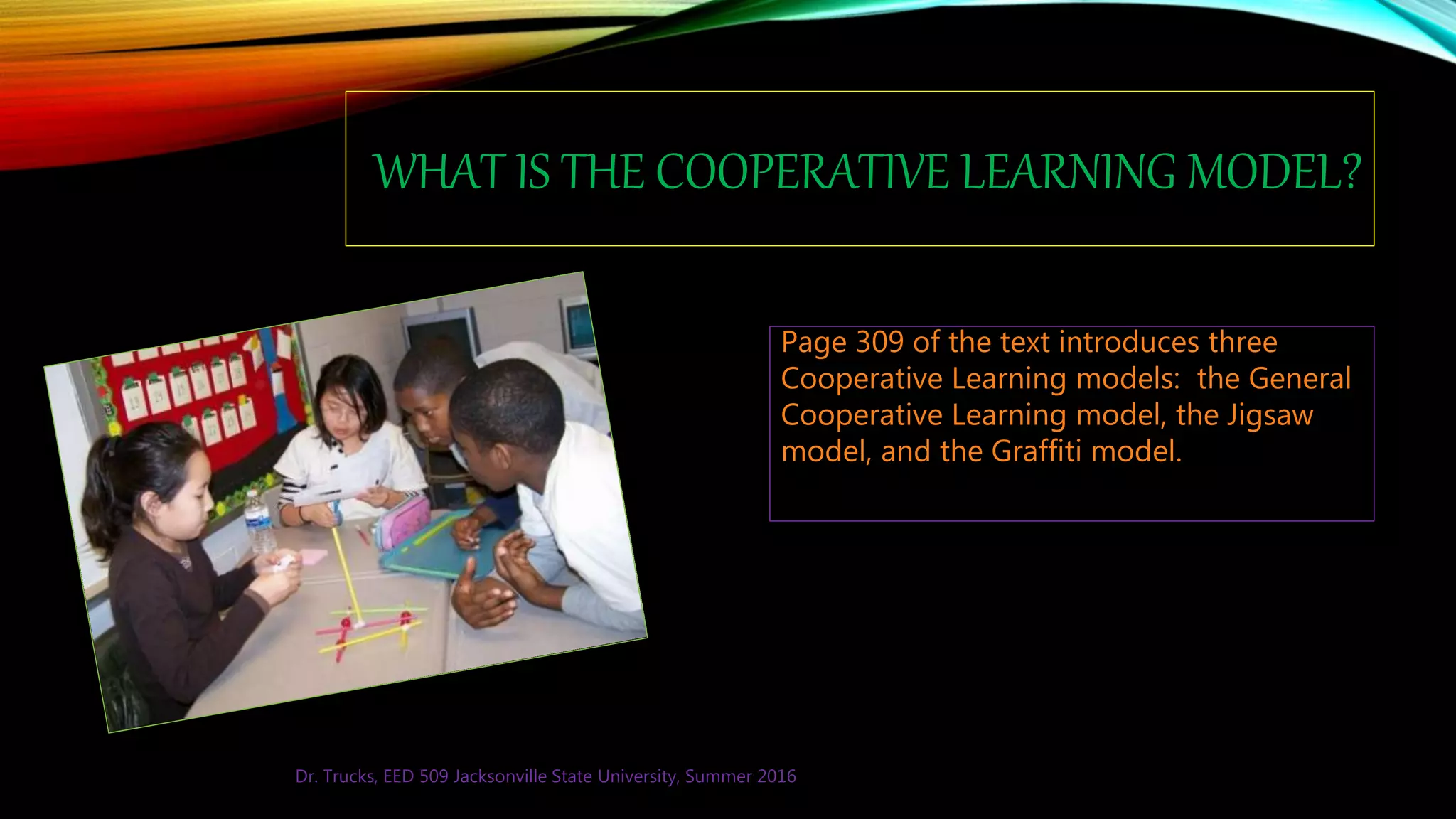
WHAT IS THE COOPERATIVE LEARNING MODEL?
Page 309 of the text introduces three
Cooperative Learning models: the General
Cooperative Learning model, the Jigsaw
model, and the Graffiti model.
Dr. Trucks, EED 509 Jacksonville State University, Summer 2016
HOW TO EFFECTIVELY USE COOPERATIVE LEARNING
IN THE CLASSROOM• Pre-Instructional Planning
Prior planning helps to establish the specific cooperative
learning technique to be used and lays the foundation
for effective group work. Plan out how groups will be
formed and structure how the members will interact with
each other.
• Introduce the Activity to the Students
Students need to get their "marching orders." Explain the
academic task to them and what the criteria are for
success. Then structure the cooperative aspects of their
work with special attention to the components of positive
interdependence and individual accountability. Set up
time limits and allow for clarifying questions themselves
to improve their cooperative work.
• Monitor and Intervene
This is where you let the groups run while you
circulate through the room to collect observation
data, see whether they understand the assignment,
give immediate feedback and praise for working
together. If a group is having problems, you can
intervene to help them get on the right track.
• Assessment
Some informal assessment is already done while you
are monitoring the groups during the exercise.
However, once the group finishes their project, work
should be assessed by both instructor and group.
• Process
Group processing involves asking the groups to rate
their own performance and set goals for themselves
to improve their cooperative work
Dr. Trucks, EED 509 Jacksonville State University, Summer 2016
BENEFITS OF COOPERATIVE LEARNING
Celebration of diversity.
Students learn to work with all types of people. During small-group interactions,
they find many opportunities to reflect upon and reply to the diverse responses
fellow learners bring to the questions raised. Small groups also allow students to
add their perspectives to an issue based on their cultural differences. This
exchange inevitably helps students to better understand other cultures and points
of view.
Acknowledgment of individual differences. When questions are raised, different
students will have a variety of responses. Each of these can help the group create
a product that reflects a wide range of perspectives and is thus more complete
and comprehensive.
Interpersonal development. Students learn to relate to their peer and other
learners as they work together in group enterprises. This can be especially helpful
for students who have difficulty with social skills. They can benefit from structured
interactions with others.
Actively involving students in learning. Each member has opportunities to
contribute in small groups. Students are apt to take more ownership of their
material and to think critically about related issues when they work as a team.
More opportunities for personal feedback. Because there are more exchanges
among students in small groups, your students receive more personal feedback
about their ideas and responses. This feedback is often not possible in large-
group instruction, in which one or two students exchange ideas and the rest of
the class listens.
Dr. Trucks, EED 509 Jacksonville State University, Summer 2016
ADDITIONAL COOPERATIVE LEARNING MODELS
• The Jigsaw Model
The "jigsaw" technique helps
students create their own learning.
Teachers arrange students in
groups. Each group member is
assigned a different piece of
information. Group members then
join with members of other groups
assigned the same piece of
information, and research and/or
share ideas about the information.
Eventually, students return to their
original groups to try to "piece
together" a clear picture of the
topic at hand.
• The Graffiti Model
Graffiti Writing is a cooperative learning structure
that facilities brainstorming and also doubles as
a group energizer.
Each cooperative group of 3 or 4 students is
given a piece of chart paper and different colored
markers.
Group #1 might have black markers; group #2
green markers, etc. There needs to be a different
color marker for each group so that the teacher
can track each individual group’s contribution.
Each group is given a different question, topic,
issue, or statement to which they respond.
All students can respond to the same topic but I
find it more effective if three or more different
topics are used.
For a short time period (3-5 minutes), every
group writes their “graffiti” (words, phrases,
statements, pictures) on their particular topic.
Dr. Trucks, EED 509 Jacksonville State University, Summer 2016
THE USE OF TECHNOLOGY TO
TEACH COOPERATIVE
LEARNING…..WEBQUEST
A WebQuest is an
inquiry-oriented
lesson format in
which most or all the
information that
learners work with
comes from the web.
Dr. Trucks, EED 509 Jacksonville State University, Summer 2016
WEBQUEST CREATED BY STEPHANIE PHILLIPS
http://zunal.com/process.php?w=322796
Dr. Trucks, EED 509 Jacksonville State University, Summer 2016
In my classroom I use a variety of teaching methods.
I enjoy observing the students as they investigate
and analyze topics. I tend to allow the students to
role play real life events. In my dramatic play area I
include set ups that the students can relate to such
as the dentist office, vet clinic, hair salon/barbershop,
grocery store, pizza restaurant and aquarium.
HANDLES TO EXPERTS
Robert Slavin Ph.D.
@RobertSlavin
Co-Founder of Success for All, Director of Hopkins Center for Research &
Reform in Education, Blogger at Huffington Post
Barbara Millis
@MillisBarabaraJ
Author of Cooperative Learning for Higher Education Faculty
Erik Palmer
@erik_palmer
Consultant. Author. Speaker. Educator. Passionate about helping teachers
improve oral communication and update instruction.
Dr. Trucks, EED 509 Jacksonville State University, Summer 2016
HAPPY BLOGGINGEDUCATIONSPY HTTPS://WWW.BLOGGER.COM/BLOGGER.G?BLOGID=5758320530396084305#ALLPOSTS
Blog 1
Teaching Young Children About Bias,
Diversity, and Social JusticeUse young
children's understanding of differences to
teach social justice through age-
appropriate literature, news stories, anti-
bias lessons, familiar examples, and
problem solving.
Blog 2
Play Nice! How to Promote Digital
Inclusion
Blog 3
A Collaborative Effort
Dr. Trucks, EED 509 Jacksonville State University, Summer 2016
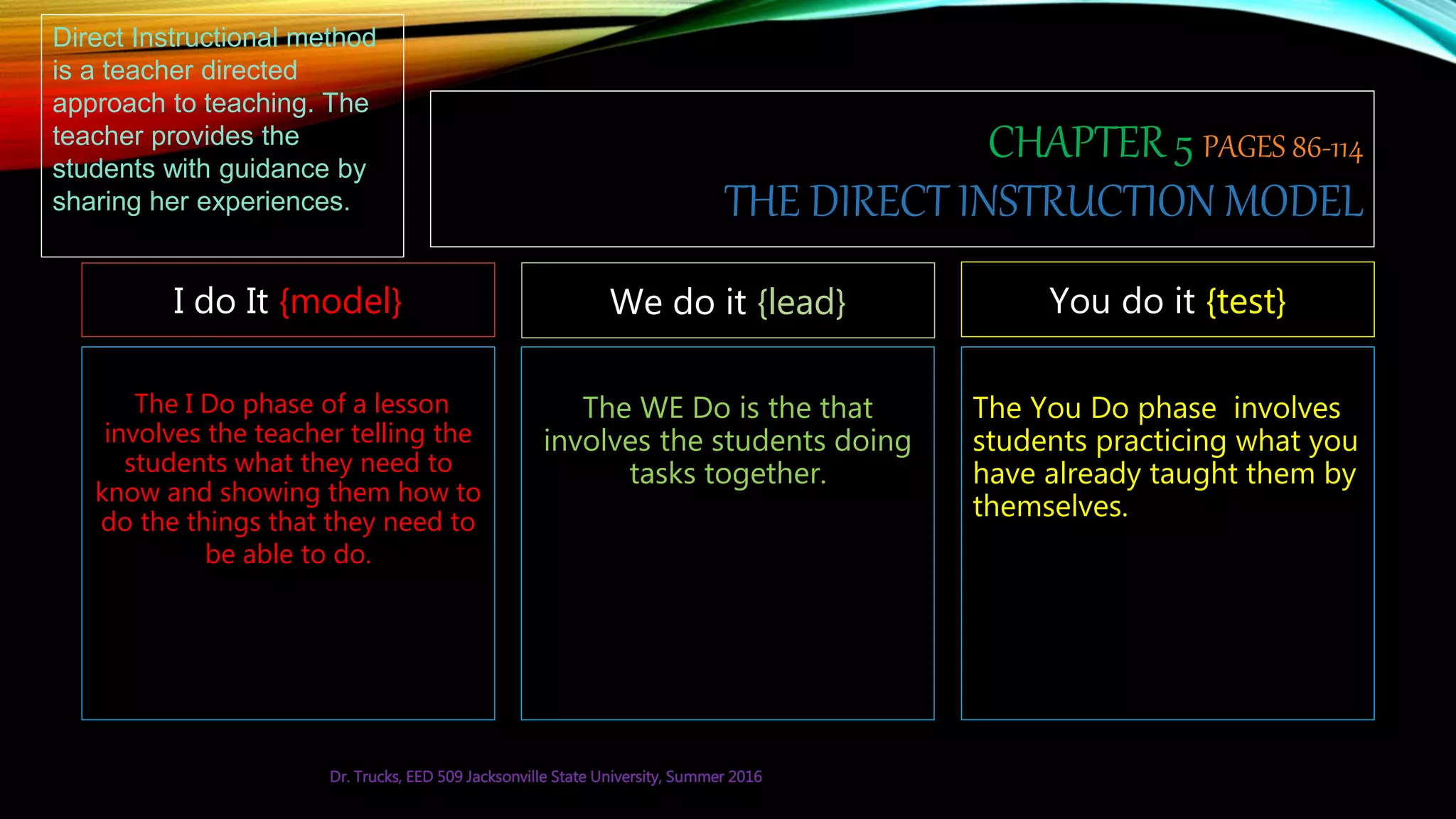
CHAPTER 5 PAGES 86-114
THE DIRECT INSTRUCTION MODEL
I do It {model}
The I Do phase of a lesson
involves the teacher telling the
students what they need to
know and showing them how to
do the things that they need to
be able to do.
We do it {lead}
The WE Do is the that
involves the students doing
tasks together.
You do it {test}
The You Do phase involves
students practicing what you
have already taught them by
themselves.
Dr. Trucks, EED 509 Jacksonville State University, Summer 2016
Direct Instructional method
is a teacher directed
approach to teaching. The
teacher provides the
students with guidance by
sharing her experiences.
REFERENCES
Twitter
• Robert Slavin
• Barbara Millis
• Erik Palmer
Teaching Models: Designing Instruction
for 21st Century Learners
Authors: Kilbane and Milman
websites
http://www.cte.cornell.edu/teaching-
ideas/engaging-students/collaborative-
learning.html
https://elearningindustry.com/cooperativ
e-and-collaborative-theory
Dr. Trucks, EED 509 Jacksonville State University, Summer 2016

EED 500 module 2

  • 1.
    CHAPTER 12 PAGES307-345 COOPERATIVE LEARNING MODELS By: Stephanie Phillips Dr. Trucks, EED 509 Jacksonville State University, Summer 2016
  • 2.
    WHAT IS THECOOPERATIVE LEARNING MODEL? Page 309 of the text introduces three Cooperative Learning models: the General Cooperative Learning model, the Jigsaw model, and the Graffiti model. Dr. Trucks, EED 509 Jacksonville State University, Summer 2016
  • 3.
    HOW TO EFFECTIVELYUSE COOPERATIVE LEARNING IN THE CLASSROOM• Pre-Instructional Planning Prior planning helps to establish the specific cooperative learning technique to be used and lays the foundation for effective group work. Plan out how groups will be formed and structure how the members will interact with each other. • Introduce the Activity to the Students Students need to get their "marching orders." Explain the academic task to them and what the criteria are for success. Then structure the cooperative aspects of their work with special attention to the components of positive interdependence and individual accountability. Set up time limits and allow for clarifying questions themselves to improve their cooperative work. • Monitor and Intervene This is where you let the groups run while you circulate through the room to collect observation data, see whether they understand the assignment, give immediate feedback and praise for working together. If a group is having problems, you can intervene to help them get on the right track. • Assessment Some informal assessment is already done while you are monitoring the groups during the exercise. However, once the group finishes their project, work should be assessed by both instructor and group. • Process Group processing involves asking the groups to rate their own performance and set goals for themselves to improve their cooperative work Dr. Trucks, EED 509 Jacksonville State University, Summer 2016
  • 4.
    BENEFITS OF COOPERATIVELEARNING Celebration of diversity. Students learn to work with all types of people. During small-group interactions, they find many opportunities to reflect upon and reply to the diverse responses fellow learners bring to the questions raised. Small groups also allow students to add their perspectives to an issue based on their cultural differences. This exchange inevitably helps students to better understand other cultures and points of view. Acknowledgment of individual differences. When questions are raised, different students will have a variety of responses. Each of these can help the group create a product that reflects a wide range of perspectives and is thus more complete and comprehensive. Interpersonal development. Students learn to relate to their peer and other learners as they work together in group enterprises. This can be especially helpful for students who have difficulty with social skills. They can benefit from structured interactions with others. Actively involving students in learning. Each member has opportunities to contribute in small groups. Students are apt to take more ownership of their material and to think critically about related issues when they work as a team. More opportunities for personal feedback. Because there are more exchanges among students in small groups, your students receive more personal feedback about their ideas and responses. This feedback is often not possible in large- group instruction, in which one or two students exchange ideas and the rest of the class listens. Dr. Trucks, EED 509 Jacksonville State University, Summer 2016
  • 5.
    ADDITIONAL COOPERATIVE LEARNINGMODELS • The Jigsaw Model The "jigsaw" technique helps students create their own learning. Teachers arrange students in groups. Each group member is assigned a different piece of information. Group members then join with members of other groups assigned the same piece of information, and research and/or share ideas about the information. Eventually, students return to their original groups to try to "piece together" a clear picture of the topic at hand. • The Graffiti Model Graffiti Writing is a cooperative learning structure that facilities brainstorming and also doubles as a group energizer. Each cooperative group of 3 or 4 students is given a piece of chart paper and different colored markers. Group #1 might have black markers; group #2 green markers, etc. There needs to be a different color marker for each group so that the teacher can track each individual group’s contribution. Each group is given a different question, topic, issue, or statement to which they respond. All students can respond to the same topic but I find it more effective if three or more different topics are used. For a short time period (3-5 minutes), every group writes their “graffiti” (words, phrases, statements, pictures) on their particular topic. Dr. Trucks, EED 509 Jacksonville State University, Summer 2016
  • 6.
    THE USE OFTECHNOLOGY TO TEACH COOPERATIVE LEARNING…..WEBQUEST A WebQuest is an inquiry-oriented lesson format in which most or all the information that learners work with comes from the web. Dr. Trucks, EED 509 Jacksonville State University, Summer 2016
  • 7.
    WEBQUEST CREATED BYSTEPHANIE PHILLIPS http://zunal.com/process.php?w=322796 Dr. Trucks, EED 509 Jacksonville State University, Summer 2016 In my classroom I use a variety of teaching methods. I enjoy observing the students as they investigate and analyze topics. I tend to allow the students to role play real life events. In my dramatic play area I include set ups that the students can relate to such as the dentist office, vet clinic, hair salon/barbershop, grocery store, pizza restaurant and aquarium.
  • 8.
    HANDLES TO EXPERTS RobertSlavin Ph.D. @RobertSlavin Co-Founder of Success for All, Director of Hopkins Center for Research & Reform in Education, Blogger at Huffington Post Barbara Millis @MillisBarabaraJ Author of Cooperative Learning for Higher Education Faculty Erik Palmer @erik_palmer Consultant. Author. Speaker. Educator. Passionate about helping teachers improve oral communication and update instruction. Dr. Trucks, EED 509 Jacksonville State University, Summer 2016
  • 9.
    HAPPY BLOGGINGEDUCATIONSPY HTTPS://WWW.BLOGGER.COM/BLOGGER.G?BLOGID=5758320530396084305#ALLPOSTS Blog1 Teaching Young Children About Bias, Diversity, and Social JusticeUse young children's understanding of differences to teach social justice through age- appropriate literature, news stories, anti- bias lessons, familiar examples, and problem solving. Blog 2 Play Nice! How to Promote Digital Inclusion Blog 3 A Collaborative Effort Dr. Trucks, EED 509 Jacksonville State University, Summer 2016
  • 10.
    CHAPTER 5 PAGES86-114 THE DIRECT INSTRUCTION MODEL I do It {model} The I Do phase of a lesson involves the teacher telling the students what they need to know and showing them how to do the things that they need to be able to do. We do it {lead} The WE Do is the that involves the students doing tasks together. You do it {test} The You Do phase involves students practicing what you have already taught them by themselves. Dr. Trucks, EED 509 Jacksonville State University, Summer 2016 Direct Instructional method is a teacher directed approach to teaching. The teacher provides the students with guidance by sharing her experiences.
  • 11.
    REFERENCES Twitter • Robert Slavin •Barbara Millis • Erik Palmer Teaching Models: Designing Instruction for 21st Century Learners Authors: Kilbane and Milman websites http://www.cte.cornell.edu/teaching- ideas/engaging-students/collaborative- learning.html https://elearningindustry.com/cooperativ e-and-collaborative-theory Dr. Trucks, EED 509 Jacksonville State University, Summer 2016