SUBJECT :
GROUP DISCUSSION
GROUP DISCUSSION
 GOHEL NIKUNJ V. (130210125035)
 PRODUCTION:A
VNS INSTITUTE OF TECHNOLOGY
PRESENTATION ON:
GROUP DISCUSSION
HOD: DR. SUPREETI DUBEY
SUBMITTED TO: SUBMITTED BY:
PROF.RUCHI SAXENA PRIYANKA BHATIA
MBA IT DEPT. AHLAM KHAN
KOMAL TAURANI
PARMINDER SINGH
MBA 1ST SEM (IT)
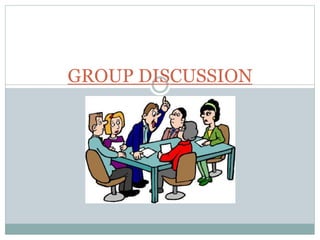
GROUP DISCUSSION
DEFINATION
 A GD is a methodology used by an organization to
gauge whether the candidate has certain personality
traits or skills that it desires in its members. In this
methodology, the group of candidates is given a topic
or a situation, given a few minutes to think about the
same, and then asked to discuss it among themselves
for 15-20 minutes.
Why do we have a GD?
 Understand a subject more deeply.
 Ability to think critically.
 Solving a particular problem.
 Group to make a particular decision.
 It gives you the chance to hear other students'
ideas.
 It improves your listening skills.
 It increases your confidence.
 It can change your attitudes.
BODY SPORT OF GDs
POSITION
 Push your body to the
back of the chair.
 Keep your hand on your
lap right
 Hand movements
should be restricted.
 Keep your legs
stationed firmly on the
ground.
SIGNIFICANCE
 Keeps you alert.
 Indicates that you are
logical person.
 Indicates you that you
don’t need hands as
props when speaking.
 Keeps you firmly
positioned.
DISCUSSION TECHNIQUES
 How to join the discussion.
 To support what some other participant has said.
 To support disagreement.
 To make a point very strongly.
 To bring a discussion back to the point.
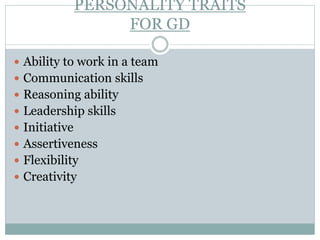
PERSONALITY TRAITS
FOR GD
 Ability to work in a team
 Communication skills
 Reasoning ability
 Leadership skills
 Initiative
 Assertiveness
 Flexibility
 Creativity
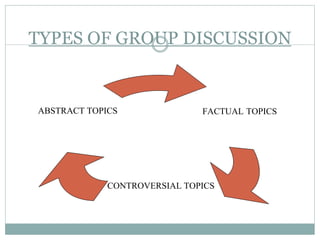
TYPES OF GROUP DISCUSSION
FACTUAL TOPICS
CONTROVERSIAL TOPICS
ABSTRACT TOPICS
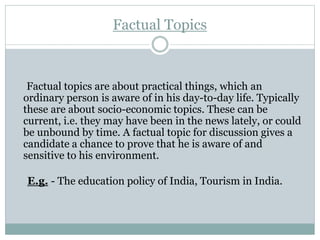
Factual Topics
Factual topics are about practical things, which an
ordinary person is aware of in his day-to-day life. Typically
these are about socio-economic topics. These can be
current, i.e. they may have been in the news lately, or could
be unbound by time. A factual topic for discussion gives a
candidate a chance to prove that he is aware of and
sensitive to his environment.
E.g. - The education policy of India, Tourism in India.
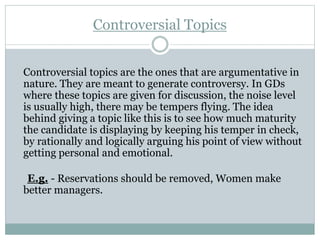
Controversial Topics
Controversial topics are the ones that are argumentative in
nature. They are meant to generate controversy. In GDs
where these topics are given for discussion, the noise level
is usually high, there may be tempers flying. The idea
behind giving a topic like this is to see how much maturity
the candidate is displaying by keeping his temper in check,
by rationally and logically arguing his point of view without
getting personal and emotional.
E.g. - Reservations should be removed, Women make
better managers.
Abstract Topics
Abstract topics are about intangible things. These
topics are not given often for discussion, but their
possibility cannot be ruled out. These topics test your
lateral thinking and creativity.
E.g. -A is an alphabet, Twinkle twinkle little star,
The number 10.
HOW TO FACE GD?
 Communication skills.
 Knowledge & ideas regarding a given subject.
 Capability to co-ordinate & lead.
 Exchange of thoughts.
 Addressing the group as the whole.
 Through preparations.
Tips for summarizing a Discussion
 Avoid raising new points.
 Avoid stating only your viewpoints.
 Avoid dwelling only on one aspect of the GD.
 Keep it brief & concise.
 It must incorporate all the important points that
came out during the GD.
 If the examiner ask you to summarize a GD, it
means the GD has come to an end.
 Do not add anything once the GD has been
summarized.
DO’S IN GD
 Listen to the subject carefully
 Put down your thoughts on a paper
 Initiate the discussion if you know the subject well
 Listen to others if you don’t know the subject
 Support points with some facts and figures
 Make short contribution of 25-30 seconds 3-4 times
 Give others a chance to speak
 Speak politely and pleasantly. Respect contribution from
other members.
 Disagree politely and agree with what is right.
 Summarize the discussion if the group has not reached a
conclusion.
DON’TS IN GD
 Initiate the discussion if you do not have sufficient
knowledge about the given topic.
 Over speak, intervene and snatch other’s chance to
speak.
 Argue and shout during the GD
 Look at the evaluators or a particular group member
 Talk irrelevant things and distract the discussion
 Pose negative body gestures like touching the nose,
leaning back on the chair, knocking the table with a
pen etc.
 Mention erratic statistics.
 Display low self confidence with shaky voice and
trembling hands.
 Try to dominate the discussion
 Put others in an embarrassing situation by asking them
to speak if they don’t want.
SUMMARY
 It’s a personality test.
 It consists usually in 8-10 candidates in a
group.
 It held with a particular purpose in mind.
 We look for certain quality in a GD.
 There are certain techniques which is
followed.
 Listening attentively & with patience.
THANK YOU

Nikunj035

  • 1.
  • 2.
    GROUP DISCUSSION  GOHELNIKUNJ V. (130210125035)  PRODUCTION:A
  • 3.
    VNS INSTITUTE OFTECHNOLOGY PRESENTATION ON: GROUP DISCUSSION HOD: DR. SUPREETI DUBEY SUBMITTED TO: SUBMITTED BY: PROF.RUCHI SAXENA PRIYANKA BHATIA MBA IT DEPT. AHLAM KHAN KOMAL TAURANI PARMINDER SINGH MBA 1ST SEM (IT)
  • 4.
  • 5.
    DEFINATION  A GDis a methodology used by an organization to gauge whether the candidate has certain personality traits or skills that it desires in its members. In this methodology, the group of candidates is given a topic or a situation, given a few minutes to think about the same, and then asked to discuss it among themselves for 15-20 minutes.
  • 6.
    Why do wehave a GD?  Understand a subject more deeply.  Ability to think critically.  Solving a particular problem.  Group to make a particular decision.  It gives you the chance to hear other students' ideas.  It improves your listening skills.  It increases your confidence.  It can change your attitudes.
  • 7.
    BODY SPORT OFGDs POSITION  Push your body to the back of the chair.  Keep your hand on your lap right  Hand movements should be restricted.  Keep your legs stationed firmly on the ground. SIGNIFICANCE  Keeps you alert.  Indicates that you are logical person.  Indicates you that you don’t need hands as props when speaking.  Keeps you firmly positioned.
  • 8.
    DISCUSSION TECHNIQUES  Howto join the discussion.  To support what some other participant has said.  To support disagreement.  To make a point very strongly.  To bring a discussion back to the point.
  • 9.
    PERSONALITY TRAITS FOR GD Ability to work in a team  Communication skills  Reasoning ability  Leadership skills  Initiative  Assertiveness  Flexibility  Creativity
  • 10.
    TYPES OF GROUPDISCUSSION FACTUAL TOPICS CONTROVERSIAL TOPICS ABSTRACT TOPICS
  • 11.
    Factual Topics Factual topicsare about practical things, which an ordinary person is aware of in his day-to-day life. Typically these are about socio-economic topics. These can be current, i.e. they may have been in the news lately, or could be unbound by time. A factual topic for discussion gives a candidate a chance to prove that he is aware of and sensitive to his environment. E.g. - The education policy of India, Tourism in India.
  • 12.
    Controversial Topics Controversial topicsare the ones that are argumentative in nature. They are meant to generate controversy. In GDs where these topics are given for discussion, the noise level is usually high, there may be tempers flying. The idea behind giving a topic like this is to see how much maturity the candidate is displaying by keeping his temper in check, by rationally and logically arguing his point of view without getting personal and emotional. E.g. - Reservations should be removed, Women make better managers.
  • 13.
    Abstract Topics Abstract topicsare about intangible things. These topics are not given often for discussion, but their possibility cannot be ruled out. These topics test your lateral thinking and creativity. E.g. -A is an alphabet, Twinkle twinkle little star, The number 10.
  • 14.
    HOW TO FACEGD?  Communication skills.  Knowledge & ideas regarding a given subject.  Capability to co-ordinate & lead.  Exchange of thoughts.  Addressing the group as the whole.  Through preparations.
  • 15.
    Tips for summarizinga Discussion  Avoid raising new points.  Avoid stating only your viewpoints.  Avoid dwelling only on one aspect of the GD.  Keep it brief & concise.  It must incorporate all the important points that came out during the GD.  If the examiner ask you to summarize a GD, it means the GD has come to an end.  Do not add anything once the GD has been summarized.
  • 16.
    DO’S IN GD Listen to the subject carefully  Put down your thoughts on a paper  Initiate the discussion if you know the subject well  Listen to others if you don’t know the subject  Support points with some facts and figures  Make short contribution of 25-30 seconds 3-4 times  Give others a chance to speak  Speak politely and pleasantly. Respect contribution from other members.  Disagree politely and agree with what is right.  Summarize the discussion if the group has not reached a conclusion.
  • 17.
    DON’TS IN GD Initiate the discussion if you do not have sufficient knowledge about the given topic.  Over speak, intervene and snatch other’s chance to speak.  Argue and shout during the GD  Look at the evaluators or a particular group member  Talk irrelevant things and distract the discussion  Pose negative body gestures like touching the nose, leaning back on the chair, knocking the table with a pen etc.  Mention erratic statistics.  Display low self confidence with shaky voice and trembling hands.  Try to dominate the discussion  Put others in an embarrassing situation by asking them to speak if they don’t want.
  • 18.
    SUMMARY  It’s apersonality test.  It consists usually in 8-10 candidates in a group.  It held with a particular purpose in mind.  We look for certain quality in a GD.  There are certain techniques which is followed.  Listening attentively & with patience.
  • 19.