Incorporation of Unnatural Amino Acids
for the Expression of Proteins with New
Function
Jessica Torres-Kolbus, Chungjung Chou, Kathrin Lang, Lloyd
Davis, Jason Chin, and Alexander Deiters*
University of Puerto Rico, Cayey
RISE Seminar
September 20, 2012
Proteins: Many Structures, Many Functions
Nature Chemical Biology 1, 13 - 21 (2005)
•  Compose over 50% of the cellular dry mass
•  Involved in all cellular functions:
•  Signaling
•  Transport
•  Defense
•  Catalysis
•  Maintenance
•  Stability
•  Tens of thousands of different proteins
Green Fluorescent Protein (GFP)
Bright green fluorescence
Aequorea victoria
238 AAs
Myoglobin (Mb)
Binds to iron and oxigen
Found in muscle tissue of most vertebrates
154 AAs
Why Study Proteins?
• understand protein structure-function relationships
• investigate protein-involved biological processes
• many diseases are caused by errors in proteins, e.g.:
cystic fibrosis – one amino acid deletion
sickle cell anemia – one incorrect amino acid position
Huntington disease – expansion repeat of an amino acid
• manipulate proteins, protein-based drugs, generate proteins and organisms with
new properties
How Study Proteins?
•  many proteins undergo post-translational modifications or bind to cofactors to extend their
properties
•  biological processes are very complex and are regulated in both space and time
•  many of these processes cannot be observed and studied when the protein involved is
isolated
•  study of biological processes in their native environments
•  reporter tags are required for the trafficking and detection of biomolecules
Strategies for Chemical Modification of Proteins
Protein
Labeling
Labeled proteins (e.g. fluorescent tags) provide exciting new tools for studying proteins and
their function in the cell
The Genetic Alphabet: 20 Common Amino Acids
Expanding The Genetic Alphabet: Unnatural Amino Acids
An Orthogonal Biosynthetic Machinery
Stealing Parts from other Organisms
→  large differences between archaea,
bacteria, and eukaryotes in tRNA genes
and their aminoacyl tRNA synthetases
→  engineer a synthetase to specifically
recognize an UAA
PylRS is found in some methanogenic archea and
bacteria, charges its cognate tRNA with pyrrolysine.
The unique and large substrate binding pocket of
pyrrolysyl synthetase (PylRS) shows that it may
recognize a broad spectrum of lysine UAA.
Pyrrolysyl synthetase (PylRS)
binding pocket
Yokoyama, S. Acta Crystallogr Sect F Struct Biol Cryst Commun 2006, 62 (Pt 10), 1031-3.
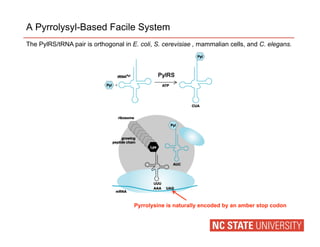
A Pyrrolysyl-Based Facile System
The PylRS/tRNA pair is orthogonal in E. coli, S. cerevisiae , mammalian cells, and C. elegans.
Pyrrolysine is naturally encoded by an amber stop codon
Promiscuity of the PylRS
Effective Pyl mimics: Ineffective Pyl mimics:
pyrrolysine
Promiscuity of the PylRS
Effective Pyl mimics: Ineffective Pyl mimics:
Unnatural Amino Acids as Bioorthogonal Chemical Reporters
Bertozzi, C. R. Nat. Chem. Bio. 2005, 1 (1): 13–21.
1.  Site-specific incorporation of UAA with reactive handle.
2.  Highly selective reaction with exogenously delivered probe.
Bioorthogonal reaction refers to any reaction that takes place inside of biological systems
with selective reactivity and biocompatibility.
 Physiological conditions
 No-cross reaction
 Non-toxic
 Low concentrations
 High yields
 Fast
The reaction results in a stable covalent bond between the protein and the probe.
Genetically Encoded Alkenes for the Expression
of Protein with New Function
Introduction of the Alkene Functionality into Proteins
• Rarely found in natural proteins.
• Versatile in organic transformations.
Alloc-L-lysine is incorporated
via the wild-type PylRS.
Bioconjugation with Alkene Lysine via the Thiol-ene Reaction
Incorporation Efficiency of Alkene Lysine Library
100% (AllocLys) 80% 109%
82% 86% 14% 9%
3.8% 102% 45%
Each amino acid was tested as PylRS substrate for incorporation into protein.
Incorporation efficiency relative to AllocLys.
Expression of Alkene-modified sfGFP
100% (AllocLys) 10 80% 109%
82% 3 86% 4 14% 9%
3.8% 102% 45%
Each amino acid was tested as PylRS substrate for incorporation into protein.
Incorporation efficiency relative to AllocLys.
58
30
46
M -AA WT +10 +3 +4
25
Incorporation in sfGFP in E. coli
Fluorescent labeling of sfGFP
Fluorescence
Comassie
Light activated, site-specific labeling of sfGFP bearing an alkene
with a thiol-containing fluorescent probe via the thiol-ene reaction
Samples were irradiated at 365 nm for 5 min
10
3
Dansyl-thiol (fluorescent)Alkene-modified
protein
Bioconjugation of sfGFP and lysozyme
M
58
30
46
25
1 2 3 4 5 6 7 8
M. Marker
1. wt sfGFP
2. +10, - lysozyme
3. wt sfGFP + lysozyme, - UV
4. +10 + lysozyme, - UV
5. +3 + lysozyme, - UV
6. wt sfGFP + lysozyme, + UV
7. +10 + lysozyme, + UV
8. +3 + lysozyme, + UV
sfGFP increased from ~28 kDa to ~44 kDa after conjugating to the lysozyme with UV light
Samples were irradiated at 365 nm for 5 min
Diels-Alder reaction.
• High selectivity
• High yields
• Fast reaction in aqueous media
Synthesis of Norbornene Lysine and Protein Expression
Nature Chem. 2012, 4, 298-304
Diels-Alder reaction.
• High selectivity
• High yields
• Fast reaction in aqueous media
Synthesis of Norbornene Lysine and Protein Expression
Nature Chem. 2012, 4, 298-304
Expression in E. coli
Bioconjugation with ‘Turn-on’ Fluorescence
Non-fluorescent Fluorescent
9
Nature Chem. 2012, 4, 298-304
Site-Specific Protein Labeling via Bioorthogonal Cycloaddition with Genetically
Encoded Norbornene in Mammalian Cells
Labeling of EGFR-(TAG)-GFP in HEK293 cells.
Nature Chem. 2012 , 4, 298-304
TAMRA
Summary and Conclusions
•  Site-specific incorporation of UAAs into proteins in both bacteria and
mammalian cells.
•  Labeled proteins via bioorthogonal reactions.
•  A library of aliphatic alkene lysines was generated for genetic encoding into
proteins.
•  The alkene-modified protein was successfully subjected to bioorthogonal
labeling via the thiol-ene reaction.
•  A norbornene-containing amino acid was synthesized and encoded into
protein for fast ‘turn-on’ fluorescence labeling in both bacterial and
mammalian cells.
Acknowledgements
Deiters Lab
Dr. Alexander Deiters
Dr. Chungjung (Hank) Chou
Collaborators:
Jason Chin Lab (MRC, Cambridge, UK)
Kathrin Lang, Lloyd Davis
NSF Graduate Fellowship
Duke University
UNC-Chapel Hill
NCSU
RTP
•  largest university in the state, with almost 30,000 students
•  more than 1,700 faculty members, many of them nationally recognized
•  offers master's degrees in 101 fields, and doctoral degrees in 59 fields, in addition to the Doctor of
Veterinary Medicine degree
•  has 10 colleges and schools: Colleges of Agriculture and Life Sciences, Design, Education, Engineering,
Natural Resources, Humanities and Social Sciences, Management, Physical and Mathematical Sciences,
Textiles, and Veterinary Medicine
•  located west of downtown Raleigh, a part of the state’s technology-rich Research Triangle area
North Carolina State University
http://www.ncsu.edu/
http://www.rtp.org/
http://www.unc.edu/index.htm
http://www.duke.edu/
Department of Chemistry at NCSU
Dabney Hall
Main Campus
http://www.ncsu.edu/chemistry/
• Over 120 graduate students and 27 research faculty
• 20 to 40 new graduate students each year
• Analytical, Biological Chemistry, ChemEd, Inorganic, Magnetic resonance,
Materials, Nanoscience, Organic, Physical, Polymers, Theoretical
Join the Department of Chemistry at NCSU
•  Bachelor’s degree in Chemistry or related fields
•  GPA of at least 3.0 (out of 4.0) in the sciences
•  GRE General Test scores are required and the Subject Test is recommended
•  Application – opens online Aug 15, closes Dec 15
http://www.ncsu.edu/grad/applygrad.htm
•  Statement of Purpose
•  One official transcript
•  Three reference letters
•  No application fee
http://www.ncsu.edu/chemistry/graduate/application.html

Jessica torres

  • 1.
    Incorporation of UnnaturalAmino Acids for the Expression of Proteins with New Function Jessica Torres-Kolbus, Chungjung Chou, Kathrin Lang, Lloyd Davis, Jason Chin, and Alexander Deiters* University of Puerto Rico, Cayey RISE Seminar September 20, 2012
  • 2.
    Proteins: Many Structures,Many Functions Nature Chemical Biology 1, 13 - 21 (2005) •  Compose over 50% of the cellular dry mass •  Involved in all cellular functions: •  Signaling •  Transport •  Defense •  Catalysis •  Maintenance •  Stability •  Tens of thousands of different proteins Green Fluorescent Protein (GFP) Bright green fluorescence Aequorea victoria 238 AAs Myoglobin (Mb) Binds to iron and oxigen Found in muscle tissue of most vertebrates 154 AAs
  • 3.
    Why Study Proteins? • understandprotein structure-function relationships • investigate protein-involved biological processes • many diseases are caused by errors in proteins, e.g.: cystic fibrosis – one amino acid deletion sickle cell anemia – one incorrect amino acid position Huntington disease – expansion repeat of an amino acid • manipulate proteins, protein-based drugs, generate proteins and organisms with new properties
  • 4.
    How Study Proteins? • many proteins undergo post-translational modifications or bind to cofactors to extend their properties •  biological processes are very complex and are regulated in both space and time •  many of these processes cannot be observed and studied when the protein involved is isolated •  study of biological processes in their native environments •  reporter tags are required for the trafficking and detection of biomolecules
  • 5.
    Strategies for ChemicalModification of Proteins Protein Labeling Labeled proteins (e.g. fluorescent tags) provide exciting new tools for studying proteins and their function in the cell
  • 6.
    The Genetic Alphabet:20 Common Amino Acids
  • 7.
    Expanding The GeneticAlphabet: Unnatural Amino Acids
  • 8.
  • 9.
    Stealing Parts fromother Organisms →  large differences between archaea, bacteria, and eukaryotes in tRNA genes and their aminoacyl tRNA synthetases →  engineer a synthetase to specifically recognize an UAA PylRS is found in some methanogenic archea and bacteria, charges its cognate tRNA with pyrrolysine. The unique and large substrate binding pocket of pyrrolysyl synthetase (PylRS) shows that it may recognize a broad spectrum of lysine UAA. Pyrrolysyl synthetase (PylRS) binding pocket Yokoyama, S. Acta Crystallogr Sect F Struct Biol Cryst Commun 2006, 62 (Pt 10), 1031-3.
  • 10.
    A Pyrrolysyl-Based FacileSystem The PylRS/tRNA pair is orthogonal in E. coli, S. cerevisiae , mammalian cells, and C. elegans. Pyrrolysine is naturally encoded by an amber stop codon
  • 11.
    Promiscuity of thePylRS Effective Pyl mimics: Ineffective Pyl mimics: pyrrolysine
  • 12.
    Promiscuity of thePylRS Effective Pyl mimics: Ineffective Pyl mimics:
  • 13.
    Unnatural Amino Acidsas Bioorthogonal Chemical Reporters Bertozzi, C. R. Nat. Chem. Bio. 2005, 1 (1): 13–21. 1.  Site-specific incorporation of UAA with reactive handle. 2.  Highly selective reaction with exogenously delivered probe. Bioorthogonal reaction refers to any reaction that takes place inside of biological systems with selective reactivity and biocompatibility.  Physiological conditions  No-cross reaction  Non-toxic  Low concentrations  High yields  Fast The reaction results in a stable covalent bond between the protein and the probe.
  • 14.
    Genetically Encoded Alkenesfor the Expression of Protein with New Function
  • 15.
    Introduction of theAlkene Functionality into Proteins • Rarely found in natural proteins. • Versatile in organic transformations. Alloc-L-lysine is incorporated via the wild-type PylRS.
  • 16.
    Bioconjugation with AlkeneLysine via the Thiol-ene Reaction
  • 17.
    Incorporation Efficiency ofAlkene Lysine Library 100% (AllocLys) 80% 109% 82% 86% 14% 9% 3.8% 102% 45% Each amino acid was tested as PylRS substrate for incorporation into protein. Incorporation efficiency relative to AllocLys.
  • 18.
    Expression of Alkene-modifiedsfGFP 100% (AllocLys) 10 80% 109% 82% 3 86% 4 14% 9% 3.8% 102% 45% Each amino acid was tested as PylRS substrate for incorporation into protein. Incorporation efficiency relative to AllocLys. 58 30 46 M -AA WT +10 +3 +4 25 Incorporation in sfGFP in E. coli
  • 19.
    Fluorescent labeling ofsfGFP Fluorescence Comassie Light activated, site-specific labeling of sfGFP bearing an alkene with a thiol-containing fluorescent probe via the thiol-ene reaction Samples were irradiated at 365 nm for 5 min 10 3 Dansyl-thiol (fluorescent)Alkene-modified protein
  • 20.
    Bioconjugation of sfGFPand lysozyme M 58 30 46 25 1 2 3 4 5 6 7 8 M. Marker 1. wt sfGFP 2. +10, - lysozyme 3. wt sfGFP + lysozyme, - UV 4. +10 + lysozyme, - UV 5. +3 + lysozyme, - UV 6. wt sfGFP + lysozyme, + UV 7. +10 + lysozyme, + UV 8. +3 + lysozyme, + UV sfGFP increased from ~28 kDa to ~44 kDa after conjugating to the lysozyme with UV light Samples were irradiated at 365 nm for 5 min
  • 21.
    Diels-Alder reaction. • High selectivity • Highyields • Fast reaction in aqueous media Synthesis of Norbornene Lysine and Protein Expression Nature Chem. 2012, 4, 298-304
  • 22.
    Diels-Alder reaction. • High selectivity • Highyields • Fast reaction in aqueous media Synthesis of Norbornene Lysine and Protein Expression Nature Chem. 2012, 4, 298-304 Expression in E. coli
  • 23.
    Bioconjugation with ‘Turn-on’Fluorescence Non-fluorescent Fluorescent 9 Nature Chem. 2012, 4, 298-304
  • 24.
    Site-Specific Protein Labelingvia Bioorthogonal Cycloaddition with Genetically Encoded Norbornene in Mammalian Cells Labeling of EGFR-(TAG)-GFP in HEK293 cells. Nature Chem. 2012 , 4, 298-304 TAMRA
  • 25.
    Summary and Conclusions • Site-specific incorporation of UAAs into proteins in both bacteria and mammalian cells. •  Labeled proteins via bioorthogonal reactions. •  A library of aliphatic alkene lysines was generated for genetic encoding into proteins. •  The alkene-modified protein was successfully subjected to bioorthogonal labeling via the thiol-ene reaction. •  A norbornene-containing amino acid was synthesized and encoded into protein for fast ‘turn-on’ fluorescence labeling in both bacterial and mammalian cells.
  • 26.
    Acknowledgements Deiters Lab Dr. AlexanderDeiters Dr. Chungjung (Hank) Chou Collaborators: Jason Chin Lab (MRC, Cambridge, UK) Kathrin Lang, Lloyd Davis NSF Graduate Fellowship
  • 27.
    Duke University UNC-Chapel Hill NCSU RTP • largest university in the state, with almost 30,000 students •  more than 1,700 faculty members, many of them nationally recognized •  offers master's degrees in 101 fields, and doctoral degrees in 59 fields, in addition to the Doctor of Veterinary Medicine degree •  has 10 colleges and schools: Colleges of Agriculture and Life Sciences, Design, Education, Engineering, Natural Resources, Humanities and Social Sciences, Management, Physical and Mathematical Sciences, Textiles, and Veterinary Medicine •  located west of downtown Raleigh, a part of the state’s technology-rich Research Triangle area North Carolina State University http://www.ncsu.edu/ http://www.rtp.org/ http://www.unc.edu/index.htm http://www.duke.edu/
  • 28.
    Department of Chemistryat NCSU Dabney Hall Main Campus http://www.ncsu.edu/chemistry/ • Over 120 graduate students and 27 research faculty • 20 to 40 new graduate students each year • Analytical, Biological Chemistry, ChemEd, Inorganic, Magnetic resonance, Materials, Nanoscience, Organic, Physical, Polymers, Theoretical
  • 29.
    Join the Departmentof Chemistry at NCSU •  Bachelor’s degree in Chemistry or related fields •  GPA of at least 3.0 (out of 4.0) in the sciences •  GRE General Test scores are required and the Subject Test is recommended •  Application – opens online Aug 15, closes Dec 15 http://www.ncsu.edu/grad/applygrad.htm •  Statement of Purpose •  One official transcript •  Three reference letters •  No application fee http://www.ncsu.edu/chemistry/graduate/application.html