Smallpox: The fight begins against infectious diseases. Mr McDonald
What we will learn today: Why was smallpox so deadly. Who was Edward Jenner. What was his theory? What was the significance of his idea.
Smallpox In the eighteenth century, smallpox was a killer disease. The victims who contracted the disease had frightening symptoms. The symptoms were a high fever, sores over the body and when the disease spread to the organs it was a certain death. People who survived were terribly scarred.
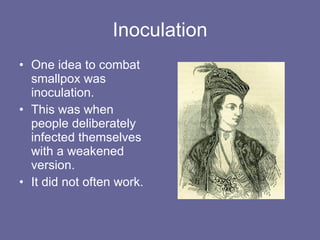
Inoculation One idea to combat smallpox was inoculation. This was when people deliberately infected themselves with a weakened version. It did not often work.
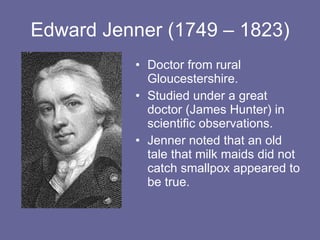
Edward Jenner (1749 – 1823) Doctor from rural Gloucestershire. Studied under a great doctor (James Hunter) in scientific observations. Jenner noted that an old tale that milk maids did not catch smallpox appeared to be true.
The Theory in Practice In 1796, Jenner decided to test out his theory by experimentation. He heeded the words of his mentor John Hunter “don’t think – try the experiment.” He needed two things for his experiment. Someone who has never had either cowpox or smallpox. And the diseases
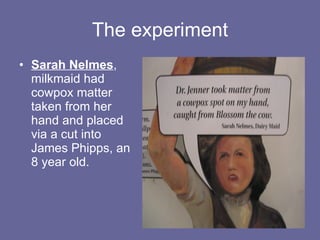
The experiment Sarah Nelmes ,  milkmaid had cowpox matter taken from her hand and placed via a cut into James Phipps, an 8 year old.
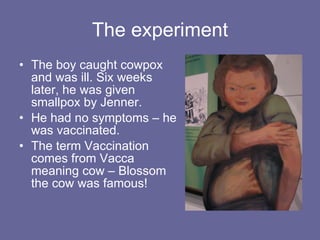
The experiment The boy caught cowpox and was ill. Six weeks later, he was given smallpox by Jenner.  He had no symptoms – he was vaccinated. The term Vaccination comes from Vacca meaning cow – Blossom the cow was famous!
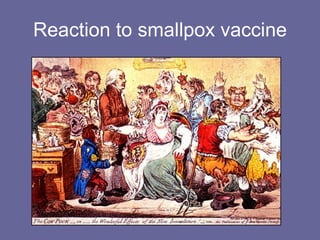
Reaction Not everyone welcomed it. Some people thought that they would turn into cows Others argued that as Jenner did not know why it worked they feared it would not. Doctors who got rich by inoculation did not like it.
Reaction to smallpox vaccine
Long term reaction By 1800, 100,000 people had been vaccinated. Napoleon vaccinated his entire army in 1805. In 1980, smallpox was deemed to have been eradicated by the WHO (World Health Organisation).

Jenner And Smallpox

  • 1.
    Smallpox: The fightbegins against infectious diseases. Mr McDonald
  • 2.
    What we willlearn today: Why was smallpox so deadly. Who was Edward Jenner. What was his theory? What was the significance of his idea.
  • 3.
    Smallpox In theeighteenth century, smallpox was a killer disease. The victims who contracted the disease had frightening symptoms. The symptoms were a high fever, sores over the body and when the disease spread to the organs it was a certain death. People who survived were terribly scarred.
  • 4.
    Inoculation One ideato combat smallpox was inoculation. This was when people deliberately infected themselves with a weakened version. It did not often work.
  • 5.
    Edward Jenner (1749– 1823) Doctor from rural Gloucestershire. Studied under a great doctor (James Hunter) in scientific observations. Jenner noted that an old tale that milk maids did not catch smallpox appeared to be true.
  • 6.
    The Theory inPractice In 1796, Jenner decided to test out his theory by experimentation. He heeded the words of his mentor John Hunter “don’t think – try the experiment.” He needed two things for his experiment. Someone who has never had either cowpox or smallpox. And the diseases
  • 7.
    The experiment SarahNelmes , milkmaid had cowpox matter taken from her hand and placed via a cut into James Phipps, an 8 year old.
  • 8.
    The experiment Theboy caught cowpox and was ill. Six weeks later, he was given smallpox by Jenner. He had no symptoms – he was vaccinated. The term Vaccination comes from Vacca meaning cow – Blossom the cow was famous!
  • 9.
    Reaction Not everyonewelcomed it. Some people thought that they would turn into cows Others argued that as Jenner did not know why it worked they feared it would not. Doctors who got rich by inoculation did not like it.
  • 10.
  • 11.
    Long term reactionBy 1800, 100,000 people had been vaccinated. Napoleon vaccinated his entire army in 1805. In 1980, smallpox was deemed to have been eradicated by the WHO (World Health Organisation).