JEE MANTRA 
IITJEE –ADVANCED 2014 PAPER 1 CHEMISTRY
INORGANIC 
• 1.QUESTION. Consider the following list of reagents: 
• Acidified K2Cr2O7, alkaline KMnO4, CuSO4, H2O2, CI2, O3, FeCI3, HNO3 and 
Na2S2O3. 
• The total number of reagents that can oxidise aqueous iodide to iodine is 
• ANS. [7] 
• H+ 
• / K2Cr2O7 , OH / KMnO4 , CuSO4 , H2O2 , Cl2 , O3, HNO3
ISOMERISM 
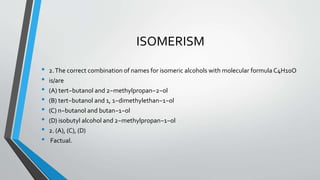
• 2. The correct combination of names for isomeric alcohols with molecular formula C4H10O 
• is/are 
• (A) tert−butanol and 2−methylpropan−2−ol 
• (B) tert−butanol and 1, 1−dimethylethan−1−ol 
• (C) n−butanol and butan−1−ol 
• (D) isobutyl alcohol and 2−methylpropan−1−ol 
• 2. (A), (C), (D) 
• Factual.
H-BONDING 
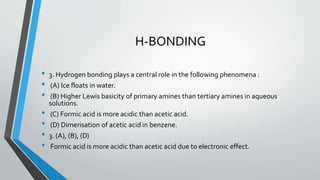
• 3. Hydrogen bonding plays a central role in the following phenomena : 
• (A) Ice floats in water. 
• (B) Higher Lewis basicity of primary amines than tertiary amines in aqueous 
solutions. 
• (C) Formic acid is more acidic than acetic acid. 
• (D) Dimerisation of acetic acid in benzene. 
• 3. (A), (B), (D) 
• Formic acid is more acidic than acetic acid due to electronic effect.
ELECTROCHEMISTRY 
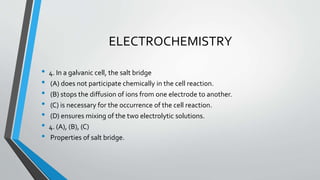
• 4. In a galvanic cell, the salt bridge 
• (A) does not participate chemically in the cell reaction. 
• (B) stops the diffusion of ions from one electrode to another. 
• (C) is necessary for the occurrence of the cell reaction. 
• (D) ensures mixing of the two electrolytic solutions. 
• 4. (A), (B), (C) 
• Properties of salt bridge.
INORGANIC CHEMISTRY –TRANSITION 
ELEMENT 
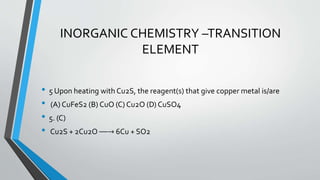
• 5 Upon heating with Cu2S, the reagent(s) that give copper metal is/are 
• (A) CuFeS2 (B) CuO (C) Cu2O (D) CuSO4 
• 5. (C) 
• Cu2S + 2Cu2O ⎯⎯→ 6Cu + SO2
INORGANIC 
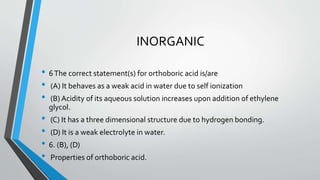
• 6The correct statement(s) for orthoboric acid is/are 
• (A) It behaves as a weak acid in water due to self ionization 
• (B) Acidity of its aqueous solution increases upon addition of ethylene 
glycol. 
• (C) It has a three dimensional structure due to hydrogen bonding. 
• (D) It is a weak electrolyte in water. 
• 6. (B), (D) 
• Properties of orthoboric acid.
OXIDATION -REDUCTION 
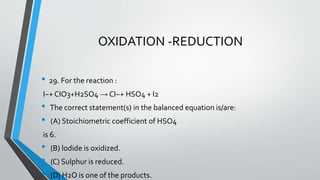
• 29. For the reaction : 
I−+ CIO3+H2SO4 → CI−+ HSO4 + I2 
• The correct statement(s) in the balanced equation is/are: 
• (A) Stoichiometric coefficient of HSO4 
is 6. 
• (B) lodide is oxidized. 
• (C) Sulphur is reduced. 
• (D) H2O is one of the products.
C-bonding 
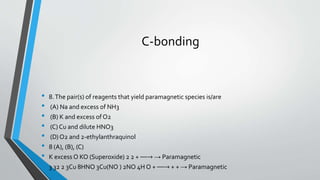
• 8. The pair(s) of reagents that yield paramagnetic species is/are 
• (A) Na and excess of NH3 
• (B) K and excess of O2 
• (C) Cu and dilute HNO3 
• (D) O2 and 2-ethylanthraquinol 
• 8 (A), (B), (C) 
• K excess O KO (Superoxide) 2 2 + ⎯⎯→ → Paramagnetic 
• 3 32 2 3Cu 8HNO 3Cu(NO ) 2NO 4H O + ⎯⎯→ + + → Paramagnetic
9. A list of species having the formula XZ4 is given below. 
• XeF4, SF4, SiF4, BF4−, [Cu(NH3)4]2+, [FeCI4]2−, [CoCl4]2− and [PtCI4]2−. 
• Defining shape on the basis of the location of X and Z atoms, the total 
number of species 
• having a square planar shape is 
• 9 [4] 
• XeF4 , BrF4− , [Cu(NH3)4]+2 , [PtCl4]2−
inorganic 
• 10. Among PbS, CuS, HgS, MnS, Ag2S, NiS, CoS, Bi2S3 and SnS2, the total 
number of 
• BLACK coloured sulphides is 
• 10. [7] 
• PbS , CuS, HgS, Ag2S, NiS, CoS, Bi2S3
inorganic 
• 11. Consider the following list of reagents: 
• Acidified K2Cr2O7, alkaline KMnO4, CuSO4, H2O2, CI2, O3, FeCI3, HNO3 and 
Na2S2O3. 
• The total number of reagents that can oxidise aqueous iodide to iodine is 
• 11. [7] 
• H+ 
• / K2Cr2O7 , OH / KMnO4 , CuSO4 , H2O2 , Cl2 , O3, HNO
Physical chemistry -solution 
• 12. A compound H2X with molar weight of 80 g is dissolved in a solvent having density of 
• 0.4 g ml−1 
• . Assuming no change in volume upon dissolution, the molality of a 3.2 molar 
• solution is 
• 12. [8] 
• Let us consider, volume of solution = 1 litre = 1000 mL 
• wt. of solvent = 0.4 × 1000 = 400 g = 0.4 kg 
• wt. of solute = 80 g ; no. of moles of solute = 3.2 moles 
• molality of solution = 3.2

Jee mantra.iit jee advanced chemistry paper and solution

  • 1.
    JEE MANTRA IITJEE–ADVANCED 2014 PAPER 1 CHEMISTRY
  • 2.
    INORGANIC • 1.QUESTION.Consider the following list of reagents: • Acidified K2Cr2O7, alkaline KMnO4, CuSO4, H2O2, CI2, O3, FeCI3, HNO3 and Na2S2O3. • The total number of reagents that can oxidise aqueous iodide to iodine is • ANS. [7] • H+ • / K2Cr2O7 , OH / KMnO4 , CuSO4 , H2O2 , Cl2 , O3, HNO3
  • 3.
    ISOMERISM • 2.The correct combination of names for isomeric alcohols with molecular formula C4H10O • is/are • (A) tert−butanol and 2−methylpropan−2−ol • (B) tert−butanol and 1, 1−dimethylethan−1−ol • (C) n−butanol and butan−1−ol • (D) isobutyl alcohol and 2−methylpropan−1−ol • 2. (A), (C), (D) • Factual.
  • 4.
    H-BONDING • 3.Hydrogen bonding plays a central role in the following phenomena : • (A) Ice floats in water. • (B) Higher Lewis basicity of primary amines than tertiary amines in aqueous solutions. • (C) Formic acid is more acidic than acetic acid. • (D) Dimerisation of acetic acid in benzene. • 3. (A), (B), (D) • Formic acid is more acidic than acetic acid due to electronic effect.
  • 5.
    ELECTROCHEMISTRY • 4.In a galvanic cell, the salt bridge • (A) does not participate chemically in the cell reaction. • (B) stops the diffusion of ions from one electrode to another. • (C) is necessary for the occurrence of the cell reaction. • (D) ensures mixing of the two electrolytic solutions. • 4. (A), (B), (C) • Properties of salt bridge.
  • 6.
    INORGANIC CHEMISTRY –TRANSITION ELEMENT • 5 Upon heating with Cu2S, the reagent(s) that give copper metal is/are • (A) CuFeS2 (B) CuO (C) Cu2O (D) CuSO4 • 5. (C) • Cu2S + 2Cu2O ⎯⎯→ 6Cu + SO2
  • 7.
    INORGANIC • 6Thecorrect statement(s) for orthoboric acid is/are • (A) It behaves as a weak acid in water due to self ionization • (B) Acidity of its aqueous solution increases upon addition of ethylene glycol. • (C) It has a three dimensional structure due to hydrogen bonding. • (D) It is a weak electrolyte in water. • 6. (B), (D) • Properties of orthoboric acid.
  • 8.
    OXIDATION -REDUCTION •29. For the reaction : I−+ CIO3+H2SO4 → CI−+ HSO4 + I2 • The correct statement(s) in the balanced equation is/are: • (A) Stoichiometric coefficient of HSO4 is 6. • (B) lodide is oxidized. • (C) Sulphur is reduced. • (D) H2O is one of the products.
  • 9.
    C-bonding • 8.The pair(s) of reagents that yield paramagnetic species is/are • (A) Na and excess of NH3 • (B) K and excess of O2 • (C) Cu and dilute HNO3 • (D) O2 and 2-ethylanthraquinol • 8 (A), (B), (C) • K excess O KO (Superoxide) 2 2 + ⎯⎯→ → Paramagnetic • 3 32 2 3Cu 8HNO 3Cu(NO ) 2NO 4H O + ⎯⎯→ + + → Paramagnetic
  • 10.
    9. A listof species having the formula XZ4 is given below. • XeF4, SF4, SiF4, BF4−, [Cu(NH3)4]2+, [FeCI4]2−, [CoCl4]2− and [PtCI4]2−. • Defining shape on the basis of the location of X and Z atoms, the total number of species • having a square planar shape is • 9 [4] • XeF4 , BrF4− , [Cu(NH3)4]+2 , [PtCl4]2−
  • 11.
    inorganic • 10.Among PbS, CuS, HgS, MnS, Ag2S, NiS, CoS, Bi2S3 and SnS2, the total number of • BLACK coloured sulphides is • 10. [7] • PbS , CuS, HgS, Ag2S, NiS, CoS, Bi2S3
  • 12.
    inorganic • 11.Consider the following list of reagents: • Acidified K2Cr2O7, alkaline KMnO4, CuSO4, H2O2, CI2, O3, FeCI3, HNO3 and Na2S2O3. • The total number of reagents that can oxidise aqueous iodide to iodine is • 11. [7] • H+ • / K2Cr2O7 , OH / KMnO4 , CuSO4 , H2O2 , Cl2 , O3, HNO
  • 13.
    Physical chemistry -solution • 12. A compound H2X with molar weight of 80 g is dissolved in a solvent having density of • 0.4 g ml−1 • . Assuming no change in volume upon dissolution, the molality of a 3.2 molar • solution is • 12. [8] • Let us consider, volume of solution = 1 litre = 1000 mL • wt. of solvent = 0.4 × 1000 = 400 g = 0.4 kg • wt. of solute = 80 g ; no. of moles of solute = 3.2 moles • molality of solution = 3.2